Wfaucet

DNOOO blank theme is active for local preview.

Bathroom Sink Faucet Flow Rate: WaterSense 1.5 GPM vs 2.2 GPM Standards Explained for US Importers

Flow rate is the specification that most importers get wrong — not because it's complicated, but because the US market has two overlapping standards, a patchwork of state-level mandates that override the federal baseline, and a compliance mechanism (the aerator) that most buyers never think to specify on their purchase order. Get it wrong and your container clears customs fine, then fails a green building inspection in California or gets rejected by a hotel procurement spec that requires WaterSense labeling.

The short version: 2.2 GPM is the federal baseline under ASME A112.18.1. 1.5 GPM is the EPA WaterSense threshold. Several states have already moved below both. And the aerator — a $0.40 component — is what actually sets the output.

This article covers what each standard covers, which markets require which, and how to specify flow rate correctly when you're placing an OEM order.
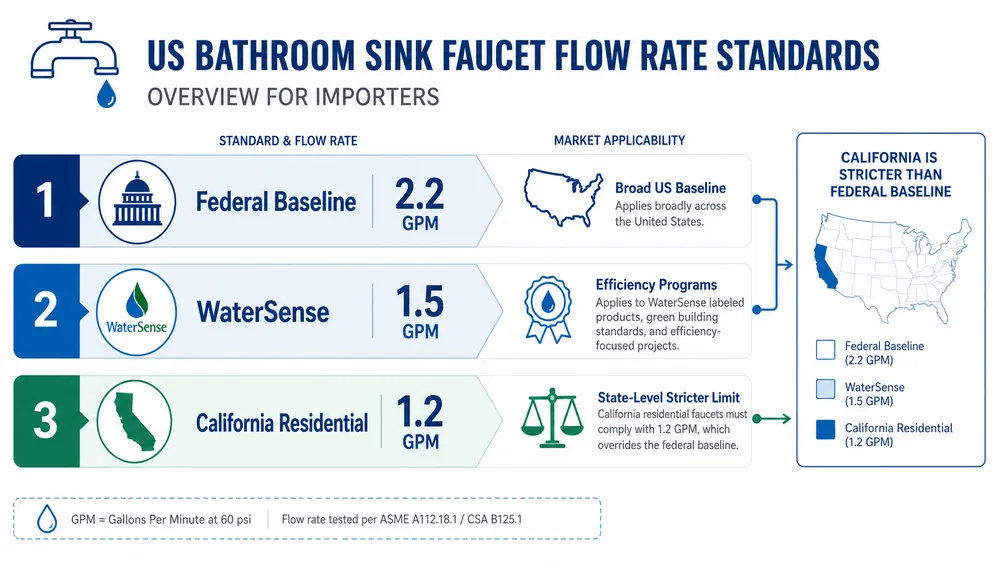
Diagram showing US bathroom faucet flow rate standards from federal 2.2 GPM baseline to WaterSense 1.5 GPM and California 1.2 GPM residential limit

What GPM actually measures — and why the test pressure matters

GPM (gallons per minute) is the volume of water a faucet delivers at a specified supply pressure. The rated pressure for US testing is 60 psi (0.41 MPa). That's the number on the spec sheet, the number on the certification, and the number your buyer's inspector will reference.

The reason pressure matters: a faucet rated at 1.5 GPM at 60 psi will deliver noticeably less at 40 psi — which is common in older commercial buildings, mid-rise residential, and some hotel properties where supply pressure drops under load. We test every outgoing unit at 0.6 MPa (87 psi) during final QC, which gives buyers a documented performance baseline above the rated condition. If the unit passes at 0.6 MPa, it will meet its rated GPM at 60 psi with margin.

(The 0.6 MPa test pressure is also what cUPC requires for leak verification — so we're running both checks in the same final QC pass, not as separate operations.)

LPM (liters per minute) is the metric equivalent. 1.5 GPM = 5.68 LPM; 2.2 GPM = 8.33 LPM. If you're supplying a project that mixes US and metric specs, confirm which unit the spec sheet is using before you sign off on the order.

The two dominant US standards: 2.2 GPM vs 1.5 GPM

These two numbers come from different regulatory frameworks and serve different purposes.

2.2 GPM — the federal baseline

The 2.2 GPM limit comes from ASME A112.18.1, the primary US standard for plumbing supply fittings. It's also referenced in the Uniform Plumbing Code (UPC) and the International Plumbing Code (IPC). Federally, a bathroom sink faucet that delivers ≤2.2 GPM at 60 psi is compliant for sale and installation across the US — no additional certification required.

For most general-market distribution (hardware chains, plumbing wholesale, non-green-building commercial projects), 2.2 GPM is the spec you're working to. It's the standard that covers the broadest market without additional certification overhead.

1.5 GPM — the WaterSense label threshold

The EPA's WaterSense program sets 1.5 GPM as the maximum flow rate for labeled bathroom faucets and faucet accessories. WaterSense certification requires third-party testing by an EPA-recognized laboratory, and the label itself is what unlocks access to specific market segments: LEED-certified projects, government procurement specs, utility rebate programs, and hotel chains with sustainability commitments.

WaterSense is voluntary at the federal level. But it's not optional if your buyer is selling into green building projects, bidding on government contracts, or distributing to markets where state law has effectively made 1.5 GPM the mandatory ceiling.

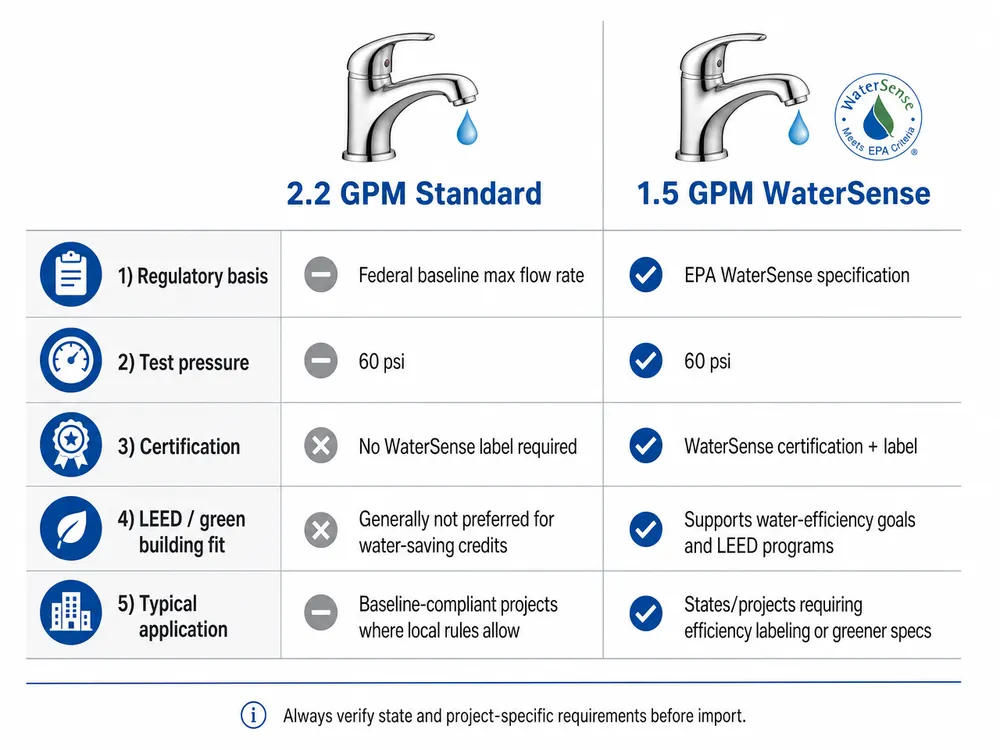
Specification 2.2 GPM (ASME A112.18.1) 1.5 GPM (EPA WaterSense)
Regulatory basis Federal plumbing code EPA voluntary label program
Test pressure 60 psi (0.41 MPa) 60 psi (0.41 MPa)
Certification required No (code compliance only) Yes — EPA-recognized lab
LEED credit eligible No Yes
State rebate programs No Yes (varies by state)
Green building specs Rarely accepted Standard requirement
Typical application General distribution, standard commercial Hospitality, government, LEED projects
Side-by-side comparison chart of 2.2 GPM standard faucet versus 1.5 GPM WaterSense certified faucet showing certification requirements and application fit

State-level mandates that override the federal baseline

This is where importers distributing nationally run into trouble. Several states have enacted flow rate limits stricter than the federal 2.2 GPM standard — and in some cases stricter than WaterSense's 1.5 GPM threshold.

California

California's Title 20 appliance efficiency regulations set the most restrictive limits in the country:

  • Residential bathroom faucets: ≤1.2 GPM (effective January 1, 2016)
  • Commercial bathroom faucets: ≤1.5 GPM

A 1.5 GPM WaterSense-labeled faucet is compliant for California commercial use but not for California residential installation. If you're distributing to California retailers who sell into both residential and commercial channels, you need to know which aerator configuration is in the box.

Colorado

Colorado's HB 21-1151 (effective January 1, 2023) requires bathroom faucets sold in the state to meet ≤1.5 GPM. This effectively makes WaterSense-equivalent flow rate mandatory for all Colorado sales, regardless of application type.

Other states with ≤1.5 GPM requirements

Washington, Oregon, and several New England states have adopted or are in the process of adopting ≤1.5 GPM requirements for bathroom faucets. The trend is clear: the federal 2.2 GPM baseline is becoming a ceiling that fewer states accept for new installations.

What this means for SKU planning

If you're distributing nationally, you have two practical options:

  1. Specify 1.5 GPM across your entire line. A 1.5 GPM faucet is compliant everywhere in the US, including California commercial. The only gap is California residential, which requires 1.2 GPM. For most importers, this is the lower-complexity path.
  1. Run separate SKUs by market. 2.2 GPM for states with no restriction, 1.5 GPM for restricted states, 1.2 GPM for California residential. This gives you maximum flexibility but multiplies your SKU count and inventory management complexity.

The aerator is what makes option 1 viable without sacrificing performance in unrestricted markets — which brings us to the component that actually controls your flow rate output.

How the aerator controls flow rate — and what to specify on your PO

The aerator is the threaded insert at the tip of the faucet spout. It mixes air into the water stream, reduces splash, and — most importantly for compliance — restricts flow to a rated GPM. The faucet body itself doesn't determine the flow rate. The aerator does.

This is a factory-level detail that most buyers never ask about, and it's the source of most flow rate compliance problems we see on incoming orders.

Standard aerator thread sizes for bathroom faucets are M22 (22mm male thread, common on European-origin designs) and M24 (24mm male thread, more common on US-spec faucets). The thread size is fixed by the spout design. The flow rate is set by the aerator insert — a 1.5 GPM insert and a 2.2 GPM insert use the same thread, so you can swap between them without changing the faucet body.

What this means for OEM buyers:

On the same faucet body, we can install a 1.5 GPM aerator or a 2.2 GPM aerator at the assembly stage. You don't need two separate faucet SKUs to cover two markets — you need one faucet body and two aerator configurations. For buyers distributing across multiple states, this reduces tooling cost, simplifies inventory, and keeps your catalog manageable.

(We've had buyers come to us after committing to a 2.2 GPM run for a national retailer, then discovering their California stores couldn't sell the product. The fix was straightforward — we swapped the aerator on the California allocation before shipping. But it's a much cleaner conversation when it's planned at the PO stage rather than resolved at the last minute.)

What to specify on your PO:

  • Target GPM output (1.5 or 2.2, or 1.2 for California residential)
  • Destination market or state (so we can confirm the applicable standard)
  • Whether WaterSense certification documentation is required

If you don't specify GPM on the PO, we default to the configuration that matches your stated destination market. For North American orders without a state specified, we default to 1.5 GPM — it's compliant everywhere except California residential, and it avoids the situation where a buyer's product fails a state inspection they didn't anticipate.
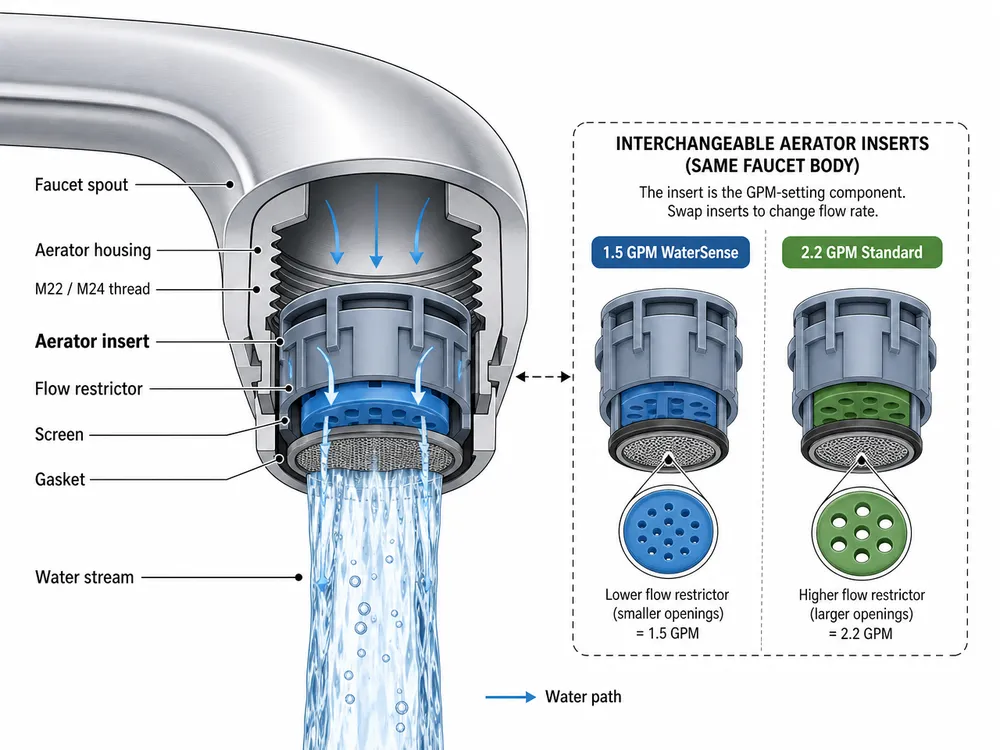
Cross-section diagram of a bathroom faucet aerator showing how the insert restricts flow to achieve 1.5 GPM or 2.2 GPM output

WaterSense certification: what the label actually requires

WaterSense is an EPA program, not a product standard. The label is a market access credential — it tells buyers, specifiers, and end users that the product has been independently tested and meets the EPA's efficiency and performance criteria.

For bathroom faucets, WaterSense requires:

  • Maximum flow rate of 1.5 GPM at 60 psi
  • Minimum flow rate of 0.8 GPM at 60 psi (to ensure adequate performance at lower supply pressures)
  • Testing by an EPA-recognized third-party laboratory
  • Manufacturer registration with the EPA WaterSense program

The minimum flow rate requirement is worth noting. A faucet that restricts flow too aggressively — below 0.8 GPM — fails WaterSense certification even though it uses less water. The program is designed to balance conservation with usability, and the 0.8 GPM floor is the EPA's line for acceptable performance.

What the label unlocks commercially:

  • LEED v4 Water Efficiency credits (WE Credit: Indoor Water Use Reduction)
  • State and utility rebate programs (varies by state — California, Colorado, and several Northeast states have active rebate programs for WaterSense-labeled fixtures)
  • Government procurement specifications (GSA and many state agencies require WaterSense for new construction and renovation)
  • Hotel and hospitality chain specs (major chains including Marriott, Hilton, and IHG have sustainability commitments that reference WaterSense)

What documentation to request from your supplier:

  • WaterSense Partner ID and product listing (verifiable on the EPA WaterSense website)
  • Third-party test report from an EPA-recognized laboratory
  • Flow rate test data at rated pressure (60 psi)

We hold cUPC certification in-house, which covers North American plumbing code compliance including flow rate requirements. For WaterSense labeling specifically, we work with EPA-recognized testing laboratories and can provide the test documentation with your order. If your buyer's spec requires the WaterSense label on the product packaging, confirm this at the RFQ stage — the label licensing and packaging artwork need to be coordinated before production.

Flow rate under real supply pressure conditions

The 60 psi test condition is a standard, not a guarantee of field performance. Supply pressure in real installations varies considerably:

  • Residential single-family: typically 40–80 psi
  • Mid-rise residential (above 4th floor): often 30–50 psi without a booster pump
  • Older commercial buildings: 35–55 psi is common
  • Hotel properties: varies by floor and building age

At 40 psi supply pressure, a 1.5 GPM aerator will deliver roughly 1.1–1.2 GPM — still within WaterSense's 0.8 GPM minimum, but noticeably lower than the rated output. For hospitality buyers specifying faucets for upper-floor hotel rooms, this is worth factoring into the product selection conversation with their plumbing engineer.

The practical implication for importers: if your buyer is supplying a project with known low supply pressure, a 2.2 GPM aerator at 40 psi will deliver approximately 1.6–1.7 GPM — closer to what a 1.5 GPM aerator delivers at 60 psi. In low-pressure applications, the 2.2 GPM configuration may actually be the right choice for performance, even in markets that permit it.

We include flow rate test data at 0.6 MPa with every outgoing shipment. If your buyer needs performance data at a specific lower pressure for a project spec, we can run supplemental testing and include it in the documentation package.

Specifying flow rate correctly on a PO — and what test reports to request

Most flow rate compliance problems we see trace back to one of three sourcing mistakes:

1. No GPM specified on the PO

The supplier ships whatever their default configuration is. If that's 2.2 GPM and your buyer is in Colorado, you have a compliance problem on arrival.

2. GPM specified but aerator not confirmed

The PO says "1.5 GPM" but doesn't confirm the aerator insert specification. Some suppliers interpret this as a target and ship a 2.2 GPM aerator with a note that the faucet "can achieve" 1.5 GPM with a different insert. That's not the same as shipping a 1.5 GPM-configured product.

3. WaterSense label assumed from flow rate compliance

A faucet that delivers 1.5 GPM is not automatically WaterSense certified. WaterSense requires third-party testing and EPA program registration. If your buyer's spec says "WaterSense labeled," you need the certification documentation, not just a flow rate that happens to match the threshold.

What to include in your RFQ and PO:

  • Target GPM (1.5 or 2.2, or 1.2 for California residential)
  • Destination state(s) or market
  • Whether WaterSense certification and labeling is required
  • Whether flow rate test reports are required with shipment documentation

What test reports to request:

  • Flow rate test report at 60 psi (0.41 MPa) — confirms rated GPM
  • Leak test report at 0.6 MPa — confirms pressure integrity
  • WaterSense third-party test report (if WaterSense label is required)
  • cUPC test report (for North American plumbing code compliance)

We include flow rate test data and leak test results with every shipment as standard documentation. cUPC certification covers the North American plumbing code requirements. WaterSense test reports are available on request — confirm at RFQ stage if your order requires them.
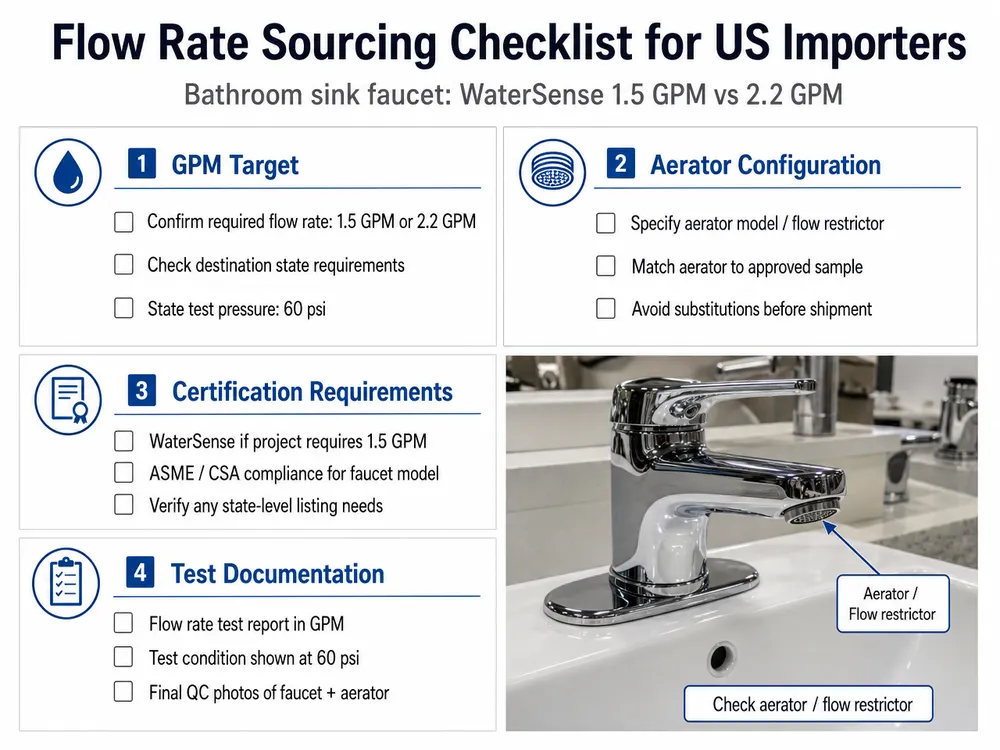
Sourcing checklist for US importers specifying bathroom faucet flow rate including GPM target, aerator confirmation, and required test documentation

Handling mixed-market orders without doubling your SKU count

If you're distributing to multiple states with different flow rate requirements, the aerator swap approach is the most practical way to manage compliance without multiplying your inventory.

Here's how we handle it on the factory side: the faucet body, finish, and cartridge are identical across configurations. The only variable is the aerator insert installed at final assembly. On a mixed-market order, you specify the split — for example, 3,000 units at 1.5 GPM for general distribution and 500 units at 1.2 GPM for California residential — and we configure them separately before packing. Each carton is labeled with the GPM configuration so your warehouse team can allocate correctly.

For buyers who want maximum flexibility, we can also ship a small quantity of replacement aerators (both 1.5 GPM and 1.2 GPM) as spare parts with the order. If your distribution network needs to reconfigure units in the field, the aerator swap takes about 30 seconds with a coin or flathead screwdriver. (This is also useful for buyers who discover mid-distribution that a state has tightened its requirements — they can reconfigure existing inventory rather than returning product.)

The SKU consolidation benefit is real. One faucet body, two aerator configurations, full national compliance. Your catalog stays clean, your tooling investment covers both markets, and your reorder process doesn't split across two separate product lines.

For buyers sourcing Bathroom Sink Faucets for the US market, this is the conversation worth having at the RFQ stage — before tooling is committed and before the first container is loaded.

Frequently asked questions

Does a 1.5 GPM faucet feel noticeably weaker than a 2.2 GPM faucet?

At 60 psi supply pressure, the difference is perceptible but not dramatic — the aerator's air-mixing function maintains a full-looking stream even at lower flow rates. The more relevant variable is supply pressure: at 40 psi, a 1.5 GPM aerator delivers around 1.1–1.2 GPM, which some users find noticeably reduced. For hospitality projects in older buildings with lower supply pressure, this is worth discussing with the project's plumbing engineer before specifying 1.5 GPM across all floors.

Can I swap the aerator after the faucet is installed?

Yes. Aerators are designed to be field-replaceable. The thread size (M22 or M24) is fixed by the spout, but the insert is removable with a coin or aerator key. If your buyer needs to reconfigure installed units — for example, to comply with a state regulation that changed after installation — the aerator swap is a straightforward field operation. Confirm the thread size with us at the order stage so your buyer has the right replacement aerator specification.

What's the difference between cUPC and WaterSense certification for flow rate?

cUPC (Canadian/Uniform Plumbing Code) certification covers plumbing code compliance for North American installation, including the 2.2 GPM federal maximum. It's what your product needs to clear customs and pass a plumbing inspection. WaterSense is a separate EPA program that certifies efficiency performance at ≤1.5 GPM and requires independent third-party testing. A cUPC-certified faucet at 2.2 GPM is code-compliant but not WaterSense labeled. A WaterSense-labeled faucet at 1.5 GPM is both code-compliant and eligible for green building credits and rebate programs. We hold cUPC in-house; WaterSense test reports are available on request.

What flow rate should I specify for a hotel project?

For new hotel construction or renovation, 1.5 GPM is the standard specification — it satisfies WaterSense requirements, qualifies for LEED credits, and meets the sustainability commitments of most major hotel chains. The exception is California properties, where residential-use bathrooms require 1.2 GPM. For a mixed-use hotel project in California, confirm with the project's plumbing engineer whether guest bathrooms are classified as residential or commercial under the applicable code.

How do I verify a supplier's flow rate claim without running my own test?

Request the flow rate test report from an accredited third-party laboratory, not just the supplier's internal QC data. The report should specify the test pressure (60 psi / 0.41 MPa), the measured flow rate, and the aerator configuration tested. For WaterSense claims, verify the product listing on the EPA WaterSense website using the supplier's Partner ID — the listing is publicly searchable and confirms both the certification status and the specific product models covered.

Flow rate compliance for the US market comes down to three decisions: which GPM standard your destination market requires, whether WaterSense certification is needed for your buyer's application, and how to configure the aerator to hit the target without multiplying your SKU count. Get those three right at the PO stage and the compliance side takes care of itself.

Browse our Bathroom Faucets catalog or go directly to the Bathroom Sink Faucets page to see available configurations. If you're ready to specify flow rate for an order, Request Quote with your target GPM, destination market, and volume — we'll confirm the aerator configuration, applicable certifications, and include flow rate test data with the quote.
Brass vs Chrome Bathroom Faucet: Finish Selection Guide for B2B Buyers and Specifiers

The finish decision on a bathroom faucet order is not an aesthetic call. It is a warranty risk decision, a maintenance communication decision, and a market-tier positioning decision — all wrapped into one SKU choice. Get it wrong and you're fielding return claims from downstream customers who didn't understand what they were buying, or you're leaving margin on the table by specifying chrome into a market that would pay a premium for brass.

Here's the short verdict before we get into the mechanics: chrome is the default for volume, consistency, and low-maintenance end users; brass — particularly unlacquered brass — is a premium segment play that requires the right market and the right end-user communication to land without warranty headaches. The rest of this article explains exactly where each finish wins, where it fails, and what to verify before you place a finish-sensitive order.

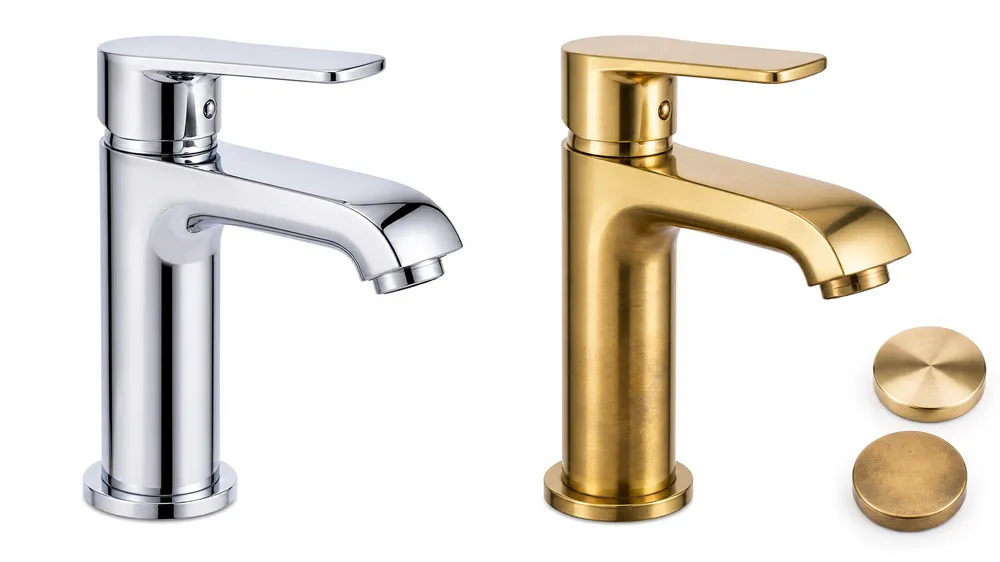
Side-by-side comparison of brass and chrome bathroom faucet finishes showing surface texture and color differences

What These Finishes Actually Are at the Surface Level

Most content on this topic treats "brass" and "chrome" as color choices. They're not. They're different surface engineering decisions with different failure modes, different maintenance profiles, and different cost structures.

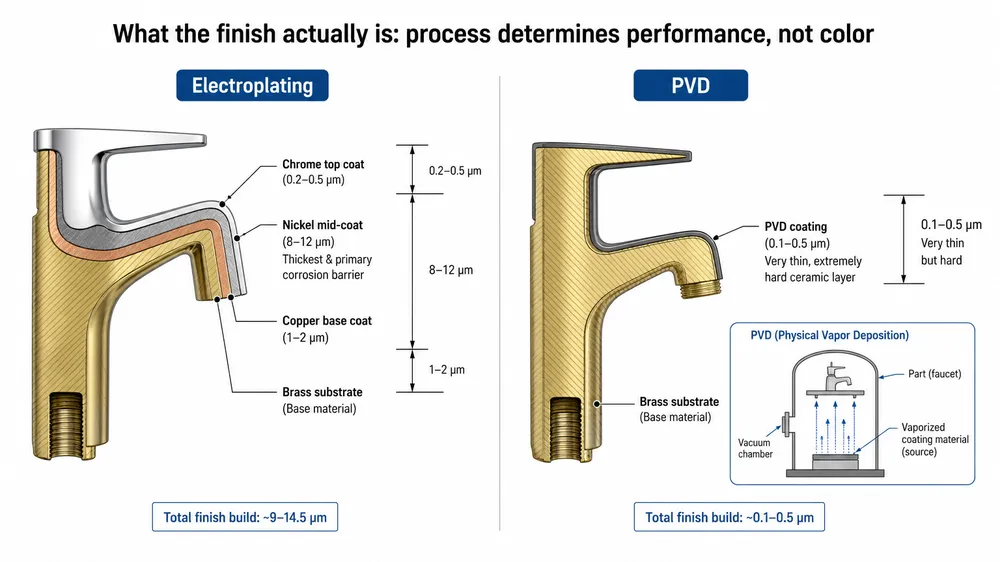
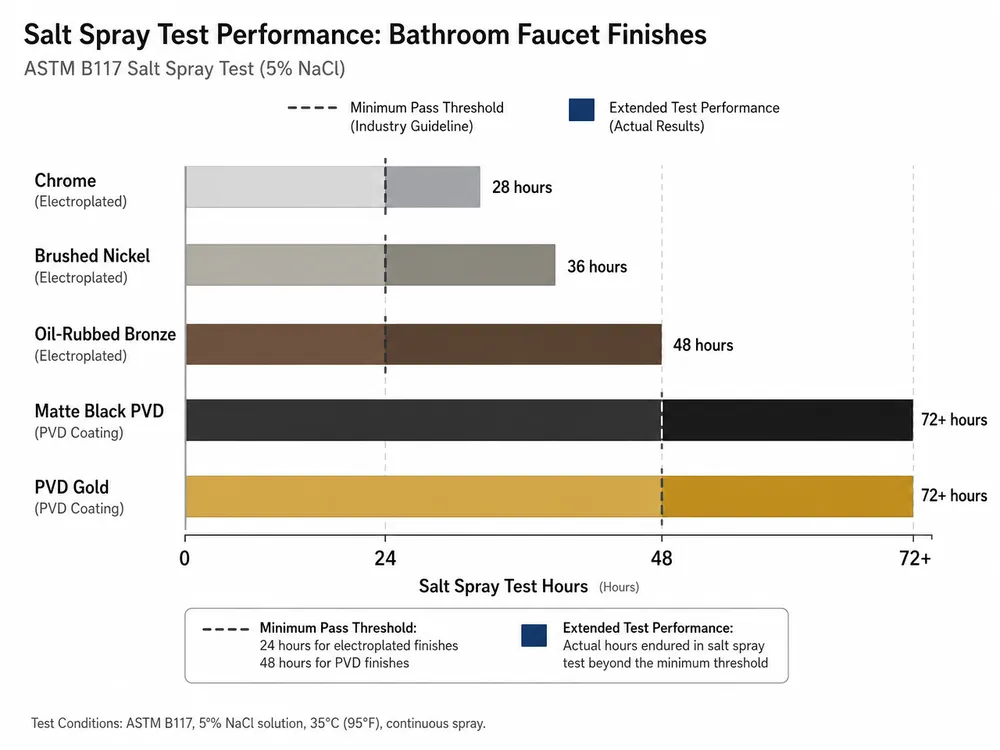
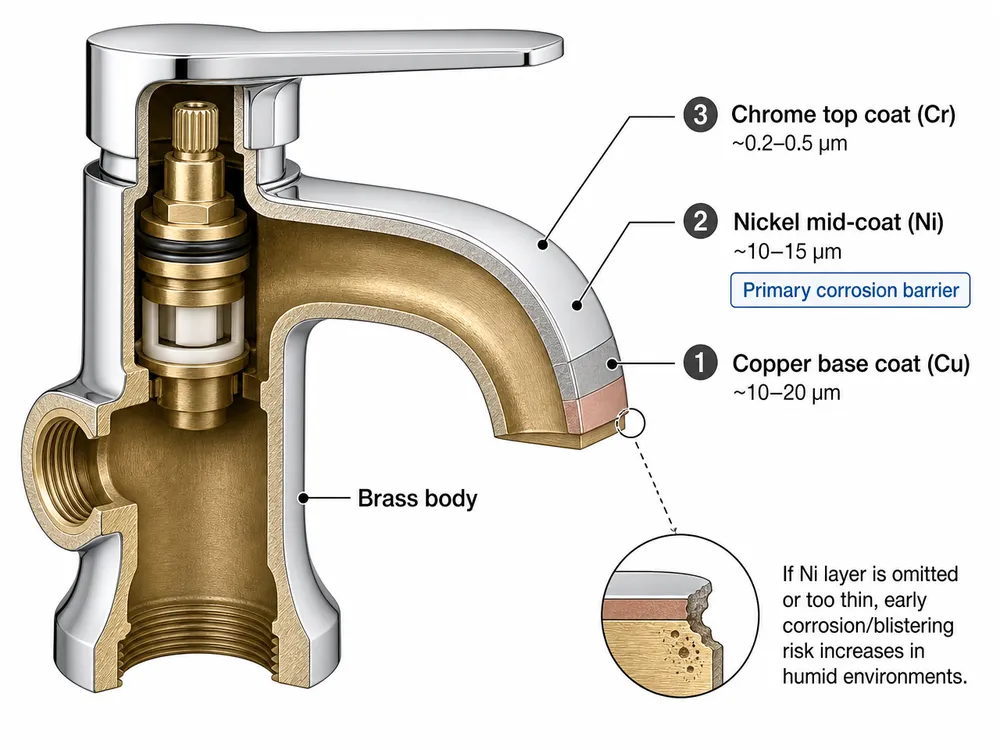
Chrome finish on a bathroom faucet is a multi-layer electroplated coating applied over the brass body. The full stack runs copper base coat → nickel mid-coat → chrome top coat. The copper layer improves adhesion to the brass substrate. The nickel mid-coat is the corrosion barrier — it's what actually protects the base metal from moisture and chlorine. The chrome top coat provides the bright, hard surface and the scratch resistance. That nickel mid-coat is also the layer that gets skipped when a factory is cutting costs. Without it, you're relying on a thin chrome layer over copper over brass, and that combination fails salt spray testing at 48 hours or less. Our chrome line runs the full Cu/Ni/Cr stack, and our standard production clears 24-hour salt spray with most batches reaching 48 hours.

Brass finish is a different category entirely, and it splits into two distinct products that behave very differently in the field:

  • Lacquered brass: The brass body is polished and then sealed with a clear lacquer coating. The lacquer locks in the warm gold tone and prevents oxidation. It looks consistent, it's low-maintenance, and it behaves predictably — until the lacquer chips or scratches, at which point the exposed brass oxidizes and you get uneven patina spots. Lacquered brass is the safer choice for buyers who want the brass aesthetic without the maintenance conversation.
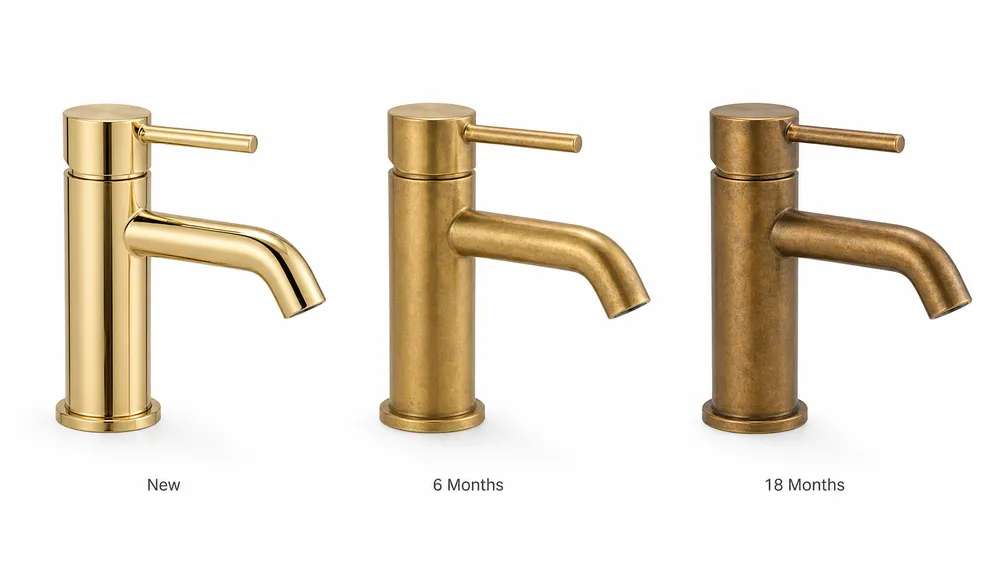
  • Unlacquered brass: No protective coating. The raw brass surface is exposed to air, water, and hand contact. It will develop a patina — the surface darkens and shifts in tone over months of use. This is not a defect. It is the intended behavior of the material, and it's what the "living finish" market segment is specifically buying. But it requires explicit end-user communication, and it is absolutely the wrong finish for a buyer whose downstream customers expect a stable, consistent surface.

(We get questions about this distinction regularly from buyers who've seen unlacquered brass trending in design media and want to add it to their catalog without fully understanding the maintenance implications. The patina is the product — if your end users don't know that going in, you'll have returns.)

Chrome Finish: Plating Stack, Durability, and Where It Fails

Chrome is the workhorse finish of the bathroom faucet market for a reason. It's bright, it's hard, it's easy to clean, and when it's done correctly, it holds up in high-humidity environments for years without visible degradation. The problem is that "done correctly" is doing a lot of work in that sentence.

The failure mode we see most often in the market — and the one that generates the most warranty claims — is nickel mid-coat omission. A factory running a two-layer stack (copper + chrome, no nickel) can produce a faucet that looks identical to a properly plated unit on day one. The difference shows up at 6–18 months in a humid bathroom environment: the chrome starts to pit, blister, or develop rust spots at micro-defect sites where moisture has penetrated to the base metal. By the time the end user notices, the damage is cosmetic and irreversible. That's a warranty claim, a replacement unit, and a customer who doesn't reorder.

The salt spray test is the standard verification tool for chrome finish durability. A properly plated Cu/Ni/Cr stack should clear 24 hours minimum in a 5% NaCl salt spray chamber with no visible corrosion. Factories running the full stack with good bath chemistry and process control will typically reach 48 hours. If a supplier can't provide salt spray test reports, or if their reports show 24-hour results as a ceiling rather than a floor, the nickel mid-coat is likely thin or absent.

Diagram showing the three-layer Cu/Ni/Cr electroplating stack on a brass faucet body with layer thickness annotations

Chrome also has a cost advantage that matters for volume orders. The electroplating process is faster and cheaper per unit than PVD coating, and the process is well-understood across the industry. For mid-market and value-tier product lines, chrome is the finish that protects your margin while still delivering a clean, professional surface.

Where chrome loses: premium positioning. A chrome faucet in a high-end hospitality fit-out or a luxury residential remodel reads as standard. It doesn't carry the warmth or the design distinctiveness that brass does. If your buyers are selling into segments where the fixture is a design statement, chrome is leaving margin on the table.

Brass Finish: Lacquered vs. Unlacquered, and the Patina Question

Lacquered brass is straightforward to source and specify. The surface is sealed, the color is stable, and the maintenance requirement is the same as chrome — wipe it down, avoid abrasive cleaners. The risk is lacquer integrity over time. A lacquer coat that's applied too thin, or over a surface that wasn't properly prepared, will start to peel or chip within 2–3 years. When it does, the exposed brass oxidizes unevenly and the finish looks damaged rather than aged. Specify lacquered brass from a factory that controls the lacquer application process in-house and can tell you the coating thickness and adhesion test protocol.

Unlacquered brass is a different sourcing and sales conversation. The patina development timeline varies by water chemistry, humidity, and how frequently the fixture is handled — in a high-use bathroom with hard water, visible darkening can appear within 3–6 months. In a low-use guest bathroom, the surface may stay relatively bright for a year or more. Neither outcome is a defect. But if your downstream customer is expecting a stable gold surface and gets a darkening, mottled fixture, they will call it a defect regardless of what the product description says.

The market segments that buy unlacquered brass correctly are the ones where the end user has specifically chosen a living finish — boutique hospitality, high-end residential renovation, design-forward e-commerce. These buyers understand the patina and often want it. The segments where unlacquered brass generates returns are the ones where the buyer chose it for the color and didn't read the maintenance requirements: mid-market residential, rental property fit-out, any context where the end user expects zero maintenance.

We've shipped unlacquered brass to buyers in the US and European markets, and the pattern is consistent: buyers who include explicit patina communication in their product listings — photos of aged fixtures, written maintenance guides, clear "living finish" labeling — have near-zero return rates on this finish. Buyers who list it as "brass finish" without further explanation get returns. The product is the same. The communication is the variable.

Visual timeline showing unlacquered brass bathroom faucet surface at new, 6 months, and 18 months showing natural patina development

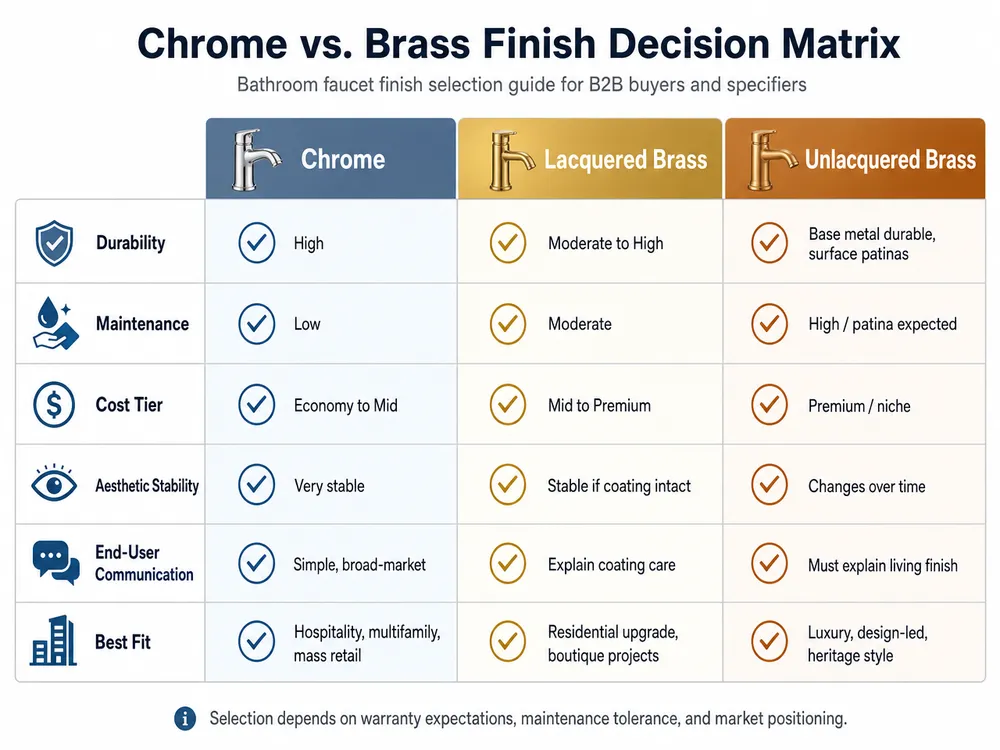
Head-to-Head: Chrome vs. Brass Finish Decision Matrix

Dimension Chrome (Cu/Ni/Cr Stack) Lacquered Brass Unlacquered Brass
Surface composition Electroplated Cu/Ni/Cr over brass body Polished brass + clear lacquer seal Raw polished brass, no coating
Salt spray durability 24–48h (full stack); <48h (skipped nickel) N/A — lacquer integrity is the variable N/A — patina is expected
Aesthetic trajectory Stable, bright, consistent Stable until lacquer failure Darkens and develops patina over time
Maintenance burden Low — wipe clean, no special care Low — same as chrome while lacquer holds Medium — periodic cleaning, wax or oil treatment to manage patina
End-user communication Minimal Minimal High — patina must be explained and expected
Cost tier Mid-market to premium Mid-premium Premium
Failure mode Pitting/blistering if nickel mid-coat absent Peeling/chipping if lacquer thin or poorly applied Returns if end user not briefed on living finish
Best application fit Volume residential, hospitality, e-commerce Design-forward residential, boutique hospitality Luxury residential, design-led e-commerce, boutique hospitality
Sourcing verification Salt spray test report (24h+ minimum) Lacquer thickness and adhesion test data Patina communication materials from supplier
Decision matrix chart comparing chrome, lacquered brass, and unlacquered brass bathroom faucet finishes across durability, maintenance, cost, and application fit dimensions

Project-Type Decision Framework: Which Finish Fits Which Market

The matrix above gives you the technical picture. This section translates it into the project types your buyers are actually operating in.

Volume residential distribution — Chrome is the right call. Your buyers in this segment are selling to homeowners who want a clean, consistent surface that requires no maintenance and no explanation. Chrome at the right price point, with documented salt spray performance, is the finish that protects your margin and generates zero finish-related returns. Lacquered brass can work here if you're targeting the upper end of the residential market, but unlacquered brass will generate returns unless your distribution channel has the product knowledge to communicate the living finish correctly.

Hospitality fit-out — This is where the decision splits by project tier. Budget and mid-market hospitality (hotel chains, serviced apartments, student accommodation) runs chrome because the maintenance staff needs a surface that wipes clean without special care and holds up to cleaning chemicals. Boutique and luxury hospitality is the segment where brass — both lacquered and unlacquered — earns its premium. A boutique hotel specifying unlacquered brass fixtures is making a deliberate design statement, and the procurement team in that segment understands the maintenance implications. The risk is mid-tier hospitality buyers who want the brass look without the maintenance infrastructure — that's where lacquered brass is the safer specification.

E-commerce mid-premium — Chrome dominates the volume, but brass is where the margin is. If you're building a product line for an e-commerce seller targeting the $150–$400 retail price point, a well-specified lacquered brass faucet with strong product photography can command a 30–50% premium over a comparable chrome unit. Unlacquered brass at this tier requires strong product content — detailed patina photos, written care guides, and ideally customer reviews from buyers who understand the finish. Without that content infrastructure, the return rate on unlacquered brass in e-commerce is high.

Commercial specification (offices, healthcare, education) — Chrome, full stop. These environments need a finish that maintenance staff can clean with standard commercial cleaners, that holds up to high-frequency use, and that generates no end-user questions. Brass in a commercial specification is a liability unless the specifier has explicitly called for it as a design element and the maintenance protocol is documented.

(We've had buyers try to run unlacquered brass into rental property fit-out — the logic being that the warm tone photographs well for listings. It doesn't work. Tenants don't maintain it, the patina develops unevenly, and the property manager gets complaints. Lacquered brass or chrome for rental.)

The Sourcing Variables That Determine Finish Quality

Knowing which finish to specify is half the decision. The other half is knowing what to verify before you commit to a supplier.

For chrome: The single most important verification is the salt spray test report. Ask for the actual test report, not a spec sheet that lists "24h salt spray" as a feature. The report should show the test standard (ASTM B117 or equivalent), the test duration, the number of samples tested, and the result. A factory running the full Cu/Ni/Cr stack with proper bath chemistry will provide this without hesitation. A factory that hedges, provides a generic certificate, or can't tell you the nickel mid-coat thickness is a risk.

Also ask whether the plating is done in-house or subcontracted. Subcontracted plating means the finish quality is controlled by a third party, and finish consistency across a mixed-SKU order — where you're running chrome and brushed nickel in the same shipment — depends on that third party's process control, not your supplier's. We run all five of our finishes in-house, which means one QC team controls the plating process across your entire order. When you're mixing chrome and brushed nickel SKUs in a single container, the consistency is managed by the same team using the same process parameters.

For lacquered brass: Ask for the lacquer application process — specifically, whether it's spray-applied or dip-applied, what the cured thickness is, and what adhesion test is used. A lacquer coat below 15–20μm is thin enough to chip under normal use. Ask for accelerated weathering test data if the supplier has it — UV exposure testing will show lacquer degradation faster than field time.

For unlacquered brass: The surface preparation before the product ships matters more than most buyers realize. A properly prepared unlacquered brass surface should be clean, evenly polished, and free of machining marks or casting porosity that would cause uneven patina development. Ask for photos of the surface under good lighting before you approve a sample. Also ask what the supplier provides in terms of patina communication materials — care guides, patina timeline photos, product description language. A factory that has shipped unlacquered brass at volume will have these materials ready.

Finish consistency across mixed-SKU orders is a sourcing risk that doesn't get enough attention. If you're ordering chrome bathroom faucets and brass kitchen faucets in the same container, and the chrome is plated in-house while the brass goes to a subcontractor, you're managing two quality systems. The chrome might clear 48-hour salt spray while the brass lacquer is applied at inconsistent thickness. Consolidating to a factory that controls all finishes in-house eliminates that variable.

Scenario Verdicts: Three Sourcing Decisions, One Clear Answer Each

Scenario 1: A US distributor building a 500-unit opening order for a mid-market bathroom faucet line, targeting $80–$150 retail.

Chrome wins. The end-user profile in this segment expects a stable, low-maintenance surface. Chrome at this price point, with documented salt spray performance and cUPC certification, is the finish that clears customs, generates no returns, and reorders predictably. Brass at this price tier is either lacquered (which adds cost without a proportional retail premium at this price point) or unlacquered (which generates returns from buyers who didn't understand the living finish). Specify chrome, verify the salt spray report, confirm the cUPC documentation, and move on.

Scenario 2: A European e-commerce brand launching a premium bathroom collection at €250–€500 retail, targeting design-conscious homeowners.

Lacquered brass is the primary specification, with unlacquered brass as a secondary SKU for buyers who specifically want the living finish. The lacquered brass gives you the warm, premium aesthetic that justifies the price point without the maintenance communication burden. The unlacquered brass SKU — clearly labeled, with patina photos and a care guide in the product listing — captures the segment that specifically wants the living finish and will pay a premium for it. Chrome in this collection is a supporting finish for buyers who want the design language of the collection without the brass tone. Don't lead with chrome at this price point; it undercuts the premium positioning.

Scenario 3: A hospitality procurement team specifying fixtures for a 120-room boutique hotel renovation.

Unlacquered brass for the feature fixtures (vanity faucets in the rooms, statement pieces in the lobby bathrooms), lacquered brass for the secondary fixtures, chrome for the back-of-house and staff areas. The boutique hotel segment is exactly the market that unlacquered brass was designed for — the patina development over the hotel's operating life becomes part of the design story. The procurement team needs to document the maintenance protocol for housekeeping (periodic wax treatment, no abrasive cleaners), but that's a one-time communication, not an ongoing problem. Verify that the supplier can deliver finish consistency across the full fixture count — 120 rooms means 120+ vanity faucets that need to start at the same surface condition and age at roughly the same rate.

What to Ask a Factory Before Placing a Finish-Sensitive Order

The questions below are the ones that separate factories running serious finish operations from factories that are reselling plated product from a subcontractor with no visibility into the process.

  • Chrome: "Can you provide the salt spray test report for your current chrome production batch? What is the nickel mid-coat thickness in your Cu/Ni/Cr stack?" A factory that can answer the second question specifically — not just "we use a full stack" — is running the process in-house.
  • Lacquered brass: "What is the cured lacquer thickness on your standard lacquered brass finish? What adhesion test do you run post-application?" Expect a specific number (μm) and a test method, not a general quality assurance statement.
  • Unlacquered brass: "Do you have patina timeline photos from production samples? What surface preparation do you run before shipping?" The patina photos tell you whether the factory has actually shipped this finish at volume and tracked the results.
  • Mixed-SKU orders: "Is your plating done in-house or subcontracted? If in-house, do chrome and brass finishes run on the same QC system?" This question surfaces the finish consistency risk before it becomes a container-level problem.
  • Certification: "Which certifications cover your bathroom faucet line, and do they extend to the finish variants I'm ordering?" A cUPC-certified body with a non-certified finish variant is a compliance gap. Confirm the certification scope covers the specific SKU you're ordering.

For buyers sourcing Brass Bathroom Faucets specifically, the unlacquered brass question is the one that most often gets skipped in the RFQ process — and it's the one that generates the most post-delivery issues. Build it into your standard supplier qualification checklist.

FAQ: Finish Selection for B2B Buyers

Does chrome or brass hold up better in coastal and high-humidity environments?

Chrome with a full Cu/Ni/Cr stack outperforms lacquered brass in sustained high-humidity environments because the nickel mid-coat provides a continuous corrosion barrier that lacquer cannot match once it develops micro-cracks. Unlacquered brass in coastal environments will develop patina faster — the salt air accelerates oxidation — which is acceptable if the end user expects it, but problematic if they don't. For coastal hospitality or residential projects where the end user wants a stable surface, chrome is the lower-risk specification. If the project specifically calls for brass, lacquered brass with a high-quality lacquer application is the safer choice over unlacquered in salt-air environments.

What salt spray rating should I require when sourcing chrome bathroom faucets?

24 hours minimum in a 5% NaCl salt spray chamber (ASTM B117 or equivalent) is the floor for a properly plated Cu/Ni/Cr stack. Require the actual test report, not a spec sheet claim. For orders going into humid climates, coastal markets, or hospitality applications where the fixtures will see frequent cleaning, specify 48-hour salt spray as your minimum and ask for the report from the current production batch, not a historical sample. Factories running the full plating stack with good process control will meet 48 hours routinely — if a supplier pushes back on this requirement, the nickel mid-coat is likely thin.

Is unlacquered brass a viable finish for e-commerce distribution?

Yes, but only with the right product content infrastructure. The return rate on unlacquered brass in e-commerce correlates directly with how well the patina behavior is communicated in the product listing. Buyers who include patina timeline photos, written care guides, and "living finish" labeling in their listings report near-zero finish-related returns. Buyers who list it as "brass finish" without further explanation see return rates that make the SKU unprofitable. If your e-commerce channel doesn't have the content infrastructure to support the living finish communication, specify lacquered brass instead — you get the brass aesthetic without the maintenance conversation.

How do I verify that a supplier's chrome plating includes the nickel mid-coat?

Three ways: (1) Ask for the salt spray test report — a full Cu/Ni/Cr stack will clear 24–48 hours; a two-layer stack without nickel typically fails below 48 hours. (2) Ask the supplier directly for the nickel mid-coat thickness in microns — a factory running the process in-house will know this number; a factory reselling subcontracted plating often won't. (3) Request a cross-section analysis on a sample unit — this is more involved but gives you definitive layer verification for high-value orders. For most sourcing decisions, the salt spray report plus a direct question about nickel thickness is sufficient.

What MOQ applies to custom finish orders, and does it affect finish consistency?

For standard catalog finishes (chrome, lacquered brass), MOQ at Wfaucet starts at 200 pieces — low enough for a market test before committing to volume. For unlacquered brass, we recommend a minimum of 500 pieces for a first order, not because of production constraints but because the patina communication materials and product listing setup represent a fixed cost that needs enough volume to amortize. Finish consistency is not an MOQ issue when plating is done in-house — a 200-unit run and a 5,000-unit run go through the same plating bath and the same QC process. The consistency risk is with subcontracted plating, where small runs may be batched with other customers' product and process parameters may vary.

Does the brass body material affect finish performance?

Yes, significantly. The brass alloy used for the faucet body affects both the plating adhesion and the long-term corrosion performance of the finished product. We use C36000-equivalent free-machining brass for our bodies — it machines cleanly, which means the surface going into the plating bath is consistent and free of the micro-tears that cause adhesion problems. Zinc alloy (zamak) bodies are cheaper to cast but require different pre-treatment before plating, and the long-term corrosion performance in chlorinated water systems is lower than brass. If you're sourcing chrome faucets for markets with aggressive water chemistry (high chlorine, high hardness), confirm the body material is brass, not zinc alloy.

The finish decision on a bathroom faucet order comes down to three variables: the end-user's maintenance tolerance, the project tier, and the market segment's willingness to pay for premium aesthetics. Chrome is the right answer for most volume applications. Brass — lacquered or unlacquered — is the right answer when the market segment supports the premium and the end-user communication is in place.

If you're building a product line that spans both finishes, the sourcing efficiency question is whether your supplier controls both finish processes in-house. Mixed-finish orders from a factory with subcontracted plating introduce consistency risk that shows up as variation between SKUs in the same container. We run chrome and brass finishes on the same QC system, so your mixed-SKU order ships with consistent finish quality across the board.

Send your finish specification, project type, target market, and annual volume to our team via the Request Quote page — we'll come back with product options, finish data sheets, and salt spray test reports for the specific SKUs you're evaluating.

Low Profile vs Standard Height Bathroom Faucet: Which Fits More Sink Configurations and Reduces Installer Callbacks

The faucet height decision looks simple until you're three weeks into a 200-room hotel installation and the plumber is calling because the spout clears the vessel sink rim by 40mm — not enough to get a hand under the water stream. That's a callback. That's a warranty claim. That's a sourcing decision that failed at the spec stage.

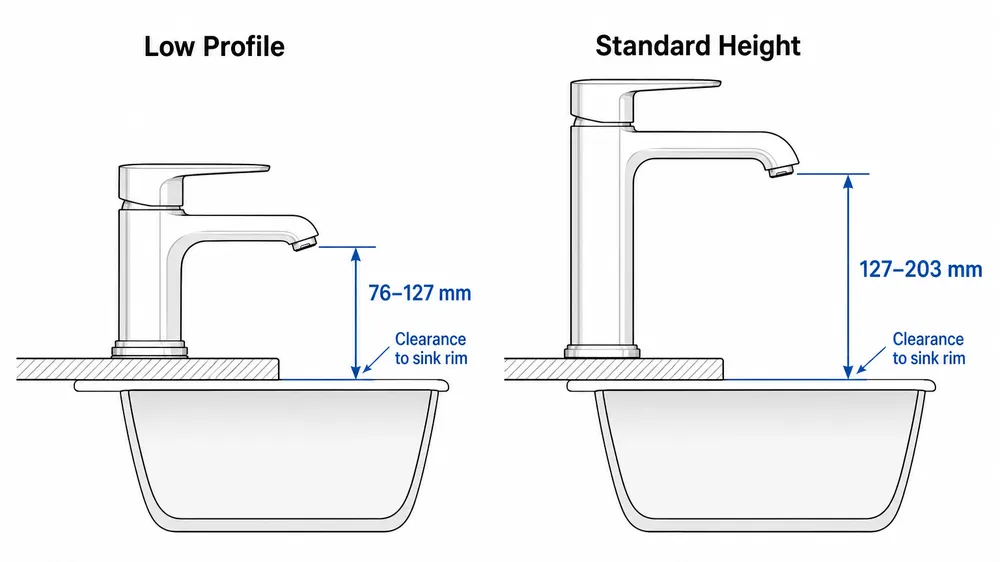
Here's the short verdict before we get into the mechanics: standard height faucets (spout height 127–203 mm / 5–8 in) are the default for undermount and drop-in sinks in residential and hospitality projects. Low profile faucets (spout height 76–127 mm / 3–5 in) are the correct choice for shallow vessel sinks, pedestal basins with limited deck clearance, and any project where the sink rim sits elevated above the deck. Mixing them up generates callbacks. Specifying the wrong one across a 50-unit residential development means your installer is back on-site, and your margin is gone.

The rest of this article explains why — with the spec table, the sink compatibility matrix, and the project-type decision logic you need to write a clean RFQ.

Side-by-side diagram comparing low profile and standard height bathroom faucet spout dimensions above a sink deck

Spout Height Defined: The Spec That Drives Every Downstream Decision

Spout height is measured from the deck surface (the mounting plane) to the center of the water outlet. It is not the same as the overall faucet height, which includes the body and handle assembly above the deck. When a plumber says "the faucet is too short," they almost always mean the spout height — the arc of water lands inside the basin instead of clearing the rim, or the clearance between the outlet and the sink floor is too tight for comfortable hand-washing.

We manufacture both variants from the same certified brass body at our Foshan facility. The spout geometry is machined on our CNC lines to hold ±0.3 mm on the outlet position — that tolerance matters when you're specifying clearance for a vessel sink where the rim sits 80–100 mm above the deck. A 2 mm error in spout height on a low profile unit can mean the difference between a clean installation and a splash-back complaint.

Specification Low Profile Faucet Standard Height Faucet
Spout height range 76–127 mm (3–5 in) 127–203 mm (5–8 in)
Typical spout reach 100–130 mm (4–5 in) 120–160 mm (4.7–6.3 in)
Deck clearance required 25–40 mm below spout outlet 40–60 mm below spout outlet
Compatible sink types Vessel (elevated rim), shallow pedestal, countertop vessel Undermount, drop-in, standard pedestal, semi-recessed
Handle-to-rim clearance risk Low (spout stays below vessel rim height) High if paired with elevated vessel sink
Splash-back risk Higher if paired with deep undermount sink Low for standard undermount/drop-in
Typical project fit Hospitality vessel sink rooms, boutique residential, retail display Standard residential, multi-unit development, commercial washroom
cUPC / CE / WaterMark certified Yes (same body, same certification) Yes

(Note: the 76–127 mm range covers the majority of low profile SKUs we produce — if your vessel sink rim sits higher than 100 mm above deck, confirm the exact clearance calculation before committing to a SKU. We can run that calculation for you if you send the sink spec sheet.)

Sink Compatibility: Where Each Height Wins and Where It Fails

This is where most specification errors happen. The sink type determines the required spout height — not the other way around. Choosing a faucet first and then fitting it to whatever sink the designer specified is how callbacks get generated.

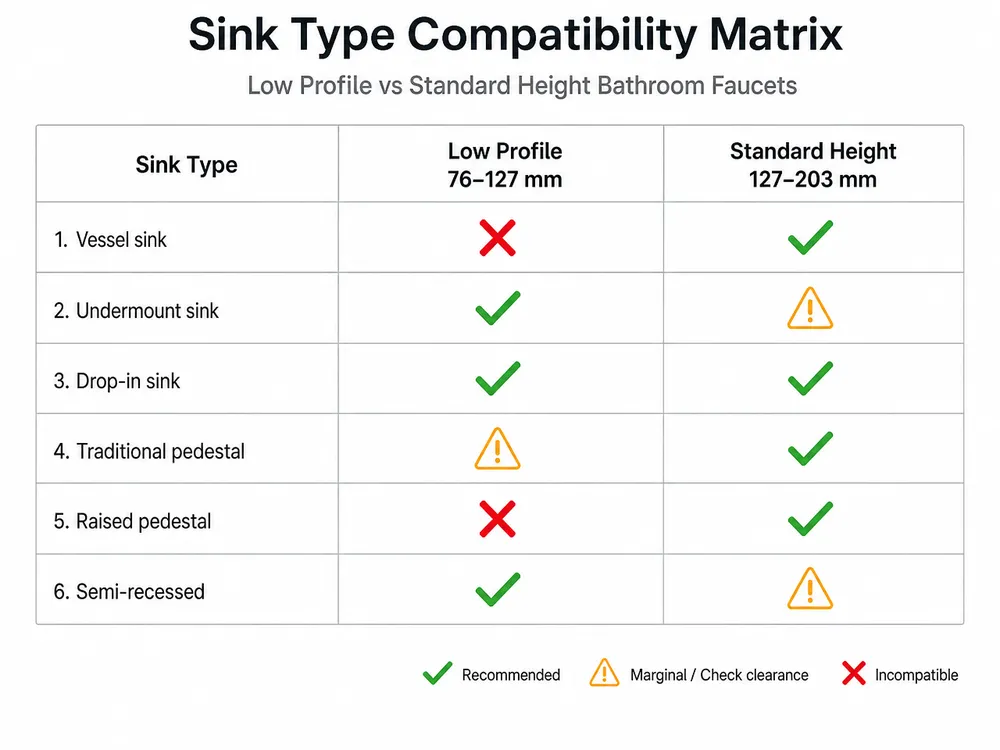
Vessel sinks sit on top of the deck surface, with the rim typically 100–150 mm above the mounting plane. A standard height faucet paired with a vessel sink creates two problems: the spout outlet may sit below the vessel rim (water hits the rim, not the basin), and the handle arc can interfere with the vessel wall during operation. Low profile faucets are designed for this configuration — the spout clears the vessel rim cleanly, and the handle geometry stays outside the vessel footprint.

Undermount and drop-in sinks sit at or below the deck surface. The basin floor is 150–200 mm below the deck. A low profile faucet here means the water stream drops nearly 200 mm before hitting the basin floor — generating splash-back onto the deck and the user. Standard height faucets are the correct specification for this configuration. The longer spout arc directs water toward the basin center, and the outlet height keeps the stream controlled.

Pedestal basins vary. Traditional pedestal designs with a shallow basin and a rim close to deck height work with standard height faucets. Contemporary pedestal designs with a raised bowl — common in boutique hotel bathrooms — behave like vessel sinks and require low profile specifications.

Semi-recessed sinks (partially inset into the vanity top) sit with the rim 30–60 mm above the deck. This is the configuration where we see the most specification errors in multi-unit residential projects. The rim height is close enough to deck level that buyers assume standard height faucets will work — and they often do, but the clearance is marginal. We recommend confirming the exact rim height and running a clearance check before specifying standard height for semi-recessed installations at scale.

Compatibility matrix showing which bathroom faucet height works with vessel, undermount, drop-in, pedestal, and semi-recessed sink types

The Hidden Cost: How Height Mismatch Generates Installer Callbacks

A faucet that ships correctly but gets installed in the wrong sink configuration is a warranty claim waiting to happen. The failure modes are predictable, and they all trace back to the same root cause: the spout height was not matched to the sink geometry at the specification stage.

Splash-back from low profile faucets in deep sinks. When the spout outlet sits too close to the basin floor, the water stream hits the basin at a steep angle and deflects onto the deck and the user. In a hotel bathroom, this generates guest complaints within the first week of occupancy. The property manager calls the contractor. The contractor calls the distributor. The distributor calls you. By the time the faucet gets replaced, the cost of the callback has exceeded the margin on the original order.

Handle interference from standard height faucets in vessel sink installations. A standard height faucet mounted next to a vessel sink often has the handle arc intersecting the vessel wall. The handle physically contacts the vessel rim during operation, or the user has to reach around the vessel to operate the handle. In a 200-room hotel project, this generates callbacks from multiple rooms simultaneously — and the fix requires either replacing the faucet or replacing the sink, neither of which is cheap.

Clearance failures in tight vanity configurations. Some contemporary vanity designs specify a vessel sink on a narrow deck with limited front-to-back depth. A standard height faucet in this configuration can have the spout outlet positioned too far forward, directing water onto the deck rather than into the basin. Low profile faucets with a shorter spout reach solve this — but only if the spout reach dimension was checked against the basin diameter at the specification stage.

We've seen all three of these failure modes in orders that came back to us for replacement product. In every case, the original specification was made without a clearance calculation. The faucet itself was fine — the pairing was wrong. (This is why we ask for the sink spec sheet when a buyer is ordering for a mixed-sink project. It takes five minutes to confirm the clearance and saves a callback.)

Project-Type Decision Guide: Which Height Fits Your Procurement Scenario

The right faucet height depends on the project type, not just the sink type. Here's how the decision maps across the three main procurement scenarios we supply.

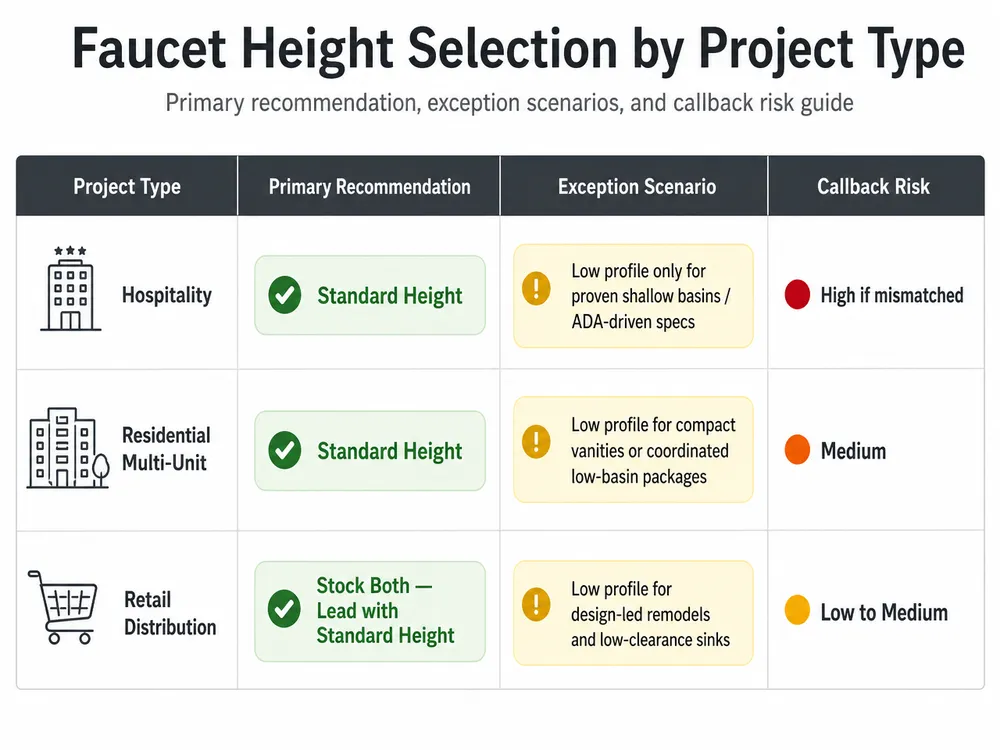
Hospitality Projects: Vessel Sink Rooms Require Low Profile Specification

Contemporary hotel bathroom design has moved heavily toward vessel sinks over the past decade — the elevated bowl creates a visual statement that designers favor for mid-range and upscale properties. If you're supplying faucets for a hospitality project with vessel sink bathrooms, low profile is the correct specification for the majority of rooms.

The exception is the accessible bathroom configuration, which typically uses an undermount or drop-in sink at ADA-compliant height. A hospitality project with mixed bathroom types — standard rooms with vessel sinks, accessible rooms with undermount sinks — needs both height variants. Sourcing both from the same manufacturer with the same certification documentation simplifies the procurement paperwork significantly. Our cUPC, CE, and WaterMark certifications cover both variants from the same brass body, so your compliance documentation is consistent across the entire order.

Residential Multi-Unit Development: Standard Height Is the Safe Default, With Exceptions

Standard residential construction — apartments, condominiums, townhouses — predominantly uses undermount or drop-in sinks in bathrooms. Standard height faucets are the correct specification for this configuration, and they represent the majority of what we ship for residential development projects.

The exception is the premium unit tier. Developers increasingly specify vessel sinks in penthouse units, show suites, and premium floor plans to differentiate the product. If your residential project has a mixed specification — standard sinks in most units, vessel sinks in premium units — you need both height variants. The risk of specifying standard height across the entire project and then discovering the premium units have vessel sinks is a mid-project change order, which is expensive for everyone.

Retail Distribution: Stock Both, Lead With Standard Height

If you're building a bathroom faucet SKU range for distribution, standard height faucets move in higher volume because they cover the larger installed base of undermount and drop-in sinks. Low profile faucets are a necessary addition to the range — vessel sink installations are common enough that distributors who don't carry a low profile option lose sales to competitors who do.

The practical approach is to stock both heights in your core finish options (chrome, brushed nickel, matte black) and use the same supplier for both so your documentation, packaging, and warranty terms are consistent. Buyers who are comparing your range against a competitor's will notice if your low profile and standard height faucets come from different sources with different certification coverage.

Decision matrix showing recommended faucet height specification by project type including hospitality, residential development, and retail distribution

OEM Spout Height Customization: When Standard Ranges Don't Cover Your Project

Standard low profile and standard height ranges cover the majority of sink configurations. But hospitality chains, branded residential developers, and large-format distributors occasionally specify a non-standard clearance requirement — a proprietary sink design, a custom vanity height, or a brand standard that falls between the two standard ranges.

We can adjust spout height within a certified brass body from a 200-piece MOQ. The CNC machining step that sets the spout geometry is a controlled variable in our production process — we're not retooling the casting, we're adjusting the machined profile on an existing certified body. That means the cUPC, CE, and WaterMark certifications remain valid for the modified variant, and your compliance documentation doesn't require a new certification cycle.

The practical limit is roughly ±15 mm from the standard range endpoints. Beyond that, the spout geometry starts to affect the flow path in ways that require re-testing. Within that range, we can hold the same ±0.3 mm tolerance on the outlet position that we hold on standard production runs.

For hospitality chains specifying a consistent bathroom standard across multiple properties — where the sink is a proprietary design and the faucet height needs to match exactly — this is the sourcing path that eliminates the clearance guesswork. You send us the sink spec sheet, we confirm the required spout height, and we produce a certified variant that fits the installation without a clearance calculation on every job site.

(We've done this for a few hotel groups in the Middle East and Southeast Asia where the bathroom design was specified by the chain's interior design team and the sink was a custom piece. The faucet height was non-standard in both cases. The OEM path was faster than trying to adapt a standard SKU.)

Sourcing Validation: What to Confirm Before You Commit to a Height Specification

Whether you're sourcing low profile or standard height faucets, there are four things worth confirming before you place an order at volume.

Spout height tolerance documentation. Ask for the dimensional drawing with the spout height tolerance called out. A supplier who can't provide a dimensional drawing with tolerances is a supplier whose production consistency you can't verify. We provide full dimensional drawings with all critical tolerances for every SKU in our Bathroom Faucets catalog.

Certification coverage for your target market. cUPC covers North America. CE covers Europe. WaterMark covers Australia. If your project spans multiple markets — a hotel chain with properties in the US, UK, and Australia, for example — you need a supplier whose certifications cover all three. We hold cUPC, CE, and WaterMark on our bathroom faucet range, so one supplier handles the documentation for all three markets.

Consistent certification across height variants. This is the detail that catches buyers who source low profile and standard height faucets from different suppliers. If the two variants carry different certifications, or if one variant's certification is from a different body than the other, your compliance documentation is inconsistent. For a hospitality project with mixed sink types, that inconsistency creates problems at the property handover stage. Our Low Profile Bathroom Faucets and standard height variants share the same certified brass body — the certification documentation is identical except for the spout height dimension.

Spout reach, not just spout height. Spout height tells you the vertical clearance. Spout reach tells you where the water stream lands in the basin. A faucet with the correct spout height but insufficient reach will direct water toward the front of the basin — or onto the deck. Confirm both dimensions against the basin diameter and the faucet's mounting position before specifying at scale. For detailed dimensional specs on our low profile range, see low profile bathroom faucet specifications.

Scenario Verdicts: Three Situations, One Clear Answer Each

Scenario 1: 150-room hotel, vessel sink bathrooms, mid-range property. Low profile faucet, 90–110 mm spout height. Standard height will generate handle interference and potential clearance failures at the vessel rim. The callback risk on a 150-room installation is not worth the marginal cost difference.

Scenario 2: 80-unit residential development, undermount sinks throughout, standard vanity height. Standard height faucet, 140–160 mm spout height. Low profile here creates splash-back in the deep basin. Standard height is the correct specification and the lower-risk choice for a uniform installation.

Scenario 3: Distribution range build, mixed market, need to cover both sink types. Stock both. Lead with standard height in your core SKUs. Add low profile in at least chrome and brushed nickel to cover vessel sink installations. Source both from the same manufacturer to keep certification documentation consistent and simplify your supplier count. One supplier, two height variants, same certified body — that's the clean sourcing path.

How to Source Matte Black Bathroom Faucets That Maintain Color Consistency Across Large Orders

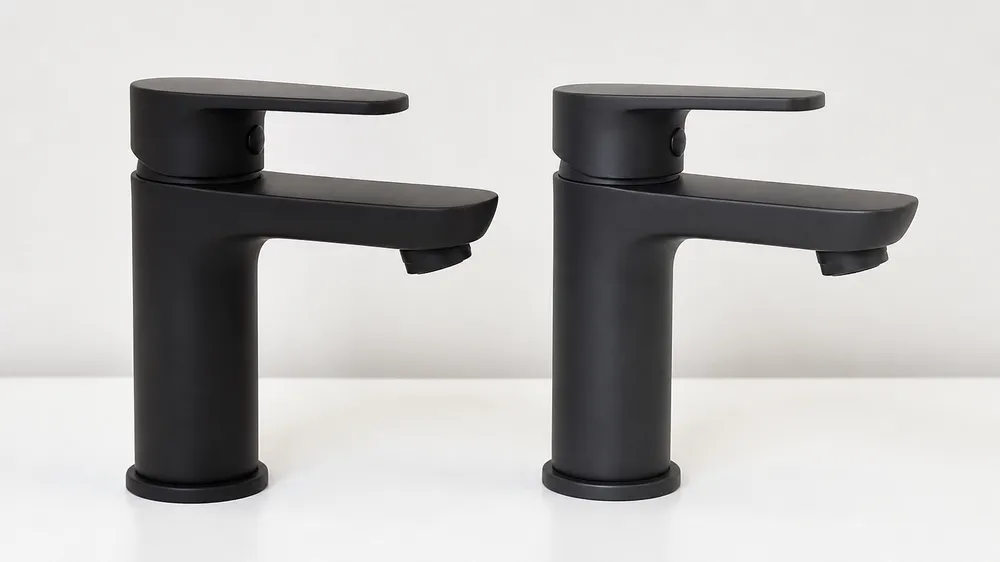
The second container arrives. You open a carton, hold a faucet next to one from the first shipment, and the difference is visible under the warehouse fluorescents. One reads warm charcoal. The other reads cool graphite. Both are labeled "matte black." Both came from the same supplier.

This is the most common finish complaint we hear from distributors and hotel FF&E teams who've been sourcing matte black faucets for a few years. It doesn't happen because the factory is careless. It happens because matte black is a finish category, not a specification — and most purchase orders never define it precisely enough to prevent drift between batches.

The fix is not complicated, but it requires knowing what to specify, what process controls to verify, and what documentation to require before you commit to volume. This guide walks through each of those steps.

Two matte black bathroom faucets side by side showing visible color variation between production batches

Why Matte Black Finish Drifts Between Batches

Matte black is not a single coating. It's an outcome that can be produced by at least three different processes — PVD (physical vapor deposition), electroplating with a black chrome or black nickel layer, and powder coating — and each process has different batch-to-batch stability characteristics.

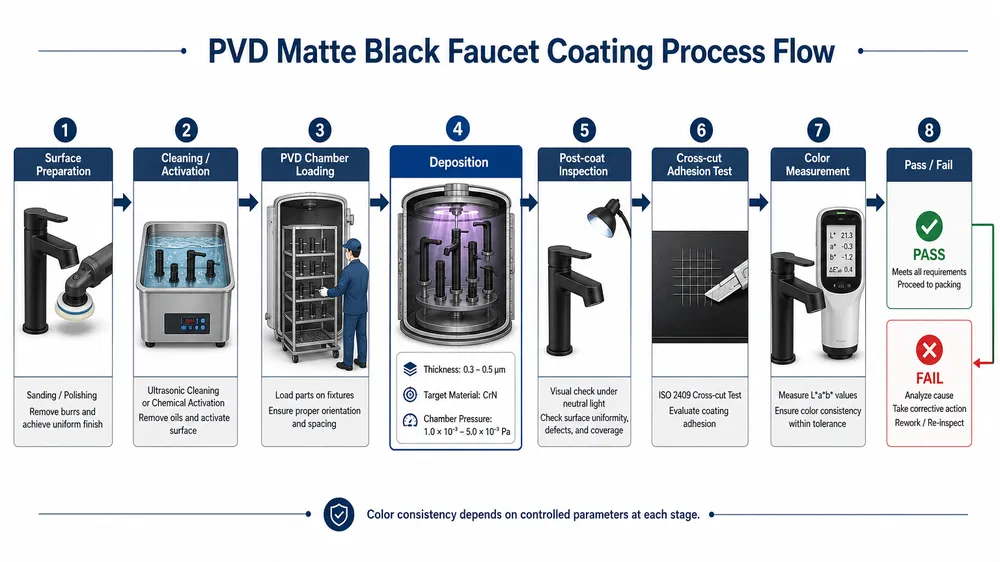
PVD deposits a thin ceramic or metallic compound layer (typically titanium nitride or zirconium nitride variants) in a vacuum chamber. The color result depends on coating thickness, target material composition, chamber pressure, and deposition time. Hold those parameters steady and the color holds steady. Let any one of them drift — a worn target, a pressure fluctuation, a batch of parts with inconsistent surface prep — and the color shifts. PVD is the most durable and most controllable process for matte black, but only if the factory is actually controlling the parameters.

Electroplating with black chrome or black nickel produces a matte black appearance through a different mechanism: the surface texture and light absorption properties of the deposited layer. Bath chemistry, current density, and plating time all affect the final color. This process is more sensitive to bath aging than PVD — a bath that's been running for three weeks produces a slightly different result than a fresh bath, and factories that don't monitor bath chemistry closely will see color drift across a production run, let alone across batches separated by weeks.

Powder coating applies a dry polymer powder electrostatically and cures it in an oven. Color consistency depends on powder lot consistency, film thickness (typically 60–80μm for faucet applications), and cure temperature. Powder coating is the least durable option for bathroom faucets — it's more susceptible to chipping at edges and to moisture penetration at pinholes — and it's the hardest to match precisely on reorders because powder lots from the same supplier can vary slightly in color.

The practical implication: if you don't know which process your supplier uses, you can't evaluate their consistency controls. And if you don't specify a color tolerance, you have no contractual basis to reject a batch that drifts.

Delta E: The Number That Belongs in Your Purchase Order

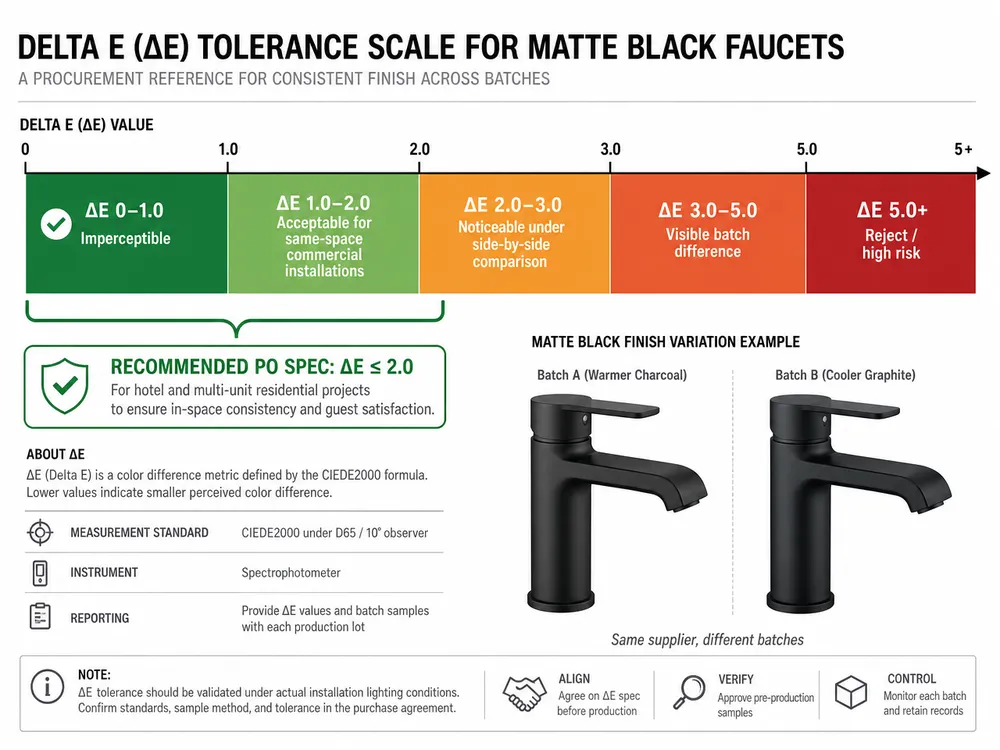
Delta E (ΔE) is the standard metric for quantifying color difference. It's calculated from measurements taken with a spectrophotometer against a defined reference color in the CIE L\a\b\* color space. The number represents the total perceptible difference between two colors — a ΔE of 1.0 is roughly the threshold of human perception under controlled viewing conditions.

For matte black faucet sourcing, here's how to think about the tolerance bands:

Delta E Range Practical Meaning for Matte Black Faucets
ΔE < 1.0 Imperceptible difference — laboratory standard
ΔE 1.0–2.0 Acceptable for most commercial applications; slight difference visible only under direct comparison
ΔE 2.0–3.5 Noticeable under direct comparison; borderline for hotel or high-end residential projects
ΔE > 3.5 Visible difference in normal viewing; likely to generate complaints in installed projects

For hotel FF&E and multi-unit residential projects where faucets from different shipments will be installed in the same space, specify ΔE ≤ 2.0 against a retained color standard. For distributor stock where batches are sold into different projects over time, ΔE ≤ 3.0 is a workable tolerance that most competent PVD lines can hold.

The reference standard matters as much as the tolerance number. Your purchase order should specify that the supplier retain a physical color standard from the approved sample batch, and that all subsequent batches are measured against that retained standard — not against a fresh reference produced at the time of measurement. (We keep retained color standards for every active OEM finish program, filed by customer and batch date. When a reorder comes in, the QC team pulls the original standard and measures against it before the batch ships.)

Delta E color tolerance scale showing acceptable ranges for matte black faucet batch consistency in commercial applications

PVD Process Parameters: What Controls the Color

If your supplier runs PVD for matte black, the color consistency comes down to four controllable parameters. A factory that can tell you their target values for each of these is a factory that's actually managing the process. A factory that gives you vague answers is a factory that's hoping the color comes out right.

Coating thickness: 0.3–0.5μm is the typical working range for decorative PVD on faucet hardware. Thinner than 0.3μm and the color can appear uneven or lighter than target. Thicker than 0.5μm and you start to see color shift toward a different tone depending on the target material. The factory should be measuring coating thickness on test coupons from each chamber run — not estimating it from deposition time alone.

Target material composition determines the base color. For matte black, common target materials include titanium (producing TiN or TiCN compounds), zirconium, and chromium-based compounds. The specific compound and its stoichiometry affect the final color. A factory that has switched target materials between your first and second order — even to a "similar" material — will produce a different color.

Chamber pressure and gas mix during reactive deposition affect the compound formation and therefore the color. Nitrogen-to-argon ratios, for example, shift the color of titanium nitride coatings from gold toward bronze toward black as the nitrogen partial pressure increases. These parameters should be documented in the factory's process specification, not adjusted by the operator based on visual judgment.

Surface preparation consistency before PVD is often the variable that gets overlooked. PVD coats whatever surface it lands on — if the pre-treatment (polishing, cleaning, activation) varies between batches, the coating adhesion and appearance will vary too. A batch of parts with residual machining oil or inconsistent polish will produce a different color result than a properly prepared batch, even with identical PVD parameters.

Ask your supplier for their documented PVD process specification. It should list target values and acceptable ranges for each of these parameters. If they can't produce that document, the process is not under control.

Supplier Qualification Checklist for Matte Black Finish Consistency

Before placing a large matte black order, work through this checklist. The questions are designed to separate factories that control their finish process from factories that produce acceptable samples but can't hold consistency at volume.

Process and equipment:

  • [ ] Is matte black finishing done in-house or subcontracted? (Subcontracted finishing means color parameters are controlled by a third party you can't audit.)
  • [ ] What coating process is used — PVD, electroplating, or powder coat?
  • [ ] For PVD: what is the target coating thickness range, and how is it measured per batch?
  • [ ] For PVD: what target material is used, and has it changed in the past 12 months?
  • [ ] For electroplating: how often is bath chemistry tested and adjusted?

Color control:

  • [ ] Does the factory use a spectrophotometer for color measurement?
  • [ ] What Delta E tolerance does the factory currently hold on matte black?
  • [ ] Are color measurements taken against a retained physical standard or a fresh reference?
  • [ ] Can the factory provide color measurement data (L\a\b\* values) from the approved sample batch?

QC documentation:

  • [ ] Is a cross-cut adhesion test performed on every batch? (ASTM D3359 or equivalent)
  • [ ] Is salt spray testing performed on matte black batches, and what is the minimum pass threshold?
  • [ ] Will color measurement reports be included in the shipment documentation?

Reorder controls:

  • [ ] Does the factory retain a physical color standard from the first approved batch?
  • [ ] Is the same PVD line and operator team used for reorders of the same SKU?
  • [ ] What is the process for notifying the buyer if a process parameter changes between orders?

A supplier who can answer all of these questions with specific numbers and documented procedures is a supplier whose matte black finish you can rely on across multiple containers. A supplier who answers with "we have strict quality control" and "our finish is very stable" is telling you they don't have the controls in place.

PVD coating process flow diagram for matte black faucet finishing showing pre-treatment, deposition, and QC inspection steps

Common Sourcing Mistakes That Cause Color Variation

Accepting a sample without specifying color tolerance. The sample approval process is where the color standard gets established. If you approve a sample without recording the L\a\b\* color coordinates and specifying a ΔE tolerance for production, you have no objective basis to reject a batch that drifts. The supplier's position will be "it's matte black, same as the sample" — and they're not wrong, technically.

Using a factory that subcontracts finishing. This is the single biggest structural risk for matte black consistency. When the factory sends parts to an outside plating shop for finishing, the color parameters are controlled by a team you've never met, on equipment you've never audited, with process specs that may change without notice. We've seen buyers receive three containers from the same factory with three visibly different matte black shades — all because the factory was rotating between two subcontract plating shops depending on capacity. In-house finishing is not a premium feature; it's a basic requirement for color consistency at scale.

Skipping inter-batch comparison on reorders. The first container looks fine. The second container arrives and goes straight to the warehouse without a comparison check. By the time the color difference is noticed — when a customer installs faucets from two different shipments in the same bathroom — the third container is already in production. Build a simple incoming inspection step: pull one unit from the new shipment, hold it next to a retained unit from the previous shipment, and check under consistent lighting. If you've specified ΔE tolerance, measure it. This takes five minutes and catches drift before it becomes a customer complaint.

Ordering mixed finishes without specifying cross-finish color matching. If your order includes both matte black faucets and matte black accessories (towel bars, toilet paper holders, robe hooks), the finish on each product type may come from a different production run or even a different process. Specify that all matte black items in the order must be measured against the same color standard and fall within the same ΔE tolerance. Otherwise you'll receive a shipment where the faucet and the towel bar are both "matte black" but don't match when installed together.

Treating the first order as a one-time event. Matte black is a finish that buyers reorder. Hotel chains renovate in phases. Distributors restock. If you don't establish the color standard and documentation requirements on the first order, you're starting from scratch on every reorder — and the color will drift.

How Wfaucet Controls Matte Black Consistency Across Batches

Our matte black finish runs on our own in-house PVD line. No subcontracted finishing. The same team, the same equipment, and the same documented process specification handle every matte black batch we produce — whether it's a 200-unit OEM trial or a 5,000-unit reorder.

The process specification for matte black PVD is documented and version-controlled. It defines target coating thickness (0.3–0.5μm), target material composition, chamber pressure range, gas mix ratios, and pre-treatment requirements. When a batch runs, the operator records the actual parameters against the spec. If a parameter falls outside the acceptable range, the batch is held for review — it doesn't move to assembly.

Every matte black batch goes through a cross-cut adhesion test (ASTM D3359 equivalent) before it leaves the finishing line. We're checking that the coating is bonded properly, not just that it looks right. A coating that passes visual inspection but fails adhesion will chip in the field — and chipping exposes the substrate, which changes the color and generates warranty claims. (We added the per-batch adhesion test after seeing a small number of early-production matte black units show edge chipping after 6 months in service. The root cause was inconsistent pre-treatment on a batch of castings with tighter-than-usual surface porosity. The adhesion test catches that before it ships.)

For OEM buyers who specify Delta E tolerance, we measure L\a\b\* color coordinates on each batch using a calibrated spectrophotometer and compare against the retained color standard from the approved sample. The measurement report is included in the shipment documentation. If a batch measures outside the agreed ΔE tolerance, it doesn't ship — we re-run the affected parts.

The 200-piece OEM MOQ exists specifically to support color-matched test batches. If you're about to commit to a 3,000-unit order of matte black faucets for a hotel project, run a 200-unit test batch first. Get the color standard established, get the measurement data, and confirm the finish matches your project specification before you're committed to full container volume. That's a much cheaper way to find out if there's a process alignment issue than discovering it after the container arrives.

For buyers sourcing Matte Black Bathroom Faucets across multiple SKUs — faucets, shower systems, accessories — we can run all matte black items against the same color standard in the same production window, so the finish matches across your full product set. This is something that's only possible when finishing is in-house and the schedule is coordinated. A factory routing different product types to different subcontract shops can't make that guarantee.

Our full Bathroom Faucets range is available in matte black, and we can extend the same color-controlled process to custom OEM designs. If you're working from a reference sample or a specific L\a\b\* target, send it to us and we'll confirm whether our current process spec can hit it before you commit to tooling.

Frequently Asked Questions

What Delta E tolerance should I specify for a hotel renovation project?

For hotel projects where faucets from multiple shipments will be installed in the same property, specify ΔE ≤ 2.0 against a retained physical color standard. At ΔE 2.0, the difference between batches is at the edge of perception under direct comparison — acceptable for most commercial environments. If the project has particularly critical color matching requirements (e.g., faucets installed adjacent to other matte black fixtures from a different manufacturer), tighten to ΔE ≤ 1.5 and confirm the supplier can hold that tolerance before ordering.

Can PVD matte black be matched to powder-coated matte black accessories from another supplier?

It's possible but requires careful coordination. PVD and powder coat produce different surface textures and light absorption characteristics, so even if the L\a\b\* coordinates are close, the visual appearance under different lighting conditions may differ. The safest approach is to source all matte black items in a project from the same factory using the same process. If you must mix sources, request physical samples from both suppliers and evaluate them together under the lighting conditions of the installation environment before committing to volume.

What documentation should I require from a matte black faucet supplier for each shipment?

At minimum: a color measurement report showing L\a\b\* values and ΔE against the retained color standard, a cross-cut adhesion test result, and a salt spray test report. For North American or European markets, also confirm that the finish complies with the relevant heavy metals restrictions (REACH for Europe, Prop 65 for California). A supplier who can't provide these documents on request is a supplier whose process controls you can't verify.

How do I evaluate a matte black faucet sample before approving it for production?

Evaluate the sample under at least two lighting conditions: neutral daylight (D65 standard illuminant if you have a light booth) and warm incandescent. Matte black finishes can shift noticeably between lighting types. Record the L\a\b\* color coordinates with a spectrophotometer and retain the physical sample as your production color standard. Check the finish at edges and around handle attachment points — these are the areas most likely to show adhesion weakness. Run a fingernail scratch test on an inconspicuous area; a properly adhered PVD coating should not scratch off with fingernail pressure.

What is the minimum order quantity for a color-matched matte black test batch at Wfaucet?

200 pieces. That's enough to establish a color standard, run the full QC process, and evaluate the finish in your market before committing to full container volume. For buyers who need to match an existing matte black finish from a previous supplier, send us a physical sample and we'll assess the match before you place the test order. You can Request a Quote with your target SKU and color reference, and we'll confirm the process alignment upfront.

For a deeper look at finish selection and durability considerations across the full matte black range, see our matte black bathroom faucet finish guide.

How to Source Stainless Steel Bathroom Faucets That Pass NSF 61 Without Reformulating Your Supply Chain

The container arrives. Your customs broker flags it. The faucets are listed as potable water fixtures, and the importer of record needs NSF 61 documentation before the shipment clears. Your supplier sends a certificate number. You look it up in the NSF database. The scope covers the body casting — but not the cartridge, not the solder joints, not the internal coating on the spout. The product fails the scope check.

That scenario plays out more often than it should, and it's almost always a sourcing documentation problem, not a product problem. The faucets may be perfectly safe. But if the certification scope doesn't cover every wetted surface component, the certificate is commercially useless in markets that require full NSF 61 compliance.

This guide explains what NSF 61 actually tests, how it differs from NSF 372 (the standard most buyers conflate it with), and how to qualify a supplier before the order is placed — not after the container is on the water.

Diagram showing all wetted surface components in a stainless steel bathroom faucet subject to NSF 61 testing

What NSF 61 Actually Tests — and Why Stainless Steel Body Material Alone Doesn't Guarantee Compliance

NSF/ANSI 61 is a drinking water system components standard. It tests whether a product leaches contaminants into potable water at levels that exceed health-based thresholds. The test protocol exposes wetted surfaces to water under controlled conditions, then analyzes the extract for a list of regulated substances — lead, cadmium, antimony, barium, and others depending on the component category.

The critical word is "wetted surfaces." NSF 61 doesn't care what the outside of your faucet looks like. It cares about every surface that water touches from the inlet to the outlet.

For a stainless steel bathroom faucet, that means:

  • The body casting — stainless steel or brass, depending on the product line
  • The cartridge and ceramic disc assembly — including the cartridge housing material and any lubricants applied during assembly
  • Internal coatings — some spout bodies have an internal epoxy or polymer coating to prevent corrosion; that coating is a wetted surface
  • Solder and flux residue — if any brazed joints exist in the water path
  • The valve seat — the seating surface the ceramic disc contacts
  • O-rings and seals — elastomers in the water path are tested separately under NSF 61 Section 9

A stainless steel body is a good starting point. Grade 304 stainless has low leachable metal content and handles chlorinated water well. But if the cartridge housing is made from a brass alloy with elevated lead content, or if the internal spout coating hasn't been tested, the body material is irrelevant to the compliance question.

We've seen buyers come to us after a compliance failure where the faucet body was fine — the problem was a cartridge sourced from a supplier who hadn't run NSF 61 testing on the housing material. The cartridge passed functional testing. It failed the extract analysis.

NSF 61 vs NSF 372: Two Standards, Two Different Questions

This is where most buyers lose time. NSF 61 and NSF 372 are related but not interchangeable, and conflating them creates documentation gaps that surface at the worst possible moment.

NSF/ANSI 61 asks: does this product leach contaminants into drinking water at harmful levels? It covers a broad list of regulated substances and applies to the full wetted surface assembly.

NSF/ANSI 372 asks: is the weighted average lead content of all wetted surfaces below 0.25%? It's a lead-specific standard, and it's the one referenced by the US Safe Drinking Water Act's "lead-free" definition for plumbing fittings.

The practical difference for sourcing:

Standard What it tests Who requires it What a certificate covers
NSF 61 Full contaminant leaching from all wetted surfaces Most US state plumbing codes; California, Vermont, Maryland, Louisiana The specific product configuration tested — body + cartridge + seals as assembled
NSF 372 Weighted average lead content of wetted surfaces Federal "lead-free" definition under SDWA; required for sale in all US states Lead content calculation across all wetted components

California's AB 1953 and the federal SDWA amendments require both standards for faucets sold into potable water applications. A product can pass NSF 372 (low lead content) and still fail NSF 61 (leaches another regulated substance). A product can have NSF 61 certification and still fail NSF 372 if the lead calculation wasn't done correctly.

(The confusion is compounded by the fact that some certification bodies issue a combined NSF 61/372 listing. When you see that, it means both standards were tested in the same program — it's not a shortcut, it's just efficient paperwork.)

For buyers sourcing into North America, you need both. For buyers sourcing into Australia, WaterMark covers similar ground under AS/NZS 4020. For Europe, the relevant standard is EN 15664 for metallic materials in contact with drinking water. The underlying testing logic is similar across all three — wetted surface extract analysis — but the specific thresholds and scope definitions differ.

Side-by-side comparison table of NSF 61 and NSF 372 faucet certification requirements for US market compliance

The Supplier Qualification Checklist: What to Request Before You Place the Order

The most expensive compliance problem is the one you discover after the container ships. The documentation checklist below is what we'd recommend requesting from any supplier before committing to an order of NSF 61-relevant product.

Step 1: Verify the certificate scope, not just the certificate number

Ask for the actual NSF certification listing, not a copy of the certificate. The NSF International database (nsf.org) is publicly searchable. Look up the certificate number and confirm:

  • The listed product model matches what you're ordering
  • The scope includes the complete assembly — body, cartridge, and seals — not just the body casting
  • The certificate is current (not expired or suspended)
  • The certification body is accredited (NSF, IAPMO, UL, or another ANSI-accredited body)

A certificate number that covers only the body casting is not NSF 61 compliance for the assembled faucet. This is the most common documentation gap we see.

Step 2: Request the test report, not just the certificate

The test report shows what was actually tested and what the extract results were. Ask for:

  • The full NSF 61 test report for the product configuration you're ordering
  • The NSF 372 lead content calculation worksheet
  • The cartridge supplier's NSF 61 test report for the cartridge housing material (if the cartridge is sourced separately)

If the supplier can't produce the test report — only the certificate — that's a red flag. Certificates can be transferred or misapplied. Test reports are specific to the product configuration tested.

Step 3: Confirm incoming material controls for wetted surface alloys

Ask how the supplier controls lead content in incoming brass or stainless alloys. The answer you want is XRF (X-ray fluorescence) incoming inspection on every batch. XRF gives a non-destructive elemental analysis of the alloy in under a minute — it's the standard tool for incoming lead content verification in factories that take cUPC or NSF 372 seriously.

If the supplier's answer is "we rely on the mill certificate," that's a weaker control. Mill certificates are batch-level documents, and they don't catch alloy substitution or contamination that happens between the mill and the casting floor.

Step 4: Verify cartridge supplier qualification

The cartridge is the component most likely to create a compliance gap. Ask:

  • Who supplies the cartridge?
  • Does the cartridge supplier hold NSF 61 certification for the cartridge housing material?
  • What endurance testing does the supplier run on incoming cartridge batches?

A cartridge that passes functional testing (500,000 cycles, no leak) can still fail NSF 61 extract analysis if the housing material wasn't qualified. These are separate tests.

Step 5: Confirm the certification extension process for new variants

If you plan to add SKUs — new finishes, new handle configurations, new spout lengths — ask how the supplier handles certification extension. A full re-certification from scratch takes months and costs money. A supplier with an established certification program can often extend coverage to new variants through a documentation update with the certification body, provided the wetted surface materials haven't changed.

Five-step supplier qualification checklist for NSF 61 compliant stainless steel bathroom faucet sourcing

How Wfaucet's Existing Documentation Infrastructure Maps to NSF 61 Requirements

We don't hold NSF 61 certification as a standalone listing — I want to be direct about that. What we do hold is cUPC certification for North American product lines, and the cUPC program under IAPMO runs NSF 61 and NSF 372 testing as part of its qualification process. So for products in our cUPC-certified range, the NSF 61 and 372 testing has been done — it's embedded in the cUPC documentation package.

For buyers who need a standalone NSF 61 listing (some state codes or project specifications require it explicitly), we can work with you on the certification path. The testing infrastructure is already in place; it's a matter of running the product through an ANSI-accredited certification body and getting the listing issued.

Here's what the documentation package looks like for a standard cUPC-certified product from our line:

  • cUPC test report — includes NSF 61 extract analysis and NSF 372 lead content calculation as part of the IAPMO qualification
  • XRF incoming inspection records — we run XRF on every incoming brass alloy batch, and we apply that standard to all production, not just North American orders
  • Cartridge supplier qualification records — our approved cartridge suppliers have been through a 50,000-cycle pre-qualification test, and we hold their material test reports on file
  • SGS audit report — third-party factory audit covering our QC system and material controls
  • Brass alloy specification — C36000-equivalent free-machining brass, with lead content documented in the alloy spec and verified by incoming XRF

The brass alloy qualification process we went through for cUPC in 2013 is directly analogous to what NSF 61 requires for wetted surface materials. We revalidated our alloy supplier and casting parameters at that point, and those controls have been in place since. (That revalidation wasn't painless — we had to qualify a new alloy supplier and run a full casting parameter study. But it's done, and the documentation exists.)

For multi-market buyers, the combination of cUPC, CE, and WaterMark under one roof means you're not managing separate supplier relationships to cover North America, Europe, and Australia. The documentation for each market ships with the order.

Common Sourcing Mistakes That Create Compliance Exposure

These are the patterns we see most often when buyers come to us after a compliance problem with a previous supplier.

Accepting a certificate number without verifying scope. The certificate exists. The product is listed. But the scope covers only the body casting, not the assembled product. The buyer didn't check. The container shipped. The project specification required full assembly certification.

Overlooking cartridge and valve seat materials. The body is stainless steel or low-lead brass. The cartridge housing is a different alloy, sourced from a different supplier, with no NSF 61 testing on the housing material. The body passes. The cartridge fails the extract analysis.

Treating NSF 61 and NSF 372 as the same requirement. The supplier provides an NSF 372 lead-free certificate. The project specification requires NSF 61. These are different tests. The buyer assumes one covers the other. It doesn't.

Not requesting batch-level test reports. The supplier has a valid NSF 61 certificate from a test run two years ago. The current production batch uses a different cartridge supplier. The certificate is still valid. The current product configuration hasn't been tested.

Assuming stainless steel body = automatic NSF 61 compliance. Stainless steel has low leachable metal content, which is a genuine advantage. But NSF 61 tests the full wetted surface assembly. A stainless body with an unqualified internal coating or an unqualified cartridge doesn't pass NSF 61 on the strength of the body material alone.

How to Structure Your RFQ to Get NSF 61 Documentation Upfront

The way you write the RFQ determines what documentation you receive — and when. Most buyers ask for "NSF 61 compliant" product without specifying what documentation they need. The supplier confirms compliance. The documentation arrives after the order is placed, or after the container ships, and it doesn't match what the project specification requires.

Structure your RFQ to include these explicit documentation requirements:

Required documentation (to be provided with quotation):
1. NSF 61 test report for the specific product configuration quoted
   (body + cartridge + seals as assembled — not body casting only)
2. NSF 372 lead content calculation worksheet
3. Current NSF/IAPMO/UL certification listing with scope confirmation
4. XRF incoming inspection protocol for wetted surface alloys
5. Cartridge supplier NSF 61 qualification documentation
6. Certification extension process for new finish or configuration variants

If the supplier can't provide items 1–3 with the quotation, that's the answer. You're not asking for anything unusual — you're asking for documentation that any supplier with genuine NSF 61 compliance should have on file.

One more thing worth stating plainly: a supplier who pushes back on providing test reports before the order is placed is telling you something. Test reports aren't proprietary. They're the evidence that the certification is real.

Practical FAQ

Can I use a cUPC-certified faucet to satisfy an NSF 61 requirement?

In most cases, yes. IAPMO's cUPC program includes NSF 61 and NSF 372 testing as part of the qualification. If the product holds a current cUPC listing, the NSF 61 testing has been done. Verify by checking the IAPMO product listing — it will show the specific standards covered. Some project specifications or state codes require a standalone NSF 61 listing rather than accepting cUPC as equivalent; confirm the requirement before assuming cUPC satisfies it.

Does a stainless steel faucet body require less NSF 61 testing than a brass body?

The testing scope is the same — all wetted surfaces must be tested regardless of body material. Stainless steel (304 or 316 grade) typically produces lower leachable metal results than brass in the extract analysis, which reduces the risk of failing the contaminant thresholds. But the cartridge, seals, and internal coatings still need to be tested. The body material affects the test results; it doesn't change the test scope.

What's the difference between NSF 61 Section 8 and Section 9?

Section 8 covers metallic and non-metallic materials in contact with drinking water — this is where faucet bodies, cartridge housings, and internal coatings are tested. Section 9 covers mechanical devices such as valves and faucets as assembled products. Most faucet certifications reference Section 9, which covers the assembled product. If a supplier's certificate references only Section 8, it covers materials, not the assembled faucet — that's a scope gap.

How often does NSF 61 certification need to be renewed?

NSF International and IAPMO both require annual factory audits and periodic retesting as part of maintaining a listing. The certification doesn't expire on a fixed date, but it can be suspended or withdrawn if the factory audit fails or if a product change isn't reported to the certification body. Always verify the current status in the certification body's database, not just the certificate document.

If I add a new finish to an existing certified product, does it need full re-certification?

Usually not, if the wetted surface materials haven't changed. A new external finish (chrome to brushed nickel, for example) doesn't affect the wetted surface assembly, so the existing NSF 61 certification typically extends to the new finish variant through a documentation update. A new internal coating or a different cartridge supplier would require retesting. Confirm the specific scope of any change with your supplier before assuming the existing certification covers it.

If you're sourcing Stainless Steel Bathroom Faucets for North American distribution or project supply and need the compliance documentation to match, send us your target SKU, destination market, and the specific certification requirements in your project specification. We'll respond with the applicable test reports and a compliance documentation package alongside the quote — not after the order is placed.

Browse our full Bathroom Faucets range, or Request a Quote with your compliance requirements included.

304 vs 316 Stainless Steel Bathroom Faucet: Grade Differences, Hard Water Performance, and What B2B Buyers Should Specify

The grade question comes up in almost every stainless steel faucet sourcing conversation we have. A buyer specifies "stainless steel" on their RFQ, the factory quotes 304, and somewhere downstream — after the container has landed and the product has been in the field for 18 months — pitting shows up around the spout base in a coastal hotel installation or a hard water market. The return claim lands on the importer's desk, and the conversation about grade starts too late.

This article is for buyers who want to have that conversation at the spec stage, not after the fact. We'll cover what separates 304 from 316 at the chemistry level, how that difference plays out in hard water and chlorinated municipal supply, when the cost premium for 316 is justified and when it isn't, and what to put in your sourcing brief so the factory you're working with can't substitute one for the other without your knowledge.

The Chemistry That Separates 304 from 316

Both grades are austenitic stainless steels — same crystal structure, similar machinability, both non-magnetic in the annealed state. The difference that matters for faucet applications is a single alloying element: molybdenum.

316 contains 2–3% molybdenum. 304 contains none.

That molybdenum addition is what earns 316 its "marine grade" designation. It stabilizes the passive oxide layer on the steel surface against chloride ion attack — the specific corrosion mechanism that causes pitting in bathroom environments. Everything else about the two grades is close enough that the distinction rarely matters for structural or machining purposes. For corrosion resistance in wet, chloride-containing environments, it's the only thing that matters.

Property 304 (SUS304 / 1.4301) 316 (SUS316 / 1.4401)
Chromium (Cr%) 18–20% 16–18%
Nickel (Ni%) 8–10.5% 10–14%
Molybdenum (Mo%) 0% 2–3%
PREN (typical) ~18–20 ~24–26
Tensile strength (typical) 515–620 MPa 515–620 MPa
Yield strength (typical) 205–310 MPa 205–310 MPa
AISI designation 304 316
JIS designation SUS304 SUS316
EN designation 1.4301 1.4401

The PREN column is the one to focus on. PREN — Pitting Resistance Equivalent Number — is calculated as: Cr% + 3.3 × Mo% + 16 × N%. For 304, with no molybdenum, PREN sits around 18–20. For 316, the 2–3% Mo contribution pushes PREN to roughly 24–26. That 6-point gap is the quantified difference in chloride pitting resistance between the two grades.

Bar chart comparing PREN values of 304 and 316 stainless steel grades for bathroom faucet corrosion resistance

Tensile and yield strength are essentially identical between the two grades — so if a buyer is specifying 316 for structural reasons on a faucet body, that's over-specification. The case for 316 is entirely about corrosion resistance, and specifically about chloride pitting.

How Hard Water and Chlorinated Supply Attack Stainless Steel Faucets

Hard water and chloride attack are two separate mechanisms, and they interact in ways that make the grade decision more nuanced than a simple "harder water = use 316" rule.

Hard water scaling — calcium and magnesium carbonate deposits — is primarily a surface problem. Scale builds up on the faucet body and around the spout outlet, and if left unaddressed, it traps moisture against the steel surface. On its own, scale doesn't cause pitting in 304. The problem is what's dissolved in the water alongside the calcium and magnesium.

Chloride ion attack is the actual corrosion mechanism. Municipal water treatment uses chlorine or chloramines to disinfect supply, and both break down to release chloride ions. Chloride ions are small enough to penetrate the passive chromium oxide layer on stainless steel surfaces, particularly at grain boundaries and surface defects. Once the passive layer is breached, pitting initiates — and pitting is autocatalytic, meaning once it starts, the chemistry inside the pit accelerates further attack.

The combination of hard water and chlorinated supply is worse than either alone. Scale deposits create crevices where chloride-rich water concentrates and stagnates. The local chloride concentration inside a scale crevice can be significantly higher than the bulk water chemistry — high enough to initiate pitting on 304 in water supplies that would otherwise be within 304's tolerance range.

(We've seen this pattern in field returns from the Middle East and parts of Australia — both hard water markets with chlorinated municipal supply. The pitting typically initiates under scale deposits at the base of the spout or around the aerator housing, not on the exposed face of the faucet body.)

For 316, the molybdenum in the passive layer raises the critical pitting potential — the electrochemical threshold at which chloride attack can initiate. In practical terms, 316 tolerates higher chloride concentrations and longer exposure before pitting begins. In a hard water market with standard municipal chlorination, 316 provides a meaningful service life advantage over 304.

Diagram showing chloride ion attack mechanism on stainless steel faucet surface under hard water scale deposits

When 316 Justifies Its Cost Premium — and When 304 Is Sufficient

316 typically carries a 20–30% material cost premium over 304 at the stainless steel coil or bar stock level. For a finished faucet, the grade premium translates to a smaller percentage of total landed cost — machining, finishing, and logistics costs are the same regardless of grade — but it's still a real number that affects your margin or your price point.

The honest answer is that 304 is sufficient for a large portion of bathroom faucet applications. Over-specifying 316 across an entire product line adds cost without adding value in markets where the water chemistry doesn't justify it.

Here's how we think about the decision:

304 is appropriate when:

  • The destination market has soft to moderately hard water (below ~200 mg/L total dissolved solids)
  • Municipal chlorination is standard (not elevated — coastal desalination plants sometimes run higher chloride in the treated supply)
  • The faucet will be installed in a regularly cleaned, well-ventilated bathroom environment
  • The product is positioned at a price point where the 316 premium would price it out of the target segment

316 is worth specifying when:

  • The destination market has hard water above ~300 mg/L TDS, particularly with elevated chloride
  • The installation environment is coastal, where airborne chloride adds to the corrosion load
  • The product is going into commercial or hospitality applications where cleaning chemicals (bleach-based sanitizers) are used regularly
  • The buyer's downstream customers are in markets with desalinated water supply — Gulf states, parts of Australia, coastal Southeast Asia
  • The product is positioned as a premium or long-warranty SKU where field performance is a brand differentiator

(The hospitality segment is worth paying attention to here. Hotel procurement teams increasingly specify 316 for bathroom fittings in coastal properties — it's become a standard clause in some FF&E specifications. If you're supplying into that channel, 316 is often the minimum the spec will accept.)

For mixed-market distributors, the practical approach is to offer both grades as separate SKUs with clear grade marking, rather than defaulting to one grade for the entire line. Your buyers in Germany and the UK can likely run 304 without issue. Your buyers in the UAE, coastal Australia, or Singapore have a stronger case for 316.

Surface Finish Behavior on 304 vs 316 Substrates

Grade choice doesn't just affect corrosion resistance — it affects how surface finishes perform and how long they hold up in the field. This is something that rarely appears in material datasheets but matters a lot in practice.

Brushed finish: Both 304 and 316 take a brushed finish well. The brushing process creates a directional grain that's largely independent of the base alloy. Long-term appearance retention is better on 316 in corrosive environments because the substrate resists the micro-pitting that eventually makes a brushed surface look dull and uneven. On 304 in a hard water market, you'll see the brushed finish lose its crispness faster — not from finish failure, but from the substrate beginning to pit beneath it.

Matte black PVD: PVD coatings on stainless steel bodies are thin — typically 0.3–0.5μm — and they're not fully impermeable. Chloride ions can migrate through micro-defects in the PVD layer over time. On a 304 substrate, this can initiate pitting under the coating, which eventually causes the PVD layer to lift or blister. On 316, the higher pitting resistance of the substrate means the coating stays intact longer even if chloride reaches the steel. For matte black PVD on stainless steel bodies going into hard water markets, we recommend 316 substrate as the default.

Electropolished finish: Electropolishing removes the surface layer and leaves a bright, smooth finish that actually improves corrosion resistance by removing surface inclusions and creating a more uniform passive layer. On 316, electropolished surfaces perform very well in chloride environments. On 304, electropolishing helps but doesn't close the gap with 316 in high-chloride conditions.

Chrome plating over stainless: Less common on stainless steel bodies (chrome plating is more typical on brass), but when it appears, the substrate grade matters for the same reason as PVD — the plating is a barrier, not a permanent seal, and the substrate's corrosion resistance determines what happens when the barrier is eventually compromised.

The practical implication: if you're specifying a matte black or brushed finish for a hard water market, the grade decision and the finish decision need to be made together. A 304 body with a premium PVD finish in a Gulf market is a warranty claim waiting to happen.

How Grade Choice Propagates into OEM Documentation and Compliance

This is where the sourcing decision gets operationally real. Specifying a grade on your RFQ is the easy part. Verifying that the factory actually used that grade — and having documentation that proves it — is where most buyers have gaps.

Stainless steel grades are not visually distinguishable. A 304 faucet body and a 316 faucet body look identical. Without material documentation, you cannot tell them apart by inspection. This is the sourcing trap: a factory can quote 316, supply 304, and you won't know until a field failure or a third-party test reveals the substitution.

The documents that close this gap:

Mill Test Certificate (MTC): The primary material traceability document. Issued by the steel mill, it certifies the chemical composition of the specific heat (batch) of steel used. An MTC for 316 will show Mo% in the 2–3% range. An MTC for 304 will show Mo% at or near zero. Request the MTC as a standard deliverable on any stainless steel faucet order — it should reference the heat number traceable to the material used in your production run.

XRF verification report: X-ray fluorescence analysis can verify the elemental composition of finished parts non-destructively. We run incoming XRF checks on stainless steel bar stock and coil before it enters production — the same discipline we apply to brass alloy incoming inspection. If your factory can't tell you how they verify incoming stainless steel grade, that's a gap worth asking about.

Grade marking on finished goods: For OEM orders, we can mark the grade (304 or 316) on the product packaging and in the product documentation. This matters for your downstream customers who need to communicate material specs to their end buyers or to project specification teams.

Compliance documentation for destination markets: Grade choice can affect which certifications apply. cUPC and WaterMark both have material requirements for wetted components — the grade needs to be documented in the certification file. If you're adding a 316 SKU to a product line that was previously certified on 304, the certification documentation needs to be updated. We manage this as part of the OEM project workflow.

(One thing we've seen buyers overlook: the grade requirement needs to be explicit in the purchase order, not just in the RFQ. If your PO says "stainless steel bathroom faucet" without specifying grade, the factory is not contractually obligated to supply 316 even if you discussed it during quoting. Put the grade in the PO line item description.)

Workflow diagram showing material traceability steps from mill certificate to finished stainless steel faucet shipment documentation

Specifying Grade in Your OEM Sourcing Brief

A well-written grade specification in your sourcing brief prevents substitution, simplifies the certification workflow, and gives your factory a clear target. Here's what to include:

Material grade: State the AISI designation (304 or 316) and the equivalent JIS or EN designation if your destination market uses those standards (SUS304/SUS316 for Japan-influenced markets; 1.4301/1.4401 for European specifications). Don't rely on "marine grade" or "food grade" as substitutes — these are informal descriptors that don't map cleanly to a single AISI grade.

Wetted vs non-wetted components: In a bathroom faucet, the body, spout, and internal flow path are wetted components. The handle and decorative trim may not be. You can specify 316 for wetted components and 304 for non-wetted trim to manage cost without compromising corrosion performance where it matters.

Surface finish and substrate grade together: As discussed above, specify the finish and the substrate grade as a paired requirement. "Matte black PVD on 316 substrate" is a complete specification. "Matte black PVD" alone leaves the substrate grade open.

Documentation requirements: List the documents you need with the shipment: MTC with heat number, XRF verification report (if required), grade marking on packaging, and any certification documentation relevant to your destination market.

Test standard for corrosion performance: If you have a specific salt spray or corrosion test requirement, state it. For 316 stainless steel faucets going into coastal or hard water markets, a 48-hour neutral salt spray test per ISO 9227 is a reasonable baseline. For premium or long-warranty products, 96 hours or higher is worth specifying.

For buyers sourcing Stainless Steel Bathroom Faucets for the first time, the grade specification is the single most important line in your brief. Everything else — finish, flow rate, hole configuration — can be adjusted after sampling. Grade substitution in the field is not adjustable.

Corrosion Test Performance: What the Numbers Mean for Your Market

Salt spray testing is the standard accelerated corrosion test for faucet finishes, but it's worth understanding what it does and doesn't tell you about grade performance.

The neutral salt spray test (NSS, ISO 9227 / ASTM B117) exposes parts to a 5% sodium chloride fog at 35°C. It's an accelerated test — 24 hours of NSS exposure doesn't map directly to 24 hours of real-world service. The test is primarily useful for comparing relative performance between samples and for catching gross defects in surface finishing.

For stainless steel faucet bodies specifically, the NSS test is less diagnostic than it is for plated brass bodies. A well-finished 304 stainless body can pass 48-hour NSS without issue — the test doesn't replicate the crevice corrosion conditions that cause real-world pitting under scale deposits. The more relevant test for stainless steel grade performance is a crevice corrosion test or a pitting potential measurement, but these are less commonly specified in commercial faucet sourcing.

The practical implication: don't use NSS pass/fail as your sole criterion for grade selection. A 304 faucet that passes 48-hour NSS can still pit in a hard water market over a 3–5 year service life. The grade decision needs to be based on the water chemistry of your destination market, not just on a salt spray result.

What NSS testing does tell you reliably: whether the surface finishing process is consistent and whether the passive layer on the stainless steel surface is intact after finishing. We run NSS on every production batch — it's a process quality check, not a grade verification tool.

Frequently Asked Questions

Is 316 stainless steel required for cUPC or WaterMark certification?

No — both 304 and 316 are acceptable under cUPC and WaterMark material requirements for faucet bodies. The certification doesn't mandate a specific grade; it requires that the material meet the applicable lead content and corrosion resistance standards. Both grades clear those requirements. The grade decision is a performance and market-fit choice, not a certification compliance requirement in most cases. That said, if your product is going into a specification that explicitly calls for 316 (some commercial and hospitality project specs do), you'll need the grade documented in your certification file.

Can I verify the grade of a stainless steel faucet I've already received?

Yes, with XRF analysis. A handheld XRF gun can read the elemental composition of a finished part non-destructively in under a minute. The Mo% reading will tell you definitively whether the part is 304 (Mo near zero) or 316 (Mo 2–3%). Third-party testing labs in most major markets offer this service. If you're auditing an existing supplier's grade compliance, XRF spot-checks on incoming shipments are the most practical approach.

Does 316L differ from 316 for faucet applications?

316L is the low-carbon variant of 316 — carbon content is held below 0.03% versus 0.08% maximum for standard 316. The low-carbon spec reduces carbide precipitation at weld heat-affected zones, which matters for welded assemblies. For faucet bodies that are machined rather than welded, the difference between 316 and 316L is negligible in practice. Both have the same Mo% and essentially the same PREN. If a factory quotes 316L, it's acceptable for faucet body applications — it's not a downgrade.

What's the minimum order quantity for 316 stainless steel faucets at Wfaucet?

Our standard MOQ for stainless steel faucet OEM orders starts at 200 pieces, the same as our brass line. For 316 specifically, the material cost is higher, so the economics of a 200-piece trial order are tighter — but it's workable for a market test. Most buyers who are introducing 316 into their line start with a 200–500 piece sample run to validate the product with their customers before committing to a full container.

How do I know if my destination market needs 316 or if 304 is sufficient?

The two data points that matter most are total dissolved solids (TDS) in the local water supply and whether the market uses chloramine-based disinfection (more aggressive than chlorine alone). Water quality reports for most municipal supplies are publicly available. As a rough guide: below 200 mg/L TDS with standard chlorination, 304 is generally sufficient. Above 300 mg/L TDS, or in coastal markets with elevated airborne chloride, 316 is the safer specification. If you're unsure, send us your destination market and we'll give you our read based on what we've seen from existing buyers in that region.

If you're ready to specify grade for your next stainless steel faucet order, the fastest path is to send us your target market, finish requirement, and volume — we'll return a quote with material certification and the relevant compliance documentation included. You can reach us through the Request Quote page or browse our full Bathroom Faucets range to identify the base models that fit your line.

Top 10 Bathroom Faucet Manufacturers for Canadian Buyers: cUPC Compliance and Lead Time Review

cUPC certification is not a preference in Canada — it is the compliance gate. The National Plumbing Code of Canada and provincial codes in Ontario, British Columbia, Alberta, and Quebec all require plumbing fixtures to carry a mark from a recognized certification body. For bathroom faucets, that means cUPC (Canadian Uniform Plumbing Code), NSF/ANSI 61 for lead content, or an equivalent mark accepted by the authority having jurisdiction. A supplier without cUPC documentation is not a supplier you can use on a permitted project, full stop.

What this article does is map the sourcing landscape honestly. The 10 suppliers below represent the range of options available to Canadian importers, distributors, and project procurement teams — from established North American brands with deep domestic distribution to factory-direct manufacturers shipping cUPC-certified product from Foshan. Each entry covers what the supplier is actually good for, where the trade-offs sit, and when a different sourcing route makes more commercial sense.

This is not a ranked popularity contest. It is a sourcing decision framework.

Supplier evaluation matrix comparing 10 bathroom faucet manufacturers on cUPC status, MOQ, lead time, and OEM capability for Canadian buyers

cUPC vs NSF/ANSI 61: The Compliance Distinction Canadian Buyers Need to Understand

Most content targeting Canadian buyers conflates cUPC and NSF/ANSI 61 as interchangeable. They are not, and the distinction matters when you are qualifying a supplier.

cUPC (Uniform Plumbing Code — Canada) is a product performance and installation standard administered by the International Association of Plumbing and Mechanical Officials (IAPMO). It covers flow rate, pressure performance, handle torque, and structural integrity. A cUPC mark means the product has been tested and listed by a recognized certification body — typically IAPMO R&T or an equivalent accredited lab — against the UPC standard as adopted in Canada.

NSF/ANSI 61 is a material safety standard covering lead and contaminant leaching from products in contact with drinking water. In Canada, NSF/ANSI 61 compliance is required under Health Canada guidelines and is referenced in provincial plumbing codes. The 2014 amendments to NSF/ANSI 61 (the "lead-free" provisions, now codified as NSF/ANSI 372) set a weighted average lead content of ≤0.25% for wetted surfaces — this is the standard that replaced the older 8% threshold.

A supplier can hold cUPC listing without separately certifying to NSF/ANSI 61 if the cUPC test scope already covers lead content. But when you are qualifying a new supplier, ask for both documents explicitly. The question to ask: "Does your cUPC listing cover NSF/ANSI 61 lead content, or do you hold a separate NSF/ANSI 61 certificate?" Suppliers who cannot answer that question clearly are suppliers whose documentation you will be chasing at the port.

(We went through the cUPC qualification process ourselves in 2013. The lead content requirements forced us to requalify our brass alloy supplier and revalidate our casting parameters — it is not a paperwork exercise. A factory that holds a current cUPC listing has done that work.)

What Serious Canadian Buyers Evaluate Before Placing an Order

Before the supplier list, the evaluation criteria. These are the five dimensions that determine whether a supplier relationship works at commercial scale:

1. Certification scope and currency cUPC listing must be current and verifiable through the IAPMO product directory. Ask for the listing number, not just the certificate. Listings expire and can be suspended — a certificate from three years ago is not the same as an active listing. Also confirm whether the listing covers the specific SKUs you are ordering, not just a representative model.

2. Lead time to Canadian port Domestic distributors typically quote 1–5 business days for in-stock items, but stock depth on specific finishes and configurations is often shallow. Factory-direct lead times from China run 25–45 days to Vancouver or Toronto depending on the supplier and shipping route. The relevant comparison is not "domestic vs. import" in the abstract — it is "what is the actual lead time for the specific SKU and volume I need, from each channel?"

3. MOQ and order flexibility For importers testing a new SKU in the Canadian market, MOQ is a real constraint. Most North American brand distributors have no formal MOQ but require you to buy at distributor pricing, which compresses your margin. Factory-direct suppliers typically set MOQ at 200–500 pieces per SKU — low enough for a market test, high enough to justify the container economics.

4. OEM and private label capability If your business model involves private-label product or custom specifications, domestic distributors cannot help you. OEM capability is a factory-level service. The relevant questions: minimum run for custom tooling, lead time to first sample, and whether the factory holds the certification on the OEM product or requires you to run your own certification.

5. Documentation quality For Canadian customs clearance, you need: commercial invoice, packing list, certificate of origin, and the relevant test reports (cUPC listing documentation, NSF/ANSI 61 if separate, and any provincial-specific requirements). Suppliers who treat documentation as an afterthought create customs delays that cost you more than the unit price difference.

cUPC certification verification checklist for Canadian bathroom faucet importers showing key document requirements

The 10 Bathroom Faucet Suppliers Serving Canada: Profiles and Trade-Off Analysis

1. Moen — moen.com

Moen is the dominant bathroom faucet brand in Canadian retail and contractor supply, with distribution through Home Depot Canada, Rona, and a network of plumbing wholesalers. Their product line carries cUPC listing across the full range, and their documentation is clean — customs clearance on Moen product is routine for any experienced broker.

For project procurement, Moen's strength is availability and brand recognition. Their Chateau, Align, and Voss series are specified by name on renovation projects across Toronto and Vancouver. The trade-off is pricing: Moen sells through distribution, and the distributor margin is built into every unit. For volume buyers, the per-unit cost at distributor pricing is significantly higher than factory-direct alternatives on comparable brass-body product. MOQ is effectively zero (you can buy one unit), but there is no OEM or private-label path through Moen's distribution channel.

Best fit: Urgent small orders, brand-specified projects, retail replenishment.

2. Delta Faucet — deltafaucet.com

Delta is Moen's closest competitor in the Canadian market, with comparable distribution depth and a strong presence in the mid-to-premium bathroom segment. Their DIAMOND Seal Technology cartridge is a genuine product differentiator — the ceramic disc valve design reduces drip failure rates, and Delta's warranty support in Canada is well-established.

From a sourcing perspective, Delta operates the same distributor model as Moen. cUPC listing is current and verifiable. Lead times for in-stock items are fast; lead times for specific finishes or configurations that are not in local warehouse stock can stretch to 2–3 weeks through the distribution chain. No OEM path.

Best fit: Mid-to-premium residential projects, contractor accounts with established Delta relationships.

3. Kohler — kohler.com

Kohler occupies the premium tier in Canadian bathroom faucet supply. Their Canadian distribution runs through Ferguson, Wolseley, and select kitchen and bath showrooms. cUPC certification is current across their faucet range, and Kohler's documentation package is thorough.

The premium positioning means Kohler product carries the highest per-unit cost in the domestic distribution channel. For project buyers sourcing for high-end residential or hospitality applications where Kohler is specified by the designer, the brand premium is justified. For volume buyers sourcing for mid-market residential or commercial applications, the cost structure is difficult to defend against factory-direct alternatives on equivalent specification.

Best fit: High-end residential, hospitality, designer-specified projects.

4. Pfister — pfisterfaucets.com

Pfister (now owned by Spectrum Brands) targets the value-to-mid segment of the Canadian market. Their distribution runs through Home Depot Canada and regional plumbing wholesalers. cUPC listing is current, and their product range covers the standard bathroom configurations — single-hole, widespread, centerset — in chrome, brushed nickel, and matte black.

Pfister's pricing is more accessible than Moen or Kohler at the distributor level, which makes them a common choice for multi-unit residential developers sourcing through domestic channels. The trade-off is that Pfister's product is positioned as a volume commodity — finish durability and cartridge longevity are adequate for standard residential use but not the specification you would choose for high-traffic commercial applications. No OEM path.

Best fit: Multi-unit residential developers buying through domestic distribution, value-segment retail.

5. American Standard — americanstandard-us.com

American Standard has a long history in Canadian commercial plumbing, particularly in institutional and healthcare applications. Their bathroom faucet range carries cUPC listing, and their commercial-grade product — sensor faucets, metering faucets, and ADA-compliant configurations — is specified on institutional projects where American Standard's track record matters to the specifier.

For standard residential bathroom faucets, American Standard is less dominant in Canada than Moen or Delta. Their strength is in the commercial and institutional segment, where specification compliance and long-term parts availability are the primary buying criteria. Distribution runs through commercial plumbing wholesalers rather than retail channels.

Best fit: Institutional and commercial projects, healthcare facilities, ADA-compliant applications.

6. Grohe — grohe.com

Grohe is the leading European brand with meaningful Canadian distribution, primarily through kitchen and bath showrooms and commercial plumbing wholesalers in Toronto, Vancouver, and Calgary. Their product carries cUPC listing for the Canadian market alongside CE certification for European supply — a useful combination for distributors managing multi-market inventory.

Grohe's positioning is premium-to-luxury, and their pricing reflects it. The SilkMove cartridge technology and StarLight chrome finish are genuine product differentiators in the premium segment. For volume buyers in the mid-market, Grohe's cost structure is difficult to justify. Lead times through Canadian distribution can be unpredictable on specific configurations — Grohe's Canadian warehouse depth is shallower than Moen or Delta's.

Best fit: Premium residential, hospitality, showroom-driven specification projects.

7. Hansgrohe — hansgrohe.com

Hansgrohe (parent company of Axor) operates in the same premium-to-luxury tier as Grohe in Canada, with distribution through select kitchen and bath showrooms and commercial plumbing wholesalers. cUPC listing is current for their Canadian-market product range.

Hansgrohe's Canadian market presence is smaller than Grohe's, and their distribution network is concentrated in major urban centers. Lead times on specific configurations can be long — some Hansgrohe SKUs are not warehoused in Canada and ship from European or US distribution centers. For project buyers who need a specific Hansgrohe product, plan for 3–6 week lead times on non-stocked items.

Best fit: Luxury residential, high-end hospitality, architect-specified projects in major urban markets.

8. VIGO Industries — vigoindustries.com

VIGO occupies a distinct position in the Canadian sourcing landscape: a US-based brand that sources factory-direct from Asian manufacturers and sells through online retail channels (Amazon, Wayfair) and select plumbing distributors. Their bathroom faucet range carries cUPC listing, and their pricing is positioned below the major North American brands.

For Canadian buyers, VIGO is interesting as a case study in the factory-direct model operating through a brand intermediary. The product quality is generally solid for the price point, but you are paying for VIGO's brand margin on top of the factory cost. If your business model involves private-label or OEM product, VIGO's channel does not serve you — you are buying their brand, not building yours.

Best fit: Online retail channels, value-segment residential, buyers who want factory-direct economics without the import logistics.

9. Kingston Brass — kingstonbrass.com

Kingston Brass is a US-based wholesale-focused brand that sells primarily through online channels and plumbing distributors. Their product range is broad — traditional, transitional, and contemporary bathroom faucet styles — and their pricing is positioned for the wholesale and contractor market. cUPC listing is current across their core range.

Kingston Brass sources from Asian manufacturers and operates as a brand and distribution layer rather than a factory. For Canadian buyers, they are accessible through US-based distributors with cross-border shipping, though the import logistics and customs documentation add complexity compared to a direct factory relationship. No OEM path.

Best fit: Wholesale and contractor buyers sourcing through US distribution, traditional-style bathroom faucet segments.

10. Wfaucet (Foshan DTE Sanitary Ware Co., Ltd) — wfaucet.com

Wfaucet is the factory-direct option in this list — not a brand layer over a factory, but the factory itself. We've been manufacturing bathroom faucets in Foshan since 2008, and our cUPC certification is held in-house, covering our full bathroom faucet range. The listing is current and verifiable through IAPMO's product directory.

The commercial case for factory-direct sourcing from Wfaucet versus buying through domestic distribution comes down to four variables: unit cost, lead time, OEM capability, and documentation control. On unit cost, factory-direct pricing on comparable brass-body, cUPC-certified bathroom faucets runs 30–45% below domestic distributor pricing at volumes of 500 units or more — the distributor margin and brand premium are simply not in the equation. On lead time, our standard production-to-container lead time is 25–35 days for catalog items, which is competitive with domestic distributors on non-stocked configurations. On OEM, we run custom projects from 200 pieces with in-house tooling, so you can test a private-label SKU in the Canadian market before committing to a full container. On documentation, every shipment includes the full cUPC listing documentation, NSF/ANSI 61 lead content test reports, certificate of origin, and SGS audit reports — the package your customs broker needs is prepared in parallel with production, not assembled after the fact.

The trade-off is honest: if you need 50 units of a specific finish by next week, factory-direct is not your answer. Domestic distribution exists for a reason, and urgent small orders are one of them. But if you are sourcing 500+ units per SKU on a repeatable cycle, the economics of factory-direct sourcing are difficult to ignore.

Our brass bathroom faucets and matte black bathroom faucets are the two most requested configurations from Canadian buyers — both carry full cUPC listing and ship with complete documentation. The full Bathroom Faucets catalog covers single-hole, widespread, and centerset configurations across five finishes.

Best fit: Volume importers, private-label distributors, multi-market buyers (Canada + US + Australia), repeat-cycle procurement at 500+ units per SKU.

Cost structure comparison between factory-direct and domestic distributor sourcing for bathroom faucets in Canada

Supplier Comparison at a Glance

Supplier Type cUPC Status MOQ Lead Time (Canada) OEM Available
Moen Brand / Distributor Current None (distributor) 1–5 days (stock) No
Delta Faucet Brand / Distributor Current None (distributor) 1–5 days (stock) No
Kohler Brand / Distributor Current None (distributor) 1–5 days (stock) No
Pfister Brand / Distributor Current None (distributor) 1–5 days (stock) No
American Standard Brand / Distributor Current None (distributor) 1–5 days (stock) No
Grohe Brand / Distributor Current None (distributor) 1–3 weeks (varies) No
Hansgrohe Brand / Distributor Current None (distributor) 3–6 weeks (non-stock) No
VIGO Industries Brand / Online Current None (online) 3–7 days (US ship) No
Kingston Brass Brand / Wholesale Current None (wholesale) 5–10 days (US ship) No
Wfaucet Factory-Direct Current (in-house) 200 pcs/SKU 25–35 days (production) Yes

When Local Distribution Is the Right Answer

Domestic distribution earns its premium in specific scenarios, and a credible sourcing article should say so directly.

Urgent small orders. If you need 20 units of a specific finish for a project starting next week, no factory-direct supplier can help you. Domestic distribution exists precisely for this scenario, and the premium you pay is the cost of that speed and flexibility.

Emergency replacement. A contractor with a failed faucet on a live project needs a replacement today, not in 30 days. Local distributor stock is the only answer.

Compliance timing. If you are sourcing for a project with a permit inspection in 6 weeks and you have not yet placed a factory order, domestic distribution is the safer path. The lead time risk of a factory order in that window is real.

Brand-specified projects. When a designer or architect has specified Moen, Kohler, or Grohe by name, the specification is the specification. Substitution requires approval, and the approval process takes time you may not have.

The honest framing: local distribution is a convenience service. You pay for the convenience — in margin compression, in limited SKU flexibility, in no OEM path. For buyers whose business model depends on volume, repeatability, and margin control, that convenience cost compounds over time.

The Factory-Direct Economics at Canadian Import Scale

The math on factory-direct sourcing becomes compelling at volumes that justify a container. A 20-foot container holds approximately 1,500–2,500 bathroom faucet units depending on packaging configuration. At that volume, the per-unit cost difference between factory-direct and domestic distributor pricing — typically 30–45% on comparable specification — translates to a meaningful landed cost advantage even after freight, duties (Canada's MFN tariff on faucets is currently 0% for most HS codes under Chapter 84), and customs brokerage.

The less obvious advantage is documentation control. When you source factory-direct from a certified manufacturer, you receive the original test reports, the IAPMO listing documentation, and the batch-specific QC records. When you source through a domestic distributor, you receive the product — the documentation chain is the distributor's problem until it becomes yours at a customs inspection or a warranty dispute.

(We have had Canadian buyers come to us after a customs hold on a competitor's product because the distributor could not produce the original cUPC test reports. The listing certificate was there; the underlying test data was not. That is a documentation gap that factory-direct sourcing eliminates by default.)

For multi-market distributors — buyers who supply both Canadian and US markets, or Canadian and Australian markets — the single-factory certification coverage is a supply chain simplification. Our cUPC listing covers both Canada and the US. Our WaterMark certification covers Australia. One factory, one documentation package, three markets.

Sourcing Decision Guide: Which Route Fits Your Business

You are sourcing for urgent or small-volume needs (under 200 units, needed within 2 weeks): Domestic distribution is the right answer. The premium is the cost of speed.

You are sourcing 500+ units per SKU on a repeatable cycle: Factory-direct economics are compelling. The landed cost advantage compounds across reorders, and the documentation consistency reduces customs friction over time.

You need OEM or private-label product: Factory-direct is the only path. No domestic distributor offers OEM capability. The question is which factory — and the answer should start with cUPC certification status, not price.

You are a multi-market distributor (Canada + US, or Canada + Australia): A factory that holds cUPC, CE, and WaterMark under one roof simplifies your supplier management significantly. You are not managing separate certification gaps across markets.

You are entering the Canadian market with a new bathroom faucet SKU: Start with a 200-unit OEM trial order from a certified factory. Test the SKU in your market before committing to a full container. The MOQ flexibility at the factory level is what makes market testing economically viable.

You are sourcing for a brand-specified or compliance-critical project with a tight timeline: Domestic distribution. The lead time certainty is worth the cost premium in that scenario.

The sourcing decision is not factory-direct versus local — it is matching the sourcing channel to the order profile. Most volume buyers end up running both: domestic distribution for urgent fill-in orders, factory-direct for planned volume procurement. The buyers who get the economics right are the ones who know which channel to use for which order type.

For planned volume procurement of cUPC-certified bathroom faucets with OEM capability and 25–35 day lead times to Canadian ports, send us your target SKUs and volume requirements — we will respond with a detailed quote and the full cUPC documentation package.

FAQ: Canadian Buyers on cUPC Compliance and Factory-Direct Sourcing

Is cUPC certification required for all bathroom faucets sold in Canada?

For permitted plumbing work, yes. The National Plumbing Code of Canada and provincial codes require fixtures to carry a mark from a recognized certification body. cUPC (IAPMO) is the most widely accepted mark across Canadian provinces. Some jurisdictions also accept CSA B125.1 certification. For retail sale without installation, the requirement depends on the retailer's compliance policy and the province. If your product is going into permitted residential or commercial construction, cUPC or equivalent certification is non-negotiable.

What is the difference between a cUPC certificate and an active IAPMO listing?

A certificate is a document. An active listing means the product is currently in IAPMO's published product directory, which is the verification tool that inspectors and customs officers use. Listings can expire or be suspended — a certificate from a previous certification cycle does not guarantee an active listing. Always verify through the IAPMO product directory at iapmo.org using the listing number, not just the certificate document.

What brass alloy should I specify for bathroom faucets going into Canadian chlorinated water systems?

For Canadian municipal water systems, which are typically chlorinated and may have higher chloramine levels in some municipalities, specify C36000-equivalent free-machining brass or a dezincification-resistant (DZR) brass alloy. Zinc alloy (zamak) bodies are not appropriate for long-term use in chlorinated water — the corrosion performance degrades over time and generates warranty claims. The cUPC certification process covers lead content but does not mandate brass over zinc alloy, so you need to specify the body material explicitly when qualifying a supplier.

What is a realistic lead time for factory-direct bathroom faucets shipped to Vancouver or Toronto?

For catalog items from a Foshan-based manufacturer, production lead time runs 25–35 days. Ocean freight from Foshan to Vancouver (Port of Vancouver) runs approximately 14–18 days; to Toronto (via Vancouver or Halifax) add 5–10 days for inland transit. Total door-to-port lead time is typically 40–55 days from order confirmation. For OEM orders with new tooling, add 10–15 days for tooling fabrication and first sample approval. Plan your inventory cycle accordingly — most volume buyers on a factory-direct model maintain 60–90 days of forward stock to absorb the lead time.

Can a Chinese manufacturer hold cUPC certification directly, or does it need to go through a Canadian intermediary?

A Chinese manufacturer can hold cUPC certification directly through IAPMO R&T or another accredited certification body. The certification is product-specific and factory-specific — it is tied to the manufacturing facility and the specific product models tested. There is no requirement for a Canadian intermediary. When you source factory-direct from a cUPC-certified Chinese manufacturer, the certification is on the product you are importing, not on a Canadian distributor's account. Verify the listing is in the manufacturer's name and covers the specific models you are ordering.

How to Repair a Bathroom Faucet Without Calling a Plumber — and Avoid the Mistakes That Cause Repeat Leaks

Most bathroom faucet repairs fail not because the person doing them lacks skill, but because they fix the symptom without understanding the mechanism. You replace the washer, the drip stops for three weeks, then it's back. You swap the cartridge, but the new one came from a hardware store bin with no cycle rating on the box, and six months later you're doing it again.

I've spent over a decade on the factory floor at Wfaucet, working through finish validation, cartridge qualification, and the kind of field failure analysis that happens when a batch of faucets comes back from a distributor with warranty claims. The patterns are consistent: repeat leaks almost always trace back to one of three root causes — worn cartridge seats, degraded O-rings, or a valve seat that was never properly toleranced to begin with. Fix the right thing, with the right part, and the repair holds. Miss the root cause, and you're back under the sink in six months.

This guide walks through the full repair sequence, but more importantly, it explains why each step matters at the component level. That's the part the YouTube tutorials skip.

Cross-section diagram of a bathroom faucet showing cartridge, valve seat, O-rings, and packing nut positions

Why the Faucet Keeps Leaking After You "Fixed" It

Before touching a wrench, understand what actually causes a faucet to drip. There are four faucet types in common use — compression, ball, cartridge, and ceramic disc — and each fails differently. Treating them the same way is the first mistake.

Compression faucets (two separate handles, older installations) use a rubber washer pressed against a brass seat to stop flow. The washer wears down with use. The fix is straightforward — replace the washer — but if the brass seat is pitted or corroded, the new washer won't seal cleanly and the drip returns within weeks.

Ball faucets (single handle that rotates and tilts) use a slotted rotating ball against spring-loaded rubber seats. These have more parts than any other type: the ball, two seats, two springs, and multiple O-rings. When a ball faucet drips from the spout, the seats and springs are usually the culprit. When it leaks around the base of the handle, the O-rings on the ball stem have failed.

Cartridge faucets (single or double handle, the most common type in modern bathrooms) use a replaceable cartridge that contains all the sealing surfaces internally. This is the easiest type to repair correctly — one part swap covers most failure modes. The catch is cartridge compatibility: the replacement must match the original manufacturer's spec, not just the physical dimensions.

Ceramic disc faucets (single lever over a wide cylindrical body) use two ceramic discs that rotate against each other. These are the most durable type when properly manufactured, but they're sensitive to sediment and hard water deposits. A ceramic disc faucet that drips usually needs the discs cleaned or replaced, not the whole cartridge.

Misidentifying the faucet type before disassembly wastes time and risks ordering the wrong parts. Take two minutes to look at the handle configuration and the body shape before you start.

Diagnose the Failure Point Before Ordering Parts

The location of the leak tells you which component failed. Don't skip this step.

Leak location Most likely cause What to replace
Drip from spout (handle off) Worn cartridge or valve seat Cartridge, or seat + washer
Drip from spout (handle on) Damaged ceramic disc or ball seat Disc set or seat/spring kit
Leak around handle base Failed O-ring on stem O-ring set
Leak at base of faucet body Failed body O-ring or loose mounting nut Body O-rings, re-torque nut
Leak at supply line connection Loose compression fitting or cracked ferrule Compression fitting or supply line

One thing I see consistently in field returns: people replace the cartridge when the actual failure is a pitted valve seat. The new cartridge seals against the same damaged seat surface and fails again within months. If you're replacing a cartridge for the second time on the same faucet, inspect the valve seat before installing the new part.

Tools and Parts: What You Actually Need

You don't need a plumber's truck. For most bathroom faucet repairs, this covers it:

Tools:

  • Adjustable wrench or basin wrench (for supply line connections)
  • Phillips and flathead screwdrivers
  • Allen key set (handle set screws are usually 3mm or 4mm hex)
  • Needle-nose pliers
  • Seat wrench (for compression faucets with replaceable seats — a standard hex wrench won't fit)
  • Plumber's grease (silicone-based, not petroleum — petroleum degrades rubber O-rings)
  • Penetrating oil (for corroded packing nuts or stuck cartridges)

Parts — what to buy before you start:

  • Replacement cartridge matched to your faucet brand and model (not just physical size)
  • O-ring assortment in the correct diameter range for your faucet body
  • Replacement seats and springs if you have a ball-type faucet
  • Teflon tape for any threaded connections you disturb

On cartridge selection: the hardware store bin with 12 "universal" cartridges is a trap. A cartridge that's 1mm too short in the stem length will seat improperly and leak from day one. A cartridge with a lower-grade ceramic disc will fail in 50,000 cycles where a properly rated one runs 500,000. (We test every cartridge batch at Wfaucet to 500,000 open/close cycles before it goes into production — that's the number that separates a faucet that holds up from one that generates warranty claims. When you're buying a replacement cartridge, ask the supplier for the cycle rating. If they don't have one, that tells you something.)

Look up your faucet's brand and model number — usually stamped on the body or printed on the original packaging — and order the OEM cartridge or a verified compatible replacement with documented specs.

Side-by-side comparison of a properly rated ceramic cartridge versus a low-grade replacement showing internal disc and seal differences

Step-by-Step Repair by Faucet Type

Cartridge faucet (most common)

  1. Shut off the water supply. Turn the shutoff valves under the sink clockwise until they stop. Open the faucet handle to release pressure and drain the lines. If there are no shutoff valves under the sink, turn off the main supply.
  1. Remove the handle. Look for a decorative cap on top of the handle — pry it off with a flathead screwdriver to expose the set screw underneath. Remove the set screw (usually Phillips or hex). Pull the handle straight up. If it's stuck, don't force it sideways — that cracks the cartridge stem. Wiggle it gently while pulling upward.
  1. Remove the retaining clip or nut. Most cartridges are held by a U-shaped retaining clip at the top of the cartridge body. Use needle-nose pliers to pull it straight out — note the orientation before removing it. Some designs use a threaded retaining nut instead; unscrew it counterclockwise.
  1. Extract the cartridge. Grip the cartridge stem with pliers and pull straight up. If it won't move, apply penetrating oil around the base and wait 10 minutes. Forcing a stuck cartridge sideways damages the valve seat — the one surface you need to be intact for the repair to hold.
  1. Inspect the valve seat. Before installing the new cartridge, look into the faucet body with a flashlight. The valve seat is the brass ring at the bottom of the cartridge bore. It should be smooth and uniform. Pitting, scoring, or visible corrosion means the seat needs attention before the new cartridge goes in. (More on this below.)
  1. Install the new cartridge. Match the orientation — most cartridges have a flat side or alignment tab that must face forward. Press it straight down until it seats fully. Replace the retaining clip in the same orientation you removed it. A cartridge installed 180° off will reverse hot and cold — annoying, but fixable by rotating the cartridge.
  1. Reassemble and test. Replace the retaining nut or clip, reinstall the handle, and turn the water back on slowly. Check for leaks at the handle base and at the spout before calling it done.

Compression faucet (older two-handle installations)

  1. Shut off supply, remove handle (same as above).
  2. Use an adjustable wrench to unscrew the packing nut — counterclockwise. Remove the stem by turning it counterclockwise as if opening the faucet.
  3. At the bottom of the stem, you'll find the seat washer held by a brass screw. Remove the screw, replace the washer with an exact-size match. If the washer is beveled, the replacement must be beveled the same way.
  4. Inspect the seat. Run your finger around the brass seat inside the faucet body. Any roughness means the seat is damaged. A seat wrench can remove a replaceable seat for replacement. If the seat is non-removable and damaged, use a seat grinder (a $15 tool) to resurface it — two or three light passes, then clean out the brass filings before reassembling.
  5. Reinstall the stem, torque the packing nut snugly but not aggressively — overtightening crushes the packing and makes the handle stiff. Undertightening lets water bypass the packing and leak around the stem.
  6. Reassemble and test.

Ball faucet

  1. Shut off supply, remove handle.
  2. Unscrew the cap and collar (usually hand-tight or with channel-lock pliers — wrap the jaws with tape to protect the finish).
  3. Remove the cam, packing, and ball. Note the ball's orientation — the slot aligns with a pin inside the body.
  4. Use needle-nose pliers to remove the seats and springs from the two ports at the bottom of the ball chamber.
  5. Replace seats, springs, and O-rings as a complete kit — replacing only one component when the others are equally worn just moves the failure point.
  6. Reassemble in reverse order. The cam's tab must align with the notch in the faucet body.

Ceramic disc faucet

  1. Shut off supply, remove handle.
  2. Unscrew the cartridge cylinder — it usually lifts straight out after removing one or two screws.
  3. Remove the ceramic discs. Clean them with white vinegar and a soft cloth to remove mineral deposits. Do not use abrasive pads — ceramic disc surfaces are precision-ground and scratching them creates the leak you're trying to fix.
  4. If cleaning doesn't restore the seal, replace the disc set. Ceramic discs from different manufacturers are not interchangeable — the port geometry must match.
  5. Reassemble and test. Open the water supply slowly — a sudden pressure surge can crack a ceramic disc.

The Mistakes That Cause Repeat Leaks

These are the patterns I see in field returns. Each one is avoidable.

Installing the wrong cartridge. "Close enough" in physical dimensions is not close enough in sealing geometry. A cartridge that's 0.5mm short in stem travel won't fully close the valve. Buy the correct part.

Skipping the valve seat inspection. A new cartridge sealing against a pitted seat will fail again. The seat inspection takes 30 seconds with a flashlight. Don't skip it.

Undertorquing the packing nut. On compression faucets, the packing nut needs to be snug enough to compress the packing material against the stem. Too loose and water bypasses the packing and leaks around the handle. The right torque is firm hand-tight plus about a quarter turn with a wrench — not cranked down.

Using petroleum-based grease on rubber O-rings. Petroleum degrades rubber. Use silicone grease only. This is a slow failure — the O-ring swells and then deteriorates over weeks, and by the time it leaks you've forgotten what grease you used.

Reassembling with the cartridge rotated. Most cartridges have a specific orientation. Installing them 180° off reverses hot and cold, and in some designs it also prevents the cartridge from seating fully against the valve seat.

Forcing a stuck cartridge sideways. If the cartridge won't pull straight out, the answer is penetrating oil and patience, not lateral force. Bending the cartridge stem damages the valve seat bore — now you have a bigger problem than a drip.

Close-up diagram showing a smooth undamaged valve seat versus a pitted corroded valve seat in a bathroom faucet body

When Repair Is Not Worth It

Some faucets are not worth repairing. Knowing when to stop is as useful as knowing how to fix.

Zinc alloy body corrosion. Zinc alloy (sometimes sold as "zamak" or listed as "zinc die cast") is cheaper than brass and common in lower-cost faucets. In chlorinated water systems, zinc alloy corrodes from the inside out — the body develops white powdery deposits, the threads strip more easily, and the valve seat bore loses dimensional stability. If you see white chalky buildup inside the faucet body when you disassemble it, the body itself is degrading. A new cartridge won't fix that.

We evaluated zinc alloy for a cost-reduction project a few years back and decided against it for our core body components. The long-term corrosion performance in chlorinated water markets — which covers most of North America and large parts of Europe — didn't hold up. Brass costs more to cast and machine, but it's the material that makes a faucet repairable five years after installation.

Finish failure at the body. If the chrome or plating is flaking, blistering, or showing base metal through the finish, the faucet has likely been through repeated moisture exposure that has compromised the plating stack. This is a surface symptom of a deeper corrosion problem. Repairing the valve mechanism while the body corrodes around it is a short-term fix.

Stripped threads on the packing nut or cartridge bore. If the retaining nut or packing nut threads are stripped, the cartridge won't stay seated under water pressure. Thread repair compounds can buy time, but they're not a permanent fix on a water-pressure application.

Multiple simultaneous failure modes. If you open a faucet and find a worn cartridge, degraded O-rings, a pitted valve seat, and corrosion on the body, the faucet has reached end of service life. Replacing one component at a time will keep you under the sink indefinitely. At some point, replacement is the right call.

The decision point for commercial or multi-unit applications is different from a single residential repair. If you're managing 50 guest bathrooms in a hotel and the faucets are showing consistent early failure, the repair cost per unit — labor plus parts — needs to be weighed against the cost of replacement with a product that won't generate the same failure pattern. That's a sourcing decision, not a maintenance decision.

How Build Quality Determines Whether a Repair Holds

This is the part the DIY guides don't cover, because they're written without manufacturing context.

A faucet repair holds long-term when two conditions are met: the replacement part is correctly specified, and the surfaces it seals against are within tolerance. The second condition depends entirely on how the faucet was manufactured.

The valve seat interface is the most critical dimension in a faucet body. At Wfaucet, we machine valve seat threads to ±0.05mm tolerance on CNC equipment. That tolerance matters because the cartridge's sealing geometry is designed around a specific seat diameter and depth. If the seat is out of spec — either from manufacturing variance or from wear — the cartridge can't achieve full contact across the sealing surface, and you get a slow drip that no amount of cartridge replacement will fix.

The same logic applies to cartridge quality. A cartridge rated for 500,000 open/close cycles uses thicker ceramic discs, tighter O-ring seat geometry, and better-grade elastomers than a generic replacement. The difference isn't visible from the outside. It shows up at 80,000 cycles when the generic cartridge starts to weep and the properly rated one is still sealing cleanly.

Finish quality also affects repairability in a way most people don't consider. PVD-coated handles and bodies are harder than chrome-plated surfaces — the PVD layer is 0.3–0.5μm of titanium nitride or zirconium nitride deposited at the molecular level, and it doesn't scratch or chip during disassembly the way chrome can. When you're removing a PVD-finished handle, you can use a wrench without worrying about the finish. Chrome-plated handles need tape on the wrench jaws to avoid scratching through to the nickel mid-coat. (If the chrome is already thin — meaning the factory skipped the nickel mid-coat to cut costs — even careful disassembly can damage the finish permanently.)

The practical implication: a faucet built to proper manufacturing tolerances, with a correctly rated cartridge and a properly plated finish, is worth repairing. A faucet built to the lowest cost point — zinc alloy body, generic cartridge, single-layer chrome — is often not. The repair cost is the same, but the outcome is different.

Sourcing Replacement-Grade Faucets for Commercial and Multi-Unit Projects

If you're replacing faucets across a commercial property, hospitality project, or multi-unit residential development, the repair guide above is useful context — but the real decision is upstream. Buying the right faucet in the first place eliminates most of the repair scenarios described here.

What to ask a manufacturer before committing to a bulk order:

Body material and alloy spec. Brass is the correct answer for any chlorinated water market. Ask for the alloy designation — C36000-equivalent free-machining brass is the standard for faucet bodies. If the answer is "zinc alloy" or "zinc die cast," factor in the replacement cycle when calculating total cost of ownership.

Cartridge cycle rating. Ask for the endurance test report, not just a verbal claim. A 500,000-cycle rating with documented test data is the standard for commercial-grade product. Some manufacturers test only new product introductions; ask whether every production batch is tested or only samples.

Valve seat tolerance. This is a question most buyers don't think to ask, but it's the one that determines long-term repairability. A ±0.05mm tolerance on the valve seat interface means the cartridge will seat correctly and the repair will hold. Looser tolerances mean the cartridge is compensating for dimensional variance, and that compensation degrades over time.

Finish certification and salt spray results. For chrome and brushed nickel, ask for salt spray test results — 24 hours minimum, 48 hours for coastal or humid climate markets. For PVD finishes, ask for adhesion test documentation. These numbers tell you whether the finish will survive the installation environment and whether the faucet can be disassembled and reassembled without finish damage.

Certification documentation for your target market. cUPC for North America, CE for Europe, WaterMark for Australia. These aren't optional for commercial projects — they're required for code compliance and insurance purposes. Ask for the actual certificates, not just a claim that the product "meets" the standard.

Our bathroom faucet catalog covers the full range of configurations we supply for commercial and residential projects — single-hole, widespread, wall-mount, and vessel configurations across five finishes. Every product in the catalog ships with the test documentation described above.

If you're evaluating faucets for a specific project and want to compare specs before committing to a sample order, the fastest path is to send us your target configuration — volume, finish, certification market, and any specific performance requirements — and we'll return a detailed quote with the relevant test reports included. You can reach us through the contact page or directly by email.

Frequently Asked Questions

Why does my bathroom faucet keep leaking after I replace the cartridge?

The most common reason is a damaged valve seat. The cartridge seals against the valve seat surface inside the faucet body — if that surface is pitted, corroded, or out of tolerance, a new cartridge won't seal cleanly regardless of its quality. Inspect the seat with a flashlight before installing the replacement. If it's damaged, resurface it with a seat grinder (for compression faucets) or replace the faucet body if the seat is integral and non-removable.

The second common reason is a mismatched cartridge. Physical dimensions that look close enough often aren't — stem travel length and sealing geometry must match the original spec. Use the OEM cartridge or a verified compatible replacement with documented specifications.

How do I know if my faucet body is brass or zinc alloy?

Weight is the first indicator — brass is significantly heavier than zinc alloy for the same size body. If you can access the inside of the body during disassembly, look for white powdery deposits or chalky buildup, which indicate zinc alloy corrosion. Brass corrodes green (verdigris) rather than white. You can also check the product documentation or contact the manufacturer with the model number.

What's the difference between a PVD finish and chrome when it comes to repair?

PVD (physical vapor deposition) finishes are harder and more scratch-resistant than chrome plating. During disassembly, PVD handles tolerate wrench contact better than chrome. Chrome-plated handles need tape on the wrench jaws to avoid scratching through to the nickel mid-coat underneath. If the chrome is thin (single-layer, no nickel mid-coat), even careful disassembly can damage the finish. PVD finishes also hold up better in humid environments, so a PVD-finished faucet is more likely to be in serviceable condition when you open it up for repair.

When should I replace a faucet instead of repairing it?

Replace when: the body shows signs of zinc alloy corrosion (white chalky deposits inside), the valve seat is non-removable and too damaged to resurface, the threads on the packing nut or cartridge bore are stripped, or you're seeing multiple simultaneous failure modes. For commercial applications, also replace when the repair cost per unit — parts plus labor — approaches the cost of a replacement unit that won't generate the same failure pattern within the same timeframe.

What cartridge cycle rating should I look for in a replacement?

For residential use, 200,000–300,000 cycles is adequate for most applications. For commercial or high-traffic installations — hotel bathrooms, office restrooms, rental properties — specify 500,000 cycles minimum. Ask the supplier for the test report, not just the claim. A cartridge with documented 500,000-cycle testing from a qualified supplier is a different product from one with the same number printed on the box without supporting data.

Bathroom Faucet Finishes Compared: Chrome vs Brushed Nickel vs Matte Black — A B2B Sourcing Guide

Finish is the first thing your customer sees and the last thing most buyers think to specify correctly. We've had containers arrive at distribution warehouses where the buyer ordered "chrome" without specifying the plating stack — and the product looked fine on arrival, then started showing corrosion at weld seams within six months. That's a warranty claim problem, a brand reputation problem, and a reorder problem, all from one underspecified line on an RFQ.

This guide covers what actually separates the three dominant bathroom faucet finishes — chrome, brushed nickel, and matte black — at the process level, what durability benchmarks to hold your supplier to, how finish selection maps to your destination market, and what to put in your RFQ so you don't end up with a container of product that fails in the field.

What the finish actually is: process determines performance, not color

The color is the last thing applied. What matters for durability, compliance, and long-term field performance is the process underneath it.

Electroplating is the process behind chrome and brushed nickel. The brass body goes through a sequence of chemical baths: a copper base coat is deposited first to improve adhesion and fill micro-porosity in the casting surface, then a nickel mid-coat, then the decorative top layer — either bright chrome or a brushed/satin nickel. The nickel mid-coat is the corrosion barrier. It's also the layer that cost-cutting suppliers skip or thin out. When you see chrome faucets failing salt spray at 24–48 hours, that's almost always a thin or absent nickel mid-coat.

PVD (physical vapor deposition) is the process behind matte black, PVD gold, and oil-rubbed bronze. The part goes into a vacuum chamber where metal ions are deposited at the atomic level onto the surface. PVD coatings run 0.3–0.5μm thick — much thinner than electroplating — but the bond is mechanical, not chemical, so adhesion is extremely strong. PVD finishes are harder than electroplated finishes and more resistant to scratching, but the process requires more equipment investment and tighter process control, which is why not every factory runs it in-house.

The practical difference for your sourcing decision: electroplated finishes are more cost-sensitive to process shortcuts, and the shortcuts are invisible until the product is in the field. PVD finishes are harder to fake — either the vacuum chamber runs correctly or the coating fails adhesion testing immediately.

Cross-section diagram comparing electroplating stack (copper, nickel, chrome layers) versus PVD coating on a brass faucet body

Finish-by-finish spec breakdown

The table below covers the process parameters and durability benchmarks that matter for bulk sourcing decisions. These are the numbers to reference when evaluating a supplier's finish quality claims.

Finish Process Coating stack Typical thickness Salt spray (min pass) Scratch resistance Typical MOQ impact
Chrome Electroplating Cu + Ni + Cr 15–25μm total 24h (48h on new batches) Moderate Standard — no premium
Brushed nickel Electroplating Cu + Ni + brushed Ni 15–25μm total 24h (48h on new batches) Moderate Standard — no premium
Matte black PVD PVD top coat over base 0.3–0.5μm 48h+ High Small premium — PVD line setup
PVD gold PVD PVD top coat over base 0.3–0.5μm 48h+ High Premium — lower volume
Oil-rubbed bronze Electroplating + patina Cu + Ni + ORB patina 15–20μm total 24h Moderate Standard

A few things worth noting in that table. The PVD coating thickness looks thin compared to electroplating, but thickness isn't the right metric for PVD — adhesion strength and hardness are. A 0.4μm PVD coating that passes cross-cut tape adhesion testing will outlast a 20μm electroplated finish with a thin nickel mid-coat. The metric that matters is salt spray hours combined with adhesion test results, not coating thickness alone.

The MOQ impact column reflects real production economics. Chrome and brushed nickel run on the same electroplating line with a process change between them — no significant setup cost difference. PVD requires a dedicated chamber run, so there's a small per-batch setup cost that gets amortized across the order quantity. For orders above 500 units, the per-unit premium is minor. Below 200 units, it's worth discussing with your supplier.

Bar chart comparing salt spray test hours for chrome, brushed nickel, matte black PVD, and oil-rubbed bronze bathroom faucet finishes

The nickel mid-coat problem: where cheap chrome fails

This is the most common finish failure mode we see in the market, and it's worth explaining in detail because it's invisible at the time of purchase.

Standard electroplating for decorative chrome runs a three-layer stack: copper base, nickel mid-coat, chrome top. The copper base improves adhesion to the brass substrate and fills surface micro-porosity from casting. The nickel mid-coat — typically 8–15μm — is the actual corrosion barrier. The chrome top coat is thin (0.2–0.5μm for decorative chrome) and provides the bright reflective surface, but it's microscopically porous. Corrosion resistance comes from the nickel underneath, not the chrome on top.

When a supplier cuts costs on electroplating, the nickel mid-coat is the first thing to go thin. A 3–5μm nickel layer instead of 10–15μm passes visual inspection, passes a 24-hour salt spray test, and looks identical to a properly plated part. It starts failing at 48–72 hours in salt spray, and in real-world use it shows corrosion at weld seams and machined edges within 6–18 months — exactly the areas where the coating is thinnest.

The way to catch this at the RFQ stage: ask for the plating specification sheet showing the target nickel mid-coat thickness, and ask for 48-hour salt spray test results, not just 24-hour. A supplier running a proper nickel stack will have both documents readily available. A supplier who hesitates on the 48-hour result is telling you something.

We run our chrome and brushed nickel through a copper/nickel/chrome stack with a nickel mid-coat in the 10–15μm range. Our standard salt spray requirement is 24 hours minimum; we run 48-hour tests on every new batch and on any plating line run after a chemistry adjustment. (We added the 48-hour protocol after our QC manager flagged early tarnishing on a brushed nickel shipment to a humid-climate market — the 24-hour test had passed, but the 48-hour test caught the issue on the next batch before it shipped.)

Trivalent chrome and EU compliance

If you're sourcing for the European market, the chrome process type matters beyond just durability.

Traditional decorative chrome plating uses hexavalent chromium (Cr VI) in the process bath. Hexavalent chromium is a regulated substance under EU RoHS and REACH directives. While the finished plated product typically contains only trace amounts of Cr VI in the coating itself, the process generates Cr VI in wastewater and air emissions — and EU buyers increasingly require suppliers to document their chrome process type as part of environmental compliance due diligence.

Trivalent chrome (Cr III) is the alternative process. It produces a visually equivalent decorative chrome finish without hexavalent chromium in the process bath. The trivalent process requires tighter bath chemistry control and slightly different process parameters, but the finished product is indistinguishable from hexavalent chrome to the eye and performs comparably in salt spray testing.

We run trivalent chrome on our decorative chrome line. For EU buyers who need to document their supply chain's environmental practices, we can provide process documentation confirming the trivalent process. This is increasingly a requirement in German and Dutch distribution channels, and it's worth confirming with any supplier you're evaluating for European supply.

Market fit by destination: which finish sells where

Finish selection isn't just a durability question — it's a market positioning question. The wrong finish for your destination market means slower inventory turns and margin pressure, regardless of how well the product is made.

Chrome remains the dominant finish in the Middle East and Southeast Asia. It reads as premium in those markets, it's easy to clean in high-humidity environments, and it's the default specification for hotel and hospitality projects in the Gulf region. If you're supplying contractors or distributors in the UAE, Saudi Arabia, Singapore, or Malaysia, chrome is your baseline SKU. Brushed nickel has some presence in higher-end residential projects in these markets, but chrome is the volume driver.

Brushed nickel holds strong in North America, particularly in the mid-to-upper residential segment. It's the finish that hides water spots and fingerprints better than chrome — a real functional advantage in markets where end users are sensitive to maintenance. It's also the finish that pairs well with stainless steel appliances, which drove its adoption in North American kitchen and bathroom remodels through the 2010s. For distributors supplying US and Canadian home improvement channels or kitchen/bath showrooms, brushed nickel is a core SKU alongside chrome.

Matte black has been the fastest-growing finish in North America and Australia over the past several years. It's moved from a design-forward niche into mainstream residential and hospitality specification. In Australia, matte black is now a standard finish option in mid-range hotel bathroom fitouts — we've seen this shift clearly in our WaterMark-certified order mix over the past three years. In North America, multifamily residential developers and boutique hotel brands have driven significant volume. If you're building a product line for these markets, matte black is no longer optional.

The practical sourcing implication: if you're supplying multiple markets from one container, finish mix matters. A container going to a US distributor who also supplies Canadian and Australian accounts might run 40% brushed nickel, 30% matte black, 25% chrome, and 5% specialty finishes. Getting that mix right — and getting consistent finish quality across all three finishes in the same container — requires a supplier who runs all finishes in-house under one QC system.

Regional market map showing dominant bathroom faucet finish preferences across North America, Middle East, Southeast Asia, Europe, and Australia

Finish consistency across mixed-SKU orders: the distributor's real problem

Single-finish orders are straightforward. The problem most distributors run into is finish consistency when they're ordering multiple SKUs in multiple finishes from the same factory — or worse, from multiple factories.

Here's what happens when finish consistency breaks down: your brushed nickel basin mixer and your brushed nickel towel bar come from two different suppliers. Both pass their individual QC checks. But when they're installed in the same bathroom, the color temperature is slightly different — one reads warmer, one reads cooler. Your customer notices. Your contractor notices. You get a call.

This is a real problem in the accessories and fittings category, and it's one reason why buyers who are building out a full bathroom hardware range increasingly want to source from a single factory. When all five finishes run on our lines under one QC team, the color reference standards, bath chemistry parameters, and visual inspection criteria are the same across every SKU. A brushed nickel faucet and a brushed nickel shower head from the same order will match because they went through the same plating bath on the same day with the same chemistry.

For buyers consolidating a mixed-SKU container — say, three faucet models in two finishes plus matching accessories — we schedule the finish runs in sequence to minimize bath chemistry variation between SKUs. It's a production scheduling discipline, not a marketing claim. The alternative is running each SKU independently and hoping the chemistry is consistent, which it won't be across a two-week production window.

If you're building a coordinated bathroom hardware range for a hotel chain or a multifamily developer, finish consistency across SKUs is worth discussing explicitly at the RFQ stage. Ask your supplier how they control finish color consistency across a mixed-SKU order. The answer will tell you a lot about how they actually run their plating operation.

Certification and compliance: what finish affects at the import stage

Most finish-related compliance questions come up in two contexts: lead content in the plating chemistry, and environmental documentation for the chrome process.

Lead content is the primary concern for cUPC (North America) and WaterMark (Australia) compliance. Both standards require that wetted surfaces — any surface that contacts drinking water — meet strict lead content limits. The plating chemistry itself can introduce lead if the supplier is using non-compliant bath additives. Our incoming brass alloy is XRF-tested for lead content on every batch, and our plating chemistry is qualified against cUPC and WaterMark requirements. For buyers importing into California (which enforces AB 1953 lead-free requirements), this documentation is non-negotiable.

Chrome process documentation matters for EU buyers, as covered above. CE marking doesn't specifically require trivalent chrome, but environmental due diligence requirements from EU importers and distributors increasingly do. If your EU customers are asking for supply chain environmental documentation, confirm the chrome process type with your supplier before you commit to an order.

WaterMark certification in Australia covers the product as a whole, including the finish, because the certification tests the complete assembled product. If you're adding a new finish variant to an existing WaterMark-certified product, that typically requires a certification extension — it's not automatic. We manage certification extensions for new finish variants on existing certified bodies, so buyers adding matte black to an existing chrome-certified range don't need to run a full re-certification from scratch.

For a full view of our bathroom faucets with available certifications by finish, the product pages list the certification status for each SKU.

How to specify finish in an RFQ: what to include

Most finish-related sourcing problems start with an underspecified RFQ. "Chrome finish" is not a specification — it's a color description. Here's what a complete finish specification looks like:

Process type: electroplating (specify trivalent or hexavalent chrome if relevant) or PVD

Coating stack: for electroplating, specify the layer sequence and target thickness for each layer (e.g., Cu 5μm / Ni 12μm / Cr 0.3μm)

Salt spray requirement: specify the minimum pass threshold in hours (e.g., 24h minimum, 48h preferred) and the test standard (ASTM B117 or equivalent)

Adhesion test: specify cross-cut tape test per ISO 2409 or equivalent

Visual reference: provide a physical sample or a Pantone/RAL reference for color temperature, especially for brushed and matte finishes where color temperature varies between suppliers

Certification requirement: specify which certifications apply to the destination market (cUPC, CE, WaterMark) and confirm the finish is covered under the existing certification or requires an extension

Consistency requirement: if ordering multiple SKUs in the same finish, specify that finish color consistency across SKUs is a QC acceptance criterion

When you send an RFQ with these parameters, you're giving the supplier a clear acceptance standard. You're also filtering out suppliers who can't meet the spec — a supplier who can't provide a plating specification sheet with layer thicknesses is telling you they don't control their process at that level.

We respond to RFQs with our process specification sheet, available salt spray test data, and certification status for the requested finish. If your spec requires something outside our standard parameters, we'll tell you directly rather than quote a product that won't meet your requirements.

Sourcing traps: what to watch for when evaluating finish quality

The 24-hour salt spray pass that doesn't tell the whole story. A 24-hour salt spray pass is the minimum threshold, not a quality benchmark. Ask for 48-hour results. If the supplier only has 24-hour data, that's a process confidence signal.

Finish samples that don't represent production. It's common for suppliers to send hand-polished or specially prepared samples that look better than production output. Ask for production samples pulled from a recent batch, not from a dedicated sample run. Better yet, ask for the QC report from the batch the sample came from.

Subcontracted finishing. Some factories subcontract their plating or PVD work to outside finishing shops. This isn't automatically a problem, but it means the factory doesn't control the process directly — and finish consistency across a mixed-SKU order becomes harder to guarantee. Ask directly: is the finishing done in-house or subcontracted? If subcontracted, ask how they control color consistency across batches.

Missing nickel mid-coat specification. If a supplier's plating spec sheet shows only "copper + chrome" without a nickel mid-coat, that's a red flag. The nickel layer is the corrosion barrier. Its absence or thinness is the most common cause of premature chrome failure.

PVD claims without adhesion test data. PVD is a premium process, and some suppliers use the term loosely to describe any dark or matte finish, including painted or powder-coated finishes. Ask for the PVD process documentation and cross-cut adhesion test results. A genuine PVD finish will have both.

Choosing the right finish for your order: a practical decision guide

The right finish depends on three things: your destination market, your project type, and your certification requirements. Here's how to think through it:

If you're supplying the Middle East or Southeast Asia: Chrome is your primary finish. It's the market expectation for hotel and residential projects in these regions. Specify trivalent chrome if your buyers have environmental documentation requirements. Brushed nickel works for premium residential, but don't over-index on it for volume.

If you're supplying North America: Brushed nickel and matte black are your core SKUs. Chrome still moves in builder-grade residential and commercial, but the design-forward segment has largely shifted to brushed nickel and matte black. For multifamily and hospitality, matte black is increasingly specified by architects and interior designers. See our matte black bathroom faucets and brushed nickel bathroom faucets for available SKUs and certification status.

If you're supplying Australia: Matte black has strong momentum in the mid-to-upper residential and hospitality segment. WaterMark certification is required — confirm the finish variant is covered under the certification before ordering. Chrome remains the volume finish for builder-grade supply.

If you're supplying Europe: Chrome and brushed nickel are the baseline. Matte black is growing, particularly in Scandinavian and German markets. Confirm trivalent chrome process for any chrome orders going to EU buyers with environmental documentation requirements. CE marking is required.

If you're building a coordinated range across multiple SKUs: Prioritize a supplier who runs all finishes in-house. Finish consistency across a mixed-SKU container is a production discipline, not a quality claim — it requires the same plating chemistry, the same color reference standards, and the same QC team across every SKU in the order.

For chrome bathroom faucets with full certification documentation, our product pages include the available certifications and process specifications for each SKU.

Frequently asked questions

Which bathroom faucet finish is most durable for commercial projects?

PVD finishes (matte black, PVD gold) are the most durable in terms of scratch resistance and long-term coating integrity. For high-traffic commercial environments — hotel bathrooms, gym facilities, multifamily common areas — PVD outperforms electroplated finishes because the coating hardness resists abrasion from cleaning products and repeated contact. For standard commercial use where scratch resistance is less critical, a properly plated chrome or brushed nickel with a full nickel mid-coat and 48-hour salt spray rating performs well.

What's the difference between PVD matte black and painted matte black?

PVD matte black is deposited at the atomic level in a vacuum chamber — the coating bonds mechanically to the substrate and is extremely hard. Painted or powder-coated matte black is a surface coating applied over the substrate; it's softer, more susceptible to chipping at edges, and typically fails adhesion testing faster than PVD. The visual difference is subtle on a new product, but PVD holds its appearance significantly longer in use. Ask for cross-cut adhesion test results and salt spray data to confirm which process your supplier is actually using.

Does finish affect cUPC or WaterMark certification?

Yes, in two ways. First, the plating chemistry must meet lead content requirements for wetted surfaces — this is a material compliance issue, not just a visual one. Second, for WaterMark certification in Australia, the finish variant is part of the certified product specification. Adding a new finish to an existing certified product typically requires a certification extension, not a full re-certification, but it does require documentation. Confirm with your supplier that the specific finish you're ordering is covered under their existing certification before placing a bulk order.

How do I verify finish quality before committing to a bulk order?

Request production samples (not dedicated sample-run parts) along with the QC report from the batch they came from. Ask for the plating specification sheet showing layer sequence and target thicknesses. Ask for 48-hour salt spray test results. For PVD finishes, ask for cross-cut adhesion test results. If the supplier can provide all four documents without hesitation, their process is controlled. If they can only provide the sample, their process documentation is weak.

What MOQ applies to less common finishes like PVD gold or oil-rubbed bronze?

For our standard finishes — chrome, brushed nickel, matte black — MOQ starts at 200 pieces per SKU. PVD gold and oil-rubbed bronze carry a slightly higher MOQ (typically 300–500 pieces) because the batch setup cost is higher relative to the order volume. For mixed-finish orders, we can discuss minimum quantities per finish within a combined order. Send your target SKU mix and volumes to Request Quote and we'll confirm the MOQ structure for your specific order.

Can I order multiple finishes in one container and get consistent color matching?

Yes, if the supplier runs all finishes in-house under one QC system. When finishes are subcontracted to different shops, color consistency across SKUs in the same container is difficult to guarantee. We run all five finishes on our own lines, and for mixed-finish orders we schedule the finish runs in sequence to minimize bath chemistry variation. Color reference standards are maintained per finish type, and post-plating visual inspection uses the same reference samples across all SKUs in the order.

Bathroom Faucet Hole Configuration Explained: Single-Hole, 3-Hole, and Widespread for Procurement Teams

Hole configuration is the spec that kills orders. Not finish. Not handle style. Hole configuration.

We've seen it happen more than once: a buyer confirms 2,000 units of a centerset faucet, the sinks on the project are pre-drilled for widespread, and the whole order sits in a warehouse while the project manager figures out what went wrong. The faucet itself was fine. The spec was wrong from the start.

This article is a working reference for anyone sourcing bathroom faucets at volume — whether you're stocking a distribution catalog, specifying for a hotel fit-out, or building an OEM product line. We'll cover the three standard configurations with exact dimensions, explain how hole count maps to handle type and certification requirements, and walk through how to document your spec correctly when placing a bulk order.

Diagram showing three bathroom faucet hole configurations — single-hole, centerset 3-hole, and widespread 3-hole — with center-to-center spacing dimensions
Figure 1. The three standard bathroom faucet hole configurations with typical center-to-center spacing. Confirming this spec before ordering prevents the most common substitution errors in bulk procurement.

The three configurations: dimensions and handle compatibility at a glance

Before getting into each type, here's the reference table your RFQ team should be working from:

Configuration Hole count Center-to-center spacing Typical handle type Deck plate option
Single-hole 1 N/A Single-handle Yes — covers unused holes in 3-hole sinks
Centerset 3 4 inches (102mm) fixed Single or double handle No — body bridges the holes
Widespread 3 8–16 inches (203–406mm) variable Two separate handles No — handles mount independently

The spacing dimension is the one that gets misquoted most often. "3-hole faucet" is not a complete spec — centerset and widespread are both 3-hole, but they are not interchangeable. A centerset faucet body bridges a 4-inch spread; a widespread faucet uses three independent mounting points at whatever spacing the sink provides. Ordering the wrong one means the faucet physically cannot mount to the sink.

(We flag this in every RFQ we receive that says "3-hole" without a spacing dimension. It's a quick clarification, but it saves a costly substitution error downstream.)

Single-hole configuration: procurement advantages and deck plate logistics

A single-hole faucet mounts through one hole in the sink deck, typically 35–38mm in diameter. The entire faucet body — spout and handle — is a single unit. This is the configuration we see most often in hotel room bathrooms, apartment fit-outs, and commercial washroom projects where the priority is installation speed and a clean countertop profile.

From a procurement standpoint, single-hole has a real SKU consolidation advantage. One faucet model covers the entire project. No handle-left, handle-right variants. No separate hot and cold supply line routing to coordinate. Your installer picks up one box and mounts one unit.

The complication comes when the project's sinks are pre-drilled for 3-hole centerset. This happens more than you'd expect — a developer sources sinks from one supplier and faucets from another, and the specs don't match until the plumber is on site. The fix is a deck plate: a cover plate that mounts over the unused holes and gives the single-hole faucet a clean base. We supply deck plates as a standard accessory for our single-hole models, and we can match the finish to the faucet body. (If you're sourcing single-hole faucets for a project where sink specs aren't confirmed yet, ask about deck plate availability upfront — it's a small item that prevents a large problem.)

For Single-Handle Bathroom Faucets, single-hole is the natural configuration. The handle and spout share one mounting point, so the body design is compact and the installation footprint is minimal.

Single-hole bathroom faucet installed on a 3-hole sink using a deck plate cover to fill unused holes

Centerset configuration: the commercial standard and why it dominates volume orders

Centerset is the most common bathroom faucet hole configuration in commercial projects, and the reason is simple: it's the default spec for most North American and European sink manufacturers. If a project spec sheet says "standard bathroom faucet" without further detail, centerset at 4-inch spread is almost certainly what the sink is drilled for.

The centerset body bridges all three holes — the center hole takes the spout, and the two outer holes at exactly 4 inches (102mm) center-to-center take the handles. Because the body is a single casting that spans the spread, the mounting is rigid and the installation is fast. There's no independent handle alignment to manage.

Handle options on centerset are broader than most buyers realize. A centerset body can carry a single-handle design (one lever controls both temperature and flow through the center hole, with the outer holes used for mounting posts) or a two-handle design (separate hot and cold handles in the outer holes). Both use the same 4-inch sink drilling. This matters for catalog buyers: you can offer two handle style variants from the same sink compatibility base, which simplifies your inventory and your customer's purchasing decision.

The 4-inch spread is fixed. There is no variation in centerset — if a sink is drilled centerset, the center-to-center distance between the outer holes is 4 inches. Any faucet labeled "centerset" must fit that spacing. We machine our centerset mounting posts to ±0.3mm on the center-to-center dimension, because even a small deviation creates visible misalignment on the sink deck and generates installation complaints.

For Two-Handle Bathroom Faucets, centerset is the dominant configuration in the mid-market commercial segment. If you're building a catalog for hotel supply or residential development, centerset two-handle is the SKU that moves volume.

Widespread configuration: specification flexibility and the sourcing complexity it creates

Widespread faucets use three independent mounting points — a separate spout body and two separate handle valves — with no rigid bridge between them. The center-to-center spacing between the handle holes can range from 8 to 16 inches (203–406mm), depending on the sink. This is what makes widespread the configuration of choice for premium vanities, custom countertops, and high-end hospitality projects: the designer can specify the sink and the faucet independently, and the widespread handles adapt to whatever spread the sink provides.

That flexibility is also the sourcing complexity. When you're ordering widespread faucets for a project, you need the exact hole spacing from the sink spec sheet before you can confirm the faucet order. "Widespread" is not a complete spec. An 8-inch spread and a 12-inch spread are both widespread, but the supply lines connecting the handles to the spout body are different lengths. Order the wrong spread and the supply lines either don't reach or bunch up under the deck.

We see this most often in hotel renovation projects where the existing sinks are staying and only the faucets are being replaced. The project buyer sends us a photo of the sink and asks for a widespread faucet — we always ask for the measured hole spacing before we confirm the SKU. It takes one extra email and saves a return shipment.

Widespread also changes the certification picture slightly. Because the spout and handles are separate components, each component needs to meet the applicable standard independently. For cUPC-certified widespread faucets, the valve bodies in the handles are the critical compliance point — the lead content and pressure performance requirements apply to each valve, not just the spout. We certify our widespread models as complete assemblies, so the cUPC documentation covers the full three-piece set.

For buyers sourcing Widespread Bathroom Faucets for premium or custom projects, the key spec to confirm is the supply line length included with the faucet — and whether the factory can adjust that length for non-standard spreads.

Technical diagram showing widespread bathroom faucet hole spacing from 8 to 16 inches with supply line routing between handle valves and spout body

How hole configuration affects certification — what most content skips

Most guides treat hole configuration as a purely mechanical spec. It's not. Certification coverage depends on it.

For cUPC compliance in North America, the faucet must be tested and certified as a complete assembly in the configuration it will be sold. A single-hole faucet certified under cUPC is certified in that configuration. If you want to sell the same body as a centerset variant, that variant needs its own certification documentation — the single-hole cert doesn't transfer. This is the detail that catches buyers who try to simplify their SKU count by mixing configurations under one cert number.

CE marking for European markets works similarly. The Declaration of Conformity covers the product as specified. If you're sourcing a faucet for both the North American and European markets, confirm that the factory holds cUPC and CE on the specific configuration you're ordering — not just on some version of the product.

WaterMark for Australia adds a flow rate requirement on top of the structural and material standards. Widespread faucets with separate valve bodies need to meet the flow rate spec at each valve, which affects the cartridge selection inside the handle. We've had buyers come to us after sourcing widespread faucets from another factory and discovering the WaterMark cert only covered the centerset version of the same body. The fix was a full re-certification run — expensive and slow.

We hold cUPC, CE, and WaterMark across our single-hole and widespread configurations. When you request a quote, we confirm which cert applies to the specific SKU and configuration you're ordering — not just the product family.

Specification checklist for procurement teams

When you're placing a bulk order for bathroom faucets, the hole configuration section of your RFQ should include:

Sink-side specs (confirm before ordering):

  • Hole count (1 or 3)
  • For 3-hole: center-to-center spacing between outer holes (4 inches for centerset; 8–16 inches for widespread — measure the actual sink)
  • Hole diameter (standard is 35–38mm; some older sinks run 32mm)
  • Deck thickness (affects the length of the mounting hardware)

Faucet-side specs (confirm with the factory):

  • Configuration type: single-hole, centerset, or widespread
  • For widespread: supply line length included, and whether non-standard lengths are available
  • Deck plate availability for single-hole faucets going into 3-hole sinks
  • Certification coverage: which cert applies to this specific configuration and finish

For OEM or custom orders:

  • Confirm whether the factory can produce the configuration you need, and at what MOQ
  • Ask for a sample in the target configuration before committing to production volume
  • Confirm that certification documentation will cover the OEM variant, not just the factory's standard catalog item

The last point matters more than most buyers realize. Some factories certify their standard catalog items and then produce OEM variants without running the OEM through certification. If your OEM faucet gets to a North American distributor without a valid cUPC cert, it doesn't clear the supply chain — and the factory's standard cert doesn't cover your product.

Procurement checklist for specifying bathroom faucet hole configuration in a bulk order RFQ, covering sink-side and faucet-side dimensions

OEM configuration customization: what's actually possible from 200 units

The retail-focused content on this topic never mentions OEM flexibility, so let's be direct about what a factory can and can't do.

Standard catalog configurations — single-hole, centerset at 4-inch spread, widespread at common spreads — are available off the shelf. If your project spec matches a standard configuration, you're ordering from existing tooling and the lead time is 25–35 days.

Non-standard configurations are possible but require tooling. If your project needs a centerset body at 3.5-inch spread (common in some European markets), or a single-hole body with a larger deck footprint for a specific vanity design, that's an OEM project. We can produce it from 200 units, which is low enough for a market test. The tooling cost depends on how much of the existing casting die can be reused — for a spread variation on an existing body, it's usually a partial die modification rather than a full new tool, which keeps the cost manageable.

Certification for OEM variants is handled as an extension of the base product certification where possible. If the OEM variant uses the same valve body and cartridge as a certified standard product, and the change is limited to the mounting configuration, we can often extend the existing cert documentation rather than running a full new certification. We manage that process with the certification body — you don't need to coordinate it separately.

MOQ for OEM configuration variants starts at 200 units. For buyers who need a non-standard spread or a custom deck plate profile, that's a realistic trial quantity before committing to a full container. Most buyers in this situation start with a 200-unit sample run, test the product with their customers or on a pilot project, and then move to 1,000–2,000 units for the main order.

(The 200-unit MOQ is a real number, not a floor we negotiate up from. Below 200 units, the setup cost per piece makes the economics difficult for both sides.)

Sourcing decision matrix: matching configuration to your market segment

Different market segments have different default configurations. Here's how we see it across our export markets:

Market segment Dominant configuration Key sourcing note
North American hotel/hospitality Centerset 4-inch, single or two-handle cUPC required; confirm per-configuration
North American residential development Single-hole or centerset Single-hole growing in new construction
European residential Single-hole dominant CE required; check local water pressure specs
Australian commercial Centerset or single-hole WaterMark required; flow rate spec critical
Middle East hospitality Widespread for premium; centerset for standard Confirm supply line length for widespread
Southeast Asia distribution Centerset most common CE or local cert depending on market

This isn't a rigid rule — project specs override market defaults. But if you're building a starter catalog for a new market and don't have project specs yet, this is where to begin.

For buyers covering multiple markets from one factory relationship, the most efficient approach is to confirm which configurations are certified for which markets before finalizing your SKU list. We can map our certified configurations against your target markets and flag any gaps before you commit to an order.

FAQ

What is the difference between centerset and widespread bathroom faucets?

Both are 3-hole configurations, but the mounting geometry is completely different. A centerset faucet is a single body that bridges a fixed 4-inch (102mm) center-to-center spread — the spout and handles are integrated into one unit. A widespread faucet has three separate components (spout body plus two independent handle valves) that mount at variable spacing, typically 8–16 inches apart. They are not interchangeable. A centerset faucet cannot mount on a widespread-drilled sink, and vice versa.

Can a single-hole faucet be installed on a 3-hole sink?

Yes, with a deck plate. The deck plate covers the two unused holes and gives the faucet a clean mounting base. The deck plate should match the faucet finish — sourcing both from the same manufacturer is the simplest way to guarantee a finish match. If you're ordering single-hole faucets for a project where sink specs aren't confirmed, ask the factory whether deck plates are available in the same finish options as the faucet.

Does hole configuration affect cUPC or CE certification?

Yes. Certifications cover the product as tested in a specific configuration. A cUPC cert on a single-hole faucet does not automatically cover a centerset version of the same body. If you're sourcing multiple configurations, confirm that each configuration has its own certification documentation. This is especially important for OEM orders — the factory's standard cert may not cover your custom variant.

What hole spacing should I specify for a widespread faucet order?

Measure the actual sink. Widespread hole spacing varies from 8 to 16 inches depending on the sink manufacturer and model. "Widespread" is not a complete spec — you need the exact center-to-center dimension between the two handle holes. If you're replacing faucets on existing sinks, measure before ordering. If you're specifying new sinks and faucets together, confirm the sink's hole spacing in the sink spec sheet and match the faucet supply line length to that dimension.

What is the minimum order quantity for a custom hole configuration?

At Wfaucet, OEM configuration customization starts at 200 units. For non-standard spreads or custom deck plate profiles, we assess whether the change requires a new casting die or a partial modification to an existing tool — the latter is faster and less expensive. We can provide a tooling cost estimate and lead time after reviewing your configuration drawing or reference sample.

How do I avoid substitution errors when ordering bathroom faucets for a multi-unit project?

Include the full hole configuration spec in your RFQ: hole count, center-to-center spacing (for 3-hole configurations), hole diameter, and deck thickness. Don't rely on the factory to infer the configuration from a product photo or a general description. If the project has multiple bathroom types with different sink specs, list each configuration separately in the RFQ and confirm that the factory can supply all variants with matching certification coverage.

If your project has a specific hole configuration requirement — standard or non-standard — send us the sink spec sheet or measured dimensions along with your target market and order volume. We'll confirm which certified SKUs fit your spec, flag any certification gaps, and scope an OEM variant if your configuration falls outside our standard catalog. Request a quote or browse our Bathroom Faucets catalog to start with the standard configurations.