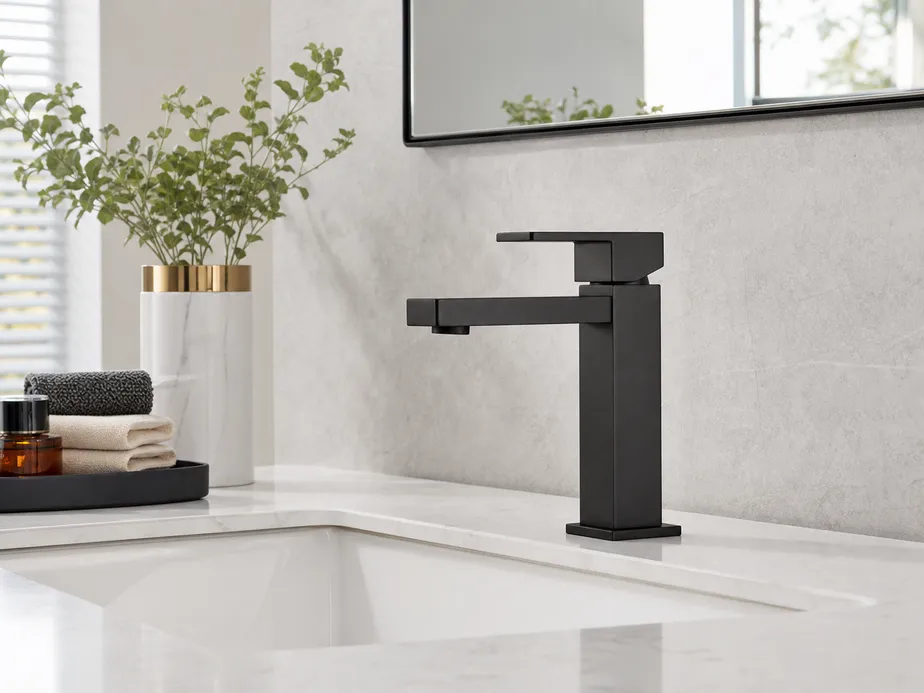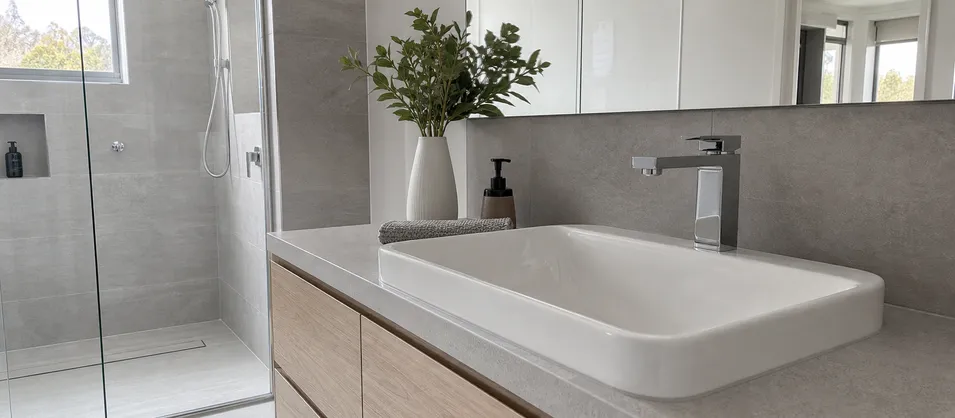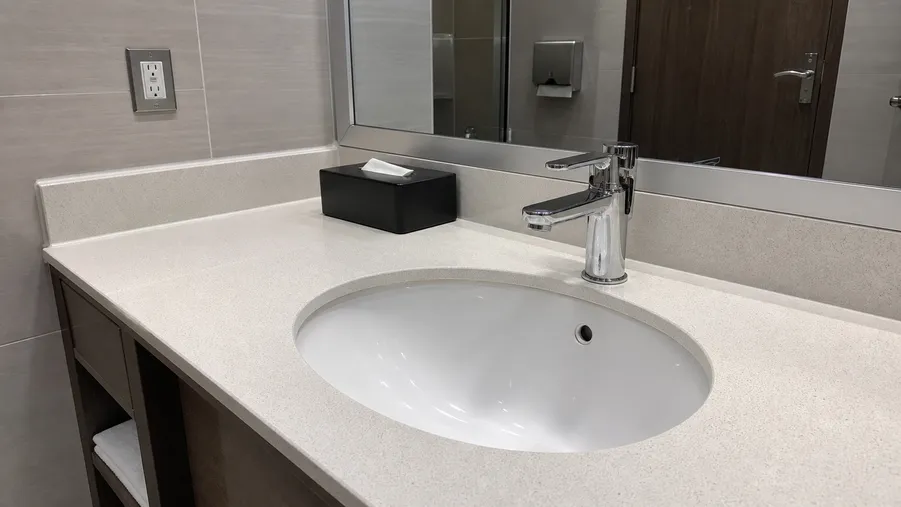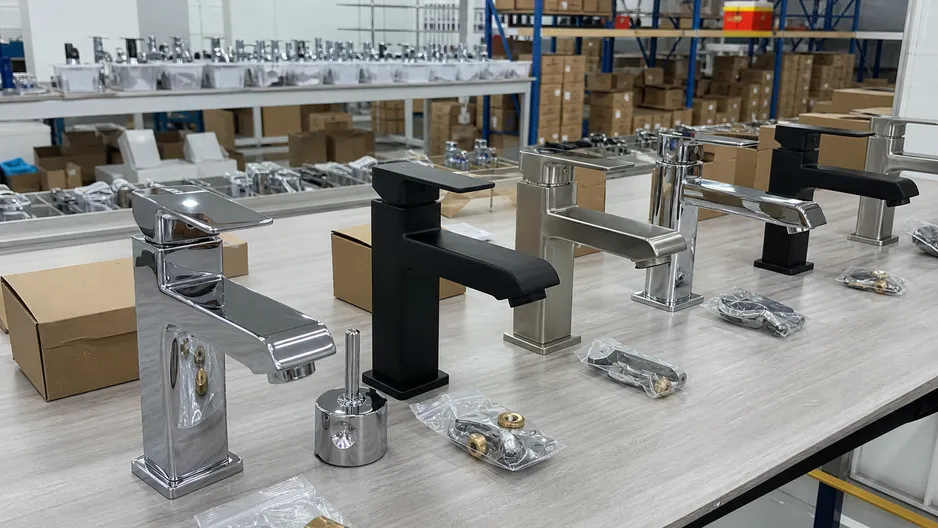

Geometric brass-body modern bathroom faucets — clean lines, five in-house finishes, certified for North America, Europe, and Australia. Every unit cast, machined, finished, and tested on our own floor.
Experience
17+ Years
Finishes
5 In-House
Sourcing Intelligence
The word "modern" in faucet sourcing carries real manufacturing weight. A modern bathroom faucet isn't just a standard body with a different handle — it's a geometric profile with tight radius corners, flat planes that show every surface defect, and a finish that has to hold up under scrutiny in a well-lit bathroom where the design is the point. That combination of tight geometry and high-visibility finish is where most factories struggle, and where the quality gap between suppliers becomes visible to your downstream buyers.
We've been manufacturing design bathroom faucets since the early 2010s, when European and Australian distributors started pushing us for cleaner profiles to match the contemporary vanity designs their markets were moving toward. The shift forced us to tighten our casting tolerances and rethink our finishing sequence.
The Flatness Problem
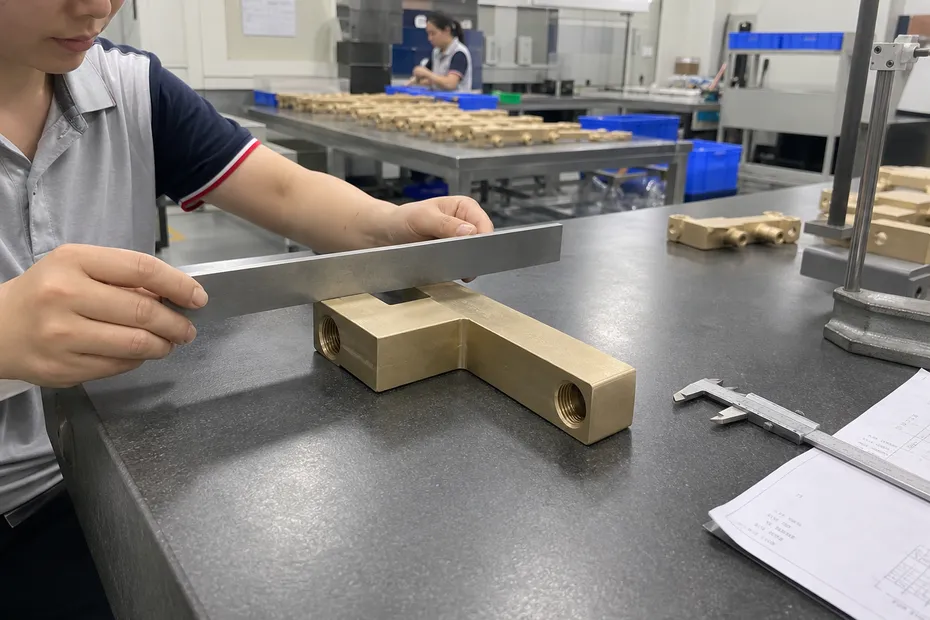
A traditional curved faucet body hides minor surface irregularities in its contours. A flat-sided modern body does not. We now run a dedicated post-casting inspection step for modern-profile bodies — every casting is checked for flatness deviation on the visible planes before it moves to machining. Anything outside ±0.3mm on a flat face gets pulled.
That's a tighter call than we make on curved bodies, and it does mean a slightly higher casting rejection rate — but it's the only way to hold the surface quality that makes a modern faucet look right on a premium vanity.
The commercial case for stocking modern bathroom faucets is straightforward: this is the style category that moves fastest in European and Australian markets right now, and it's gaining ground in North American mid-to-premium residential and hospitality. If your catalog is heavy on traditional and transitional styles, adding a modern line gives you coverage in the segment where the growth is. The per-unit value is also higher than standard centerset — modern designs command a premium at retail, which supports your margin.
±0.3mm flatness tolerance on visible planes. Dedicated post-cast inspection before machining.
cUPC for North America, CE for Europe, WaterMark for Australia — all held in-house.
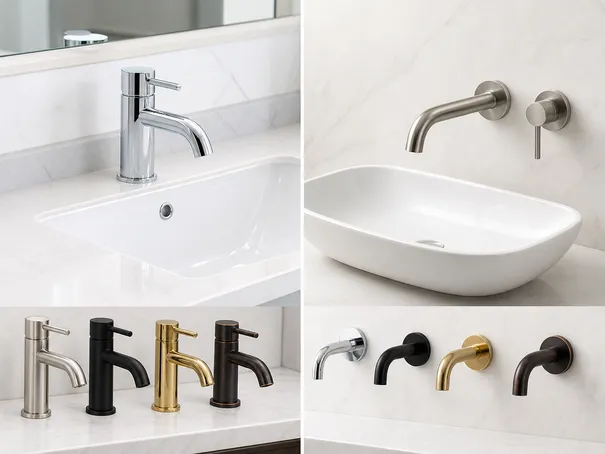
Chrome, brushed nickel, matte black, PVD gold, oil-rubbed bronze — all applied and QC'd on our floor.
Market Momentum
Modern is the fastest-moving style category in European and Australian markets, and gaining ground in North American mid-to-premium residential and hospitality. Modern designs command a retail premium over standard centerset — adding a modern line gives your catalog coverage where the growth is.
Engineering Data
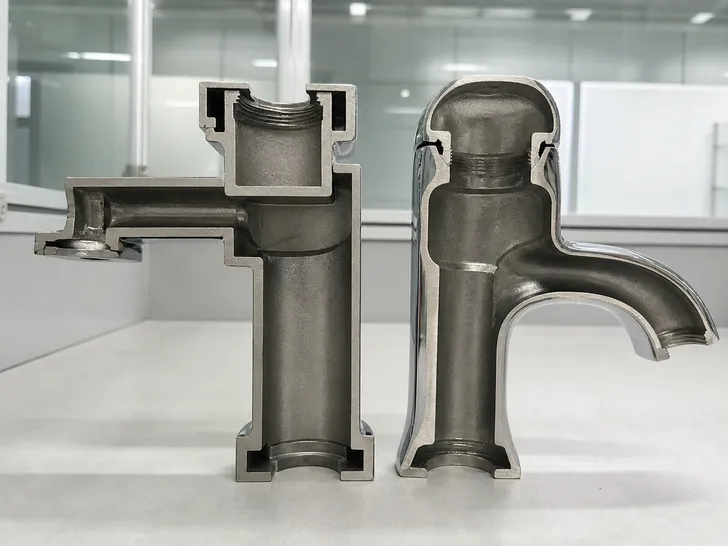
Modern bathroom faucets in our line are built on the same brass body platform as the full bathroom range — C36000-equivalent free-machining brass, gravity cast in-house, CNC machined to our standard tolerances. What differs is the body geometry, the spout profile, and the handle design. The specs below reflect the standard configurations we run; custom dimensions are available within the ranges noted.
| Parameter | Standard Value | Notes |
|---|---|---|
| Body material | C36000-equivalent brass | Gravity cast, in-house |
| Spout height (deck mount) | 150–200mm typical | Custom heights available |
| Spout reach | 120–160mm typical | Varies by configuration |
| Mounting type | Single-hole deck mount (standard); 3-hole available | Wall mount available as separate configuration |
| Handle configuration | Single lever (standard); two-handle available | Lever geometry: flat bar or cylindrical |
| Cartridge | Ceramic disc, 35mm or 40mm | 500,000-cycle endurance tested |
| Flow rate | 1.2 GPM / 1.5 GPM / 2.2 GPM | Aerator-configured; specify at order |
| Operating pressure | 0.05–0.8 MPa | Tested at 0.6 MPa for 60 seconds |
| Connection | 3/8" compression (standard) | G1/2" available for European market |
| Available finishes | Chrome, brushed nickel, matte black, PVD gold, oil-rubbed bronze | All in-house |
| Valve seat thread tolerance | ±0.05mm | CNC machined |
Specifications shown are industry-standard values for this product type. Actual specifications may vary by configuration. Contact us for detailed product data sheets and custom dimension confirmation.
35mm or 40mm ceramic disc, endurance-tested to 500,000 cycles. Consistent actuation feel across the full service life — no progressive stiffening or drip onset.
Every unit tested at 0.6 MPa for 60 seconds. Operating range 0.05–0.8 MPa covers both low-pressure gravity-fed systems and high-pressure mains.
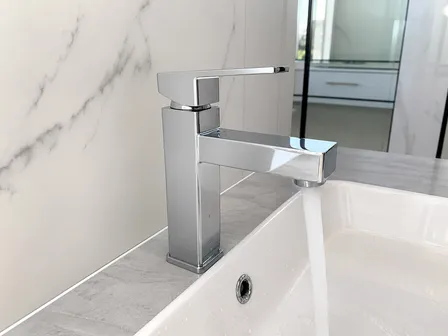
Chrome
High-polish, in-house plating
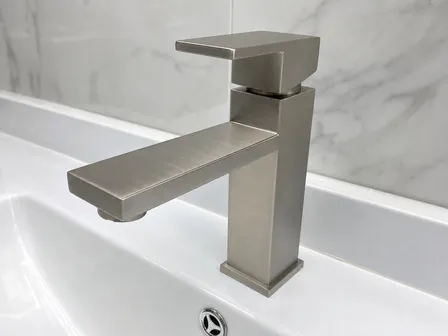
Brushed Nickel
Satin texture, in-house
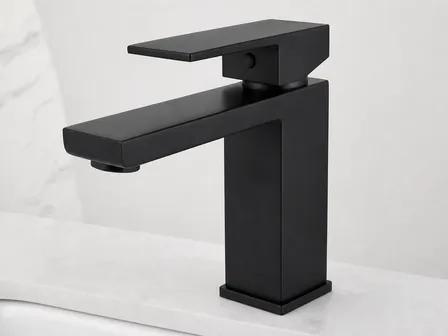
Matte Black
PVD-applied, in-house
PVD Gold
Physical vapour deposition, in-house
Oil-Rubbed Bronze
Hand-applied patina, in-house
This is the section most factory websites skip, and it's the one that actually tells you whether a supplier can deliver what the product photos show. Modern bathroom faucet bodies are defined by their geometry — square or rectangular cross-sections, flat spout faces, sharp transitions between planes. That geometry is harder to cast consistently than a traditional curved body, harder to machine without leaving tool marks on visible flat surfaces, and harder to plate without finish variation showing up on the flat planes where light hits evenly.
Each of those three steps — casting, machining, finishing — has a failure mode that's specific to modern profiles and that doesn't show up the same way on traditional designs. Below is how we address each one.
Failure mode: shrinkage porosity on flat faces
Flat-faced bodies are more sensitive to shrinkage porosity than curved bodies. When brass cools in the die, it contracts, and on a flat face that contraction can leave a slight concavity or a surface pit that's invisible on a curved body but visible on a flat one.
Adjusted gating and riser design for modern-profile dies — metal fill sequence differs from standard curved-body tooling
Riser placement optimized to pull shrinkage away from visible faces
Slower cooling cycle on modern-profile castings reduces porosity rate on flat faces
Post-casting flatness check: ±0.3mm on visible planes
Failure mode: tool marks on visible flat surfaces
Flat surfaces on a faucet body — typically the spout face and the base plate — are both visible after installation. Tool marks on these surfaces show through the plating. Surface finish before plating determines whether chrome reads as polished or slightly hazy.
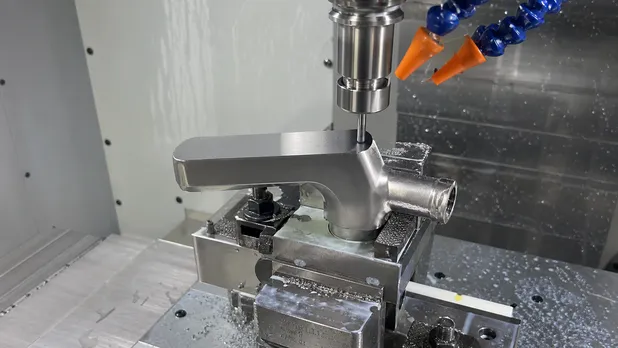
Finishing pass on all visible flat surfaces using fine-feed CNC program
Surface roughness held below Ra 0.8μm before the part goes to plating
Smooth substrate gives plating a consistent bond surface — the foundation of a clean final finish
Failure mode: plating thickness variation on flat planes
Electroplating deposits more material on edges and corners than on flat centers — the "edge effect." On a modern faucet body with prominent flat planes, that variation can produce a visible color difference between the center of the face and the edges under showroom lighting.
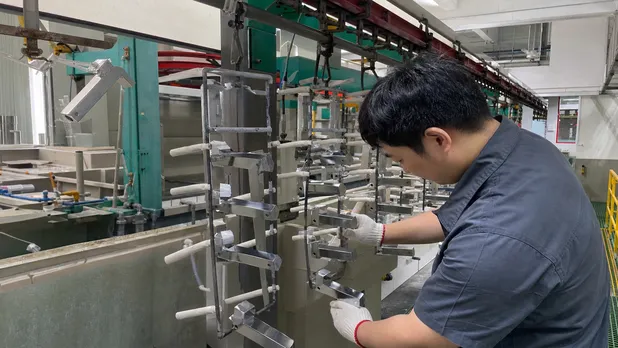
Adjusted rack positioning and current density settings for modern-profile parts
Process parameter adjustment — not a different plating chemistry — applied per part type
Plating team flags modern-profile parts at setup — learned from a real batch pull on early square-body production for a European buyer
From the Production Floor
On an early run of square-body faucets for a European buyer, the center of the spout face was visibly lighter than the edges under showroom lighting. We pulled the batch, adjusted the rack geometry, and re-ran. The buyer waited an extra week, but the product that shipped was right. That batch is why modern-profile parts now get flagged at plating setup as a standard step — not an exception.
The finish choice matters more on a modern bathroom faucet than on a traditional one, because the flat surfaces and sharp edges that define the modern aesthetic are also the surfaces where finish failures are most visible. Here's how each finish performs on modern-profile bodies, from a manufacturing standpoint.
Finish Option
The most forgiving finish on modern profiles from a plating standpoint. The three-layer stack — copper base, nickel mid-coat, chrome top — produces a hard, smooth surface that reads as crisp on flat planes.
Salt Spray
24h minimum / most batches clear 48h
Layer Stack
Copper base → Nickel mid-coat → Chrome top
Why the nickel mid-coat matters: Without it, chlorinated water vapor gets under the chrome at the edges and produces the white haze visible on cheap chrome faucets at 18 months. We run the full three-layer stack on every unit — no shortcuts on the mid-coat.
Finish Option
A strong commercial choice on a modern body. The brushed texture hides minor surface variations better than polished chrome, which means a slightly lower rejection rate at final inspection and fewer end-user complaints about surface marks.
Inspection Advantage
Lower rejection rate vs. polished chrome on flat faces
Brush Direction
Parallel to longest face dimension — linear, not swirled
Setup detail that gets missed: Brushing direction matters on flat faces. Factories running brushed nickel on curved bodies often don't adjust for flat-faced modern profiles — the result is a swirled pattern instead of a consistent linear texture. We set brush stroke direction per face geometry.
Finish Option
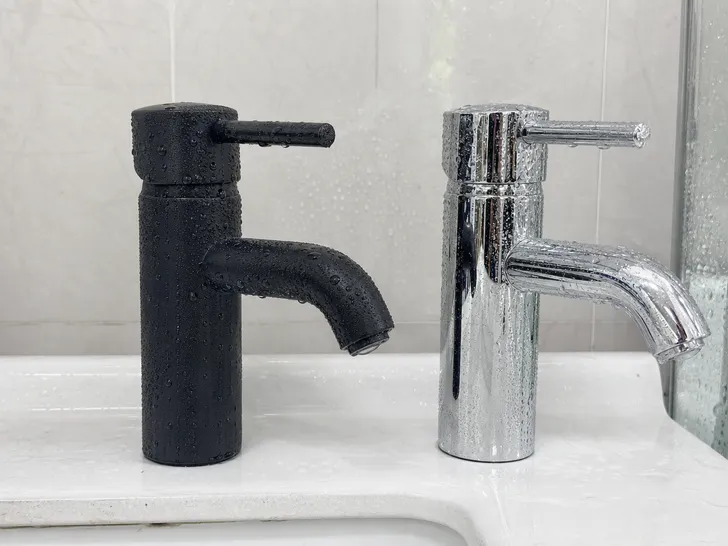
The finish that moves fastest in the modern style category — and the one with the highest failure rate in the market when it's done wrong. Painted or powder-coated matte black looks identical to PVD in a product photo. In a bathroom, they perform very differently.
Painted / Powder-Coated
Abrades at handle contact point within 6–12 months
Leaves shiny wear spot on matte surface where fingers grip lever
Identical to PVD in product photos — warranty claims reveal the difference
PVD Matte Black (Our Process)
Bonds at the molecular level — does not abrade under normal use
Coating thickness: 0.3–0.5μm, cross-cut adhesion tested per batch
Cost difference at factory level is real but modest; warranty claim difference is not
Finish Option
A strong play for Middle East hospitality and premium residential in Europe and Australia. The flat planes of a modern body show the gold tone cleanly — it reads as intentional and high-end rather than decorative. Same PVD process as matte black, different target color.
PVD Gold
Full mirror gold finish. Flat planes of modern body read as intentional and high-end. Strong in hospitality and premium residential.
Brushed Gold
PVD over a brushed substrate. Warmth of gold without the full mirror finish. Available for buyers who want a softer, textured gold tone.
Process note: PVD gold uses the same physical vapor deposition process as matte black — the difference is the target color, not the bonding method. Adhesion and durability characteristics are equivalent across both PVD colors.
| Finish | Process | Key Spec | Modern Profile Consideration | Primary Markets |
|---|---|---|---|---|
| Chrome | 3-layer electroplate (Cu / Ni / Cr) | 24h salt spray min; most batches 48h | Most forgiving on flat planes; edge effect managed via rack setup | Global / universal |
| Brushed Nickel | Electroplate + directional brush | Brush stroke parallel to longest face dimension | Hides minor surface variation; lower rejection rate vs. polished | North America, Europe |
| Matte Black | PVD (physical vapor deposition) | 0.3–0.5μm coating; cross-cut adhesion tested per batch | Flat planes show coating uniformity clearly — PVD vs. paint is visible at wear points | North America, Europe, Australia |
| PVD Gold | PVD (physical vapor deposition) | Same adhesion spec as matte black PVD | Flat planes read gold tone cleanly — intentional, not decorative | Middle East, Europe, premium residential |
| Brushed Gold | PVD over brushed substrate | Brushed substrate + PVD top layer | Softer gold tone; brush direction set per face geometry | Europe, hospitality, premium residential |
Valve & Flow Control
The modern body is visible. The valve is not. But the valve is what generates after-sale service calls, warranty replacements, and retailer chargebacks. Here's how we spec the internals for the modern faucet category.
Standard Spec
All modern bathroom faucets ship with a ceramic disc cartridge as standard. The ceramic disc format is the correct choice for the modern category — it matches the clean-operation expectation of the buyer and eliminates the drip failure mode that generates the most warranty claims in the faucet category.
500,000-cycle rated — tested per EN 817 / ASME A112.18.1 cartridge durability protocol
Quarter-turn operation — consistent with modern design language; no multi-turn compression feel
Drip-free seal — ceramic-on-ceramic contact surface; no rubber seat to degrade over time
Replaceable cartridge design — field-serviceable without replacing the faucet body
Sourcing note: Cartridge supplier matters more than cartridge format. We use Sedal and equivalent Tier-1 ceramic cartridge suppliers. The cost difference between a Tier-1 and a generic cartridge at the factory level is under $1.50 per unit. The warranty claim rate difference is not.
Flow Control
Flow rate is a market-specific spec, not a universal one. The same faucet body ships with different aerator inserts depending on destination market. Getting this wrong means your product fails certification in the target market or gets returned for low pressure complaints.
North America (US/Canada)
WaterSense1.2 GPM @ 60 PSI — WaterSense certified aerator insert. Required for California, Colorado, and most major retail programs.
Europe
EN 8175–6 L/min flow limiter. WRAS or equivalent required for UK. Flow limiter is a separate insert — same body, different aerator.
Australia / New Zealand
WELSWELS 4-star or 5-star rating. 4.5–6 L/min depending on star target. WELS registration required before import — we support the registration process.
Middle East / Other
Standard8–10 L/min standard flow. No flow restriction unless buyer specifies. Higher flow rate preferred in markets with lower municipal pressure.
Aerator thread standard: M22×1 male thread as default. M24×1 available on request. Aerator housing is recessed flush with spout face on modern profiles — no protruding insert visible from front.
Operation Feel
Handle feel is a quality signal that buyers notice immediately at point of sale and that end users notice every day. On a modern faucet, the handle is a flat lever or a geometric knob — the movement feel is part of the design language. We tune handle torque and travel to match the body style.
Opening Torque
Tuned to 0.3–0.5 Nm for single-lever modern handles. Firm enough to feel intentional; light enough for one-finger operation. Tested per EN 817 handle torque protocol.
Temperature Arc
180° full arc from cold to hot. Cold stop and hot stop are positive — no soft end-of-travel feel. Scalding limiter available as a factory-set option for hospitality and care facility buyers.
No Rattle, No Play
Handle-to-stem fit is tested for lateral play before shipment. A handle that rattles or has visible side-to-side movement at the base is a quality signal failure — it's caught at final QC, not at the customer's warehouse.
Installation & Deck Configuration
Modern faucets are almost exclusively single-hole deck mount. The clean single-hole profile is part of the design — a three-hole modern faucet is a contradiction in terms for most buyers. Here's how we handle the installation side of the spec.
Standard configuration for all modern profiles. 35mm cartridge body fits standard 1-3/8" (35mm) deck hole. Deck plate not required — the faucet base covers the hole directly.
Deck hole: 35mm standard (1-3/8")
Base footprint covers hole without escutcheon
Deck thickness range: 25–60mm standard; extended shank available to 80mm
Available for buyers targeting premium vanity and vessel sink applications. Widespread modern faucets use the same geometric body language with separate hot/cold handles at 8" centers. Wall mount requires rough-in valve body — we supply the trim kit and valve body as a matched set.
Widespread: 8" center-to-center standard
Wall mount: trim kit + rough-in valve supplied as matched set
Rough-in depth: 1/2" NPT or BSP on request
Supply line spec is a frequent source of market-entry errors. Thread standard, hose length, and braided vs. unbraided are all market-specific. We configure supply lines per destination market at the factory — not as an afterthought.
US/Canada: 3/8" compression × 1/2" FIP, 12" braided SS hoses
Europe: G3/8" × G1/2", 300mm hoses, WRAS-rated where required
Australia: 3/8" compression, AS/NZS 3718 compliant hose assembly
Modern faucets ship with a matching pop-up drain assembly as standard. The drain finish matches the faucet finish — chrome drain with chrome faucet, matte black drain with matte black faucet. Mismatched drain finish is a common cost-cutting move that buyers notice immediately at unboxing.
Drain Type
Push-open pop-up, no overflow rod. Clean underside — no visible linkage rod on modern profiles.
Drain Opening
1-1/4" (32mm) standard. 1-1/2" (38mm) available for vessel sink applications.
Finish Match
Drain finish matched to faucet finish at factory. All five finish options available on drain assembly.
The modern bathroom faucet is not a universal SKU — it's a style-driven product that performs well in specific market segments and less well in others. Here's where our buyers are finding the volume.
Strongest Global Segment
German, Dutch, and Scandinavian markets have been specifying geometric bathroom fixtures for over a decade — the modern faucet is the standard, not the premium option. Distributors serving these markets typically carry 3–5 modern faucet SKUs across different finishes and handle configurations.
Order Pattern
500–2,000 units / SKU / year
Reorder Cycle
3–4 months
High-Value Segment
Mandatory WaterMark certification requirements filter out non-compliant suppliers, which means less price competition for buyers who are already certified. Modern geometric faucets are the dominant style in new residential construction and hotel fit-outs in Sydney and Melbourne. Our WaterMark certification covers this product line — your Australian buyers can install without compliance risk.
Residential Projects
100–500 units
Hotel Fit-Outs
200–800 units
Growing Segment
The style shift from traditional to contemporary has been accelerating in the US market since around 2018. Distributors and e-commerce sellers who added modern faucet SKUs to their catalogs in that window have seen consistent year-over-year growth. Particularly strong in new construction and renovation projects targeting the 35–55 demographic. Worth building out if you're not already there.
Fastest-Growing Finish
Matte Black
Volume Leader
Brushed Nickel
Large Project Orders
UAE and Saudi Arabia specify modern geometric faucets in PVD gold and brushed gold finishes for hotel bathrooms and luxury residential projects. Finish consistency across all fixtures in the property is a hard requirement. The modern profile in gold finish is a strong visual statement in this market, and the per-unit value supports the margin profile for both the distributor and the contractor.
Hotel Fit-Out Order
500–2,000 units
Key Requirement
Finish Consistency
Global Segment
Increasingly specifying modern single-lever faucets for public restrooms and hotel bathrooms where the clean profile is easier to maintain and the contemporary aesthetic aligns with the property's design intent. Single-lever modern faucets in chrome or brushed nickel are the standard specification for mid-range hotel chains in most markets.
The modern bathroom faucet line is fully available for OEM and ODM from 200 pieces per SKU. For category-level OEM information, see the bathroom faucet overview.
Square cross-section spout, rectangular flat-face spout, and cylindrical minimalist spout tooling maintained in-house. Revisions don't go to an outside vendor — we run our own brass casting dies.
The most visible design element and the most common customization request. Flat bar lever, cylindrical lever, and T-bar lever are the configurations we run most frequently.
All five standard finishes available from 200 pieces. Custom PVD colors on runs of 500+ pieces. Mixed-finish orders are scheduled in the same plating run where possible to minimize batch-to-batch variation.
Adjustable within the body's structural constraints. Relevant for vessel sink applications where standard spout height may be insufficient — vessel sinks typically require a spout height of 180mm or above to clear the basin rim.
Confirm your sink configuration before specifying. Vessel sink clearance: ≥180mm spout height
Specify at order time. Aerator configuration is set during assembly — confirm your target market's regulatory requirement before placing the order.
Custom carton printing, branded installation instructions, retail-ready packaging with your logo and barcode. For e-commerce sellers, FBA-compliant configuration available: poly-bag inner, barcode placement per Amazon requirements, drop-test rated outer carton.
Issued in your brand name for qualifying OEM orders
cUPC, CE, and WaterMark test reports can be issued in your brand name for OEM orders meeting minimum volume thresholds. If you're adding a new finish variant to an existing certified body, we manage the certification extension documentation — you don't run a full re-certification from scratch.
New finish variant on an existing certified body? We handle the certification extension — no full re-certification required.
Minimum 200 pieces per SKU · Samples available before full production commitment
Every production batch goes through a defined inspection sequence before it ships. The steps below apply to the modern bathroom faucet line specifically — not a generic factory overview.
Before casting begins
Brass rod and bar stock is verified against composition spec on arrival. We use XRF (X-ray fluorescence) spot-checks on each incoming lot — not every piece, but a statistically meaningful sample from each coil or bundle. Lead content is confirmed below 0.25% for NSF 61 / NSF 372 compliance on North America-bound product.
XRF results are retained per lot and available on request for OEM buyers requiring traceability documentation.
Post-machining, pre-assembly
Critical dimensions — valve seat bore, thread pitch, spout outlet diameter, and mounting shank diameter — are checked with calibrated gauges after CNC machining. Tolerance stack-up on the valve seat is held to ±0.05mm to ensure consistent cartridge seating across the production run.
100% of assembled units
Every assembled faucet is pressure-tested at 0.6 MPa (87 PSI) for a minimum hold time before passing to finishing. This is not a sample test — it is 100% inline. Units that show any pressure drop are pulled, disassembled, root-caused, and either reworked or scrapped.
Post-plating, pre-packaging
Visual inspection under standardized lighting for pinholes, blistering, color deviation, and surface contamination. PVD coating thickness is verified by eddy-current gauge on a sample basis per plating batch. Chrome and brushed nickel are additionally checked for corrosion resistance via CASS (copper-accelerated acetic acid salt spray) on qualification lots.
CASS test reports for chrome and brushed nickel finishes available on request. PVD thickness records retained per batch.
500,000-cycle qualification standard
The ceramic disc cartridges used in this line are qualified to 500,000 open/close cycles per ASME A112.18.1 methodology. Cycle testing is conducted on the cartridge at the component level, not just the assembled faucet. Replacement cartridges are stocked and available as a spare part — buyers can offer their end customers a serviceable product rather than a disposable one.
AQL 2.5 sampling on finished, packed goods
Final inspection is conducted on packed, finished goods using AQL 2.5 sampling. The inspection covers finish quality, completeness of accessories (supply lines, mounting hardware, aerator key, installation instructions), and packaging integrity.
Third-party PSI by SGS, Bureau Veritas, or Intertek is available at buyer's cost for orders above 500 pieces. We coordinate factory access and provide the inspection checklist — buyers don't need to manage the logistics of arranging inspector access.
Questions we get from buyers sourcing modern bathroom faucets for the first time, and from established buyers adding this line to an existing program.
The MOQ is 200 pieces per SKU for standard configurations (existing body, existing finish). Custom finishes from the extended palette start at 500 pieces. New body tooling requires a minimum of 500 pieces to amortize tooling cost, though the tooling itself is quoted separately and remains your property after the first production run.
Standard configurations: 25–35 days from deposit receipt. Custom finish or handle variant: add 7–10 days for plating or tooling setup. New body OEM: 45–60 days including first-sample approval cycle. Lead times are quoted per order at the time of confirmation — these are typical ranges, not guarantees, and can be affected by upstream material availability.
Yes. The wetted brass components meet NSF 61 and NSF 372 (lead-free, ≤0.25% weighted average lead content). cUPC certification covers both NSF 61 and NSF 372 compliance. XRF verification is performed on incoming brass lots. If you're selling into California, the product meets AB 1953 requirements under the same certification.
Yes. Pre-production samples are available for all standard configurations. Sample cost is charged at a per-unit rate and is credited against your first production order above 200 pieces. For OEM configurations, a first-article sample is produced before production tooling is finalized — you approve dimensions, finish, and function before we run the batch.
US standard: 1.5 GPM. WaterSense or California-compliant: 1.2 GPM. Australia (WELS): 6 L/min (1.6 GPM). The aerator is set during assembly — specify at order time. If you're unsure of your target market's requirement, confirm with your local plumbing code authority before placing the order. Changing the aerator after delivery is possible but adds cost and handling.
Yes. Custom carton printing with your brand, logo, and barcode is available from 200 pieces. Installation instructions can be printed in your brand name and in any language. For Amazon FBA sellers, we configure packaging to FBA compliance requirements — poly-bag inner, FNSKU barcode placement, drop-test rated outer carton. Blind drop-shipping is available for established buyers.
We offer a 5-year warranty on the cartridge and a 1-year warranty on finish under normal use conditions. Defect claims require photo documentation and a defect rate report. For claims above 2% of a shipment lot, we issue replacement units or credit at our discretion. Replacement cartridges are stocked and can be shipped separately to support your after-sales service program.
Yes, with the constraint that each SKU meets its individual MOQ (200 pieces for standard configurations). Mixed-finish orders are scheduled in the same plating run where possible to minimize batch-to-batch color variation. If you're building a coordinated collection across multiple finishes, let us know at the RFQ stage so we can schedule the plating runs accordingly.
Manufacturing Integrity
Modern profiles demand more from the quality process than standard faucet bodies. Flat planes, sharp edges, and visible geometry leave no room for tolerance drift. Here's how the inspection sequence is structured — and where modern-profile production adds checkpoints that the standard line doesn't require.
Modern-Profile Specific
Every modern-profile casting is checked for flatness deviation on visible flat planes using a surface plate and feeler gauge. Tolerance is ±0.3mm.
Parts outside tolerance are pulled before machining — catching them here saves the machining labor cost and prevents a defective casting from consuming finishing capacity.
Modern-Profile Specific
Visible flat surfaces are checked for surface roughness using a profilometer. Target is Ra 0.8μm or below.
Parts above this threshold show tool marks through the plating — they're re-machined or scrapped, not plated and inspected out at the end.
The two modern-profile checkpoints above sit on top of the standard four-stage process that runs across the full bathroom faucet line.
Stage 1
XRF lead content testing on incoming brass stock. Material that fails lead compliance is rejected before it enters the production flow.
Stage 2
Thread gauge verification post-machining. Dimensional checks confirm threads and critical interfaces are within spec before parts move to finishing.
Stage 3
Cross-cut adhesion test and visual inspection. Finish adhesion is verified before assembly — defects caught here don't consume cartridge and assembly labor.
Stage 4
100% functional testing: handle torque, flow rate at rated pressure, and 60-second leak test at 0.6 MPa. Every unit tested before shipment.
Cartridge assemblies are endurance-tested at 500,000 open/close cycles on every production batch — not on a sample, on every batch.
This is the operational life test that matters most for warranty exposure in your distribution channel. Batch-level testing means the result is representative of what ships, not a best-case sample.
Salt spray testing runs on a statistical sample from every production run. Chrome and brushed nickel: 24-hour minimum. New finish batches: extended 48-hour tests.
PVD finishes are tested separately using the cross-cut adhesion protocol rather than salt spray. Test reports travel with the shipment documentation — available for your incoming QC review.
Bathroom Faucet Line
Modern bathroom faucets are one of 14 configurations in the bathroom faucet line. If the modern style is right but another configuration variable needs to change, here's where to look.
Finish as Primary Differentiator
The two finishes that move fastest in the modern style category. Finish-specific detail on process and performance for each.
Wall-Mount Configuration
Modern profiles available in wall-mount configuration. Covers rough-in depth specs and installation requirements that affect project specifications.
Premium Catalog Tier
Three-piece 8-inch spread, available in modern geometric profiles. Higher per-unit value, stronger margin for your distribution channel.
Vessel Sink Applications
Compact body height designed specifically for vessel sink installations, available in modern profiles.
ADA-Compliant Commercial
Handle positioned on the side of the body, increasingly specified in healthcare and commercial ADA applications.
Full Line Overview
Browse the complete bathroom faucet catalog. Filter by configuration, finish, handle type, and mounting to find the right fit for your project or catalog tier.
Practical answers to the sourcing, specification, and finish questions buyers ask most when evaluating modern bathroom faucets for their product lines.
The difference is in the body geometry and the production requirements it creates. A modern bathroom faucet has flat planes, sharp transitions, and geometric profiles — square or rectangular cross-sections rather than the rounded curves of traditional designs.
Those flat surfaces require tighter casting controls (flat faces are more sensitive to shrinkage porosity), a finer machining pass to eliminate tool marks on visible surfaces, and adjusted plating rack positioning to compensate for the edge effect in electroplating.
The result is a higher production cost per unit than a comparable traditional body, which is why modern faucets carry a higher per-unit value at retail — and why the margin profile is better for your channel.
Manufacturing Differences at a Glance
PVD finishes (matte black, PVD gold) are the most durable in humid bathroom environments because the coating bonds at the molecular level and doesn't delaminate or chip.
For chrome and brushed nickel, the key variable is whether the factory runs a full three-layer electroplating stack — copper base, nickel mid-coat, chrome top. The nickel mid-coat is the corrosion barrier, and without it, chrome faucets show tarnishing or blistering within 12–18 months in humid conditions.
Ask any supplier for their salt spray test results: 24 hours minimum is the floor; 48 hours is what you want for coastal or high-humidity markets.
Salt Spray Test Benchmarks
Molecular-level bond. Does not delaminate or chip. Best choice for humid environments.
Durability depends on full 3-layer stack: copper base → nickel mid-coat → chrome top. Nickel mid-coat is the corrosion barrier. Without it: tarnishing or blistering within 12–18 months in humid conditions.
Supplier Verification Checklist
Always request salt spray test certificates from any supplier. Confirm the full three-layer electroplating stack is documented in their QC records before placing an order.
It depends on the destination state. California and other WaterSense-compliant states require 1.2 GPM maximum for bathroom lavatory faucets. Most other US states accept 1.5 GPM.
If your distribution covers multiple states, specify 1.2 GPM — it's compliant everywhere in the US and the flow difference is not noticeable to end users at typical residential water pressure. We configure the aerator at order time; specify your target market and we'll set the right flow rate.
California & WaterSense States
1.2 GPM
Maximum — compliant across all US states
Most Other US States
1.5 GPM
Accepted — not valid for CA/WaterSense markets
Yes, if the factory holds both cUPC (for North America) and WaterMark (for Australia). We hold both, along with CE for Europe — so the same production run can ship with the documentation your customs team needs in each market.
The certification requirements are different but not mutually exclusive. cUPC covers lead-free compliance under NSF/ANSI 61 and 372; WaterMark covers AS/NZS plumbing standards. A faucet body that meets cUPC lead-free requirements also meets WaterMark material requirements.
One production run, three markets:
The aerator flow rate may need to be configured differently for each market — confirm at order time.
200 pieces per SKU for OEM orders adapting an existing body from our catalog (ODM). For a completely new body design with new tooling, the practical minimum is 500 pieces to amortize the tooling cost at a reasonable per-unit rate — though we can run 200 pieces if you're willing to carry the tooling cost separately.
Most buyers testing a new modern faucet design in their market start with a 200–500 unit trial order, confirm sell-through, and then move to full container quantities on the reorder. We can ship samples (typically 2–4 units) before you commit to production.
ODM / Catalog Body
200 pcs
Per SKU minimum
New Tooling (Practical)
500 pcs
To amortize tooling cost
Pre-Production Samples
2–4 units
Before committing to production
All five finishes run on our own lines, controlled by our own team. For a mixed-SKU order, we schedule the same finish across all SKUs in the same plating run where possible.
Chrome & Brushed Nickel
Same bath chemistry and plating time parameters across all product families. A chrome modern bathroom faucet and a chrome widespread faucet from the same order will match.
PVD Finishes
All PVD parts run in the same deposition cycle. If your order includes both electroplated and PVD finishes, those run in separate cycles by definition — but within each finish type, consistency is controlled by one team on one floor.
Send us your target configuration — body profile, finish, handle style, flow rate, destination market, and volume. We'll come back with a detailed quote, confirm which certifications apply, and flag any configuration details worth discussing before you commit.
If you're building a modern faucet line from scratch and aren't sure which configurations to start with, tell us your target market and price tier — we'll suggest a starter SKU mix based on what's moving for our existing distributors in that region.
Most new buyers in this category start with a 2–4 unit sample order to evaluate finish quality and geometry before committing to production.
Use the RFQ form to send full configuration details. We'll confirm certifications, flag any configuration questions, and return a detailed quote.
Submit a Quote Request© 2026 Wfaucet. All rights reserved.