

Kitchen Faucet Aerators Built for Working Kitchens
Swivel-style and fixed configurations, dual-function spray/stream switching, brass and zinc alloy housings. Every batch runs 50,000 switch cycles before it ships.
Not a bathroom sink with a different thread — a kitchen aerator engineered for the mechanical demands of a working kitchen.
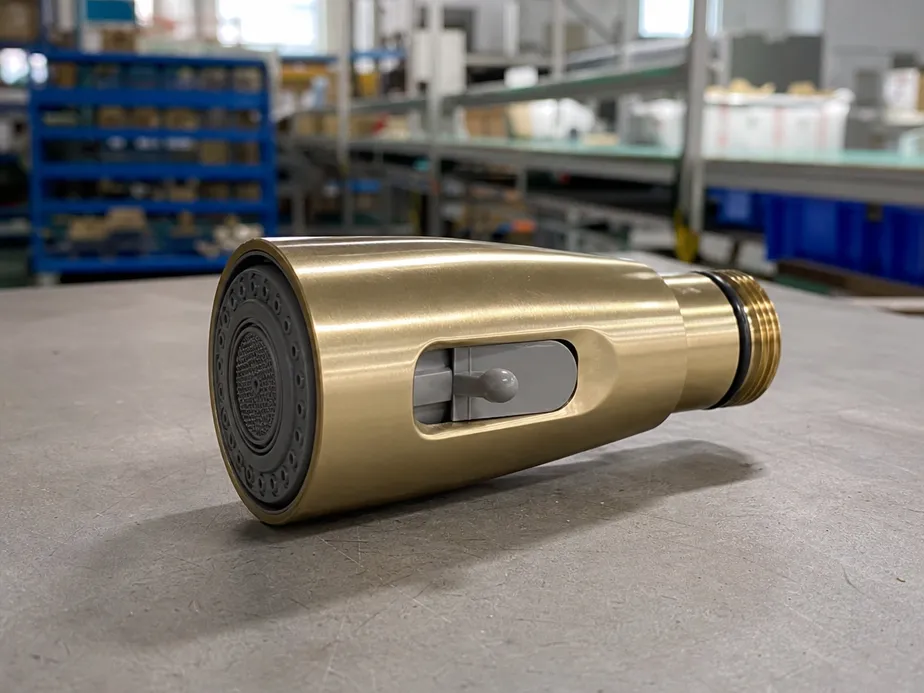
Switch Endurance
50,000
cycles per batch
OEM From
200 pcs
minimum order
Product Context
Why Kitchen Aerators Are a Different Product Than Bathroom Aerators
The parent category page covers our full aerator range — including thread sizing, flow rate compliance, and housing material selection. This page focuses on what's specific to kitchen applications.
Kitchen faucet aerators take more mechanical abuse than any other aerator type. A bathroom aerator gets turned on and off a few times a day. A kitchen aerator in a restaurant supply line or a busy household gets switched between spray and stream dozens of times daily, rotated on its swivel joint constantly, and exposed to grease, food particles, and cleaning chemicals that a bathroom unit never sees.
The failure modes are different, the spec requirements are different, and the sourcing decision should reflect that.
We've been making kitchen aerators as part of our faucet component line since 2010. The design choices we've made — swivel joint construction, mesh stack configuration, switch mechanism durability — come from watching what fails in the field and building the fix into the production spec.
A kitchen aerator that looks identical to a bathroom aerator on a spec sheet is not the same product.
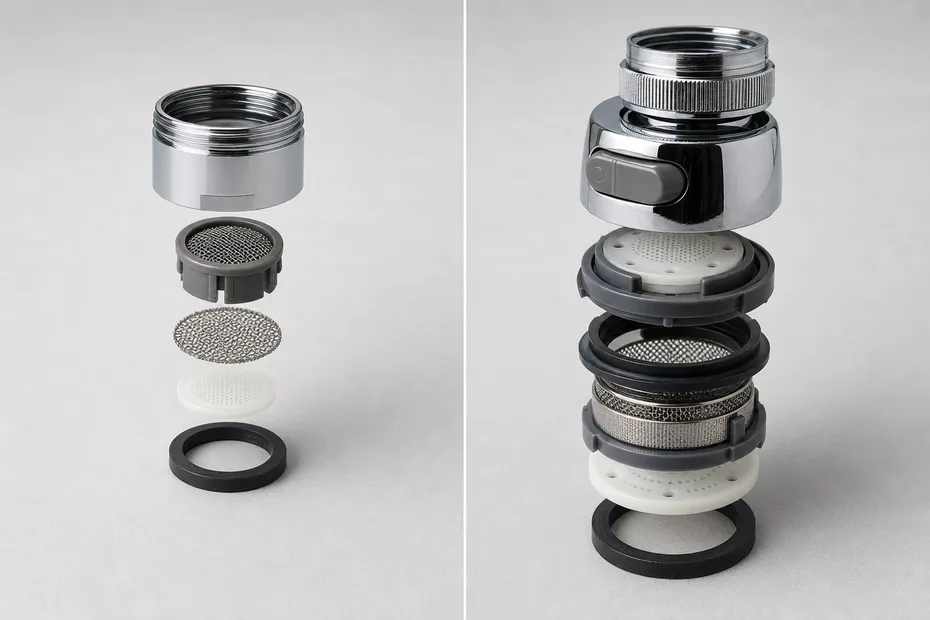
Bathroom Aerator
- A few on/off cycles per day
- Fixed position, no swivel demand
- Water and soap exposure only
- Single-function stream typical
Kitchen Aerator
- Dozens of spray/stream switches daily
- Constant swivel rotation under load
- Grease, food particles, cleaning chemicals
- Dual-function spray + stream required
Design Decisions Driven by Field Failures
Swivel
joint construction
Mesh
stack configuration
Switch
mechanism durability
Also in the aerator range:
Technical Data
Kitchen Faucet Aerator Specifications
Get a QuoteSpecifications shown are standard production values. Contact us to confirm exact parameters for your application or OEM requirements.
Standard Production Parameters
50K
switch cycles
tested per batch
30K
swivel rotation
cycles per batch
360°
swivel range
(swivel models)
5
flow rate options
1.0–2.2 GPM
3-Layer Mesh Stack
Housing Material Options
Brass (Standard)
Higher corrosion resistance, preferred for premium and commercial applications
Zinc Alloy ZA-8 (Mid-Market)
Cost-effective option for mid-market product lines without sacrificing dimensional accuracy
Component Engineering
The Switch Mechanism: Where Kitchen Aerators Fail and How We Address It
The dual-function spray/stream switch is the highest-wear component in a kitchen aerator. Understanding how it fails — and what prevents that failure — is the difference between a product that holds up and one that generates warranty claims.
How the Failure Happens in Cheap Aerators
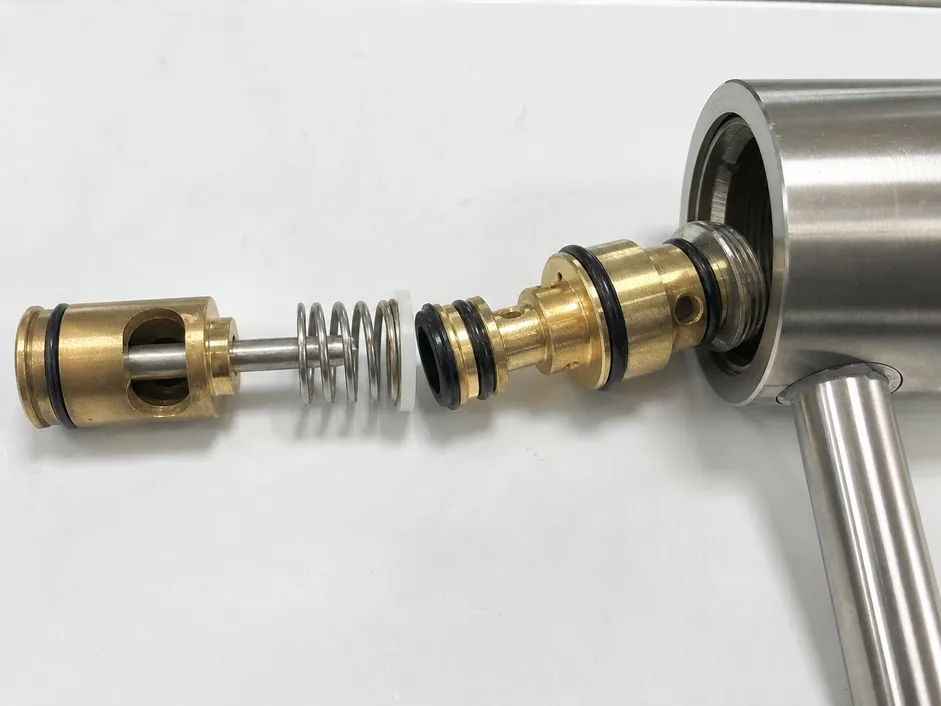
A small diverter valve inside the housing — a spring-loaded button or rotating collar — redirects water between the aerated stream and the spray pattern. In a cheap aerator, the switch mechanism uses a plastic diverter with a thin spring.
After 10,000–15,000 cycles, the spring fatigues, the diverter starts sticking, and the aerator either locks in one mode or starts leaking around the switch. That's the failure mode. It's predictable, and it's preventable.
Our Switch Specification
We run the switch mechanism in our kitchen aerators at a higher spec than the bathroom line. Three material upgrades drive the difference:
Brass Diverter Body
Rather than ABS plastic. Brass resists deformation under repeated load and doesn't become brittle in humid environments.
Stainless Steel Spring
Higher fatigue limit than the carbon steel springs used in standard-grade aerators. The spring maintains consistent return force across the full service life.
EPDM O-Ring at 70 Shore A
The same spec we use in our cartridges. EPDM at this durometer seals the switch interface without over-compressing, which is what causes premature seal failure in softer O-rings.
Production Testing Protocol
50,000-Cycle Switch Test
We test every production batch at 50,000 switch cycles on a pneumatic cycling rig. At 50,000 cycles, the switch should operate with the same resistance and the same flow pattern as it did at cycle one.
If a batch shows more than 2% deviation in switch force or any leakage at the interface, it doesn't ship.
50,000
Switch cycles tested per production batch
<2%
Maximum allowed deviation in switch force before batch rejection
4–6 yrs
Equivalent residential service life at 20–30 cycles/day
~18 mo
Commercial kitchen equivalent at 80–100 cycles/day
Why 50,000 Cycles — The Data Behind the Threshold
We set the 50,000-cycle threshold after analyzing return data from a hospitality distributor in Southeast Asia. Their hotel accounts were cycling kitchen aerators 80–100 times per day in commercial kitchen applications. At that rate, 50,000 cycles represents roughly 18 months of use — which is the warranty period their downstream customers expected. The threshold isn't arbitrary.
For buyers supplying residential product, 50,000 cycles is conservative — a typical household kitchen aerator sees 20–30 cycles per day, so 50,000 cycles represents 4–6 years of normal use. For buyers supplying commercial kitchens, food service, or hospitality, the margin is tighter, and the spec is what protects your warranty exposure.
Durability Engineering
Swivel Joint Construction and Why It Matters for Your Returns Rate
The swivel joint is the second common failure point in kitchen aerators. A kitchen faucet aerator rotates constantly — users swing it out of the way, rotate it to fill a pot, swing it back. The swivel joint takes that rotational load thousands of times over the product's life.
The Standard Failure Pattern
A poorly constructed swivel joint develops play, starts dripping at the joint interface, and eventually seizes or cracks. The root cause is almost always the same: a plastic retaining clip and an unlined bearing surface.
Plastic clips are the standard cost-cutting move in this component, and they're the reason swivel joints fail prematurely in humid environments where the plastic becomes brittle.
Our Swivel Joint Construction
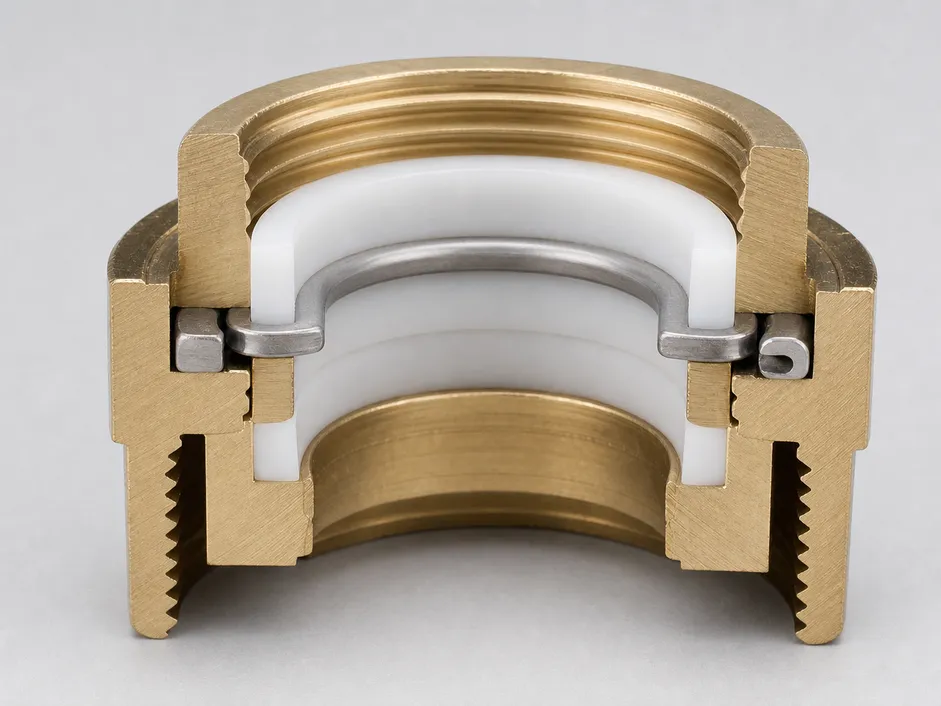
Brass Collar with PTFE-Lined Bearing Surface
PTFE reduces friction at the joint interface, which means the swivel operates smoothly without requiring the user to force it. Smooth operation means less stress on the joint body — and less stress means longer service life.
Stainless Steel Snap Ring Retention
The collar is retained by a stainless steel snap ring rather than a plastic clip. This eliminates the brittleness failure mode that affects standard-grade swivel joints in humid or high-cycle environments.
Test Protocol
30,000 Rotation Cycle Validation
We test swivel joints at 30,000 rotation cycles. Three pass criteria must all be met at end of test:
Zero Play
No measurable play in the joint after 30,000 cycles
Zero Leakage at 0.4 MPa
No leakage at the joint interface under full test pressure
No Scoring on PTFE Bearing
Surface wear inspection shows no scoring on the PTFE bearing surface
The test protocol is documented and available if your QC team wants to run incoming inspection.
30,000
Rotation Cycles
Standard test duration for every swivel joint production batch
0.4 MPa
Leakage Test Pressure
Joint interface must hold zero leakage at full test pressure post-cycling
PTFE
Lined Bearing Surface
Eliminates forced-rotation stress that accelerates joint body wear
Component Comparison: Standard vs. Wfaucet Swivel Joint
| Component | Standard Grade | Wfaucet |
|---|---|---|
| Collar material | Zinc alloy or ABS | Brass |
| Bearing surface | Unlined metal-on-metal | PTFE-lined |
| Retention method | Plastic clip | Stainless steel snap ring |
| Humidity resistance | Clip becomes brittle | No degradation |
| Cycle test | Not typically disclosed | 30,000 cycles, documented |
| QC documentation | Rarely available | Protocol available for incoming inspection |
Technical Specification
Flow Rate Selection for Kitchen Applications
Kitchen aerators operate under different flow rate logic than bathroom aerators. A bathroom lavatory aerator is typically specified at 1.0–1.5 GPM because the application is hand-washing — low flow is fine. A kitchen aerator needs enough flow to fill a pot, rinse produce, and handle the volume demands of a working sink. Restricting kitchen flow too aggressively creates a usability problem that generates complaints.
Conservation-Mandate Markets
Meets California CEC requirements and WaterSense kitchen faucet standards. Appropriate for markets with strict water conservation mandates. Expect some pushback from end users in high-volume kitchen applications.
Best For
California, WaterSense-certified product lines
North American Residential
The sweet spot for most North American residential markets. Meets federal WaterSense kitchen faucet requirements (≤2.2 GPM) with room to spare, and delivers enough flow for normal kitchen use without complaints.
Best For
Broad US residential, OEM kitchen faucet programs
Unrestricted & Commercial
Standard for markets without strict flow rate mandates, and for commercial kitchen applications where volume matters more than conservation compliance.
Best For
International markets, food service, commercial kitchens
Inventory Simplification
One Housing SKU. Three Flow Rate Variants.
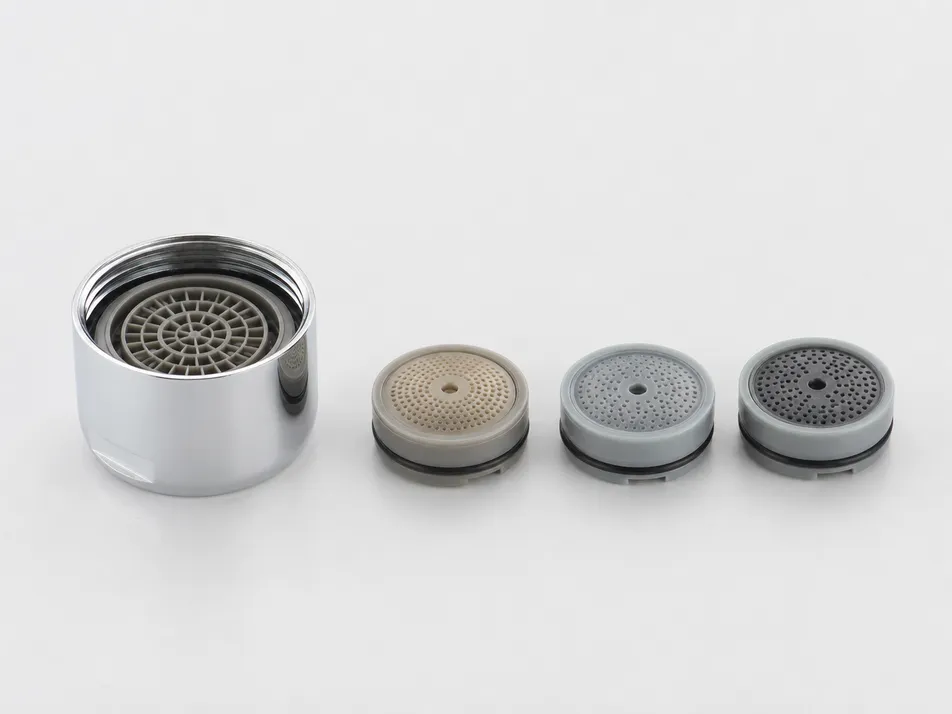
The flow restrictor in our aerator design is a separate insert disc — it's not molded into the housing. That means you can run a single housing SKU with multiple flow rate variants by swapping the restrictor disc.
If you're building a catalog that covers California, the broader US market, and international markets, you don't need three separate aerator SKUs — you need one housing with three restrictor options. That simplifies your inventory and your reorder process.
1 Housing
Single SKU
3 Discs
Flow variants
All Markets
CA, US, Intl
Buyer Segments
Market Segments Where Kitchen Faucet Aerators Move at Volume
Kitchen aerators are a high-turnover, repeat-purchase product across multiple B2B channels. The four segments below account for the majority of volume demand — each with distinct specification priorities and buying patterns.
Segment 01
Residential Plumbing Distribution
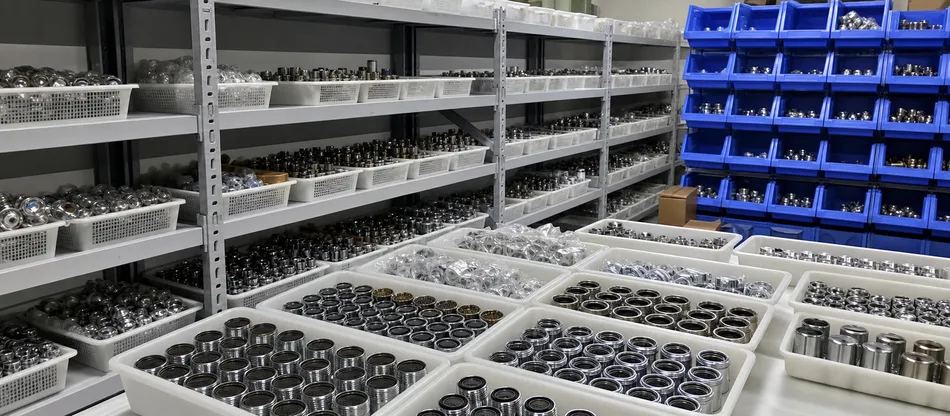
Kitchen aerators are the highest-turnover replacement part in a plumbing distributor's catalog. Every kitchen faucet eventually needs a new aerator — mineral scale, sediment, or a failed switch mechanism drives the replacement.
Distributors who stock a reliable kitchen aerator SKU in M22 and M24 thread sizes, in chrome and brushed nickel, cover the majority of replacement demand without managing a complex assortment. Reorder frequency is predictable, and the margin on a $4–8 retail aerator is solid relative to its shelf space.
Thread Sizes
M22, M24
Finishes
Chrome, Brushed Nickel
Reorder
Predictable cycle
Segment 02
Kitchen Faucet OEM Programs
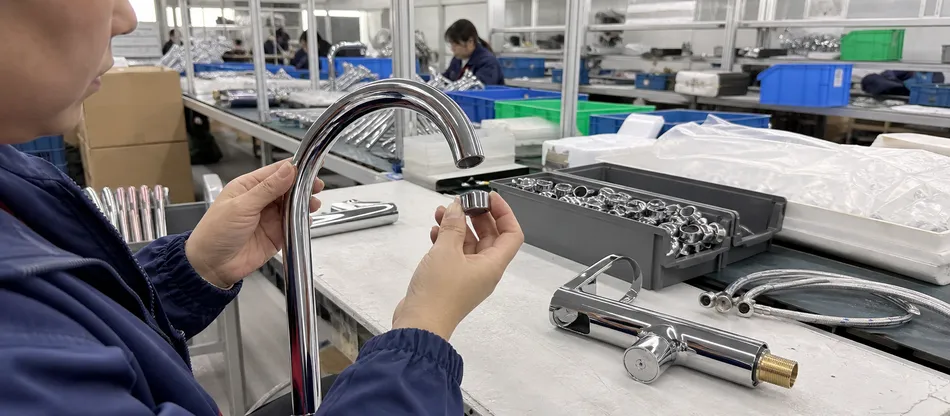
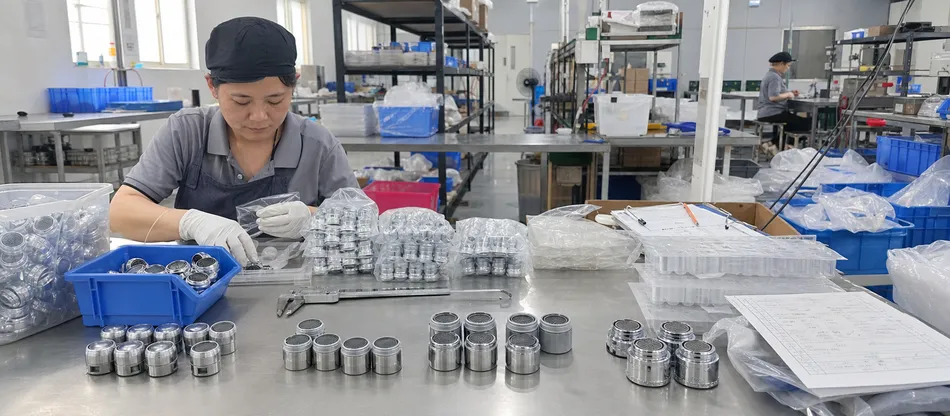
If you're manufacturing or private-labeling kitchen faucets, the aerator is the component your end customer interacts with most. A faucet that looks premium but has a cheap aerator that sticks after six months generates returns and damages your brand.
Sourcing the aerator from the same factory as the faucet body means the thread spec is guaranteed to match, the finish is from the same plating line, and the documentation package covers both components. We coordinate aerator and faucet production schedules for buyers who source both from us — they arrive in the same container, which saves a freight consolidation step.
Thread Match
Guaranteed
Finish Source
Same plating line
Logistics
Same container
Segment 03
Hospitality and Food Service Supply
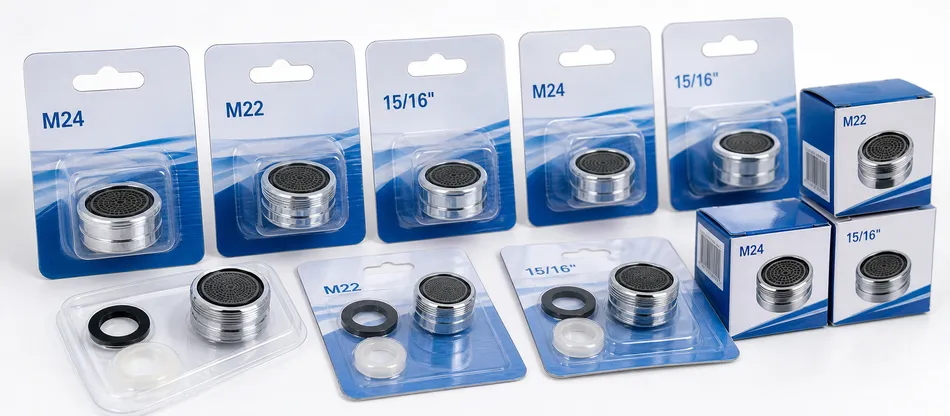
Hotels, restaurants, and institutional kitchens replace kitchen aerators on a scheduled maintenance cycle — typically every 12–18 months regardless of condition, because the cost of an aerator is lower than the cost of a maintenance call for a clogged or failed unit.
This segment buys in volume, buys consistently, and cares about two things: cache vs. standard configuration (hospitality often specifies cache to prevent guest removal) and compliance documentation for their facilities management team. We supply both configurations and provide the compliance documentation as standard.
Replacement Cycle
12–18 months
Configuration
Cache & standard
Docs
Included standard
Segment 04
E-Commerce and Retail Replacement Parts
Kitchen aerators are a high-search, high-conversion product on Amazon and home improvement retail platforms. The search intent is transactional — someone's aerator failed and they need a replacement.
Buyers building an e-commerce assortment in this category need aerators that photograph well, have clear thread size labeling on the packaging, and arrive without damage. We supply retail-ready packaging with header cards, UPC barcodes, and thread size callouts — ready for FBA or direct-to-consumer fulfillment without additional labeling work at your warehouse.
Packaging
Retail-ready
Labeling
UPC + thread size
Fulfillment
FBA / DTC ready
Explore Related Products
Other Aerator & Component Products
If you're sourcing across multiple aerator categories or need related faucet components, the links below cover the full range available from Wfaucet.
Regulatory Compliance
Compliance Documentation for Your Destination Market
Kitchen faucet aerators sold into regulated markets need documentation that travels with the product. Here's what we provide by market.
North America
- › Brass housings use C36000-equivalent alloy with lead content below 0.25% — compliant with California AB 1953 and the federal Reduction of Lead in Drinking Water Act
- › cUPC certification covers Canadian plumbing code compliance
- › Flow rate test reports available for WaterSense program qualification
- › NSF/ANSI 61 material compliance documentation available on request
Europe
- › CE marking covers EU market entry
- › Thread dimensions manufactured to EN 246 tolerances (M22×1 and M24×1)
- › Flow rate compliance with EU EcoDesign requirements (≤8 L/min for kitchen faucets) met by our 1.8 GPM and lower variants
Australia
- › WaterMark certification included with every shipment to Australian buyers
- › WELS flow rate rating documentation available for products meeting the 3-star minimum (≤9 L/min for kitchen faucets)
Middle East / Southeast Asia
- › SGS test reports available for all kitchen aerator lines
- › Accepted for import clearance in most Gulf and ASEAN markets
Single SKU. Three Markets. One Documentation Package.
If you're building a multi-market catalog and need a single SKU with documentation covering North America, Europe, and Australia, we can supply the full cUPC + CE + WaterMark documentation package on one part number.
Private Label Manufacturing
OEM Kitchen Faucet Aerators: Private Label from 200 Pieces
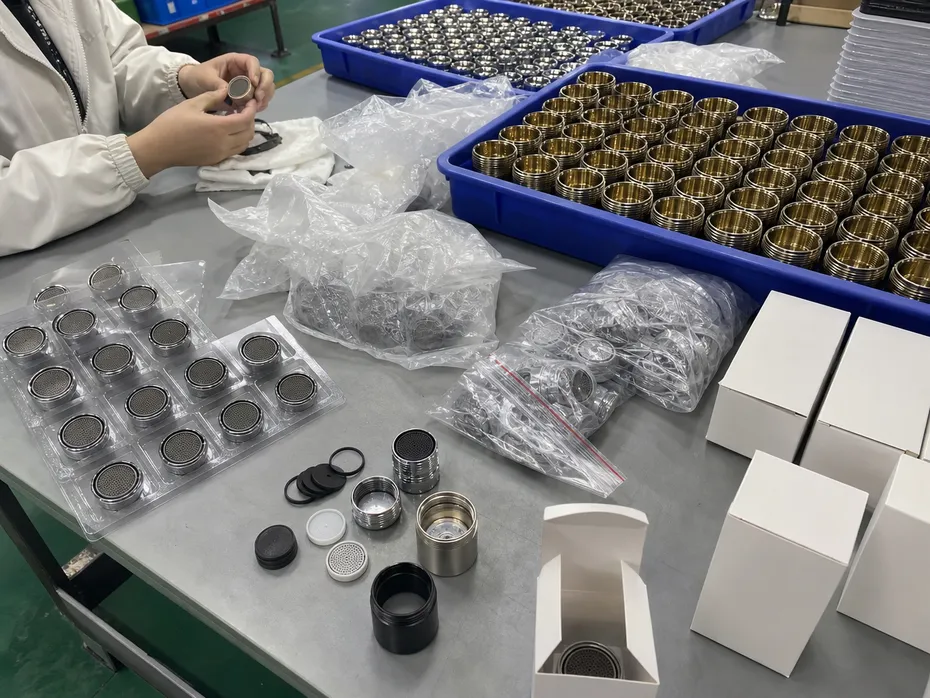
Most buyers in this category are running private-label programs. The OEM process for kitchen aerators is straightforward.
Lead Times & Tooling
MOQ: 200 pieces per SKU
Standard OEM orders using existing tooling — new finish, new flow rate, new packaging.
15–20 days: Standard OEM lead time
Applies when using existing tooling with new finish, flow rate, or packaging configuration.
+20–25 days for new tooling
New housing profiles or non-standard thread sizes require die fabrication. Tooling cost is quoted separately and typically runs $800–$1,200 for an aerator housing die.
Sourcing aerators to pair with kitchen faucets?
If you're sourcing kitchen aerators to pair with kitchen faucets you already buy from us, we confirm the thread spec from the faucet drawing before production — no thread mismatch risk, and we can coordinate the production schedules so both arrive in the same container.
Standard Customization Options
Housing Material
Brass (standard) or zinc alloy ZA-8 (mid-market price point)
Finish
Chrome, brushed nickel, matte black — all run on our in-house plating line
Flow Rate
1.0 / 1.5 / 1.8 / 2.0 / 2.2 GPM via swappable restrictor disc
Thread Size
M22×1 or M24×1, male or female
Configuration
Swivel with dual-function switch, swivel stream-only, or fixed
Logo
Engraving on housing or pad printing on the collar
Packaging
Retail blister pack, bulk poly bag, or branded box with your UPC and thread size callout
Logistics & Fulfillment
Packaging and Container Loading
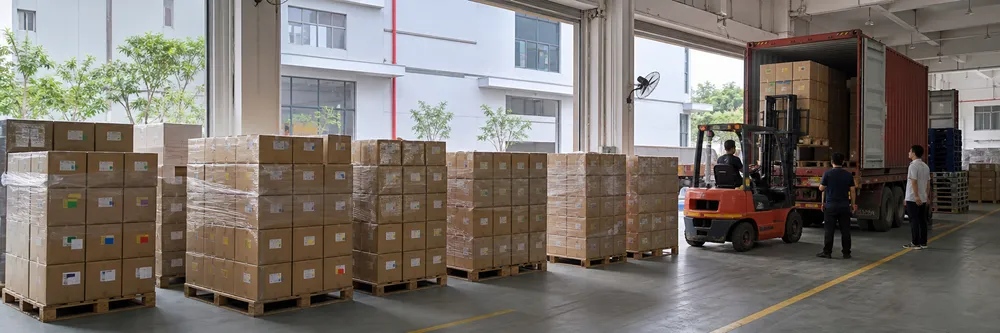
Kitchen aerators are compact, high-density products — container loading efficiency directly affects your landed cost per unit. Here is how we structure packaging to keep your freight math clean and your warehouse intake simple.
Standard Retail Packaging Structure
40HQ Container Capacity
2,800
Master cartons per 40HQ
1.4M
Aerator units at full FCL
A 40HQ container loads approximately 2,800 master cartons — 1,400,000 aerator units at full container load.
Mixed-SKU Orders
For orders spanning multiple thread sizes, flow rates, or finishes, we pack by SKU in separate master cartons and provide a detailed packing list with carton count, CBM, and gross weight per SKU.
Your warehouse receives a clean, sortable shipment rather than a mixed-carton puzzle. Each SKU is isolated to its own carton run — no manual sorting required at intake.
Retail-Ready & E-Commerce Packaging
For e-commerce programs, retail-ready packaging includes:
- Header card with thread size and flow rate callout
- UPC barcode
- Product photography-ready presentation
We can apply your brand's hang tag and barcode pre-production, which eliminates a labeling step at your fulfillment center.
Consolidated Faucet + Aerator Orders
For buyers consolidating kitchen aerators with a faucet order, we coordinate the packing sequence and provide a single combined packing list — one document for your freight forwarder, one customs entry. No separate shipment coordination required on your side.
Frequently Asked Questions
What thread size do I need for a kitchen faucet aerator?
M22×1 is the most common thread in North American kitchen faucets. M24×1 is standard in most European products. To confirm: unscrew the existing aerator and measure the outside diameter of the male thread (or inside diameter of the female thread) with a caliper. M22 measures approximately 22mm OD on the male thread; M24 measures approximately 24mm. If you're sourcing aerators to pair with kitchen faucets you're also buying from us, we confirm the thread spec from the faucet drawing — no measurement required on your end.
What is the difference between a swivel aerator and a fixed aerator for kitchen faucets?
A swivel aerator has a rotating joint that allows the aerator head to pivot independently of the spout — useful for kitchen faucets where users frequently redirect the stream. A fixed aerator threads directly onto the spout with no rotation. For kitchen applications, swivel is the standard specification; fixed aerators are typically used on bathroom faucets where directional adjustment isn't needed. The swivel joint adds a wear point, which is why we test swivel joints at 30,000 rotation cycles — a fixed aerator doesn't have that failure mode.
How do I prevent kitchen faucet aerators from clogging in hard-water markets?
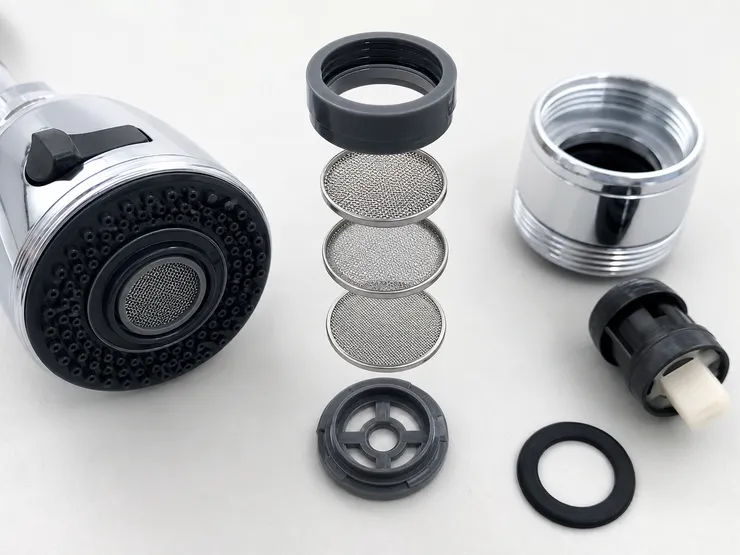
Hard water deposits calcium and magnesium scale on the aerator mesh, progressively restricting flow. Our kitchen aerators use a 3-layer mesh stack — a coarse outer screen catches larger particles before they reach the fine inner mesh, extending the time between cleanings. The housing is designed for tool-free disassembly so the mesh can be cleaned without replacing the unit.
For markets with consistently hard water (above 200 ppm hardness), we recommend our filter faucet aerator line, which adds a replaceable sediment pre-filter upstream of the mesh stack. The pre-filter extends mesh life significantly and is replaceable without removing the aerator housing.
What flow rate should I specify for kitchen faucet aerators sold in California?
California CEC (California Energy Commission) requires kitchen faucets to deliver no more than 1.8 GPM. For kitchen aerators sold in California, specify 1.8 GPM or lower. If you're also selling into markets without flow restrictions and want to minimize SKU count, a 1.8 GPM aerator works across California and most other North American markets — it meets federal WaterSense kitchen faucet requirements (≤2.2 GPM) and is acceptable in Canada.
The only market where you'd need a separate SKU is if you're targeting WaterSense-labeled product specifically, which requires ≤2.2 GPM but with third-party certification.
Can kitchen faucet aerators be supplied with cache (key-removal) configuration?
Yes. Cache aerators recess into the spout end and require a special key tool for removal — they can't be unscrewed by hand. We supply cache kitchen aerators for commercial and institutional applications where vandalism or unauthorized removal is a concern: hotels, restaurants, school cafeterias, and public facilities.
Cache configuration is available in M22 and M24 thread sizes, in chrome and brushed nickel finishes. MOQ for cache kitchen aerators is 200 pieces. If you're building a hospitality or food service product line, specify cache — it's a recognized feature in those segments and a legitimate selling point to facilities managers.
What is your MOQ and lead time for OEM kitchen faucet aerators?
MOQ is 200 pieces per SKU. For standard OEM orders using existing tooling — new finish, new flow rate, new packaging, or logo engraving — lead time is 15–20 days from order confirmation. New housing profiles or non-standard thread sizes requiring new tooling add 20–25 days for die fabrication.
MOQ
200 pcs / SKU
Standard Lead Time
15–20 days
New Tooling Lead Time
+20–25 days
Tooling cost for a new aerator housing die typically runs $800–$1,200, quoted separately and amortized over the first production run. Sample orders (5–10 units) ship within 7 days and include flow rate test reports and compliance documentation.
Source Kitchen Faucet Aerators Direct from the Manufacturer
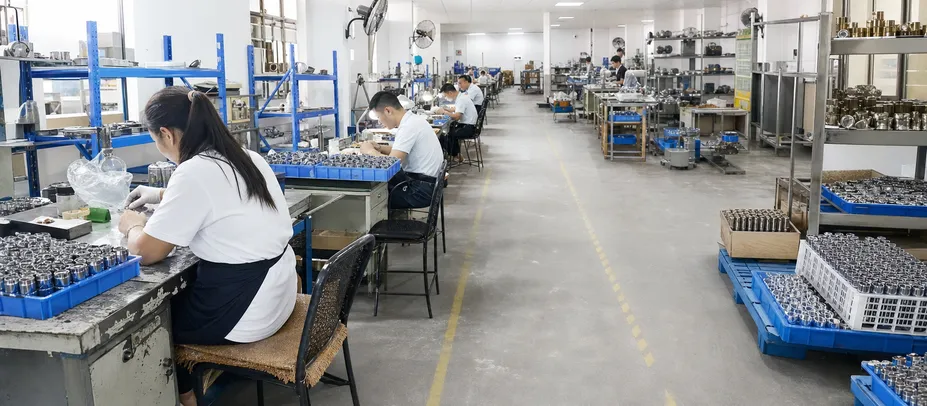
We've been making kitchen faucet aerators as part of a faucet manufacturing operation since 2010 — not as a standalone component supplier, but as the team that also makes the faucets these aerators go on. The thread specs, the finish quality, the compliance documentation — it all comes from the same infrastructure.
If you're building a replacement parts program, a private-label kitchen aerator line, or sourcing aerators to pair with kitchen faucets you already carry, send us your thread size, flow rate requirements, and target volume. We'll come back with a detailed quote, sample availability, and a recommendation on configuration based on your destination market.
Since
2010
Manufacturing aerators
MOQ
200 pcs
Per SKU
Samples
7 days
With test reports
Get in Touch
What to Include in Your Inquiry
- Thread size (M22 or M24) and male/female configuration
- Target flow rate and destination market (California, EU, AU, etc.)
- Finish preference (chrome, brushed nickel, matte black, etc.)
- Target volume and whether private label / logo engraving is needed
- Any compliance certifications required (cUPC, CE, WaterMark, etc.)
Explore Related Products