

Bathtub Shower
Faucets
Combination tub/shower valve sets built for export — single valve body, integrated diverter, five in-house finishes. Pressure-balance valve standard; thermostatic available on OEM runs. Every batch endurance-tested to 500,000 cycles before it ships.
Product Definition
What a Bathtub Shower Faucet Is — and Where It Sits in the Product Line
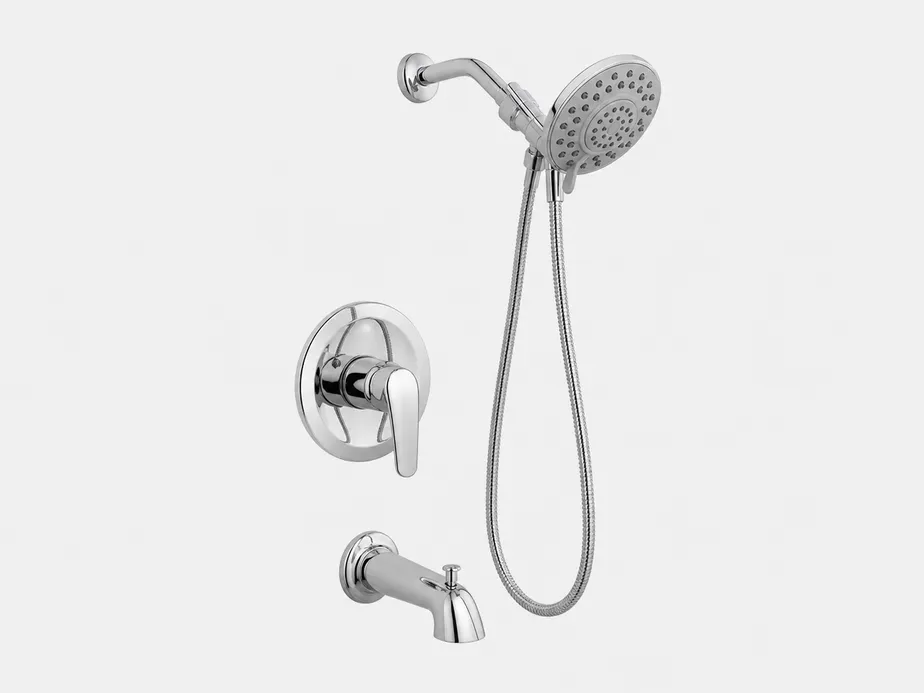
A bathtub shower faucet is a combination valve set: one valve body controls both the tub spout and the overhead shower head, with a diverter that routes water between the two outlets. It's the dominant configuration for standard alcove tub/shower enclosures in North America — the kind of installation where a single wall cavity houses both a soaking tub and a shower, and a single valve handles both functions. If you're supplying the US or Canadian residential renovation market, this is one of the two or three highest-volume SKUs in the tub and shower category.
The distinction from sibling products matters for your catalog decisions. The bathtub faucet is a tub-only filler — no shower function, no diverter. The shower faucet is a shower-only valve — no tub spout. The bathtub shower faucet combines both into a single valve body with a diverter mechanism, which is what makes it the right SKU for the standard North American tub/shower enclosure.
If your buyers are specifying a dedicated soaking tub with a separate shower stall, they need two separate products. If they're specifying a combined tub/shower alcove — which is the majority of residential bathroom configurations in the US — this is the product.
We've been manufacturing this configuration since our early export years, and it's one of the most technically demanding products in the tub and shower line. The diverter mechanism adds a wear component that pure shower valves don't have, and the valve body has to handle two outlet paths with consistent pressure balance across both. Getting that right in production requires tighter casting tolerances and more rigorous QC than a single-outlet valve.
Product Line Comparison
Bathtub Shower Faucet
This ProductSingle valve body with integrated diverter. Controls both tub spout and shower head. Standard for North American alcove tub/shower enclosures.
Diverter included · Tub spout · Shower head
Tub-only filler. No shower function, no diverter. Correct for dedicated soaking tub installations with a separate shower stall.
No diverter · Tub spout · No shower head
Shower-only valve. No tub spout. Correct for dedicated shower stall installations where no tub is present.
No diverter · No tub spout · Shower head
The tub & shower category page covers our general manufacturing approach. This page goes into the specific production decisions we make for the combination valve configuration.
Engineering Detail
Diverter Engineering: The Component That Separates a Good Combination Valve from a Warranty Problem
The diverter is the part of a bathtub shower faucet that your downstream customers will interact with every day — and the part that generates the most warranty claims in this product type when it's not engineered correctly. We spend more attention on diverter design and validation than on any other component in this SKU, because it's where the failure risk concentrates.
How the Diverter Mechanism Works
The diverter mechanism in a combination tub/shower valve works by redirecting water flow from the tub spout outlet to the shower head outlet. In a pull-up diverter configuration (the most common in North American residential), a stem in the tub spout is pulled upward to redirect flow. In a three-function valve configuration, the diverter is integrated into the valve body itself as a separate handle or button.
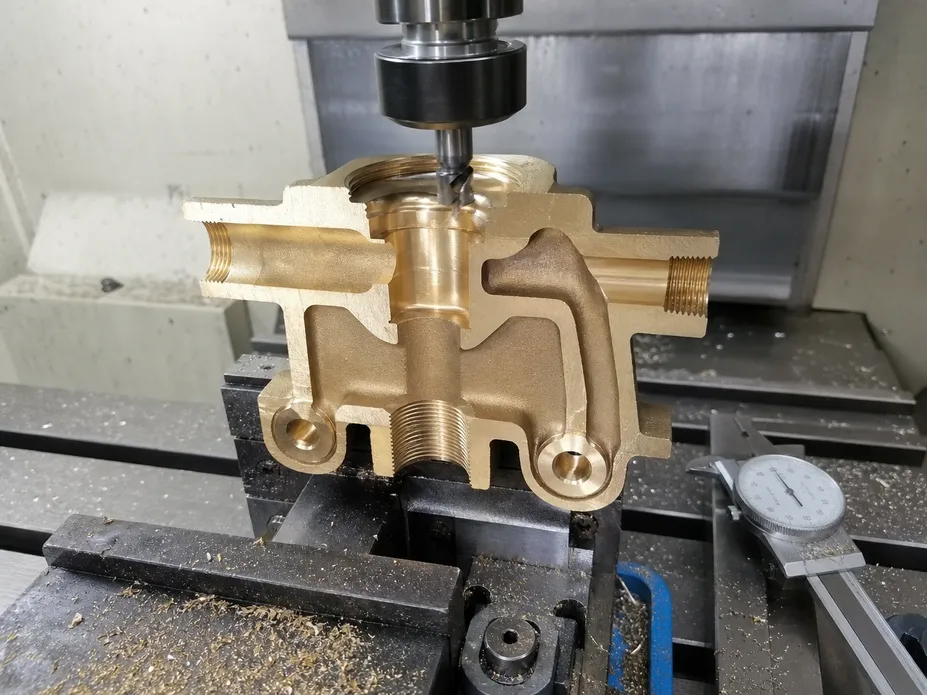
Both configurations rely on a precisely cast and machined channel in the valve body. If the casting has porosity or the machining tolerance is loose, mineral deposits accumulate in the channel and the diverter becomes stiff or jams within two to three years of normal use.
Gravity Casting and Alloy Selection
We use gravity casting rather than die casting for our valve bodies specifically because gravity casting produces denser brass with lower porosity. The alloy is C36000-equivalent free-machining brass — the same material we use across our entire faucet range.
Post-casting, every body goes through a dimensional check before machining, and the diverter channel is machined to a tolerance that leaves enough clearance for normal mineral buildup without causing sticking.
Production Update — 2021
We tightened the diverter channel tolerance spec in 2021 after seeing a small number of sticking complaints from a Gulf market buyer. The root cause was marginal porosity in a casting batch combined with high mineral content in the local water supply. The tighter spec resolved it, and we've applied it to all production since.
Seal Specification and Assembly
The diverter stem and seat are assembled with a silicone O-ring seal rated for the full operating temperature range of 0–90°C. This covers both cold-climate installations and high-temperature thermostatic configurations without requiring a different seal specification.
Outgoing Inspection Protocol
Diverter Function Test
Full flow to tub spout → full diversion to shower head → return to tub spout. Every assembled unit.
Leak Test
0.6 MPa for 60 seconds on every unit before it leaves the line.
Endurance Test
500,000 cycles on the cartridge assembly, including diverter actuation cycles — not just the mixing cartridge in isolation.
Dimensional Check
Every cast body checked before machining. Diverter channel tolerance verified post-machining.
Diverter Configuration Types
Pull-Up Diverter
Most common in North American residential. Stem in the tub spout is pulled upward to redirect flow to the shower head. Simple, field-serviceable, and familiar to plumbers.
Three-Function Valve (Integrated Diverter)
Diverter integrated into the valve body as a separate handle or button. Cleaner trim appearance; preferred for higher-spec OEM configurations and thermostatic setups.
Technical Specifications
Industry-standard values for this product type. Actual specifications may vary by configuration. Contact us for detailed product data sheets.
| Parameter | Specification |
|---|---|
| Body material | C36000-equivalent free-machining brass |
| Body wall thickness | Typical 3.0–3.5mm |
| Valve type | Pressure-balance (standard); thermostatic (OEM) |
| Cartridge type | Ceramic disc |
| Cartridge endurance rating | 500,000 open/close cycles (tested every batch) |
| Diverter type | Pull-up tub spout diverter (standard); integrated valve body diverter (OEM) |
| Valve seat thread tolerance | ±0.05mm (CNC machined) |
| Operating pressure range | 0.05–0.8 MPa |
| Leak test pressure | 0.6 MPa, 60 seconds per unit |
| Parameter | Specification |
|---|---|
| Water temperature range | 0–90°C |
| Tub spout connection | 1/2" NPT (North America); G1/2" (Europe/Australia) |
| Shower outlet connection | 1/2" NPT (North America); G1/2" (Europe/Australia) |
| Available finishes | Chrome, brushed nickel, matte black, PVD gold, oil-rubbed bronze |
| Salt spray rating | 24h minimum; 48h extended on new finish batches |
| PVD coating thickness | 0.3–0.5μm (matte black, PVD gold) |
| Chrome plating stack | Copper base / nickel mid-coat / chrome top coat |
| Certifications | cUPC CE WaterMark ISO 9001:2015 SGS |
Specifications shown are industry-standard values for this product type. Actual specifications may vary by configuration.
Request Detailed Specs or a QuotePressure-Balance vs. Thermostatic: Which Configuration Fits Your Market
Standard production runs on a pressure-balance cartridge. Thermostatic cartridges are available on OEM runs. Here's what that means for your sourcing decision.
Standard Production
Pressure-Balance Valve
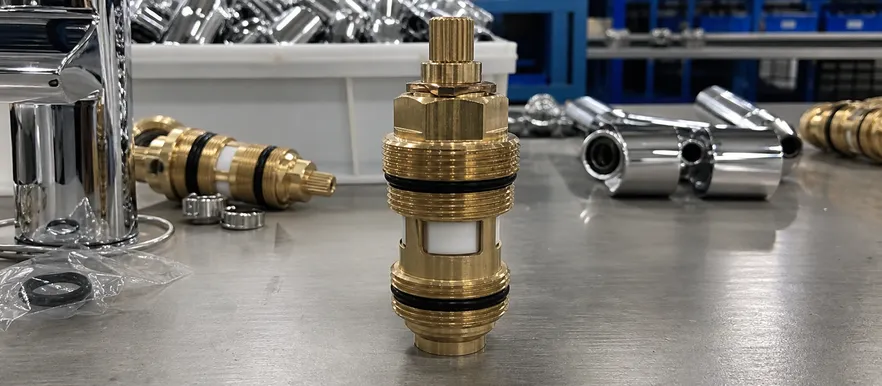
The pressure-balance valve maintains a fixed hot/cold ratio when supply pressure fluctuates. If someone flushes a toilet while the shower is running, the valve compensates to prevent a sudden temperature spike.
- Code-required configuration for shower valves in most North American jurisdictions (ASSE 1016 standard)
- Specified by the majority of residential renovation buyers in the US and Canada
- Standard SKU — available on all production runs, no minimum OEM requirement
- Most North American buyers run this as their standard SKU and add thermostatic as a premium tier
Best Fit
North American residential renovation market; standard-tier product lines; buyers requiring ASSE 1016 compliance
OEM Runs
Thermostatic Valve
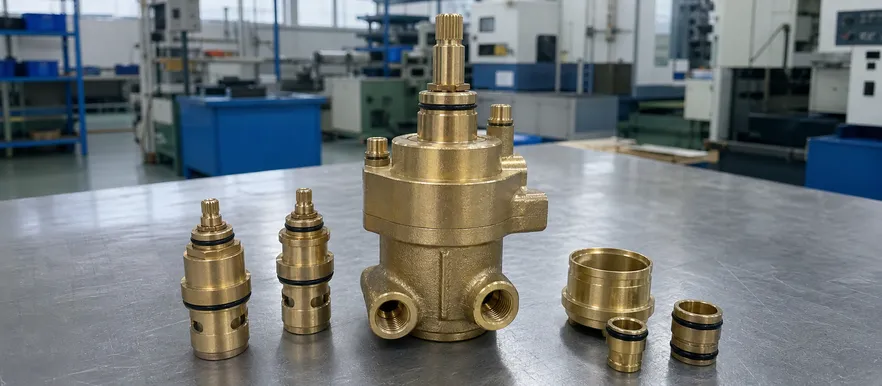
A thermostatic valve maintains a set water temperature regardless of supply pressure or temperature fluctuations — a more precise control mechanism that commands a higher retail price point.
- Requires a different casting — the thermostatic cartridge has a larger diameter and different port geometry than the pressure-balance cartridge
- Separate SKU — not a drop-in swap from the pressure-balance body
- Must be specified at the RFQ stage to confirm correct body casting and certification documentation
- Typically retails at 40–60% above pressure-balance in the same finish and handle design
Best Fit
European market thermostatic tub/shower lines; premium North American segments; buyers building a two-tier product range with meaningful margin differential
Sourcing Note: Specify Configuration at RFQ Stage
If you're building a thermostatic tub/shower line for the European market or for a premium North American segment, discuss it at the RFQ stage so we can spec the correct body casting and confirm the certification documentation. The valve body for a thermostatic configuration requires a different casting — it is a separate SKU, not a drop-in swap.
Most of our North American buyers run pressure-balance as their standard SKU and add thermostatic as a premium tier. The margin differential between the two configurations is meaningful — thermostatic typically retails at 40–60% above pressure-balance in the same finish and handle design.
Finish Program
Five Finishes, One Factory: Finish Consistency Across Your Tub/Shower Line
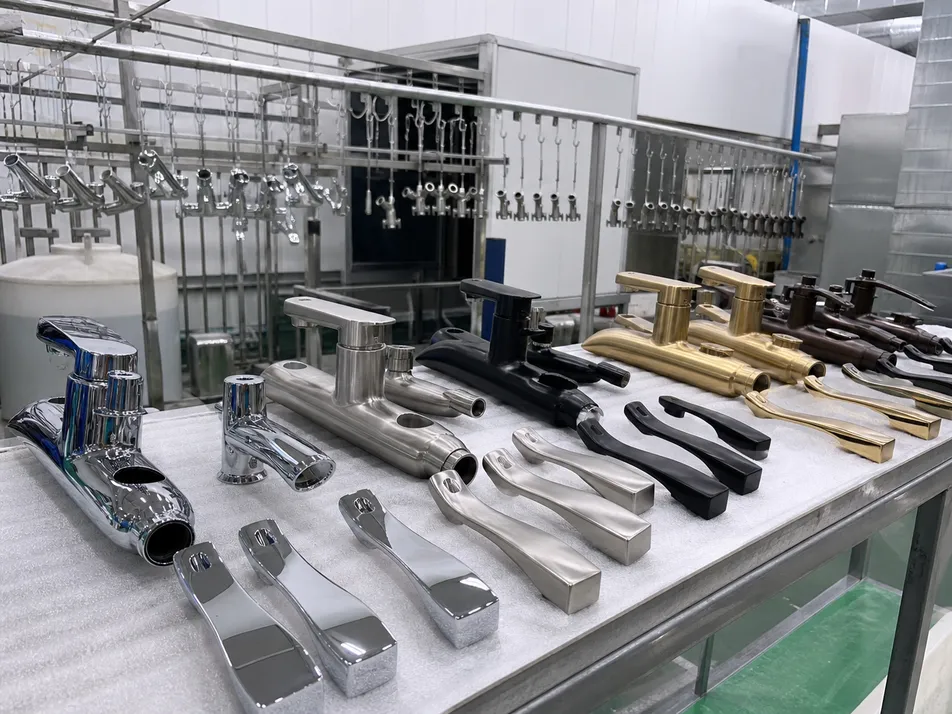
All five finishes run in-house: chrome, brushed nickel, matte black, PVD gold, and oil-rubbed bronze. For buyers building a coordinated bathroom hardware line — bathtub shower faucet, bathroom sink faucet, and accessories all in the same finish — sourcing from a single factory means the brushed nickel on your combination valve matches the brushed nickel on your sink faucet. Both pieces run through the same finishing line on the same chemistry and the same process parameters.
Chrome
Three-layer electroplating: copper base coat, nickel mid-coat, chrome top coat. The nickel mid-coat is the corrosion barrier — skipping it is a common cost-cutting move in the industry, and it's why chrome faucets from some factories fail salt spray at 48 hours.
Salt Spray Performance
24-hour minimum; most batches clear 48 hours. Critical for coastal markets, humid climates, Southeast Asia, the Gulf, and coastal Australia.
Brushed Nickel
Same three-layer electroplating process as chrome: copper base, nickel mid-coat, brushed nickel top coat. Runs through the same finishing line and chemistry as the chrome program, ensuring cross-SKU finish consistency when you source both finishes from this factory.
Cross-SKU Matching
Same line, same chemistry, same parameters as chrome. Brushed nickel on your combination valve matches brushed nickel on your sink faucet.
Matte Black
Runs on a PVD line, not a paint or powder process. PVD coating thickness is 0.3–0.5μm. Adhesion tested on every batch using a cross-cut tape test before parts move to assembly.
Why PVD Matters Here
The shower environment is the harshest finish test in residential hardware — daily water contact, temperature cycling, soap and cleaning product exposure. PVD doesn't lift the way spray finishes do. For buyers supplying North American and Australian markets where matte black is a strong trend, the PVD process keeps your return rate near zero.
PVD Gold
Physical vapor deposition process, same line as matte black. PVD gold delivers the durability profile of a hard coating rather than a plated or lacquered gold finish, which is relevant for buyers supplying hospitality and premium residential segments where finish longevity is a specification requirement.
Process
PVD line. Hard coating, not plated or lacquered. Suitable for hospitality and premium residential specifications.
Oil-Rubbed Bronze
In-house finishing alongside the other four finishes. Sourcing all five finishes from a single factory eliminates the cross-supplier finish variation that creates catalog inconsistency when a buyer's brushed nickel from one source doesn't match their oil-rubbed bronze from another.
Single-Source Advantage
All five finishes run in-house. No cross-supplier variation across your hardware line.
Single-Factory Finish Consistency
For buyers building a coordinated bathroom hardware line, sourcing from a single factory means every finish in your catalog runs through the same chemistry and the same process parameters — combination valve, sink faucet, and accessories all match.
- ✓ Chrome & brushed nickel: 3-layer electroplating with nickel corrosion barrier
- ✓ Matte black & PVD gold: physical vapor deposition, 0.3–0.5μm, batch adhesion tested
- ✓ Oil-rubbed bronze: in-house, same finishing operation
- ✓ Chrome salt spray: 24-hour minimum, most batches 48 hours
Process Detail
Why the Nickel Mid-Coat Matters
Chrome and brushed nickel go through a three-layer electroplating process: copper base coat, nickel mid-coat, chrome or brushed top coat. The nickel mid-coat is the corrosion barrier. Skipping it is a common cost-cutting move in the industry — it's why chrome faucets from some factories fail salt spray at 48 hours.
For buyers supplying coastal markets or humid climates — Southeast Asia, the Gulf, coastal Australia — that extra corrosion margin is the difference between zero warranty claims and a container of returns.
3
Electroplating layers (chrome & brushed nickel)
48h
Salt spray most batches clear
0.3–0.5μm
PVD coating thickness
Distribution & Volume
Market Segments Where This SKU Moves
Three distinct buyer patterns drive volume on this product. Understanding which segment fits your distribution model determines the right configuration, certification package, and order structure.

Primary Volume Driver
North American Residential Renovation
The standard alcove tub/shower enclosure is the most common bathroom configuration in US and Canadian housing stock. Renovation cycles run 8–15 years for bathroom hardware. Distributors supplying plumbing wholesalers and home improvement retailers in this market typically run 1,000–3,000 units per SKU per order on the bathtub shower faucet.
Volume Spec
Single-handle pressure-balance configuration in chrome or brushed nickel. It's what plumbers reach for on a standard renovation job.
1,000–3,000
units/SKU/order
8–15 yr
renovation cycle

Margin Opportunity
Multi-Unit Residential & Hospitality Procurement
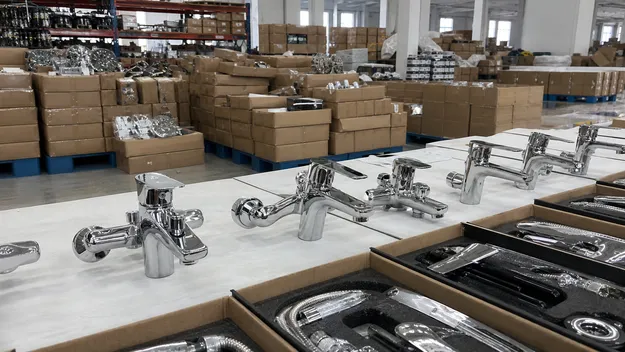
Apartment developers and hotel chains specifying a consistent finish and configuration across all units — 50 to 300 rooms, same SKU, same finish, same documentation package — represent a high-volume, low-complexity order pattern. We've shipped hotel procurement orders to buyers in the UAE, Southeast Asia, and Australia in this configuration.
Multi-Market Advantage
cUPC and WaterMark certifications on the same product body mean the same SKU clears customs in both North America and Australia without a separate compliance run — simplifying procurement for buyers supplying multiple markets.
50–300
rooms per order
UAE · SEA · AU
active markets
Catalog Distribution
Plumbing Wholesale Distribution — Southeast Asia & Middle East
Plumbing wholesale distribution in Southeast Asia and the Middle East tends to run broader SKU mixes at lower per-SKU volumes. A distributor building a tub and shower catalog might order 200–500 units of the bathtub shower faucet alongside other SKUs in a single container.
Why the Combination Valve Fits This Pattern
The combination valve covers both tub and shower function in a single product, which simplifies the distributor's catalog and reduces the number of SKUs a plumber needs to stock. Our OEM MOQ of 200 pieces per SKU is structured for exactly this order pattern.
200–500
units/SKU typical
200 pcs
OEM MOQ per SKU
Order Structure by Segment
The same product body, the same certification package, and the same finish program serve all three segments. What changes is the order volume, the documentation requirements, and the configuration spec. Understanding your segment determines how to structure the initial inquiry.
North America Reno
1,000–3,000 units
Chrome / brushed nickel · pressure-balance · cUPC
Hospitality / Multi-Unit
50–300 rooms
Any finish · same SKU · cUPC + WaterMark
SEA / Middle East Wholesale
200–500 units/SKU
Broad SKU mix · container · 200 pcs MOQ
OEM Configuration Options for This Product
Custom work on the bathtub shower faucet is common — buyers building coordinated bathroom collections want the handle design, trim plate profile, and finish to match across their shower valve, tub filler, and sink faucet. We handle that kind of collection development regularly, and the combination valve is typically the anchor SKU that the rest of the collection is designed around.
What Can Be Customized
Handle Design
Custom handle geometry from your 2D drawing or reference sample. In-house tooling room for brass casting dies means tooling revisions don't go to an outside vendor and add weeks to the timeline.
Trim Plate and Escutcheon
Custom profile shapes to match your collection design language. The trim plate is the most visible component of the installed valve — getting the profile right is worth the tooling investment if you're building a branded collection.
Valve Configuration
Pressure-balance standard; thermostatic available on OEM runs with appropriate certification documentation.
Diverter Configuration
Pull-up tub spout diverter (standard) or integrated valve body diverter (OEM). The integrated diverter configuration requires a different body casting.
Finish
All five in-house finishes available on OEM runs. Custom finish development — a specific brushed gold tone, a custom PVD color — is available on runs over 500 units.
Connection Standard
NPT for North America, G-thread for Europe and Australia, specified at order confirmation.
Private Label Packaging
Your brand name, logo, and packaging design on all cartons and product documentation.

MOQ and Lead Times
OEM Run Minimum
200 pieces per SKU minimum
First Sample — New Drawing or Reference
25–35 days from 2D drawing or reference product
Modified Sample — Existing Catalog SKU
15–20 days from an existing catalog SKU
Certification Extension
New handle or finish variants on an existing certified body handled by our engineering team — no full re-certification from scratch
Ready to discuss a custom collection or private label run? Our OEM team works directly with your product development team from drawing review through first sample approval.
Explore OEM & ODM ServicesCompliance Coverage for Your Export Markets
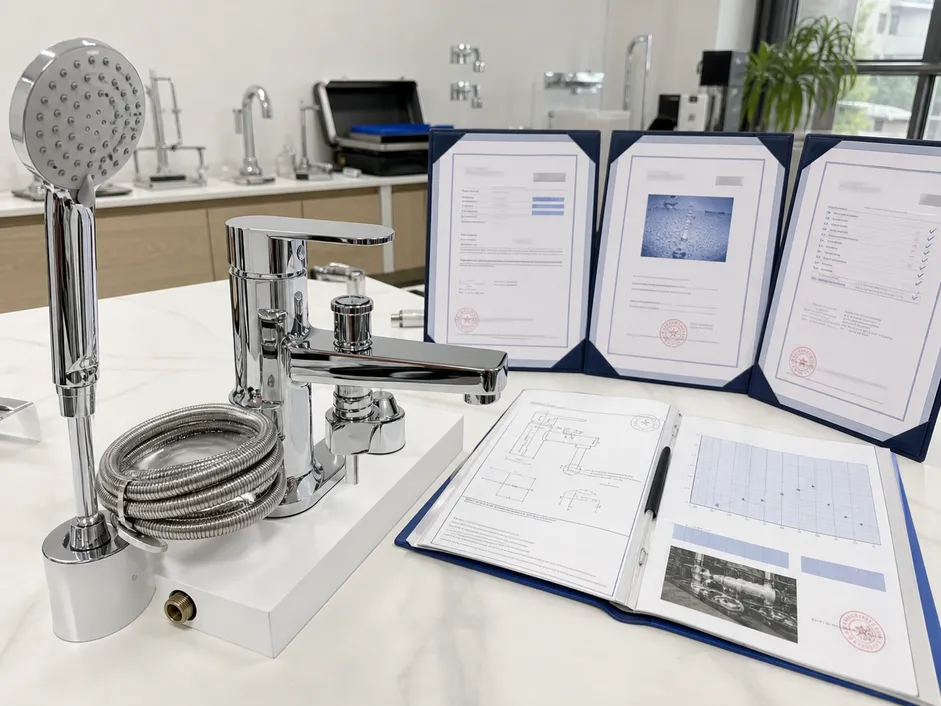
The bathtub shower faucet carries market-specific certification requirements that vary by destination. A product entering the US without cUPC documentation will be held at the port. A product entering Australia without WaterMark won't be installed by a licensed plumber.
| Market | Required Certification | Our Status |
|---|---|---|
| North America (US/Canada) | cUPC (IAPMO) | Certified |
| Europe | CE marking | Certified |
| Australia / New Zealand | WaterMark (AS/NZS) | Certified |
| International / General | ISO 9001:2015, SGS | Certified |
Lead Content Compliance — NSF/ANSI 61 & 372
The cUPC certification covers lead content compliance under NSF/ANSI 61 and 372. We test every incoming brass batch for lead content using XRF analysis and apply the same standard to all production regardless of destination market — so a batch destined for Southeast Asia is cast from the same lead-compliant alloy as a batch going to California.
For North American shipments, we prepare HS code classification and can provide binding ruling references for customs pre-clearance if your broker needs it.
Multi-Market Distribution from a Single SKU
For buyers supplying multiple markets from a single SKU — a common pattern for distributors in Southeast Asia who also supply Australia — the CE and WaterMark certifications on the same product body mean you're not managing two separate product lines to cover your compliance footprint.
Confirm at the RFQ stage and we'll specify the correct connection thread (NPT vs G-thread) for each destination market's cartons.
Container Loading and Landed Cost
Standard carton dimensions for the bathtub shower faucet are designed against 20GP and 40HQ container floor plans. Here's what to expect from order confirmation through container loading.
Carton & CBM Specs
A typical combination valve set — valve body, trim plate, handle, tub spout, and shower arm connection — packs at approximately 0.010–0.015 CBM per unit depending on configuration and packaging spec.
For a 40HQ container loaded with a mixed tub and shower SKU order, we calculate the packing sequence to minimize void space and provide a packing list with CBM and gross weight per SKU before you confirm the order, so your freight forwarder can quote accurately.
Documentation Prepared in Parallel
Documentation is prepared in parallel with production — your QC team has the data without requesting it separately.
- Commercial invoice
- Packing list
- Certificate of origin
- Applicable test reports (cUPC, CE, WaterMark, SGS, salt spray, endurance test) for the destination market

Lead Time: Order Confirmation to Container Loading
Standard Catalog Items
25–35 days
OEM Orders with New Tooling
35–50 days
Sourcing Decision FAQ
Common questions from buyers specifying bathtub shower faucets for the first time or expanding into new markets. Concrete answers, no filler.
What is the MOQ for bathtub shower faucets?
200 pieces per SKU for both standard catalog items and OEM orders. Mixed-SKU orders are common — we can combine the bathtub shower faucet with other tub and shower SKUs in one container.
Pressure-balance vs. thermostatic: which should I specify for the North American market?
Pressure-balance is the code-required configuration for shower valves in most US and Canadian jurisdictions (ASSE 1016). It's also the volume spec — plumbers on standard renovation jobs specify pressure-balance by default. Thermostatic is a premium tier that commands a higher retail price point and is worth adding to your catalog if you're targeting the upper-mid or luxury residential segment. If you're unsure which configuration fits your market, send us your target retail price point and we'll recommend the spec that protects your margin.
Can the same bathtub shower faucet ship to both the US and Australia?
Yes, if it carries both cUPC and WaterMark certification. Most of our standard bathtub shower faucet SKUs hold both certifications. The connection thread differs — NPT for North America, G-thread for Australia — so confirm at the RFQ stage and we'll specify the correct thread for each destination market's cartons.
What finish holds up best in a humid or coastal market?
PVD finishes (matte black, PVD gold) are the most corrosion-resistant option in wet environments — the PVD process produces a harder, denser coating than electroplating, and we've had zero finish-related returns on PVD product from our Southeast Asia and Gulf buyers. For chrome and brushed nickel, ask for the 48-hour salt spray test report for the specific batch — we have it for every production run. Oil-rubbed bronze has a living finish characteristic that develops patina over time; confirm with your downstream buyers before specifying it for a humid climate project.
How do I prevent diverter sticking complaints from my customers?
Diverter sticking in combination valves is almost always a casting quality issue — porosity in the valve body allows mineral deposits to accumulate in the diverter channel. We use gravity casting (denser brass, lower porosity than die casting) and machine the diverter channel to a tolerance that accommodates normal mineral buildup without causing sticking. We tightened this tolerance spec in 2021 specifically in response to feedback from a high-mineral-content water market. If your buyers are in a region with hard water, ask us about the diverter channel spec — we can confirm the tolerance and provide the relevant QC data.
What documentation comes with each shipment?
Commercial invoice, packing list, certificate of origin, and the applicable test reports (cUPC, CE, WaterMark, SGS, salt spray, endurance test) for the destination market. The test reports travel with the shipment — your QC team has the data without requesting it separately.
Tub & Shower Line
Other Products in the Tub & Shower Line
The bathtub shower faucet is the combination valve configuration. If your buyers need a different setup, these sibling products cover the adjacent configurations.
Bathtub Faucets
Tub-Only Filler
Tub-only fillers with integrated diverter for handheld shower connection. The right SKU when the shower function is handled by a separate valve.
Shower Faucets
Shower-Only Valve
Shower-only valve and trim assemblies. For dedicated shower enclosures with no tub.
Single Handle Shower Faucets
Pressure-Balance Valve
Single-lever pressure-balance valves, the dominant spec in North American residential construction.
Wall Mount Bathtub Faucets
Wall-Mounted Tub Filler
Wall-mounted tub fillers for alcove or freestanding tub installations where a deck-mount profile isn't practical.
Freestanding Bathtub Faucets
Floor-Standing Tub Filler
Floor-standing tub fillers for freestanding soaking tubs. The highest-margin SKU in the category for most distributors.
Ready to Move Forward? Let's Build Your Quote.
Send us your target market, the configuration you're evaluating — pressure-balance or thermostatic, standard catalog or OEM — and your volume expectations. We'll come back with a detailed quote and a recommendation on which finish and connection spec fits your market best.
Most new buyers in this product type start with a sample order across two or three finish options to test with their own customers before committing to a full container.
What to Include in Your First Message
- Target market and destination country
- Configuration preference: pressure-balance or thermostatic
- Standard catalog or OEM requirement
- Volume expectations (units per order or per year)
Contact Us Directly
Typical First Order
Most new buyers start with a sample order across two or three finish options to test with their own customers before committing to a full container.