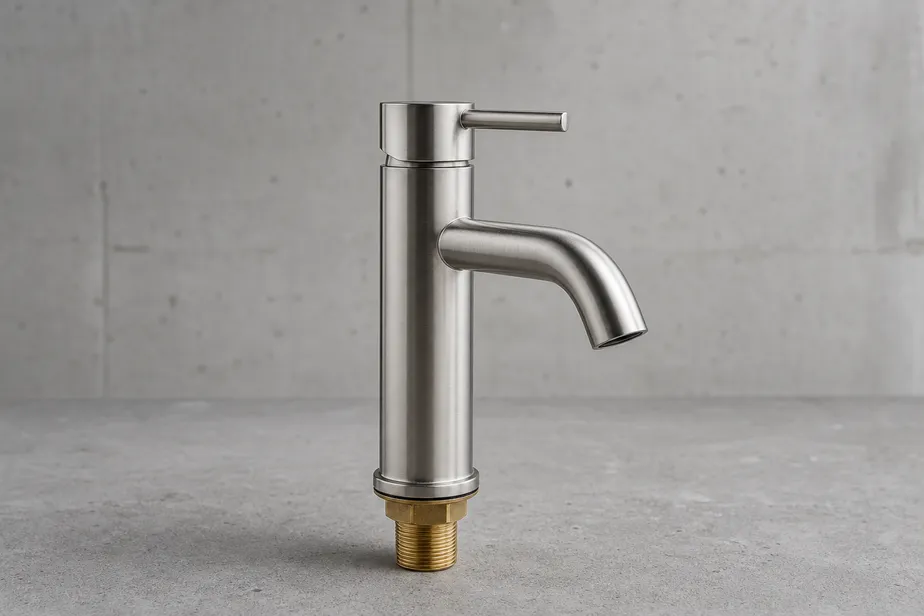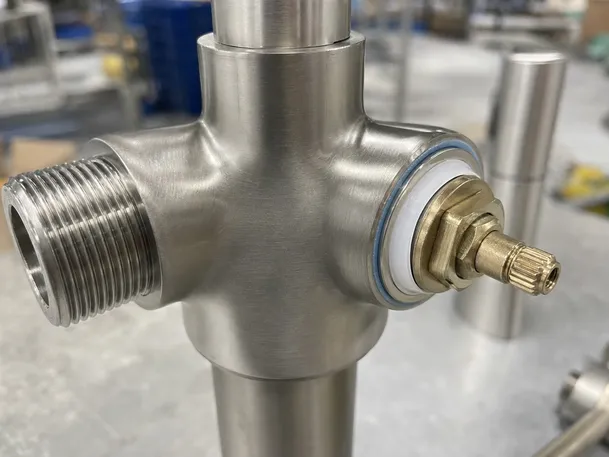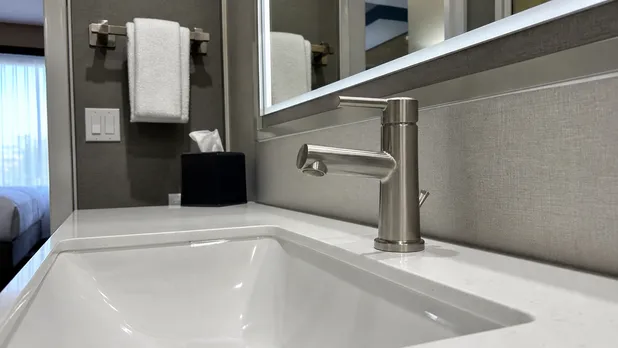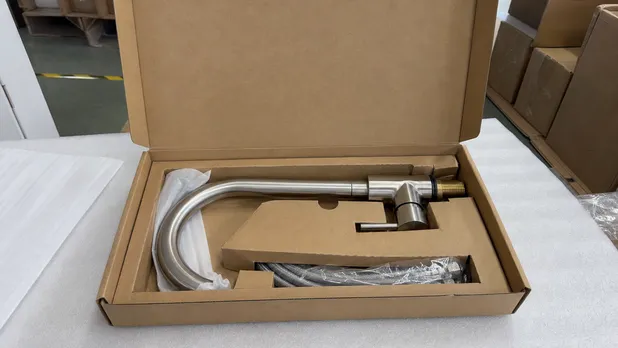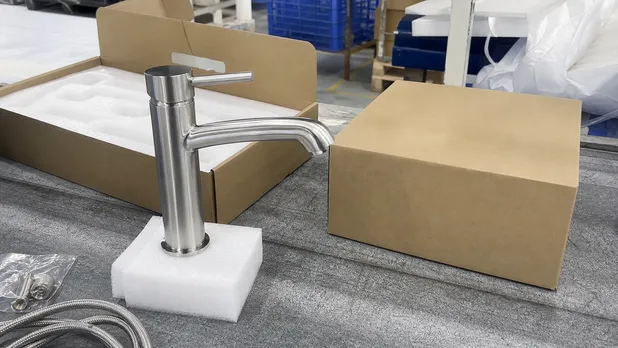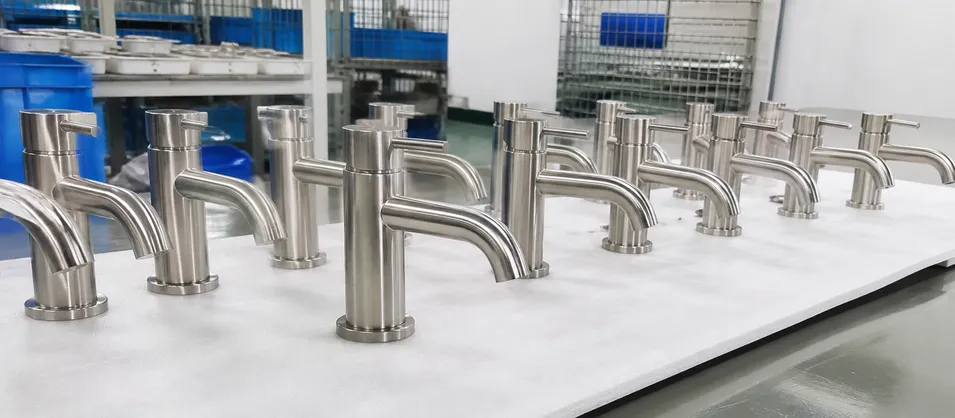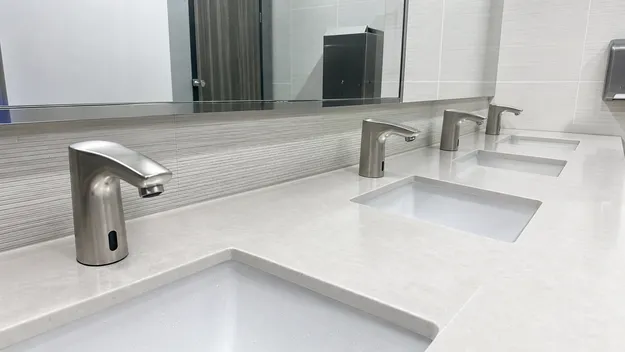

Brass body, multi-layer electroplating, 48-hour salt spray rated. CE, cUPC, and WaterMark certified. OEM from 200 units with in-house surface finishing.
Surface Engineering
Brushed nickel faucets look nearly identical across suppliers on day one. The difference shows up at month 14 in a coastal Florida bathroom, or in a humid Bangkok hotel room, or in a Pacific Northwest kitchen where the faucet sees hard water and daily cleaning spray. By then, a faucet built on a thin or incomplete plating stack has started tarnishing, and your buyer is filing a warranty claim.
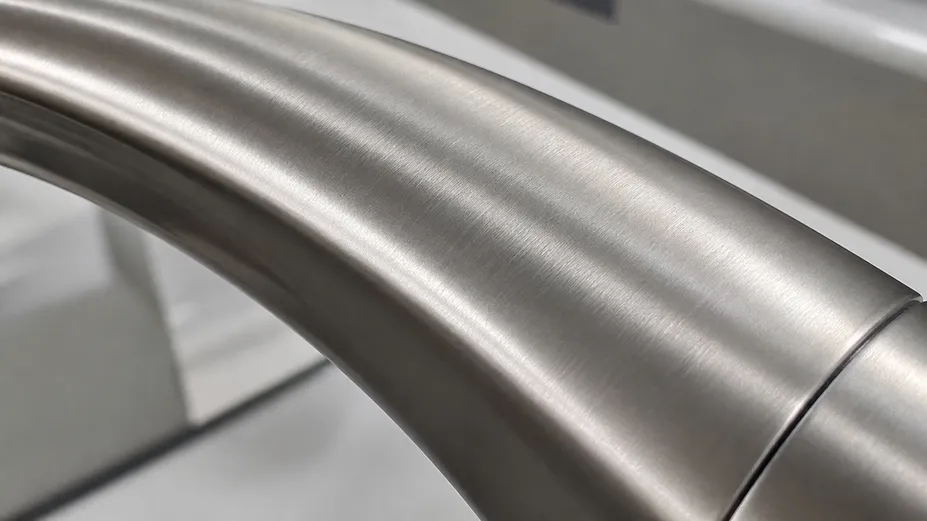
The finish we run on our brushed nickel faucets is a three-layer electroplating stack: copper base coat, nickel mid-coat, brushed nickel top coat. The copper base improves adhesion between the brass substrate and the nickel layers. The nickel mid-coat — typically 8–12μm thick — is the actual corrosion resistance layer. The brushed nickel top coat gives the finish its characteristic matte, directional texture.
Skipping or thinning the nickel mid-coat is the most common cost-cutting move in this category, and it's why you see brushed nickel faucets from some factories failing salt spray at 48 hours and showing early tarnishing in the field.
Our brushed nickel passes 24-hour salt spray as a minimum. Most production batches clear 48 hours. We pull a statistical sample from every batch for salt spray testing — not just on new product introductions, not just on first orders. Every batch. The test reports travel with the shipment documentation so your QC team has the data without requesting it separately.
Our QC manager pushed us to add the 48-hour extended protocol after we saw a batch of brushed nickel product show early tarnishing in a humid climate market — that was years ago, and the protocol has been standard since.
For your distribution business, the commercial translation is straightforward: a brushed nickel faucet that holds its finish in coastal and humid markets generates zero warranty claims from those accounts. A faucet that tarnishes at 14 months generates returns, replacement costs, and a conversation with your buyer about whether to continue the line. The plating stack is the difference between those two outcomes.
Layer 3 — Top Coat
Brushed Nickel
Directional matte texture. The visible finish surface. Applied after mechanical brushing to create the characteristic grain.
Layer 2 — Mid-Coat
Nickel 8–12μm
The corrosion resistance layer. Thickness here is the primary determinant of long-term finish durability. Skipping or thinning this layer is the most common cost-cutting move in the category.
Layer 1 — Base Coat
Copper
Improves adhesion between the brass substrate and the nickel layers. Provides a uniform foundation for the mid-coat to bond to.
Substrate
Brass Body (C36000-equivalent)
Free-machining brass. Dimensionally stable, corrosion-resistant base material for the full plating stack.
Minimum Rating
24h
Salt spray — all batches
Extended Protocol
48h+
Most production batches
Product Data
Specifications shown are standard values for this product line. Contact us for exact parameters on specific SKUs or custom configurations.
| Parameter | Specification |
|---|---|
| Body Material | Brass (C36000-equivalent free-machining brass) |
| Plating Stack | Copper base coat → nickel mid-coat (8–12μm) → brushed nickel top coat |
| Finish Texture | Directional brushed, matte surface |
| Valve / Cartridge | Ceramic disc, 500,000-cycle endurance rated |
| Operating Pressure | 0.05–0.8 MPa |
| Flow Rate | 1.5–8 L/min (aerator-adjustable) |
| Temperature Range | Cold water / mixed (up to 90°C) |
| Salt Spray Rating | 24h minimum · 48h+ on most production batches |
| Connection | Standard 1/2" supply connections (3/8" adapter available) |
| Certifications |
CE cUPC WaterMark SGS
|
| MOQ (standard catalog) | 200 units |
| MOQ (OEM / custom) | 200 units |
| Lead Time (standard) | 25–35 days from order confirmation |
| Lead Time (OEM) | 35–50 days (new tooling) · 15–20 days (catalog body modification) |
Production Lead Times
From order confirmation. Subject to current production schedule.
OEM Services
Most buyers start with a catalog body and modify the finish, handle, or spout. Full custom tooling is available for volume programs. Here's what's practical at each level.
Tier 1 — No Tooling Cost
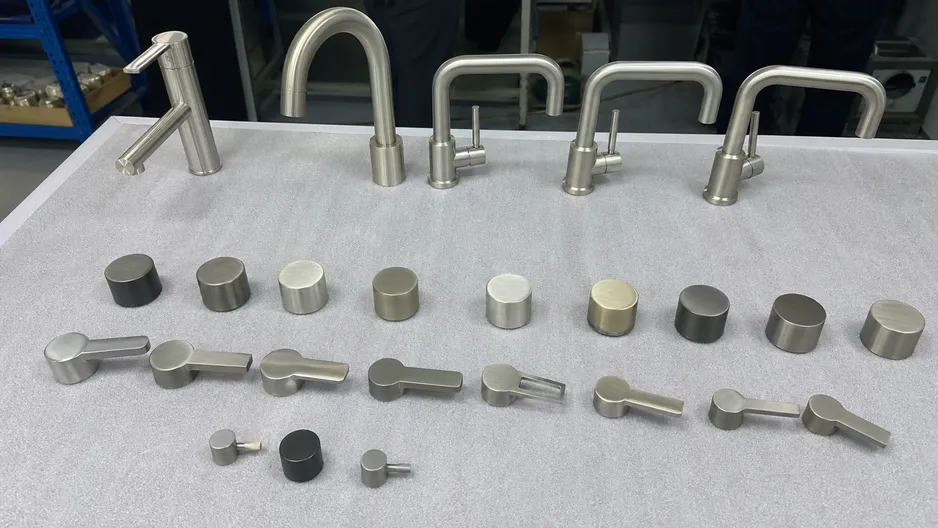
Switch the surface finish on an existing catalog body. Available finishes include brushed nickel, chrome, matte black, brushed gold, and ORB. Custom packaging, private label, and branded inserts are included at this tier.
Tier 2 — Minor Tooling
Modify handle shape, spout reach, or spout height on an existing catalog body. Tooling cost is low because the core body casting is unchanged. Lead time for modified catalog bodies is 15–20 days.
Tier 3 — Full Custom
Full custom body geometry from your drawings or 3D files. We handle tooling fabrication, sample approval, and production. Lead time is 35–50 days for new tooling. Minimum volume applies — contact us to discuss your program.
Share your requirements
Send us your target finish, handle style, spout dimensions, certifications needed, and annual volume estimate.
We recommend a path
We'll identify the closest catalog match and tell you exactly what tooling, if any, is needed to hit your spec.
Sample approval
Physical samples are produced and shipped for your review. Production starts only after written approval.
Production & QC
Full production run with in-line QC, salt spray testing, and pre-shipment inspection. Third-party inspection available on request.
Ready to discuss your program?
Send us your spec and we'll respond within one business day.
Manufacturing Standards
Every production batch goes through a defined inspection sequence before it ships. Here's what that looks like in practice.
Step 1 — Incoming
Brass billets are verified for alloy composition before entering the machining line. Plating chemistry is checked at bath setup for each production run.
Step 2 — In-Process
Critical dimensions are checked at machining. Plating thickness is measured by XRF at defined intervals during the plating run to confirm the 8–12μm nickel layer is within spec.
Step 3 — Finish
Batch samples are run through salt spray (ASTM B117 protocol). Minimum pass threshold is 24 hours with no blistering or corrosion. Most batches exceed 48 hours. Adhesion cross-cut test is run in parallel.
Step 4 — Functional
100% of assembled units are pressure-tested at 1.6 MPa (2× operating maximum) before packaging. Any unit that shows leakage at the valve, body, or connections is rejected and not reworked into the shipment.
Step 5 — Pre-Shipment
AQL 2.5 visual and functional inspection on the packed cartons. Inspection report, test certificates, and packing list are issued with every shipment. Third-party inspection (SGS, Bureau Veritas, Intertek) available on request.
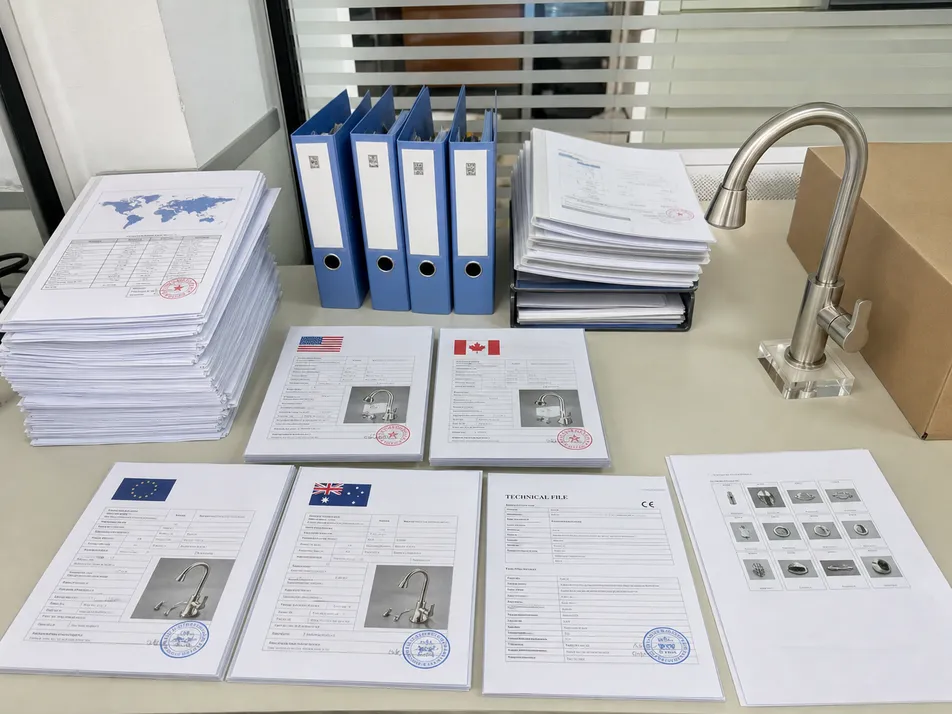
Certificate copies available on request with your inquiry.
Third-Party Inspection
SGS, Bureau Veritas, and Intertek inspections can be arranged at your cost. We coordinate access and documentation. Most buyers on repeat programs waive this after the first two orders.
Buyer's Guide
What to verify before placing an order — and the questions most buyers don't think to ask until after a quality problem.
Nickel layer thickness
Ask for the XRF measurement report from the last production batch. The number to look for is the nickel mid-coat — anything under 6μm is a durability risk. Many suppliers quote a total plating thickness that includes the copper base coat to make the number look larger.
Salt spray test hours — and the protocol
A "salt spray test" without a protocol reference is meaningless. Ask for ASTM B117 or ISO 9227 results. Also ask whether the number quoted is the minimum across all batches or the best result from a single sample.
Certificate validity and scope
Check that the certificate covers the specific SKU you're ordering, not just a similar product. cUPC and WaterMark certificates are model-specific — a certificate for a different spout height or handle style does not cover your product.
Valve source and cycle rating
Ask for the valve manufacturer and the cycle test report. A ceramic disc valve rated to 500,000 cycles is the standard for a product that will last in a residential bathroom. Anything below 200,000 cycles is a warranty liability.
Packaging and transit protection
Brushed nickel surfaces scratch easily in transit. Ask whether the faucet body is individually wrapped in foam or PE film before boxing. Loose packing in a single carton is a common cause of finish damage that only shows up after delivery.
Is the plating done in-house or subcontracted?
Subcontracted plating means the supplier has less control over bath chemistry and thickness consistency. It's not automatically a problem, but you should know — and ask whether the sub-plater is audited and how often.
What happens to a rejected unit?
Some factories re-strip and re-plate rejected units and put them back into the shipment. Ask explicitly whether reworked units are included in your order or scrapped. The answer tells you a lot about how the supplier thinks about quality.
What is the lead time for a repeat order vs. a first order?
First orders often get quoted with optimistic lead times. Ask what the lead time is for a repeat order of the same SKU when you're not the only customer in the queue. That number is closer to what you'll actually experience at scale.
Can you hold safety stock for me?
If you're running a retail or e-commerce program, ask whether the supplier can hold a buffer stock against a blanket PO. Many factories will do this for established buyers — it cuts your effective lead time to days rather than weeks.
Who owns the tooling?
If you've paid for custom tooling (handle shape, spout profile, private label), confirm in writing that the tooling is yours and can be transferred. Tooling ownership disputes are one of the most common reasons buyers get locked into a supplier they want to leave.
| Order Type | MOQ | Lead Time | Notes |
|---|---|---|---|
| Sample order | 1–5 pcs | 7–10 days | Standard stock SKUs only |
| Trial / first order | 50–100 pcs | 25–35 days | Includes full QC documentation |
| Repeat / stock order | 100–500 pcs | 20–30 days | Priority scheduling for repeat buyers |
| OEM / custom | 500+ pcs | 45–60 days | Includes tooling and sample approval |
| Blanket PO / safety stock | 1,000+ pcs/yr | 3–7 days (from stock) | Requires annual volume commitment |
Lead times are from order confirmation and deposit receipt. Shipping transit time is additional.
Where It's Used
Brushed nickel faucets serve a wide range of end markets. Understanding where your buyers are placing the product helps align spec, certification, and packaging requirements before you order.
Residential
The largest single end-use segment. Brushed nickel is the dominant finish in mid-range new construction and renovation projects in North America and Australia. cUPC certification is required for US and Canadian distribution.
Residential
Kitchen faucets in brushed nickel are a strong seller in the mid-to-premium retail segment. Pull-out and pull-down spout variants are the most requested. Higher cycle ratings on the valve are expected given daily use frequency.
Commercial
Hotel and serviced apartment fit-outs specify brushed nickel for its ability to hide water spots and fingerprints — a practical advantage in high-turnover environments. Bulk orders with consistent finish matching across batches are the key requirement.
Commercial
Multi-unit residential developers buy in volume and need finish consistency across hundreds of units. Lot traceability and batch documentation are important — if a finish issue appears in unit 47, the developer needs to know which other units came from the same production run.
Retail
Amazon, Wayfair, and home improvement retail channels require retail-ready packaging, compliance documentation, and fast replenishment. Private label and OEM programs are common. Return rates are directly tied to finish quality and installation ease.
OEM / Private Label
Brands and distributors sourcing under their own label need custom packaging, logo placement, and sometimes modified handle or spout geometry. Tooling costs and minimum volumes apply. Certificate re-issuance under the buyer's brand name is available for most markets.
Common Questions
The terms are used interchangeably in most markets. Both refer to a nickel plating that has been mechanically brushed to create a fine linear grain texture. Some manufacturers use "satin nickel" to indicate a slightly warmer or softer sheen, but there is no standardized distinction. When ordering, ask for a physical sample to confirm the exact appearance.
Brushed stainless steel faucets are made from solid stainless steel with a brushed surface — no plating involved. They are more corrosion-resistant and harder to scratch, but cost more and are heavier. Brushed nickel faucets are brass-bodied with a nickel plating, which gives more design flexibility and a warmer tone. For most residential and hospitality applications, brushed nickel is the more cost-effective choice.
Yes, within a production run. Finish consistency is controlled by bath chemistry and brushing parameters. If you're ordering faucets, towel bars, and accessories to match, they need to come from the same production batch or from a supplier who maintains a documented finish standard. Cross-batch matching is possible but requires a reference sample and explicit approval step.
cUPC (IAPMO) certification is the primary requirement for plumbing fixtures sold in the US and Canada. It covers both performance and lead-free compliance (NSF/ANSI 61 and 372). Some states and retailers also require WaterSense certification for water efficiency. Check your specific channel requirements — big-box retailers often have their own compliance checklists on top of the base certifications.
Samples of standard stock SKUs are available from 1 piece. Sample cost covers the unit and handling — shipping is at the buyer's cost or via the buyer's courier account. For custom or OEM configurations, a pre-production sample is required before bulk production and is quoted separately.
Wipe with a soft damp cloth and dry after use. Avoid abrasive cleaners, scouring pads, and acidic or bleach-based products — these will damage the nickel surface. For hard water deposits, a diluted white vinegar solution applied briefly and rinsed thoroughly is safe. This information is worth including in your product packaging to reduce warranty claims from finish damage caused by improper cleaning.
Yes. Private label and OEM programs are available. This includes custom packaging design, logo on the product (where geometry allows), and custom instruction manuals. Minimum quantities for private label are typically 500 pieces per SKU. Certificate re-issuance under your brand name is available for CE, cUPC, and WaterMark — timelines vary by certification body.
Standard terms are 30% deposit on order confirmation, 70% balance before shipment. For established buyers with a track record of three or more orders, 30/70 with balance against copy of bill of lading is available. Letter of credit (LC at sight) is accepted for orders above USD 50,000. Payment is accepted via T/T bank transfer or LC.
Brushed nickel is a finish-driven purchase. The commercial opportunity is in the segments where finish selection drives the buying decision. Here's where the volume is.
Residential Distribution & Kitchen/Bath Retail
The North American and European residential renovation market has shifted toward brushed and matte finishes over the past several years. Brushed nickel is the entry point into that shift — the accessible price tier below brushed gold and champagne bronze, and the finish that coordinates with stainless appliances and grey-tone cabinetry that dominates current residential design.
Distributors supplying plumbing showrooms, kitchen and bath retailers, and home improvement channels are seeing brushed nickel outperform chrome in the mid-price tier.
Margin Structure
Brushed nickel faucets retail at 20–40% above equivalent chrome products, while the manufacturing cost premium is modest. That spread is where your margin lives on this SKU.
Hospitality Renovation & Contract Supply
Hotel renovation projects specify brushed nickel for bathroom and vanity faucets because the finish photographs well for marketing materials, resists fingerprints better than chrome in high-use environments, and holds its appearance longer under daily cleaning.
Typical Project Scale
A mid-scale hotel renovation — 150 to 300 rooms — might specify 300–600 faucets across bathroom, vanity, and public area applications.
Brushed nickel is typically the standard specification at the 3-to-4-star tier; brushed gold moves into the 4-to-5-star tier. If you're supplying hospitality procurement or FF&E (furniture, fixtures, and equipment) distributors, brushed nickel is a recurring line item on renovation cycles that run every 7–10 years per property.
E-Commerce & Online Retail Channels
Brushed nickel faucets are a strong performer in e-commerce channels — Amazon, Wayfair, and independent online stores in North America and Europe — because the finish photographs distinctively and commands a clear price premium over chrome in search results.
For buyers building an e-commerce SKU mix, brushed nickel is a lower-risk entry point than brushed gold: the price point is accessible enough to generate volume, and the finish is established enough that buyers aren't making an unfamiliar choice.
Packaging Note
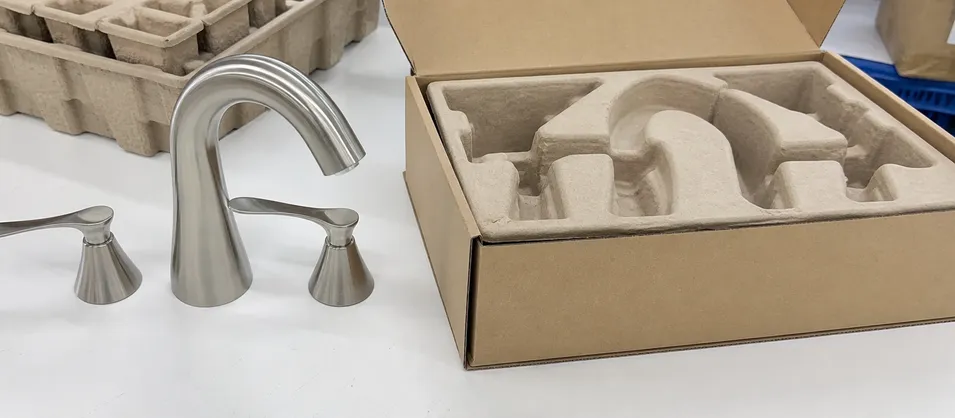
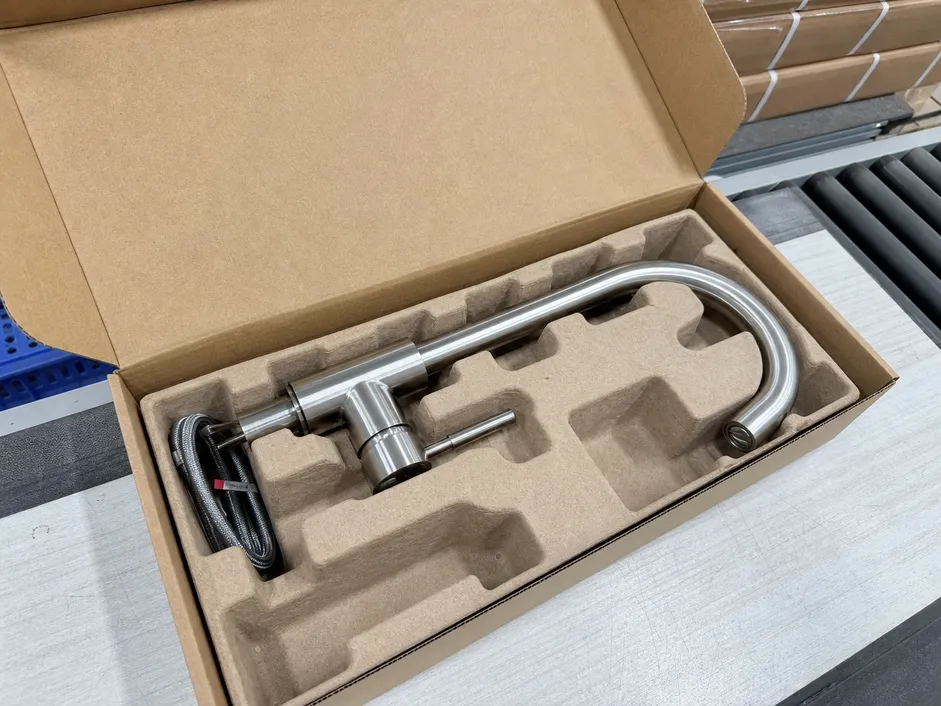
Our standard carton packaging is designed for mail-order durability — double-wall corrugated, molded pulp inserts, no polystyrene. The product arrives undamaged whether it's going to a warehouse or direct to a consumer address. We moved away from polystyrene inserts a few years back; the damage rate on transit drops noticeably with molded pulp, and it's better for your returns rate.
Coastal & Humid Climate Markets
Buyers supplying coastal markets — Florida, the Gulf Coast, Southeast Asia, the Middle East, Australia — deal with customers who have been burned by brushed nickel faucets that tarnished within a year.
A supplier who can provide a 48-hour salt spray test report has a concrete answer to that objection. Our brushed nickel is specified for these markets by buyers who've learned the hard way that the cheaper option costs more in warranty claims.
Selling Tool, Not Just Compliance
If your distribution territory includes coastal or high-humidity accounts, the salt spray documentation is a selling tool, not just a compliance document.
Residential Retail
20–40% retail premium over chrome; modest cost delta
Hospitality Contract
300–600 units per mid-scale renovation; 7–10 year cycles
E-Commerce
Strong photography, clear price premium, lower-risk SKU entry
Coastal Markets
48h salt spray documentation as a direct sales argument
The finish starts with the brass body coming off our CNC machining line. Every step in the sequence below has a direct consequence for the quality your customers receive.
Before any plating, the brass body goes through a pre-treatment sequence: alkaline degreasing, acid activation, and a rinse cycle. This pre-treatment is where surface contamination and oxidation are removed. If you skip or rush it, the plating adhesion is compromised at the substrate level — and no amount of plating thickness fixes a bad bond.
The copper base coat goes on first, applied by electroplating in a copper sulfate bath. Copper is a better adhesion surface for nickel than bare brass — the bond strength between copper and nickel is higher than between brass and nickel, which matters when the finished faucet goes through thermal cycling in use.
The nickel mid-coat follows, applied in a nickel sulfamate bath at controlled current density to achieve the 8–12μm target thickness.
Thickness Target
8–12 μm
Batch Variation
±1 μm
Thickness measured by X-ray fluorescence (XRF) — the same equipment used for incoming brass alloy verification.
The brushed nickel top coat is applied last, then mechanically brushed to create the directional texture. The brushing direction and pressure are controlled to produce a consistent grain pattern across the batch. Inconsistent brushing shows up as visible variation in texture when multiple faucets are installed side by side — a problem in hospitality applications where uniformity matters. We run a visual inspection on every unit at the post-plating checkpoint before parts move to assembly.
Post-Plating Final Inspection
After assembly, every faucet goes through our standard final inspection sequence:
The salt spray sample pull happens at this stage — we test a statistical sample from each production batch, not just from new product introductions.
Each step in the plating sequence has a downstream consequence. Shortcuts at any stage show up as adhesion failures, thickness variation, or texture inconsistency — all of which become your warranty problem, not ours.
Adhesion at the Substrate
Pre-treatment quality determines bond strength. A compromised bond can't be corrected by adding plating thickness.
Thickness Consistency
XRF measurement on every batch. ±1μm variation across a batch means predictable corrosion resistance, not batch-to-batch surprises.
Texture Uniformity
Controlled brushing direction and pressure. Visible grain variation across installed faucets is a hospitality specification failure — we inspect every unit before assembly.
Brushed nickel faucets have more customization flexibility than most buyers expect, and a few hard limits that are worth knowing upfront.
Body Profile & Spout Configuration
We work from 2D drawings or reference samples. Our in-house tooling room handles brass casting die modifications, so tooling revisions don't go to an outside vendor. New body tooling adds 25–35 days to the first sample timeline; modifications to existing catalog bodies run 15–20 days.
Handle Design
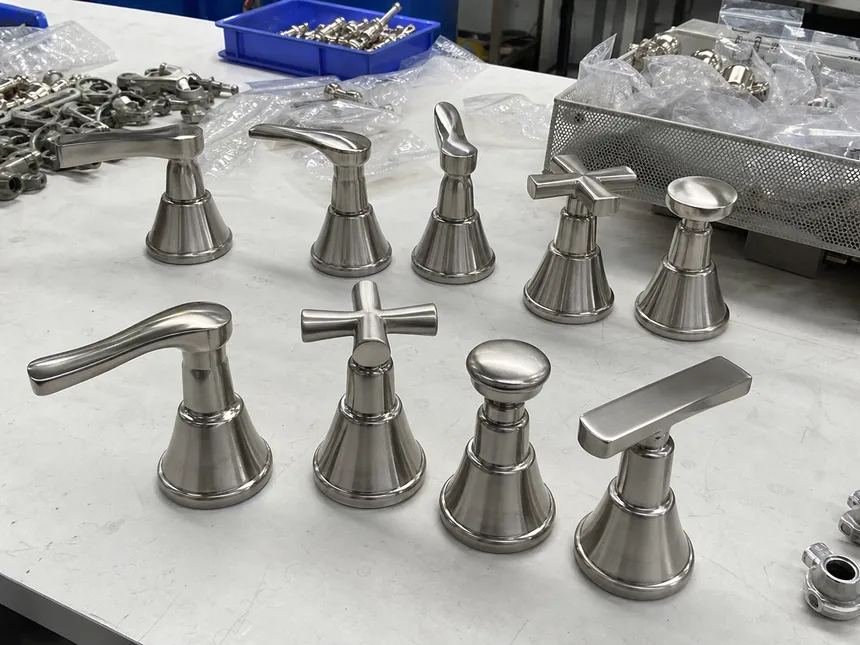
Single-lever, two-handle, cross-handle, and lever configurations are all available. Handle tooling is typically simpler than body tooling and can often be adapted from existing catalog options.
Spout Reach and Height
Within the structural constraints of the body design, spout geometry is adjustable. We'll tell you if a requested geometry creates a structural or flow issue.
Brushing Texture
The grain direction and coarseness of the brushed finish can be adjusted within a range. We can match a reference sample's texture if you provide one.
Private Label & OEM Branding
Logo engraving on handle or body, custom packaging, and private label documentation are all available. MOQ for private label is the same as standard OEM: 200 units.
Plating Stack Composition
We don't offer a "budget" version of the brushed nickel finish that skips the nickel mid-coat. If you need a lower-cost brushed finish, we'll discuss chrome-over-brass with a brushed top coat, but we'll be clear about the performance difference.
Custom PVD Color Matching
PVD brushed gold and brushed champagne bronze are available in our standard color range. Custom PVD color matching requires a minimum run of 500 units to justify the bath chemistry setup cost.
All timelines are first-sample lead times from order confirmation.
Standard Catalog Items
200 units
25–35 days
Catalog Body + Modification
200 units
15–20 days
Handle or finish modification
New Body Tooling (OEM)
200 units
35–50 days
Our brushed nickel faucets carry the certifications your destination market requires. Here's what's in place and what it covers for your import and resale process.
North America
North American plumbing code compliance. Covers lead content (NSF 61/372 compliant — maximum 0.25% weighted average lead content in wetted surfaces), pressure and flow performance, and material standards.
Required for sale through licensed plumbing channels in the US and Canada. California AB 1953 compliance is covered under cUPC.
If your buyers are in commercial procurement channels that require NSF 61 listing separately, contact us for documentation on which SKUs carry it.
European Union
European conformity. Required for sale in EU markets. Covers material safety, pressure ratings, and flow performance under EN 817 and EN 200 standards.
Our brushed nickel line is CE marked.
Australia & New Zealand
Australian standards compliance (AS/NZS 3718). Required for sale through licensed plumbing channels in Australia and New Zealand.
Our brushed nickel faucets carry WaterMark certification — relevant if you're supplying the Australian residential or commercial renovation market.
Third-Party Testing
Third-party testing and audit. SGS test reports covering material composition, salt spray performance, and endurance testing are available for all brushed nickel SKUs.
Useful for buyers whose import process requires third-party verification independent of manufacturer documentation.
All certification documentation ships with the order. Your customs broker and compliance team get the paperwork without having to request it separately — same documentation package, container to container.
Included Markets
US, Canada, EU, AU/NZ
Third-Party Audit
SGS Reports Available
Lead Compliance
NSF 61/372 · AB 1953
EU Standards
EN 817 · EN 200
Logistics & Fulfillment
How faucets are packed determines whether they arrive in sellable condition. Here's the full picture — from carton construction to container optimization to e-commerce labeling.
Double-wall corrugated + molded pulp insert
Standard carton packaging uses double-wall corrugated outer cartons with molded pulp inner inserts. The molded pulp holds the faucet body and handle assembly in fixed position without contact between metal surfaces — transit damage from surface-to-surface contact is the most common source of finish damage on faucets in shipping, and the molded pulp eliminates it.
Recyclable packaging, lower damage rate
We moved away from polystyrene foam inserts several years ago. The damage rate on transit drops measurably with molded pulp, and the packaging is recyclable — which matters for buyers selling into markets with packaging waste regulations.
FBA, 3PL, and parcel carrier compatible
The standard carton is designed to survive parcel carrier handling without additional outer packaging. If your fulfillment model involves FBA or third-party warehouse receiving, we can add FNSKU labels, ASIN barcodes, or warehouse-specific labeling to the carton before shipment. White-label packaging with your brand name and product photography is available on OEM orders.
We calculate carton dimensions against 20GP and 40HQ floor plans and provide a packing list with CBM and gross weight per SKU before you confirm the order.
For buyers consolidating multiple SKUs — brushed nickel kitchen faucets, bathroom faucets, and shower faucets in the same container — we coordinate the packing sequence to minimize void space and keep the container weight balanced for port handling.
CBM and gross weight documentation provided per SKU before order confirmation — no surprises at freight booking.
OEM Packaging Options
FNSKU / ASIN Labels
Applied to carton before shipment for FBA receiving
3PL Labeling
Warehouse-specific labeling per your 3PL requirements
White-Label Carton
Your brand name and product photography on OEM orders
Parcel-Ready
Standard carton survives parcel carrier handling without outer wrap
Product Range
Brushed nickel is one finish in a broader brushed and specialty finish range. If your market or project requires a different finish, here's where to look.
Brushed Finish Range
The broader brushed finish category, covering brushed gold (PVD), brushed champagne bronze, and brushed gunmetal in addition to brushed nickel. If your buyers are in the upper-tier residential or luxury hospitality segment where brushed gold and champagne bronze are the specified finishes, this is the product line.
PVD coating 0.3–0.5μm, cross-cut adhesion tested per batch
Brushed gold and champagne bronze retail at a significant premium over brushed nickel — real margin expansion if your market supports the price point
Commercial & Food Service
If your application requires corrosion resistance from the base material rather than from a plating stack — commercial kitchens, food service, marine-adjacent installations — the stainless steel line is the right choice.
304-grade body, no plating required
Intrinsic corrosion resistance — suited for environments where plating durability is a liability
Touchless & Commercial
If your buyers are in commercial washroom, healthcare, or public facility applications where touchless operation is the specification, the sensor faucet line covers that segment.
Available in brushed stainless and chrome finishes
Suited for healthcare, public facility, and high-traffic commercial washroom specifications
Not sure which finish fits your market?
The full specialty faucet range covers brushed, stainless, sensor, and more — all available for OEM specification.
Decision-support answers for distributors, importers, and OEM buyers evaluating brushed nickel faucets.
MOQ is 200 units for standard catalog items. You can mix SKUs within the brushed nickel line to reach the MOQ — for example, 100 kitchen faucets and 100 bathroom faucets. For OEM orders with new body tooling, MOQ is 200 units per SKU.
Market trial note: If you're testing a new SKU in your market before committing to volume, 200 units is low enough to run a meaningful trial without a full container commitment.
Standard Catalog MOQ
200 units — SKU mixing allowed within the brushed nickel line
OEM / New Tooling MOQ
200 units per SKU — applies when new body tooling is required
Both finishes command a premium over chrome, but they serve different buyer segments. The right choice depends on your market position and risk tolerance.
Brushed Nickel
Matte Black
Our recommendation: For a distributor building a core SKU mix, brushed nickel is the lower-risk choice with reliable volume. We manufacture both finishes — if you want to compare the margin structure for your specific market, send us your target retail price points and we'll spec both options.
There are three specific things to ask for — and the answers will tell you quickly whether a supplier's quality commitment is real.
Request the salt spray test report — in hours, not pass/fail
Ask for the result in hours, not just a pass/fail statement. 24 hours is the industry floor; 48 hours is the standard for quality product. A supplier who only offers pass/fail is likely testing to the minimum threshold.
Ask whether testing is batch-level or introduction-only
Ask whether the test is run on every production batch or only on new product introductions. Batch-level testing is the meaningful commitment — introduction-only testing tells you nothing about production consistency.
Ask about the plating stack — specifically the copper base and mid-coat
A full-quality brushed nickel finish includes a copper base coat, nickel mid-coat, and brushed nickel top coat. If a supplier describes their process as "nickel plating" without mentioning the copper base or the mid-coat thickness, the stack is likely incomplete.
Wfaucet standard: We provide salt spray test reports as standard with shipment documentation and will describe our plating stack in detail on request.
Standard Catalog Items
25–35 days
From order confirmation to container loading
OEM — New Body Tooling
35–50 days
New mold or tooling required for body
OEM — Modified Catalog Body
15–20 days
Handle change or spout adjustment on existing body
For first orders, we recommend confirming the order with a 10% deposit and requesting a pre-shipment sample inspection. We can arrange third-party inspection — SGS, Bureau Veritas, or your preferred inspector — at the factory before the container loads.
Installation
The installation process is standard for faucets — no special requirements beyond what applies to any deck-mount or wall-mount faucet. No additional documentation or tooling is needed compared to chrome or other finishes.
Maintenance & After-Sales Burden
Brushed nickel is more forgiving than chrome: water spots and fingerprints are less visible on the matte surface, and the finish doesn't show micro-scratches from cleaning as readily as polished chrome.
Practical end-user guidance
Avoid abrasive cleaners and steel wool, which can damage the brushed texture. For your downstream customers, this translates to a lower after-sales support burden compared to polished finishes.
cUPC certification is the primary requirement for sale through licensed plumbing channels in the US. It covers lead content compliance under NSF 61/372, pressure and flow performance, and material standards. California AB 1953 compliance is covered under cUPC.
Lead Content
NSF 61/372
Maximum 0.25% weighted average lead in wetted surfaces
Performance
Pressure & Flow
Covered under cUPC certification scope
California
AB 1953
Covered under cUPC — no separate filing required
E-Commerce & Retail Channels
For e-commerce and retail channels that don't require licensed plumbing installation, cUPC is still the credibility signal that separates quality product from commodity imports. Buyers who've been burned by non-compliant product will ask for it.
Our brushed nickel faucets carry cUPC certification, and the documentation ships with every order.
Send us your target market, volume expectations, and any finish or configuration requirements — we'll come back with a quote and the relevant certification documentation for your destination market.
We can usually identify the plating root cause
If you're currently sourcing brushed nickel faucets from another supplier and seeing tarnishing or warranty claims, send us a photo of the failure. We can usually identify the plating root cause and tell you whether our process addresses it.
Test with your own customers before committing
Most new buyers in this category start with a 200-unit sample order to test with their own customers before committing to a full container.
Reach us directly via email, WhatsApp, or phone. We respond to all sourcing inquiries within one business day.
Explore Related Products
© 2026 Wfaucet. All rights reserved.