

3 Way Concealed
Shower Mixers
Brass body, pressure-balanced, three-outlet diverter — routes water independently to overhead rain head, hand shower, and body jet or third outlet. CE and cUPC certified, five in-house finishes, OEM from 200 pieces.
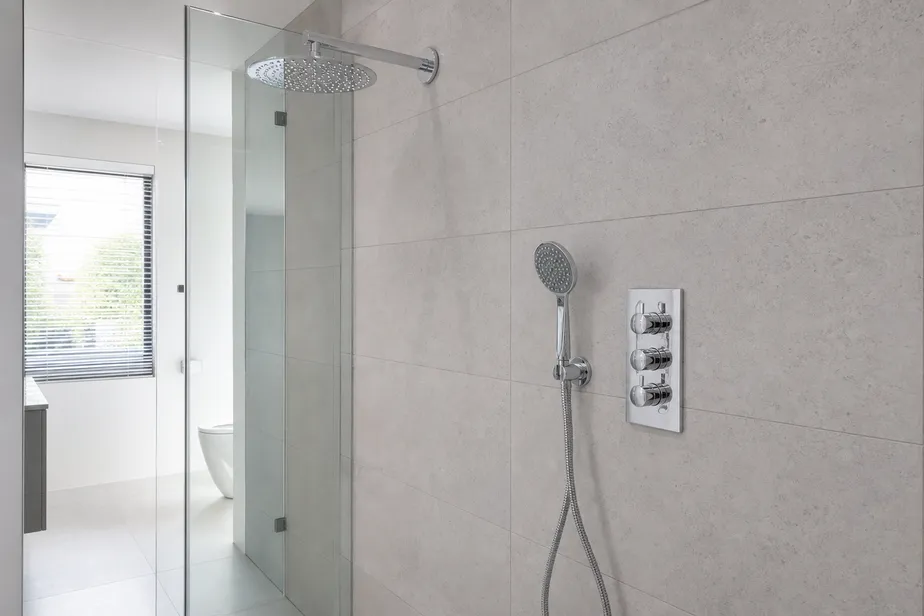
Product Configuration
What the 3 Way Configuration Means for Your Product Line
A 3 way concealed shower mixer is a pressure-balanced in-wall valve with an integrated three-outlet diverter — one handle controls temperature and flow, a separate diverter routes water to one of three outlets at a time: typically overhead rain head, hand shower, and a body jet or secondary outlet. That third outlet is what separates this product from the standard 2-way configuration, and it's the specification that premium bathroom buyers are increasingly asking for by name.
We've been producing this variant for several years, and the demand pattern is clear: it comes from buyers building programs for premium residential renovation, boutique hotels, and high-specification multi-unit residential projects. The buyers in these segments aren't choosing between a 2-way and a 3-way on price — they're choosing on specification.
The 3-way is the product that lets their downstream customers configure a full multi-outlet shower experience from a single in-wall valve, and that configuration commands a meaningful price premium over the 2-way equivalent. For your margin structure, that matters.
The category page covers the full concealed shower line — view all eight variants here. This page focuses on the 3-way configuration specifically: what it is, how it's built, where it sells, and what you need to know to evaluate it for your program.
3-Way vs. 2-Way: The Specification Difference

Engineering Data
Technical Specifications
Specifications shown are industry-standard values for this product type. Actual specifications may vary by configuration. Contact us for detailed product data sheets and exact parameters for your order.
Core Specifications
Connections & Dimensions
Surface Finishes
Certifications
OEM & Lead Time
Diverter Mechanism Note
The diverter on this valve is a sequential rotary type — the selector steps through outlets one at a time, with a positive detent at each position. We run the detent mechanism through the same 500,000-cycle endurance test we apply to all our valve cartridges. Ours uses a stainless steel spring rated for the full test cycle count.
The Diverter Mechanism: How We Build It and Why It Holds
The three-outlet diverter is the component that distinguishes this product from a standard concealed mixer, and it's where most of the engineering attention goes. A diverter that routes cleanly and holds its position under pressure is the difference between a product your downstream customers recommend and one that generates callbacks.
Brass Diverter Body — Not Zinc Alloy
Material Specification
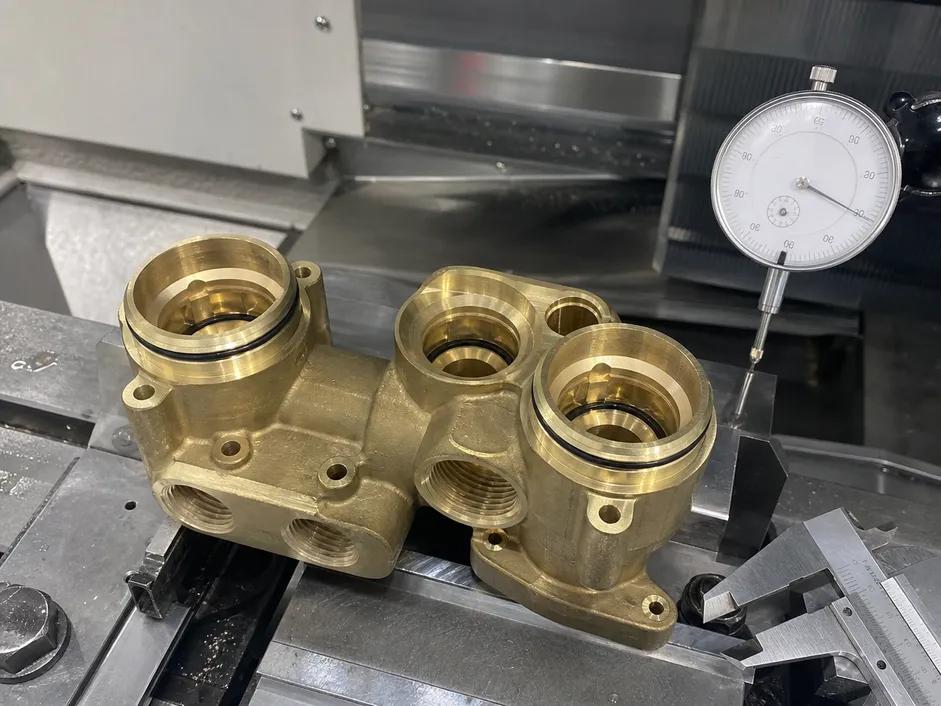
Our diverter body is machined from the same C36000-equivalent brass as the main valve body — not a separate zinc alloy insert, which is a common cost-reduction approach in the industry. In pressurized in-wall applications, zinc alloy's long-term corrosion performance in chlorinated water systems doesn't meet the standard we hold for export markets. The brass diverter body adds cost; it also means the diverter won't develop internal corrosion that causes the selector to seize or the outlet ports to weep after two years in the wall.
±0.03mm Seat Interface Tolerance
Machining Precision
The diverter ports are machined to a sealing tolerance of ±0.03mm on the seat interface — tighter than the main valve seat, because the diverter needs to hold pressure at the inactive outlets while the active outlet is running. We check every machined diverter body with a go/no-go gauge before assembly. Bodies that don't pass the gauge check go back to machining; they don't move forward to the line.
EPDM O-Ring Seals — Full Temperature Range
Seal Material
The seal at each outlet port uses an EPDM O-ring rated for the full temperature and pressure range of the valve. We switched from NBR O-rings on this product after seeing early hardening in high-temperature markets. EPDM holds its elasticity better above 60°C, which matters for buyers supplying markets where shower temperatures run high.
Pressure Test Protocol
Test Pressure: 0.8 MPa
33% above rated working pressure — applied to every assembled diverter before the valve moves to final assembly.
Duration: 60 Seconds
Any weep at an inactive outlet port fails the test. We catch those at this stage, not after the product is in a container.
Go/No-Go Gauge Check
Every machined diverter body is gauged before assembly. Bodies that don't pass go back to machining — not forward to the line.
Why This Matters for Your Program
A diverter that routes cleanly and holds its position under pressure is the difference between a product your downstream customers recommend and one that generates callbacks. The engineering choices here — brass body, tight seat tolerance, EPDM seals, 100% pressure testing — are what support a multi-year warranty claim in export markets.
Market Segments Where This Configuration Sells
The 3 way concealed shower mixer sits at the premium end of the concealed shower category. The buyers who specify it are making a deliberate choice to offer their customers a multi-outlet shower experience from a single in-wall valve — and they're paying for that specification. Here's where the volume is and what the commercial logic looks like for each segment.

Segment 01
Premium Residential Renovation
Homeowners and interior designers specifying multi-outlet shower configurations for bathroom remodels. In North America and Europe, this segment drives significant volume through plumbing distributors and kitchen-and-bath showrooms. The typical project spec calls for overhead rain head, hand shower, and body jets — exactly the three-outlet configuration this valve supports.
CE or cUPC documentation required to satisfy contractor customers
Finish consistency required across mixed-SKU orders
3-way margin typically 20–35% higher at retail vs. 2-way
Segment 02
Boutique and Mid-Scale Hospitality
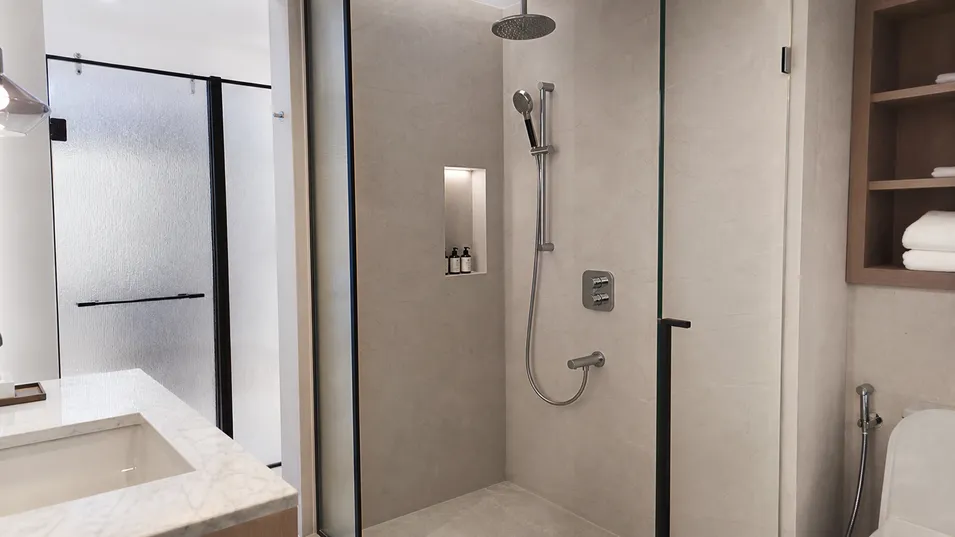
Hotels specifying multi-outlet shower systems for bathroom renovations or new builds. Hospitality procurement typically runs 50–500 units per property, with repeat orders as properties expand or renovate additional floors. The 3-way configuration is increasingly the standard specification for boutique hotels in the Middle East and Southeast Asia — markets where the premium bathroom experience is a competitive differentiator for the property.
50–500 units per property; repeat orders as floors renovate
Strong growth in Gulf region hospitality projects over the last three years
3-way is worth anchoring your SKU mix around for Middle East programs

Segment 03
High-Specification Multi-Unit Residential
Property developers specifying premium bathroom packages across luxury apartment or condominium projects. Volume per project can run 100–500 units depending on project scale. Developers in this segment use the bathroom specification as a marketing differentiator — the 3-way concealed shower system photographs well and communicates premium positioning in sales materials.
100–500 units per project depending on scale
Reliable performance required to avoid warranty callbacks across all units
Finish consistency across all units — in-house surface finishing is a practical advantage here
Segment 04
Plumbing Wholesale and Distribution
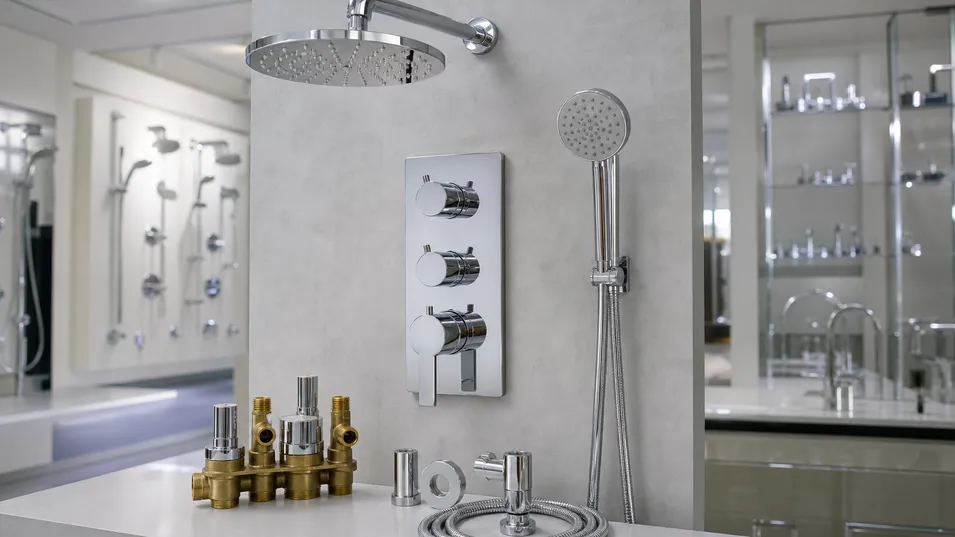
Distributors building a premium concealed shower program to serve contractors and showrooms. The 3-way valve is the anchor SKU for a premium program — it's the product that justifies the program's positioning and supports the margin structure. Buyers in this channel typically start with a 2-unit sample order to test with their own customers before committing to a stocking order.
3-way valve anchors the premium program's positioning and margin structure
Typical entry: 2-unit sample order before committing to stocking quantity
Serves contractors and showrooms requiring CE or cUPC documentation
Margin Logic Across Segments
The buyer who specifies a 3-way is already committed to a premium bathroom budget, so the upsell is natural. The 3-way valve commands 20–35% higher retail margin versus a 2-way configuration — and in hospitality and multi-unit residential, the volume per project makes that margin differential significant at the program level.
Across all four segments, the common requirement is a product that performs reliably enough to avoid warranty callbacks, documents cleanly for the relevant export market, and finishes consistently across a full project order. Those are the three things we build the program around.
Retail Margin Premium
20–35%
3-way vs. 2-way configuration
Hospitality Volume Range
50–500
Units per property
Developer Project Volume
100–500
Units per project
Building a program for one of these segments?
We can discuss SKU mix, documentation requirements, and volume pricing for your specific channel.
Surface & Durability
Finish Options and Durability in Premium Shower Environments
Five finishes, all run on our in-house lines: chrome, brushed nickel, matte black, PVD gold, and oil-rubbed bronze. The in-house finishing matters more for this product than for a standalone faucet, because the 3-way mixer is typically specified as part of a complete shower system — the trim plate, handle, and diverter selector need to match the hand shower holder, the overhead arm, and any body jet fittings.
When all components run through the same plating bath on the same production run, the finish matches. When components come from different suppliers or different batches, the chrome on the trim plate and the chrome on the hand shower holder will be visibly different under bathroom lighting. We've seen this problem on competitor products; it's a consistent source of warranty claims and returns in the premium segment.
Why In-House Finishing Matters
- Same plating bath, same production run — trim plate, handle, diverter selector, hand shower holder, and overhead arm all match visually
- Eliminates the visible finish mismatch that drives warranty claims and returns in the premium segment
- PVD gold and matte black: cross-cut tape adhesion testing on every batch before parts move to assembly
Chrome & Brushed Nickel Stack
Our chrome and brushed nickel finishes run a multi-layer electroplating stack: copper base coat, nickel mid-coat, chrome or brushed top coat. The nickel mid-coat is the corrosion barrier — skipping it is a common cost-cutting move in the industry, and it's why you see chrome shower trim from some factories failing salt spray at 48 hours.
Salt Spray Performance
24h minimum; most batches clear 48h
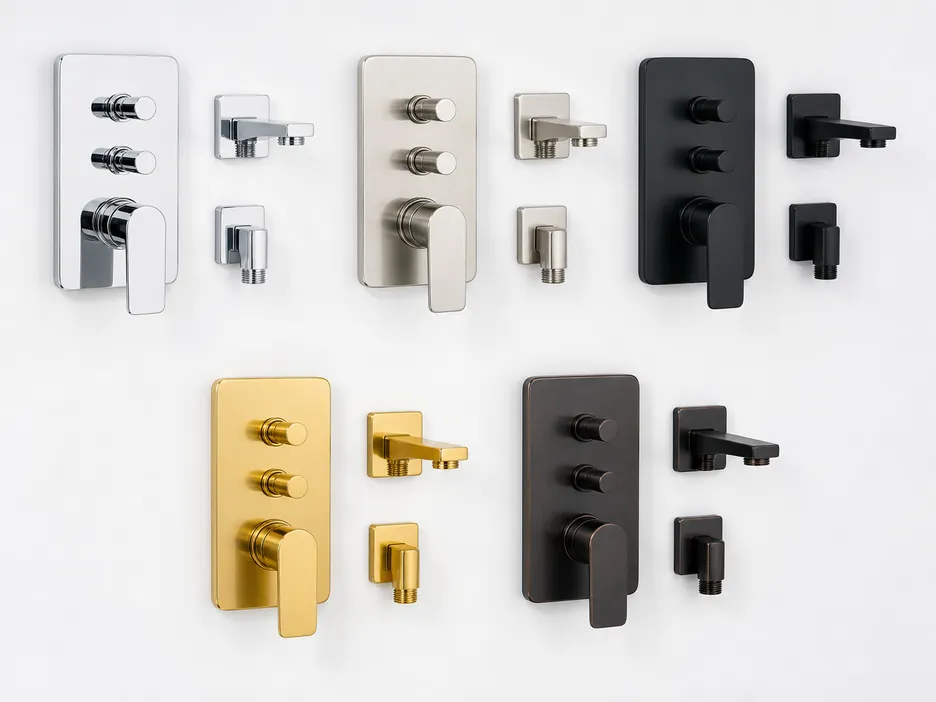
PVD Gold & Matte Black
The two finishes that have grown fastest in the premium concealed shower segment. Our PVD line runs 0.3–0.5μm coating thickness, with cross-cut tape adhesion testing on every batch before parts move to assembly — fewer finish warranty claims from your downstream customers.
PVD Thickness
0.3–0.5μm
Adhesion Test
Every Batch
Finish Specifications by Market
All five finishes meet 24h+ salt spray rating. Process and primary market notes below.
| Finish | Process | Salt Spray Rating | Market Notes |
|---|---|---|---|
| Chrome | Multi-layer electroplating (Cu/Ni/Cr) | 24h+ (most batches 48h) | Standard specification, broad market |
| Brushed Nickel | Multi-layer electroplating + brushing | 24h+ | Strong demand in North America |
| Matte Black | PVD or electroplating + matte treatment | 24h+ | Fast-growing in premium segment globally |
| PVD Gold | Physical vapor deposition, 0.3–0.5μm | 24h+ | Middle East, Southeast Asia, premium EU |
| Oil-Rubbed Bronze | Electroplating + patina treatment | 24h+ | Primarily North American market |
Installation Engineering
Rough-In Requirements and Installation Parameters
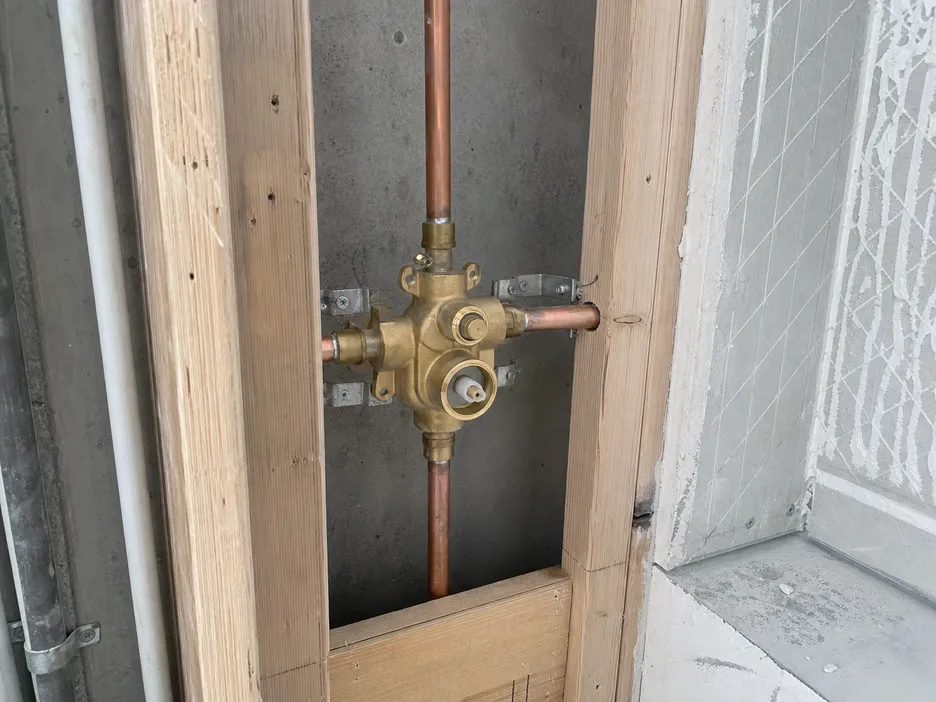
The 3-way concealed shower mixer installs the same way as the 2-way variant — the rough-in valve body goes into the wall before tile work, and the trim kit mounts to the finished wall surface. The difference is the diverter selector, which adds a second control element to the trim plate.
Trim Plate Footprint
Our standard trim plate accommodates both the main lever and the diverter selector within a 200 × 120mm footprint, which fits standard tile layouts without requiring special tile cutting around the trim.
Trim Plate Width
200mm
Trim Plate Height
120mm
Rough-In Depth
65–85mm
from finished wall surface
Covers standard wall construction in our primary export markets — drywall plus tile, or tile on cement board. For markets with non-standard wall construction (thicker tile assemblies, double-layer drywall, or specific commercial wall systems), we can adjust the rough-in depth specification on OEM orders.
Outlet Port Connections
The three outlet ports exit the valve body at standard G1/2" connections, positioned for typical overhead, hand shower, and body jet outlet placement.
Standard Outlet Spacing
- 150mm center-to-center between hand shower and body jet ports
- Overhead port centered above
Rough-In Guide Included
We include a rough-in guide with every valve body shipment that covers the standard installation parameters, outlet positioning, and the minimum wall cavity dimensions required for the valve body.
OEM Outlet Port Customization
For non-standard market requirements
If your market uses non-standard outlet spacing — some European markets have specific requirements for body jet positioning — we can adjust the outlet port positions on OEM orders.
This is a tooling change, so it requires the OEM MOQ of 200 pieces and adds 10–15 days to the first sample timeline. The same OEM flexibility applies to rough-in depth for markets with non-standard wall construction.
OEM MOQ
200 pcs
Added Sample Lead Time
+10–15 days
OEM Configuration for Premium Shower Programs
Most buyers who source the 3-way mixer are building a program, not sourcing a single SKU. The OEM questions come up early: trim plate profile, handle design, finish selection, private label packaging, and sometimes outlet port positioning for specific market requirements.
What We Customize — and What Stays Standard
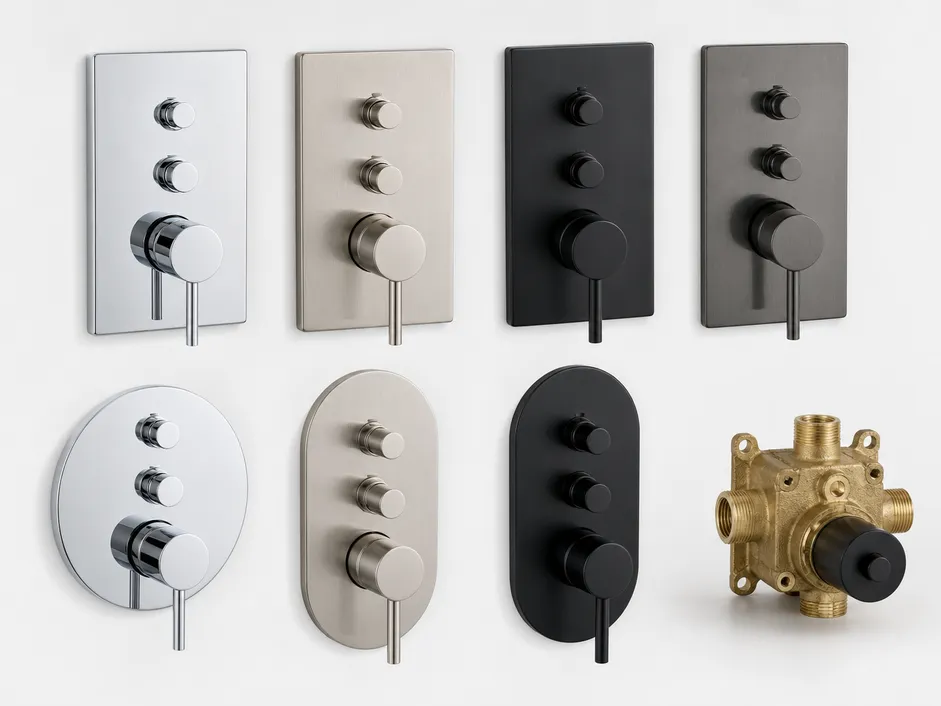
Our OEM capability covers the dimensions that matter for program differentiation. The valve body — the rough-in component that goes into the wall — is standardized, which keeps tooling costs manageable and certification coverage straightforward.
The trim kit is where the design differentiation happens: trim plate profile and dimensions, handle shape, diverter selector style, and finish. For buyers who want a distinctive trim aesthetic that matches their broader bathroom hardware program, this is where we focus the OEM development work.
Custom OEM Trim Kit
From your design brief or reference sample to first sample in 25–35 days. We maintain an in-house tooling room for casting dies and CNC fixtures — tooling revisions don't go to an outside vendor and add weeks to the timeline.
Private Label on Standard Trim
Start with our standard trim profiles and add private label packaging and branding. Faster path to market — 15–20 days to first sample. Same 200-piece MOQ. Low-risk way to test a new design in your market before committing to a full container.
Certification Coverage on OEM Builds
If your custom trim kit pairs with our certified valve body, the valve body's CE and cUPC certifications remain valid. If you're modifying the valve body itself — changing the rough-in depth, adjusting outlet port positions, or altering the pressure-balancing mechanism — we manage the certification extension with the relevant certification body. You don't run a full re-certification from scratch.
Ready to discuss OEM options for this product?
Share your design brief, reference sample, or program requirements and we'll outline the development path, tooling scope, and timeline.
Compliance Coverage by Export Market
Certification requirements vary by destination market. Here's where our current coverage stands and what documentation travels with each shipment.
North America (US / Canada)
cUPC — IAPMO / ASSE 1016
Documentation available. For North American shipments, we prepare HS code classification and can provide a binding ruling reference for customs pre-clearance if your broker needs it.
European Union / UK
CE — EN 1111
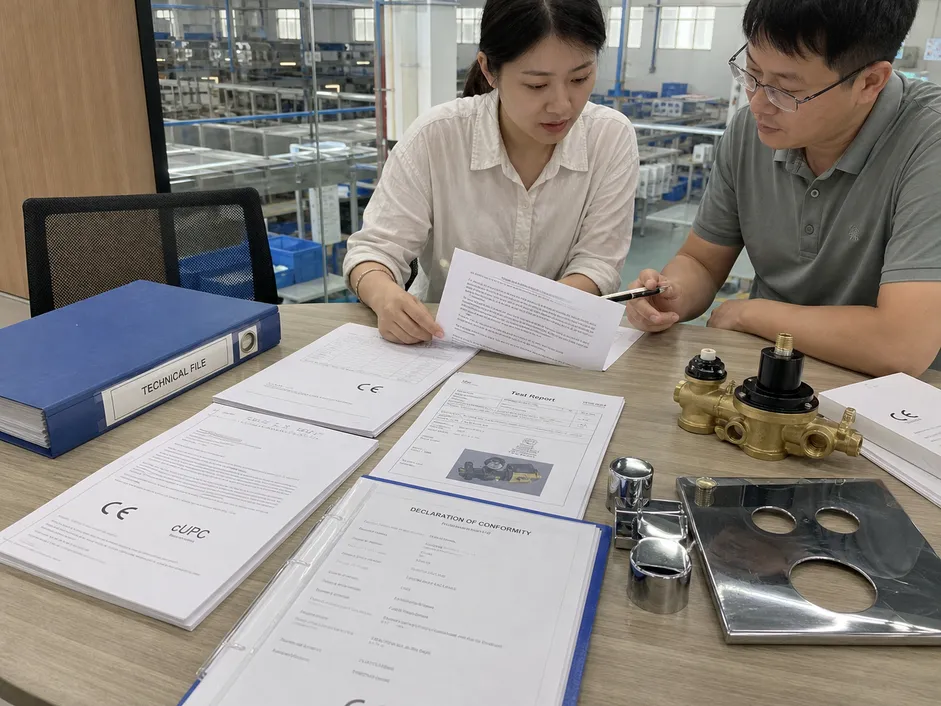
CE declaration available. For European shipments, the CE declaration of conformity and technical file travel with the shipment documentation.
Australia / New Zealand
WaterMark — AS 4032
Available on request — confirm at inquiry. Contact us to verify current coverage status for your specific shipment requirements.
Middle East / Southeast Asia
CE accepted in most markets
CE documentation covers most requirements across Middle East and Southeast Asian markets. Confirm specific country requirements at inquiry.
Compliance Summary Table
| Market | Standard | Coverage |
|---|---|---|
| US / Canada | cUPC (IAPMO / ASSE 1016) | Certified |
| EU / UK | CE (EN 1111) | Certified |
| AU / NZ | WaterMark (AS 4032) | On Request |
| ME / SEA | CE accepted | CE Covers |
Full certification details, declaration of conformity documents, and technical file references are available on our certifications page. For shipment-specific documentation requests, include your destination market and HS code in your inquiry.
Container Loading and Landed Cost
Accurate container planning starts before you confirm the order. Here's how we pack, document, and coordinate shipment so your freight forwarder has everything they need to quote accurately.

Packing Configuration
Valve bodies are packed in individual foam-lined cartons, then master-carton packed for container optimization. A standard 40HQ container holds approximately 3,500–4,500 concealed valve bodies in this configuration, depending on trim kit inclusion.
We calculate carton dimensions against container floor plans and provide a packing list with CBM and gross weight per SKU before you confirm the order, so your freight forwarder can quote accurately.
Multi-SKU Consolidation
For buyers consolidating multiple SKUs — 3-way mixers, 2-way mixers, and trim kits in one container — we coordinate the packing sequence to minimize void space and keep the container weight balanced for port handling.
Documentation Package
The documentation package is prepared in parallel with production and ready at container loading. It includes:
- Commercial invoice
- Packing list
- Certificate of origin
- CE / cUPC test reports (as applicable)
Lead Time: Order Confirmation to Container Loading
Standard Catalog Items
25–35 days
In-range items with existing tooling and standard finish options.
OEM Orders with New Tooling
35–50 days
Custom configurations requiring new tooling development and approval samples.
How This Product Fits the Concealed Shower Line
The 3-way mixer is the premium diverter configuration in our concealed shower range. Here's how it positions against the closest alternatives so you can match the right SKU to your market and project spec.
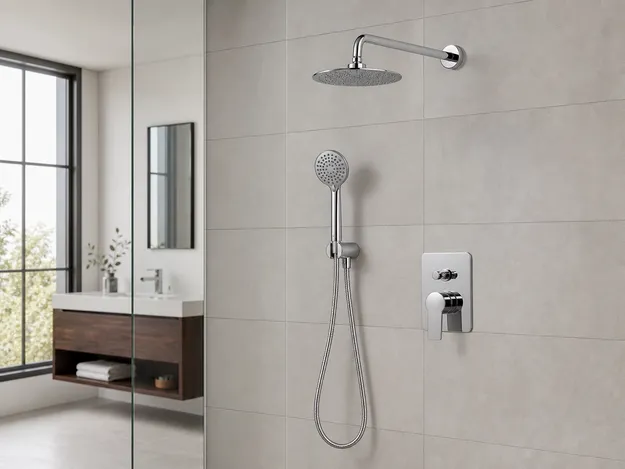
2-Outlet Configuration
2-Way Concealed Shower Mixer
Two outlets (overhead and hand shower), no body jet. The workhorse SKU for residential construction and mid-range hospitality. If your market is price-sensitive or the project spec doesn't call for body jets, the 2-way is the right starting point.
Best For
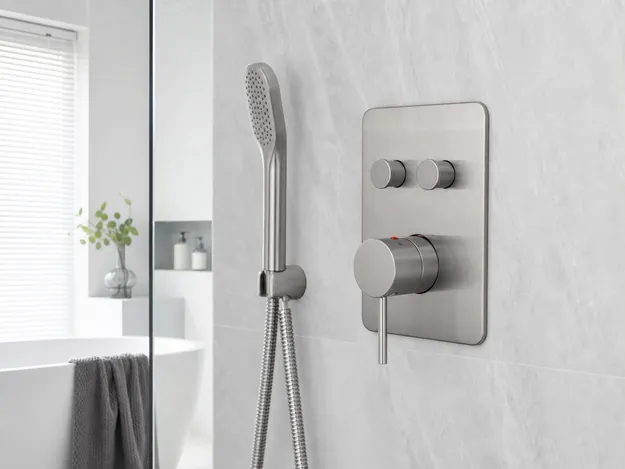
Thermostatic Configuration
Concealed Thermostatic Shower Mixer
Thermostatic cartridge with anti-scald protection, holding outlet temperature within ±2°C of set point. If your buyers are in the UK, Germany, or Australia, or if you're targeting commercial hospitality where scald liability is a concern, the thermostatic variant is the specification they'll ask for.
Best For
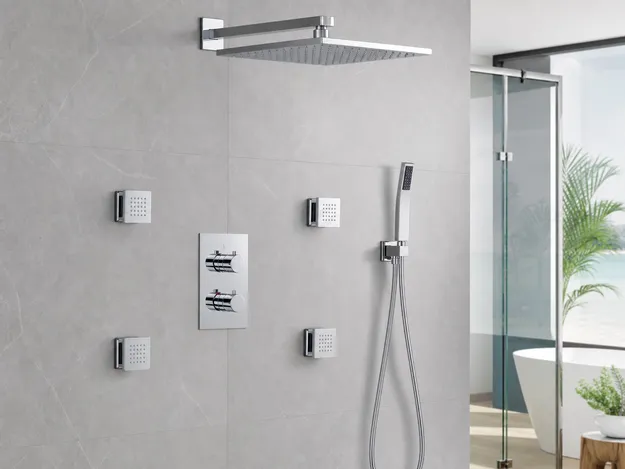
Complete System
Concealed Shower System
Full system with thermostatic mixer, rain head, hand shower, and body jets, packaged as a complete set. If your buyers want a single-SKU purchase that covers the entire shower installation, the complete system is the higher-value option. The 3-way mixer is the right choice when your buyers are sourcing the valve separately and specifying their own heads and jets.
Best For
Thermostatic 3-Way Configuration Available
We also produce a thermostatic version of the 3-way configuration — combining three-outlet diversion with anti-scald temperature control. Contact us if that's the spec your market requires.
Explore the Full Concealed Shower Range
Frequently Asked Questions
Decision-support answers for distributors, project specifiers, and OEM buyers evaluating the 3-way concealed shower mixer.
What is the difference between a 3 way and a 2 way concealed shower mixer?
A 2-way concealed shower mixer has an integrated diverter that routes water to one of two outlets — typically overhead rain head or hand shower. A 3-way concealed shower mixer adds a third outlet, usually for a body jet or secondary shower head. The diverter is sequential: only one outlet is active at a time.
The 3-way configuration is specified when the shower design includes body jets or a third outlet point — it's the standard valve for multi-outlet premium shower installations. If your project spec doesn't include body jets, the 2-way is the simpler and lower-cost option.
Can a 3 way concealed shower mixer run two outlets simultaneously?
No — the standard 3-way diverter is sequential, meaning one outlet is active at a time. This is the typical configuration for pressure-balanced valves, where simultaneous multi-outlet operation would require a larger valve body and a more complex pressure management system.
If your buyers need simultaneous multi-outlet operation, that requires a thermostatic system with independent volume controls per outlet — a different product category. For most premium residential and hospitality applications, sequential diverter operation is the specified configuration.
What certifications does a 3 way concealed shower mixer need for the North American market?
For the US and Canada, concealed shower valves need to meet ASSE 1016 (pressure-balancing) performance standards, and cUPC certification from IAPMO is the standard compliance pathway.
Our 3-way concealed shower mixer carries cUPC certification, and we provide the full documentation package — test reports, certificate of conformity, and HS code classification — with every North American shipment. If your customs broker needs a binding ruling reference for pre-clearance, we can provide that as well.
What rough-in depth does the 3 way concealed shower mixer require?
Standard rough-in depth is 65–85mm from the finished wall surface, covering standard drywall-plus-tile and tile-on-cement-board wall constructions in North America, Europe, and Australia.
For non-standard wall assemblies — thicker tile, double-layer drywall, or specific commercial wall systems — we can adjust the rough-in depth on OEM orders. The rough-in guide included with every valve body shipment covers standard installation parameters and minimum wall cavity dimensions.
What is the minimum order for a custom trim design on the 3 way mixer?
200 pieces per SKU for custom OEM trim kits with new tooling. For private label packaging on our standard trim profiles (no tooling required), the MOQ is the same — 200 pieces.
First sample lead time is 25–35 days for new tooling, 15–20 days for standard profiles with branding changes. The valve body is standardized and certified; OEM development focuses on the trim kit.
MOQ
200 pcs / SKU
Sample Lead Time
15–35 days
Three way concealed shower mixer vs thermostatic: which is right for my market?
The 3-way pressure-balanced mixer is the right choice for markets where scald protection is not a code requirement and the buyer's priority is multi-outlet configuration at a competitive price point.
The thermostatic variant — which we also produce — is required by code in the UK, Germany, and most of Europe for commercial applications, and is increasingly specified in Australian commercial projects. If your buyers are in those markets or are targeting hospitality where scald liability is a concern, specify thermostatic.
If your buyers are in North America or Southeast Asia and the project spec calls for multi-outlet without a thermostatic requirement, the 3-way pressure-balanced mixer is the standard specification. We can supply both — contact us with your market and we'll recommend the right configuration.
Get a Quote for the 3 Way Concealed Shower Mixer
Send us your target market, volume expectations, and finish requirements — we'll come back with a detailed quote, finish samples if you need them, and a recommendation on configuration based on what's moving for our existing distributors in your region.
Most new buyers in this category start with a 2-unit sample order to test with their own customers before committing to a stocking order. We can ship samples within 7–10 days of order confirmation.

Sample Lead Time
7–10 days
OEM MOQ
200 pcs
Finish Options
5 standard
Certifications
CE + cUPC