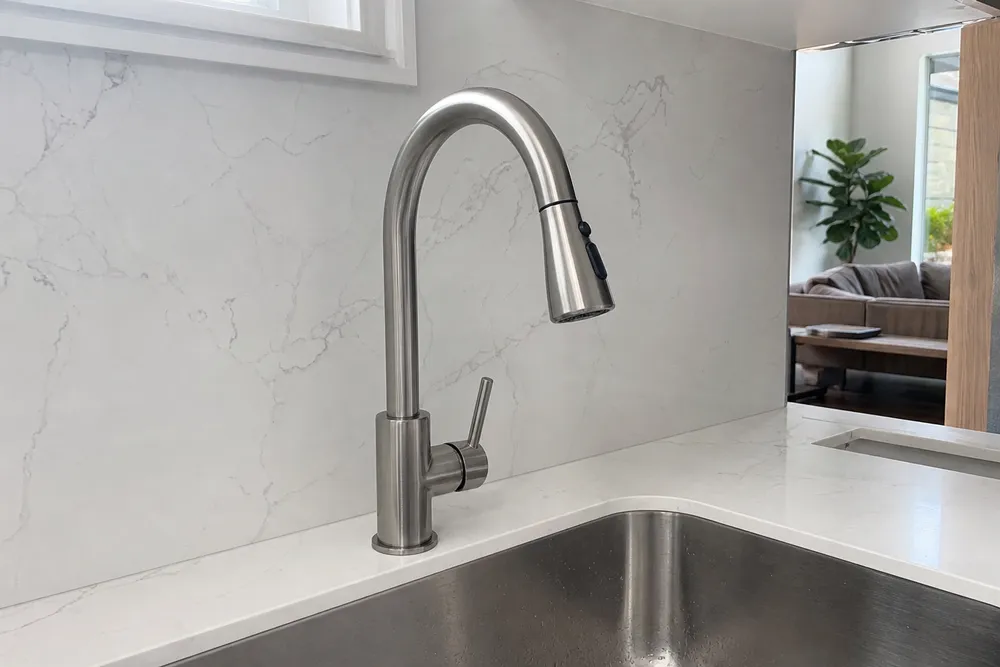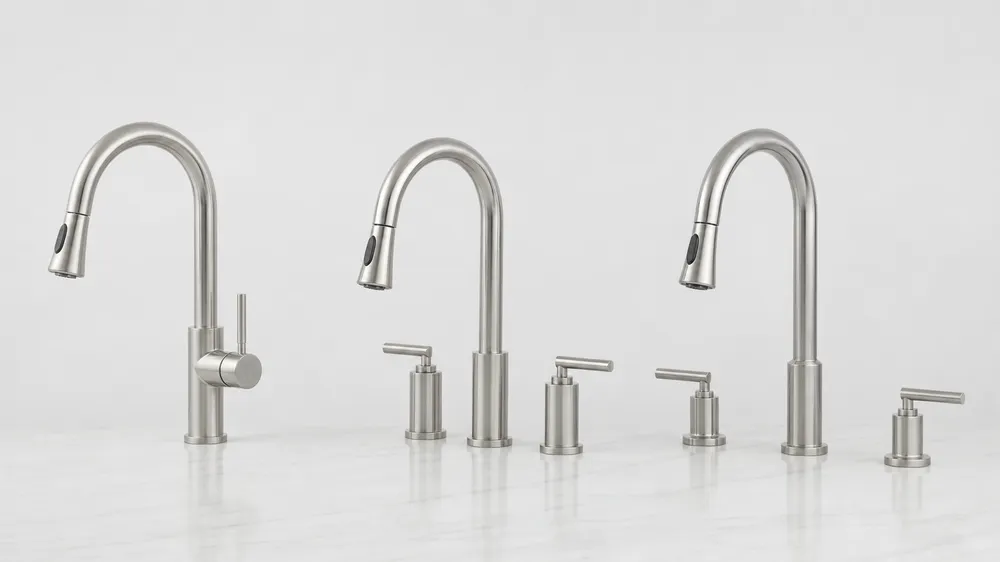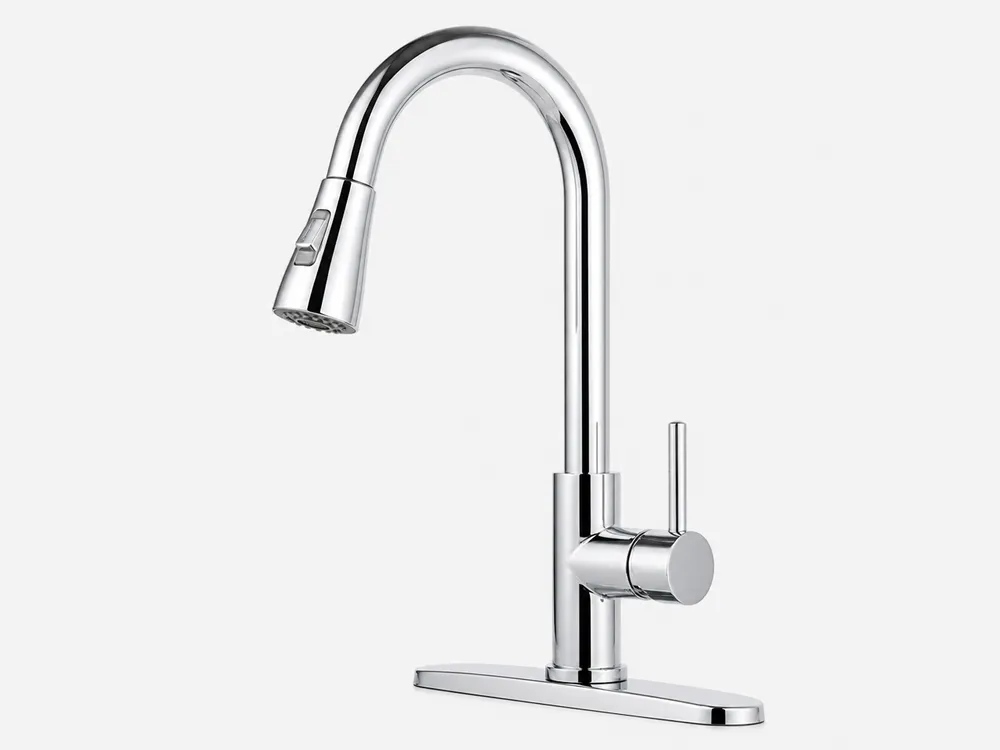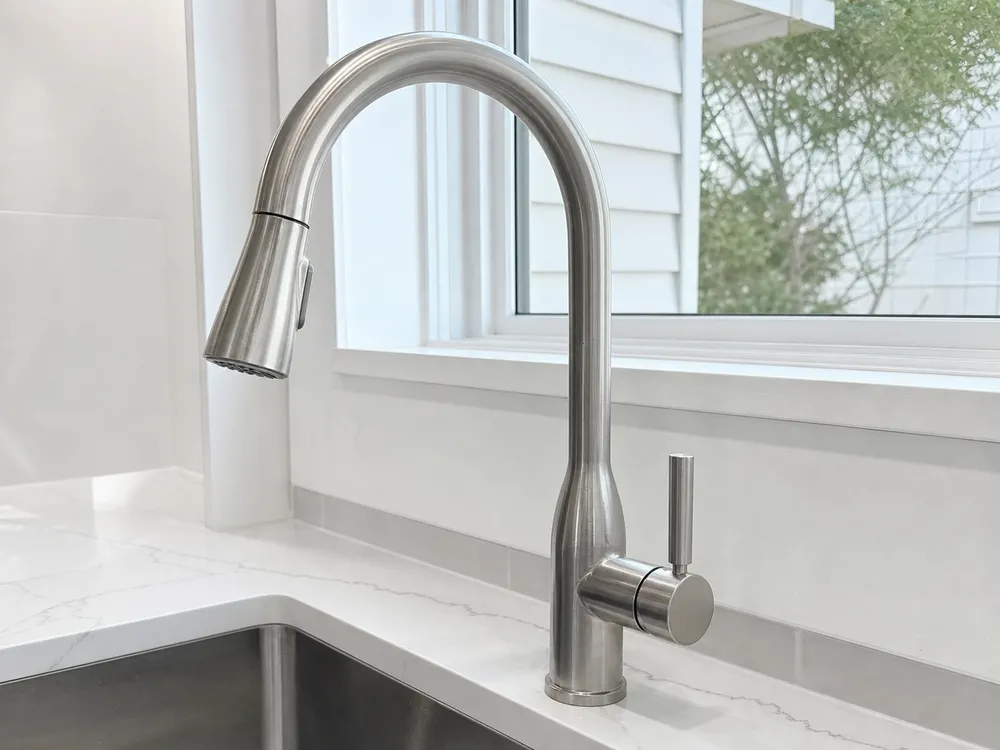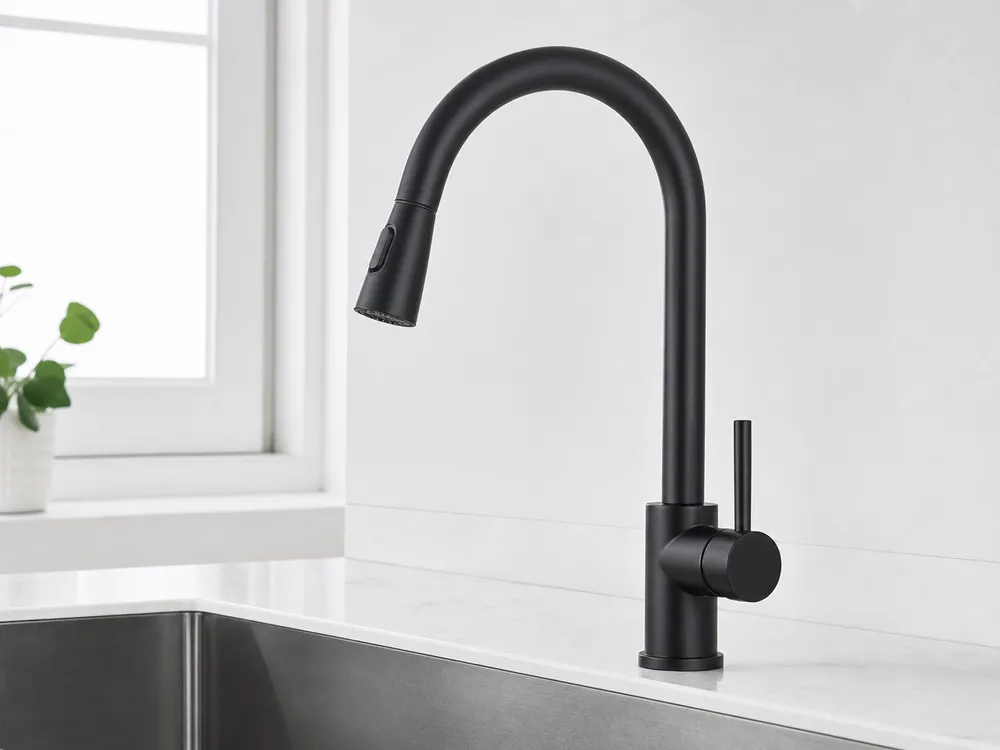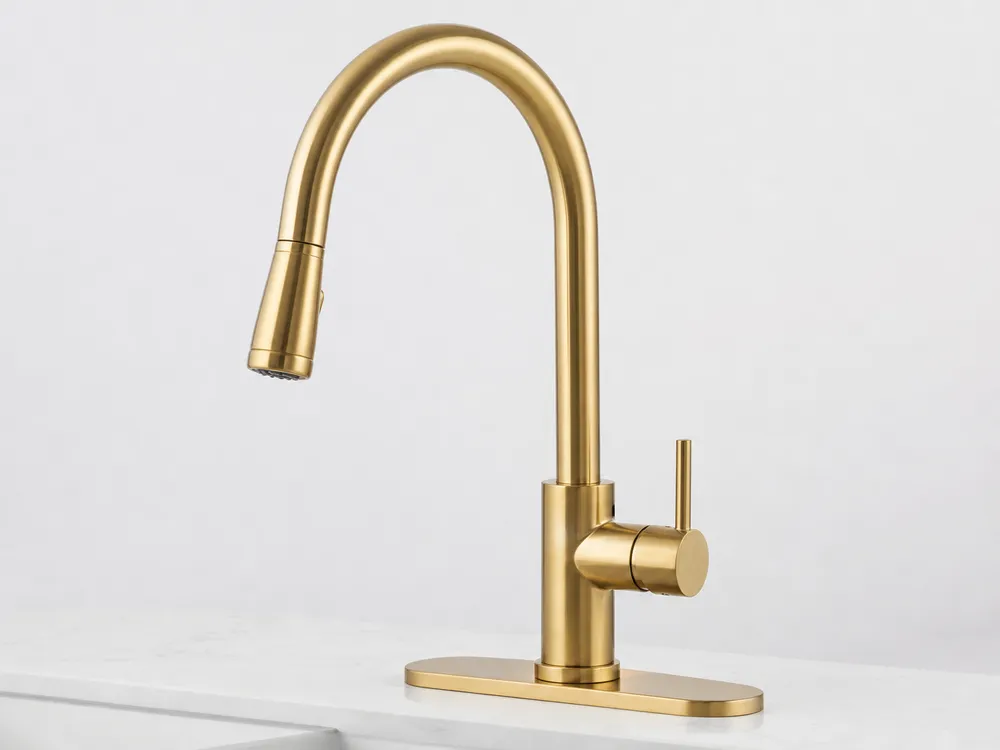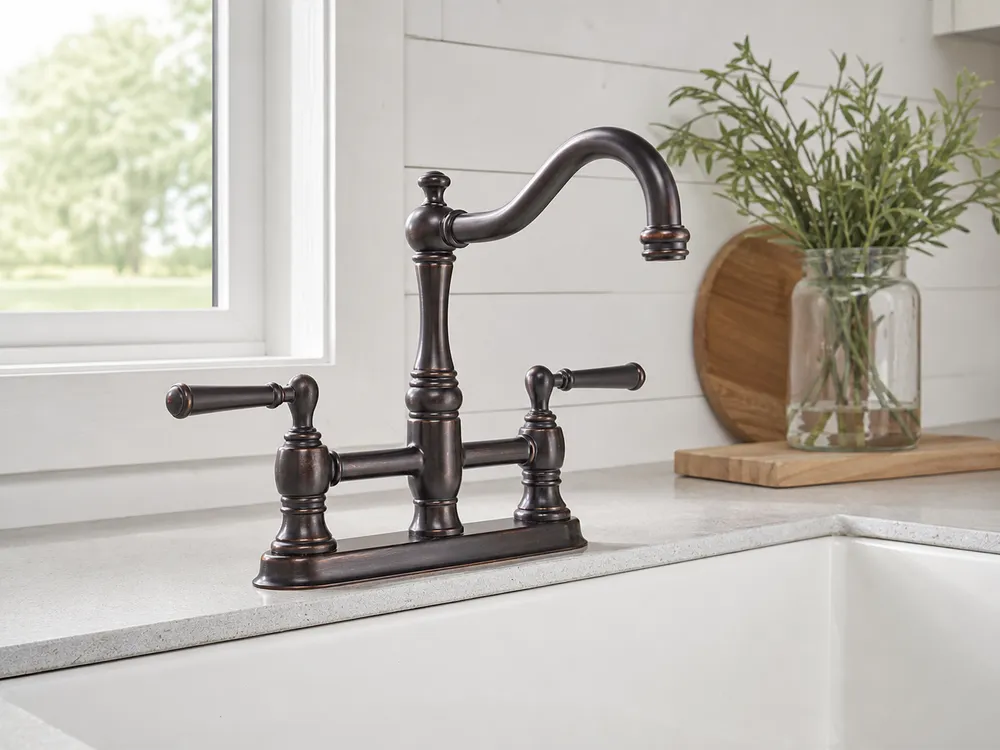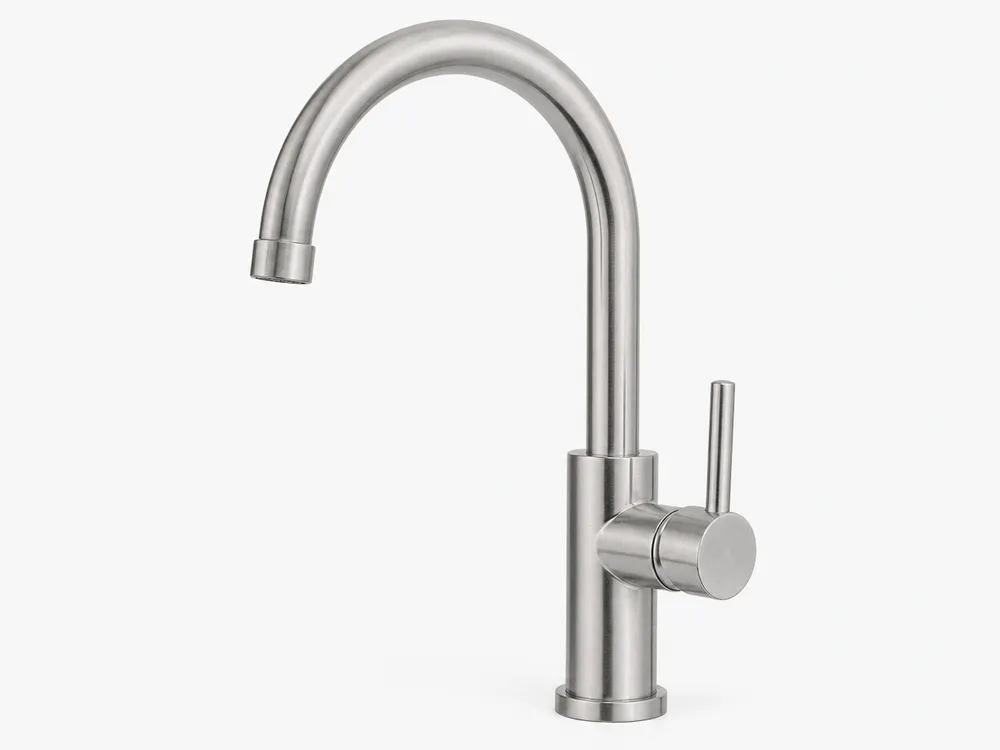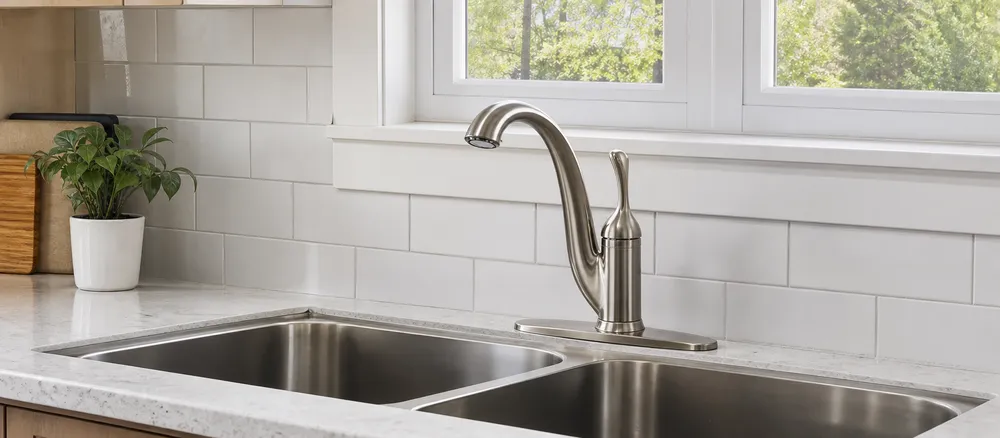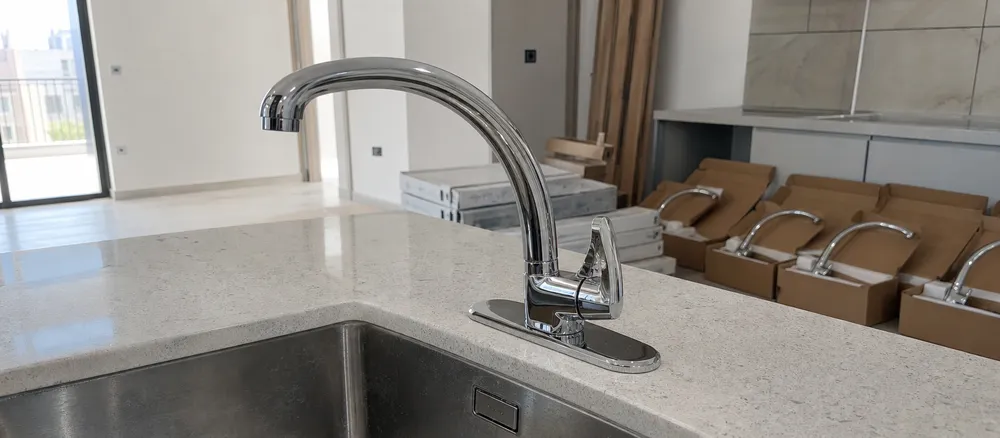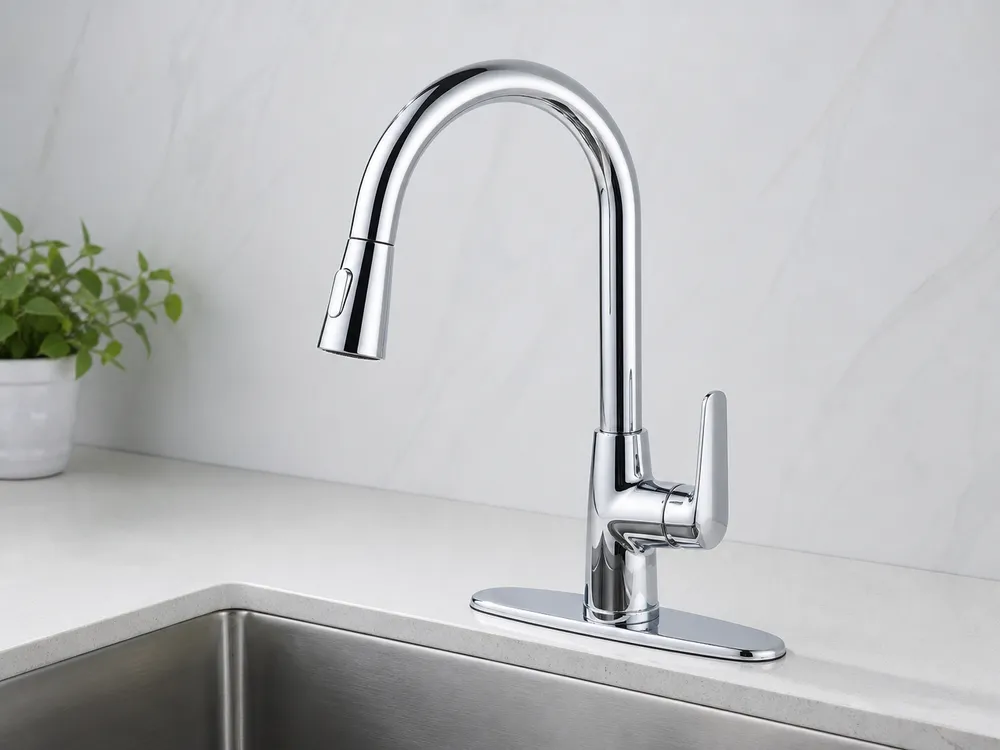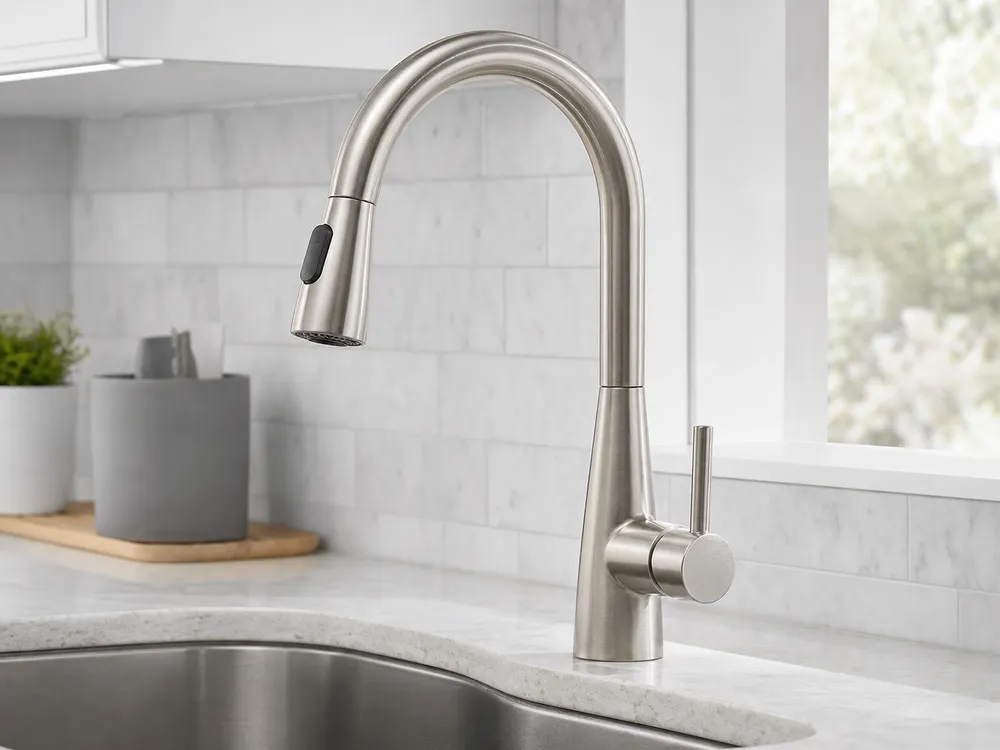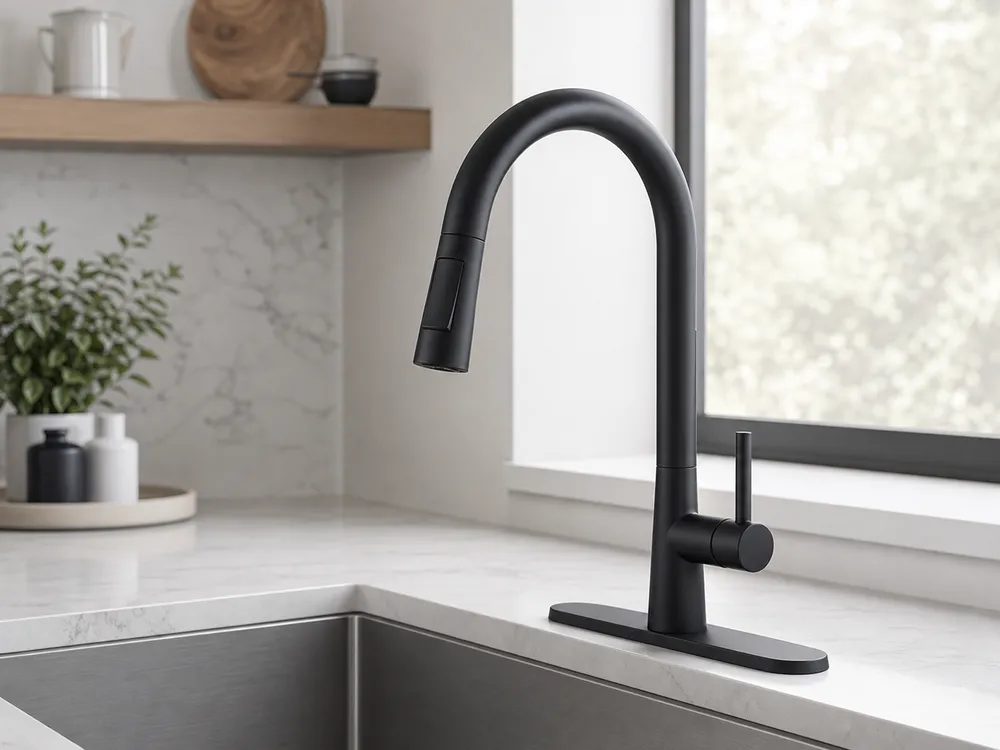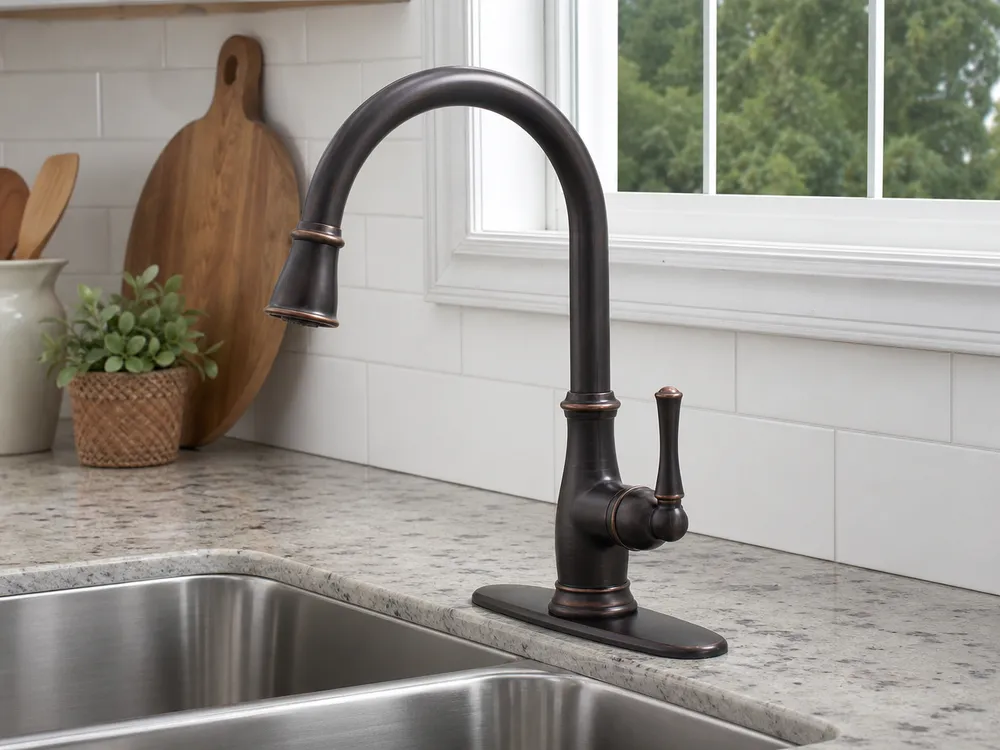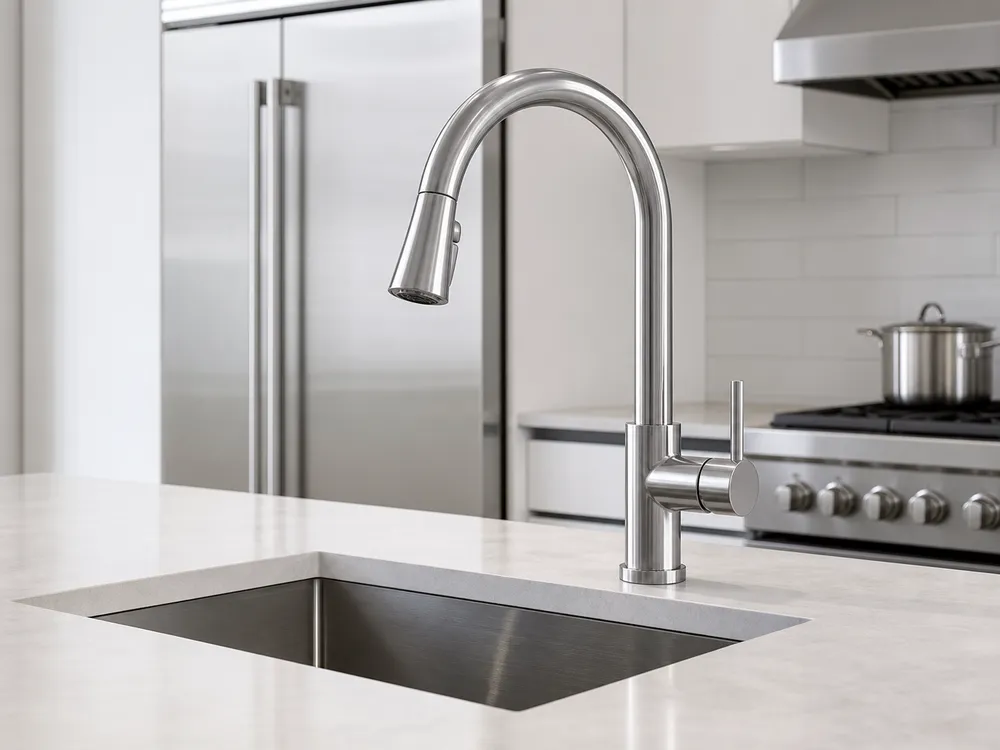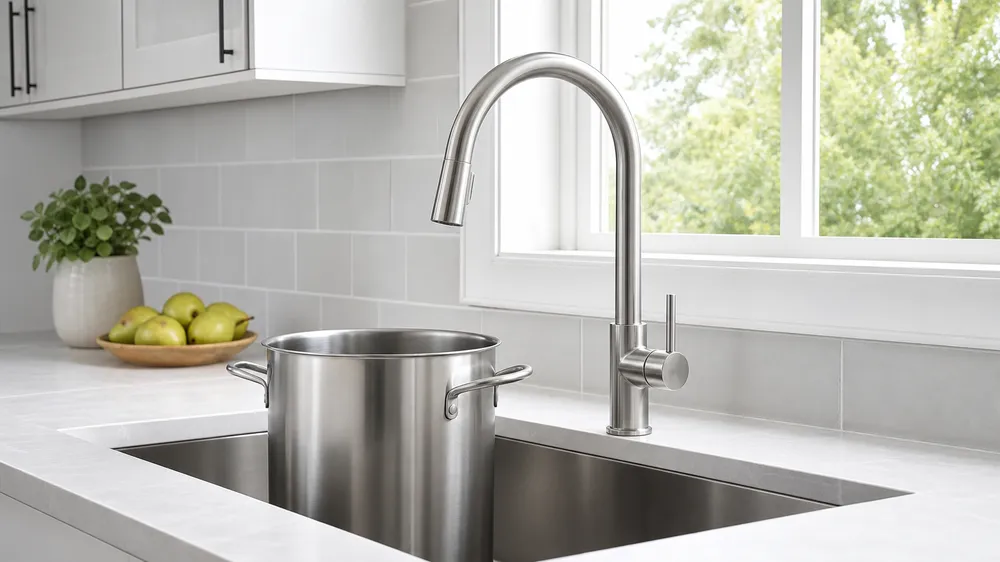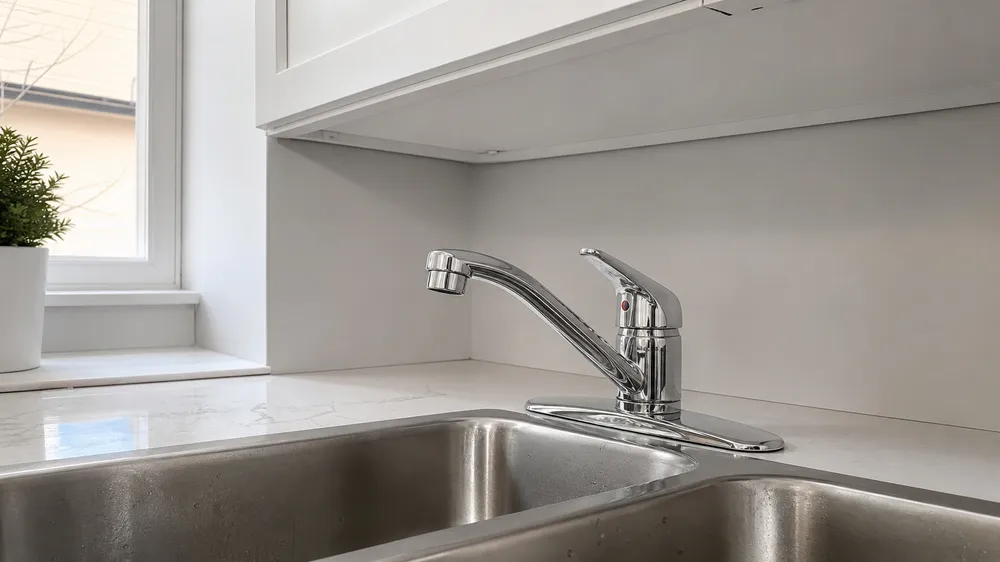

1-hole, 3-hole, and widespread configurations from a manufacturer with 17 years in brass faucet production. The broadest-compatibility mount type in the kitchen faucet category.
Every configuration ships with cUPC, CE, or WaterMark documentation matched to your destination market.
Installation Type
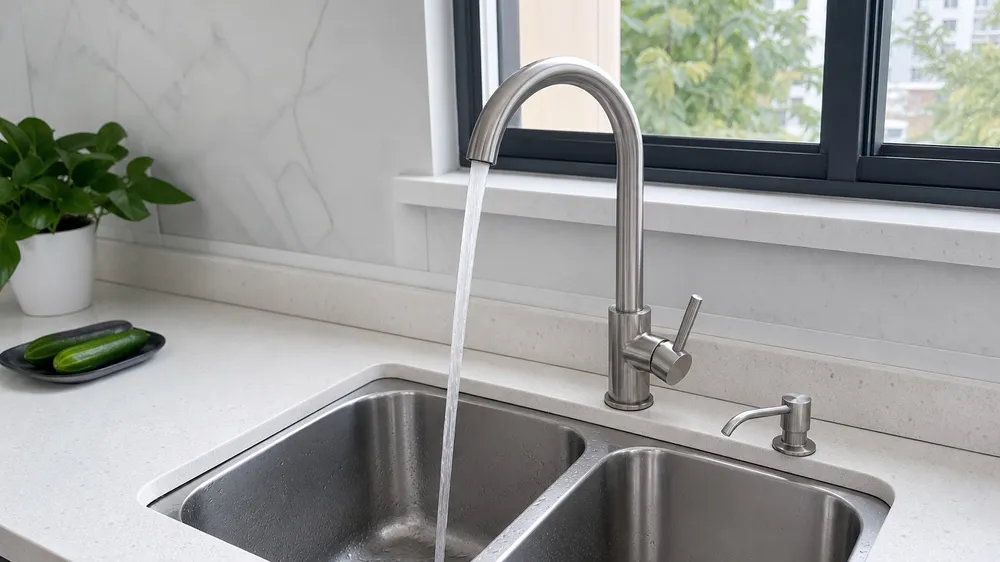
Deck mount kitchen faucets install through pre-drilled holes in the sink deck or countertop. That's the installation method the majority of residential and light commercial kitchens are built around — which is why deck mount is the configuration that moves the most units across every distribution channel we supply.
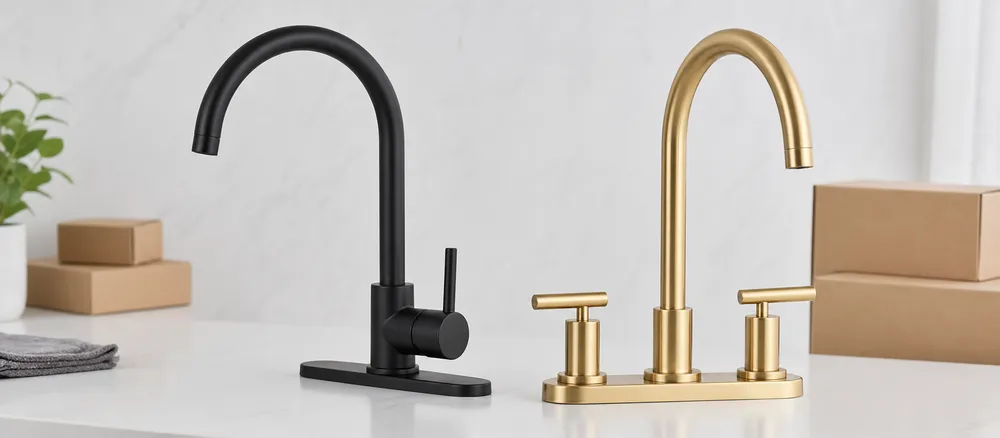
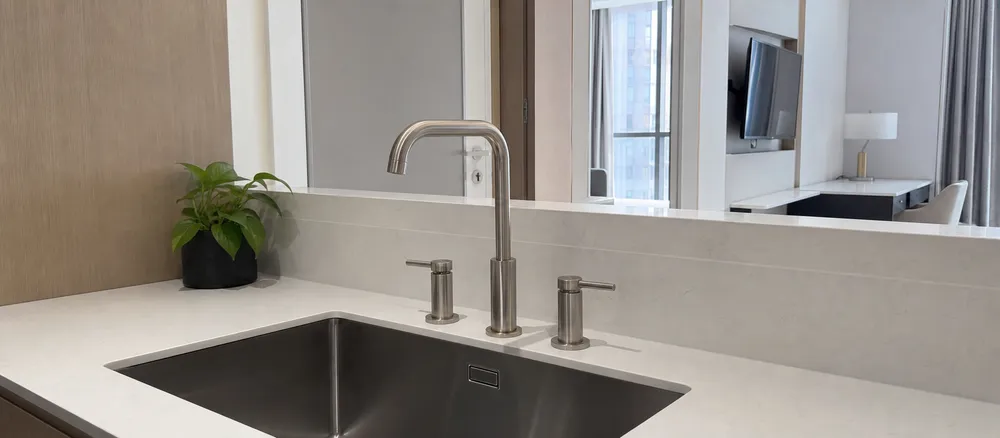
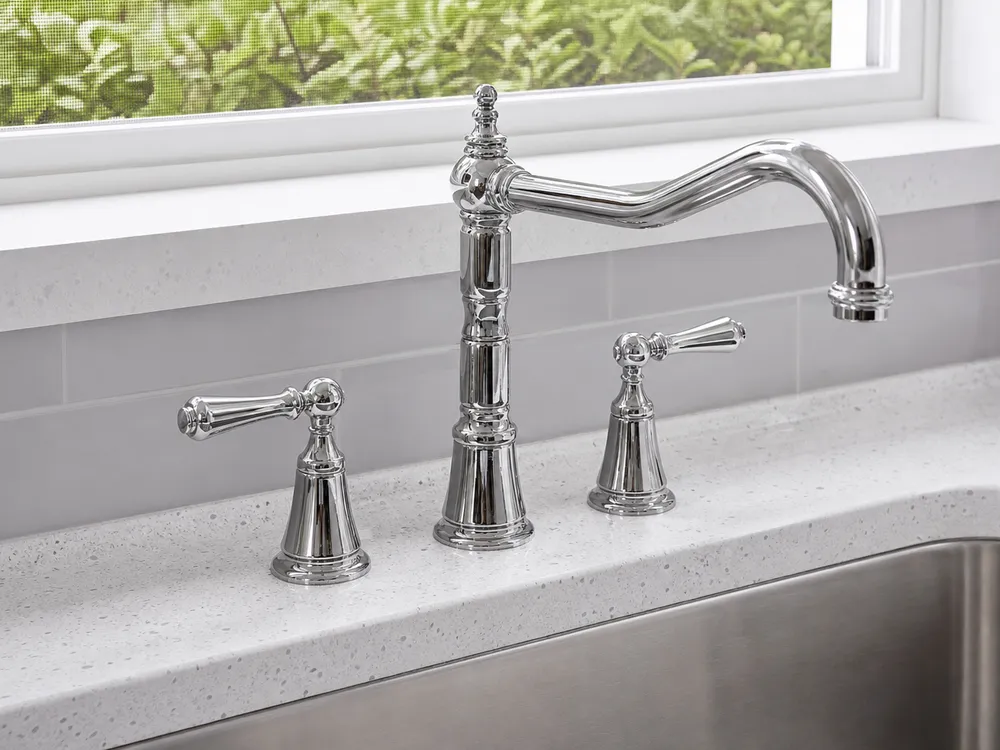
The three hole configurations we produce cover the full range of sink compatibility your catalog needs. Single-hole deck mount fits the modern undermount and drop-in sinks that dominate new construction and renovation projects. Three-hole deck mount covers the traditional setup with separate hot and cold handles plus a center spout — still the dominant configuration in European markets and in North American replacement segments where the existing sink has three pre-drilled holes. Widespread deck mount uses the same three-hole footprint but with handles spaced 8 inches apart, the standard for premium residential and hospitality specifications.
The commercial logic here is straightforward: a buyer stocking deck mount in all three configurations can cover virtually any kitchen sink installation without sending their customer to a competitor. Wall mount is a specialty configuration — it requires specific rough-in conditions and is specified for a narrower set of projects. Deck mount is the default, and the default is where the volume lives.
We've been running deck mount kitchen faucets on our production lines since the early years of the factory. The body geometry, the valve seat tolerances, the cartridge interface — all of it has been refined through 17 years of production and export feedback. When a North American distributor tells us their customers are seeing drip failures at 18 months, we know exactly which tolerance to check. That institutional knowledge is built into every batch we ship.
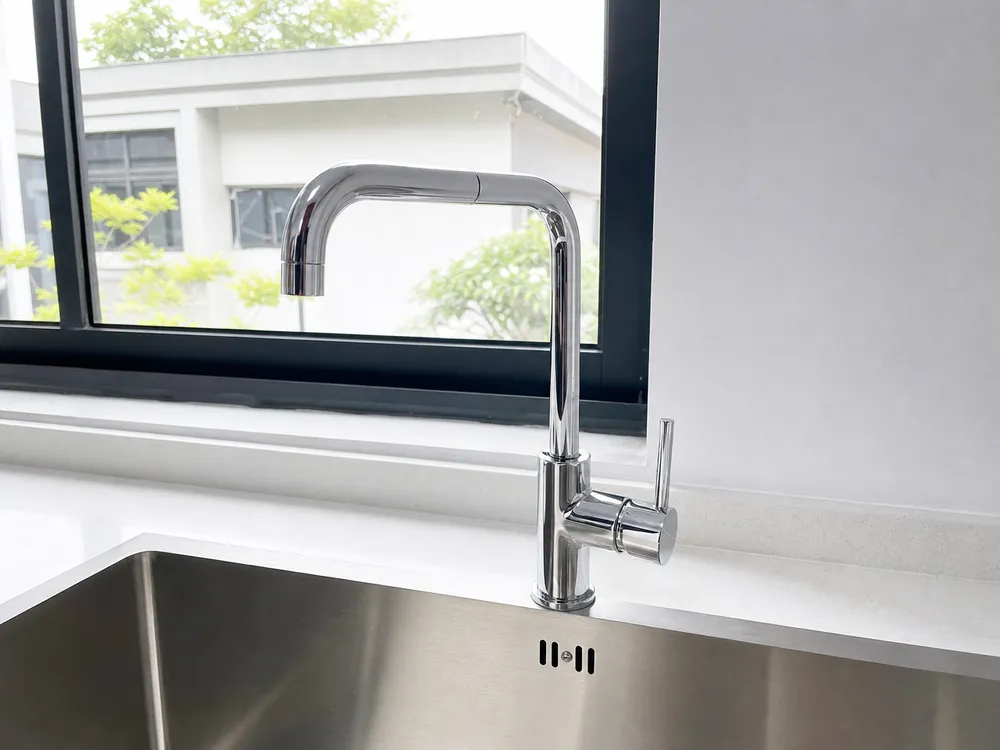
Modern undermount and drop-in sinks. Dominant in new construction and renovation.
Separate hot/cold handles with center spout. Dominant in European markets and NA replacement.
8-inch handle spread. Standard for premium residential and hospitality specifications.
The catalog coverage logic
A buyer stocking deck mount in all three configurations can cover virtually any kitchen sink installation without sending their customer to a competitor. Wall mount is a specialty configuration for narrower project sets.
Technical Data
Standard parameters for our deck mount kitchen faucet line. Exact specifications vary by configuration — contact us for detailed data sheets on specific models.
| Parameter | 1-Hole Deck Mount | 3-Hole Deck Mount | Widespread Deck Mount |
|---|---|---|---|
| Installation | |||
| Hole Configuration | 1 hole, 35–38mm diameter | 3 holes, center 35–38mm | 3 holes, 8" (203mm) spread |
| Handle Configuration | Single-handle or two-handle | Two-handle (standard) | Two-handle (standard) |
| Materials & Construction | |||
| Body Material | C36000-equiv. brass | C36000-equiv. brass | C36000-equiv. brass |
| Valve / Cartridge | Ceramic disc, 500,000-cycle tested | Ceramic disc, 500,000-cycle tested | Ceramic disc, 500,000-cycle tested |
| Dimensions | |||
| Spout Height (typical) | 200–420mm | 180–280mm | 180–280mm |
| Spout Reach (typical) | 180–250mm | 150–220mm | 150–220mm |
| Spout Rotation | 360° swivel (standard) | 360° swivel (standard) | 360° swivel (standard) |
| Flow & Pressure | |||
| Flow Rate | 1.5–2.2 GPM (adjustable aerator) | 1.5–2.2 GPM | 1.5–2.2 GPM |
| Water Pressure Rating | 0.05–0.8 MPa | 0.05–0.8 MPa | 0.05–0.8 MPa |
| Leak Test | 0.6 MPa, 60 sec, 100% of units | 0.6 MPa, 60 sec, 100% of units | 0.6 MPa, 60 sec, 100% of units |
| Connections | |||
| Supply Connections | 3/8" compression (standard) | 3/8" compression (standard) | 3/8" compression (standard) |
| European Connection | G1/2" available | G1/2" available | G1/2" available |
| Finishes & Surface | |||
| Available Finishes | Chrome, brushed nickel, matte black, PVD gold, oil-rubbed bronze | Chrome, brushed nickel, matte black | Chrome, brushed nickel, PVD gold |
| Surface Treatment | PVD or electroplating, 8+ μm | PVD or electroplating, 8+ μm | PVD or electroplating, 8+ μm |
| Salt Spray Rating | ≥ 200 hours (NSF/ANSI 61 aligned) | ≥ 200 hours | ≥ 200 hours |
| Compliance & Certifications | |||
| Lead Content | ≤ 0.25% weighted avg (CA AB1953) | ≤ 0.25% weighted avg | ≤ 0.25% weighted avg |
| Certifications Available | cUPC, NSF/ANSI 61, CE, WRAS | cUPC, NSF/ANSI 61, CE, WRAS | cUPC, NSF/ANSI 61, CE, WRAS |
| MOQ (standard) | 200 units per SKU | 200 units per SKU | 200 units per SKU |
| Lead Time (stock) | 15–25 days | 15–25 days | 15–25 days |
| Lead Time (custom) | 45–60 days | 45–60 days | 45–60 days |
All specifications are nominal values. Tolerances and exact parameters provided in product-specific data sheets. Custom configurations available — contact our engineering team.
How We Build It
Every deck mount kitchen faucet moves through a defined production sequence. The steps below are the ones buyers ask about most — the points where quality is built in, not inspected in.
Hot-forged brass bodies from C36000-equivalent alloy. Forging aligns grain structure for pressure resistance — cast bodies cannot match this density.
Multi-axis CNC centers machine valve seats, thread profiles, and mounting surfaces to ±0.05mm tolerance. Critical for leak-free cartridge seating.
Multi-stage polishing followed by PVD or electroplating. Minimum 8μm coating thickness. Salt spray tested to ≥200 hours before batch release.
Ceramic disc cartridges installed in a controlled environment. Each cartridge is pre-tested to 500,000 cycles before assembly. No substitutions on valve components.
100% of assembled units pressure-tested at 0.6 MPa for 60 seconds. Any unit that fails is pulled from the line — not reworked into the batch.
Visual and functional inspection against AQL 1.5 standard. Accessories verified against packing list. Export cartons rated for sea freight stacking loads.
Quality Credentials
ISO 9001:2015
Quality Management
cUPC Listed
NA Plumbing Code
NSF/ANSI 61
Drinking Water Safety
CE / WRAS
EU & UK Markets
OEM & Private Label
Most of our volume ships under buyer brands. We handle engineering, tooling, certification, and logistics — you control the product identity. Here's how the customization layers work.
Tier 1 — No Tooling Required
Private label packaging
Your logo, brand colors, and language on carton and instruction sheet
Finish selection
Choose from available PVD and plating options across the catalog
Flow rate configuration
Aerator swap for market-specific GPM or LPM requirements
Connection type
3/8" compression or G1/2" supply lines per destination market
Tier 2 — Minor Tooling
Handle shape & style
Lever, cross, or knob handle profiles using existing base tooling
Spout profile variation
Arc height and reach adjustments within existing body envelope
Escutcheon / deck plate
Custom deck plate shape for 3-hole and widespread configurations
Tier 3 — Full Custom Development
New body geometry
Full tooling development from your industrial design files or brief
Integrated features
Pull-down spray, touch activation, or filtration bypass integration
Certification support
We manage third-party lab testing and documentation for new SKUs
Brief & Scope
Week 1Configuration, finish, volume, target market, and certification requirements confirmed in writing.
Sampling
Weeks 2–4Pre-production samples shipped for approval. Finish, dimensions, and function verified against spec sheet.
Sample Approval
Week 5Buyer signs off on golden sample. Any revisions loop back to sampling stage before production release.
Production
Weeks 6–10Full production run with inline QC. Third-party inspection available at buyer's request before container loading.
Shipment & Docs
Week 11+FOB Ningbo or CIF destination. Full documentation package: CO, packing list, test reports, and certification copies.
Ready to spec your private label line?
Share your target configuration and volume — we'll respond with a preliminary quote within 24 hours.
Manufacturing Process
The body is where deck mount kitchen faucets either hold up or fail. Every body we cast starts with the right alloy, the right process, and 100% dimensional verification before it moves to finishing.
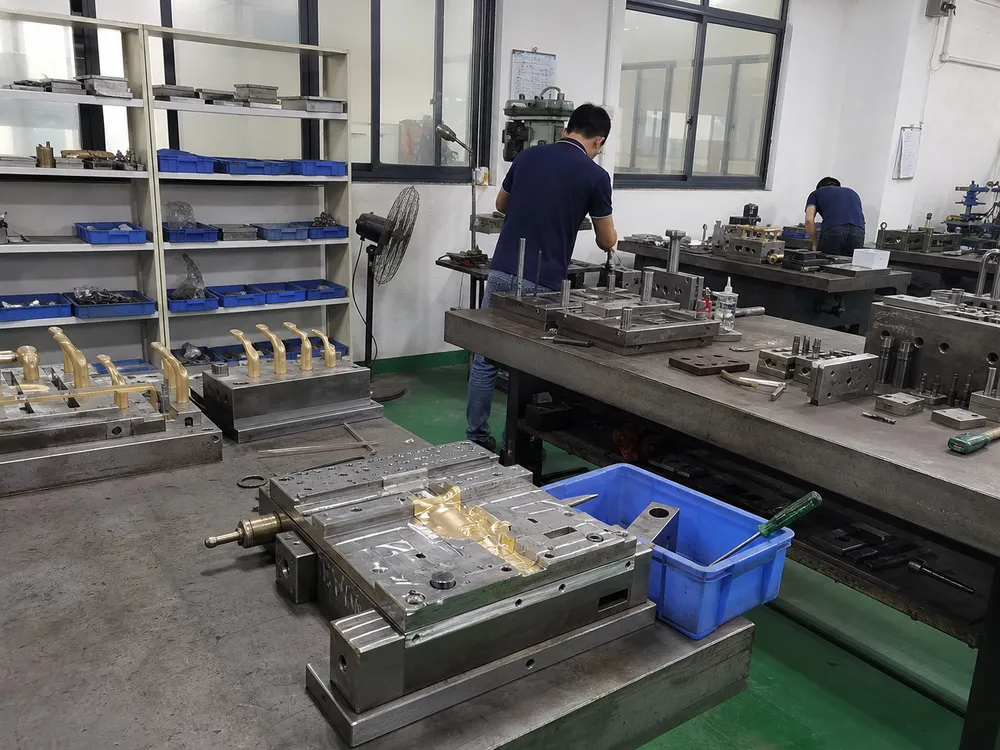
We cast every body from C36000-equivalent free-machining brass using gravity casting — the same process and alloy we've run since we started exporting to North American markets. Gravity casting gives us a denser, more uniform grain structure than die casting, which matters for the valve seat interface where the cartridge seats and seals under pressure.
After casting and trimming, each body goes through CNC machining where we hold valve seat thread tolerances to ±0.05mm. That tolerance is the one that determines whether a faucet drips at 18 months or runs clean for years.
A loose valve seat lets the ceramic disc shift under pressure cycling — the cartridge doesn't seal properly, and the faucet drips. We verify every body with a thread gauge at the post-machining inspection checkpoint before it moves to the finishing line.
We added this 100% verification step after seeing a batch of bodies from a period when we were running the CNC at higher throughput — the failure rate on that batch was low, but it was non-zero, and that's not acceptable for export product.
Alloy Standard
C36000-Equiv.
Free-machining brass, gravity cast for dense uniform grain structure
Thread Tolerance
±0.05mm
Valve seat thread tolerance held at CNC machining, 100% gauge-verified
For cUPC-certified product destined for North American markets, we use a low-lead brass alloy that meets NSF 61/372 lead content requirements — weighted average lead content ≤0.25%. Every incoming brass batch is tested with XRF analysis before it enters production.
We apply the same standard to all production regardless of destination market, because the discipline of consistent incoming material control is what keeps our quality system coherent across a mixed-destination production schedule.
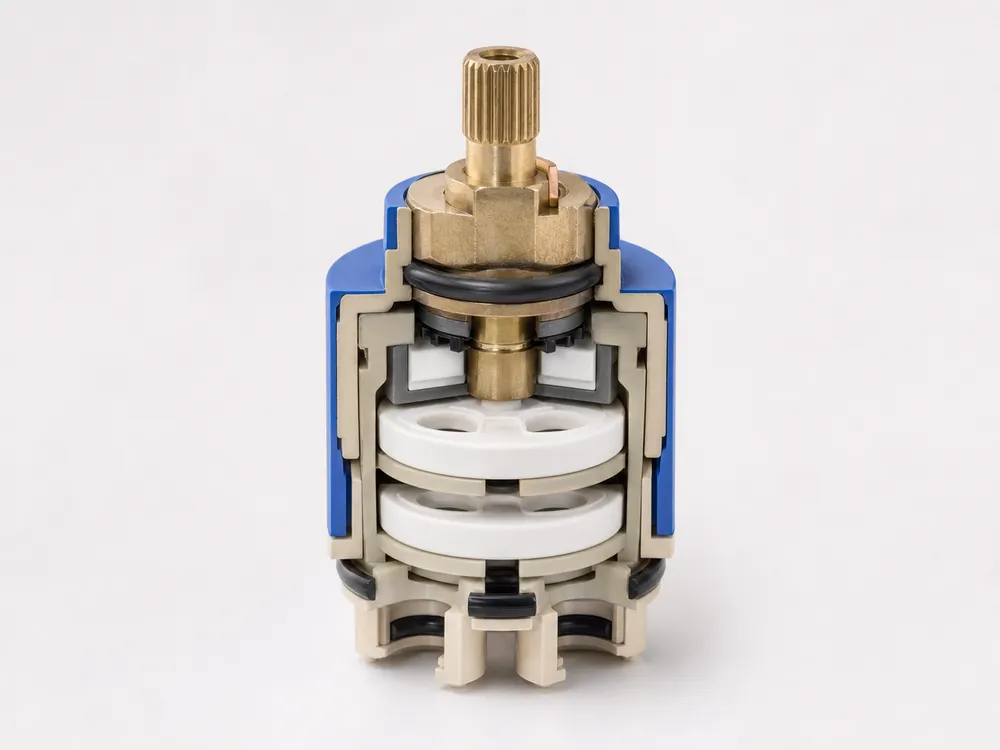
The cartridge assembly uses ceramic disc valves sourced from qualified suppliers with their own test reports. We run 500,000-cycle endurance testing on every production batch — not just on new product introductions. The cartridge that passed your sample order is the same cartridge performance your container delivers.
Quality Discipline
The 500,000-cycle endurance test runs on every production batch of cartridges — not just at new product introduction. Combined with 100% valve seat gauge verification on every body, the quality controls that applied to your sample order apply identically to your container order. There is no gap between sample performance and production performance.
100%
Body gauge verification
500K
Cycle cartridge test per batch
≤0.25%
Weighted avg. lead content
XRF
Incoming brass batch analysis
In-House Production
All six finishes run on our own lines in Foshan. No subcontracting, which means finish consistency across a mixed-SKU order is controlled by one team, one set of bath chemistry parameters, and one QC checkpoint.
Multi-Layer Electroplated
Copper base coat, nickel mid-coat, chrome top coat. The nickel mid-coat is the corrosion barrier — skipping it is a common cost-cutting move in the industry, and it's why chrome faucets from some factories fail salt spray at 48 hours.
Highest-volume finish globally. Anchor SKU for any distribution catalog.
PVD Process · 0.3–0.5μm
Fingerprint-resistant surface. The dominant finish in North American kitchen hardware retail for the past several years. Higher unit cost than chrome, but commands a retail price premium that protects your margin. Zero RMA for finish degradation from your coastal accounts — PVD holds where electroplated nickel doesn't.
PVD Process · 48h Salt Spray Min.
The fastest-growing finish in the contemporary kitchen segment. If you're building an e-commerce catalog or targeting the design-forward renovation market, this is the finish driving the most new SKU requests from our OEM buyers right now.
PVD Process · 0.3–0.5μm
The premium finish tier. Specified for hospitality, luxury residential, and Middle Eastern markets. PVD gold holds color consistency better than electroplated gold over time — no color shift from cleaning chemicals, which matters when your downstream customer is a hotel that needs the hardware to look consistent across 200 rooms for five years.
Electroplated · Living Finish
Electroplated with a living finish characteristic. Specified for traditional and transitional kitchen styles. Popular in North American markets with a strong farmhouse and craftsman aesthetic segment.
304 Stainless · Mechanical Brush
Available on our 304 stainless steel body line. No plating required — the finish is mechanical brushing of the stainless surface. Zero corrosion risk, specified for food service and health-conscious residential segments.
Finish Consistency Advantage
All six finishes run on our own lines in Foshan with no subcontracting. When you place a mixed-SKU order across chrome, brushed nickel, and matte black, every finish is controlled by the same team and the same bath chemistry parameters. There is no inter-factory variation to manage, and no finish-consistency gap between SKUs in the same shipment.
6
Finish options
3
PVD finishes
0
Subcontracted lines
| Finish | Process | Salt Spray | Primary Market | Margin Profile |
|---|---|---|---|---|
| Chrome | Multi-layer electroplated | 24h min / 48h typical | Global volume | Standard |
| Brushed Nickel | PVD · 0.3–0.5μm | — | North America retail | Premium |
| Matte Black | PVD | 48h min | Contemporary / E-commerce | Premium |
| PVD Gold / Brushed Gold | PVD · 0.3–0.5μm | — | Hospitality / Luxury / Middle East | High premium |
| Oil-Rubbed Bronze | Electroplated · Living finish | — | Traditional / Farmhouse | Standard–Premium |
| Brushed Stainless | Mechanical brush · 304 SS | N/A — no plating | Food service / Health-conscious | Premium |
Valve Technology
Every warranty claim, every RMA, every one-star review that mentions "dripping" or "hard to turn" traces back to the valve. We run ceramic disc cartridges across our entire deck mount line — not because it's a marketing claim, but because it's the only cartridge type that holds up across the full range of water quality conditions your buyers will encounter.
Two alumina ceramic discs — one fixed, one rotating — control flow and temperature by aligning or blocking precision-machined ports. The sealing surfaces are lapped to a flatness tolerance measured in microns. There are no rubber seats to swell, no O-rings under constant compression load, and no metal-on-metal wear surfaces. The disc stack is self-lubricating under water pressure.
The cartridge decision is a downstream cost decision, not just a spec decision. Here's how it plays out across your customer base.
Rubber-seat ball valves and cartridges with elastomer seals degrade faster in high-chlorine municipal water and in hard water above 200 ppm. Ceramic discs are chemically inert to both. Switching to ceramic disc across your line typically reduces valve-related warranty claims by 60–80% based on our OEM buyers' reported RMA data.
On Amazon and Home Depot's marketplace, "dripping faucet" and "hard to turn" are the two most common 1- and 2-star review triggers for kitchen faucets. Both are cartridge failure modes. A ceramic disc cartridge eliminates both failure modes at the source — which protects your product's review score and your account health metrics with major retail platforms.
If you're distributing across multiple markets — North America, Europe, Middle East, Southeast Asia — water hardness and chlorine levels vary dramatically by region. A single ceramic disc cartridge spec handles all of them. You don't need region-specific cartridge SKUs or separate QC protocols for different water conditions.
| Cartridge Type | Cycle Rating | Hard Water | Drip Risk | Warranty Exposure |
|---|---|---|---|---|
| Ceramic Disc (ours) | 500,000+ | Excellent | Minimal | Low |
| Ball Valve | ~100,000 | Poor — seat wear | High after 2–3 years | High |
| Rubber Seat Cartridge | ~150,000 | Fair — swelling risk | Moderate | Moderate–High |
We stock replacement cartridges for every model in our deck mount line and can supply them as a separate line item for your after-sales or spare parts program. If you're building a branded faucet line, having a cartridge replacement SKU in your catalog reduces your warranty service cost and gives your end customer a repair path that doesn't require a full unit replacement.
Flow Rate & Water Efficiency
Flow rate is a compliance variable, not just a performance spec. The aerator we install at the factory determines whether your product is legal to sell in California, compliant with WaterSense labeling requirements, or optimized for markets where water pressure is low and flow restriction would create a poor user experience. We configure this at the factory to your spec.
1.0 GPM / 3.8 LPM
Required for sale in California under CALGreen and applicable to any product sold through California retail or e-commerce channels with California delivery. Also meets Colorado and other state-level restrictions. If you're selling on Amazon with nationwide delivery, this is the safe default for US market compliance.
1.5 GPM / 5.7 LPM
Meets EPA WaterSense criteria for kitchen faucets (≤1.8 GPM). Qualifies for WaterSense labeling if you pursue certification. Appropriate for most US markets outside California. Balances water efficiency with user-perceived flow performance — the most common spec for mid-market US retail.
2.2 GPM / 8.3 LPM
Standard flow for markets without flow restriction mandates. Common for Middle East, Southeast Asia, and parts of Europe where water pressure is variable and users expect full flow. Also used for commercial and food service applications where fill speed matters. Not for California or WaterSense-labeled products.
Standard Aerator (fixed)
Factory-installed, non-removable. Lowest cost. Appropriate when your target market has a single flow rate requirement.
Neoperl-Compatible Thread (M22/M24)
Threaded aerator housing accepts standard Neoperl inserts. Allows your end customer or installer to swap flow rate without tools. Preferred for plumbing supply and trade channels.
Key-Removal Vandal-Resistant Aerator
Requires a key tool to remove. Specified for commercial, hospitality, and multi-family residential where tamper resistance is required by the property manager or building code.
Pull-Down Spray Head (integrated)
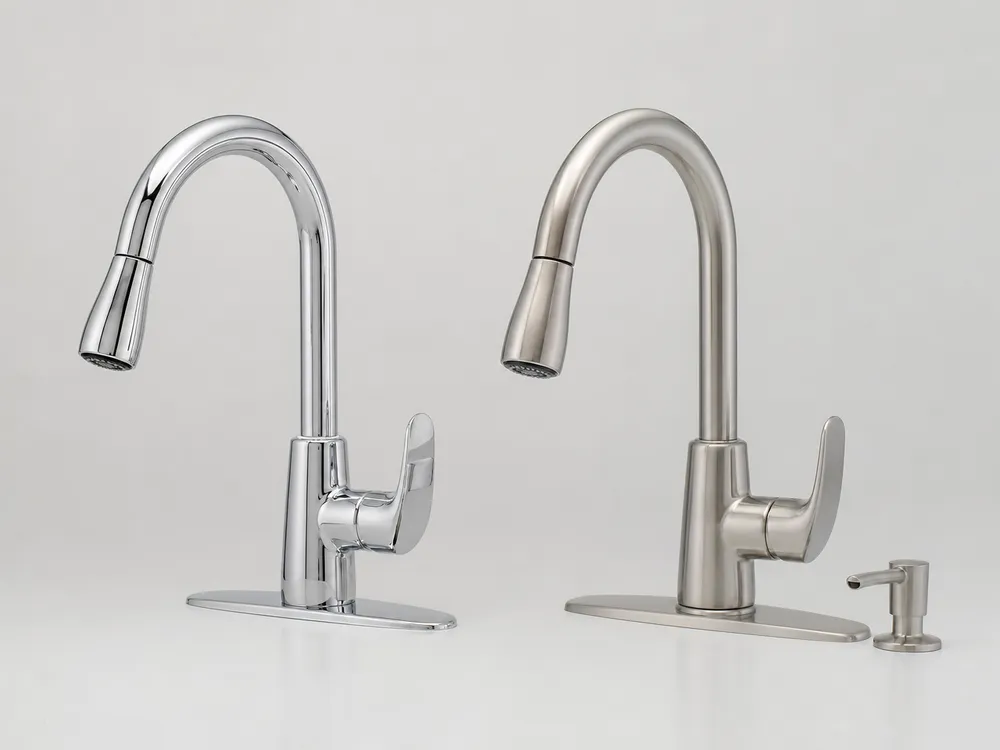
On pull-down and pull-out models, flow rate is controlled at the spray head. Stream and spray modes are configurable. Flow rate spec applies to stream mode at rated pressure.
Compliance Note
Flow rate compliance is a common source of import delays and marketplace listing suspensions for buyers who don't specify it at the order stage. We include the correct aerator insert for your target market as part of the standard production spec — not as an afterthought. If you're selling across multiple markets with different requirements, we can produce market-specific SKU variants in the same production run with different aerator inserts, clearly marked on the carton for your warehouse team.
Deck mount is the configuration that fits the most channels. Here's where our buyers are deploying it and what the commercial logic looks like.
North America · Europe
The largest volume segment for deck mount. Replacement buyers are working with existing sink holes — and the majority of North American kitchen sinks have either a single center hole or three holes in a standard spread. Single-handle deck mount in brushed nickel and matte black drives the bulk of orders in this channel.
Typical Order Profile
The key sourcing requirement is finish consistency across reorders — your retail customers notice when the brushed nickel on a replacement faucet doesn't match the one they bought 18 months ago. We hold finish parameters batch-to-batch using documented plating bath chemistry controls.
Southeast Asia · Middle East
Project procurement teams specify deck mount kitchen faucets by the container for residential developments and hotel fit-outs. Chrome single-handle deck mount is the volume configuration in this channel. Lead time reliability matters more than price here — a delayed container can hold up an entire floor of unit completions.
What This Channel Requires
This segment has been growing steadily in the Gulf region — hotel and serviced apartment projects are specifying deck mount in chrome and brushed nickel at volumes that make it worth building a dedicated SKU for the channel.
Global
MOQ of 200 pieces makes deck mount viable to test a new SKU before committing to a full container. Matte black single-handle deck mount and brushed gold widespread are the configurations moving fastest in this channel.
Private Label Capabilities
Matte black single-handle deck mount and brushed gold widespread are the configurations moving fastest in this channel.
Europe · Middle East
Hotel and serviced apartment projects specify kitchen faucets in volume with tight aesthetic consistency requirements. Widespread deck mount in brushed nickel or PVD gold is common in this segment. OEM with custom handle profiles and finish matching is available from 200 pieces.
Project Specification Support
Aesthetic consistency across a large project order is the key requirement — we hold finish parameters batch-to-batch, and we can provide a reference panel from the first production run for your project manager to approve before the full batch ships.
Australia · Southeast Asia
WaterMark-certified deck mount in chrome and brushed nickel covers the Australian replacement market. Single-handle configurations dominate. Buyers in this channel typically want a catalog that covers both the 1-hole and 3-hole installation scenarios from a single supplier, so they're not managing two sourcing relationships for what is essentially the same product category.
Certification
WaterMark Certified
Coverage
1-hole & 3-hole from one supplier
The hole configuration is the first decision your downstream customer makes — and it's the one that determines which SKU they need. Getting this wrong means a return. Here's how we think about it.
Fits the single center-hole configuration that's standard on most modern undermount and drop-in sinks. Also the configuration for buyers who want to offer a clean, minimal aesthetic — one hole, one faucet, no escutcheon plate required.
Note: Escutcheon plate available for 1-hole faucets installed in 3-hole sinks — covers unused holes for a clean finish. Ask us when specifying your order.
Covers the traditional three-hole sink setup with a center spout and two handle holes at 4-inch centers. Two-handle operation is standard. This is the dominant configuration for the European replacement market and for North American buyers serving the traditional kitchen segment.
Also the configuration for buyers who want to offer a two-handle aesthetic — separate hot and cold handles are a design preference in certain market segments, not just a legacy installation requirement.
Uses the same three-hole footprint but with handles spaced 8 inches (203mm) apart. The premium configuration — specified for higher-end residential renovations and hospitality projects where the wider handle spread is part of the design language.
Worth carrying in your catalog if you're targeting the mid-to-premium residential segment — widespread commands a higher retail price point than standard 3-hole.
We can supply an escutcheon plate for 1-hole faucets installed in 3-hole sinks — this is a common request from buyers who want to offer a single-handle faucet to customers with existing 3-hole sinks. The plate covers the unused holes and gives a clean finish. Ask us about this option when you're specifying your order.
| Configuration | Holes Required | Handle Spread | Operation | Primary Markets |
|---|---|---|---|---|
| 1-Hole | 1 center hole | N/A | Single-handle | North America (new construction & renovation) |
| 3-Hole | 3 holes | 4 inches (102mm) | Two-handle | Europe (replacement), North America (traditional) |
| Widespread | 3 holes | 8 inches (203mm) | Two-handle | Mid-to-premium residential, hospitality |
Related Kitchen Faucet Configurations
Finish is the first thing the end buyer sees on the shelf or in a product photo. Getting your finish mix right means fewer slow-moving SKUs and better sell-through. Here's how we think about finish selection for wholesale buyers.
The volume finish. High-gloss, highly reflective, and the easiest to match across a mixed kitchen. Chrome is the default for buyers who need broad market coverage — it moves in every channel from big-box to independent hardware.
The second-highest volume finish in North America. Warm satin tone that hides water spots and fingerprints better than chrome — a practical advantage that end buyers notice. Strong in the mid-range residential renovation segment.
The fastest-growing finish in the premium residential segment. Bold, contemporary, and commands a higher retail price point. Buyers targeting design-forward kitchens and hospitality projects are increasingly leading with matte black.
Warm, dark, and well-suited to traditional and transitional kitchen styles. Strong in the North American market where buyers are serving the replacement segment — particularly in regions where traditional kitchen aesthetics remain dominant.
The luxury tier finish. PVD (Physical Vapor Deposition) coating delivers superior durability compared to standard electroplating — it's the finish specification that hospitality buyers and premium residential projects ask for by name. Higher MOQ applies.
The professional kitchen aesthetic — pairs naturally with stainless appliances and undermount sinks. Strong in the commercial-residential crossover segment and with buyers serving the foodservice-adjacent residential market. Cooler tone than brushed nickel.
For most wholesale buyers entering the North American market, the practical starting point is chrome + brushed nickel as your core two-finish SKU set. Add matte black if you're targeting the mid-to-premium residential segment. Oil rubbed bronze is worth carrying if your customer base skews toward the traditional replacement market. Brushed gold and stainless are specialty finishes — carry them when you have a specific channel or project type that demands them.
We can advise on finish mix based on your target market and order volume. Ask us when you're building your initial SKU list.
| Finish | Coating Method | Durability | Maintenance | Price Tier |
|---|---|---|---|---|
| Chrome | Electroplating | Good | Shows water spots; easy to wipe | Entry–Mid |
| Brushed Nickel | Electroplating + brushing | Good | Hides spots; occasional polish | Mid |
| Matte Black | PVD or powder coat | Very Good | Hides spots; avoid abrasives | Mid–Premium |
| Oil Rubbed Bronze | Electroplating + patina | Good | Living finish; patina evolves | Mid |
| Brushed Gold | PVD | Excellent | Low maintenance; PVD hardness | Premium |
| Stainless Steel | Brushed SS surface | Excellent | Very low; corrosion resistant | Mid–Premium |
Spout geometry determines usability at the sink. The wrong spout reach or height for a given sink depth creates a return — and a dissatisfied end buyer. Here's how to match spout specs to your customer's sink inventory.
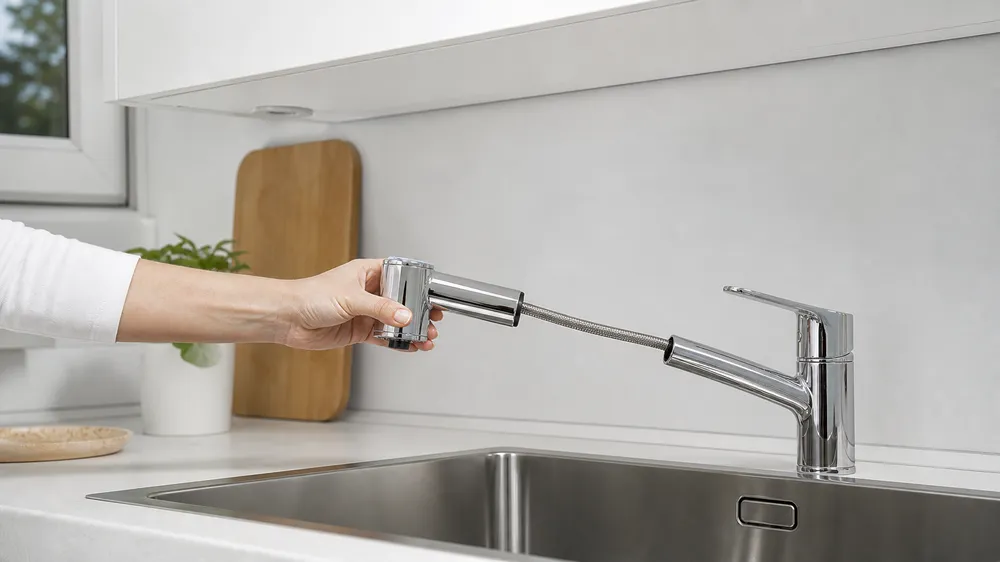
The dominant spout style in the North American market. Tall clearance — typically 8 to 10 inches above the deck — makes it practical for filling large pots and working with deep undermount sinks. The high arc profile is also a strong visual statement that photographs well for e-commerce listings.
Spout Height
8–10 inches above deck
Spout Reach
8–9 inches typical
Best For
Deep sinks, large pots
Market
North America dominant
Splashing note: High arc spouts can cause splashing in shallow sinks. Confirm sink depth with your customer when specifying — 8-inch minimum sink depth is the practical guideline.
The practical choice for installations with limited under-cabinet clearance or shallow sinks. Spout height typically 4 to 6 inches above the deck. Strong in the European market and in North American renovation projects where cabinet height constrains the installation envelope.
Spout Height
4–6 inches above deck
Spout Reach
6–8 inches typical
Best For
Shallow sinks, low cabinets
Market
Europe, renovation
Clearance note: Measure from the sink deck to the underside of the cabinet before specifying. Low arc spouts need a minimum of 6 inches of clearance above the deck to operate comfortably.
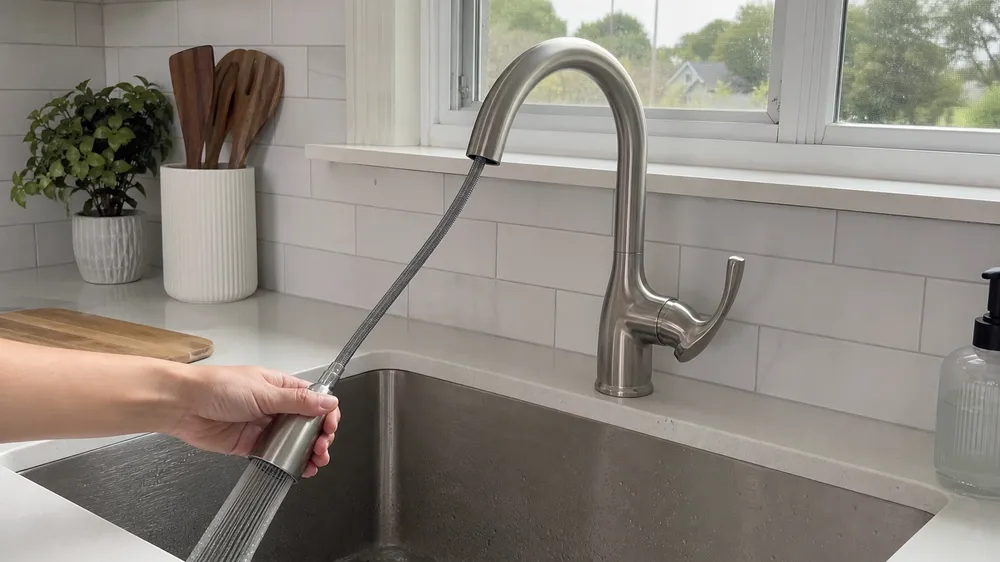
The spray head retracts into the spout body and pulls down into the sink basin. The most popular configuration in the North American residential market. The integrated hose — typically 59 to 68 inches — gives the user full sink coverage and makes rinsing produce or washing large items significantly easier than a fixed spout.
Hose Length
59–68 inches typical
Spray Modes
Stream + spray (2-function)
Best For
Deep sinks, high-use kitchens
Retraction
Magnetic or weighted
Retraction quality: Magnetic docking systems hold the head more securely than weighted counterbalance systems. Specify magnetic docking for mid-to-premium SKUs — it's a feature end buyers notice and comment on.
The spray head pulls forward and out rather than down. Lower spout profile than pull-down — typically 5 to 7 inches above the deck — making it the right choice when under-cabinet clearance is limited. Common in European kitchens and in North American installations with upper cabinets mounted close to the counter.
Spout Height
5–7 inches above deck
Hose Length
32–40 inches typical
Best For
Low clearance, compact kitchens
Market
Europe, compact residential
Hose length tradeoff: Pull-out hoses are shorter than pull-down hoses, which limits reach. If your customer's end buyers frequently fill large pots at the sink, pull-down is the better specification.
| Spout Type | Height Above Deck | Reach | Min. Sink Depth | Splashing Risk |
|---|---|---|---|---|
| High Arc Fixed | 8–10 in | 8–9 in | 8 in | High in shallow sinks |
| Low Arc Fixed | 4–6 in | 6–8 in | 5 in | Low |
| Pull-Down | 8–10 in | 8–9 in | 8 in | Low (head retracts) |
| Pull-Out | 5–7 in | 6–8 in | 5 in | Low (head retracts) |
Published spout reach figures from Chinese manufacturers are measured from the center of the faucet body to the center of the aerator outlet. Confirm this measurement convention with your supplier — some measure to the tip of the aerator, which adds 0.5 to 1 inch to the stated figure. For private label programs, specify the measurement convention in your product brief to avoid discrepancies between your listing copy and the physical product.
Spout reach tolerance from Chinese factories is typically ±0.5 inch. If your customer's installation has tight clearance requirements — for example, a farmhouse sink with a specific apron depth — build that tolerance into your specification and confirm with a pre-production sample measurement.
The valve is the single component that most determines a faucet's service life and return rate. Understanding valve types, ceramic disc quality tiers, and flow rate compliance is essential for building a product line that doesn't generate warranty claims.
The industry standard for deck mount kitchen faucets. Two ceramic discs — one fixed, one rotating — control flow by aligning or misaligning ports. Properly specified ceramic disc valves are rated for 500,000 cycles, which translates to roughly 20 years of residential use.
Spec requirement: Always specify ceramic disc hardness ≥ HV1200 and confirm the valve supplier (Sedal, Kerox, or equivalent) in your product brief.
A stainless steel ball with ports controls both flow and temperature in a single-handle design. Historically common in North American single-handle faucets (Delta's original patent). Still found in entry-level SKUs but largely displaced by ceramic disc in new product development due to higher maintenance requirements.
Recommendation: Avoid ball valves in new SKU development unless specifically targeting a price-sensitive entry segment where the cost delta justifies the tradeoff.
A self-contained plastic or brass cartridge with rubber seals controls flow. Common in two-handle configurations and in some single-handle designs. Easier to replace than a ball valve assembly, but rubber seal degradation over time means a finite service life. Quality varies significantly by cartridge supplier.
Spec requirement: If using cartridge valves, specify EPDM seals (not NBR) for chlorinated water resistance and confirm cartridge cycle rating ≥ 200,000.
Federal (EPA WaterSense)
≤ 1.8 GPM at 60 PSI — voluntary but increasingly required by retailers and green building programs
California (CALGreen)
≤ 1.8 GPM at 60 PSI — mandatory for new construction and renovation in California
Colorado / Other Restricted States
≤ 1.8 GPM — several western states have adopted California-equivalent standards; verify current state list before shipping
Standard Federal Maximum
≤ 2.2 GPM at 60 PSI — the federal maximum for non-restricted states; acceptable for general distribution but not WaterSense eligible
European Union (EN 817)
No mandatory flow limit at EU level; individual countries vary. Germany and Netherlands commonly specify ≤ 6 L/min (1.6 GPM) for eco-labeled products
Australia / New Zealand (WELS)
Mandatory WELS registration; kitchen faucets rated 1–6 stars. 4-star minimum (≤ 7.5 L/min) required for most retail channels
UK (post-Brexit)
Follows EN 817 testing; no mandatory flow limit but WRAS approval required for products contacting potable water
Middle East / GCC
Dubai Municipality and Saudi SASO require flow ≤ 8 L/min for water conservation compliance in new construction projects
Flow rate in a deck mount kitchen faucet is primarily controlled by the aerator insert, not the valve body. This means a single faucet body can be configured for multiple markets by swapping the aerator. A 1.8 GPM aerator for California-compliant SKUs, a 2.2 GPM aerator for standard North American distribution, and a 6 L/min aerator for European eco-label programs — all from the same faucet body.
When building a private label program, specify aerator flow rate explicitly in your product brief and confirm the aerator thread standard (M22×1 male or M24×1 male are the two common standards). Mismatched aerator threads are a common source of field complaints when customers try to replace aerators with off-the-shelf parts.
OEM Services
Deck mount kitchen faucets are one of our most-customized product lines. Here's what's available and the practical parameters around each option.
The most common OEM request. We maintain an in-house tooling room for brass casting dies and CNC fixtures, so handle tooling revisions don't go to an outside vendor.
Adjustable within the body platform's geometry. Specify your clearance requirement and we'll spec the right spout geometry.
All six standard finishes are available at 200-piece MOQ. Custom finishes outside our standard lineup require higher volume to amortize process setup.
Standard configurations cover both major export markets. Dual-market supply is possible but most buyers run separate SKUs to keep documentation clean.
OEM packaging with your brand name, logo, and barcode is standard. We prepare carton dimensions against container floor plans before you confirm the order.
Adding a new finish or handle configuration to an existing cUPC-certified body doesn't require a full re-certification from scratch.
Certifications
The certifications your container needs depend on where it's going. We hold the documentation for the three major export markets under one roof — your compliance team isn't managing documentation from three different suppliers.
United States / Canada
ASME A112.18.1 / CSA B125.1
California
Low-lead brass ≤0.25% weighted average
European Union
EN 817 / EN 200
Australia / New Zealand
AS/NZS 3718
Global
Third-party factory and product audit
All Markets
Quality management system
| Market | Required Certification | Status |
|---|---|---|
| US / Canada | cUPC (IAPMO) — ASME A112.18.1 / CSA B125.1 | Certified |
| California | Low-lead brass ≤0.25% (AB 1953) | Qualified |
| European Union | CE (EN 817 / EN 200) | Certified |
| AU / NZ | WaterMark (AS/NZS 3718) | Certified |
| Global | SGS third-party audit | Audited |
| All Markets | ISO 9001:2015 | Certified |
We prepare HS code classification and can provide binding ruling references for customs pre-clearance. Your logistics team isn't solving classification questions at the port.
For buyers consolidating North American, European, and Australian orders from a single factory, the multi-certification coverage means your compliance team isn't solving new problems every time a container arrives from a different supplier.
Logistics & Fulfillment
Deck mount kitchen faucets are compact enough to load efficiently, but the packaging has to protect the finish through port handling and last-mile delivery. Here's how we approach it.
Standard carton packing
Standard carton packing uses a molded pulp inner tray — we moved away from expanded polystyrene foam inserts for most product lines because the pulp holds the faucet body more securely against lateral movement during container transit. The chrome and PVD finishes are the most vulnerable to contact scratches, so the tray geometry is designed to keep the spout and handle surfaces from touching the carton walls. Each unit is individually poly-bagged before tray insertion.
CBM and weight coordination
Carton dimensions are calculated against 20GP and 40HQ container floor plans. We provide a packing list with CBM and gross weight per SKU before you confirm the order, so your freight forwarder can quote accurately. For buyers consolidating multiple SKUs into one container, we coordinate the packing sequence to minimize void space and keep the container weight balanced for port handling.
E-commerce fulfillment ready
For e-commerce buyers shipping direct to Amazon FBA or other fulfillment centers, we prepare FBA-compliant carton labeling — FNSKU barcodes, suffocation warning labels, and carton content labels — as part of the standard OEM packaging service. Blind drop-shipping with your brand name on the documentation is available if your logistics setup requires it.
Approximate — single-handle deck mount. Varies by model and carton size.
20GP Container
Standard general purpose
1,800–2,400
units
40HQ Container
High cube, maximum volume
4,200–5,600
units
Exact loading quantities depend on carton dimensions for your specific model. We provide confirmed loading calculations before order finalization.
Catalog Planning
Both mount types are in our kitchen faucet line, and buyers sometimes ask which to prioritize. The answer depends on your channel.
Installs through the sink deck or countertop — the standard configuration for the vast majority of residential and light commercial kitchens. No rough-in work required beyond the pre-drilled holes in the sink. This is the configuration your customers can install themselves or have a plumber complete in under an hour.
Best for
Residential, light commercial, general distribution, e-commerce, hardware retail
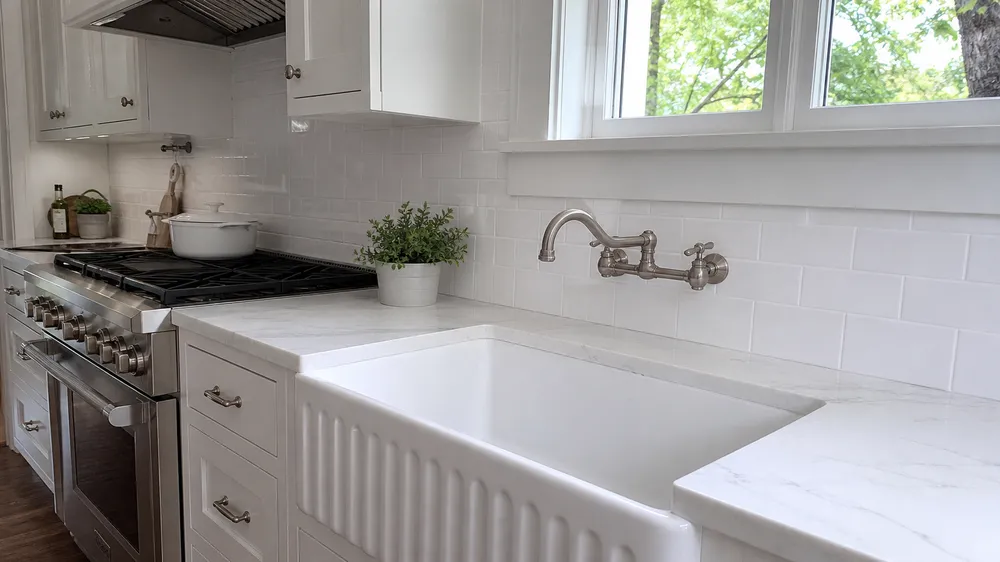
Mounts to the wall above the sink — specified for farmhouse sinks, commercial-style kitchens, and renovation projects where the countertop has no pre-drilled holes. The rough-in depth is adjustable ±15mm to accommodate varying wall thicknesses, but the installation requires access to the wall cavity and is typically a contractor job.
Best for
Premium renovation segment, farmhouse kitchen specialists, commercial-style kitchen distributors
Lead with Deck Mount
Cover all three hole configurations — 1-hole, 3-hole, and widespread — as your volume anchor SKUs.
Establish Core SKUs
Single-handle, two-handle, gooseneck, and pull-down variants within the deck mount format.
Add Wall Mount as Premium Tier
Once core deck mount SKUs are established, expand into wall mount for the farmhouse and premium renovation segment.
Technical and commercial questions we hear most from distributors and OEM buyers evaluating deck mount kitchen faucets.
The standard mounting hole diameter for a deck mount kitchen faucet is 35–38mm (approximately 1-3/8" to 1-1/2"). Most kitchen sinks and countertops are pre-drilled to this specification.
For 3-hole and widespread configurations, the two outer holes are the same diameter, with center-to-center spacing of 4 inches (102mm) for standard 3-hole and 8 inches (203mm) for widespread.
If your downstream customers are working with non-standard hole spacing, ask us about escutcheon plate options that can cover the gap.
Quick Reference
Both use three holes in the sink deck, but the handle spread is different.
Standard 3-Hole
Handles at 4-inch (102mm) center-to-center spacing. The traditional configuration that fits most three-hole sinks. This is the volume configuration for the replacement market.
Widespread
Handles at 8-inch (203mm) center-to-center spacing. Requires a sink or countertop drilled to the wider spread. A premium configuration that commands a higher retail price point.
If you're not sure which your customers need, stock both — they serve different installation scenarios and don't cannibalize each other.
No — deck mount is compatible with undermount, drop-in, and farmhouse sinks as long as the sink or countertop has the appropriate pre-drilled holes. The faucet mounts through the hole and secures with a mounting nut underneath the deck.
The only constraints are hole diameter (35–38mm standard) and, for multi-hole configurations, hole spacing. Deck mount is the most broadly compatible kitchen faucet installation method, which is why it's the default configuration for most residential and light commercial applications.
For the US market, the primary certification is cUPC (IAPMO), which verifies compliance with ASME A112.18.1 / CSA B125.1 plumbing standards.
For California and states that have adopted AB 1953, the faucet must also meet lead-free requirements — weighted average lead content ≤0.25% in wetted components.
Our cUPC-certified deck mount faucets use a low-lead brass alloy that meets this requirement, and we test every incoming brass batch with XRF analysis. Test reports and certification documentation ship with your order.
Certifications Included
cUPC (IAPMO)
ASME A112.18.1 / CSA B125.1
AB 1953 / Lead-Free
≤0.25% weighted avg, XRF verified
200 pcs
MOQ per SKU for handle design changes using existing body tooling
500 pcs
Recommended minimum for custom finishes outside standard six options
25–35 days
First sample lead time from design brief or reference product
For entirely new body tooling (new casting die), we discuss the tooling investment separately from the per-unit price — most buyers amortize tooling over the first 1–2 production runs. For custom finishes outside our standard six options, we recommend a minimum of 500 pieces to keep the per-unit cost impact manageable.
Finish consistency across reorders is one of the most common concerns we hear from distributors. Our approach is documented and process-driven:
Bath Chemistry Control
Documented plating bath chemistry parameters for each finish, tested and adjusted before every production run.
PVD Thickness Measurement
Coating thickness measured on a sample basis using a coating thickness gauge — target range 0.3–0.5μm.
Reference Panel Comparison
For chrome and brushed nickel, a reference panel from the previous order runs alongside the new batch under standardized lighting before approving the run.
All parameters are recorded in the batch production record, which travels with the shipment documentation.
Start with a sample order
Most new buyers start with 2–4 units across the configurations they're evaluating before committing to a production run. We can ship samples within 7–10 business days from our catalog inventory.
Comparing an existing source?
If you have an existing deck mount product you're currently sourcing and want to compare quality or pricing, send us a reference sample or detailed photos. Our engineering team will identify the closest configuration in our catalog or spec an OEM equivalent and send back a detailed quote.
Building a new catalog?
Tell us your target channel, hole configuration requirements, and volume expectations — we'll suggest a starter SKU mix based on what's moving for our existing distributors in that region.
Contact Us Directly
julie@wfaucet.com
+86 18145781319
Phone
+86-0757-81228796
Address
Block A, Jinsha Smart Manufacturing Park, No. 88 Xilian East Road, Danzao Town, Nanhai District, Foshan City, Guangdong Province, China
© 2026 Wfaucet. All rights reserved.