

Waterfall Kitchen Faucets Sheet-Flow. Brass Body. OEM-Ready.
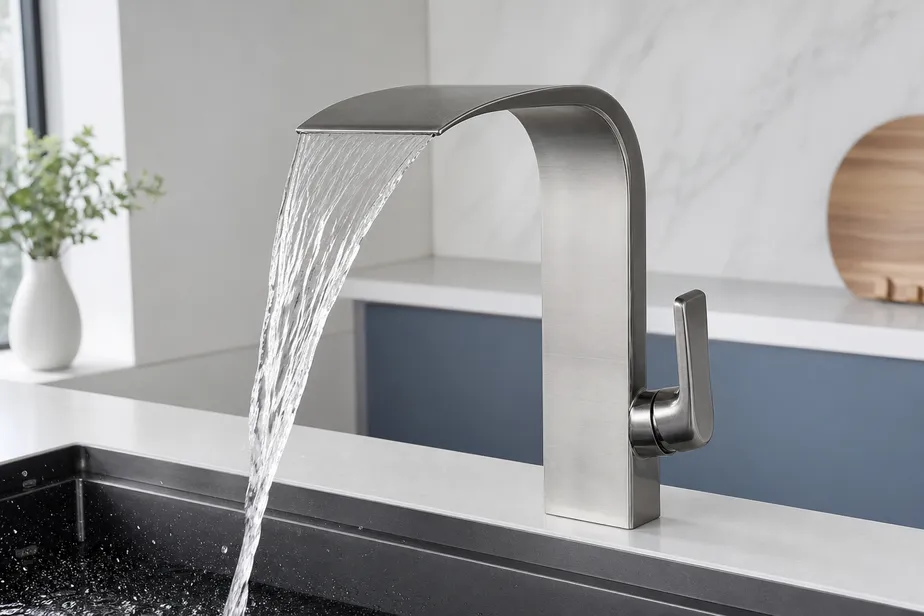
Wide flat-spout waterfall kitchen faucet — sheet-flow water delivery on the same brass body platform as our full kitchen line. Design-forward configuration that commands a retail price premium in contemporary kitchen segments.
Commercial Positioning
What Makes a Waterfall Kitchen Faucet Different — and Why That Matters for Your Margin
The waterfall kitchen faucet is the one configuration in the kitchen line where the spout geometry is the entire commercial story. Every other kitchen faucet we make — pull-down, gooseneck, single-handle — competes primarily on function and price. The waterfall competes on visual differentiation. That distinction changes how you position it, what you charge for it, and which market segments it unlocks for your distribution business.
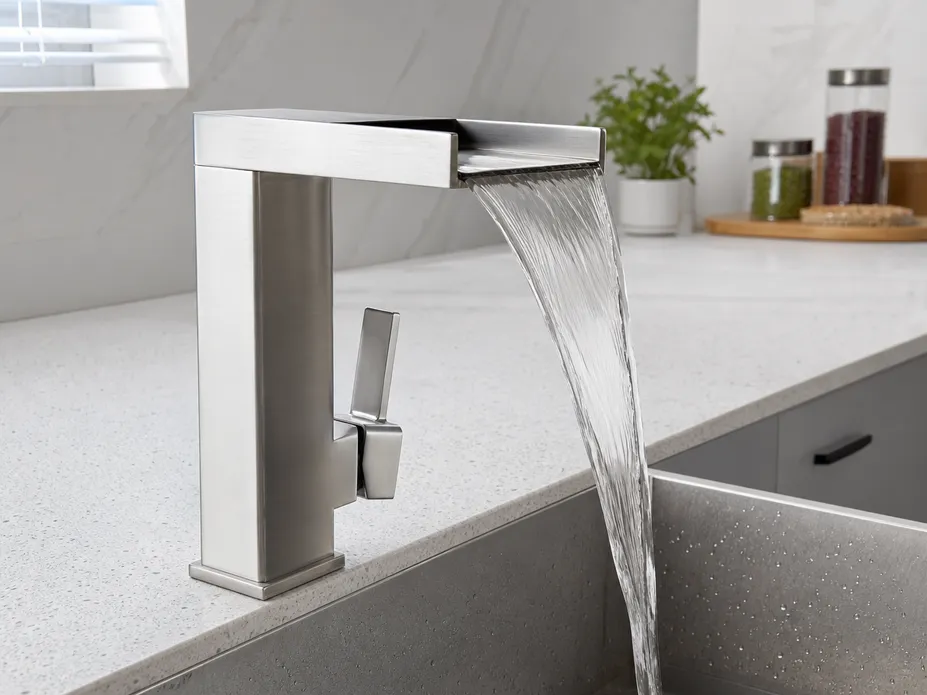
The defining feature is the wide flat spout that delivers water in a broad, laminar sheet rather than a concentrated stream. We achieve this through a precision-machined spout channel — the internal flow path is wider and shallower than a standard spout, and the outlet geometry is what produces the sheet-flow characteristic. Getting that flow pattern right requires tighter tolerances on the spout casting than a standard round-outlet design.
We run the waterfall spout on the same C36000-equivalent brass body platform as the rest of our kitchen line, so the structural integrity and corrosion resistance are identical — the spout geometry is the differentiator, not a separate material system or a compromised body spec.
The Margin Opportunity
For your business, the waterfall configuration sits at the premium tier of the kitchen faucet catalog. Buyers in the contemporary residential renovation market — the segment driving the strongest retail velocity in kitchen hardware right now — are willing to pay a meaningful premium for the visual statement a waterfall faucet makes at the sink.
We've seen our OEM buyers in North America and Europe successfully position waterfall kitchen faucets at 30–50% above their standard single-handle pull-down price points in the same finish. The product earns that premium because it looks different on the shelf and at the sink — and it holds up in the field because the underlying brass body and cartridge system are the same ones we've been shipping in volume for 17 years.
Spout Geometry
Wide flat outlet — the defining visual and functional differentiator from every other kitchen faucet configuration.
Same Brass Body
C36000-equivalent brass body platform — identical structural integrity and corrosion resistance as the full kitchen line.
Premium Positioning
30–50% price premium over standard single-handle pull-down in the same finish — documented across OEM buyers in NA and Europe.
Target Segment
Contemporary residential renovation — the segment driving the strongest retail velocity in kitchen hardware right now.
Manufacturing Process
Spout Engineering: How We Produce the Sheet-Flow Pattern Consistently
This is the section most suppliers skip, and it's the one that matters most if you're evaluating whether our waterfall faucet will hold up across a production run of 2,000 units the same way it does on a 10-unit sample order.
Dimensional Tolerance Comparison
The Sheet-Flow Geometry Challenge
The sheet-flow characteristic in a waterfall kitchen faucet comes from the internal spout channel geometry. The outlet opening is typically 40–60mm wide and 6–10mm tall — a flat rectangular profile that spreads the water into a laminar curtain as it exits.
The challenge in manufacturing is that this geometry is sensitive to casting variation. A standard round-outlet spout can tolerate ±0.3mm dimensional variation without affecting flow pattern. The flat waterfall outlet cannot — if the channel width varies by more than ±0.15mm across the outlet, the sheet breaks up into an uneven, turbulent flow that looks wrong at the sink and generates complaints from your downstream customers.
CNC Machining After Casting
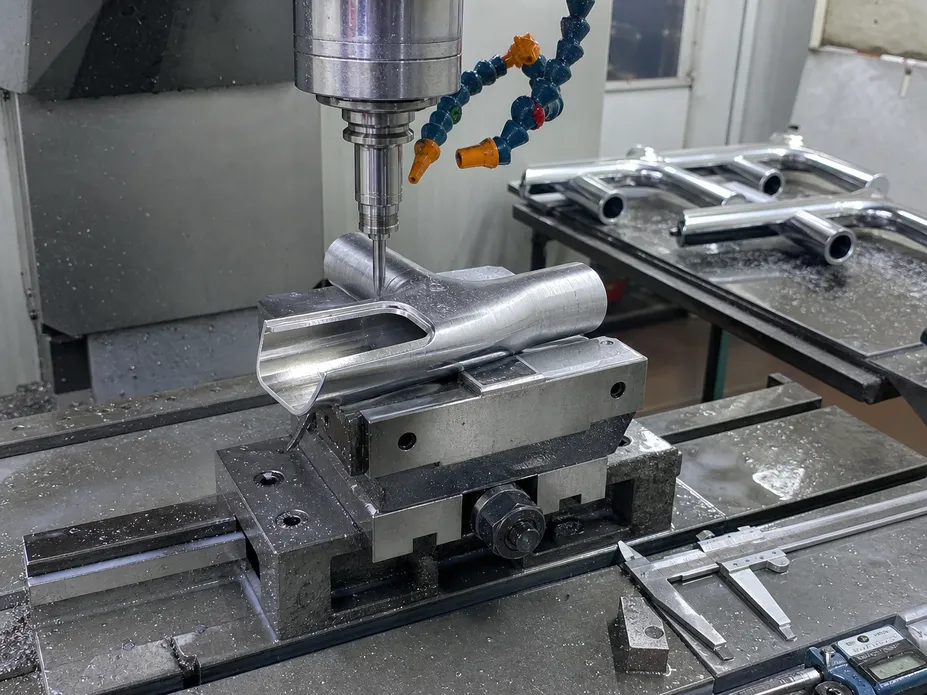
We hold the waterfall spout outlet to ±0.1mm using CNC machining after casting. The casting itself gets us close; the CNC pass is what locks in the tolerance. This two-step process is what separates consistent sheet-flow production from inconsistent casting-only approaches.
Flow Pattern Verification — Every Unit
Every spout goes through a flow pattern visual check at the post-assembly inspection station — we run water through the assembled faucet and verify the sheet-flow profile before it goes into the carton.
We added this check after seeing a batch early in our waterfall production history where casting variation in the spout channel produced inconsistent flow patterns that weren't caught until the buyer's QC team opened the container. That batch cost us a rerun. The flow check has been standard ever since.
Same Proven Internal System
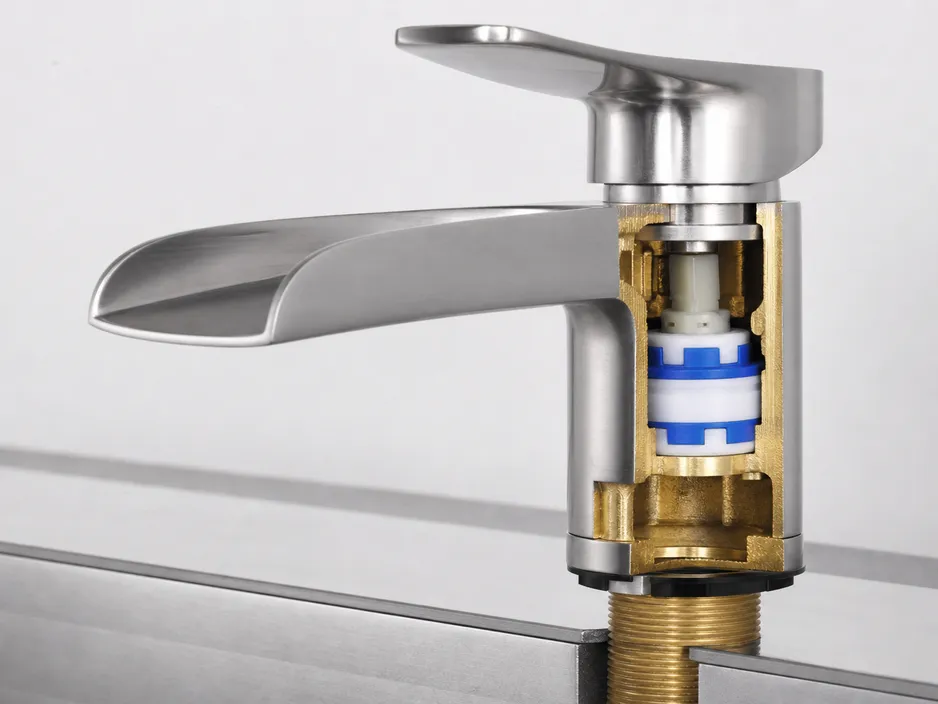
The valve seat and cartridge interface are identical to our standard kitchen faucet line — ceramic disc cartridge, 500,000-cycle endurance tested per production batch, valve seat threads held to ±0.05mm. The waterfall spout is a different geometry on top of the same proven internal system.
That means the failure modes we've engineered against across 17 years of kitchen faucet production — drip failure at the valve seat, finish degradation, connection failure — are addressed the same way here as on every other product in the line.
Production QC Sequence
Brass casting
C36000-equivalent body cast to near-net shape
CNC spout machining
Outlet held to ±0.1mm — locks in sheet-flow geometry
Cartridge assembly
Ceramic disc cartridge, valve seat threads at ±0.05mm
Flow pattern visual check
Live water run — sheet-flow profile verified before carton
Batch cartridge endurance test
500,000-cycle ceramic disc test per production batch
Technical Specifications
Industry-standard values for this product type. Actual specifications may vary by model and configuration. Contact us for detailed product data sheets.
| Parameter | Specification |
|---|---|
| Body Material | C36000-equivalent free-machining brass |
| Spout Type | Wide flat-channel waterfall outlet |
| Spout Outlet Width | Typically 40–60mm (varies by model) |
| Spout Height | Typically 280–360mm |
| Spout Reach | Typically 180–220mm |
| Spout Rotation | 360° swivel |
| Valve / Cartridge | Ceramic disc, 500,000-cycle endurance tested per batch |
| Handle Configuration | Single-handle (standard); two-handle available on request |
| Flow Rate | 1.5–2.2 GPM (adjustable aerator; WaterSense-compatible configurations available) |
| Water Pressure Rating | 0.05–0.8 MPa operating range |
| Leak Test Standard | 0.6 MPa, 60 seconds, 100% of units |
| Connections | 3/8" compression (standard); G1/2" available for European market |
| Hole Configuration | 1-hole deck mount (standard) |
| Surface Finishes | Chrome, brushed nickel, matte black, PVD gold, oil-rubbed bronze |
| Salt Spray (chrome/nickel) | 24h minimum; 48h on new finish batches |
| Salt Spray (PVD finishes) | 48h minimum; cross-cut adhesion tested per batch |
| Certifications | cUPC (North America), CE (Europe), WaterMark (Australia), SGS |
| OEM MOQ | 200 pieces per SKU |
| Standard Lead Time | 25–35 days (catalog items); 35–50 days (OEM with new tooling) |
Cartridge Endurance
500,000
cycles tested per batch — ceramic disc valve
Leak Test
100%
of units tested at 0.6 MPa for 60 seconds
Certifications
4 Markets
cUPC · CE · WaterMark · SGS
OEM Entry Point
200 pcs
per SKU — viable for catalog testing
Specifications shown are industry-standard values for this product type. Actual specifications may vary by model and configuration.
Request Detailed Specs and a QuoteMarket Segments Where Waterfall Kitchen Faucets Generate Repeatable Volume
The waterfall kitchen faucet isn't a volume driver the way pull-down single-handle is — it's a margin driver and a catalog differentiator. The segments below are where our buyers are generating consistent, profitable orders.
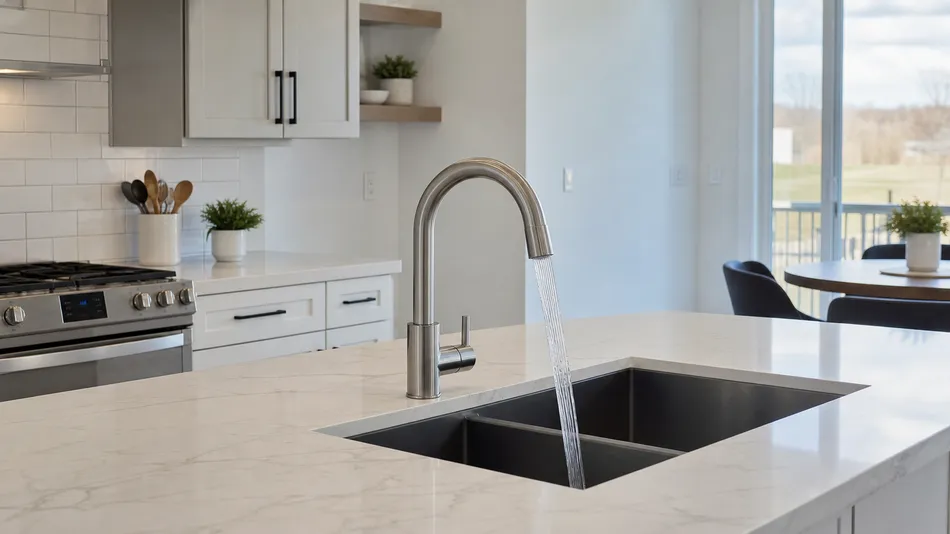
North America · Europe · Australia
Contemporary Residential Renovation
This is the primary segment. Kitchen renovation projects in the mid-to-premium tier increasingly specify design-forward fixtures, and the waterfall faucet is the configuration that signals a premium kitchen without requiring a full fixture package upgrade. Distributors supplying kitchen showrooms and renovation contractors in this segment typically carry 2–4 waterfall SKUs alongside their standard pull-down line.
200–800
units/SKU per order
6–12 mo
reorder cycle
2–4 SKUs
typical catalog carry
The margin profile is stronger than standard configurations — your retail customers are buying on aesthetics, not on price comparison.
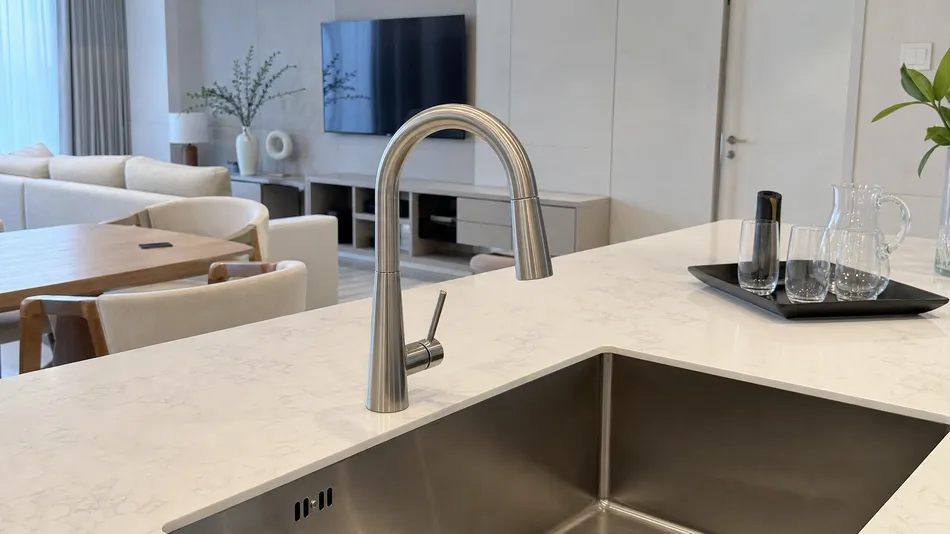
Middle East · Southeast Asia · Europe
Hospitality and Serviced Apartment Fit-Outs
Hotel and serviced apartment projects specify kitchen faucets in volume, and the waterfall configuration is increasingly specified for premium-tier properties where the kitchen aesthetic is part of the guest experience proposition. Project procurement teams in this segment order 500–2,000 units per project, often with custom finish requirements. PVD gold and brushed nickel are the most requested finishes in this channel.
500–2,000
units per project
PVD Gold
top finish request
Custom
finish specs common
This segment has grown meaningfully over the past three years — worth building into your project supply catalog if you're not already there.
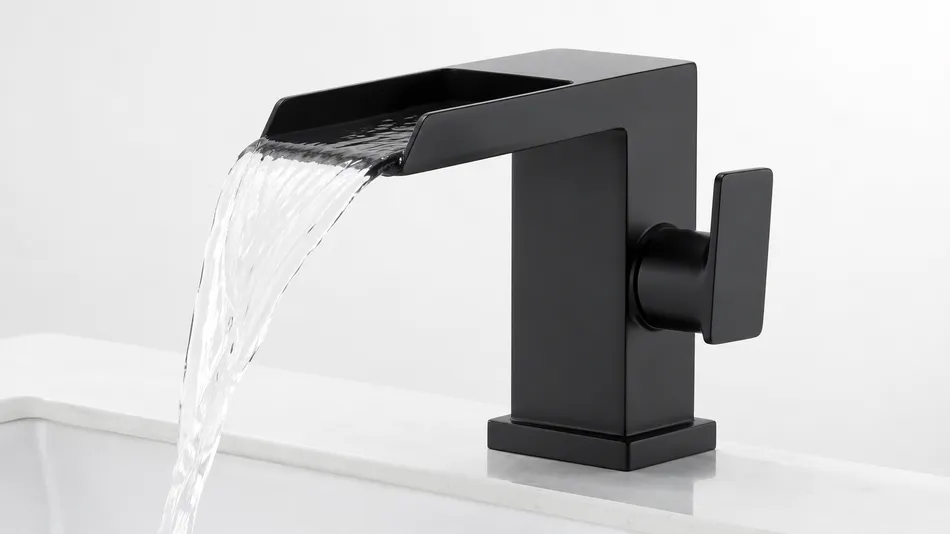
Global · Amazon · Independent E-Commerce
E-Commerce Private Label
The waterfall kitchen faucet photographs well, which matters in online retail. The wide spout and sheet-flow visual are distinctive in product photography and drive click-through rates on marketplace listings. Our OEM buyers building private label catalogs for Amazon and independent e-commerce stores consistently report that waterfall configurations outperform standard pull-down in conversion rate at equivalent price points.
200 pcs
MOQ to test a SKU
Matte Black
strongest online velocity
Higher CVR
vs. standard pull-down
Matte black and brushed gold are the finishes with the strongest online retail velocity in this configuration. MOQ of 200 pieces makes it viable to test a waterfall SKU before committing to a full container.
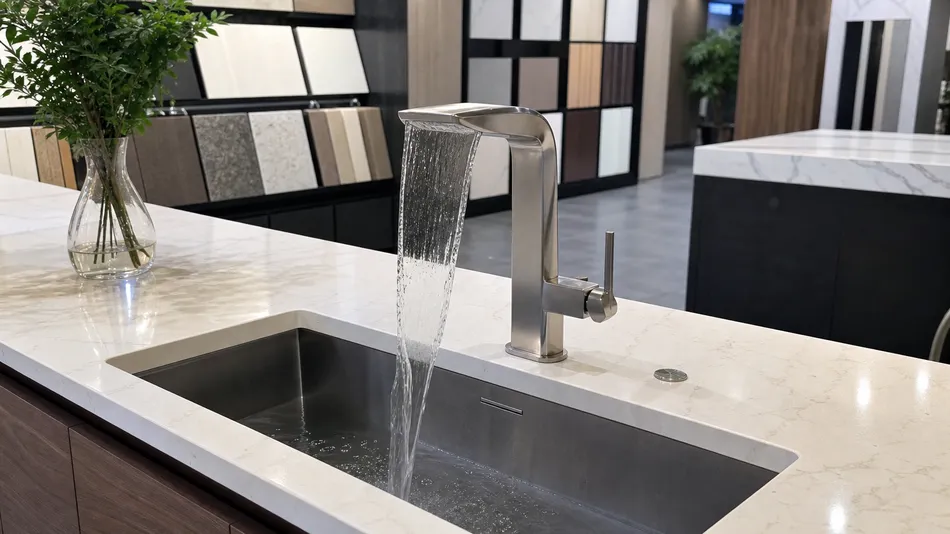
North America · Europe · Trade Channel
Interior Design and Specification Supply
Interior designers specifying kitchen fixtures for residential projects increasingly include waterfall faucets in their standard specification packages for contemporary kitchen designs. Distributors who supply the trade channel — design showrooms, specification reps, kitchen and bath dealers — find that carrying a waterfall option in their catalog opens conversations with designers who would otherwise source from premium European brands.
cUPC / CE
clears spec compliance
Trade
showroom + spec rep
Accessible
vs. European alternatives
The price point is accessible relative to European alternatives, and the certification coverage (cUPC for North America, CE for Europe) means the product clears the compliance bar for specification projects.
Building a Waterfall SKU Into Your Catalog?
Whether you're entering a new segment or expanding an existing line, we can walk you through the right configuration, finish, and MOQ structure for your channel. Most buyers start with 2–3 SKUs to test velocity before scaling.
Surface & Finish
Finish Options and Their Commercial Logic
All five finishes run on our in-house lines — no subcontracting, so finish consistency across a mixed-SKU order is controlled by one team. For the waterfall configuration specifically, finish selection has a stronger impact on market positioning than it does for standard kitchen faucets, because the product is being sold on aesthetics.
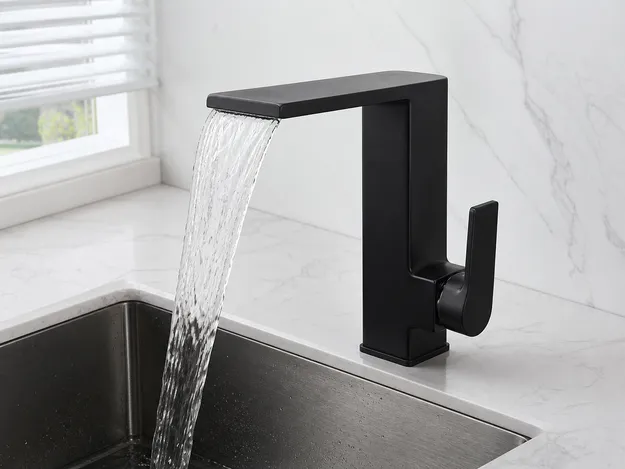
Matte Black
The fastest-moving finish for waterfall kitchen faucets in contemporary residential and e-commerce channels. The visual contrast between the flat black spout and the sheet-flow water is the strongest aesthetic statement in the waterfall line. If you're building a waterfall SKU for the first time, start here.
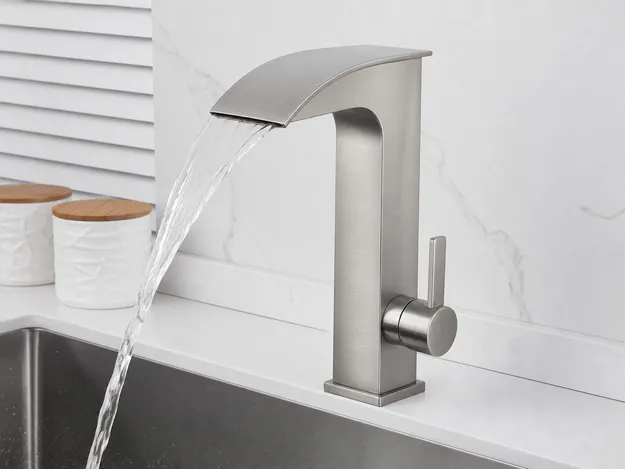
Brushed Nickel
The dominant finish in North American kitchen hardware retail, and the safe choice for buyers who want a waterfall option that fits into an existing brushed nickel catalog. Strong retail velocity, predictable reorder pattern.
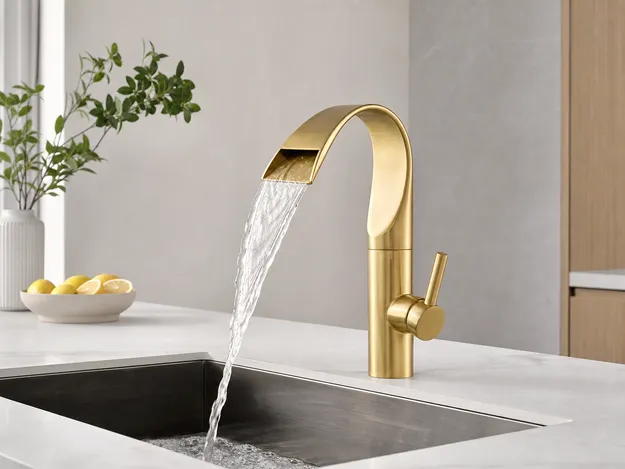
PVD Gold / Brushed Gold
The premium finish tier. Specified for hospitality, luxury residential, and Middle Eastern markets. PVD gold holds color consistency better than electroplated gold over time — no color shift from cleaning chemicals, which matters when your downstream customer is a hotel property manager who will notice if the faucet finish changes over a 5-year service life.
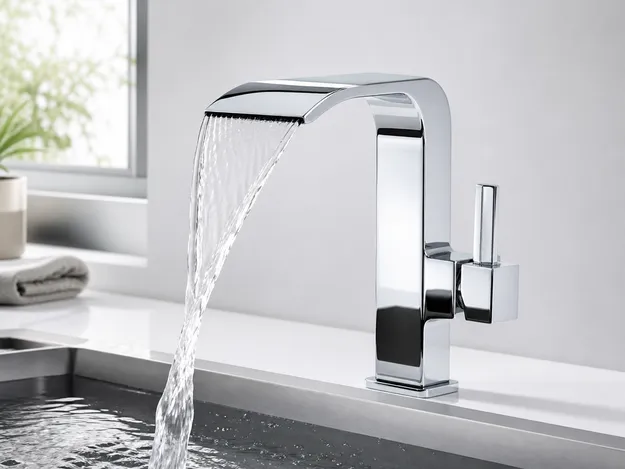
Chrome
The volume anchor for buyers who want a waterfall option at an accessible price point. Still commands a premium over standard pull-down chrome in the same catalog. Multi-layer electroplated, copper/nickel/chrome stack.
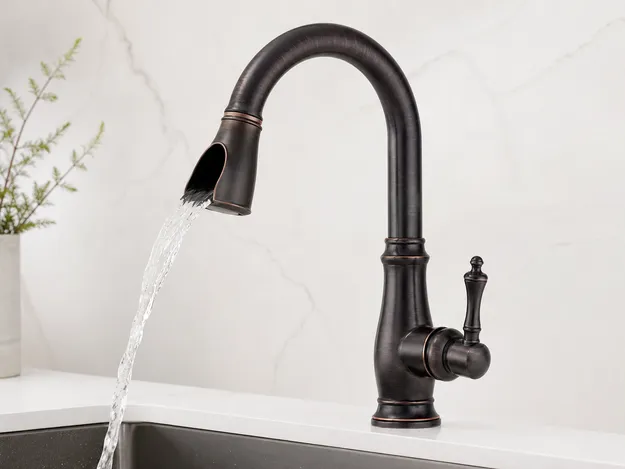
Oil-Rubbed Bronze
Specified for traditional and transitional kitchen styles. Less common in the waterfall configuration than in standard kitchen faucets, but worth carrying if your distribution territory has a strong farmhouse or craftsman aesthetic segment.
In-House Production
One Team, All Five Finishes
No subcontracting means finish consistency across a mixed-SKU order is controlled end-to-end. For waterfall faucets — where the product is sold on aesthetics — that consistency is a commercial differentiator, not just a quality note.
- Matte Black — fastest-moving waterfall SKU
- Brushed Nickel — dominant in NA retail
- PVD Gold — hospitality & luxury tier
- Chrome — volume anchor, accessible price
- Oil-Rubbed Bronze — farmhouse & craftsman
| Finish | Process | Salt Spray | Primary Channel | Price Tier |
|---|---|---|---|---|
| Matte Black | PVD 0.3–0.5μm | 48h | Contemporary residential, e-commerce | Mid–Premium |
| Brushed Nickel | PVD, fingerprint-resistant | — | NA kitchen hardware retail | Mid |
| PVD Gold / Brushed Gold | PVD (stable vs. electroplated) | — | Hospitality, luxury residential, Middle East | Premium |
| Chrome | Multi-layer electroplated Cu/Ni/Cr | 24h min / 48h typical | Volume, accessible price point | Entry–Mid |
| Oil-Rubbed Bronze | — | — | Traditional, farmhouse, craftsman | Mid |
OEM Program
OEM Customization: What You Can Specify and What the Constraints Are
The waterfall kitchen faucet has more customization sensitivity than standard configurations because the spout geometry is the product's core value. Here's what's workable and what isn't.
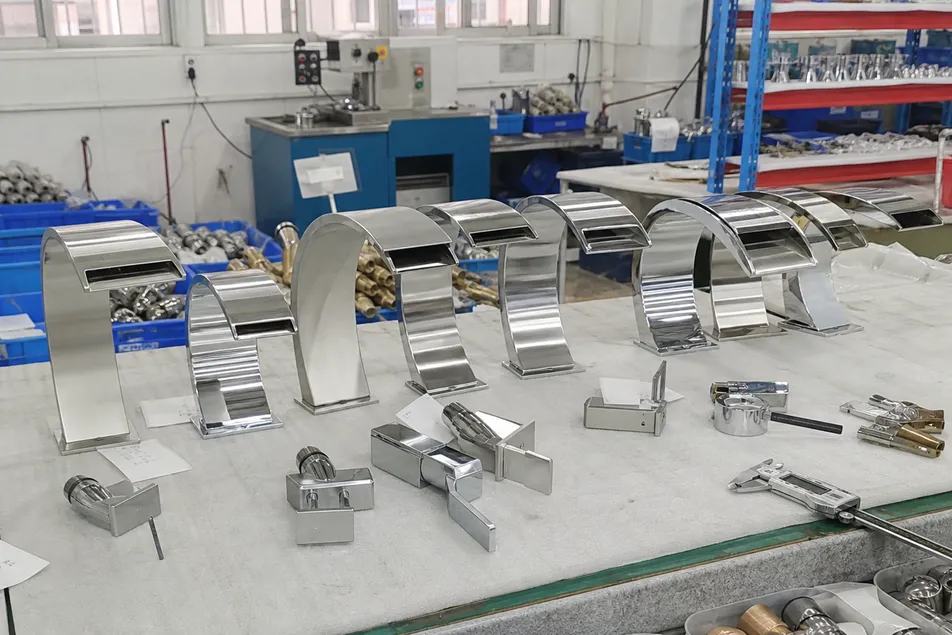
Spout Geometry Is the Core Value — Customization Starts There
Because the sheet-flow pattern defines the product, spout width and outlet profile are the most commercially significant customization parameters. Most custom requests fall within ranges we can accommodate on existing tooling — which keeps lead times and tooling costs predictable.
Spout Width Range
35–70mm
40–60mm on existing tooling
OEM MOQ
200 pcs
Standard finishes & branding
Custom Finish MOQ
500 pcs
RAL / custom PVD tones
Handle Tooling Lead
3–4 wks
New handle casting, quoted separately
Spout Width & Outlet Profile
Adjustable within approximately 35–70mm. Wider than 70mm requires a new casting die and flow validation before production. Narrower than 35mm loses the sheet-flow characteristic and approaches a standard spout profile.
Standard tooling range: 40–60mm — CNC parameter adjustments only
Outside range: New casting die + flow validation required
Spout Height & Reach
Adjustable within the ranges in the spec table. Taller spouts above 360mm require structural reinforcement at the spout base — wall thickness increases and unit weight goes up. Worth discussing before committing to a spec.
Above 360mm: Structural reinforcement at spout base
400mm+ requests: Feasible for farmhouse sink applications; confirm weight impact
Handle Design
Single-handle is standard. Two-handle configurations available on existing body tooling. Custom handle profiles — different shapes, lever lengths, or ergonomic designs — are available from 200 pieces using existing body tooling with new handle casting.
Standard: Single-handle on existing tooling
Two-handle: Available on existing body tooling
Custom profile: From 200 pcs; new handle tooling 3–4 weeks, quoted separately
Finish
Any of the five standard finishes from 200 pieces. Custom finishes outside the standard lineup — specific RALcolors, custom PVD tones, or proprietary color matching — require 500 pieces minimum and a finish sample approval cycle of approximately 2–3 weeks before production.
Standard finishes: From 200 pcs
Custom RAL / PVD: 500 pcs min; 2–3 week sample approval
Proprietary color match: Available; confirm pantone or physical sample
Valve & Flow Rate
Standard configuration ships with a 35mm ceramic disc cartridge at 1.8 GPM. Flow restrictors can be swapped to 1.5 GPM or 2.2 GPM for market-specific compliance. Thermostatic cartridge upgrades are available for select body configurations.
Standard: 35mm ceramic disc, 1.8 GPM
Flow options: 1.5 GPM (CA/NY compliant) or 2.2 GPM
Thermostatic: Available on select body configs; confirm at inquiry
Branding & Packaging
Private label branding is standard on OEM orders — laser-etched or pad-printed logos on the body or handle, plus custom retail packaging with your artwork. Instruction manuals can be localized for target markets.
Logo application: Laser etch or pad print; no MOQ uplift
Packaging: Custom retail box from 200 pcs; artwork supplied by buyer
Manual localization: Available for major markets; confirm languages
What Cannot Be Customized Without New Tooling
Some parameters are locked to the existing casting geometry. Changing them means new tooling investment, longer lead times, and a higher MOQ threshold. These are worth knowing upfront so project timelines stay realistic.
Body casting profile
Fundamental shape changes require new die casting tooling — typically 8–12 weeks and a separate tooling cost quoted per project
Spout width beyond 70mm
Requires new casting die plus flow validation testing before production approval
Mounting hole pattern
Deck plate and escutcheon geometry are fixed to standard 1-hole and 3-hole configurations; non-standard patterns require new tooling
Internal waterway routing
The internal channel geometry that produces the sheet-flow pattern is fixed; altering it changes the flow characteristic and requires full re-validation
Ready to Discuss Your OEM Specification?
Share your target spec and we'll confirm feasibility, tooling requirements, and lead time within 48 hours.
Installation
Installation Requirements and Common Mistakes
Waterfall faucets install the same way as standard deck-mount faucets, but the taller spout and wider outlet create a few specific considerations worth flagging for your customers or installation teams.
Step-by-Step Installation
-
1
Confirm deck hole size and count
Single-hole models require a 35–38mm deck hole. Three-hole models use standard 4-inch center spacing. Verify before ordering if the sink is pre-drilled.
-
2
Check under-sink clearance
The supply lines and mounting hardware extend 80–100mm below the deck. Confirm clearance before installation, especially in shallow cabinet configurations.
-
3
Thread supply lines and drop faucet body
Feed the supply lines through the deck hole first. Lower the faucet body into position. Hand-tighten the mounting nut from below — do not use a wrench at this stage.
-
4
Align spout and torque mounting nut
Align the spout over the sink basin before final tightening. Torque the mounting nut to 3–4 Nm — overtightening can crack the deck plate on thinner countertop materials.
-
5
Connect supply lines and test
Connect hot and cold supply lines with PTFE tape on threaded fittings. Turn on supply valves slowly and check for leaks at all connections before finishing.
Common Installation Mistakes
Spout aimed at the sink wall, not the basin
The taller spout height means small rotational misalignment has a larger impact on where the water lands. Align carefully before final torque.
Overtightening the mounting nut
Especially on quartz or thin composite decks. 3–4 Nm is sufficient. Overtightening causes micro-cracks that may not be visible immediately.
Skipping the aerator flush after install
Debris from supply lines can lodge in the outlet channel and disrupt the sheet-flow pattern. Run water for 30 seconds with the aerator removed before final assembly.
Mismatched supply line length
Taller spout bodies mean the supply lines travel further before reaching the shutoff valves. Measure the under-sink run and use the correct length — kinked lines restrict flow and cause noise.
Sink Compatibility Notes
Sink Depth
Minimum 180mm basin depth recommended. Shallower sinks increase splash risk given the higher spout and wider water curtain. 200mm+ is ideal.
Deck Thickness
Mounting hardware accommodates deck thicknesses of 6–50mm. Thicker stone decks may require an extended mounting shank — confirm at order if deck exceeds 40mm.
Farmhouse / Apron Sinks
Wall-mount configurations are available for farmhouse sink applications where deck mounting is not practical. Confirm rough-in dimensions and wall structure before specifying.
Regulatory Compliance
Compliance Coverage by Destination Market
The certifications your container needs depend on where it's going. Our waterfall kitchen faucet line is covered under the same certification umbrella as the full kitchen faucet range — learn more about our certification infrastructure.
| Market | Required Certification | Our Status |
|---|---|---|
| United States / Canada | cUPC (IAPMO) | Certified — test reports available |
| European Union | CE (EN 817 / EN 200) | Certified — declaration of conformity available |
| Australia / New Zealand | WaterMark (AS/NZS 3718) | Certified — license documentation available |
| Global (third-party audit) | SGS | Audited — reports available on request |
| All markets | ISO 9001:2015 | Certified — quality management system |
North American Shipments: Lead Compliance
cUPC / NSF 61 / NSF 372
For North American shipments, our cUPC-certified waterfall faucets use low-lead brass alloy meeting NSF 61/372 requirements — ≤0.25% weighted average lead content. XRF analysis on every incoming brass batch is standard. The test reports ship with your container documentation, so your compliance team has the evidence file before the goods arrive.
Multi-Market Consolidation Advantage
Single Factory, Three Certifications
For buyers consolidating North American, European, and Australian orders from a single factory, the multi-certification coverage means your compliance team isn't managing documentation from three different suppliers. One factory, one audit relationship, one documentation package — covering all three major destination markets simultaneously.
Logistics & Freight
Packaging and Container Loading
Waterfall kitchen faucets ship in individual retail cartons with foam insert protection engineered specifically for the flat spout geometry — and the container loading figures below are what your freight forwarder actually needs to quote accurately.
Custom-Profile Foam Insert
Spout Face Protection
The flat spout geometry is more vulnerable to transit damage than a round-outlet spout — the flat surface contacts the carton wall differently. We use a custom-profile foam insert that cradles the spout face rather than a generic rectangular foam block.
We learned this after seeing spout face scratches on a batch that shipped with standard foam. The custom insert added approximately $0.15 per unit to packaging cost and eliminated the damage issue entirely.
Carton Dimensions & Pre-Order Data
Freight Forwarder Ready
Standard carton dimensions are optimized for 20GP and 40HQ container loading. We provide a packing list with CBM and gross weight per SKU before you confirm the order, so your freight forwarder can quote accurately.
For buyers consolidating waterfall faucets with other kitchen faucet SKUs in one container, we coordinate the packing sequence to minimize void space.
20GP Container
800–1,200 units
Varies by spout height and carton dimensions. Exact CBM and unit count confirmed on your packing list before order confirmation.
40HQ Container
1,800–2,600 units
Optimized carton stacking for high-cube containers. Packing sequence coordinated when consolidating with other kitchen faucet SKUs.
E-Commerce & FBA Packaging
Amazon FBA / Blind Drop-Ship
For e-commerce buyers requiring FBA-compliant packaging or blind drop-shipping capability, we can produce cartons with your brand identity and FNSKU labeling. Discuss your channel requirements when you request a quote — packaging configuration is confirmed at the order stage, not after production begins.
Frequently Asked Questions
Decision-support answers for importers, distributors, and OEM buyers evaluating waterfall kitchen faucets for commercial sourcing.
What is the difference between a waterfall kitchen faucet and a standard kitchen faucet, and does the sheet-flow pattern affect water pressure?
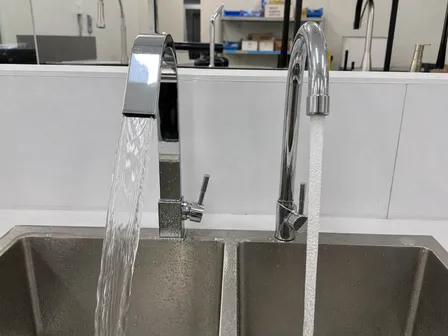
The difference is the spout outlet geometry. A standard kitchen faucet uses a round or oval outlet with an aerator that mixes air into the stream. A waterfall kitchen faucet uses a wide flat outlet — typically 40–60mm wide — that delivers water in a broad laminar sheet without aeration.
The sheet-flow pattern does not reduce functional water pressure at the valve; the flow rate (1.5–2.2 GPM) is the same as a standard kitchen faucet. What changes is the visual character of the water delivery — the sheet-flow pattern is the aesthetic feature, not a functional upgrade or downgrade.
Buyer note on downstream complaints
For buyers evaluating whether the waterfall configuration will generate complaints from downstream customers about "low pressure," the answer is no — the flow rate is equivalent, and the sheet-flow pattern is a selling point, not a limitation.
Outlet Geometry Comparison
Standard Faucet
Round/oval outlet with aerator — aerated stream
Waterfall Faucet
Wide flat outlet 40–60mm — broad laminar sheet, no aeration
What certifications does the waterfall kitchen faucet need for the US market, and do you hold them?
For the US market, the primary certification is cUPC (IAPMO), which verifies compliance with ASME A112.18.1 / CSA B125.1 plumbing standards. Our waterfall kitchen faucets are covered under our cUPC certification, and we can provide test reports and certification documentation with your shipment.
For California specifically, the AB 1953 lead-free requirement is covered by our low-lead brass alloy qualification — we use XRF analysis on every incoming brass batch to verify lead content compliance. NSF 61/372 documentation is available on request.
US Market Certification Coverage
cUPC (IAPMO)
ASME A112.18.1 / CSA B125.1 — included with shipment
AB 1953 (California)
Low-lead brass alloy — XRF analysis on every incoming batch
NSF 61/372
Documentation available on request
Can the waterfall spout be customized to a wider outlet for a more dramatic sheet-flow effect?
Yes, within limits. We can adjust the spout outlet width up to approximately 70mm on existing tooling. Beyond 70mm, the flow dynamics change — the sheet becomes thinner and more prone to breaking up at lower water pressures, and the structural requirements at the spout base increase.
We've produced custom 65mm outlet widths for buyers targeting the luxury residential segment, and the result is a noticeably wider sheet that photographs well and commands a higher retail price point.
If you're considering a wider outlet, send us your target retail price point and market — we'll spec the version that makes commercial sense.
Outlet Width Parameters
Note: Above 70mm, sheet integrity at lower pressures degrades and spout base structural requirements increase. Spec the outlet width against your target pressure range before committing.
What is the MOQ for waterfall kitchen faucets with a custom finish like brushed gold or matte black?
MOQ for standard finishes (chrome, brushed nickel, matte black, PVD gold, oil-rubbed bronze) is 200 pieces per SKU. For custom PVD tones outside our standard lineup — specific brushed gold shades, custom color PVD — we recommend a minimum of 500 pieces to amortize the line setup cost.
Below 500 pieces, the per-unit cost impact is significant enough to affect your margin on a premium-positioned product.
Standard Finishes
200 pcs
per SKU minimum
Chrome, brushed nickel, matte black, PVD gold, oil-rubbed bronze. No line setup surcharge.
Custom PVD Tones
500 pcs
recommended minimum
Specific brushed gold shades, custom color PVD. Amortizes line setup cost at acceptable per-unit margin.
Finish Validation Run
50 pcs
sample run available
Higher per-unit cost. Use to validate the finish with retail customers before committing to the 500-piece production order.
Buyer Workflow for Custom Finishes
Most buyers use the 50-unit sample run to validate the finish with their retail customers, then place the 500-piece production order once the finish is confirmed. This two-step approach reduces the risk of committing to a large run on an unvalidated color.
How do you ensure the sheet-flow pattern is consistent across a production run of 1,000+ units?
Every waterfall spout goes through CNC machining after casting to hold the outlet tolerance to ±0.1mm. After assembly, every unit goes through a flow pattern visual check — we run water through the assembled faucet and verify the sheet-flow profile before it goes into the carton.
Units that show turbulent or uneven flow are pulled for spout inspection and either reworked or rejected. The combination of tight machining tolerance and 100% flow check means the sheet-flow pattern your sample showed is the pattern your production run delivers.
We've been running this check as standard since early in our waterfall production history — it's not an optional QC step.
±0.1mm
Outlet tolerance
CNC machined
100%
Flow pattern
visual check
Applied to every unit before carton
Waterfall kitchen faucet vs. gooseneck kitchen faucet: which is better for a contemporary kitchen catalog?
They serve different commercial purposes. For a contemporary kitchen catalog, carry both — the two configurations don't cannibalize each other because they address different purchase motivations.
Gooseneck
Functional Premium
- High arc, 360° swivel, strong utility for deep sinks and large pots
- Sells on function; commands a moderate premium over standard pull-down
- Attracts price-sensitive buyers who still want a premium look
Waterfall
Visual Premium
- Sells on aesthetics; commands a stronger premium in design-forward segments
- Design-statement tier for buyers purchasing on visual impact
- Targets a distinct purchase motivation — no cannibalization with gooseneck
See our gooseneck kitchen faucet page for specs and configuration details.
Kitchen Faucet Catalog
Related Kitchen Faucet Configurations
The waterfall is one of 12 kitchen faucet configurations we manufacture. If the waterfall doesn't fit your current sourcing need, these are the most relevant alternatives.
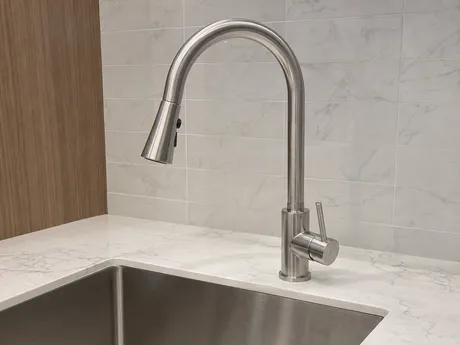
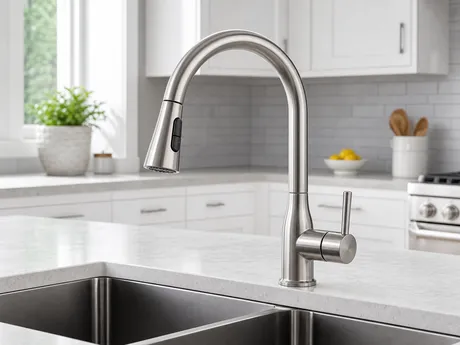
Gooseneck
Gooseneck Kitchen Faucets
High-arc curved spout, 360° swivel, 360–420mm spout height. The functional premium tier — strong margin profile for mid-to-premium residential renovation distribution without the design-specificity of the waterfall.
Pull-Down
Pull-Down Kitchen Faucets
High-arc spout with retractable spray head. The volume configuration in North American retail. If you need a high-velocity SKU to anchor your kitchen faucet catalog, this is it.
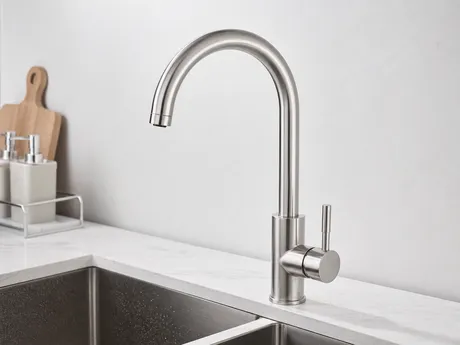
Single Handle
Single Handle Kitchen Faucets
One-lever control, ceramic disc cartridge, 500,000-cycle tested. The broadest-compatibility option across residential and light commercial channels.
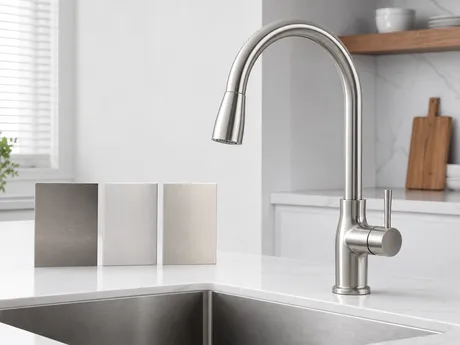
By Finish
Brushed Nickel Kitchen Faucets
If finish is your primary sourcing criterion rather than spout configuration, the brushed nickel line covers multiple configurations in the finish that's held the strongest North American retail velocity.
Start Your Waterfall Kitchen Faucet Sourcing
Most new buyers in this configuration start with a 2–4 unit sample order to evaluate the sheet-flow pattern, finish quality, and packaging before committing to a production run. We can ship catalog samples within 7–10 business days.
If you have a specific retail price point you're targeting or a reference product you're currently sourcing, send it to us — our engineering team will identify the closest configuration in our catalog or spec an OEM equivalent and come back with a detailed quote.
For buyers building a contemporary kitchen catalog for the first time, tell us your target market and channel: we'll suggest a waterfall SKU mix based on what's moving for our existing distributors in that region.
Contact Us
-
Email
julie@wfaucet.com -
WhatsApp
+86 18145781319 -
Phone
+86-0757-81228796 -
Address
Block A, Jinsha Smart Manufacturing Park, No. 88 Xilian East Road, Danzao Town, Nanhai District, Foshan City, Guangdong Province, China
Typical First Order Path
-
1
Request 2–4 unit sample order to evaluate sheet-flow pattern, finish quality, and packaging
-
2
Share your retail price point or reference product — engineering team identifies closest catalog match or specs OEM equivalent
-
3
Receive detailed quote with configuration, MOQ, lead time, and compliance documentation
-
4
Confirm production run — OEM from 200 pcs, private label from 500 pcs