

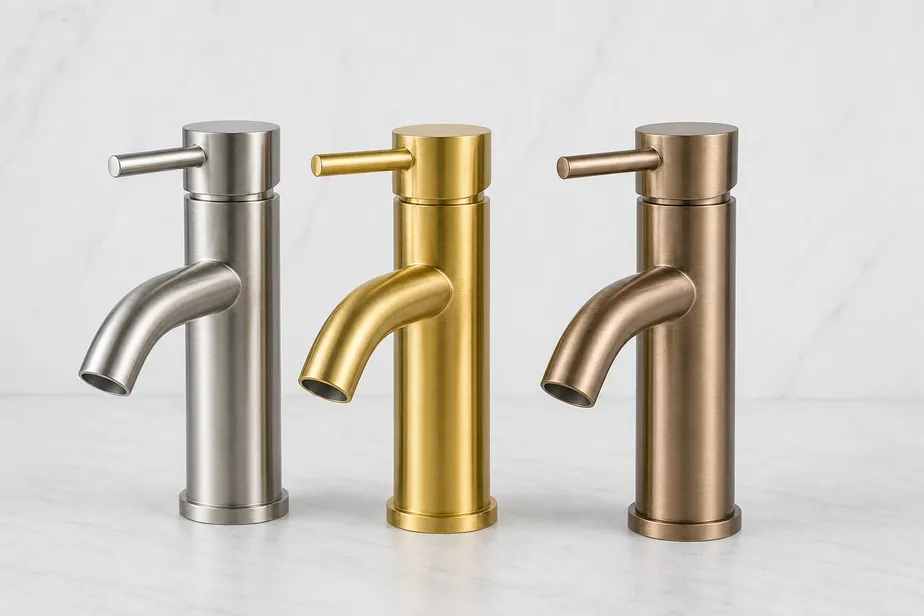
Brushed Faucets in Nickel, Gold & Champagne Bronze
All finished in-house, all tested to 24h+ salt spray before they leave the floor. One factory, one quality system, three brushed finishes your downstream buyers are actively requesting. OEM from 200 pieces with in-house tooling and no subcontracted finishing.
Production Intelligence
What "Brushed" Actually Means at the Production Level — and Why It Matters for Your Margin
The word "brushed" covers a lot of ground in the faucet market, and the production method behind the finish determines how long it holds up in the field. There are two fundamentally different ways to produce a brushed faucet: mechanical brushing on an electroplated surface, and PVD (physical vapor deposition) coating applied over a pre-brushed substrate. We run both, and the choice between them affects your landed cost, your warranty exposure, and the price tier your product can credibly occupy.
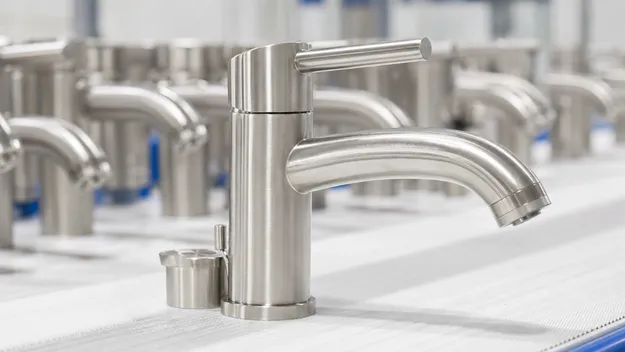
Brushed Nickel — Electroplating Process
Highest-volume brushed finish
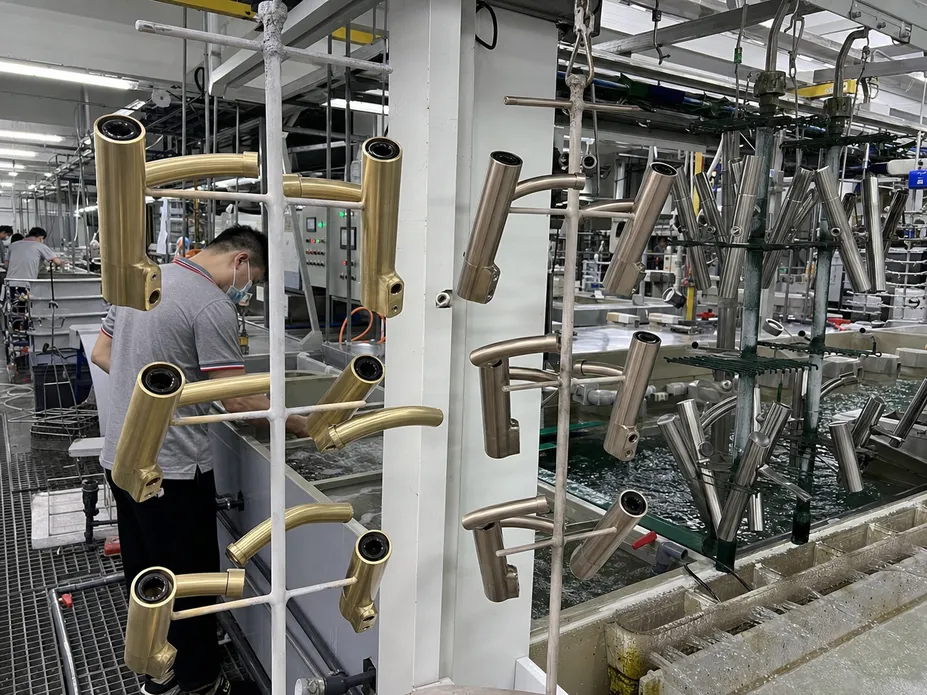
The process runs copper base coat, nickel mid-coat, then a brushed nickel top layer applied through our electroplating line. The nickel mid-coat is the structural layer — it's what gives the finish its corrosion resistance, and skipping it is the most common cost-cutting move you'll see from lower-tier factories.
Our brushed nickel passes 24-hour salt spray as a minimum; most production batches clear 48 hours. That matters if you're selling into coastal markets or humid climates where a finish that fails at 200 hours generates warranty claims within the first year of installation.
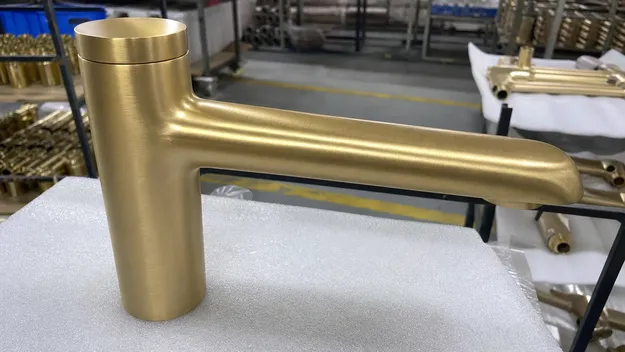
Brushed Gold & Brushed Champagne Bronze — PVD Process
Mid-to-premium retail segment
PVD runs at 0.3–0.5μm coating thickness on a pre-brushed brass substrate, and we test adhesion on every batch using a cross-cut tape test before parts move to assembly. (We added the cross-cut test after seeing a batch of PVD gold product from a trial run show micro-delamination at the handle interface — caught it before shipment, but it told us the adhesion check couldn't be skipped.)
PVD finishes carry a harder surface than electroplated finishes — Vickers hardness in the 1,500–2,000 HV range versus 200–400 HV for standard nickel plating — which translates to scratch resistance your downstream customers can actually feel when they handle the product. That's a real differentiator in the mid-to-premium retail segment, and it gives you language to justify a higher shelf price.
Surface Hardness Comparison
Vickers hardness (HV). Higher hardness = greater scratch resistance. PVD's advantage is measurable and communicable to retail buyers.
Brushed Champagne Bronze — Market Positioning Note
The brushed champagne bronze finish sits between brushed gold and brushed nickel in terms of market positioning. It reads as warm-toned and contemporary, and it's been moving well for our buyers targeting the North American renovation and hospitality segments over the last two to three years. This finish has grown noticeably for us — worth considering if you're building out a finish portfolio for a distributor catalog.
Technical Reference
Finish Specifications: What to Put in Your Comparison Sheet
Electroplating
Brushed Nickel
-
- Process
- Multi-layer electroplating (Cu/Ni/brushed Ni)
- Coating Thickness
- 15–25μm total stack
- Salt Spray
- 24h min, 48h typical
- Surface Hardness
- 200–400 HV
- Typical Application
- Kitchen, bathroom, standard commercial
PVD
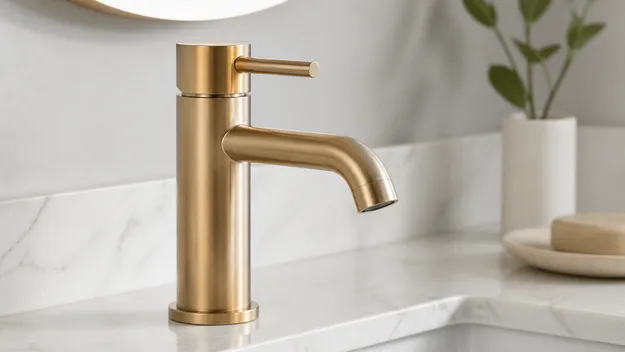
Brushed Gold
-
- Process
- PVD over pre-brushed brass
- Coating Thickness
- 0.3–0.5μm PVD layer
- Salt Spray
- 24h min
- Surface Hardness
- 1,500–2,000 HV
- Typical Application
- Mid-premium bathroom, hospitality
PVD
Brushed Champagne Bronze
-
- Process
- PVD over pre-brushed brass
- Coating Thickness
- 0.3–0.5μm PVD layer
- Salt Spray
- 24h min
- Surface Hardness
- 1,500–2,000 HV
- Typical Application
- Renovation, hospitality, North American retail
Full Product Specifications
Applies across all three brushed finish variants unless noted
| Parameter | Specification |
|---|---|
| Body Material | Brass (C36000 / C37700) or zinc alloy (ZA-8/ZA-12) per SKU |
| Cartridge | Ceramic disc, 35mm or 40mm; rated 500,000 cycles |
| Flow Rate | 1.2 GPM / 1.8 GPM / 2.2 GPM (aerator-selectable) |
| Working Pressure | 0.05–1.0 MPa (7–145 PSI) |
| Water Temperature Range | 0–90°C (32–194°F) |
| Inlet Connection | G1/2" (BSP) or 3/8" compression; specify at order |
| Spout Reach | 120–220mm depending on model |
| Deck Hole Requirement | 35mm single hole; 3-hole 8" spread available |
| Certifications Available | cUPC, CUPC (China), CE, WRAS — specify at RFQ |
| Lead Content | Low-lead brass (<0.25% Pb) available; CA AB1953 compliant option |
| MOQ | 200 pcs per finish per model (mixed finish orders negotiable) |
| Sample Lead Time | 7–12 business days |
| Production Lead Time | 30–45 days after approved sample and deposit |
Manufacturing Detail
How the Brushed Texture Is Made — and Why It Matters for QC
The brushed texture isn't applied after plating — it's created on the substrate before any coating goes on. That sequence matters for consistency, adhesion, and the final visual result. Here's how the process runs in our facility.
Substrate Preparation
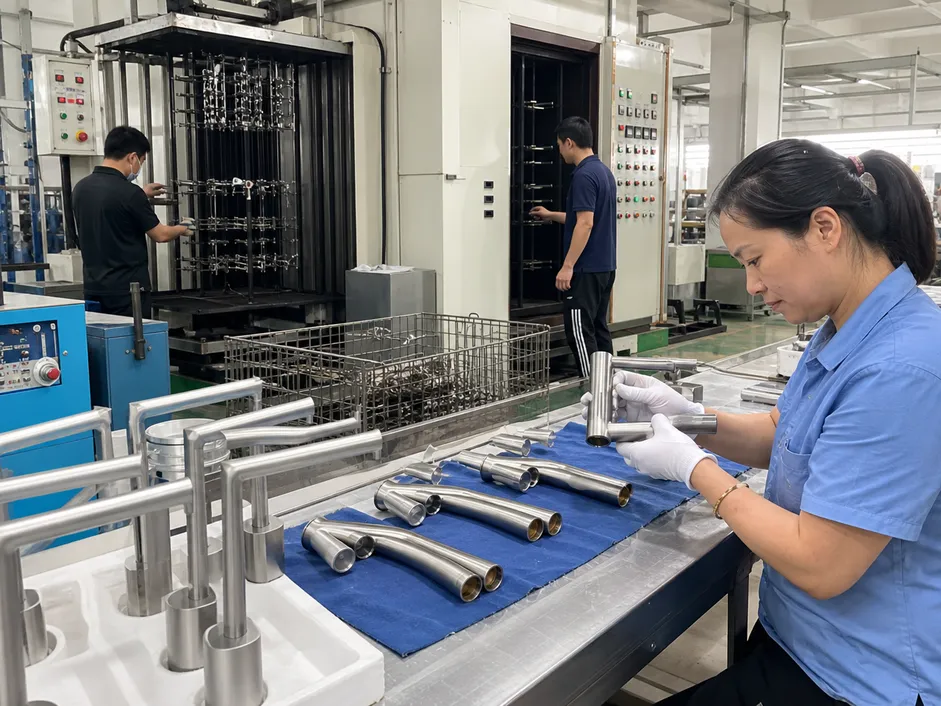
Cast or forged brass bodies are tumbled to remove casting flash and surface irregularities. Zinc alloy bodies go through a similar deburring cycle. The goal is a uniform base surface before any mechanical finishing begins.
Mechanical Brushing
Abrasive belt or wheel brushing creates the linear grain pattern. Grit selection (typically 180–320 grit for faucet finishes) determines grain coarseness. Consistent belt speed and contact pressure are critical — variation here shows up as uneven sheen in the final product.
Pre-Treatment & Cleaning
After brushing, parts go through an ultrasonic cleaning and chemical pre-treatment line to remove abrasive residue, oils, and oxidation. Surface cleanliness at this stage directly affects coating adhesion — skipping or rushing this step is a common source of peeling failures in lower-tier production.
Electroplating or PVD Coating
For brushed nickel: multi-layer electroplating (copper strike → semi-bright nickel → bright nickel → brushed nickel top layer). For brushed gold and champagne bronze: PVD physical vapor deposition in a vacuum chamber, depositing a TiN or ZrN-based compound layer 0.3–0.5μm thick over the pre-brushed substrate.
Post-Coat Inspection
Each batch is inspected under controlled lighting for grain uniformity, color consistency, and surface defects. Salt spray testing is conducted on sample pulls from each production run. Parts that don't meet the reference standard are rejected before assembly.
QC Checkpoints We Run on Every Batch
- Grain direction consistency — checked visually under 45° raking light
- Color match to approved reference sample (Delta E <1.5 tolerance)
- Adhesion cross-cut test (ISO 2409) on plated samples
- Salt spray exposure on batch pull samples (24h minimum)
- Coating thickness measurement via XRF on PVD parts
- Flow rate and pressure test on assembled units (100% inline)
- Cartridge cycle test on sample pull (500,000-cycle rated)
For buyers doing factory audits: ask to see the salt spray chamber log and the reference color standard for each finish. If a supplier can't produce both on request, that's a signal worth noting.
Common Finish Defects and How to Spot Them
Reference for incoming inspection or factory audit
| Defect | Visual Sign | Root Cause | Inspection Method |
|---|---|---|---|
| Grain inconsistency | Swirl marks or cross-grain patches | Inconsistent belt pressure or direction change | Raking light at 45° |
| Color shift between pieces | Visible tone difference in same batch | PVD chamber load variation or bath chemistry drift | Compare against reference tile under D65 light |
| Peeling or flaking | Coating lifting at edges or high-contact areas | Poor pre-treatment adhesion prep | Cross-cut adhesion test (ISO 2409) |
| Pitting or porosity | Small pinholes visible under magnification | Substrate contamination or plating bath issues | 10× loupe inspection on flat surfaces |
| Corrosion at joints | White or brown staining at threaded connections | Galvanic incompatibility or uncoated internal threads | Salt spray test; visual after 24h exposure |
Product Range
Brushed Faucet Types Available for OEM and Private Label
All models below are available in brushed nickel, brushed gold, and brushed champagne bronze unless noted. Custom handle styles, spout configurations, and private label packaging are available from MOQ.
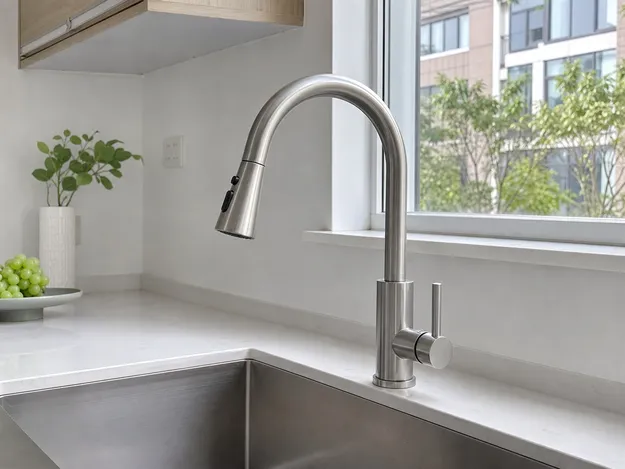
Single-Handle Kitchen Faucet
Pull-down or pull-out sprayer. 360° swivel spout. Available in deck-mount or wall-mount configurations.
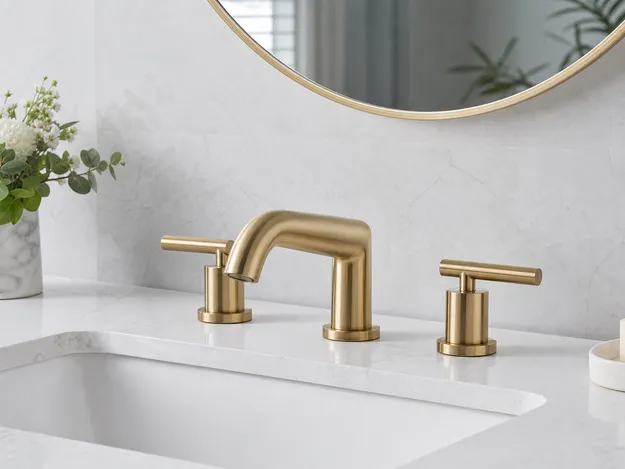
Two-Handle Widespread Bathroom Faucet
8" widespread or centerset. Ceramic disc cartridges. Drain assembly included or available separately.
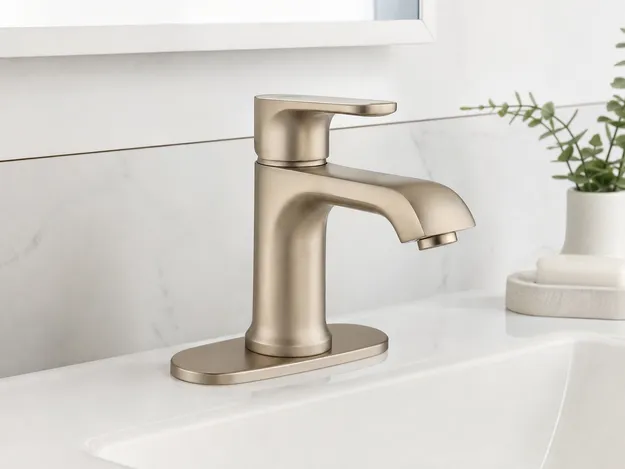
Single-Handle Centerset Bathroom Faucet
4" centerset. Single-hole or 3-hole deck mount. Lever or cross handle options available.
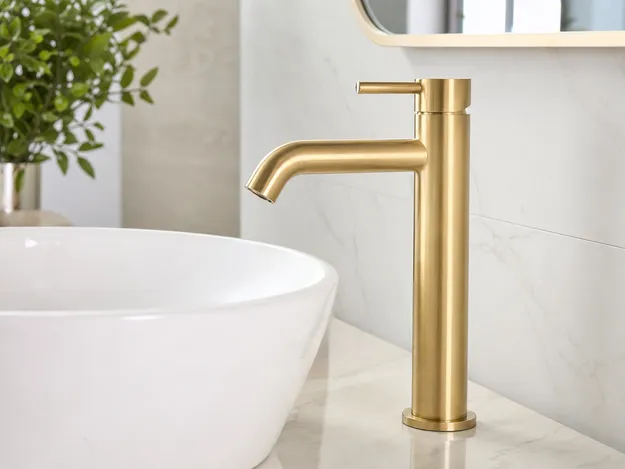
Vessel Sink Faucet — Tall Spout
Designed for above-counter vessel basins. 300–360mm height. Single-hole deck mount. Popular in hospitality and boutique residential.
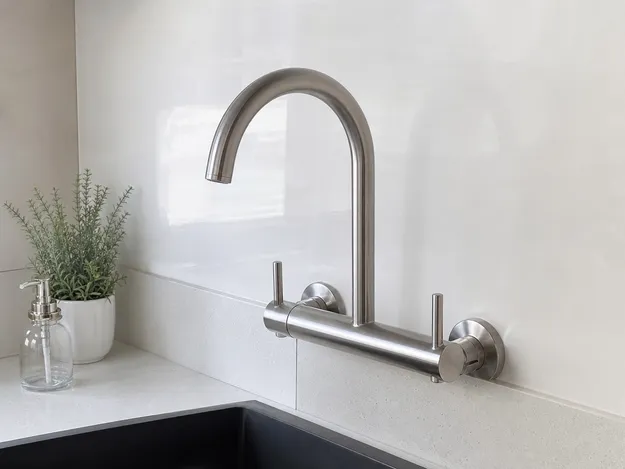
Wall-Mount Kitchen Faucet
Commercial-style wall mount. Swivel spout with pull-down option. Rough-in valve included. Suitable for farmhouse and professional kitchen segments.

Thermostatic Shower System
Thermostatic valve with 2 or 3 outlets. Rain head, hand shower, and body jets configurable. Full brushed finish on all exposed components.
Custom Configurations Available
Handle style, spout height, hole configuration, cartridge brand, and finish tone are all adjustable per order. Private label packaging, custom part numbers, and co-branded documentation available from standard MOQ. Lead time for custom tooling is 30–45 days after sample approval.
Finish Comparison
Brushed Nickel vs. Brushed Gold vs. Champagne Bronze
Each brushed finish has a distinct tone, reflectivity, and market positioning. Understanding the differences helps buyers specify the right finish for their project segment and avoid costly substitutions.
Brushed Nickel
- Cool silver-gray tone with low warm undertones
- Pairs with chrome, stainless, and gray palettes
- Most widely specified in North American residential
- Hides water spots and fingerprints effectively
- PVD or electroplated nickel over brass or zinc
Best for
Contemporary, transitional, and Scandinavian interiors
Brushed Gold
- Warm yellow-gold tone, medium saturation
- Pairs with white, cream, and warm wood tones
- Strong growth in luxury residential and hospitality
- PVD TiN or ZrN coating for color stability
- More visible fingerprints than nickel; wipe-down recommended
Best for
Luxury, glam, and warm-toned modern interiors
Champagne Bronze
- Muted warm bronze with subtle golden undertone
- Pairs with greige, taupe, and natural stone
- Fastest-growing finish in North American new construction
- Lower reflectivity than brushed gold; more forgiving in varied lighting
- PVD with proprietary bronze alloy target for consistent tone
Best for
Transitional, organic modern, and earth-tone interiors
| Attribute | Brushed Nickel | Brushed Gold | Champagne Bronze |
|---|---|---|---|
| Base tone | Cool silver-gray | Warm yellow-gold | Muted warm bronze |
| Reflectivity | Medium | Medium-high | Low-medium |
| Fingerprint visibility | Low | Medium-high | Low-medium |
| Typical PVD coating | Ni or CrN | TiN or ZrN | Bronze alloy target |
| Salt spray resistance | ≥ 500 h (PVD) | ≥ 500 h (PVD) | ≥ 500 h (PVD) |
| Market segment | Mass to premium residential | Premium to luxury | Mid to premium residential |
| Trend trajectory | Stable, high volume | Growing, design-led | Fastest growing |
OEM & Private Label
How We Support OEM Buyers and Private Label Programs
From first sample to full production run, our process is built around reducing your sourcing risk and protecting your brand. Here is what that looks like in practice.
Spec Submission
Share your target finish, handle style, spout configuration, and any existing reference samples. We confirm feasibility within 3 business days.
Sample Production
Pre-production samples delivered in 15–20 days. Includes finish tile, functional prototype, and dimensional drawing for your approval.
Approval & Tooling
Once samples are approved, custom tooling (if required) is completed in 30–45 days. Tooling cost is amortized over the first production run.
Production & QC
Full production with in-line QC checkpoints. Pre-shipment inspection report and finish comparison against approved sample included with every order.
Private Label Capabilities
Custom packaging
Branded boxes, inserts, and hang tags with your logo and part numbers
Co-branded documentation
Installation guides, spec sheets, and warranty cards in your brand identity
Custom part numbering
Your SKU system applied to all components and carton labels
Finish tone matching
Match to existing product line or reference sample within ΔE < 1.5
Certification support
cUPC, CUPC, WRAS, and CE documentation available on request
Consolidated shipment
Mixed SKU consolidation for multi-finish or multi-product orders
50
Units MOQ
Standard catalog finishes, no custom tooling
15–20
Days to Sample
Pre-production sample with finish tile and drawing
30–45
Days Custom Tooling
After sample approval, amortized over first run
FAQ
Frequently Asked Questions
Common questions from buyers, specifiers, and OEM partners about brushed faucet finishes, sourcing, and production.
What is the difference between PVD brushed and electroplated brushed finishes?
PVD (Physical Vapor Deposition) deposits a thin ceramic or metallic layer in a vacuum chamber, producing a coating that is harder, more chemically resistant, and more color-stable than electroplating. PVD brushed finishes typically achieve ≥ 500 hours salt spray resistance and a Vickers hardness of 1500–2500 HV. Electroplated brushed finishes are less expensive but more susceptible to tarnishing and wear over time, particularly in high-humidity environments. For OEM and commercial applications, PVD is the recommended standard.
Can you match a brushed finish to an existing product in my line?
Yes. Send us a physical reference sample or a finish tile from your existing supplier. We measure the tone using a spectrophotometer and target a ΔE of less than 1.5 against your reference. For brushed texture, we match the grit direction and Ra value to within ±0.1 µm. A finish approval tile is included with every pre-production sample so you can compare side by side before committing to full production.
What certifications are available for brushed faucets?
Our brushed faucets are available with cUPC (ASME A112.18.1 / CSA B125.1) for North American markets, WRAS for the UK, and CE marking for the EU. NSF/ANSI 61 and 372 (lead-free) documentation is available on request. If you require a specific certification not listed, contact us and we will confirm availability or advise on the testing timeline.
What is the minimum order quantity for a custom brushed finish?
For standard catalog finishes such as brushed nickel, brushed gold, and brushed black, the MOQ is 50 units per SKU. For custom finishes requiring new PVD recipe development or custom tooling, the MOQ is typically 200 units to cover setup and amortization costs. Mixed-finish orders can be consolidated into a single shipment, and we can discuss tiered pricing for larger annual volume commitments.
How do brushed finishes hold up in hard water conditions?
Brushed finishes, particularly PVD-coated ones, are well suited to hard water environments because the matte texture diffuses light and makes mineral deposits less visible than on polished surfaces. The PVD layer itself is chemically inert and does not react with calcium or magnesium ions. For end users, routine cleaning with a damp cloth is sufficient. We recommend avoiding abrasive cleaners or acidic descalers, which can dull the brushed texture over time regardless of coating type.
Can brushed faucets be mixed with other finishes in the same bathroom?
Yes, and this is increasingly common in premium residential and hospitality design. Brushed nickel pairs well with matte black accessories, brushed gold coordinates with warm-toned hardware, and brushed gunmetal works alongside both polished chrome and matte surfaces. The key is maintaining tonal consistency — warm brushed finishes with warm accents, cool brushed finishes with cool accents. We can supply coordinated finish sets across faucets, shower systems, and accessories to ensure consistency across a full bathroom specification.
What lead times should I plan for when sourcing brushed faucets?
For in-stock catalog items, lead time is 7–14 days from order confirmation to ex-factory. For made-to-order production on standard finishes, plan for 30–45 days. Custom finishes with new PVD recipe development add 15–20 days for sample approval before production begins. Custom tooling for new body styles adds a further 30–45 days. We recommend building a 60-day buffer into your first order cycle when introducing a new finish or product configuration, then moving to a replenishment model once the line is established.
Do you offer drop-shipping or direct-to-site delivery for project orders?
We ship ex-works from our facility. For project orders, we can consolidate multiple SKUs and finishes into a single container or LCL shipment with project-specific labeling. Direct-to-site delivery within the destination country is arranged through our freight partners and is available for orders above a minimum cargo value. Contact our logistics team with your project address and timeline and we will provide a door-to-door quote alongside the product pricing.
Get Started
Ready to Source Brushed Faucets for Your Next Project?
Whether you need a sample run, a full OEM program, or a quote on a specific finish, our team responds within one business day. Tell us what you are working on and we will take it from there.
15+
Years manufacturing brushed finishes
40+
Export markets served
500+
OEM and private label programs
1-day
Response time on all inquiries
Three Brushed Finishes, One Supplier — What That Means for Your Supply Chain
Most factories that offer brushed gold or brushed champagne bronze are subcontracting the PVD work. That means your finish consistency depends on a third party's process control, your lead time includes a subcontractor's schedule, and your quality documentation has a gap between the factory's QC and the finishing house's QC.
The Subcontracting Problem
- Finish consistency depends on a third party's process control
- Lead time includes a subcontractor's schedule — not just yours
- Quality documentation has a gap between factory QC and finishing house QC
Our In-House Advantage
We run our PVD line in-house, alongside our electroplating line, inside the same 12,000 m² facility. All three brushed finishes — brushed nickel, brushed gold, brushed champagne bronze — operate under one quality system.
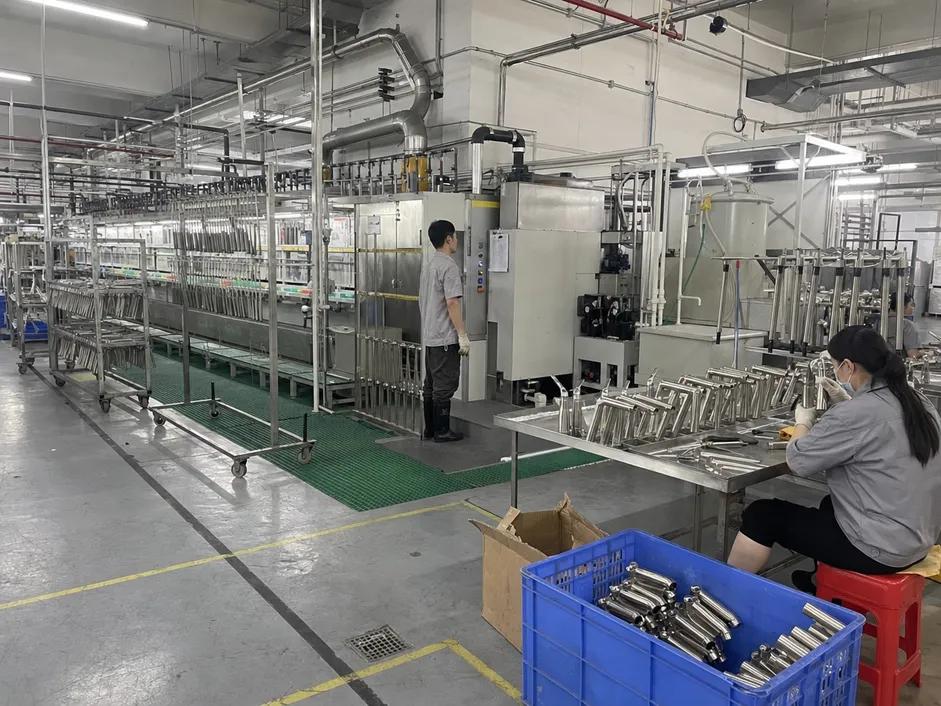
Mixed-Finish Order: What Changes for You
If you're ordering a mixed-finish container — say, 1,000 units brushed nickel kitchen faucets and 500 units brushed gold bathroom faucets — both finishes run under the same quality system, ship on the same schedule, and arrive with the same documentation package.
Production Scheduling
We schedule production in 4-week windows. A 2,000-unit brushed nickel kitchen faucet order runs on the kitchen line without competing for floor time against a shower valve run. Your order doesn't share floor time with a different product family.
Market Segments Where Brushed Faucets Generate Repeatable Volume
Four distinct buyer segments drive consistent demand for brushed finishes. Each has its own volume pattern, margin profile, and specification cycle — understanding which segment you're serving shapes how you structure your catalog and reorder cadence.
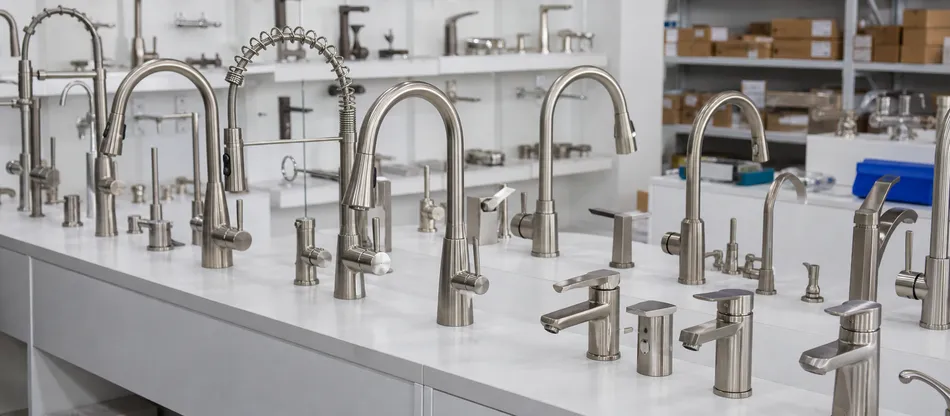
Segment 01
North American Kitchen & Bathroom Renovation Retail
The core volume driver for brushed nickel. The renovation cycle in the US and Canada runs on a 7–12 year replacement pattern, and brushed nickel has held its position as the dominant non-chrome finish in the mid-market for over a decade.
Distributors supplying home improvement chains and independent plumbing showrooms typically order on a replenishment basis — predictable, repeatable volume with low SKU complexity if you're running a focused catalog.
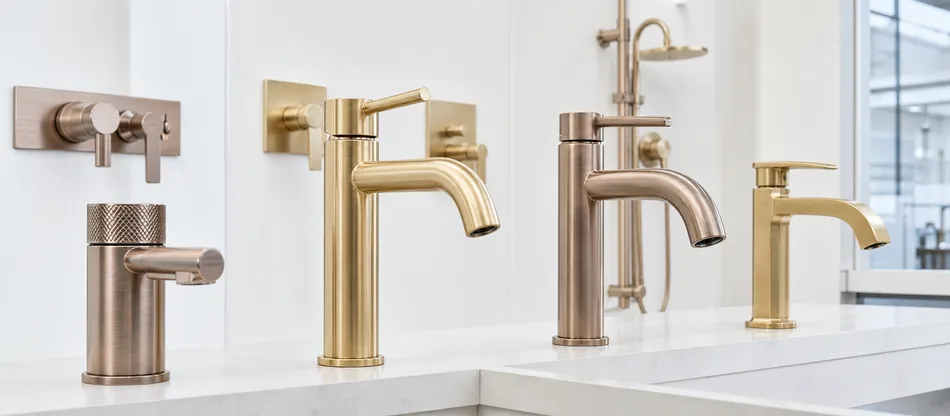
Segment 02
Hospitality & Commercial Fit-Out
Where brushed gold and brushed champagne bronze earn their margin premium. Hotel renovation projects in the 3–5 star segment specify warm-toned brushed finishes at a rate that's been increasing since 2020, driven by interior design trends away from chrome.
A single mid-size hotel renovation (150–300 rooms) can generate 600–1,200 faucet units across bathroom and kitchen applications. Once your product is written into a spec, the order follows. The margin on brushed gold in this segment is meaningfully higher than brushed nickel in retail.
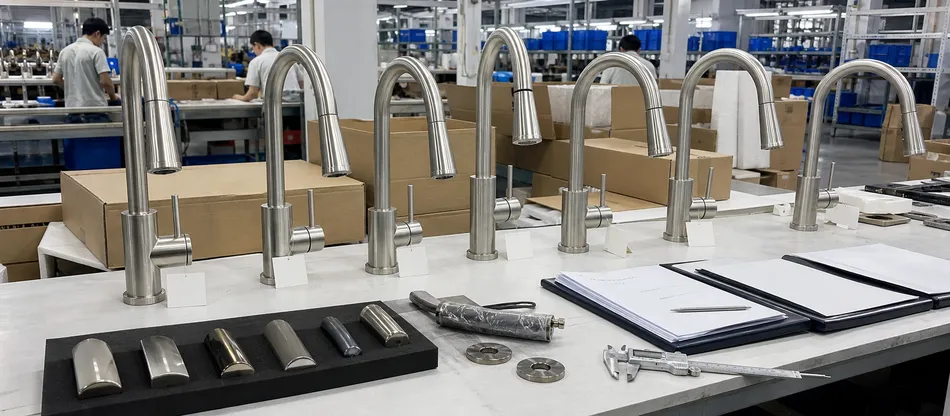
Segment 03
OEM for Overseas Manufacturers & Private-Label Brands
Buyers in this category are sourcing brushed faucets to complete a product line under their own brand. They need a factory that can hold finish consistency across multiple production runs, provide certification documentation for their target market, and handle OEM labeling without minimum order friction.
Our OEM MOQ starts at 200 pieces — low enough for a market test before committing to a full container. We've run OEM programs for buyers in Germany, Australia, and the UAE. The certifications are already in place, so you're not paying for a new compliance process.
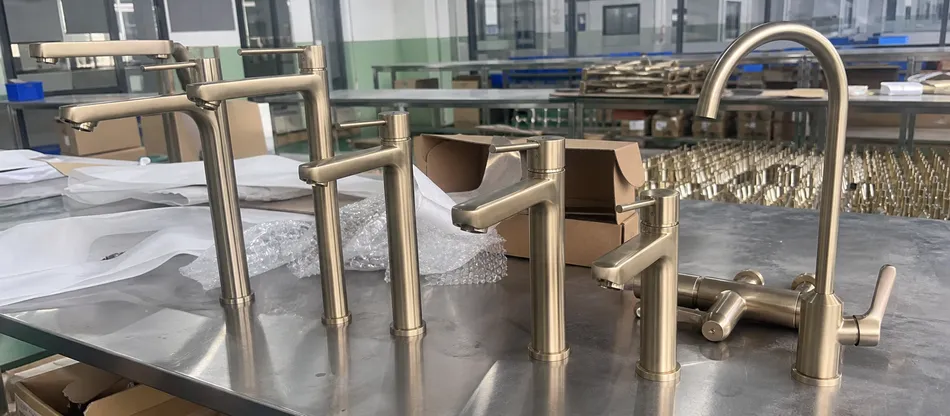
Segment 04
Southeast Asian & Middle Eastern Distribution
A growing segment for brushed champagne bronze specifically. The warm-toned finish aligns with design preferences in these markets, and the price point sits between chrome and PVD gold in a way that works for mid-market distribution.
Our existing export infrastructure covers these regions — we ship regularly to buyers in Singapore, Malaysia, the UAE, and Saudi Arabia. Documentation for these markets is routine for us, not a special-request process.
Which Segment Fits Your Sourcing Model?
Whether you're building a replenishment catalog for retail, specifying into hospitality projects, launching a private-label line, or opening a new distribution territory — the volume patterns and documentation requirements differ. We can walk through the specifics for your market before you commit to an order.
How We Produce Brushed Finishes: The Process Behind the Spec
Every finish specification on a comparison sheet traces back to a production decision. Here's what actually happens on our lines — from casting to final inspection.
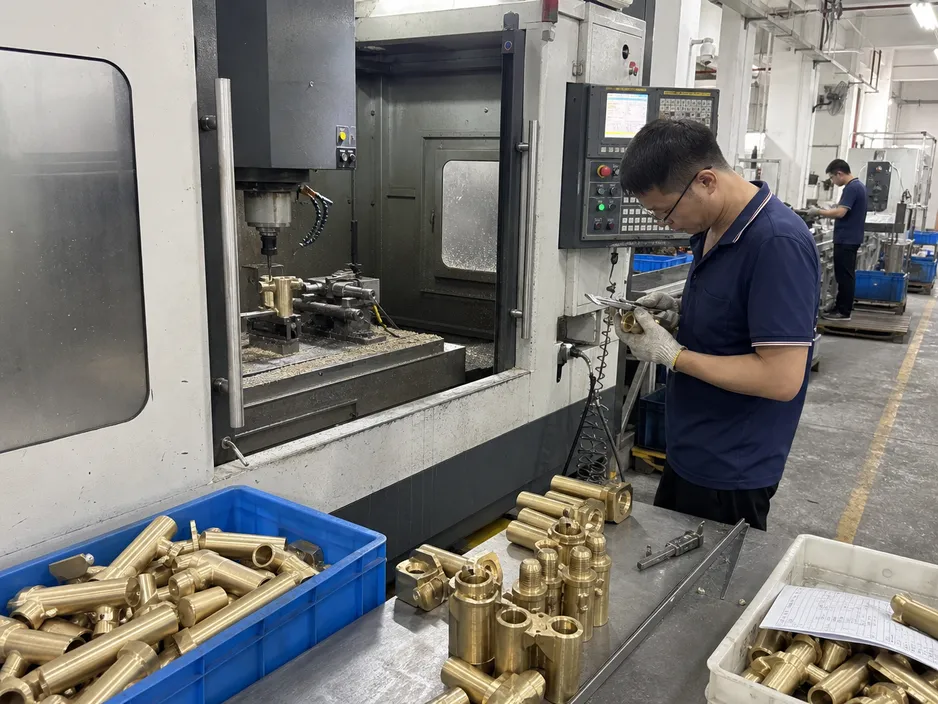
Casting and CNC Machining
The brass body starts in our casting hall. We use C36000-equivalent free-machining brass for gravity casting — selected for machinability and corrosion resistance in chlorinated water systems.
We evaluated zinc alloy casting for a cost-reduction project a few years back and decided against it for core body components. The long-term corrosion performance in chlorinated water didn't meet our standards for export markets.
After casting, each body is trimmed, deburred, and moved to CNC machining. Valve seat threads are held to ±0.05mm tolerance. A loose valve seat is the most common source of drip failure in the field, and drip failures generate warranty claims — that tolerance is where we spend the most attention in machining.
Why This Matters for Buyers
Drip failures are the leading source of warranty claims in the faucet category. The ±0.05mm valve seat tolerance is a direct cost-of-ownership decision, not a marketing specification.
Electroplating Line: Brushed Nickel
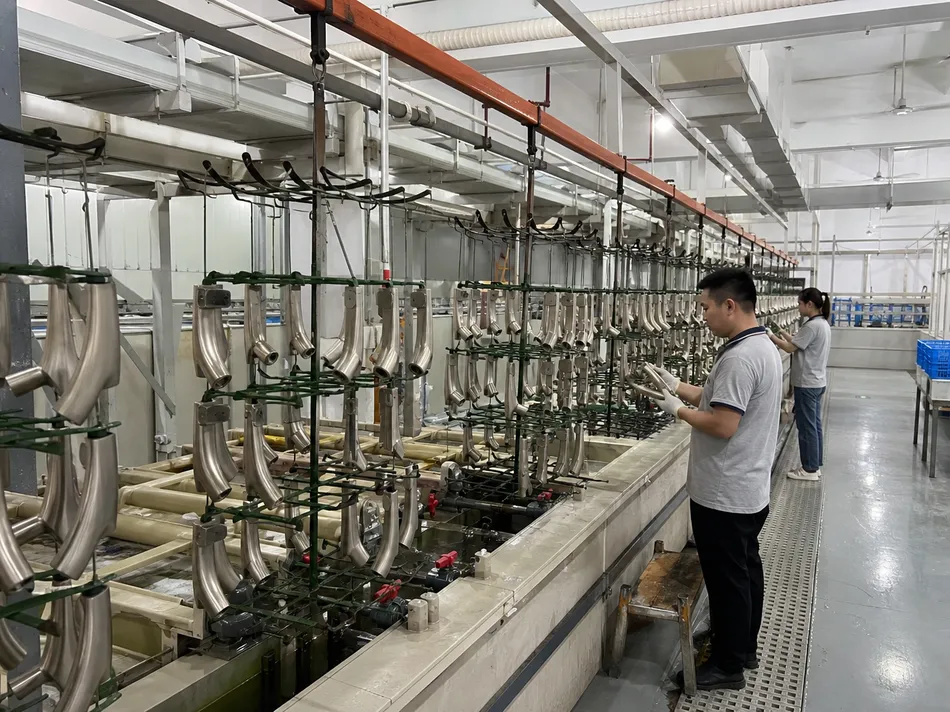
For brushed nickel, bodies move to the electroplating line. The deposition sequence is fixed and non-negotiable for corrosion performance:
-
1
Copper Strike
Initial adhesion layer, prepares the brass substrate for build coats.
-
2
Copper Build Coat
Fills surface micro-porosity and provides a uniform base for the nickel layers.
-
3
Nickel Mid-Coat — 8–12μm
This is the corrosion barrier. It's where we see the biggest variation between factories. A thin or absent nickel mid-coat is invisible to the buyer at inspection but shows up as finish failure within 12–18 months in humid environments.
-
4
Brushed Nickel Top Layer
Final decorative coat with the characteristic matte linear texture.
Post-Plating Inspection
Every part is checked visually for pinholes, blistering, and coverage uniformity. Parts that don't pass are rejected before assembly, not after.
PVD Chamber: Brushed Gold and Brushed Champagne Bronze
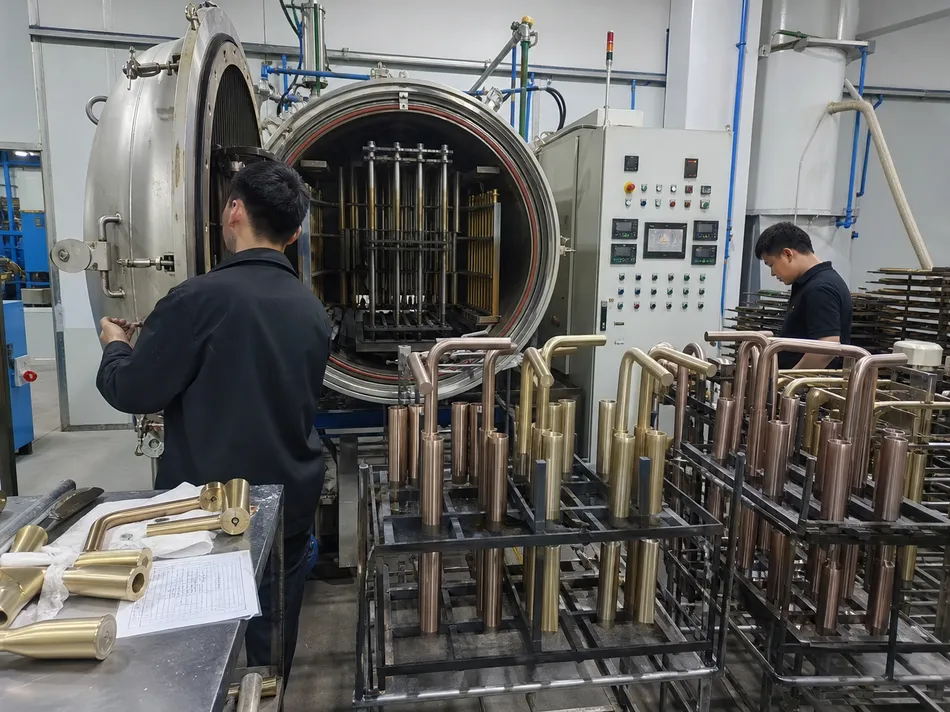
For brushed gold and brushed champagne bronze, the substrate is mechanically brushed before entering the PVD chamber. The brushing direction and grit sequence determine the final texture.
Substrate Prep
180-Grit Finish
Consistent grit sequence gives the characteristic fine linear texture that reads as premium in the retail environment.
PVD Coating Thickness
0.3–0.5μm
Deposition runs at controlled temperature and pressure to achieve target thickness consistently across each batch.
Adhesion testing: Cross-cut tape test per ISO 2409 on every batch before parts move to assembly.
Thickness verification: XRF spot-check on a statistical sample from each batch.
Final Assembly and Quality Verification
Final assembly runs on our dedicated product-family lines. Every assembled unit goes through a complete verification sequence before it leaves the line.
Handle Torque Check
Every assembled unit verified for handle operation within spec.
Flow Rate Verification
Confirmed at rated pressure on every unit before packaging.
60-Second Leak Test
Pressure tested at 0.6 MPa on every assembled unit.
500,000-Cycle Endurance
Cartridge assemblies tested to 500,000 open/close cycles — not just on new introductions, but on every production batch. Test reports travel with shipment documentation.
Customization Parameters for OEM and Private-Label Programs
Brushed faucets are one of our more active OEM categories because the finish itself is a differentiator that buyers want to own under their brand. Here's what's actually customizable and what the constraints are.
Finish Customization
Standard and custom PVD tones
Brushed nickel, brushed gold, and brushed champagne bronze are standard. Custom PVD tones — brushed rose gold, brushed gunmetal, brushed titanium — are available on runs of 500+ pieces.
The PVD process parameters change for each target color, and below 500 units the setup cost doesn't make sense for either side.
Custom Color Matching
If you have a specific Pantone or RAL reference for a custom brushed tone, send it to us and we'll run a sample panel before committing to production.
Body and Handle Configuration
Kitchen and bathroom applications
Single-handle and two-handle configurations are available across kitchen and bathroom applications. Handle shape, spout height, and spout reach can be modified within the tooling envelope of our existing casting dies.
Modified Samples
15–20 days
No new tooling required
New Tooling Samples
25–35 days
In-house tooling room
Most configuration changes don't require new tooling. If your design requires a new casting die, we maintain an in-house tooling room — revisions don't go to an outside vendor.
Branding and Packaging
White-label and retail-ready programs
OEM labeling on the product body, handle, and aerator housing is standard. Packaging can be customized to your brand spec — box dimensions, print, and insert configuration.
We've run white-label programs for buyers who need retail-ready packaging for Amazon FBA and independent showroom distribution.
Container Optimization
Carton dimensions are designed for container optimization. We provide CBM and gross weight per SKU before you confirm the order.
Certification Coverage
Existing and new market qualifications
Current certifications already in place:
If you're adding a new finish variant to an existing certified body, we manage the documentation update — you don't run a full re-certification from scratch. For markets with specific requirements beyond our current certifications, contact us to discuss the qualification path.
Minimum Order Quantities
OEM programs require 200 pieces per finish per SKU. Standard catalog brushed faucets are available at lower quantities for buyers who want to test the product before committing to a branded program.
OEM / Private Label
200 pcs
Per finish, per SKU
Custom PVD Tones
500 pcs
Per custom color run
Related Products in This Category
Compliance and Certification: What Clears Customs in Your Market
The certifications we hold cover the major import markets where brushed faucets move in volume. For brushed finishes specifically, finish durability documentation matters as much as plumbing compliance documentation.
Quality Management System
Third-party audited quality management system. Your procurement team's baseline requirement for supplier qualification.
North American Plumbing Code
Required for sale in the US and Canada through licensed plumbing channels. Our cUPC qualification required us to tighten incoming brass alloy controls for lead content — we apply those same XRF incoming inspection standards to all production regardless of destination market.
European Conformity
Covers the EU and UK markets for faucet products.
Australian Standards
Required for sale through licensed plumbing channels in Australia and New Zealand.
Third-Party Audit & Testing
Third-party audit and testing reports available on request.
Finish Durability Documentation
Brushed Finish Specific
For brushed faucets specifically, the finish durability documentation matters as much as the plumbing compliance documentation. We provide the following with every shipment:
- Salt spray test reports — 24h minimum, 48h for brushed nickel batches
- PVD adhesion test reports with every shipment
- Finish warranty documentation evidence base for downstream customers and retail buyers
Lead Content Compliance
XRF-Verified Incoming Brass
All production uses XRF-verified incoming brass alloy. This is non-negotiable for cUPC, and we apply it across all production.
If your market has specific lead content requirements, the incoming material controls are already in place:
- California AB 1953 — incoming XRF controls in place
- NSF/ANSI 61 Section 9 — incoming XRF controls in place
Ask us for the XRF test report format when you request a quote.
Manufacturing Capabilities & Certifications
Full certification documentation, audit reports, and manufacturing capability details available on our about page.
Brushed Faucet vs. Brushed Nickel Faucet: Positioning the Two SKUs in Your Catalog
This page covers our full brushed finish range — nickel, gold, and champagne bronze. If you're specifically sourcing brushed nickel faucets as a standalone SKU, our Brushed Nickel Faucets page covers that finish in more detail, including the specific electroplating stack, finish variants, and application scenarios where brushed nickel is the dominant choice.
Volume SKU
Brushed Nickel
Highest demand, broadest application, most competitive pricing. The right choice if you're building a core catalog for mid-market distribution.
- Highest demand across all distribution channels
- Broadest application — kitchen, bath, commercial
- Most competitive unit pricing in the brushed range
- Right choice for mid-market distribution core catalog
Margin SKU
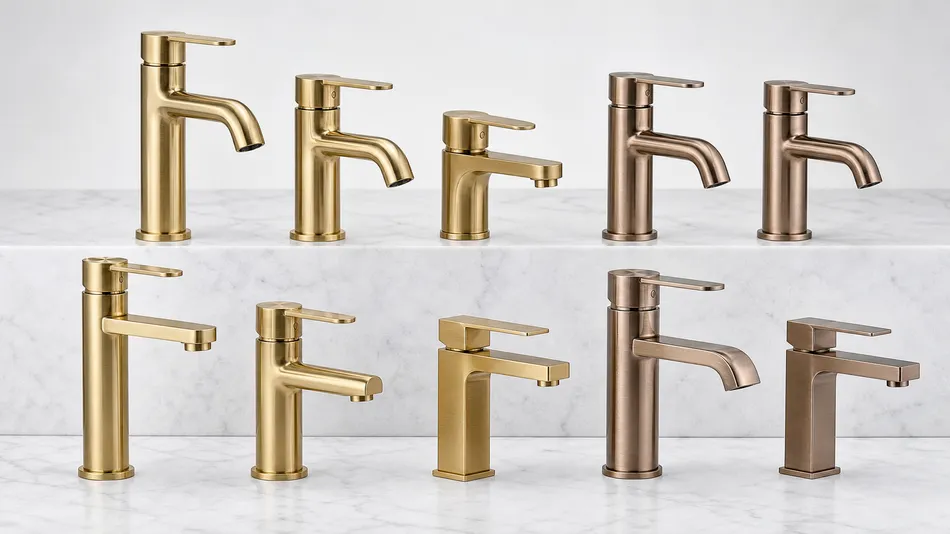
Brushed Gold & Brushed Champagne Bronze
Lower volume, higher unit price, less price-sensitive buyers. The right choice if you're building a premium tier or targeting hospitality and renovation segments where finish differentiation justifies a price premium.
- Higher unit price and margin per SKU
- Less price-sensitive buyer segment
- Targets hospitality and renovation segments
- Finish differentiation justifies premium pricing
One Supplier for Your Full Brushed Range
Running both nickel and gold/champagne bronze in your catalog gives you coverage across price tiers without requiring two supplier relationships. We produce all three finishes in-house, so the quality system, documentation, and logistics are identical across your full brushed range.
- All three finishes produced in-house — single quality system
- Identical documentation and logistics across your full brushed range
- Price tier coverage without multiple supplier relationships
Brushed Nickel
Volume SKU
Brushed Gold
Margin SKU
Champagne Bronze
Margin SKU
Explore Related Products
Frequently Asked Questions
Technical and sourcing questions from buyers, importers, and OEM program managers — answered with the specifics you need to make a decision.
What is the difference between brushed nickel and brushed gold faucets in terms of durability?
Brushed nickel uses a multi-layer electroplating process — copper base, nickel mid-layer, brushed nickel top coat — with a total coating stack of 15–25μm. Brushed gold uses PVD coating at 0.3–0.5μm applied over a pre-brushed brass substrate.
Hardness Comparison
Coating Stack
Practical interpretation
PVD hardness means brushed gold holds up better to surface abrasion in daily use. The thicker electroplated stack on brushed nickel provides a more robust corrosion barrier. Neither is categorically superior — the right choice depends on the primary failure mode in your end market.
For coastal or high-humidity markets: specify the 48-hour salt spray test report when you request samples. We can provide the test documentation with your sample shipment.
What is brushed champagne bronze, and how does it differ from brushed gold?
Both are PVD finishes applied over a pre-brushed brass substrate. The production process is identical — the difference is the PVD target material and deposition parameters, which are adjusted to achieve a different output color.
Brushed Gold
Warm yellow-gold tone. Reads as a rich, formal gold — closer to bright gold than aged brass.
Moves well in
- — Middle Eastern markets
- — Southeast Asian markets
- — Buyers preferring a richer gold tone
Brushed Champagne Bronze
Softer, more muted warm tone — closer to aged brass than bright gold. Less formal, more transitional.
Moves well in
- — North American renovation projects
- — Hospitality and contract interiors
- — Buyers wanting warmth without formal gold
Process note
Because both finishes share the same substrate preparation and PVD deposition process, they can be produced on the same line. If you are running both SKUs, there is no tooling or line-change cost between them — only the target material changes.
What certifications do brushed faucets need for the North American market?
For sale through licensed plumbing channels in the US and Canada, cUPC certification is the standard requirement. Our brushed faucets are cUPC certified. For California specifically, AB 1953 lead content compliance is required — our incoming brass alloy is XRF-verified for lead content on every batch, and we can provide the test documentation.
If your buyer is selling through retail (not licensed plumbing), the certification requirements vary by state and channel — ask us for the specific documentation package for your target market when you request a quote.
What is the minimum order quantity for custom brushed finish faucets?
Standard catalog brushed faucets (brushed nickel, brushed gold, brushed champagne bronze in existing configurations) are available from 200 pieces per SKU for OEM programs. Custom PVD tones beyond our standard three brushed finishes require a minimum of 500 pieces due to PVD process setup.
Handle and spout configuration changes within existing tooling can be accommodated at 200 pieces. New casting tooling for a fully custom body design starts at 200 pieces MOQ, with a tooling lead time of 25–35 days to first sample.
| Program Type | MOQ |
|---|---|
| Standard catalog (existing config) | 200 pcs / SKU |
| Config change within existing tooling | 200 pcs |
| Custom PVD tone (beyond standard 3) | 500 pcs |
| New casting tooling (custom body) | 200 pcs + 25–35 day tooling |
How do I prevent brushed faucet finishes from tarnishing in humid climates?
The finish durability in humid environments depends primarily on the quality of the underlying plating stack, not the surface treatment. For brushed nickel, the nickel mid-coat thickness is the critical variable — a full 8–12μm nickel mid-coat provides the corrosion barrier that prevents tarnishing in humid conditions.
For PVD brushed finishes (gold, champagne bronze), the PVD layer itself is highly corrosion-resistant, but the substrate preparation matters: any porosity in the brass casting that isn't sealed before PVD deposition creates a path for corrosion to undercut the coating. We run a pre-treatment step on all PVD substrates to address this.
Supplier Evaluation Tip
When evaluating suppliers for humid-climate markets, ask for 48-hour salt spray test results specifically — 24-hour results are the minimum standard, but 48-hour results tell you more about long-term performance.
What lead time should I plan for a brushed faucet order?
Production windows are scheduled in 4-week blocks — if your order is in the queue, it ships in the committed window. For time-sensitive orders, contact us before placing the order to confirm current production availability.
Standard catalog items
25–35 days from order confirmation to container loading
OEM orders with configuration changes (existing tooling)
35–45 days — includes 15–20 days for modified sample approval
OEM orders requiring new casting tooling
50–65 days — includes 25–35 days for tooling and first sample