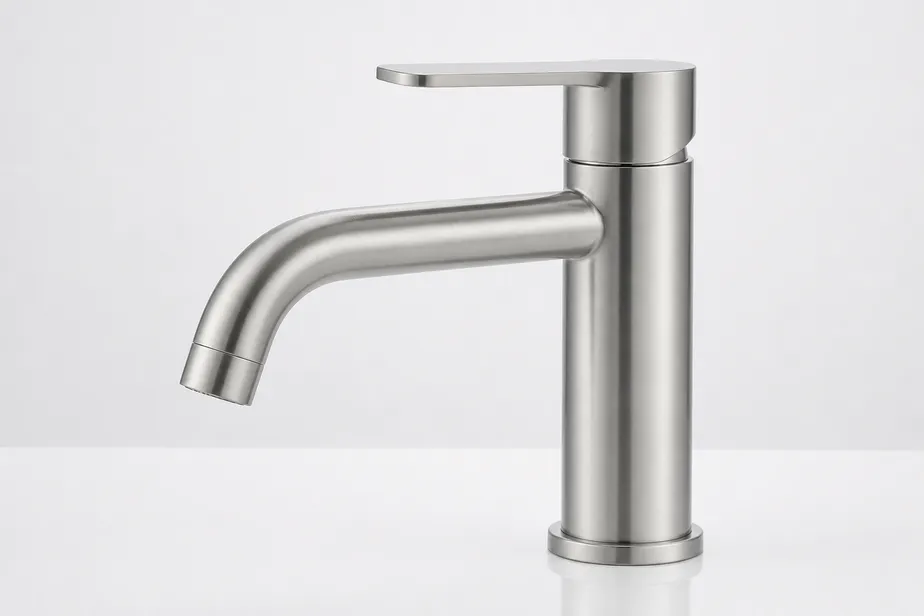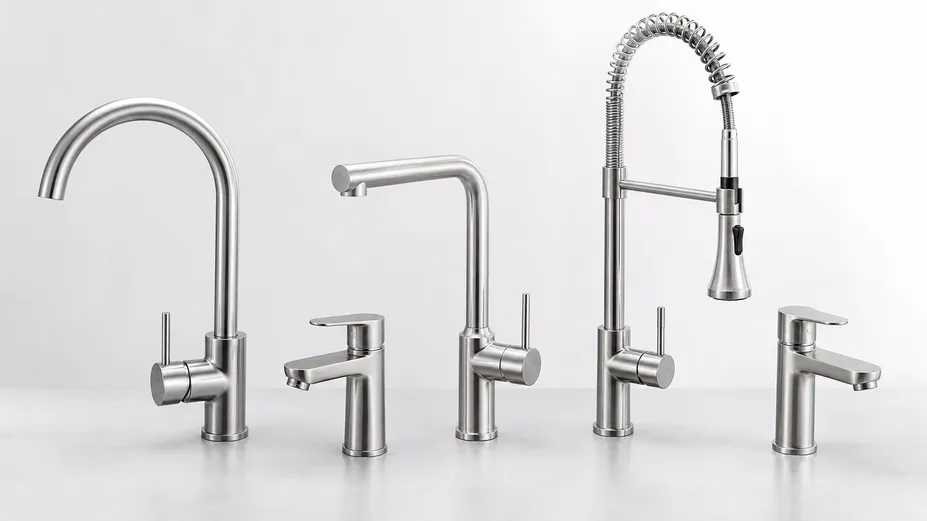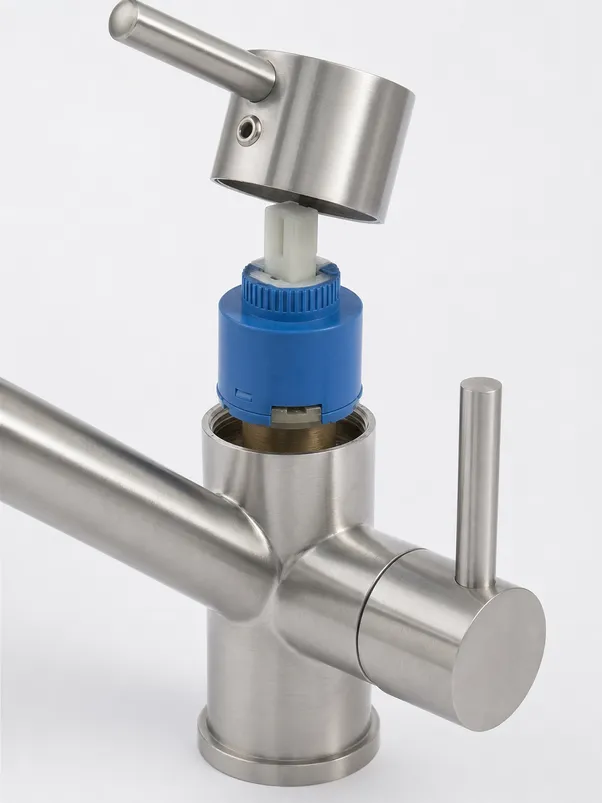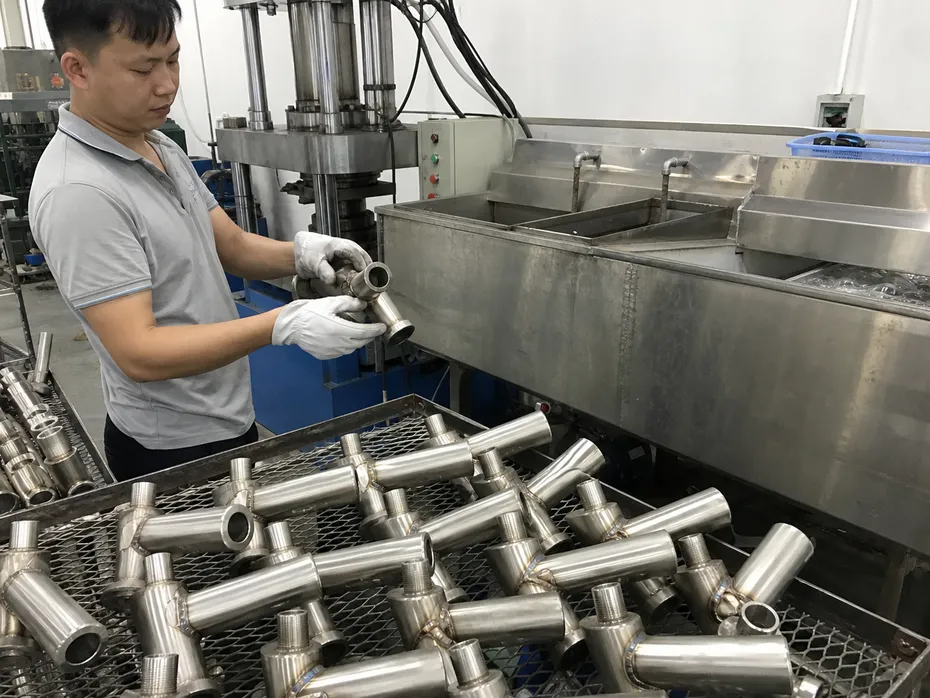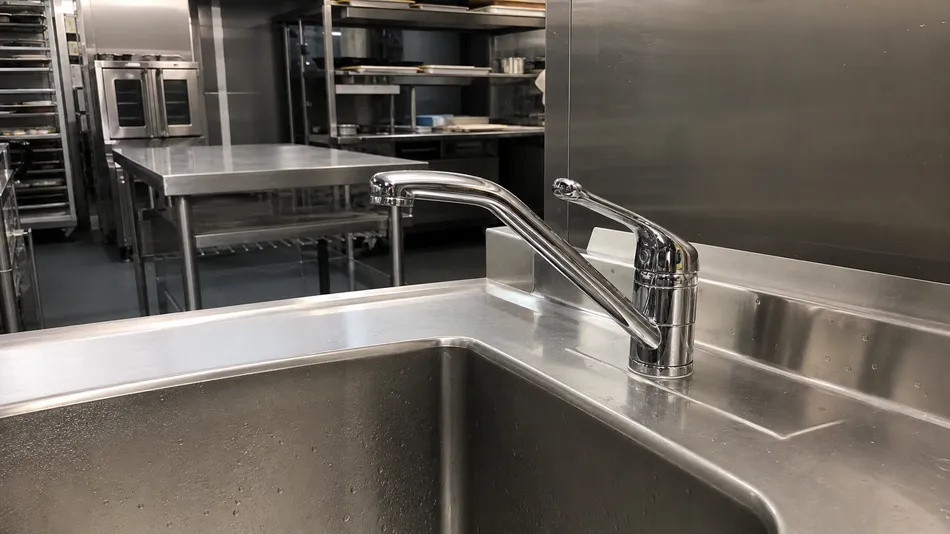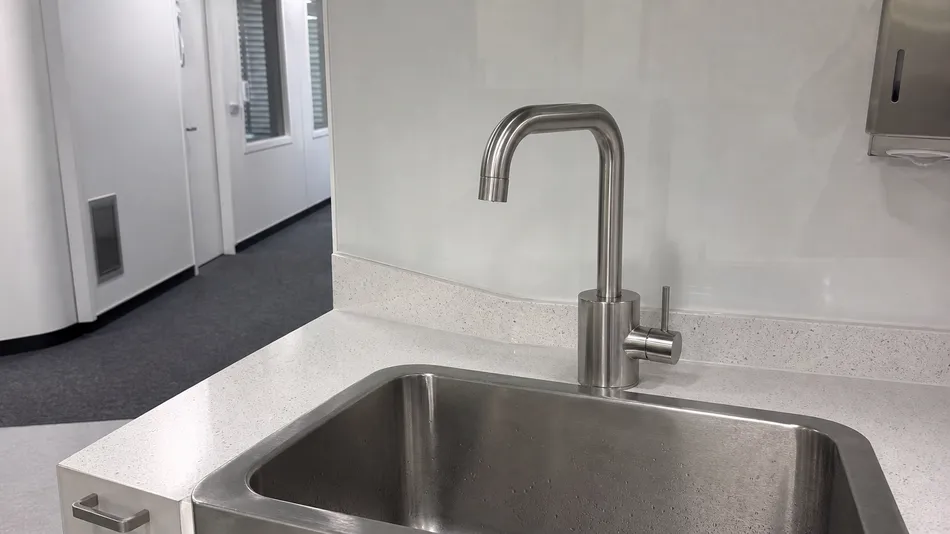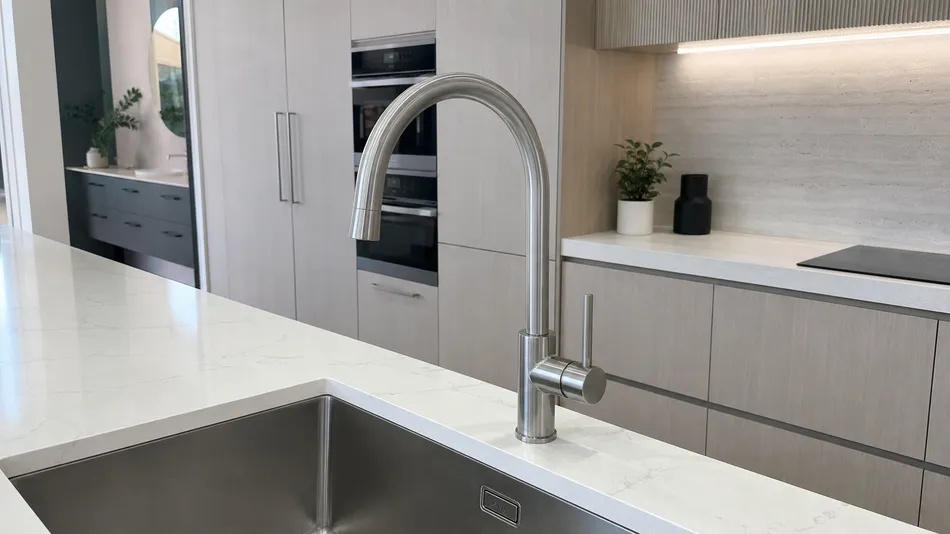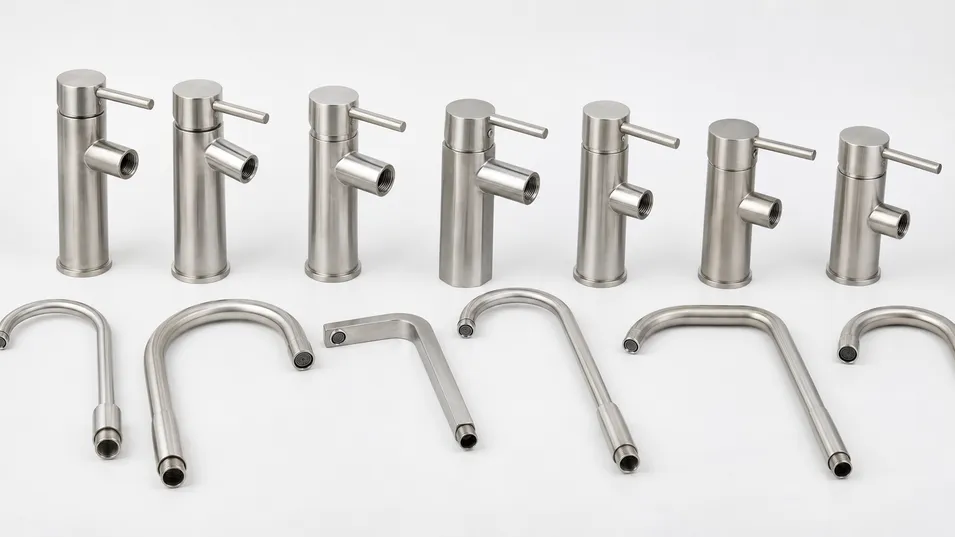

Single-lever mixing faucet with a 304 stainless steel body and ceramic disc cartridge — certified for North America, Europe, and Australia. The corrosion resistance is intrinsic to the material, not dependent on a plating stack that can fail.
Product Definition
A stainless mixer tap is a single-lever mixing faucet with a 304 stainless steel body. One handle controls both temperature and flow, and the body material is fabricated stainless rather than cast brass with a surface coating. That distinction matters commercially: the corrosion resistance is intrinsic to the material, not dependent on a plating stack that can fail.
Within our stainless steel faucet line, the mixer tap occupies a specific position. The stainless steel faucet is the broader category product — available in multiple handle configurations. The stainless sink faucet is a deck-mount configuration optimized for pairing with stainless sinks in commercial kitchen and laboratory settings.
The stainless mixer tap is the single-lever format, covering both kitchen and bathroom applications, and it's the configuration that maps most directly to European and Australian plumbing specifications where the mixer tap is the default rather than the exception.
The category page covers the full stainless steel and specialty faucet line — view the complete range here. This page covers the mixer tap specifically: exact specs, application segments, customization parameters, and what to verify before you commit.
Product Line Positioning
Current Page
Single-lever format. Kitchen and bathroom applications. Maps directly to European and Australian plumbing specifications.
Broader Category
The broader category product — available in multiple handle configurations beyond the single-lever format.
Commercial / Lab
Deck-mount configuration optimized for pairing with stainless sinks in commercial kitchen and laboratory settings.
Engineering Data
The specs below are standard production values for our stainless mixer tap line. Contact us for exact data sheets on specific SKUs.
Specifications are standard production values. Actual dimensions and performance may vary by SKU. Contact us for product-specific data sheets and test reports.
Cartridge Durability
500,000
cycles · ceramic disc valve
Operating Pressure
0.05–0.8
MPa · wide range compatibility
Flow Rate Range
1.5–8
L/min · aerator-adjustable
Salt Spray (Body)
48h+
no coating required on stainless body
Brushed Stainless
Standard — satin linear grain, hides water spots
Polished Stainless
Mirror finish — high-gloss, premium aesthetic
Brushed Black PVD
OEM orders — physical vapour deposition, scratch-resistant
How We Build It
Every stainless mixer tap goes through a defined production sequence — from raw coil to finished unit — with in-process checks at each stage. Here's what that looks like.
304 stainless coil stock sourced from certified mills. Mill certificates (MTC) verified for Cr/Ni content before production release.
Mill test certificate on file per batch
Hydroforming and deep-drawing shape the body. TIG or laser welding joins components. Weld seams are inspected for porosity and penetration.
100% weld visual inspection
Post-weld acid passivation restores the chromium oxide passive layer. Surface finishing — brushing or polishing — is applied to spec before assembly.
Passivation bath log per production run
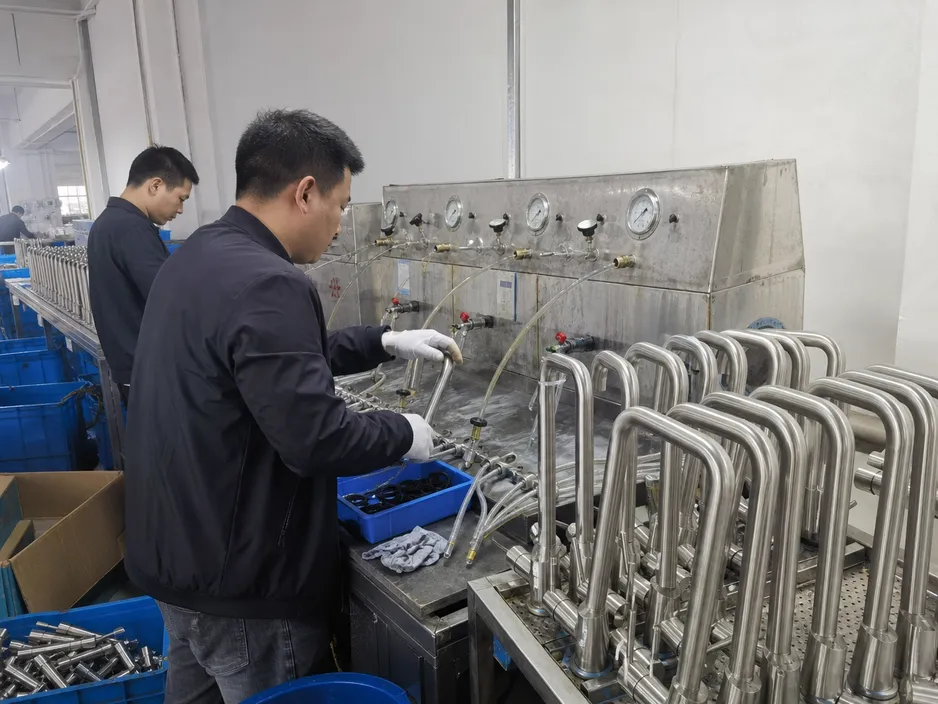
Ceramic cartridge, aerator, and supply lines assembled under controlled conditions. Each unit pressure-tested and leak-checked before packaging.
100% hydrostatic leak test at 1.6 MPa
Incoming Material Inspection
XRF spot-check on incoming stainless coil to confirm alloy grade. Hardness and surface condition verified before production release.
Dimensional Verification
Critical dimensions — spout reach, hole spacing, thread pitch — checked against drawing tolerances using CMM and go/no-go gauges.
Hydrostatic Pressure Test
Every unit tested at 1.6 MPa for a minimum hold period. Zero leakage tolerance — any failure triggers full batch review.
Salt Spray Sampling
Batch samples submitted to neutral salt spray (NSS) per ISO 9227. Stainless body targets 48h+ with no red rust. Results logged per production lot.
Pre-Shipment Inspection
AQL 2.5 sampling inspection on finished goods. Covers appearance, function, packaging integrity, and labelling. Third-party PSI available on request.
CE
EU Conformity
cUPC
North America
WaterMark
Australia / NZ
SGS
Third-party tested
Certificate copies available on request. Additional market-specific certifications (WRAS, ACS, etc.) available for OEM orders.
Manufacturing Process
The stainless mixer tap body follows a different fabrication path than our brass faucet line. Understanding that path explains why the weld seam is where manufacturing quality separates — and why passivation is a standard production step, not an optional upgrade.
Stainless steel doesn't cast well for faucet bodies. The same material properties that give it corrosion resistance make it difficult to gravity-cast into complex shapes. So the body is formed by hydroforming or deep drawing from 304 stainless sheet stock, then welded at the joint.
The result is a cleaner, more geometric profile than a cast brass body — which aligns with the contemporary design direction that drives the commercial and modern residential segments where stainless mixer taps sell.
When stainless steel is welded, the heat-affected zone loses chromium to the surrounding metal, reducing local corrosion resistance. If that zone isn't treated, it becomes the first point of corrosion failure — typically visible as rust staining at the seam within 12–24 months in humid or chloride-rich environments.
We added post-weld passivation as a standard step after seeing field returns from an early production run where passivation was inconsistent. The failure mode was exactly what you'd expect: rust lines at the weld seam on units installed in commercial kitchen environments.
The fix is post-weld passivation: an acid treatment that removes the iron-rich surface layer and allows the chromium oxide passive film to reform uniformly across the weld zone.
We passivate every stainless mixer tap body as a standard production step. Every unit in your container receives the same treatment as the sample you approved.
The ceramic disc cartridge runs 500,000 open/close cycles in endurance testing — the same standard applied across the full faucet line. We test every production batch, not just new product introductions.
Cartridges come from qualified suppliers with their own test reports. We run incoming functional checks before they enter the assembly line, so the cartridge performance your sample showed is what your container delivers.
The aerator adjusts from 1.5 to 8 L/min — relevant for buyers supplying markets with water efficiency regulations. Factory-configured to 1.5 or 2.2 GPM for California and other US markets, so your product arrives pre-compliant.
Compliance Note
Australian WaterMark certification requires flow rate compliance under AS/NZS 3718 — our standard aerator configuration meets this. For California or other US markets with mandatory flow restrictions, we configure the aerator at the factory. Your product arrives pre-compliant rather than requiring field adjustment.
Distribution Intelligence
The stainless mixer tap sits at the intersection of two buyer motivations: material durability and the mixer tap format preference. Understanding which segments drive volume helps you build the right SKU mix.
Highest Volume Segment
Commercial kitchen fit-out is the highest-volume segment for stainless mixer taps. Health codes in most markets require or strongly prefer stainless in food preparation areas, and the single-lever mixer format is the standard specification for prep sinks and hand-wash stations.
Distributors supplying restaurant equipment dealers, commercial kitchen contractors, or institutional catering operations — hospitals, schools, corporate cafeterias — have consistent, recurring demand.
Order Pattern
200–500 units
per order, multiple times/year
Replacement Cycle
3–5 years
high reorder frequency
The stainless body eliminates the warranty exposure from cleaning chemical damage that plated brass faucets carry in these environments.
Specification-Driven
Healthcare procurement specifies stainless mixer taps for scrub sinks, utility rooms, and laboratory wash stations where chemical resistance is a requirement, not a preference. The single-lever format is preferred in clinical environments because it can be operated with the wrist or forearm — relevant for infection control protocols.
cUPC certification is a prerequisite for sale through licensed plumbing channels in North American healthcare procurement, including GPO channels. Our cUPC documentation covers this.
304 stainless handles standard laboratory cleaning agents. 316 stainless is available on OEM orders for applications involving high-chloride or acid-based cleaning protocols.
Default Specification Markets
The mixer tap format is the default plumbing specification in Australia and most of Europe — not a premium option. Buyers supplying commercial renovation contractors, plumbing wholesalers, or project procurement teams in these markets are sourcing mixer taps as a standard line item, not a specialty product.
Compliance Already in Place
WaterMark certification is already in place for our stainless mixer tap line — your product clears Australian licensed plumbing channels without a certification gap. CE certification covers European market requirements. For European distribution, the brushed stainless finish is the dominant specification in the contemporary commercial renovation segment.
Growing Residential Position
The stainless body mixer tap has a growing position in the premium residential market, particularly where the "industrial" or "professional kitchen" aesthetic is a selling point. Plumbing showrooms and kitchen and bath retailers in North America and Europe are stocking stainless mixer taps as a differentiated alternative to chrome-plated brass in the mid-to-upper price tier.
Margin structure is favorable: stainless mixer taps retail at a premium over equivalent chrome products, and the genuine stainless material story is a selling point your downstream customers can use.
E-commerce return reduction: the stainless body reduces return rates from buyers who test with a magnet expecting genuine stainless — because it is genuine stainless.
200–500
Units per commercial kitchen order
3–5 yr
Commercial replacement cycle
4
Active distribution segments
316
Stainless available OEM for lab/clinical
The stainless mixer tap line carries the full certification stack for our primary export markets. Here's what each covers and what it means for your import process.
European Union
Required for sale in EU markets. Covers material safety, pressure ratings, and flow performance under EN 817 and EN 200 standards. CE documentation ships with every order destined for European markets.
United States & Canada
Required for sale through licensed plumbing channels in the US and Canada. Covers lead content compliance under NSF 61/372 (maximum 0.25% weighted average lead content in wetted surfaces), pressure and flow performance, and material standards. California AB 1953 compliance is covered under cUPC. Our cUPC certification covers the stainless mixer tap line.
Australia & New Zealand
Required for sale through licensed plumbing channels in Australia and New Zealand under AS/NZS 3718. Our stainless mixer taps carry WaterMark certification — this is the certification that most commonly creates friction for buyers entering the Australian market from a supplier who doesn't hold it.
Third-Party Verification
SGS test reports covering material composition, salt spray performance, and endurance testing are available for all shipments. Useful for buyers whose import process requires third-party verification independent of manufacturer-issued documentation.
If your destination market requires a certification not listed here, contact us. We've navigated certification extensions for new markets before and can give you an honest assessment of timeline and cost.
The stainless mixer tap line has more OEM activity than our standard brass faucet products, for a straightforward reason: commercial and institutional buyers often need products that match an existing project specification or a branded product line. Here's what's customizable and what the constraints are.
Body & Spout
Spout reach, spout height, and body profile are the most common customization requests. We work from 2D drawings or reference samples. Tooling for stainless bodies involves hydroforming dies rather than casting dies — the tooling cost and lead time are different from brass OEM work, and we'll give you an honest assessment of whether your design is cost-effective to tool versus adapting an existing body.
For most commercial kitchen and bathroom applications, our existing body range covers the standard spout reach and height requirements without new tooling.
Handle
Single-lever is standard. Lever handle shape, length, and material are customizable:
For healthcare applications where lever handle operation with the wrist or forearm is a requirement, extended lever handles can be configured on OEM orders.
Connection & Mounting
Standard
G1/2" standard connection. 3/8" compression supply lines included.
OEM Options
Three-hole deck mount available on select models. Wall-mount configurations available on OEM orders.
Surface Treatment
Water Efficiency
Aerator flow rate can be pre-configured at the factory for market-specific water efficiency requirements:
Particularly relevant for buyers supplying California, Australia (WELS rating requirements), or other markets with mandatory flow restrictions.
Order Parameters
MOQ
200 units
Standard catalog and OEM orders
First Sample Lead Time
25–35 days
New tooling. 15–20 days for modifications to existing catalog bodies.
Production Lead Time
25–35 days
Standard catalog after sample approval. 35–50 days for OEM with new tooling.
Whether you're matching an existing project specification, building a branded product line, or entering a new market with specific compliance requirements, we can walk you through what's achievable and what the real cost and timeline looks like.
200
Units MOQ — catalog & OEM
500+
Units for custom PVD color matching
15–20
Days first sample, existing body mods
35–50
Days production, OEM new tooling
Logistics & Landed Cost
Accurate carton data before you confirm the order means your freight forwarder can quote without surprises. Here's how stainless mixer taps pack, load, and move.
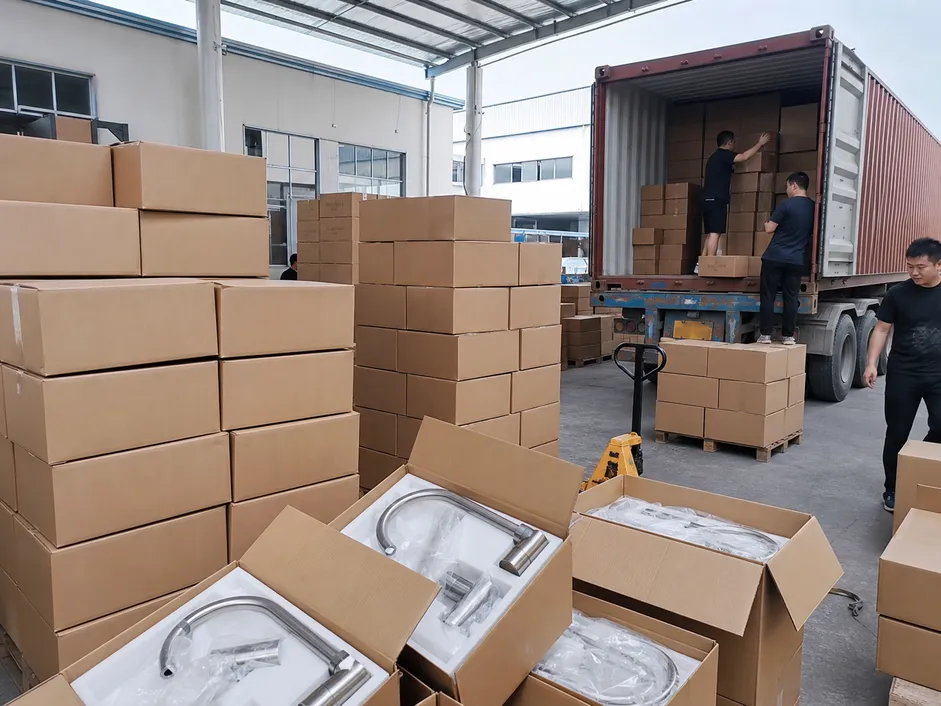
Stainless mixer taps ship in individual retail-ready cartons with foam or molded pulp inserts, packed into master cartons. Master carton configuration is determined by spout height:
Kitchen Mixer Taps
6 units
Per master carton — taller spout height reduces pack density
Bathroom Mixer Taps
12 units
Per master carton — compact spout profile allows higher density
We calculate carton dimensions against 20GP and 40HQ container floor plans and provide a packing list with CBM and gross weight per SKU before you confirm the order, so your freight forwarder can quote accurately.
2,400 – 3,600 units / 40HQ
Capacity range depends on spout configuration and packaging spec. A standard 40HQ container loads approximately this range of stainless mixer taps.
For buyers consolidating multiple SKUs into one container, we coordinate the packing sequence to minimize void space and keep the container weight balanced for port handling.
For e-commerce distribution, we can configure packaging for direct-to-consumer shipment:
Mail-Order Channel Advantage
The stainless body reduces damage-in-transit claims compared to chrome-plated products because there's no plating layer to chip or scratch during handling — a practical advantage for mail-order channels where packaging damage is a consistent return driver.
Product Selection Guide
The stainless steel faucet line has three products that overlap in application. The right choice depends on your market format, handle configuration requirements, and installation context.
| Specification | Stainless Mixer Tap | Stainless Steel Faucet | Stainless Sink Faucet |
|---|---|---|---|
| Handle | Single lever | Multiple configurations | Single or dual lever |
| Primary Application | Kitchen and bathroom, mixer format markets | Broad commercial and residential | Deck-mount, stainless sink pairing |
| Market Fit | Europe, Australia, mixer-spec commercial | North America, broad commercial | Commercial kitchen, laboratory |
| Certification |
CE cUPC WaterMark
|
CE cUPC WaterMark
|
CE cUPC WaterMark
|
| OEM MOQ | 200 units | 200 units | 200 units |
Choose This If
Your market specifies mixer taps as the standard format — which covers most of Europe, Australia, and commercial kitchen specifications globally. The single-lever mixer format is the right product for mixer-spec markets.
Current page — you're already here.
Choose This If
You need a broader range of handle configurations for a North American residential distribution business. The stainless steel faucet gives you more SKU flexibility across handle formats.
View Stainless Steel FaucetsChoose This If
You're supplying commercial kitchen contractors who need a faucet that visually matches a stainless sink installation. The stainless sink faucet is the deck-mount configuration built for that pairing.
View Stainless Sink FaucetsAlso in the Stainless Range
The stainless steel faucet category includes sensor faucets, brushed nickel faucets, and brushed finish faucets alongside the mixer tap and sink faucet lines. All share the same 304 stainless body construction and certification coverage.
Decision-support answers for distributors, importers, and procurement teams evaluating stainless mixer taps for commercial and specialty channels.
The body material is the core difference. A stainless mixer tap has a 304 stainless steel body — the corrosion resistance is intrinsic to the material. A chrome faucet has a brass body with a chrome plating stack; the corrosion resistance depends on the plating quality.
In standard residential environments, a well-made chrome faucet performs fine. In commercial kitchens, healthcare facilities, or coastal environments where cleaning chemicals, chlorinated water, or salt air are factors, the plating on a brass body will eventually fail. The stainless body doesn't have that failure mode.
For your distribution business, this translates to zero warranty claims from chemical damage — a meaningful difference if you're supplying commercial kitchen or healthcare channels where the environment is aggressive.
Material Comparison
Stainless Mixer Tap
304 stainless steel body — corrosion resistance is intrinsic to the material, not dependent on a surface coating
Chrome Faucet
Brass body with chrome plating stack — corrosion resistance depends on plating quality and will eventually fail under aggressive cleaning or salt air
Distribution implication: Zero warranty claims from chemical damage when supplying commercial kitchen or healthcare channels where the environment is aggressive.
Two practical checks cover the verification process for incoming material.
304 stainless is non-magnetic or very weakly magnetic — slight magnetism at weld points is normal. A brass body with chrome plating will respond differently to a magnet. This is a fast, tool-free field check.
Request the XRF analysis or mill certificate from the steel supplier. Any factory producing genuine stainless steel faucets will have incoming material test reports. If a supplier can't produce material documentation, treat the stainless claim as unverified.
Wfaucet Documentation Standard
We provide XRF test reports as standard with shipment documentation. Material traceability is included in every order package — no separate request required.
WaterMark certification under AS/NZS 3718 is required for sale through licensed plumbing channels in Australia and New Zealand. The certification covers pressure and flow performance, material safety, and connection standards. Our stainless mixer taps carry WaterMark certification — the documentation ships with every Australian-destined order.
WELS (Water Efficiency Labelling and Standards) rating is a separate requirement for water efficiency labeling in Australia. Our standard aerator configuration meets WELS requirements, and we can pre-configure flow rates at the factory to hit specific WELS star ratings if your market requires it.
Certification
WaterMark / AS/NZS 3718
Required for licensed plumbing channels in AU & NZ. Covers pressure, flow, material safety, and connection standards. Documentation ships with every AU-destined order.
Labelling
WELS Rating
Separate water efficiency labelling requirement. Standard aerator configuration meets WELS. Factory can pre-configure flow rates to hit specific star ratings on request.
MOQ is 200 units. You can mix SKUs within the stainless mixer tap line to reach the MOQ — for example, 100 kitchen mixer taps and 100 bathroom mixer taps. You can also mix across the stainless steel faucet family (stainless mixer taps, stainless steel faucets, stainless sink faucets) to reach the 200-unit threshold. For OEM orders with new tooling, MOQ is 200 units per SKU.
| Order Type | MOQ | SKU Mixing Allowed |
|---|---|---|
| Standard catalog | 200 units total | Yes — mix across stainless mixer tap line and stainless steel faucet family |
| OEM with new tooling | 200 units per SKU | Per-SKU minimum applies |
Post-weld passivation is the step that determines whether a stainless mixer tap actually performs like stainless steel at the weld seam. When stainless is welded, the heat-affected zone loses chromium to the surrounding metal, reducing local corrosion resistance. Without passivation, that zone corrodes first — typically visible as rust staining at the seam within 12–24 months in commercial kitchen or coastal environments.
Passivation is an acid treatment that removes the iron-rich surface layer and allows the chromium oxide passive film to reform uniformly. Ask any stainless faucet supplier whether they passivate weld seams and request the process documentation. We passivate every stainless mixer tap body as a standard production step.
Supplier Qualification Checklist
Ask whether weld seams are passivated as a standard step
Request process documentation for the passivation treatment
Verify the acid treatment removes the iron-rich surface layer at the heat-affected zone
Without passivation, expect rust staining at seams within 12–24 months in commercial or coastal use
For standard catalog items, production lead time is 25–35 days from order confirmation to container loading. For OEM orders with new tooling, first sample lead time is 25–35 days, then 35–50 days for production after sample approval. If you're placing a first order and want to verify product quality before committing to a full container, we can ship a 2-unit sample within 5–7 business days from our existing stock.
Most new buyers in this category start with a sample order before placing their first production run.
Sample Order
5–7 days
2-unit sample from existing stock. Recommended first step for new buyers.
Standard Catalog Production
25–35 days
From order confirmation to container loading.
OEM with New Tooling
25–35 days
First sample. Then 35–50 days for production after sample approval.
Tell us your target market, the application environment (commercial kitchen, healthcare, residential renovation), and your volume expectations. We'll recommend the right configuration — spout reach, flow rate pre-set, finish, and certification documentation — and send back a quote with the relevant test reports for your destination market.
Weld seam failures and finish inconsistency are the two most common complaints we hear.
If you're currently sourcing stainless mixer taps from another supplier and seeing quality issues at the weld seam or with finish consistency, send us a photo of the failure mode. We can usually identify the manufacturing root cause and tell you whether our process addresses it.
We respond within one business day. WhatsApp typically faster.
What Happens After You Send a Message
We'll confirm your application environment, recommend the right spout reach and flow rate pre-set, and return a quote with the relevant test reports for your destination market — typically within one business day.
Also in the Stainless Steel & Specialty Range
© 2026 Wfaucet. All rights reserved.