
Water Filter & RO Faucet Line

Reverse Osmosis Faucets Built for RO Systems

Brass-body reverse osmosis faucets — lead-free alloy, cUPC-certified, air-gap and non-air-gap configurations, OEM from 200 pieces.

Built specifically for RO system dispensing: low-pressure cartridge spec, ≤0.25% lead by weight, matched finishes across both configurations so your system bundle looks designed, not assembled.

cUPC Certified NSF/ANSI 61 Docs 500,000-Cycle Cartridge OEM from 200 pcs
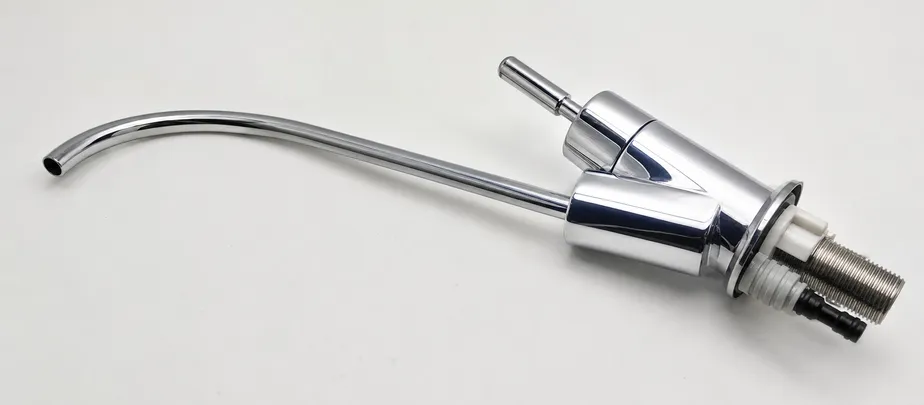
Brass reverse osmosis faucet with brushed nickel finish for RO drinking water systems

Technical Context

What Makes an RO Faucet Different from a Standard Filter Faucet

A reverse osmosis faucet is not a standard filter faucet with a different label. The two products have different operating conditions, different cartridge requirements, and different compliance implications — and sourcing the wrong one creates problems that show up after your customer has already installed the system.

Operating Pressure: The Core Difference

A standard filter faucet connects to the main cold water supply at normal tap pressure — typically 40–80 PSI at the faucet inlet. An RO faucet connects to the storage tank of a reverse osmosis system, which holds purified water at a much lower pressure: typically 7–20 PSI when the tank is full, dropping further as it empties.

A cartridge spec'd for standard tap pressure will develop a slow drip at RO tank pressures because the ceramic disc seating force is calibrated for higher inlet pressure. We've seen this failure mode in product from factories that don't test at low pressure — the faucet passes the standard 0.6 MPa leak test and then drips in the field at 0.1 MPa.

Flow Path Sizing for RO Output

RO systems produce purified water slowly — a typical residential membrane produces 50–75 gallons per day, which works out to roughly 2–3 ounces per minute. The faucet's internal flow path needs to be sized to match that output rate, not optimized for high flow.

An oversized flow path drains the storage tank faster than the membrane can replenish it, leaving your customer's end users with an empty tank mid-use. We size the internal orifice on our RO faucets to deliver 1.0–1.5 L/min at 0.1 MPa — matched to the output profile of standard residential RO systems.

Drinking Water Contact Standard

Because the water coming through an RO faucet has been purified and is consumed directly, the lead content and surface quality requirements are stricter than for standard faucets. Our RO faucets use C36000-equivalent brass held to ≤0.25% lead by weight, with XRF incoming inspection on every brass batch.

The internal waterway is machined smooth and passivated — casting porosity is a secondary lead leaching pathway that material specification alone doesn't close.

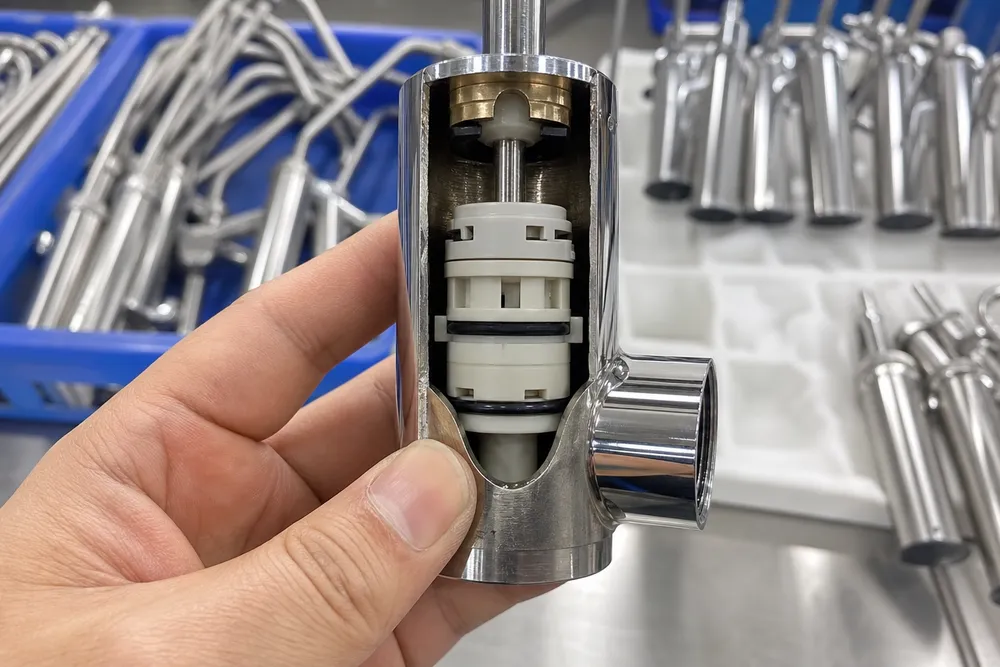
Low-pressure ceramic disc cartridge detail inside a reverse osmosis faucet body

Pressure Comparison

Why the Pressure Gap Matters at the Cartridge Level

Standard Filter Faucet

40–80 PSI (0.28–0.55 MPa) inlet pressure. Ceramic disc seating force calibrated for this range. Passes standard 0.6 MPa leak test.

RO Storage Tank Faucet

7–20 PSI (0.05–0.14 MPa) at full tank, dropping as tank empties. Requires low-pressure cartridge spec tested at 0.1 MPa — not 0.6 MPa.

Wrong Cartridge in the Field

Standard-pressure cartridge installed in an RO faucet: slow drip develops at 0.1 MPa. Failure mode invisible at factory test pressure. Shows up after installation.

Product Data

Technical Specifications

Specifications shown are industry-standard values for this product type. Actual specifications may vary by model and configuration. Contact us for detailed product data sheets.

Specification Table
Body material C36000-equivalent free-machining brass
Lead content ≤0.25% by weight (NSF/ANSI 61 Section 9 compliant)
Valve type Ceramic disc cartridge, low-pressure spec
Cartridge endurance 500,000 open/close cycles (tested per production batch)
Spout reach Typically 120–160 mm (varies by model)
Spout height Typically 250–320 mm overall (varies by model)
Deck hole size Standard 1-3/8" (35 mm); escutcheon plate available
Supply tube connection 1/4" push-fit (standard); 3/8" push-fit available
Drain connection (air gap only) 3/8" OD tubing
Operating pressure 0.05–0.8 MPa; optimized for 0.05–0.2 MPa RO tank pressure
Flow rate 1.0–1.5 L/min at 0.1 MPa
Finishes available Chrome, brushed nickel, matte black, PVD gold, oil-rubbed bronze
Salt spray rating 24h minimum; 48h extended test on new finish batches
Certifications cUPC, CE, WaterMark, SGS; NSF/ANSI 61 material documentation available

Specifications shown are industry-standard values for this product type. Actual specifications may vary by model and configuration. Contact us for detailed product data sheets.

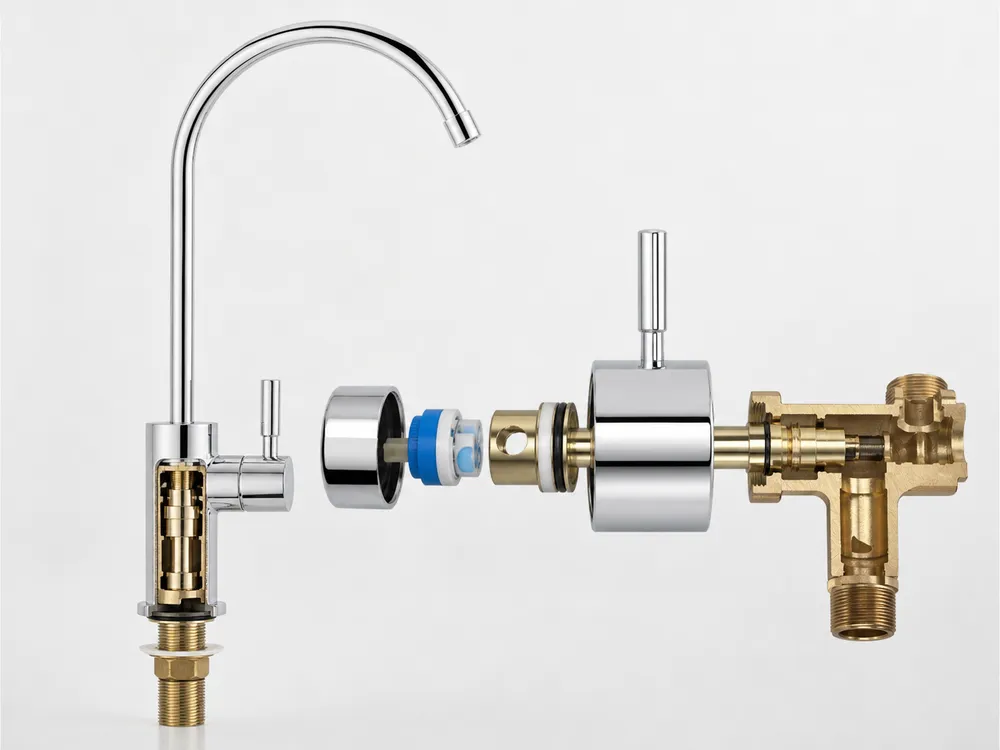
C36000-equivalent brass body reverse osmosis faucet showing internal construction and finish quality

Key Spec Highlights

C36000-Equivalent Brass

Free-machining alloy with XRF incoming inspection on every batch. ≤0.25% lead by weight.

Low-Pressure Cartridge Spec

Optimized for 0.05–0.2 MPa RO tank pressure. Tested at 0.1 MPa, not just the standard 0.6 MPa.

500,000-Cycle Endurance

Ceramic disc cartridge tested per production batch. Drip-free performance across the product lifetime.

Multi-Market Certifications

cUPC, CE, WaterMark, SGS. NSF/ANSI 61 material documentation available on request.

Configuration Guide

Air Gap vs Non-Air-Gap: Which Configuration Do You Need?

The choice between air gap and non-air-gap is a plumbing code and backflow prevention question, not an aesthetic one. Getting it wrong creates a code violation or a contamination risk.

Non-Air-Gap Faucet

Single spout, two tube connections

How It Works

One tube from the RO membrane/storage tank connects to the faucet inlet. One tube carries purified water to the spout. The drain line from the RO membrane runs directly to the sink drain — not through the faucet.

Tube Connections

2 tubes: supply in + purified water out

When to Specify

  • Local plumbing code does not require air gap on RO drain
  • Drain line already has a separate air gap fitting at the sink drain
  • Residential installation where code is permissive
  • Cleaner under-sink appearance preferred

Limitations

  • No physical backflow barrier at the faucet body
  • May not satisfy code in jurisdictions requiring air gap on RO drain discharge

Air-Gap Faucet

Single spout, three tube connections

How It Works

The faucet body contains an internal air gap chamber. The RO membrane drain line connects to the faucet, passes through the air gap, and exits via a third tube to the sink drain. This physical break prevents drain water from siphoning back into the RO membrane.

Tube Connections

3 tubes: supply in + purified water out + drain out

When to Specify

  • Local plumbing code requires air gap on RO drain (common in California, Canada, commercial)
  • Maximum backflow protection without a separate fitting
  • Commercial or food-service installations
  • Installer preference for a single-point solution

Limitations

  • Occasional gurgling noise during RO membrane flush cycle — normal, not a defect
  • Requires a third tube run to the sink drain
  • Slightly more complex under-sink routing

Specifier Note

The Code Question Comes First

Before selecting a configuration, confirm whether the local authority having jurisdiction (AHJ) requires an air gap on the RO drain discharge. In many US states and Canadian provinces, an air gap is mandatory on any indirect drain connection — which includes the RO membrane drain line. Specifying a non-air-gap faucet in those jurisdictions creates a code violation regardless of how the rest of the system is installed.

If the code requirement is unclear, the air-gap configuration is the conservative choice. It satisfies both air-gap and non-air-gap jurisdictions and eliminates the need to revisit the faucet selection if code interpretation changes during inspection.

California / Canada

Air gap typically required by code. Specify air-gap configuration.

Commercial / Food Service

Health codes almost universally require air gap. Non-air-gap not recommended.

Residential (permissive code)

Either configuration acceptable. Non-air-gap offers simpler installation.

Surface Engineering

Finish Options and Long-Term Durability

RO faucet finishes face a specific challenge: the water dispensed is highly purified and slightly aggressive to metal surfaces. Finish selection and substrate preparation matter more here than on a standard kitchen faucet.

Chrome

Electroplated chromium over nickel undercoat. Hardest standard finish; resists scratching and water spotting. Easiest to clean. Universally compatible with kitchen hardware.

Salt spray: 48h standard test
Best corrosion resistance of plated finishes
Recommended for high-humidity under-sink environments

Brushed Nickel

Satin-textured nickel plating. Hides fingerprints and minor water spots better than polished chrome. Popular in contemporary and transitional kitchen designs.

Salt spray: 48h standard test
Fingerprint-resistant texture
Pairs well with stainless appliances

Matte Black

Multi-layer PVD or powder-coat over electroplated base. Trending in modern and industrial kitchen designs. Requires attention to water chemistry — hard water deposits are more visible on dark finishes.

PVD variant: superior hardness and adhesion
Salt spray: 48h standard; 96h on PVD variant
Wipe dry after use in hard-water areas

PVD Gold / Brushed Gold

Physical vapour deposition gold-tone finish. Harder and more durable than electroplated gold. Does not tarnish or peel under normal use. Suitable for premium kitchen and bathroom RO installations.

PVD hardness: significantly above electroplate
Salt spray: 96h standard on PVD
Tarnish-resistant under normal conditions

Oil-Rubbed Bronze

Chemically darkened and lacquered finish. Living finish — subtle variation is characteristic, not a defect. Pairs with traditional and farmhouse kitchen styles.

Salt spray: 24h standard
Living finish: patina develops with use
Avoid abrasive cleaners; use mild soap only

Custom / OEM Finishes

Matched finishes for OEM programs and private-label projects. Colour-match to existing hardware ranges, custom PVD tones, and bespoke lacquer colours available with MOQ.

Colour-match to existing hardware range
Custom PVD tones and bespoke lacquers
MOQ applies; contact for programme details

RO Water and Finish Longevity

Reverse osmosis water has very low mineral content and a slightly lower pH than tap water. Over time, prolonged contact with the spout exterior can accelerate finish degradation on lower-quality plating. Our faucets use a minimum nickel undercoat thickness of 8 µm before the decorative layer, which provides the adhesion and barrier properties needed for long-term performance in RO dispensing applications. Electroplated gold and thin lacquer finishes from lower-tier suppliers are the most common failure point — specify PVD or chrome for maximum longevity.

Installation Reference

Installation Guide

RO faucet installation is straightforward but has a few steps that differ from a standard kitchen faucet. The notes below cover the common failure points seen in the field.

1

Verify the Deck Hole

Standard RO faucets require a 1-3/8" (35 mm) deck hole. Most sinks include a pre-drilled knockout at this size. If the existing hole is larger (common on older sinks with a 1-1/2" hole), use the escutcheon plate supplied or available as an accessory. Do not attempt to install without covering an oversized hole — the mounting nut will not seat correctly.

Standard deck hole: 1-3/8" (35 mm) diameter

2

Thread the Supply Tube Before Mounting

Feed the 1/4" supply tube up through the deck hole before lowering the faucet body into position. Attempting to thread the tube after the faucet is mounted is the most common installation error — the tube kinks or cannot be routed cleanly under the sink deck.

Thread the supply tube first, then lower the faucet body into the hole.

3

Secure the Mounting Nut — Hand-Tight Plus Quarter Turn

Place the rubber gasket, then the metal washer, then thread the mounting nut from below. Tighten hand-tight, then add a quarter turn with a basin wrench or faucet installation tool. Over-tightening cracks the deck gasket and can stress the faucet shank — it does not improve the seal.

Torque target: hand-tight + ~90°. No thread sealant required on the mounting nut.

4

Connect the 1/4" Supply Tube to the RO System

John Guest or equivalent push-fit fittings are standard. Cut the tube cleanly and squarely — a diagonal cut prevents the collet from gripping evenly and is the leading cause of slow drip leaks at the fitting. Push the tube fully into the fitting until it bottoms out, then give a gentle tug to confirm it is locked.

Square cut flush with tube cutter or sharp blade

Diagonal or crushed cut — collet will not seal

5

Pressure Test Before Closing Up

Restore system pressure and leave the faucet closed for 10 minutes. Inspect all connections — the push-fit at the faucet inlet, the fitting at the RO storage tank port, and the deck gasket. A slow drip at the push-fit almost always means an incomplete tube insertion or a diagonal cut. Re-cut and re-insert before assuming the fitting is faulty.

10-minute static pressure hold at operating pressure before sign-off.

6

Flush the System Before Use

Open the faucet and run water to drain for 5–10 minutes after installation or after a filter change. This purges any carbon fines from a new filter and clears any manufacturing residue from the faucet body. Discard this initial flush volume — do not use it for drinking.

Flush 5–10 minutes after new installation or filter change. Discard flush water.

Tools Required

  • Basin wrench or faucet installation tool
  • Tube cutter (1/4" capacity) or sharp utility knife
  • Adjustable wrench (for escutcheon nut if applicable)
  • Flashlight or under-sink work light
  • Dry cloth for pressure test inspection

Common Field Issues

Drip at push-fit connection

Almost always a diagonal tube cut or incomplete insertion. Re-cut square and re-insert fully before replacing the fitting.

Faucet rotates after installation

Mounting nut not tight enough, or rubber gasket has compressed and seated. Re-tighten a quarter turn. Check that the anti-rotation pin (if present) is engaged in the deck hole.

Low flow after installation

Check that the supply tube is not kinked under the sink. A single kink reduces flow significantly. Also verify the RO storage tank pressure (should be 7–8 psi empty).

Water tastes of plastic after install

Normal for first use. Extend the initial flush to 15 minutes. If taste persists after 24 hours of normal use, flush again. NSF/ANSI 61 certified components resolve this in all but the most sensitive cases.

System Compatibility

All standard RO faucets in this range are compatible with 1/4" OD polyethylene or LLDPE tubing and John Guest-style push-fit fittings. For systems using 3/8" tubing, a reducing adapter is required — available as an accessory. Confirm your RO system's output port size before ordering.

Configuration Guide

Air Gap vs. Non-Air Gap: Which Configuration Your Market Requires

This is the first configuration decision for any buyer sourcing reverse osmosis faucets, and it has compliance implications that go beyond product preference.

Non-air gap RO faucet showing two-port configuration

Non-Air Gap RO Faucet

Configuration

2 ports Purified water supply Drain line

Two ports: one for the purified water supply line from the RO storage tank, one for the drain line. The drain line connects directly to the sink drain. Simpler design, easier to install, and carries a lower retail price point.

Market Position

  • Default configuration for most residential RO system OEMs
  • Volume SKU in this category — majority of US residential RO installations
  • Most local plumbing codes permit non-air gap
Air gap RO faucet showing three-port configuration with physical drain break

Air Gap RO Faucet

Configuration

3 ports Purified water supply Drain line Air gap port

Three ports including the air gap port itself. The air gap is a physical break in the drain line — drain water is routed up through the faucet body and drops back down to the drain, creating a gap that prevents contaminated drain water from siphoning back into the RO membrane.

Compliance Requirement

  • Required by plumbing code in California, Massachusetts, and other states
  • Commercial RO installations increasingly specifying air gap as standard regardless of local code
  • Non-air gap in a code-required market is a violation — not a preference issue

Same Brass Body, Both Configurations

We manufacture both configurations from the same brass body casting. The air gap version requires an additional machined channel through the spout body and a third port fitting — it's a more complex part, but the body geometry is shared.

This keeps lead times and MOQs identical across both variants. We can supply matched pairs in the same finish and handle style for buyers building private-label RO system bundles — the faucet looks like it was designed with the system rather than sourced separately. That matters for your downstream brand presentation.

Distributor Stocking Guidance

For distributors covering multiple US states: carry both. The compliance risk of stocking only non-air gap and having a customer install in California is a product return and a damaged relationship.

The incremental inventory cost of stocking both configurations is small relative to that risk.

Explore Configuration-Specific Pages

Engineering Detail

How We Engineer the Low-Pressure Cartridge Problem

The cartridge specification is where most RO faucet failures originate. It's worth explaining what we do differently because it's not visible from the outside of the product.

RO faucet ceramic disc cartridge cross-section showing low-pressure seating engineering

Pressure Range Comparison

Standard tap water pressure 0.3–0.6 MPa

Standard cartridge spring tension calibrated for this range

RO tank operating pressure 0.05–0.15 MPa

Where standard cartridges fail — insufficient spring force to maintain seal

Our batch test pressure 0.2 MPa

Specifically targets the RO failure mode — not just the standard 0.6 MPa test

Why Standard Cartridges Fail in RO Applications

Standard ceramic disc cartridges are designed for inlet pressures of 0.3–0.6 MPa — normal tap water pressure. The spring tension that holds the ceramic discs in contact is calibrated for that pressure range.

At RO tank pressures of 0.05–0.15 MPa, the spring tension is often insufficient to maintain a positive seal between the discs, and the result is a slow drip that appears weeks or months after installation.

The failure pattern: The faucet passed the factory leak test at 0.6 MPa. It fails in the field at 0.1 MPa. The customer calls your warranty line.

Our Engineering Approach

Lighter Spring Tension

We spec our RO faucet cartridges with lighter spring tension calibrated for low-pressure RO operating conditions, not standard tap pressure.

Tighter Flatness Tolerance: ±0.003 mm

Ceramic disc seating surface flatness tolerance of ±0.003 mm, compared to the ±0.005–0.008 mm typical of standard cartridges. The tighter flatness tolerance means the discs seat correctly even with reduced spring force, maintaining a positive seal at low inlet pressure.

0.2 MPa Production Batch Testing

We test every production batch at 0.2 MPa specifically to catch this failure mode before the product ships. The standard 0.6 MPa test is also run, but the 0.2 MPa test is the one that matters for RO applications.

Endurance Testing

500,000-Cycle Testing on Every Production Batch

We run 500,000-cycle endurance testing on every production batch — not just on new product introductions. The cartridge performance your sample showed is the cartridge performance your container delivers.

Batch-to-Batch Consistency

Why We Test Every Batch

We've had buyers come to us after a competitor's product showed early cartridge failure on their second or third container. The issue is almost always that the competitor tested the first batch and assumed subsequent batches would match.

We test every batch because production variation is real.

Cartridge Specification Comparison

Specification Standard Cartridge Wfaucet RO Cartridge
Designed inlet pressure 0.3–0.6 MPa 0.05–0.6 MPa (RO-optimized)
Ceramic disc flatness tolerance ±0.005–0.008 mm ±0.003 mm
Spring tension calibration Standard (high-pressure) Lighter (low-pressure RO)
Factory leak test pressure 0.6 MPa only 0.6 MPa + 0.2 MPa (RO-specific)
Endurance cycle testing New product introduction only 500,000 cycles, every production batch
Channel Intelligence

Market Segments Where Reverse Osmosis Faucets Generate Repeatable Volume

Four buyer segments drive consistent RO faucet volume. Each has distinct order patterns, compliance requirements, and channel economics — understanding them helps you position inventory and set realistic reorder cycles.

RO system OEM assembly line with matched faucet components

Anchor Segment

Residential RO System OEMs

Companies that manufacture or assemble RO systems under their own brand — whether in North America, Europe, or Asia — need a matched dispensing faucet to complete the system. The faucet is the most visible component of the finished product; it's what the end customer touches every day and what appears in the product photography.

Typical Run Size

2,000–5,000 units

Reorder Pattern

Follows production schedule

We supply several RO system OEMs on a private-label basis. The relationship tends to be sticky once the finish and handle style are locked in — switching faucet suppliers means re-photographing the product and potentially re-certifying the system bundle.

Water treatment distributor warehouse stocking RO faucet replacement parts

North America · Australia · Europe

Water Treatment Distributors

Distributors carry RO faucets as both new-installation components and replacement parts. The replacement market is underappreciated: RO faucets get replaced when kitchens are renovated, when the original finish shows wear, or when a homeowner upgrades their system.

Finish Coverage for Full Demand Capture

Brushed Nickel Chrome Matte Black ↑

Distributors who stock multiple finishes and both air gap and non-air gap configurations capture the full replacement demand, not just the new-installation segment. Brushed nickel and chrome cover the majority of the installed base in North America; matte black is the current growth finish for new installations.

RO faucet retail packaging prepared for Amazon FBA fulfillment

Amazon · Wayfair · Online Platforms

E-Commerce Importers

RO faucets have become a significant online category. The product ships in a compact carton, has a retail price point that works for e-commerce economics, and generates consistent search volume from homeowners upgrading or replacing their RO systems.

FBA-Ready Packaging Stack

  • Fitted inner box with foam corner protection
  • Master carton rated for FBA drop and compression testing
  • FBA labeling and prep handled at factory before container ships
  • Shipped to Amazon FBA warehouses in US and EU

For this channel, packaging durability matters — the carton needs to survive the fulfillment center and last-mile delivery without damage. We know the labeling and prep requirements and can handle them at the factory before the container ships.

Plumbing and HVAC distributor catalog showing water treatment accessories

Water Treatment Accessories

Plumbing & HVAC Distributors

RO faucets are a natural add-on for distributors who already supply RO membranes, housings, and filters — the faucet completes the system and adds a SKU with reasonable margin.

Compliance Docs Provided for Catalog Listing

cUPC NSF/ANSI 61 Material Certs

The compliance documentation we provide is what these distributors need to list the product in their catalog without additional qualification work.

SKU Planning

Finish Options and SKU Planning for Your Market

Five finishes, two configurations, one supplier. All combinations are available in-house — no split sourcing, no finish-tier supplier management.

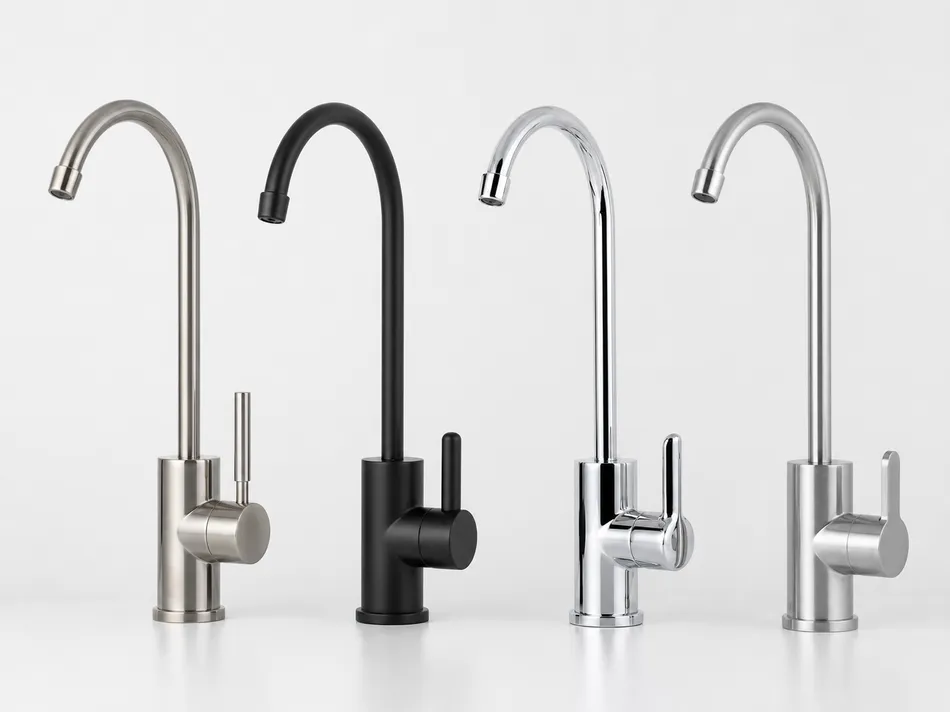
Chrome finish RO faucet

Chrome

Leads in Europe and Southeast Asia. High-volume baseline SKU across all markets.

Air Gap Non-Air Gap
Brushed nickel finish RO faucet

Brushed Nickel

Leads in North America. Coordinates with stainless appliances that dominate residential kitchens.

Air Gap Non-Air Gap
Matte black finish RO faucet

Matte Black

Growing steadily across all markets for three years. Premium signal finish with higher retail price point than chrome or brushed nickel.

Air Gap Non-Air Gap
PVD gold finish RO faucet

PVD Gold

Lower volume but protects margin. Positioned for the premium tier of the catalog rather than as a volume SKU.

Air Gap Non-Air Gap
Oil-rubbed bronze finish RO faucet

Oil-Rubbed Bronze

Lower volume but protects margin. Buyers typically stock it for the premium tier rather than as a volume SKU.

Air Gap Non-Air Gap

Starter SKU Mix

Most new buyers in this category open with brushed nickel and chrome in both air gap and non-air gap configurations — four SKUs that cover the majority of market demand. Matte black is the natural third finish to add once the first two are moving.

1

Brushed Nickel — Air Gap + Non-Air Gap

North America volume leader

2

Chrome — Air Gap + Non-Air Gap

Europe and Southeast Asia volume leader

3

Matte Black — Air Gap + Non-Air Gap

Add once first two finishes are moving

We can supply all five finishes from the same order — you're not managing separate supplier relationships for different finish tiers.

Finish Durability: Base-to-Deck Interface

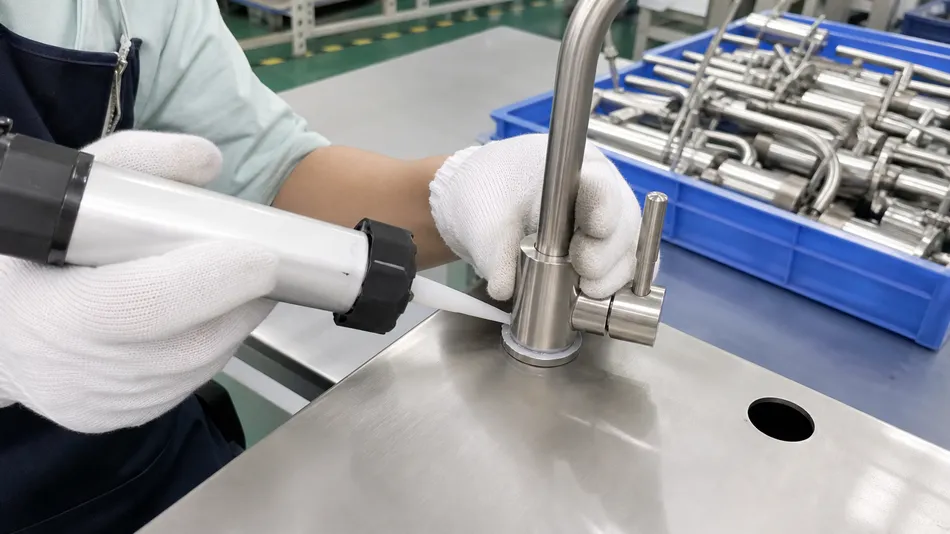
RO faucet base-to-deck sealant bead applied at assembly to prevent finish delamination

RO faucets sit on the kitchen counter and get handled multiple times a day. The base-to-deck interface is a moisture trap — water drips from the spout, condensation forms, and cleaning products pool there.

Sealant Bead at Assembly

We apply a sealant bead at the base-to-deck interface before packaging. This eliminates the most common cosmetic warranty claim in this product category — finish delamination six months after installation. It's a 30-second step in assembly that prevents a return.

Finish Distribution Across Export Markets

North America

Brushed Nickel

Coordinates with stainless appliances that dominate residential kitchens. Matte black growing as the premium new-installation choice.

Europe

Chrome

Chrome leads across European markets. Matte black growing steadily as a premium signal finish in the residential segment.

Southeast Asia

Chrome

Chrome leads. Matte black has been growing across all markets for the past three years and carries a higher retail price point.

OEM & Private Label

Customization Options for OEM and Private-Label Programs

The reverse osmosis faucet is one of the more customization-friendly products in our line because the body geometry is relatively simple and the tooling investment is modest. Here's what's adjustable and what isn't.

Handle Style and Geometry

The most common customization request. We can modify handle shape, length, and lever angle within the constraints of the valve cartridge geometry. Custom handle tooling typically runs 25–35 days from approved drawing to first sample. If you're matching the faucet handle to an existing product family in your catalog, send us a reference sample and we'll design to match.

Spout Profile and Reach

Spout geometry can be modified within the constraints of the body casting. Reach adjustments of ±20 mm from our standard are typically achievable without new casting tooling; larger changes require a new casting die. We'll tell you upfront which category your request falls into.

Deck Plate and Escutcheon Configuration

Single-hole installation is standard. We offer escutcheon plates in matching finishes for installations where the deck hole is larger than standard, or where the buyer wants a more finished look at the deck interface.

Supply Tube Connection Spec

1/4" push-fit is standard for North American and most international markets. 3/8" push-fit is available for markets where that's the standard connection. Compression fittings are available on request.

Branding

Logo engraving on the handle or body, branded packaging, and private-label documentation are all standard OEM services. MOQ for OEM with custom tooling starts at 200 pieces per SKU. For ODM orders starting from our existing catalog bodies with modified finishes or branding only, the same 200-piece MOQ applies and the sample turnaround is 15–20 days rather than 25–35.

OEM customization options for reverse osmosis faucet handles and finishes

What Can't Be Customized Without Significant Tooling Investment

Some elements require a full OEM tooling project rather than a handle or finish modification:

  • Core body casting geometry
  • Cartridge interface dimensions
  • Port configuration — air gap vs. non-air gap requires different body castings

If you need a fundamentally different body geometry, that's a full OEM tooling project — we can do it, but the timeline and investment are different from a handle or finish modification.

OEM Sample Turnaround at a Glance

Custom handle / spout tooling 25–35 days
ODM — finish or branding only 15–20 days
MOQ (both paths) 200 pcs / SKU
Compliance & Certifications

Compliance Documentation: What You Need for Each Market

Reverse osmosis faucets face stricter compliance requirements than standard faucets in most export markets because of the direct drinking water contact application. Here's what we hold and what it covers for your target markets.

US/CA

North America — US and Canada

cUPC NSF/ANSI 61

cUPC certification covers plumbing code compliance for most US states and Canadian provinces — it's the baseline requirement for listing with most distributors and retailers. NSF/ANSI 61 Section 9 is the drinking water contact material standard; California, Vermont, Maryland, and several other states have adopted it into law, and major retailers increasingly require it as a listing condition.

We hold cUPC and can provide XRF test reports and material certifications that support NSF 61 compliance documentation. If your buyers require a full NSF 61 product certification (as opposed to material compliance documentation), we can discuss the certification extension process for specific SKUs.

EU

Europe

CE

CE marking covers the EU market. Our CE certification covers the brass body variants in this product line.

AU/NZ

Australia and New Zealand

WaterMark

WaterMark certification is required for sale in these markets. We hold WaterMark on our filter and RO faucet range.

SGS

SGS Third-Party Verification

SGS

Third-party audit and testing reports are available for buyers who need independent verification for their own compliance processes or for markets where SGS documentation is the standard import requirement.

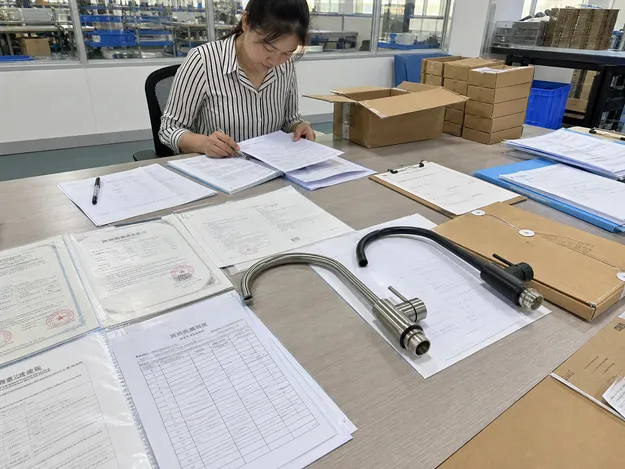
Compliance certifications and documentation for reverse osmosis faucets across global markets

Documentation Ships With the Container

We prepare compliance documentation in parallel with production — test reports, certificates of origin, and certification documents travel with the shipment. Your customs broker and compliance team have what they need without chasing us for it after the container ships.

Test reports & certificates of origin
Certification documents included with shipment
HS code classification & binding ruling references for North American customs pre-clearance

Certification Coverage at a Glance

cUPC US & Canada
NSF/ANSI 61 material compliance US (state-mandated markets)
CE European Union
WaterMark Australia & New Zealand
SGS third-party reports Available on request
Installation Guide

Installation Compatibility: What Your Buyers Need to Know Before They Order

RO faucets have specific installation requirements that affect which products sell into which projects. Understanding these upfront reduces returns and customer service calls.

Deck Hole Size

Standard 1-3/8" (35 mm)

Standard installation requires a 1-3/8" (35 mm) deck hole — the same as most standard kitchen faucets. Most kitchen sinks have this hole pre-drilled, or it can be drilled. We offer an escutcheon plate option for installations where the existing hole is larger.

Supply Tube Routing

Standard 24" (600 mm) included

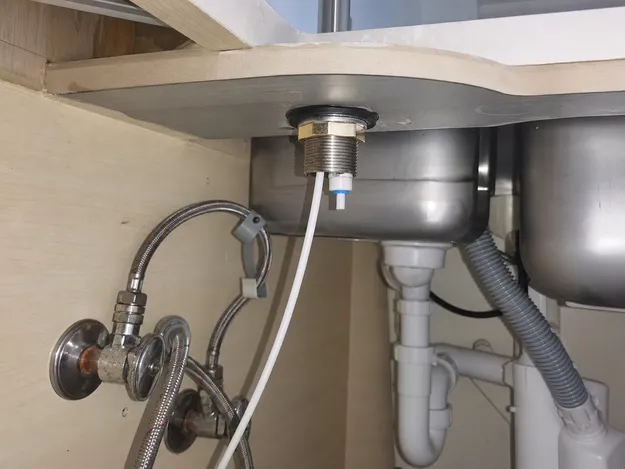
The supply tube runs from the RO storage tank (typically under the sink) up through the cabinet and deck to the faucet. Standard tube length in our packaging is 24" (600 mm), which covers most under-sink cabinet depths. For deeper cabinets or longer runs, buyers can use standard 1/4" push-fit extension tubing available at any plumbing supply.

Air Gap Drain Connection

Plumber-standard step

Air gap faucets require a connection to the sink drain — typically to the dishwasher inlet port on the drain tailpiece, or to a dedicated drain saddle. This is a standard installation step for plumbers but can be a barrier for DIY installation. If your channel includes DIY retail, the non-air gap configuration has a simpler installation path.

Water Pressure

Rated 0.05–0.8 MPa

Our RO faucets are rated for 0.05–0.8 MPa inlet pressure. RO storage tanks typically deliver 0.05–0.2 MPa, which is within spec. If your buyers are in markets with unusually high municipal water pressure (above 0.6 MPa), a pressure regulator upstream of the RO system is standard practice — the faucet itself is not the limiting component.

Quick Reference: Installation Requirements at a Glance

Deck hole: 1-3/8" (35 mm) standard — escutcheon plate available for oversized holes
Supply tube: 24" (600 mm) included; extend with standard 1/4" push-fit tubing
Air gap drain: connects to dishwasher inlet port or dedicated drain saddle
Pressure range: 0.05–0.8 MPa rated; regulator recommended above 0.6 MPa municipal supply
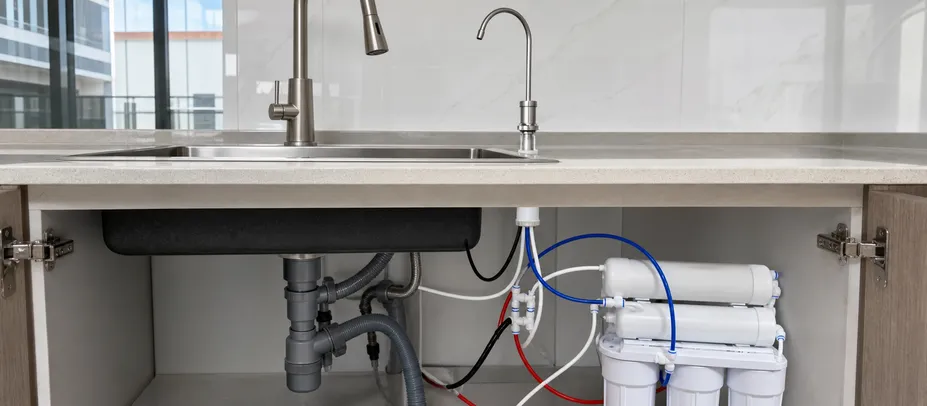
RO faucet installation under sink showing supply tube routing and deck hole connection
Buyer FAQ

Frequently Asked Questions

Technical and commercial questions we hear most often from distributors, system OEMs, and procurement teams evaluating RO faucet supply.

Q

What is the difference between a reverse osmosis faucet and a standard water filter faucet?

An RO faucet connects to the storage tank of a reverse osmosis system and operates at low pressure — typically 0.05–0.2 MPa. A standard filter faucet connects to the main cold water supply line and operates at normal tap pressure. The two products have different cartridge specifications, different flow path sizing, and different installation requirements. They are not interchangeable. Using a standard filter faucet on an RO system typically results in dripping at low tank pressure; using an RO faucet on a standard filter system results in restricted flow.

Q

Do I need an air gap or non-air gap RO faucet for the US market?

It depends on the state. California, Massachusetts, and several other states require air gap faucets by plumbing code. Most other US states permit non-air gap faucets.

For distributors covering multiple states, carrying both configurations is the safest approach — the compliance risk of stocking only non-air gap and having a customer install in a code-required state is a product return and a failed inspection.

We manufacture both variants with identical body castings and matched finishes, so they can be sold as a coordinated product line. See our dedicated pages for air gap RO faucets and non-air gap RO faucets.

Q

What certifications does your reverse osmosis faucet hold?

We hold cUPC (North American plumbing code compliance), CE (European market), WaterMark (Australia and New Zealand), and SGS third-party testing.

cUPC CE WaterMark SGS

For NSF/ANSI 61 Section 9 (drinking water contact material standard), we can provide XRF test reports and material certifications demonstrating ≤0.25% lead content. If your buyers require a full NSF 61 product certification, contact us to discuss the certification extension process for specific SKUs.

Q

Why do some RO faucets drip after installation?

The most common cause is a cartridge spec'd for standard tap pressure being used in a low-pressure RO application. At RO tank pressures of 0.05–0.15 MPa, standard cartridge spring tension is insufficient to maintain a positive seal between the ceramic discs.

We spec our RO faucet cartridges with lighter spring tension and tighter disc flatness tolerance (±0.003 mm on the seating surface) and test every production batch at 0.2 MPa to catch this failure mode before the product ships.

Supplier qualification check: If you're seeing drip failures from a current supplier, ask them what pressure they test at — if the answer is only 0.6 MPa, that's the problem.

Q

What is the minimum order quantity for private-label reverse osmosis faucets?

OEM Orders

200 pcs

Per SKU with custom tooling (handle style, spout profile)

ODM Orders

200 pcs

From existing catalog bodies with modified finishes or branding — sample turnaround 15–20 days

Most new buyers start with a 200-unit trial order in one or two configurations to test market response before scaling to container quantities.

Q

Can you supply matched air gap and non-air gap faucets in the same finish for a system bundle?

Yes. Both configurations are manufactured from the same body casting and are available in all five finishes — chrome, brushed nickel, matte black, PVD gold, and oil-rubbed bronze. We can supply matched pairs in the same finish and handle style so the faucet looks designed with the system rather than sourced separately.

Chrome Brushed Nickel Matte Black PVD Gold Oil-Rubbed Bronze

This is a standard request from RO system OEMs building private-label bundles.

Water Filter & RO Faucet Line

Other Products in the Water Filter & RO Faucet Line

If this configuration doesn't match your requirements, here are the closest alternatives in the same product family.

Request a Quote

Get a Quote for Reverse Osmosis Faucets

Send us your target configuration (air gap or non-air gap), finish, volume, and destination market — we'll come back with a detailed quote and, if relevant, a recommendation on which configuration fits your product line best.

If you're building a private-label RO system bundle, tell us your handle style preference and we'll spec matched pairs across both configurations.

Submit an RFQ

Include your target configuration, finish, order volume, and destination market. We respond within one business day.

We respond within one business day. For urgent inquiries, contact us directly via WhatsApp or phone.