

RO Faucets Direct From Factory
Brass body, lead-free alloy, air gap and non-air gap configurations, cUPC-compliant and ready to source. We manufacture reverse osmosis water faucets for RO system OEMs, water treatment distributors, and importers who need consistent quality, matched finishes, and documentation that clears customs without surprises.
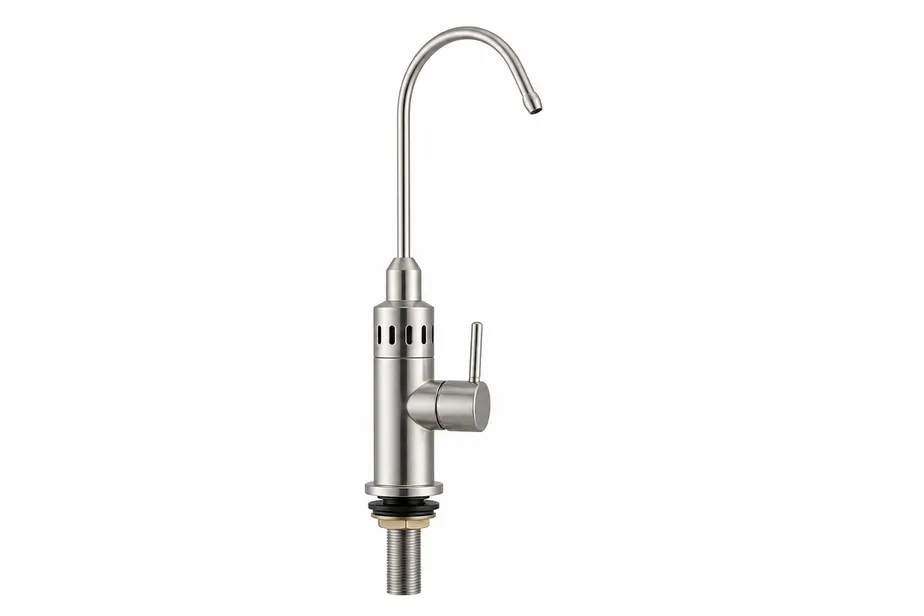
Sourcing Intelligence
What Makes an RO Faucet Different — and Why It Matters for Your Sourcing Decision
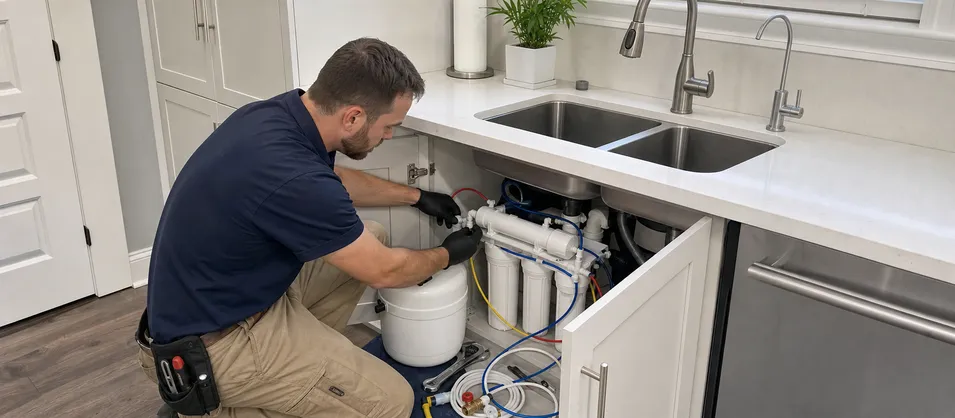
An RO faucet is not a standard kitchen faucet with a smaller spout. The design requirements are fundamentally different, and sourcing the wrong product creates problems that land on your customers, not on the factory.
The water coming through an RO faucet has already passed through a reverse osmosis membrane and a pressurized storage tank. It's low-pressure — typically 40–80 PSI feed from the tank, compared to 60–100 PSI from a standard tap supply. It's also the water your downstream customers are drinking directly, which means lead content and internal surface quality are not optional specifications. And the flow rate is intentionally restricted — RO membranes produce purified water slowly, and a faucet with a standard kitchen flow path would drain the storage tank faster than the system can replenish it.
We've been manufacturing RO faucets for export since our filter faucet line launched, and the three failure modes we see most often in the market — cartridge drip at low pressure, finish delamination at the base, and lead leaching from internal surfaces — all trace back to factories applying standard faucet specs to a product that needs different specs. The sections below explain exactly how we address each one.
View all water filter and RO faucet variants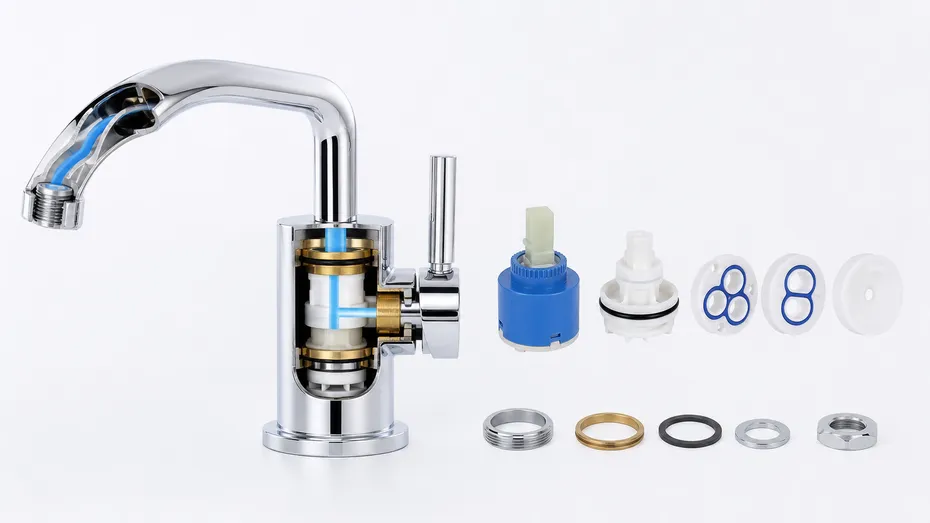
Three Failure Modes We Engineer Against
Standard cartridges are calibrated for 60–100 PSI. RO tank pressure runs 40–80 PSI — cartridges not spec'd for this range drip at the seat.
Condensation collects at the deck ring where the spout meets the countertop. Thin or improperly bonded finishes fail here first, visibly and quickly.
Purified RO water is more aggressive at leaching metals than tap water. Internal alloy composition is not a secondary spec — it's the primary one for drinking water faucets.
Technical Data
RO Faucet Specifications
Standard values for this product type. Actual specifications may vary by configuration. Contact us for detailed product data sheets and custom specifications.
Specifications shown are standard values for this product type. Actual specifications may vary by configuration. Contact us for detailed product data sheets and custom specifications.
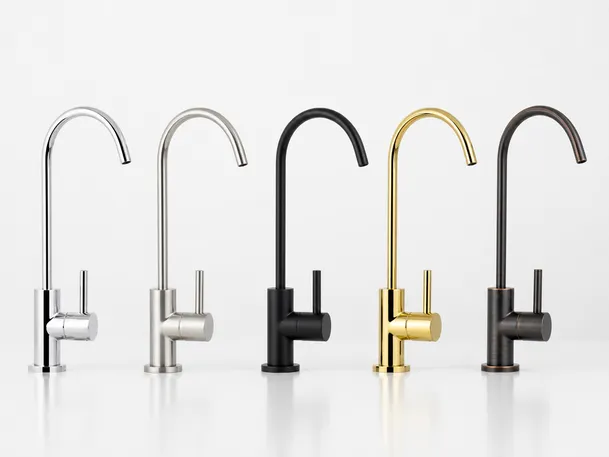
Available Finishes
Certifications & Documentation
Why Work With Us
Why Source RO Faucets From Us
We manufacture RO faucets for water treatment brands, distributors, and OEM buyers across North America, Europe, and Australia. Here's what that means for your sourcing.
Direct Factory Pricing
No middlemen. You buy directly from the manufacturer, which means better margins and a shorter supply chain. MOQs start at 500 units for standard configurations.
OEM & Private Label
Custom logos, packaging, and finish combinations. We support full private-label programs with your branding on the faucet body, box, and documentation.
In-House QC & Testing
Every production batch goes through pressure cycling, salt spray, and cartridge endurance testing before shipment. Third-party inspection (SGS, BV) available on request.
Certification Support
We provide NSF/ANSI 61 material documentation, cUPC, CE, and WaterMark certificates. We can assist with market-specific compliance requirements for your target region.
Reliable Lead Times
Standard configurations ship in 25–35 days. Custom finishes or OEM tooling add 15–20 days. We provide production tracking and pre-shipment inspection reports.
Dedicated Account Support
A single point of contact handles your orders, samples, and technical questions. No ticket queues — direct communication with the team managing your account.
Buyer's Guide
How to Choose the Right RO Faucet
The right faucet depends on your system configuration, local plumbing code, and end-user preferences. Here are the key decisions to work through before placing an order.
Air Gap or Non-Air Gap?
Air gap faucets are required by plumbing code in many US states and Canadian provinces. They route the drain line through the faucet body, creating a physical break that prevents backflow into the RO membrane. Non-air gap faucets are simpler to install and work fine where code permits. If you're unsure, specify air gap — it's the safer default for North American markets.
Finish & Aesthetic Match
The RO faucet sits on the countertop alongside the main kitchen faucet. Buyers increasingly want a finish match. Chrome remains the most popular globally, but brushed nickel and matte black are growing fast in North America and Australia. PVD finishes offer better durability for high-humidity environments.
Spout Style: Standard vs. Long-Reach
Standard spout reach (120–140 mm) suits most sink configurations. Long-reach spouts (160–200 mm) are preferred for farmhouse sinks or when the faucet hole is positioned further from the basin center. Confirm sink dimensions with your customers before specifying.
Lead-Free Compliance Requirements
US federal law (Safe Drinking Water Act) and California AB 1953 require ≤0.25% weighted average lead content for drinking water faucets. Our standard brass body meets this requirement. If you're selling into California or other regulated markets, request the NSF/ANSI 61 Section 9 documentation with your order.
Tubing Connection Size
Most RO systems use 1/4" tubing. Some higher-flow systems use 3/8". Confirm the tubing size used in the RO system you're pairing with, or specify both connection sizes if you're selling the faucet as a standalone accessory. We supply both push-fit configurations.
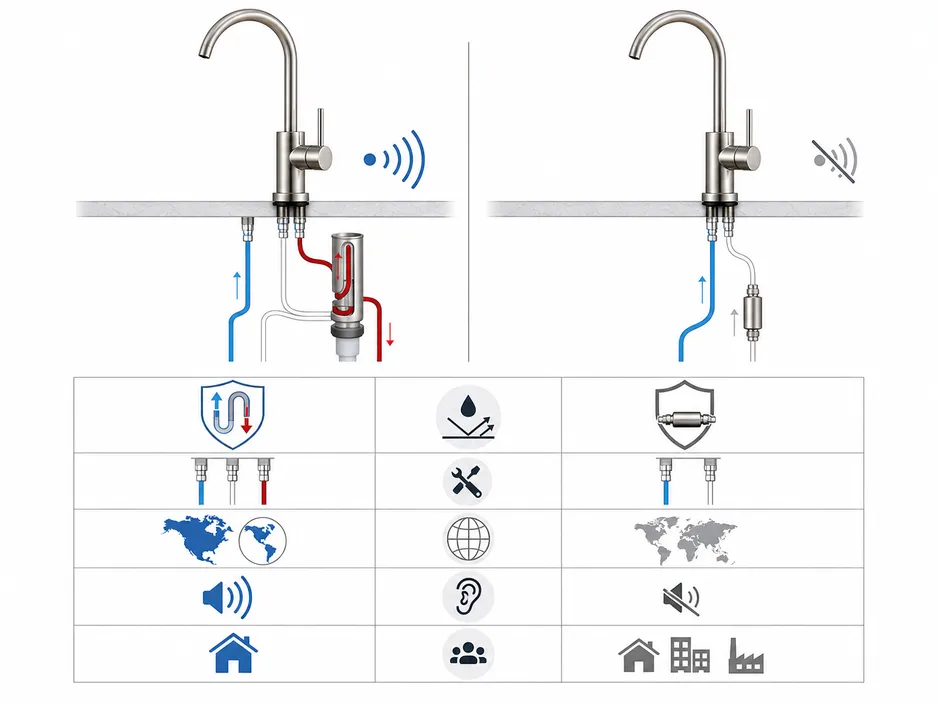
Quick Reference: Air Gap vs Non-Air Gap
| Factor | Air Gap | Non-Air Gap |
|---|---|---|
| Backflow protection | Built in | External check valve |
| Install complexity | 3 tubes to route | 2 tubes, simpler |
| US/CA code compliance | Required in many states | Check local code |
| Noise potential | Slight gurgle possible | Silent operation |
| Best for | NA regulated markets | EU, AU, unregulated |
Configuration Guide
Air Gap vs. Non-Air Gap: The Configuration Decision That Determines Your Market Coverage
This is the first question to resolve before placing an order, because the two configurations are not interchangeable in the field.
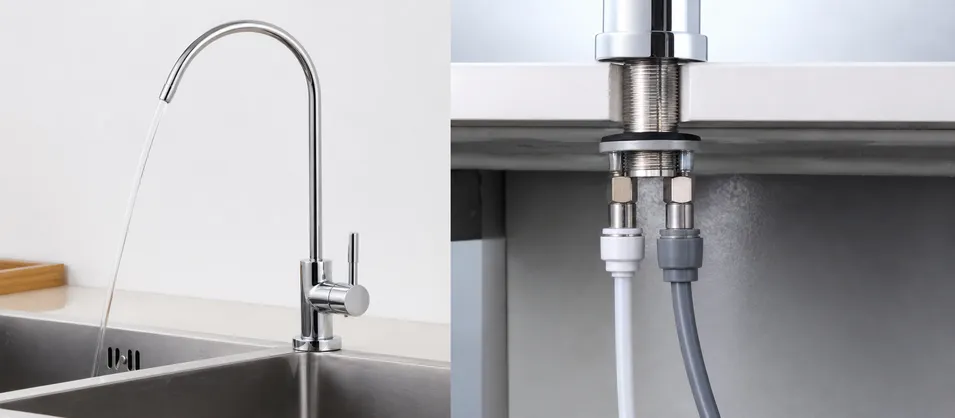
Non-Air Gap RO Faucet
Two ports: purified water supply line from the RO storage tank, and drain line carrying reject water to the sink drain. The simpler design, easier to install, and the default choice for most residential RO system OEMs. The majority of US residential RO installations use non-air gap faucets, and most local plumbing codes permit them.
Best Fit
- Residential RO system OEM bundles
- Markets where non-air gap is code-compliant
- Distributors prioritizing ease of installation
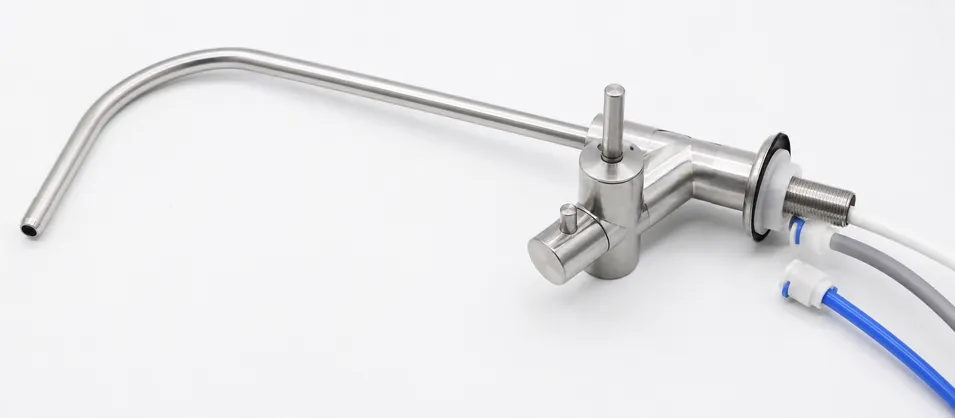
Air Gap RO Faucet
Three ports: purified water supply, drain line, and a third port that creates a physical air break in the drain line. That air break prevents contaminated drain water from siphoning back into the RO membrane — a backflow prevention mechanism required by plumbing code in California, Massachusetts, and several other US states.
Compliance note: If your buyers are installing RO systems in California, Massachusetts, or other states with air gap requirements and they use a non-air gap faucet, they fail inspection. That's a product return and a credibility problem.
Best Fit
- California, Massachusetts, and states with air gap code requirements
- Commercial projects with tightening plumbing inspection enforcement
- Distributors covering multiple US states who need full market coverage
Production Details
Same Production Line. Same MOQ.
We manufacture both variants on the same production line using the same brass body casting. The difference is in the spout body machining and port configuration — the air gap version requires an additional machined channel and a third port fitting. Lead times and MOQs are identical for both configurations.
Private-Label Bundles
Coordinated SKU Pairs for System Branding
For distributors covering multiple US states, carrying both configurations is the practical approach. We can supply them as a coordinated SKU pair — same finish, same handle, different port count — so your catalog presents a clean product family rather than two unrelated items.
If you're supplying a private-label RO system bundle, we can produce matched pairs in the same finish and handle style so the faucet looks designed-in rather than sourced separately — a detail that matters for premium system branding.
Engineering & Quality
How We Engineer Around the Three Failure Modes
Filter faucets have a specific failure profile that's different from standard kitchen faucets. Understanding it is useful when you're evaluating suppliers, because the fixes are visible in the production process — not in the marketing copy.
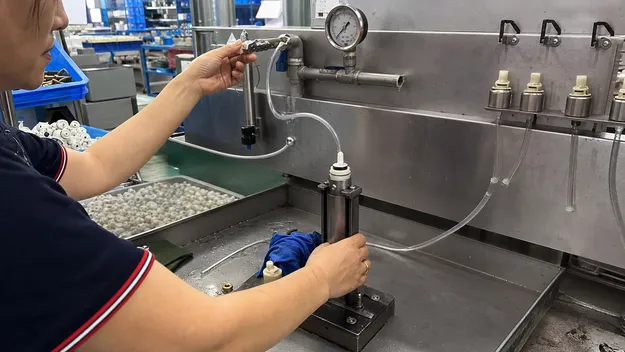
Cartridge Drip Under Low Pressure
RO systems operate at lower inlet pressure than standard tap water — sometimes as low as 40 PSI from the storage tank. Ceramic disc cartridges spec'd for standard tap pressure can develop a slow drip at RO system pressures because the disc seating force is calibrated for higher pressure. The disc doesn't fully close against the seat at low pressure, and you get a slow drip that your customers notice within weeks of installation.
Our Process Fix
-
Lighter spring tension calibrated to maintain positive disc seating at 0.2 MPa rather than 0.6 MPa
-
Ceramic disc flatness tolerance held to ±0.003mm on seating surface (vs. ±0.005mm on standard faucet cartridges)
-
Every production batch tested at 0.2 MPa inlet pressure specifically to catch this failure mode before shipment
We added the low-pressure test protocol after seeing early drip failures on a batch shipped to a North American RO system OEM — the standard 0.6 MPa test passed fine, but the product failed in the field. We've run the 0.2 MPa test on every batch since.
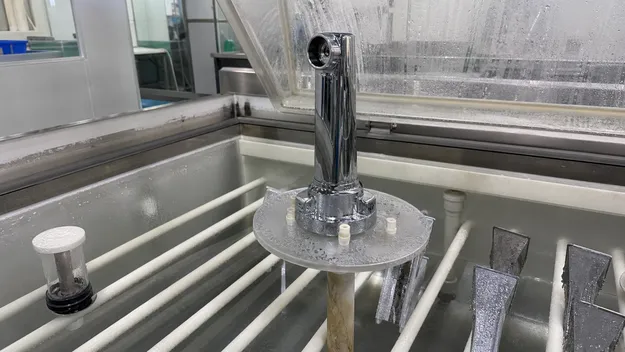
Finish Failure at the Base
The area where the faucet body meets the deck plate is a moisture trap in any kitchen environment, but it's worse on RO faucets because the drain line connection creates additional condensation and occasional drips at the base. Factories that skip the nickel mid-coat in their plating stack see chrome and brushed nickel finishes delaminating at the base within 12–18 months — the kind of cosmetic failure that generates warranty claims and erodes your brand with downstream customers.
Our Process Fix
-
Full copper/nickel/chrome electroplating stack on every unit — nickel mid-coat intact, no shortcuts
-
Sealant bead applied at the base-to-deck interface before packaging — eliminates the most common cosmetic warranty claim in this category
-
Chrome passes 24-hour salt spray minimum; most batches clear 48 hours
The sealant bead adds 30 seconds to assembly time, but it eliminates the most common cosmetic warranty claim in this product category.
Lead Leaching from Internal Surfaces
This is the failure mode with the most serious downstream liability. Brass alloys with higher lead content can leach lead into standing water — and in low-flow applications like RO faucets, water sits in the spout between uses for extended periods. The leaching risk is higher here than in a standard kitchen faucet that runs at full flow multiple times a day.
Our Process Fix
-
Brass held to ≤0.25% lead by weight, below the NSF/ANSI 61 Section 9 threshold
-
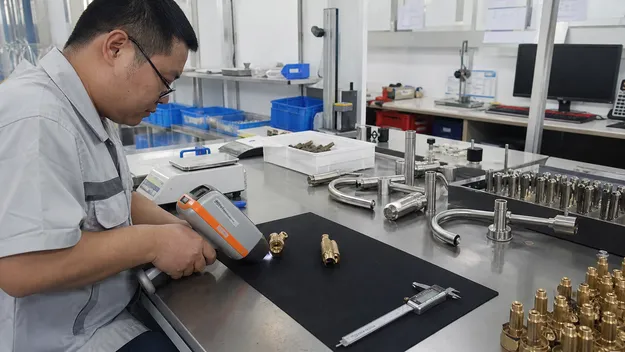
Every incoming brass batch tested with XRF analysis before it enters production
-
Internal waterway machined to a smooth finish and passivated — rough casting porosity is a secondary leaching pathway that material specification alone doesn't address
-
XRF test reports and material certifications included with each shipment — your compliance team has the documentation without having to request it separately
Engineering Summary
Three failure modes. Three process fixes. All documented.
Every control described above is built into our standard production process — not available as an upgrade, not something you need to negotiate. If a batch doesn't pass the 0.2 MPa drip test, the XRF screen, or the salt spray minimum, it doesn't ship. The test reports travel with the shipment.
0.2 MPa
Low-pressure drip test run on every production batch — not just the standard 0.6 MPa line test
≤0.25%
Lead by weight in brass — XRF-verified on every incoming material batch
OEM & Private Label
Customization options that don't require a tooling conversation every time
Most of what buyers ask for is already in our standard option matrix. Finish, handle style, spout height, tubing color, branding — these are selections, not engineering projects. Tooling conversations happen when you need something genuinely outside the matrix, and we'll tell you upfront whether that's the case.
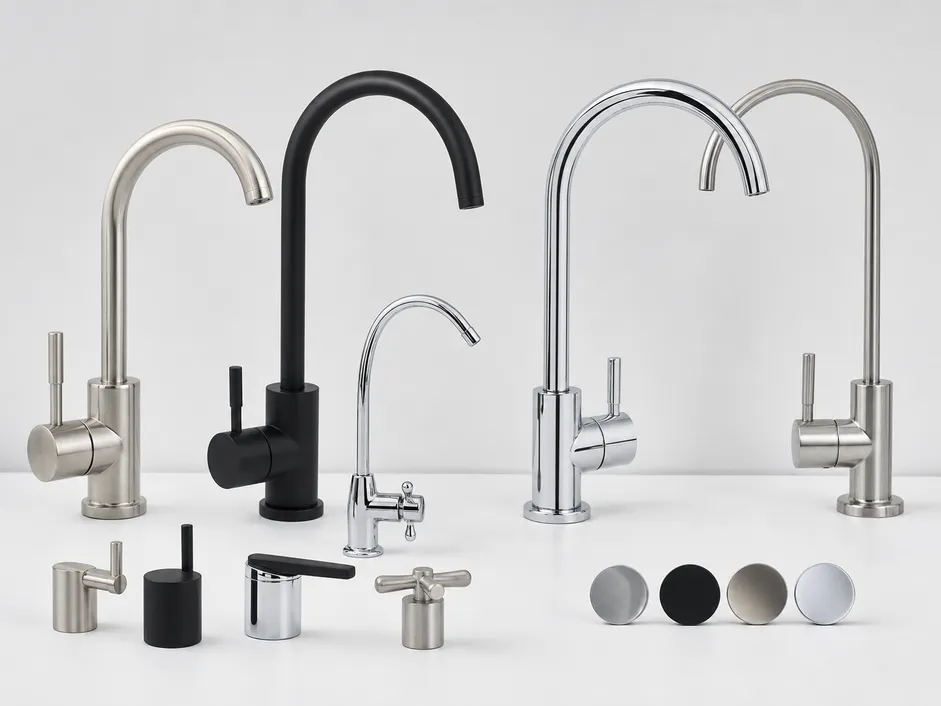
Surface Finish
Standard matrix covers the finishes that move volume in North American and European retail channels.
- Chrome
- Brushed Nickel
- Oil-Rubbed Bronze
- Matte Black (PVD)
- Brushed Gold (PVD)
Handle Style
Lever and cross-handle styles available across all finishes. No MOQ premium for switching within the matrix.
- Single lever (standard)
- Cross handle (4-spoke)
- Knob / dome handle
- Long-reach lever (ADA-friendly)
Spout Height
Two standard heights cover the majority of under-sink cabinet clearance scenarios in residential and light commercial installs.
- Standard: 270mm overall height
- Tall: 360mm overall height
- Custom heights: tooling required, MOQ applies
Tubing & Fittings
Supply line color and fitting standard are selectable to match your system's existing tubing or regional plumbing norms.
- Clear, blue, or black PE tubing
- 1/4" John Guest push-fit (standard)
- 3/8" push-fit available
- Compression fitting option for EU markets
Private Label & Branding
Logo placement on handle cap and packaging. No tooling charge for engraving within standard handle cap dimensions.
- Laser engraving on handle cap
- Custom retail box (full-color print)
- Branded installation guide insert
- Custom handle cap shape: tooling required
Certification Documentation
Test reports and material certifications ship with every order. Third-party certification support available for buyers entering regulated markets.
- NSF/ANSI 61 material compliance docs
- XRF brass analysis reports
- Salt spray test certificates
- REACH / RoHS declarations available
When tooling is actually required
Custom spout heights outside the two standard options, non-standard handle cap shapes, and body geometry changes require new tooling. Tooling cost is quoted separately and is a one-time charge — it doesn't recur on reorders. Lead time for tooling is typically 45–60 days before first production run. If your request is within the standard matrix, we'll confirm that in the first response so you're not waiting on a tooling quote that isn't needed.
Ask whether your spec needs toolingWhere RO Faucets Sell: Market Segments and Order Patterns
Four distinct buyer segments drive RO faucet demand. Each has different volume expectations, reorder logic, and compliance requirements — understanding which segment you're serving shapes how you spec and stock.
Highest Volume
Residential RO System OEMs
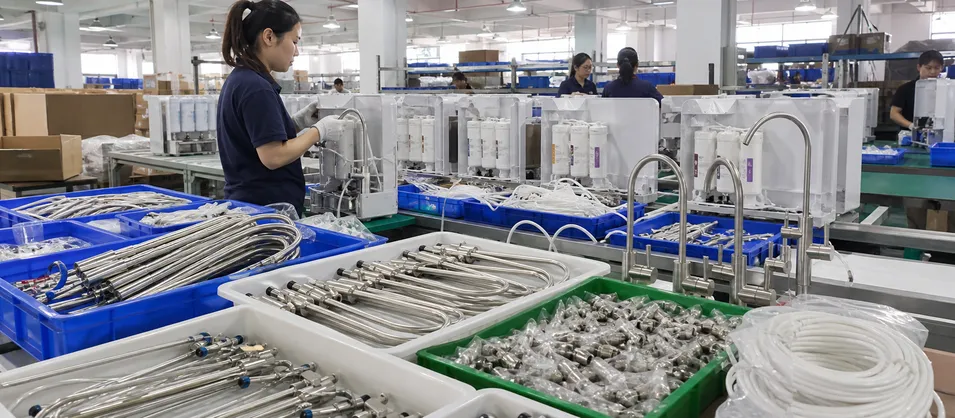
Companies that manufacture or assemble RO systems under their own brand need a matched faucet to complete the system — consistent finish, consistent quality, and consistent supply across multiple production runs. The faucet is a small line item in the system BOM but the most visible component in the finished product.
We supply several RO system OEMs on a private-label basis, typically in runs of 2,000–5,000 units per order. The reorder cycle is predictable once the spec is locked — same casting, same finish, same documentation every time.
Typical Order Size
2,000–5,000 units
Supply Model
Private Label
Recurring Demand
Water Treatment Distributors
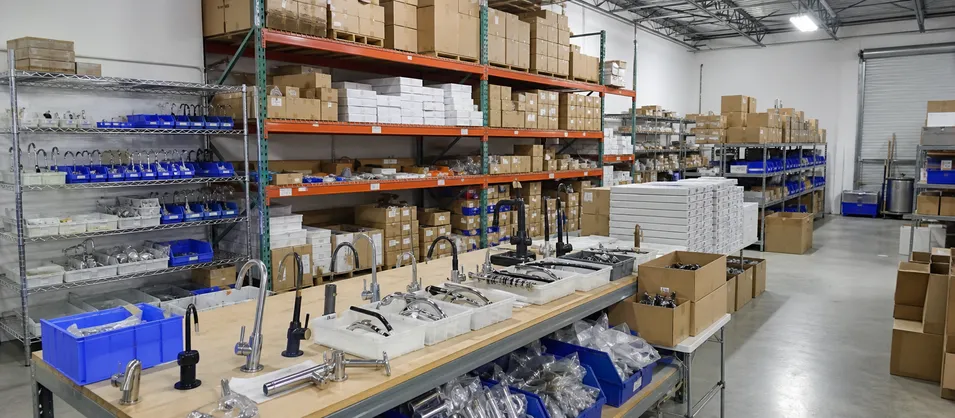
Distributors in North America, Europe, and Australia carry RO faucets as both system components and replacement parts. The replacement market is real and recurring: faucet bodies get replaced when kitchens are renovated, when finish wear becomes visible, or when a homeowner upgrades their RO system and wants a matching faucet.
Distributors who stock both air gap and non-air gap configurations in two or three finishes capture the full replacement demand in their territory without sending customers to a competitor.
Markets Served
NA · EU · AU
Demand Type
System + Replacement
Category Expansion
Kitchen & Bath Importers
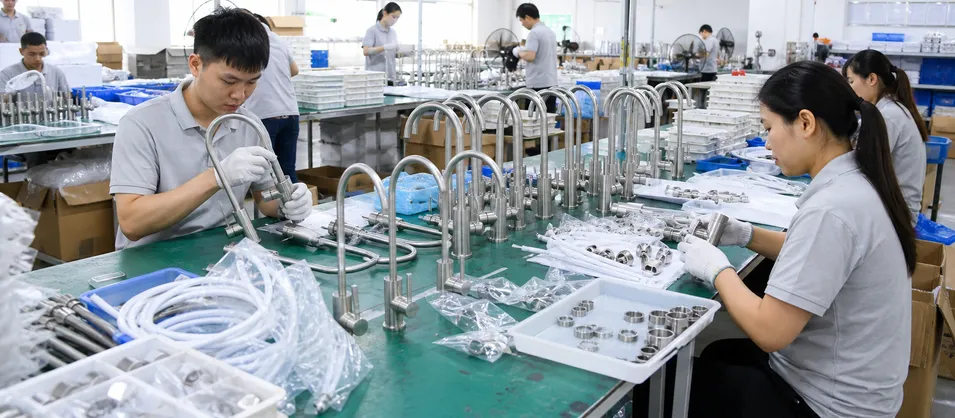
If you're already importing kitchen or bathroom faucets, adding RO faucets is a natural extension — same supplier, same documentation, same container. The RO faucet category has been growing faster than standard kitchen faucets in most of our export markets, driven by increasing consumer awareness of water quality.
In the Middle East and Southeast Asia specifically, residential RO adoption has been accelerating at the retail level. Importers who have the SKU in their catalog are capturing that demand while competitors are still sourcing.
Growth Markets
ME · SEA · Global
Logistics
Same Container
Compliance-Driven
Plumbing & HVAC Contractors
Contractors who supply and install RO systems as part of whole-home water treatment projects typically order in smaller quantities — 50–200 units per order — but they're consistent reorders. Their installations are subject to inspection, so compliance documentation is a hard requirement, not a nice-to-have.
Having cUPC certification and NSF 61 material documentation ready to provide is the difference between winning and losing this segment.
Typical Order Size
50–200 units
Key Requirement
cUPC + NSF 61 Docs
2,000–5,000
Units per OEM run
50–200
Units per contractor order
4
Distinct buyer segments served
3
Continents with active distributor demand
Customization Options for Private-Label RO Faucets
The water treatment market rewards brand differentiation. RO system OEMs and distributors who sell under their own brand consistently command better margins than those reselling generic product.
We support private-label development on this product line from 200 pieces per SKU — covering both OEM projects starting from a design brief and ODM projects starting from our existing catalog bodies.
Minimum Order Quantity
200 pcs / SKU
Applies to both OEM and ODM paths. Most new buyers start with a 200-unit trial order in one configuration to test market response before scaling to container quantities.
Standard Customization Dimensions
Handle Style & Geometry
Lever handle, cross handle, or custom profile from your design brief. Handle geometry is the most visible brand differentiator on the finished product.
Spout Profile & Reach
Standard reach or extended spout for deeper sink configurations. Spout reach affects usability in undermount and farmhouse sink installations.
Surface Finish
All five in-house finishes available. Matched finish across air gap and non-air gap variants for coordinated product families — critical for OEMs building a complete system aesthetic.
Branding
Logo engraving on the body or handle, custom badge, or branded packaging. Branding options apply to both the faucet hardware and the retail or trade packaging.
Supply Tube Connection
1/4" push-fit standard; 3/8" push-fit or compression fitting available for specific market requirements. Connection type is often dictated by the RO system's tubing spec.
Deck Plate Configuration
Single-hole mount or escutcheon plate for larger deck holes. Escutcheon plates are required in markets where sink deck holes are pre-drilled at 1-3/8" or larger.
OEM vs. ODM: Which Path Fits Your Project
OEM — From Your Design Brief
Starting from a design brief or reference sample. We maintain in-house tooling for brass casting dies, so tooling revisions don't go to an outside vendor and add weeks to the timeline.
First Sample Turnaround
25–35 days
MOQ
200 pcs / SKU
Tooling
In-house brass casting dies
ODM — Modified Catalog Bodies
Starting from our existing catalog bodies with modified handles, finishes, or branding. Faster turnaround because the core casting tooling already exists — only the modification elements need development.
Modified Sample Turnaround
15–20 days
MOQ
200 pcs / SKU
Modification Scope
Handle · Finish · Branding
Start with a 200-Unit Trial Order
Most new buyers start with a 200-unit trial order in one configuration to test market response before scaling to container quantities. The trial order is a low-risk way to validate the product in your market before committing to volume.
We've had buyers come back within 60 days of their first trial order with a full container request.
Trial MOQ
200 pcs
Per SKU, OEM or ODM
Reorder Cycle
60 days
Typical first reorder window
OEM Sample
25–35 days
From design brief
ODM Sample
15–20 days
From catalog body
Built to Pass the Tests That Matter
Certification requirements vary by market. Our RO faucets are designed and tested to meet the most common regulatory thresholds buyers encounter — so you're not starting from scratch when your market requires documentation.
NSF/ANSI 61
Drinking Water System Components
Material safety standard for components in contact with potable water. Required by most U.S. state plumbing codes and referenced by major retail buyers as a baseline requirement for RO faucets.
NSF/ANSI 372
Lead-Free Compliance
Weighted average lead content ≤ 0.25% across wetted surfaces. Mandatory for sale in California, Vermont, Maryland, and Louisiana under state lead-free plumbing laws — and increasingly expected in other states.
AB 1953 / S3874
California & Federal Lead-Free
California AB 1953 and the federal Reduction of Lead in Drinking Water Act (S3874) set the 0.25% weighted average lead standard. Our brass alloy selection and wetted-surface design are validated against both statutes.
WRAS (UK)
Water Regulations Advisory Scheme
Required for plumbing products installed in UK water supply systems. WRAS approval is the standard reference for UK distributors and installers when specifying RO faucets for residential and light commercial use.
KTW / W270 (DE)
German Drinking Water Hygiene
German Federal Environment Agency guidelines for materials in contact with drinking water. KTW and W270 compliance is the baseline expectation for the German and broader DACH market distribution channel.
RoHS / REACH
EU Substance Restrictions
Restriction of Hazardous Substances and Registration, Evaluation, Authorisation and Restriction of Chemicals compliance for EU market entry. Required for CE marking and expected by EU importers as part of standard technical documentation.
Documentation Available on Request
Test reports, material declarations, and third-party certification documents are available for qualified buyers under NDA. If your market requires a certification not listed here, contact us before assuming it's unavailable — we may have it on file or can advise on the fastest path to obtain it.
For OEM and private-label orders, certification documentation can be transferred or re-issued under your brand name depending on the certifying body's rules. We'll walk you through the process during the qualification stage.
Quality Control at Each Production Stage
Incoming Material
Brass bar and casting stock verified against alloy spec. Lead content spot-checked by XRF analysis before entering production.
In-Process Machining
Dimensional checks at CNC machining stage. Thread gauging and seat geometry verified before assembly to prevent downstream leakage failures.
Finish Inspection
PVD and electroplated finishes inspected for adhesion, color consistency, and coating thickness. Salt spray test samples pulled per batch for corrosion resistance validation.
Final Assembly & Pressure Test
100% pressure test at final assembly. Each unit tested at operating pressure before packaging. Leak failures are rejected and root-caused, not reworked and passed.
From First Inquiry to Delivery
Lead times depend on order type, configuration, and whether tooling is required. Here's what to expect at each stage so you can plan your procurement timeline accurately.
| Order Type | MOQ | Sample Lead Time | Production Lead Time | Notes |
|---|---|---|---|---|
| Catalog — Standard | 200 pcs | 3–5 days | 20–25 days | Existing SKU, no tooling required |
| Catalog — Custom Finish | 200 pcs | 7–10 days | 25–30 days | Finish development adds time to first sample |
| ODM — Modified Body | 200 pcs | 15–20 days | 30–35 days | Handle or branding modification on catalog casting |
| OEM — New Design | 200 pcs | 25–35 days | 35–45 days | New tooling; in-house casting dies |
| Reorder — Same Config | 200 pcs | — | 15–20 days | No sample required; tooling and spec already on file |
The Standard Order Process
Inquiry & Specification
Day 1Submit your inquiry with target configuration, quantity, and any certification or packaging requirements. We'll confirm feasibility and send a quotation within 24 hours on business days.
Sample Order & Approval
Days 3–35Sample produced and shipped for your evaluation. Approval or revision feedback collected. Most buyers approve on first or second sample. Revision rounds add 7–10 days each.
Purchase Order & Deposit
Upon ApprovalFormal PO issued and 30% deposit received to release production. Production scheduling confirmed and production start date communicated within 48 hours of deposit receipt.
Production & QC
15–45 DaysProduction runs with inline QC at each stage. Pre-shipment inspection report issued before balance payment request. Third-party inspection can be arranged at buyer's request.
Balance Payment & Shipment
Upon QC Pass70% balance due before shipment release. We handle export documentation, packing list, and commercial invoice. FOB Shenzhen standard; CIF and DDP available on request.
Shipping Terms
- FOB Shenzhen — standard for most buyers; you arrange freight from port
- CIF — cost, insurance, freight to destination port; available on request
- DDP — delivered duty paid; available for select markets; contact for pricing
- Express courier — DHL / FedEx for samples and small trial orders
Payment Terms
- T/T 30/70 — 30% deposit on PO, 70% balance before shipment; standard terms
- L/C at sight — letter of credit accepted for orders above USD 20,000
- PayPal / credit card — available for sample orders only
- Net 30/60 — available for established accounts with order history; apply after first order
Questions Buyers Ask Before the First Order
Answers to the questions that come up most often during the qualification and sourcing process.
What's the minimum order quantity for a private-label RO faucet?
For catalog models with a standard finish, the MOQ is 100 pieces per SKU. Custom finishes and ODM modifications start at 200 pieces. Full OEM new-design orders require 200 pieces minimum for the first run, which covers tooling amortization. If you're testing a new market, we can discuss a trial order of 50–100 pieces on select catalog SKUs — contact us to check availability.
Can I get my logo on the faucet body and the packaging?
Yes. Logo placement on the faucet body is done by laser engraving, silk-screen printing, or a branded escutcheon plate depending on the surface and finish. Packaging — retail box, inner carton, and master carton — can all carry your branding. Provide your logo in vector format (AI, EPS, or SVG) and we'll send a digital proof before production. Setup fees apply for new tooling on escutcheon plates; laser and print setup is typically included for orders above MOQ.
Which certifications do your faucets carry, and can you support NSF or WRAS?
Our standard catalog carries CE and RoHS documentation. For North American markets, select SKUs have been tested to NSF/ANSI 61 and NSF/ANSI 372 (lead-free). For the UK and Commonwealth markets, WRAS approval is available on specific models. If you need a certification not currently on file, we can coordinate third-party testing through accredited labs — typical lead time is 4–8 weeks and cost is passed through at cost. Confirm your target market early so we can flag any compliance gaps before sampling.
How do I know the faucet will fit my RO system's feed and product lines?
All catalog faucets ship with a standard 1/4-inch OD push-fit inlet fitting, which is compatible with the tubing used by the vast majority of residential RO systems. If your system uses 3/8-inch OD tubing or a different connection standard, we can substitute the fitting at no extra charge — just specify when ordering. Dimensional drawings and installation templates are available for every model so you can verify sink hole diameter and spout reach before committing to a sample.
What's included in the pre-shipment inspection report?
The report covers quantity verification, dimensional checks against approved sample, finish and appearance inspection (AQL 2.5 for major defects, AQL 4.0 for minor), pressure and leak test results, and packaging conformity. Photos of random units and carton markings are included. The report is issued as a PDF before we request the balance payment. If you want a third-party inspector on-site — SGS, Bureau Veritas, or your own agent — we'll coordinate access and scheduling at no additional charge from our side.
Can you match a finish I've seen on a competitor's faucet?
In most cases, yes. Send us a physical sample or a high-resolution photo with a Pantone or RAL reference if you have one. Our finishing team will develop a match and apply it to a sample piece for your approval before production. Finish development typically adds 7–10 days to the sample stage. Note that exact replication of a competitor's proprietary PVD color is not always possible due to process differences, but we can get very close. A finish development fee may apply for highly custom colors; this is credited back against your first production order.
What warranty do you offer, and how are defective units handled?
We warrant all products against manufacturing defects for 12 months from shipment date. If defective units are found within that window, submit photos and a defect description. For defect rates within AQL tolerance, we'll supply replacement units in the next order at no charge. For rates exceeding AQL, we'll issue a credit or replacement shipment depending on the situation. We don't require units to be returned to China for assessment — photo and video evidence is sufficient for most claims. Extended warranty terms up to 24 months are available for high-volume accounts.
Do you offer drop-shipping or fulfillment services for e-commerce sellers?
We're a manufacturer, not a fulfillment house, so we don't offer per-unit drop-shipping. However, for e-commerce brands that want to hold inventory closer to their customers, we can ship to third-party 3PL warehouses in the US, EU, or UK on your behalf. We can also prepare FBA-ready cartons with FNSKU labels and Amazon-compliant packaging if you're selling on Amazon. Minimum shipment for FBA prep is one full production run. Contact us to discuss your logistics setup and we'll advise on the most practical arrangement.
Ready to Source Your Next RO Faucet Line?
Tell us your target model, quantity, finish, and any certification requirements. We'll come back within one business day with a quotation and sample lead time.
-
Quotation within 24 hours on business days
-
Samples available before committing to production
-
No pressure — we answer technical questions at no obligation
-
OEM, ODM, and catalog orders all welcome from 100 pcs
Send an Inquiry
Import Compliance
Compliance Documentation for Your Import Markets
RO faucets face stricter compliance requirements than standard faucets in most export markets because of the drinking water contact application. Here's what we hold and what it covers for this product line.
cUPC
North American Plumbing Code
Required for sale in most US states and Canadian provinces. Our cUPC certification covers the brass body variants in this product line.
NSF/ANSI 61 Section 9
Drinking Water Contact Material
Our ≤0.25% lead specification and XRF material documentation support NSF 61 compliance. California, Vermont, Maryland, and other states have adopted NSF 61 into law — many retailers and distributors require it as a listing condition. We provide XRF test reports and material certifications with each shipment.
CE
European Market
Required for sale in EU member states.
WaterMark
Australia & New Zealand
Australian and New Zealand standards compliance for drinking water contact products.
SGS
Third-Party Audit & Testing
Third-party audit and testing reports available for buyers who need independent verification for their own compliance processes.
No Chasing Documents After the Container Ships
All documentation is prepared in parallel with production and travels with the shipment. For North American shipments, we can provide HS code classification and binding ruling references for customs pre-clearance.
Your customs broker and compliance team have what they need without chasing us for it after the container ships.
Included
XRF Test Reports
Included
Material Certifications
North America
HS Code Classification
North America
Binding Ruling References
Logistics & Landed Cost
Packaging, Container Loading, and Landed Cost
RO faucets pack efficiently — compact dimensions and relatively light weight make the landed cost economics favorable for importers.
Standard Carton Configuration
Units per Master Carton
12–24 units per master carton depending on configuration, with individual inner boxes for retail-ready presentation.
What Ships With Each Unit
Supply tube(s), mounting hardware, deck plate (where applicable), and installation instructions in the language of your destination market.
Localized Instructions
Installation instructions prepared in the language of your destination market — no separate localization step required on your end.
40HQ Container Loading
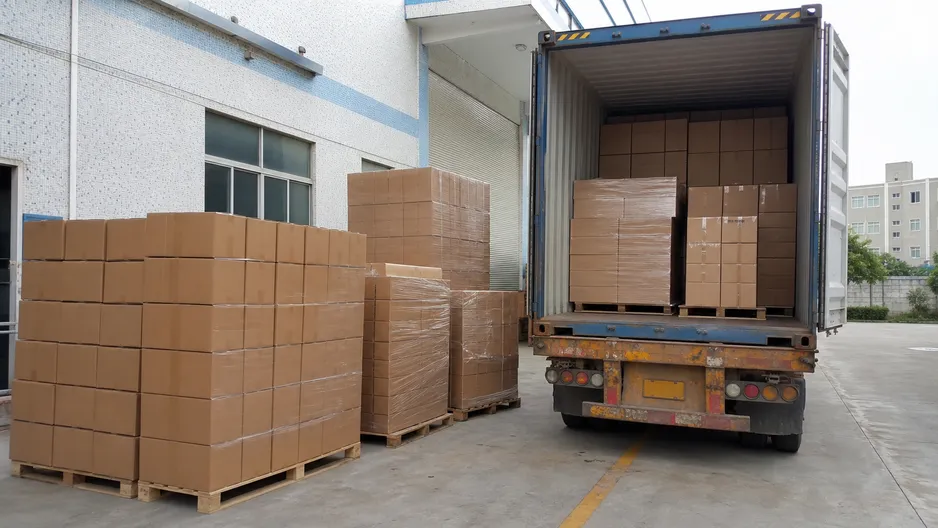
8,000–12,000
units per 40HQ container
Pre-Ship
packing list with CBM & gross weight per SKU
Exact unit count depends on the mix of air gap and non-air gap variants and carton configurations. We calculate the loading plan against your SKU mix and provide a packing list with CBM and gross weight per SKU before you confirm the order — your freight forwarder can quote accurately without waiting for the container to be loaded.
Consolidate RO Faucets With Other Wfaucet Lines
For buyers consolidating RO faucets with other Wfaucet product lines in the same container, we coordinate the packing sequence to minimize void space.
A mixed container of kitchen faucets and RO faucets is a common order pattern for our distributors — it reduces per-unit freight cost and simplifies the import process to a single shipment.
Minimized Void Space
Coordinated packing sequence
Lower Per-Unit Freight
Mixed SKU efficiency
Single Shipment
Simplified import process
Frequently Asked Questions
Decision-support answers for distributors, OEMs, and importers evaluating RO faucet sourcing.
What is the difference between an RO faucet and a standard water filter faucet?
An RO faucet is a dedicated dispensing faucet for reverse osmosis systems. It connects to the RO system's pressurized storage tank via a separate supply line — it is not connected to the main water supply. A standard water filter faucet connects to the cold water supply line and dispenses water that has passed through an under-sink filter.
The two are not interchangeable: an RO system requires an RO faucet, and using a standard filter faucet with an RO system will result in incorrect flow behavior and potential system damage. If you're unsure which product your customers need, the determining factor is whether they have an RO system with a storage tank (RO faucet) or a standard inline filter (filter faucet).
Do I need to stock both air gap and non-air gap RO faucets?
If you're distributing across multiple US states, yes. Air gap faucets are required by plumbing code in California, Massachusetts, and several other states. Non-air gap faucets are permitted in most states and are the standard choice for residential RO system OEMs.
Carrying both configurations in matched finishes lets you cover the full market without sending customers elsewhere. We manufacture both variants with identical body castings and matched finishes, so they present as a coordinated product family in your catalog.
What certifications do I need to sell RO faucets in the US market?
cUPC covers plumbing code compliance for most US states and Canadian provinces. NSF/ANSI 61 Section 9 is the drinking water contact material standard — required by law in California, Vermont, Maryland, and other states, and increasingly required by retailers and distributors as a listing condition.
We hold cUPC and can provide NSF 61 material documentation (XRF test reports and material certifications). If your buyers require a full NSF 61 product certification rather than material compliance documentation, we can discuss the certification extension process for specific SKUs.
What is the minimum order quantity for private-label RO faucets?
200 pieces per SKU for both OEM orders with custom tooling and ODM orders starting from our existing catalog bodies. Most new buyers start with a 200-unit trial order in one configuration — air gap or non-air gap — to test market response before scaling.
We can ship samples in advance of a production order so you can validate the product with your own customers first.
How do you ensure the cartridge doesn't drip at low RO system pressure?
We spec our RO faucet cartridges with lighter spring tension than our standard kitchen faucet cartridges, calibrated for positive disc seating at 0.2 MPa rather than 0.6 MPa. We also hold ceramic disc flatness to ±0.003mm on the seating surface.
Every production batch is tested at 0.2 MPa inlet pressure — not just at the standard 0.6 MPa — specifically to catch low-pressure drip before the product ships. This is a test protocol we added after seeing field failures on a batch that passed standard pressure testing but dripped at real-world RO system pressures.
Can you supply matched RO faucets for a private-label RO system bundle?
Yes. We can produce air gap and non-air gap variants in the same finish, same handle style, and same branding so the faucet looks designed-in rather than sourced separately. This is a common request from RO system OEMs who want a cohesive product presentation.
MOQ is 200 pieces per variant, and we can coordinate production timing so both variants ship in the same container.
Get a Quote for RO Faucets
Send us your target configuration (air gap or non-air gap), volume expectations, destination market, and finish preference — we'll come back with a detailed quote and, if relevant, a recommendation on which configuration fits your product line best.
If you're building a private-label RO system bundle, tell us your handle style and finish requirements and we'll spec a matched pair.
Most inquiries receive a response within 24 hours. Samples available before production commitment.
What to Include in Your Inquiry
- Configuration: Air gap or non-air gap (or both if you need matched variants)
- Volume: Annual volume estimate and initial trial order size
- Destination market: US state(s), Canada, or other import markets
- Finish preference: Matte black, brushed nickel, chrome, or other
- Private-label requirements: Handle style, branding, and packaging if applicable