

About Wfaucet Company Overview
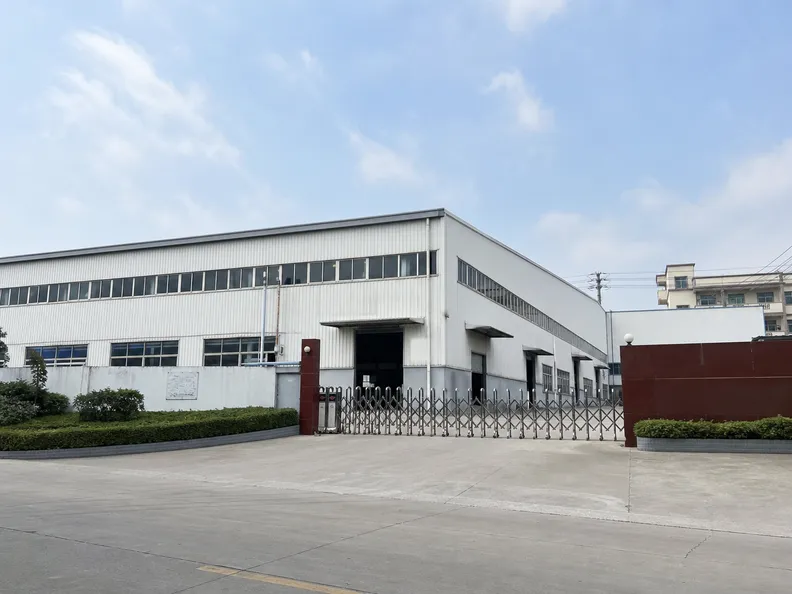
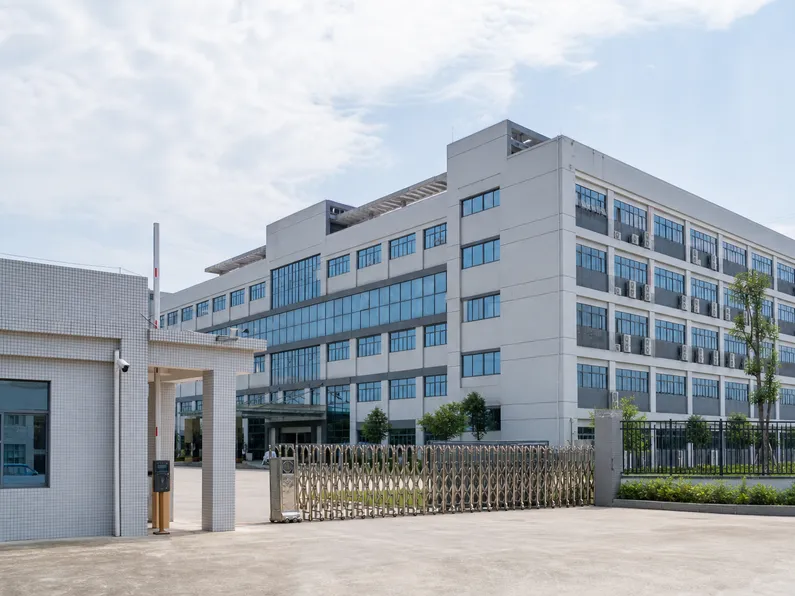
Wfaucet is the export brand of Foshan DTE Sanitary Ware Co., Ltd — a dedicated faucet manufacturer based in Danzao Town, Nanhai District, Foshan. We've been running production here since 2008, and faucets are all we do.
Annual Output
1,200,000
units / year
In Operation
17+
years
12,000
m² Facility
6
Production Lines
12
QC Inspectors
4
Certifications
Our Business
What We Make and Who We Supply
Wfaucet is the export brand of Foshan DTE Sanitary Ware Co., Ltd, a dedicated faucet and sanitary ware manufacturer based in Danzao Town, Nanhai District, Foshan — the center of China's sanitary hardware industry. We've been running production here since 2008, and faucets are all we do.
No furniture, no lighting, no diversified product lines that dilute focus. Every engineer, every production line, every QC checkpoint on this floor is built around one product category.
Our facility covers 12,000 square meters and runs 6 production lines with an annual output capacity of 1,200,000 units. We supply distributors, importers, and project procurement teams across North America, Europe, Southeast Asia, the Middle East, and Australia — primarily on OEM and ODM terms, though we also supply under the Wfaucet brand for buyers who prefer a ready-to-list catalog.
The buyers we work with are sourcing to resell or deploy at scale. They need a factory that can hold tolerances across a 10,000-unit run the same way it holds them on a 500-unit sample order, and they need documentation that clears customs in California, Germany, and Sydney without surprises. That's the problem we've spent 17 years building the infrastructure to solve.
Export Markets We Supply
North America
cUPC certified. Documentation clears California customs.
Europe
CE certified. Clears German and EU customs requirements.
Australia
WaterMark certified. Meets Australian compliance standards.
Southeast Asia & Middle East
Active distributor and project supply relationships.
OEM / ODM
Primary supply mode. Custom specifications, private label, and full product development from your brief.
Learn moreWfaucet Brand
Ready-to-list catalog for buyers who prefer a branded product without custom development overhead.
InquireConsistency at Scale
A factory that holds tolerances across a 10,000-unit run the same way it holds them on a 500-unit sample order — and documentation that clears customs in California, Germany, and Sydney without surprises.
Product Families We Manufacture
Our History
How We Got Here
We started in 2008 with a small brass casting operation and a handful of product lines targeting the domestic market. Export came later — and it changed everything about how we run the factory.
The first time we shipped a container to a North American distributor and had it held at the port over a documentation gap, we understood that export manufacturing is a different discipline from domestic supply. Certifications, traceability, packaging specs, lead time commitments — none of that is optional when your buyer's retail season depends on your container arriving on schedule.
Key Milestones
2008
Founded in Foshan
Started with a small brass casting operation and domestic product lines. Established the production foundation in Danzao Town, Nanhai District — the center of China's sanitary hardware industry.
Early Export Phase
First North American Container
First export shipment to a North American distributor was held at port over a documentation gap. That experience redefined how we approach export manufacturing — certifications, traceability, packaging specs, and lead time commitments became non-negotiable.
2013
ISO 9001 + cUPC Certification
ISO 9001 quality management system established. Actively pursued cUPC certification for the North American market. The cUPC process forced us to tighten incoming material controls significantly — lead content requirements required qualifying a new brass alloy supplier and revalidating casting parameters. Those tighter controls were kept for all orders, not just North American ones.
2018
European Market Expansion
Pursued WRAS and WATERMARK certifications to serve UK and Australian buyers. Each new market's regulatory requirements pushed us to improve documentation systems, material traceability, and testing protocols — improvements that benefited every customer regardless of destination.
2021
Facility Expansion
Expanded production floor to 18,000 m² and added a dedicated OEM/ODM development wing. Increased in-house finishing capacity — PVD, electroplating, and powder coating — to reduce lead times and tighten finish consistency across large runs.
Today
Serving 30+ Export Markets
Over 200 active SKUs, 30+ export markets, and a development pipeline that turns a brief into a production-ready sample in 25–35 days. The factory that started with domestic brass casting now ships certified, documented product to distributors, retailers, and private-label brands across six continents.
Inside the Factory: 12,000 m² Built Around Brass
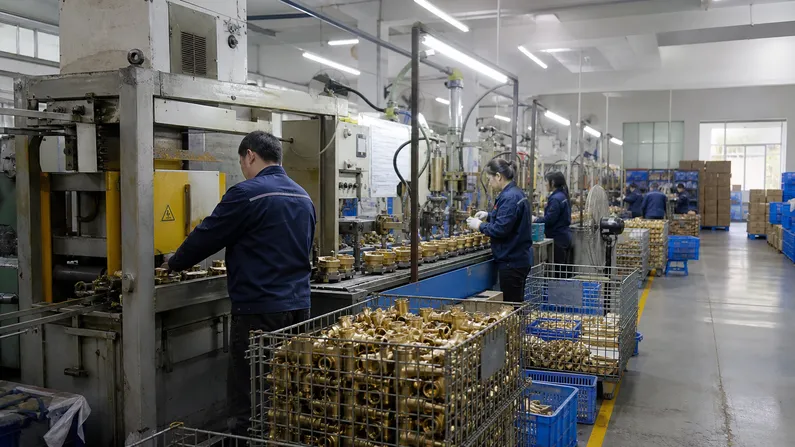
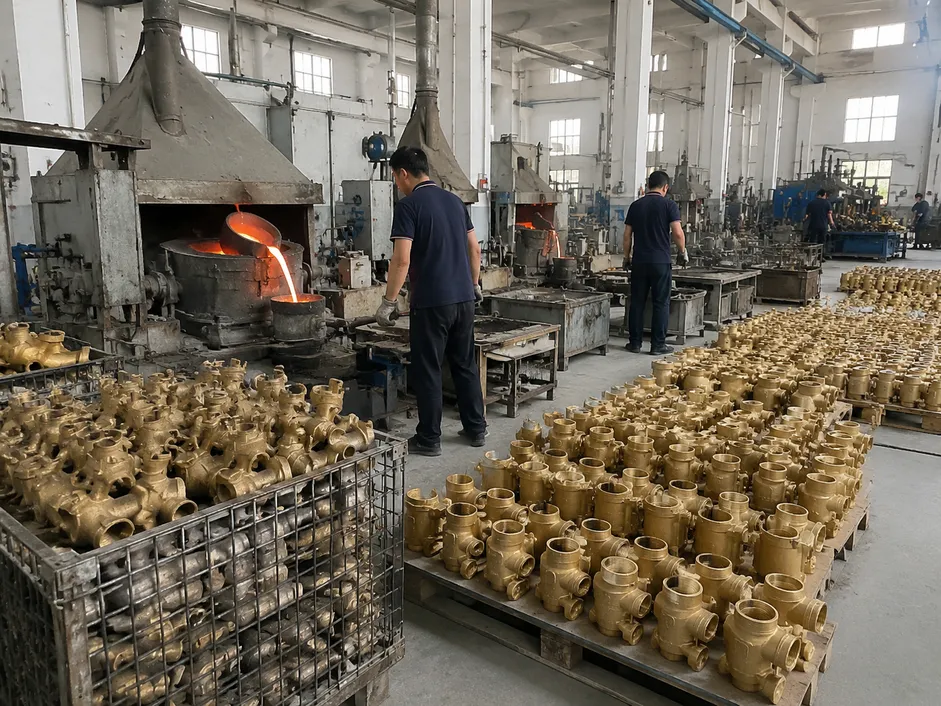
Walk through the front of the building and you're in the casting hall. Every process — from alloy selection to final assembly — is designed around one material and one standard of performance.
Alloy Selection: Why C36000-Equivalent Brass
We run brass gravity casting as our primary body-forming process — the alloy we use is C36000-equivalent free-machining brass, selected for its machinability and corrosion resistance. We evaluated zinc alloy casting for a cost-reduction project a few years back and decided against it for the core body components — the long-term corrosion performance in chlorinated water systems didn't meet our standards for export markets.
Thread Tolerance: ±0.05mm on Valve Seat Interfaces
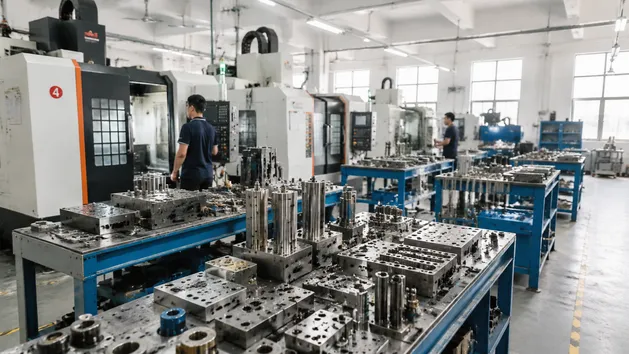
Each casting is trimmed, deburred, and moved to the CNC machining section, where we hold thread tolerances to ±0.05mm on valve seat interfaces. That tolerance matters because a loose valve seat is the most common source of drip failure in the field — and drip failures generate warranty claims.
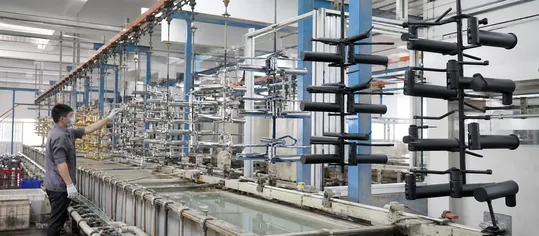
Surface Finishing: Five Options, All In-House
From machining, bodies move to the surface finishing line. We run five finish options in-house — and the standards we hold on each one are worth understanding before you specify a finish for your catalog.
PVD Physical Vapor Deposition
PVD Gold
Coating thickness runs 0.3–0.5μm. We test adhesion on every batch using a cross-cut tape test before parts move to assembly. The PVD line is the one we're most particular about.
Multi-Layer Electroplating
Chrome
Copper base coat → nickel mid-coat → chrome top coat. The nickel mid-coat is what gives the finish its corrosion resistance. Skipping it is a common cost-cutting move in the industry — it's why you see chrome faucets from some factories failing salt spray at 48 hours. Our chrome passes 24-hour salt spray as a minimum, with most batches clearing 48 hours.
Multi-Layer Electroplating
Brushed Nickel
Same copper/nickel stack as chrome, with a brushed top coat. The multi-layer process ensures the corrosion resistance that single-coat brushed finishes can't match.
In-House Finishing
Matte Black
Applied in-house on the same finishing line. Consistent coverage and adhesion tested before assembly.
In-House Finishing
Oil-Rubbed Bronze
Applied in-house. All five finishes run on dedicated lines — no cross-contamination between finish types.
Industry Benchmark
24–48h
Salt spray rating on chrome and brushed nickel. Most batches clear 48 hours. Some factories fail at 48 hours because they skip the nickel mid-coat. We don't.
6 Dedicated Assembly Lines — Product-Family Specific
Assembly happens on 6 dedicated lines, each configured for a specific product family. Keeping lines product-specific means the assemblers know every tolerance and every torque spec for their product type without switching context. Your 5,000-unit kitchen faucet order runs on the kitchen line from start to finish — it doesn't share floor time with a shower valve run.
The facility's 1,200,000-unit annual capacity is distributed across those 6 lines. In practice, most of our regular buyers run 2,000–10,000 units per order, and we schedule production in 4-week windows. If your order is in the queue, it ships in the window we committed to — we don't push orders back to accommodate a larger buyer's rush.
6
Dedicated assembly lines, product-family specific
1.2M
Units annual production capacity
4-wk
Production scheduling windows — committed, not estimated
12,000
m² total facility footprint
Assembly Line Configuration
Kitchen Faucets
Dedicated line — kitchen-specific tolerances and torque specs
Bathroom Faucets
Dedicated line — basin and vanity product family
Shower Valves
Dedicated line — thermostatic and pressure-balance configurations
Concealed Systems
Dedicated line — in-wall rough-in and trim assemblies
Filter Faucets
Dedicated line — RO and drinking water product family
Components
Dedicated line — aerators, cartridges, and sub-assemblies
Core Manufacturing Capabilities
Brass Gravity Casting
C36000-equivalent alloy, in-house casting and trimming
CNC Precision Machining
Valve seat threads to ±0.05mm tolerance
Multi-Layer Electroplating
Copper/nickel/chrome stack, 24h+ salt spray rated
PVD Physical Vapor Deposition
0.3–0.5μm coating, cross-cut adhesion tested per batch
In-House Surface Finishing
Chrome, brushed nickel, matte black, PVD gold, oil-rubbed bronze
Cartridge and Valve Assembly
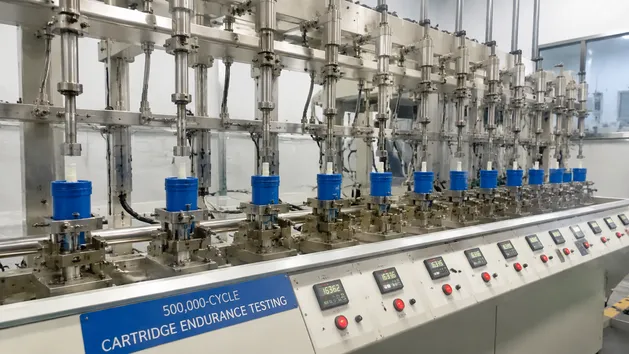
500,000-cycle endurance testing on every production batch
Quality Control: From Incoming Brass to Outgoing Container
Certifications are the floor, not the ceiling. We hold ISO 9001:2015, CE, cUPC, WaterMark, and SGS — and those certifications define the minimum documentation your compliance team needs to clear imports in most markets. But the actual quality work happens in the three inspection stages that run before any product reaches a shipping carton.
Incoming Inspection
Incoming inspection starts with the brass rod and casting alloy. We test every incoming batch for lead content using XRF analysis — this is non-negotiable for cUPC compliance, and we apply the same standard to all production regardless of destination market.
Cartridges and ceramic disc valves come from qualified suppliers with their own test reports, and we do incoming functional checks on a sample basis before they enter the assembly line.
Cartridge Supplier Qualification
We've had two cartridge suppliers over the years who passed paper qualification but showed early failure rates in our endurance testing — both were removed from the approved list. We now require a 50,000-cycle pre-qualification test on any new cartridge supplier before they enter production.
- XRF lead content analysis — every incoming brass batch
- Cartridge functional checks on incoming sample basis
- 50,000-cycle pre-qualification for new cartridge suppliers
In-Process Inspection
In-process inspection runs at three checkpoints: post-casting dimensional check, post-machining thread gauge verification, and post-plating visual and adhesion inspection.
The post-plating check is where we catch the most issues — surface defects like pinholes, blistering, or uneven coverage are rejected at this stage, not after assembly. Catching them here saves the labor cost of disassembly and means your batch doesn't get delayed by a late-stage rejection.
- Post-casting dimensional check
- Post-machining thread gauge verification
- Post-plating visual and adhesion inspection — pinholes, blistering, uneven coverage rejected before assembly
Final Outgoing Inspection
Final outgoing inspection covers every unit in a batch for functional performance: handle torque, flow rate at rated pressure, and leak test at 0.6 MPa for 60 seconds.
We pull a statistical sample for salt spray testing — 24 hours minimum, with extended 48-hour tests on new finish batches or new plating line runs. Endurance testing runs 500,000 open/close cycles on cartridge assemblies; we test every production batch, not just new product introductions.
Documentation Ships With the Order
The test reports travel with the shipment documentation so your QC team has the data without having to request it separately.
- 100% unit leak test — 0.6 MPa for 60 seconds
- Handle torque and flow rate at rated pressure — every unit
- 500,000-cycle endurance test — every production batch
- Salt spray 24h minimum, 48h on new finish batches
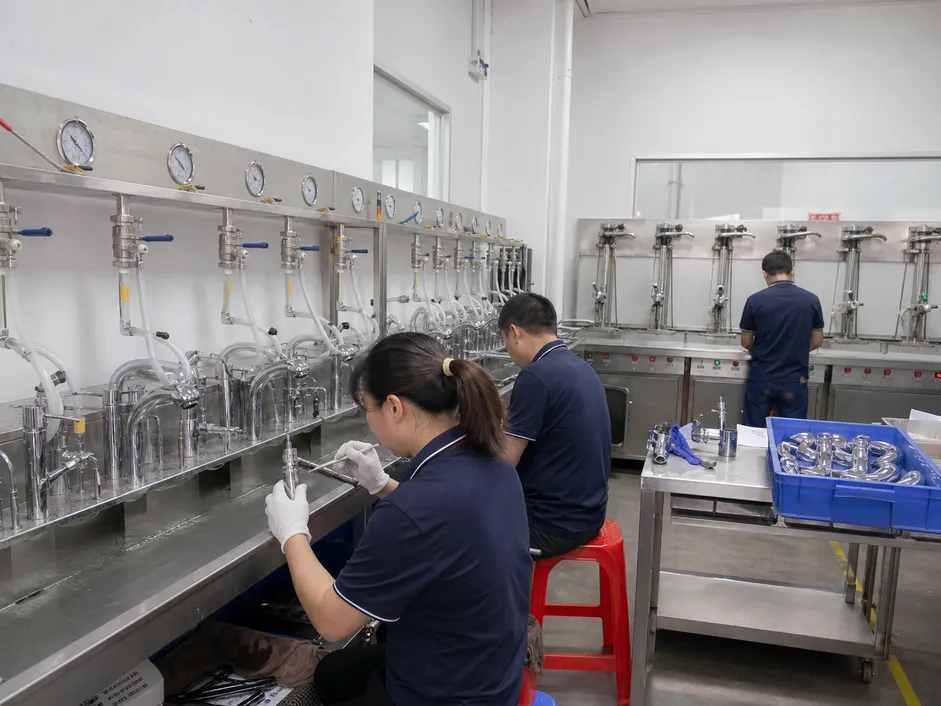
0.6 MPa
Leak test pressure, 60 seconds, every unit
500K
Open/close cycles — cartridge endurance, every batch
48h
Salt spray on new finish batches and new plating runs
±0.05mm
CNC thread tolerance, verified post-machining
Certifications We Hold
These cover the major import markets our buyers ship into. If your market requires a certification not listed here, ask — we've added certifications for specific buyers before and can discuss what's feasible for your volume.
ISO 9001:2015
Quality management system — covers our full production and inspection process documentation
cUPC (IAPMO)
Required for plumbing fixture sales in the US and Canada — covers lead content, flow rate, and pressure performance
CE Marking
European conformity — covers pressure equipment directive requirements for faucet and valve products
WaterMark (SAI Global)
Required for plumbing products sold in Australia and New Zealand — covers AS/NZS standards compliance
SGS Testing Reports
Third-party lab verification for buyers who require independent test documentation alongside factory reports
OEM and ODM: What We Actually Do, and What We Don't
Most factories say they do OEM and ODM. The distinction matters for your project timeline and tooling budget. Here's exactly where our capabilities start and stop, so you can decide whether we're the right fit before spending time on a sample request.
OEM — Your Brand on Our Products
OEM means you select from our existing product range and we produce it under your brand. Your logo on the product, your packaging, your documentation. No tooling cost, no design lead time — you're buying production capacity against proven tooling we already own.
This is the fastest path to market. If you have a catalog gap to fill or need a reliable supply source for a product category you already sell, OEM is usually the right starting point.
- Custom logo on product body, handle, or cartridge cap
- Custom retail packaging — box design, insert cards, poly bag printing
- Private label documentation — spec sheets, installation guides, warranty cards
- Finish selection from our standard range — no additional tooling
- MOQ from 200 units per SKU for standard catalog items
Typical OEM Timeline
Sample approval in 7–10 days. Production lead time 30–45 days from deposit, depending on order volume and current line capacity.
ODM — Custom Design Development
ODM means we develop a new product to your specification — a design you own, built on our manufacturing infrastructure. You bring the design brief or reference samples; we handle engineering, tooling, and production.
We have an in-house design and engineering team. We can work from your sketches, your CAD files, or a reference product you want to improve on. We'll flag manufacturability issues early and propose alternatives where your design would create quality or cost problems in production.
- Design development from brief, sketch, or reference sample
- 3D modeling and engineering drawings provided for approval
- Tooling fabricated in-house — brass casting dies and machining fixtures
- Tooling ownership transferred to buyer after agreed production volume
- NDA available before design brief submission
Typical ODM Timeline
Design review and 3D approval: 2–3 weeks. Tooling fabrication: 4–6 weeks. First sample: 2 weeks after tooling. Production: 45–60 days from sample approval.
What We Don't Do — So You Don't Waste Time Finding Out Later
We'd rather tell you upfront where we're not the right fit than have you discover it three months into a project.
Stainless steel body faucets — our core is brass; stainless requires different casting and machining infrastructure we don't have
Plastic body faucets — we don't run injection molding; we're a brass house
Trial orders under 50 units — below that threshold, setup cost per unit makes pricing unworkable for both sides
Touchless or sensor-activated faucets — we don't manufacture electronic valve assemblies or solenoid components
Thermostatic shower systems with digital controls — mechanical thermostatic valves yes, digital/electronic no
Drop-shipping to end consumers — we're a B2B manufacturer; minimum shipment is a pallet, not individual parcels
How an ODM Project Moves Through Our Factory
Brief & NDA
You submit your design brief, reference samples, or CAD files. We sign NDA before you share anything proprietary. We review for manufacturability and flag any issues within 5 business days.
3D Modeling & Approval
Our engineering team produces 3D models and technical drawings. You review and approve dimensions, thread specs, and finish details. Revision rounds are included until you sign off.
Tooling & First Sample
We fabricate casting dies and machining fixtures in-house. First physical sample ships to you for approval — typically 6–8 weeks from design sign-off. We cover one round of tooling adjustments at no additional charge.
Production & Handover
Sample approved, deposit received, production scheduled. Full QC documentation ships with the order. Tooling ownership transfers to you after the agreed production volume threshold is met.
Environmental Practices and Factory Compliance
The electroplating and surface finishing operations are the part of faucet manufacturing that carries the most environmental risk, and we treat them accordingly.
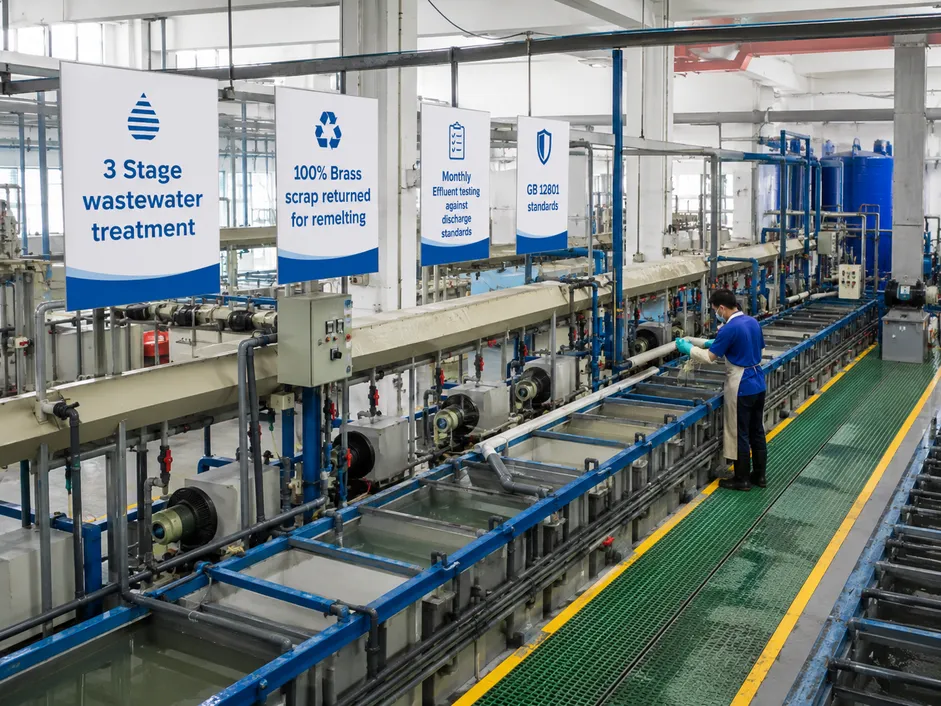
Closed-Loop Rinse Water Recovery
Plating line wastewater management
Our plating line runs a closed-loop rinse water recovery system. Wastewater goes through a three-stage treatment process — neutralization, precipitation, filtration — before discharge. We test effluent monthly against local discharge standards.
Trivalent Chrome on Decorative Lines
Reduced hexavalent chromium load
Chrome plating generates hexavalent chromium in the process bath. We run trivalent chrome on our decorative chrome line to reduce that load. The trivalent process requires tighter bath chemistry control, but the environmental and worker safety case is straightforward.
100% Brass Scrap Recovery
Casting and machining waste loop
Brass scrap from casting and machining is 100% collected and returned to our alloy supplier for remelting. Brass is too valuable to landfill, and the recycling loop is standard practice in Foshan's sanitary hardware cluster.
Packaging & Worker Safety
- Packaging materials sourced from suppliers using recycled cardboard. Expanded polystyrene foam inserts replaced with molded pulp across most product lines.
- Worker safety on the plating floor follows GB 12801 standards — PPE requirements, ventilation specifications, and regular air quality monitoring in the finishing area.
R&D and Custom Development
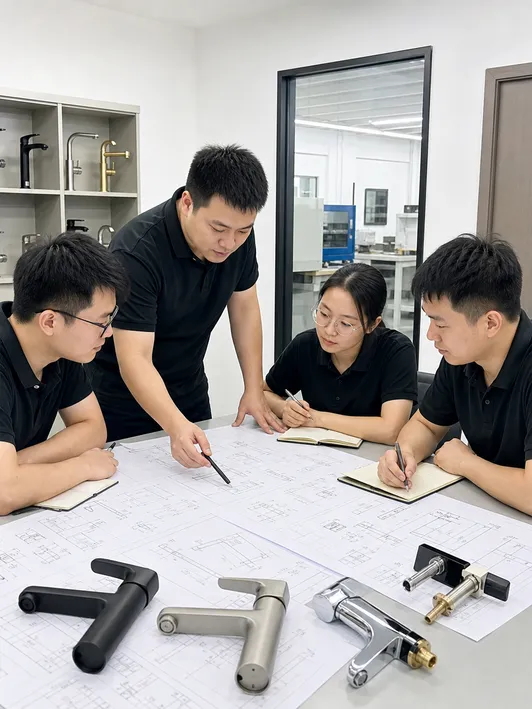
Our in-house R&D team runs 15 engineers — structural designers, tooling engineers, and a surface finishing specialist who manages our PVD and plating process development.
The team's primary work is OEM and ODM project execution: taking a buyer's design brief, or an existing product they want to improve, and turning it into a manufacturable specification with tooling, material selection, and process parameters defined before the first sample is cast.
OEM Projects
Typical workflow runs from 2D drawing or reference sample to first sample in 25–35 days, depending on tooling complexity.
We maintain an in-house tooling room for brass casting dies and CNC fixtures — tooling revisions don't go to an outside vendor and add weeks to the timeline.
Low enough for a market test before committing to a full container
ODM Projects
Where the buyer wants a product from our existing catalog adapted to their spec — we can usually turn around a modified sample in 15–20 days.
Existing catalog products adapted to your finish, handle configuration, or dimensional spec — faster turnaround because the core tooling already exists.
Catalog base reduces tooling lead time significantly
Certification Extension for New Variants
The engineering team handles certification extension for new product variants. If you're adding a new finish or a new handle configuration to an existing certified body, we manage the documentation update with the certification body — you don't need to run a full re-certification from scratch.
R&D Team at a Glance
- 15 in-house engineers
- In-house tooling room for brass dies & CNC fixtures
- Dedicated PVD & plating process specialist
- OEM first sample: 25–35 days
- ODM modified sample: 15–20 days
- Custom OEM MOQ from 200 pieces
The People Running the Lines
The factory's technical backbone is a core group of long-tenured staff. Institutional knowledge built over years on the floor is what keeps process consistency tight and quality decisions grounded in real production experience.
Chief Engineer
20 Years in Brass Sanitary Hardware
12 of those years at this facility. He designed the current casting line layout and wrote the original process specifications for our cUPC qualification. When the line runs, it runs to his spec.
QC Manager
9 Years Running the Quality System
Came up through the plating inspection side of the business. She pushed to add the 48-hour extended salt spray protocol after early tarnishing appeared on brushed nickel product in a humid climate market. That protocol is now standard.
Production Supervisors
8-Year Average Across 6 Lines
The supervisors on each of the 6 production lines average 8 years on the floor. They know the equipment and they know when something is running off-spec before the gauges tell them.
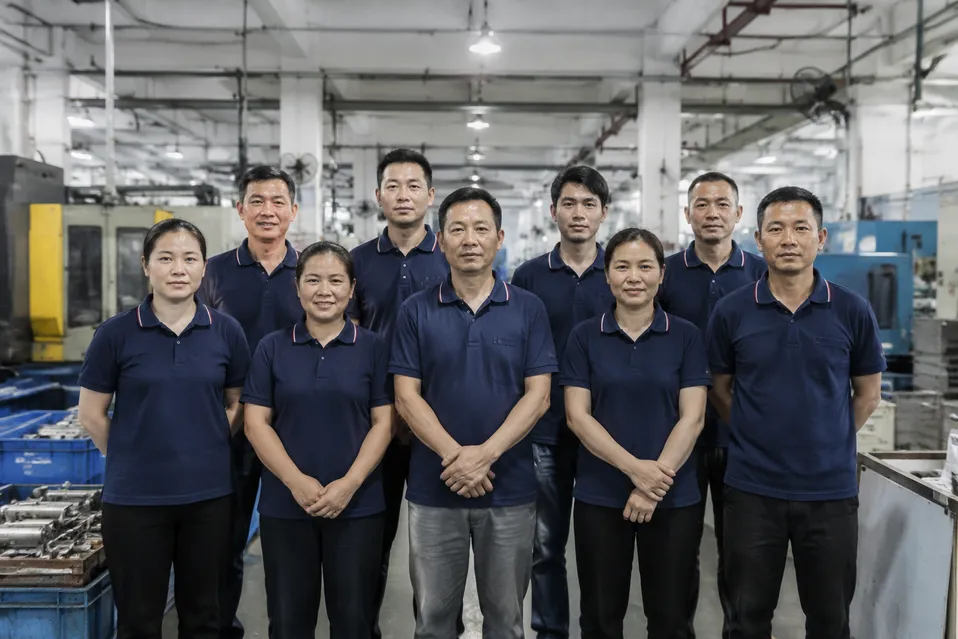
Tenure Translates to Consistency
Long-tenured staff means institutional knowledge stays inside the factory. Process drift, tooling wear, and material variation get caught early because the people watching the lines have seen the same problems before and know what they look like at the start, not after a batch is already out the door.
20
Years, Chief Engineer
9
Years, QC Manager
8
Avg. Years, Line Supervisors
Shipping to Five Continents: Export Logistics We've Worked Out
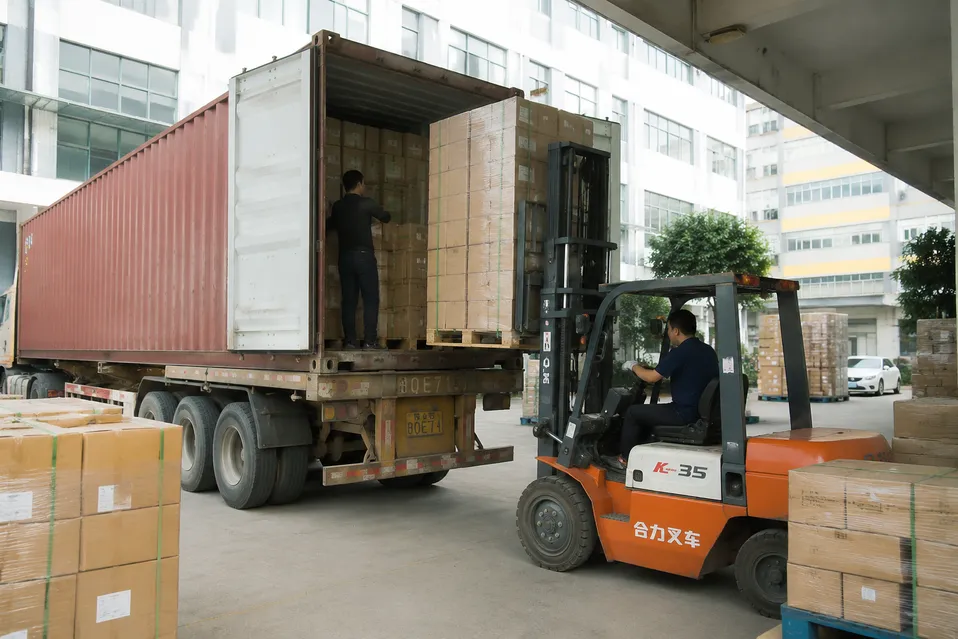
We've been shipping export containers since 2010. The logistics side of the business is as developed as the manufacturing side — packing, documentation, and customs prep are handled in parallel with production, not as an afterthought.
Container Packing & Optimization
20GP and 40HQ Optimization
Standard carton packing is designed against container floor plans. We calculate carton dimensions per SKU and provide a packing list with CBM and gross weight before you confirm the order, so your freight forwarder can quote accurately.
Multi-SKU Consolidation
For buyers consolidating multiple SKUs into one container, we coordinate the packing sequence to minimize void space and keep the container weight balanced for port handling.
Lead Times
25–35 days from order confirmation to container loading for standard catalog items. 35–50 days for OEM orders with new tooling.
Documentation Prepared in Parallel
Standard Export Documents
Commercial invoice, packing list, certificate of origin, and the relevant test reports — SGS, cUPC, CE, WaterMark — as applicable to your destination market. All prepared while production runs.
North American Customs Support
For North American shipments, we prepare the HS code classification and can provide a binding ruling reference for customs pre-clearance if your broker needs it.
Consistent Reorder Cycles
Most repeat buyers have been ordering for 3 years or more. The reorder cycle is straightforward because product specs, packaging, and documentation are consistent from one order to the next.
Markets We Ship to Regularly
Active export destinations across five continents
North America
United States
Canada
Europe
Germany
United Kingdom
France
Netherlands
Oceania
Australia
Middle East
UAE
Saudi Arabia
Southeast Asia
Singapore
Malaysia
2010
Year we began shipping export containers
5
Continents with active repeat buyers
25–35
Days, order to container loading (catalog items)
3+
Years average tenure of repeat buyers
Why Logistics Consistency Matters for Repeat Orders
Inconsistent documentation, shifting carton dimensions, or underprepared customs paperwork adds cost and delay on the buyer's side — even when the product itself is correct. We've standardized the logistics workflow so that the second order runs the same as the first, and the tenth runs the same as the second.
Your freight forwarder gets accurate CBM and weight data before you confirm. Your customs broker gets the HS classification and test reports they need. The container arrives packed the way it was quoted. That's the baseline we hold to on every shipment.
Six Reasons Your Sourcing Decision
Comes Down to Execution
Specifications are easy to match on paper. These are the operational realities that determine whether your container arrives right — and keeps arriving right.
17 Years of Faucet-Only Manufacturing
No category drift, no divided engineering attention. Every process improvement we've made since 2008 applies directly to your order.
In-House Surface Finishing Across 5 Finishes
Chrome, brushed nickel, matte black, PVD gold, and oil-rubbed bronze all run on our own lines. Finish consistency across a mixed-SKU order is controlled by one team, not farmed out to three subcontractors.
cUPC + CE + WaterMark Under One Roof
Your North American, European, and Australian orders ship with the right documentation from the same factory. You're not managing two supplier relationships to cover your market footprint.
500,000-Cycle Endurance Testing on Every Batch
Not just on new product introductions. Every production run gets tested, so the cartridge performance your sample showed is the cartridge performance your container delivers.
OEM from 200 Pieces with In-House Tooling
Low enough to test a new SKU in your market before committing to volume. Fast enough — 25–35 days to first sample — to keep your product development timeline moving.
Consistent Documentation, Container to Container
Same HS codes, same test reports, same packing specs on every reorder. Your customs broker and warehouse team aren't solving new problems every time a container arrives.
Contact Wfaucet
Ready to discuss your sourcing requirements or request samples? Send us your target SKUs, volume expectations, or a reference product — we'll come back with a detailed quote and, if relevant, a recommendation on which configuration fits your market best.
Phone
+86-0757-81228796Address
Block A, Jinsha Smart Manufacturing Park, No. 88 Xilian East Road, Danzao Town, Nanhai District, Foshan City, Guangdong Province, China
Zip Code: 528216
Explore further
Start with a Sample Request
Send us a reference product or target SKU list. We'll confirm compatibility with your market certifications, provide a lead time estimate, and arrange samples — typically within 25–35 days.
17+
Years manufacturing
1.2M
Units per year
5
Continents served