
17+ Years Faucet Manufacturing

304 Stainless Steel
Bathroom Faucets

Corrosion-resistant, hygiene-compliant, built for commercial and healthcare sourcing. Formed stainless bodies, brushed or polished finish, certified for North America, Europe, and Australia.

Different manufacturing process from our brass line — and that difference is exactly why certain buyers specify it.

cUPC Certified CE Certified WaterMark Certified OEM from 200 pcs
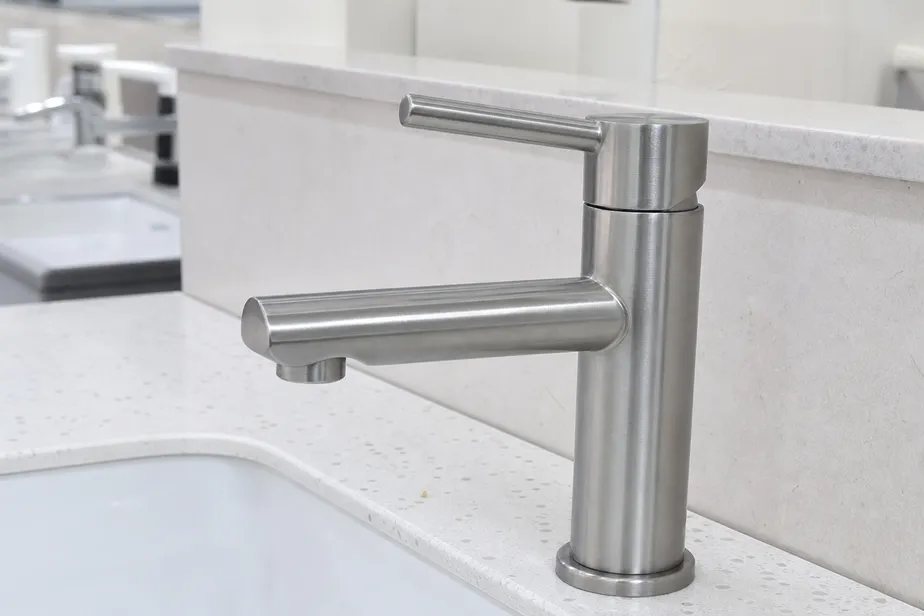
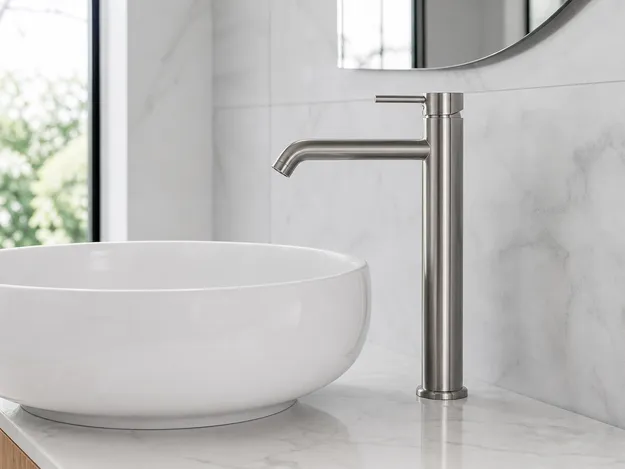
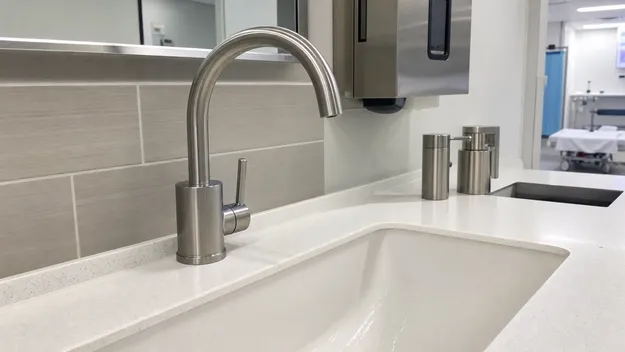
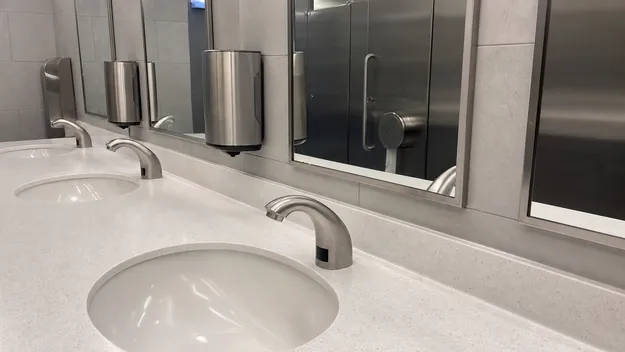
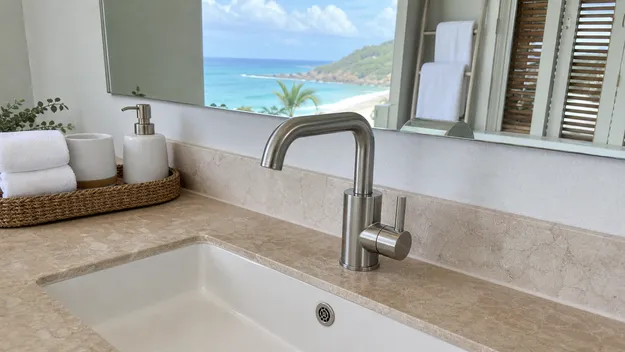
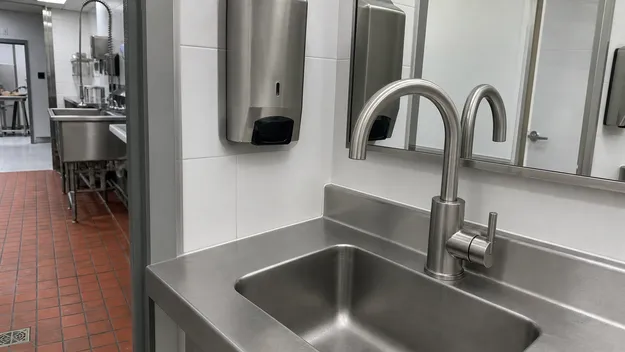
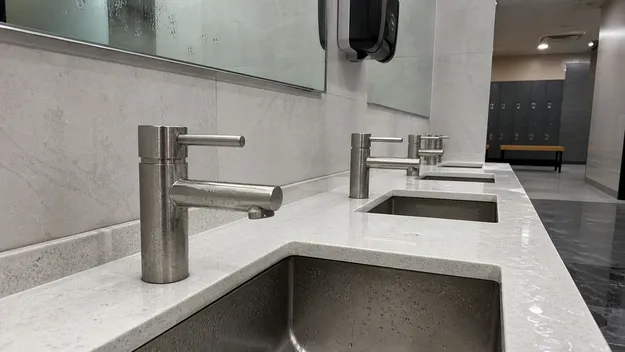
304 stainless steel bathroom faucet with brushed finish for commercial and healthcare applications

Material Specification

Why Stainless Steel, Not Brass: The Commercial Case

Most bathroom faucets in our catalog — and in the industry — are brass-body. Brass is the right choice for the majority of applications: it casts cleanly, machines precisely, and takes electroplated finishes well. We've built our entire production infrastructure around brass, and we're not going to tell you otherwise.

But stainless steel bathroom faucets exist for specific reasons, and those reasons map directly to market segments where brass creates problems.

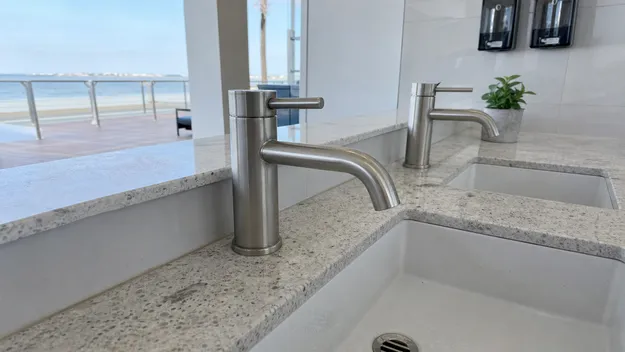
Stainless steel faucet in coastal commercial installation showing corrosion resistance

Corrosion Resistance in Aggressive Water Chemistry

Coastal installations, water treatment facilities, and commercial buildings with high-chlorine water systems put brass bodies under sustained chemical stress that accelerates dezincification — a failure mode where zinc leaches out of the brass alloy, leaving a porous, weakened structure.

Grade 304 stainless steel doesn't dezincify. Its chromium oxide passive layer regenerates when scratched, which is why it's the material of choice in marine hardware, food service equipment, and clinical environments.

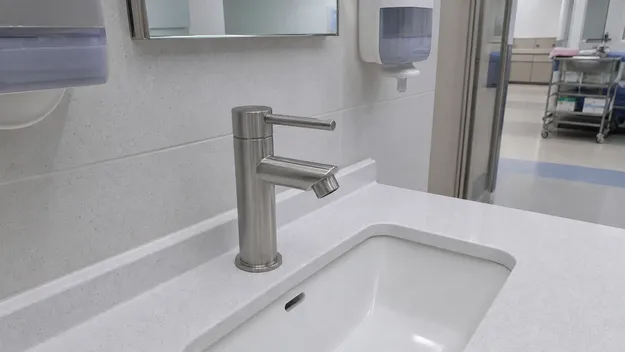
Stainless steel bathroom faucet in healthcare facility meeting infection control protocols

Hygiene Compliance for Healthcare and Food Service

Healthcare facilities, food service environments, and public restrooms in certain markets have surface material requirements that favor stainless steel over plated brass — not because brass is unsafe, but because stainless steel's non-porous surface is easier to document as compliant with infection control protocols.

When your buyer is a hospital procurement team or a commercial kitchen contractor, the material specification on the data sheet matters as much as the product itself.

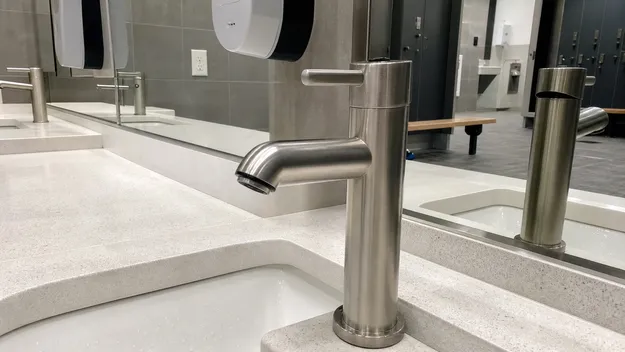
Brushed stainless steel faucet finish durability in high-traffic gym and school restroom

Finish Durability in High-Traffic Environments

A brushed stainless finish on a bathroom faucet in a gym locker room or a school restroom will outlast a brushed nickel electroplated finish by years. The brushed texture is in the material itself, not in a coating layer that can wear through.

We've had buyers switch from brushed nickel to brushed stainless specifically for school and gym accounts after seeing finish wear complaints at the 18-month mark. The per-unit cost is higher, but the warranty claim rate drops to near zero.

Understanding Dezincification: Why It Matters for Specification

Dezincification is a specific failure mode in brass alloys where zinc selectively leaches out under sustained chemical stress — particularly in high-chlorine or coastal water systems. The result is a porous, weakened structure that can fail structurally or develop persistent leaks. Grade 304 stainless steel is immune to this failure mode. Its chromium oxide passive layer is self-repairing: when scratched, the layer regenerates on contact with oxygen. This is the same property that makes 304 stainless the standard material in marine hardware, food processing equipment, and surgical instruments.

Passive Layer

Self-Repairing

Chromium oxide regenerates on oxygen contact

Dezincification Risk

Zero

No zinc content in 304 stainless alloy

Industry Precedent

Marine · Food Service · Clinical

Standard material in demanding environments

Manufacturing Process

How We Make Stainless Steel Bathroom Faucets: A Different Process from Our Brass Line

This is worth explaining because it affects what you can specify and what the lead times look like.

Forming, Not Casting

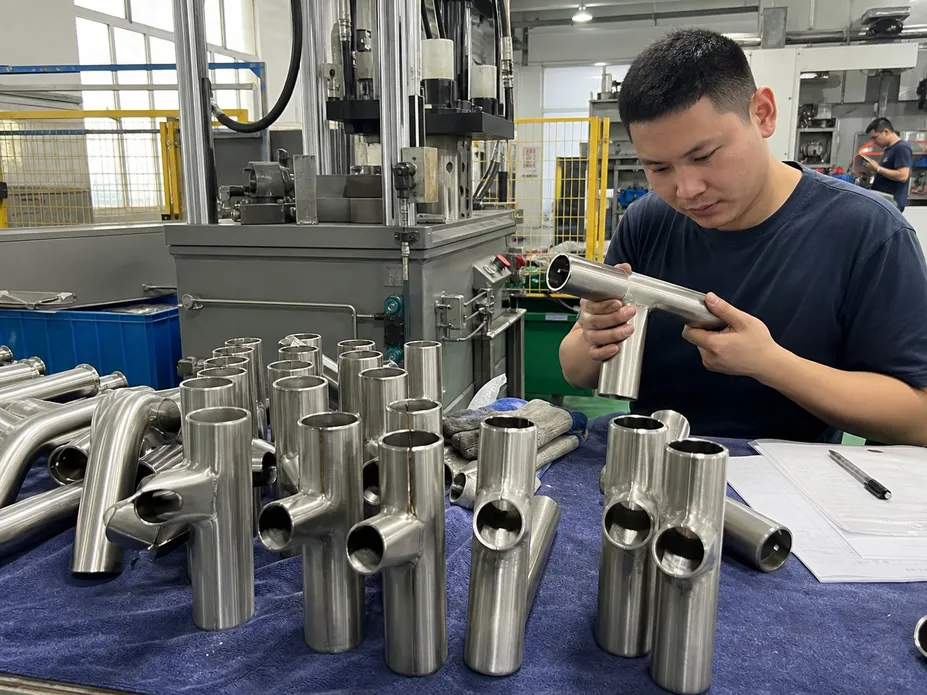
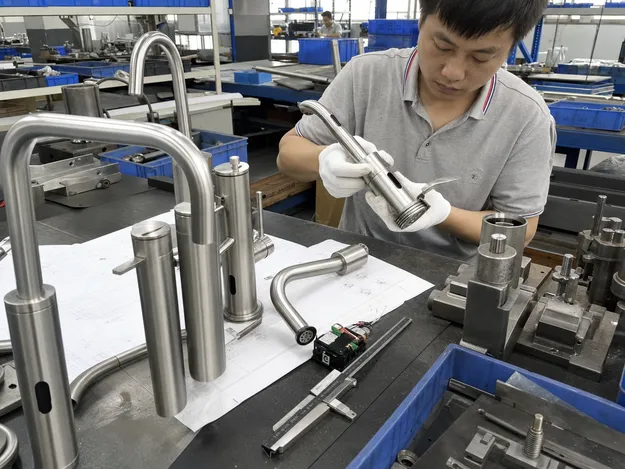
Our brass bathroom faucets start as gravity castings — molten alloy poured into a die, solidified, trimmed, and moved to CNC machining. Stainless steel doesn't cast the same way for faucet bodies at this scale. Instead, stainless bathroom faucet bodies are formed: we start with 304 stainless tube and sheet stock, hydroform or press the body sections to shape, then weld and grind the joints.

The result is a seamless-looking body with wall thickness typically in the 1.0–1.2mm range for the spout and body sections.

Precision-Machined Valve Seat and Cartridge Housing

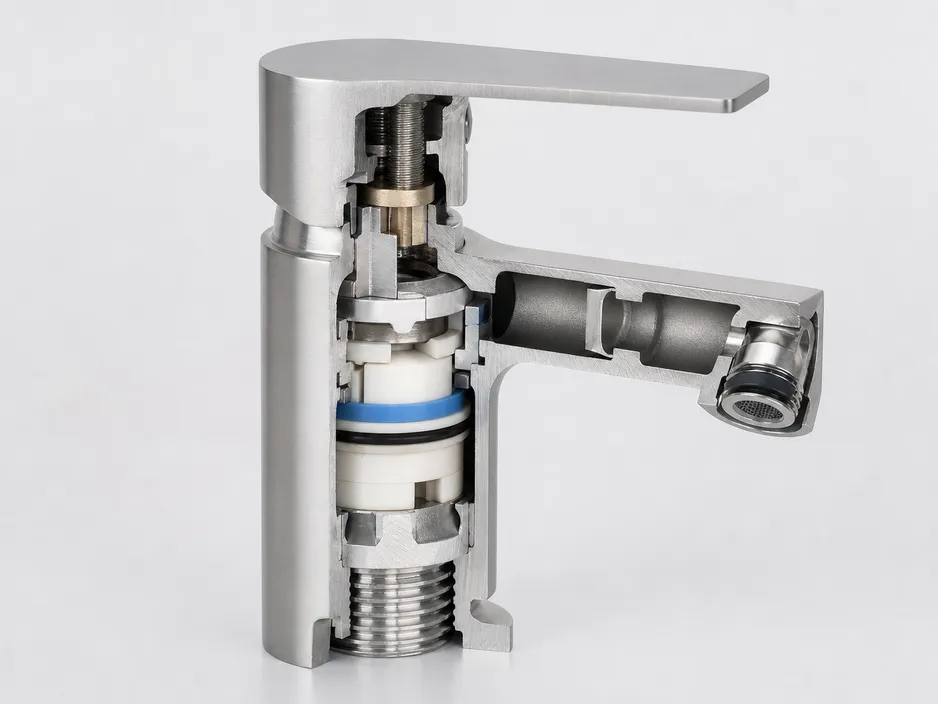
The internal valve seat and cartridge housing are still precision-machined — we hold the same ±0.05mm thread tolerance on valve seat interfaces that we hold on the brass line. That tolerance is what prevents drip failure, and it doesn't change based on the body material. The cartridge itself is the same ceramic disc assembly we use across the bathroom faucet line, 500,000-cycle endurance tested per production batch.

Surface Finishing: Simpler and More Consistent

Surface finishing on stainless is simpler than on brass, which is actually an advantage for consistency. Brushed stainless is achieved by mechanical brushing of the formed body — the texture is in the metal, not in a coating. Polished stainless goes through a multi-stage buffing process to achieve the mirror finish.

Neither finish requires electroplating chemistry, which means there's no plating bath variation to manage and no coating adhesion to test. What you see in the sample is what you get in the production run.

Stainless steel bathroom faucet body hydroforming and forming process at Wfaucet factory

Mandatory Weld Inspection Checkpoint

After hydroforming and welding, every joint is ground and polished to match the surrounding surface. We inspect every unit for weld line visibility before it moves to assembly — a visible weld line on a finished faucet is a cosmetic rejection, and we catch it at this stage rather than after assembly.

Early in our stainless production, we had a batch where the grinding step was rushed on a Friday afternoon run. The weld lines were visible under certain lighting. We added a dedicated weld inspection checkpoint after that — it's now a mandatory step before any stainless unit moves forward.

Stainless vs. Brass: Manufacturing Process Comparison

Weld Inspection
Process Stage Stainless Steel Line Brass Line
Body Formation Hydroforming / pressing from 304 tube and sheet stock Gravity casting from molten alloy
Wall Thickness 1.0–1.2mm (spout and body sections) Varies by casting geometry
Valve Seat Tolerance ±0.05mm (CNC machined, same as brass line) ±0.05mm (CNC machined)
Cartridge Ceramic disc, 500,000-cycle tested per batch Ceramic disc, 500,000-cycle tested per batch
Surface Finish Mechanical brushing (brushed) or multi-stage buffing (polished) — no electroplating Electroplated finish over brass substrate
Finish Consistency No plating bath variation; sample matches production run Plating bath chemistry managed per batch
Mandatory checkpoint after grinding — cosmetic rejection before assembly Not applicable (cast body, no weld joints)
Custom Body Shapes Tooling required for new hydroform dies; lead time impact New casting die required; similar tooling lead time
MOQ (Standard SKUs) 200 units per SKU 100 units per SKU

Lead Time Note for New Stainless SKUs

Standard stainless SKUs from our existing tooling ship on the same lead time as brass — typically 30–45 days for production runs. If you're specifying a custom body geometry that requires new hydroform tooling, add 3–4 weeks for die fabrication and first-article approval. We'll flag this during the RFQ review so there are no surprises on your project timeline.

Quality Checkpoints: Stainless Steel Faucet Production Flow

Step 1

Material Incoming

304 stainless tube and sheet verified for grade and wall thickness before production entry

Step 2

Hydroforming

Body sections pressed and formed; dimensional check against spec before welding

Step 3

Weld Inspection

Mandatory cosmetic checkpoint — weld line visibility rejection before assembly

Step 4

CNC Machining

Valve seat and cartridge housing machined to ±0.05mm; thread gauge verified per unit

Step 5

Pressure Test

100% hydrostatic pressure test at 1.6 MPa before finish and packaging

Product Range

Stainless Steel Bathroom Faucet Styles, Configurations, and Finishes

What's available in standard tooling, what requires custom work, and how to specify it correctly.

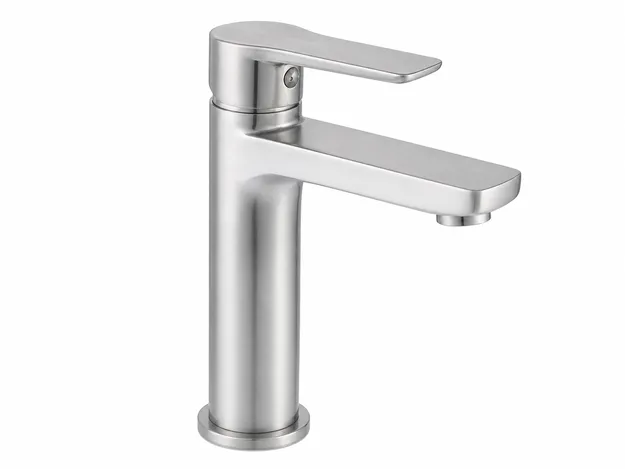
Single-hole single-handle stainless steel bathroom faucet

Single-Hole Single-Handle

Standard

Most common configuration for modern vanity installations. Single deck hole, lever or knob handle, available in brushed or polished stainless. Deck plate available for retrofit to 3-hole vanities.

  • Spout reach: 120mm / 150mm
  • Spout height: 160mm / 200mm
  • Flow rate: 1.2 GPM (4.5 L/min) standard
  • MOQ: 200 units
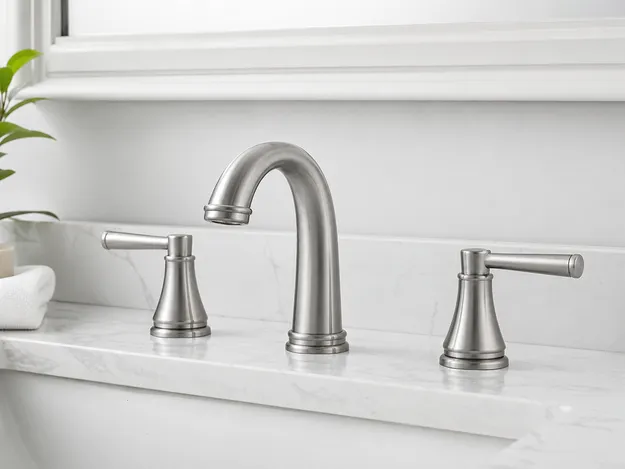
Widespread two-handle stainless steel bathroom faucet

Widespread Two-Handle

Standard

Three-hole installation, 6-inch or 8-inch center spread. Separate hot and cold handles with shared spout body. Common in hotel and hospitality specifications where traditional aesthetics are required alongside stainless durability.

  • Center spread: 6" or 8"
  • Handle options: cross, lever, knob
  • Flow rate: 1.2 GPM standard
  • MOQ: 200 units
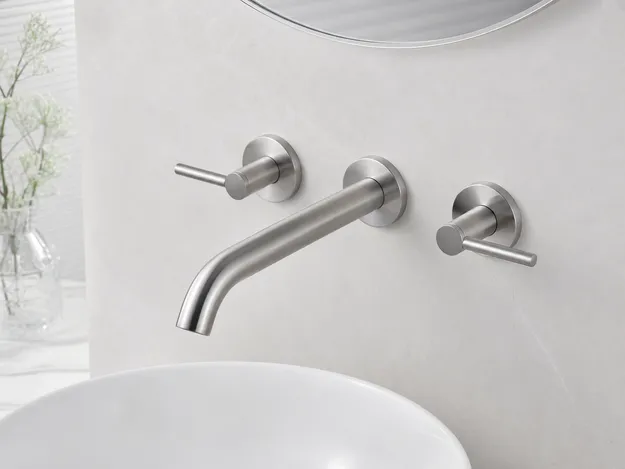
Wall-mount stainless steel bathroom faucet

Wall-Mount

Extended Lead Time

Mounts to wall rough-in rather than deck. Requires in-wall valve body (supplied separately). Stainless spout and handle trim only. Popular in vessel sink configurations and high-end residential projects.

  • Spout projection: 180mm / 220mm
  • Rough-in valve: specify separately
  • Flow rate: 1.2 GPM standard
  • MOQ: 300 units
Tall vessel stainless steel bathroom faucet for above-counter basins

Vessel / Tall Spout

Standard

Designed for above-counter vessel basins. Extended spout height clears the basin rim. Single-hole deck mount. The stainless body handles the extended spout geometry without the weight penalty of a comparable brass casting.

  • Spout height: 280mm / 320mm
  • Spout reach: 130mm
  • Flow rate: 1.2 GPM standard
  • MOQ: 200 units
Sensor touchless stainless steel bathroom faucet for commercial use

Sensor / Touchless

Commercial

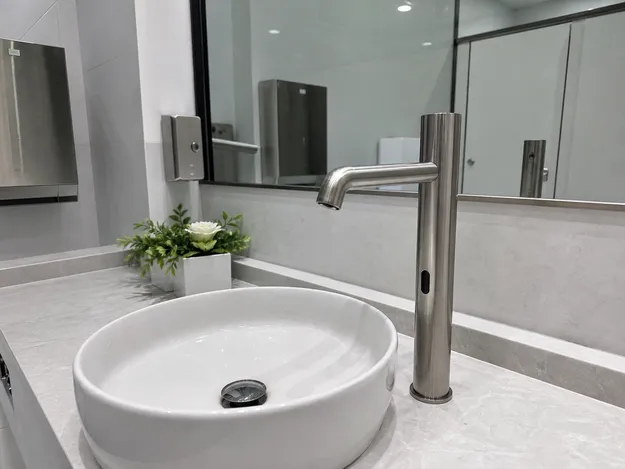
Infrared sensor activation, AC or battery-powered options. Stainless body with concealed sensor window. Specified heavily in commercial washrooms, healthcare facilities, and hospitality projects where hygiene and vandal resistance are primary requirements.

  • Power: AC hardwired or 6V battery
  • Sensor range: 100–200mm adjustable
  • Flow rate: 0.5 GPM (water-saving)
  • MOQ: 200 units
Custom OEM stainless steel bathroom faucet design and manufacturing

Custom / OEM Body

Tooling Required

Custom spout geometry, handle design, or branded trim. Requires new hydroform tooling. We provide DFM review before tooling commitment — we'll flag any geometry that creates weld or grinding challenges before you're committed to a die.

  • Tooling lead time: +3–4 weeks
  • First-article approval included
  • DFM review before commitment
  • MOQ: 500 units

Available Finishes

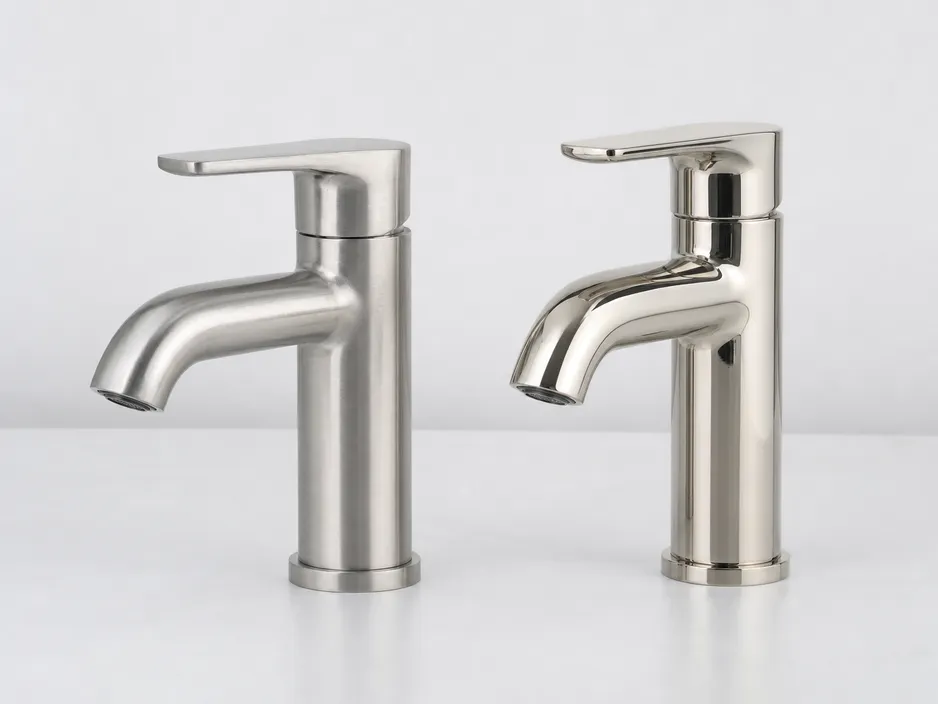
Brushed

Brushed Stainless

Mechanical grain finish. Hides water spots and minor surface contact marks. Most specified finish for residential and hospitality. No coating — texture is in the metal.

Mirror

Polished / Mirror Stainless

Multi-stage buffing to high-gloss mirror finish. Shows water spots more readily than brushed. Specified for high-end residential and luxury hospitality where visual impact is prioritized.

PVD Black

PVD Matte Black

Physical vapor deposition coating over brushed stainless substrate. Harder than electroplating, no heavy metal chemistry. Passes 48-hour salt spray. MOQ and lead time same as brushed.

PVD Gold

PVD Brushed Gold

Warm gold tone over brushed stainless. Increasingly specified in hospitality and premium residential. Same corrosion resistance as base stainless — PVD layer adds color without compromising the substrate.

Additional PVD colors (gunmetal, rose gold, champagne bronze) available on request. Minimum order quantities apply for non-standard colors.

Configuration Quick Reference

Configuration Deck Holes Standard Finishes MOQ Lead Time
Single-hole single-handle 1 Brushed, Polished, PVD Black, PVD Gold 200 30–45 days
Widespread two-handle 3 Brushed, Polished, PVD Black, PVD Gold 200 30–45 days
Wall-mount Wall rough-in Brushed, Polished, PVD Black 300 45–60 days
Vessel / tall spout 1 Brushed, Polished, PVD Black, PVD Gold 200 30–45 days
Sensor / touchless 1 Brushed, PVD Black 200 45–60 days
Custom / OEM Per spec All + custom PVD colors 500 60–90 days
How We Make Them

Manufacturing Process

Every stainless steel bathroom faucet we produce goes through the same controlled sequence — hydroforming, welding, surface treatment, assembly, and pressure testing. No shortcuts between steps.

1

Material Selection

304 or 316L stainless coil stock. Mill certificates verified. Wall thickness confirmed before cutting.

2

Hydroforming

High-pressure fluid forms the spout body in a single operation. No seams in the spout geometry. Consistent wall thickness throughout the curve.

3

TIG Welding

Spout, body, and connection points joined by TIG. Weld seams ground flush. No filler metal mismatch — same alloy throughout.

4

Surface Treatment

Mechanical polishing or brushing to spec. PVD coating applied in-house for black and gold variants. Passivation bath restores chromium oxide layer after grinding.

5

Cartridge Assembly

Ceramic disc cartridge installed and torque-tested. Supply lines, aerator, and mounting hardware fitted. Handle alignment checked before sealing.

6

Pressure Testing

Each unit pressure-tested at 1.6 MPa. Zero-leak threshold. Failed units pulled from line — not reworked into production stock.

First-Article Inspection on Every New SKU

Before a new configuration enters production, we run a first-article inspection against your approved drawings. Dimensional report, surface finish confirmation, and pressure test results are shared before we release the production run. If anything is out of spec, we correct it before you're committed to volume.

Standards & Certifications

Material & Compliance

Stainless steel faucets sold into North American and European markets face a specific set of material and performance requirements. Here's where our standard product lands and what we can support for market-specific certification.

Material Specifications

Primary alloy 304 stainless (standard)

18% chromium, 8% nickel. Suitable for residential and most commercial applications. 316L available for coastal or high-chloride environments.

Lead content < 0.25% weighted average

Meets NSF/ANSI 61 and California AB 1953 (Prop 65 lead-free) requirements. Verified by third-party lab on each alloy batch.

Wall thickness 0.8mm – 1.2mm

Spout body wall thickness maintained within ±0.05mm tolerance across the hydroformed section. Confirmed by ultrasonic measurement on first-article.

Cartridge Ceramic disc, 35mm or 40mm

Rated 500,000 open/close cycles. Drip-free at 0.05 MPa residual pressure. Compatible with standard replacement cartridges from major suppliers.

Certifications & Standards

NSF

NSF/ANSI 61 & 372

Drinking water system components — health effects. Lead-free compliance. Required for sale in all US states. Available on standard product.

cUPC

cUPC / IAPMO

Uniform Plumbing Code compliance. Required by many US and Canadian jurisdictions for commercial installation. Available on request.

CE

CE / EN 817

European mechanical mixing valve standard. Required for EU market entry. Available for products destined for European distribution.

WaterSense (EPA)

Flow rate ≤ 1.2 GPM at 60 PSI. Required for LEED projects and many commercial specifications. Available on standard aerator configuration.

Salt Spray & Corrosion Testing

Standard 304 stainless passes 200-hour neutral salt spray (NSS) per ASTM B117. PVD-coated variants pass 480 hours. 316L alloy option passes 500+ hours — specified for coastal installations, pool environments, and projects where chloride exposure is a documented concern.

200h

304 SS salt spray

480h

PVD-coated salt spray

500h+

316L alloy salt spray

Material Comparison

Stainless Steel vs Brass Faucets

Both materials work. The right choice depends on your application, market, and cost targets. Here's an honest comparison without the marketing spin.

Factor Stainless Steel Brass
Lead content Inherently lead-free alloy Requires lead-free brass alloy (C69300 or equivalent); adds cost
Weight 30–40% lighter than brass equivalent Heavier; relevant for vessel and wall-mount applications
Corrosion resistance Excellent; 316L for coastal/pool Good with plating; dezincification risk in aggressive water
Manufacturing method Hydroforming + TIG welding; seamless spout geometry Sand or die casting; complex internal geometry easier
Surface finish options Brushed, polished, PVD; no base coat required Wider plating range; chrome, nickel, ORB, etc.
Unit cost (standard) Generally lower at equivalent spec Higher material cost; casting labor adds to unit price
Tooling cost Lower hydroform tooling vs casting dies Higher die cost; longer amortization period
Best fit Commercial, healthcare, hospitality, coastal, lead-free mandates Traditional residential, wide finish range, complex body geometry

Bottom line: If your project has a lead-free mandate, a weight constraint, or a coastal/commercial corrosion requirement, stainless is the straightforward choice. If you need a highly complex internal body geometry or a finish that isn't achievable with PVD, brass casting may be the better fit. We manufacture both — we'll tell you which makes more sense for your specific application.

Engineering Data

Technical Specifications

Industry-standard values for this product type. Actual specifications may vary by configuration. Contact us for detailed product data sheets.

Parameter Specification
Body Material Grade 304 stainless steel
Body Formation Hydroformed / press-formed tube and sheet
Wall Thickness 1.0–1.2mm (body and spout sections)
Valve Seat Tolerance ±0.05mm (CNC machined)
Cartridge Type Ceramic disc, 35mm or 40mm
Cartridge Endurance 500,000 open/close cycles (tested per batch)
Standard Finishes Brushed stainless, polished stainless
Spout Height (typical) 120–180mm (configuration-dependent)
Spout Reach (typical) 100–150mm (configuration-dependent)
Mounting Deck mount, single-hole standard; 3-hole available
Supply Connection 3/8" compression or flexible braided hose
Flow Rate Options 1.2 GPM / 1.5 GPM / 2.2 GPM (aerator-configured)
Operating Pressure 0.05–0.8 MPa
Leak Test 0.6 MPa, 60 seconds, 100% outgoing inspection
Certifications cUPC, CE, WaterMark, ISO 9001:2015, SGS
Stainless steel bathroom faucet cross-section showing ceramic disc cartridge and CNC-machined valve seat

500,000 Cycles

Ceramic disc cartridge endurance, tested per production batch — not just on sample units.

100% Leak Tested

0.6 MPa for 60 seconds on every outgoing unit — not a statistical sample.

±0.05mm Tolerance

CNC-machined valve seat precision — the spec that determines long-term drip-free performance.

3 Flow Rate Options

1.2 / 1.5 / 2.2 GPM aerator-configured at order — no retooling required between SKUs.

Need configuration-specific data sheets for a procurement submission or facility spec package?

Request Specifications for Your Project
Commercial Distribution

Market Segments Where Stainless Steel Bathroom Faucets Move

The commercial case for stainless steel bathroom faucets is strongest in segments where durability, hygiene documentation, or corrosion resistance drives the specification decision. These are the segments our buyers are successfully selling into.

Stainless steel faucet installed in a clinical healthcare sink environment

Healthcare & Clinical Facilities

Hospitals, clinics, dental offices, and aged care facilities specify stainless steel fixtures for infection control compliance. The non-porous surface and absence of coating layers that can chip or flake are the key specification drivers.

Procurement through facility management contractors or healthcare-specific distributors
Order sizes: 50–500 units per facility; repeat orders tied to renovation cycles
Segment won't accept plated brass substitutes on clinical sink applications
Brushed stainless steel faucet in a high-traffic commercial restroom installation

Commercial & Institutional Restrooms

Schools, universities, government buildings, and corporate offices specify stainless steel for high-traffic public restrooms where finish durability is the primary concern. A brushed stainless faucet will look the same at year five as it did at installation — the brushed texture is in the metal, not in a coating that wears through.

Order sizes: 200–1,000 units per project
Tends to standardize on a single SKU across a facility — simplifies your inventory management
Facility managers with finish wear complaints on plated faucets are a receptive audience
Stainless steel faucet in a coastal resort bathroom resistant to salt air corrosion

Coastal & Marine-Adjacent Hospitality

Hotels, resorts, and residential developments within a few kilometers of the ocean deal with salt air corrosion that accelerates finish failure on plated brass faucets. Brushed stainless holds up in these environments without the maintenance overhead of replating or replacement.

Active markets: Middle East Gulf coast, Southeast Asian resort markets, Australian coastal residential
One of our faster-growing stainless segments over the past two years
Stainless steel bathroom faucet in a food service facility staff restroom adjacent to commercial kitchen

Food Service & Commercial Kitchen Adjacents

Commercial kitchens, food processing facilities, and cafeteria restrooms often carry stainless steel specifications across all fixtures for consistency with NSF/ANSI food service standards. A stainless bathroom faucet in the staff restroom adjacent to a commercial kitchen is a natural extension of the stainless specification that already covers the kitchen equipment.

Specification consistency with NSF/ANSI food service standards across all fixtures
Natural extension of the stainless spec already covering kitchen equipment
Stainless steel faucet in a gym locker room withstanding high humidity and commercial disinfectant cleaning

Gym & Fitness Facilities

High-humidity environments with frequent cleaning using commercial disinfectants are hard on plated finishes. Stainless steel handles the chemical exposure without finish degradation. Gym and fitness facility operators who've had warranty issues with plated faucets are a straightforward conversion — the durability argument is concrete and the cost premium over plated brass is modest at the per-unit level.

Resists commercial disinfectant exposure without finish degradation
Cost premium over plated brass is modest at the per-unit level — easy conversion sell

Building a Catalog for a Specific Segment?

Tell us your target segment and order volume. We'll confirm which SKUs, certifications, and flow rate configurations are the right fit — and provide pricing for your catalog build.

Get a Quote for Your Target Segment

Segment Coverage at a Glance

Five distinct commercial segments with different procurement channels, order sizes, and specification drivers — all served by the same core stainless steel SKU range.

Healthcare

Institutional

Coastal Hospitality

Food Service

Gym & Fitness

Compliance Documentation

Certification Coverage for Commercial Procurement

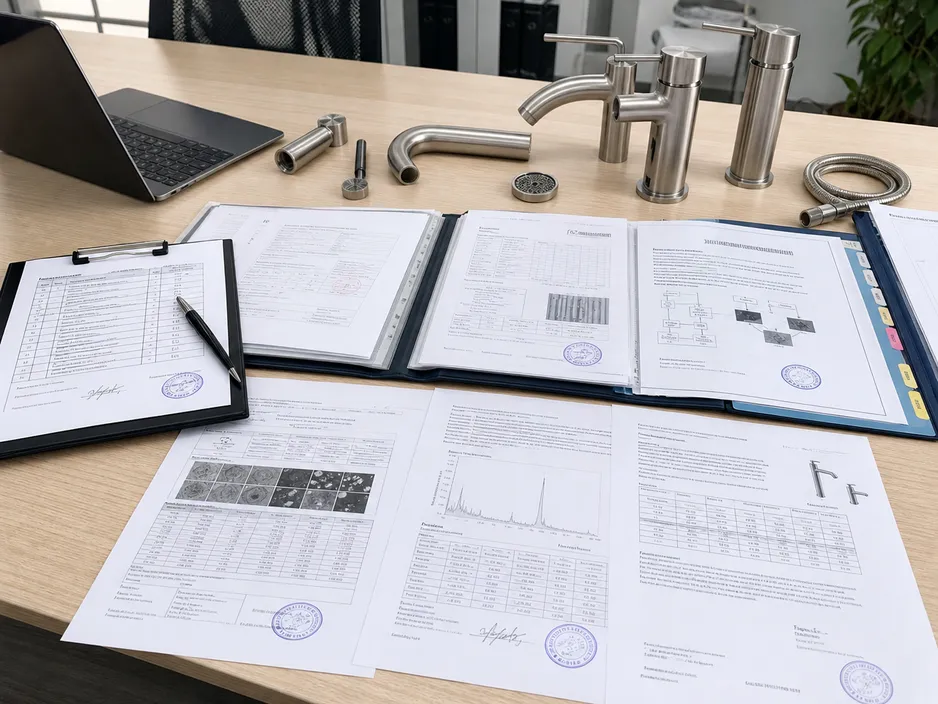
Stainless steel bathroom faucets from our line carry the same certification stack as our brass bathroom faucets — cUPC, CE, WaterMark, ISO 9001:2015, and SGS. For commercial and healthcare procurement, this matters more than it does for residential distribution, because institutional buyers often require certification documentation as part of the bid package.

cUPC — North America

Covers NSF/ANSI 61 and 372 lead-free requirements for North American plumbing code. For healthcare procurement in the US and Canada, lead-free certification is typically a mandatory specification. Our XRF testing on every incoming stainless batch confirms material compliance, and the test reports travel with the shipment documentation.

CE — European Union

Covers European pressure performance and material safety requirements. Required for any fixture entering EU distribution channels.

WaterMark — Australia & New Zealand

Mandatory for any fixture installed in Australia. WaterMark covers Australian plumbing code compliance — without it, the product cannot be legally installed.

ISO 9001:2015 & SGS

ISO 9001:2015 covers quality management system documentation across all markets. SGS audit reports provide third-party independent verification and are available on request for buyers whose procurement process requires documentation beyond our own test reports.

Certification documentation package for commercial and healthcare procurement of stainless steel bathroom faucets

Healthcare-Specific Documentation

For healthcare-specific procurement that requires additional documentation — material safety data sheets, surface finish specifications, or compliance statements for infection control protocols — contact us with your specific requirements and we'll prepare the documentation package.

Request Documentation Package
Certification Market Relevance for Commercial Procurement
cUPC USA, Canada Lead-free compliance, plumbing code — mandatory for healthcare and institutional
CE European Union Pressure performance, material safety
WaterMark Australia, New Zealand Mandatory for legal installation
ISO 9001:2015 All markets Quality management system documentation
SGS All markets Third-party independent audit verification

OEM & Custom Orders

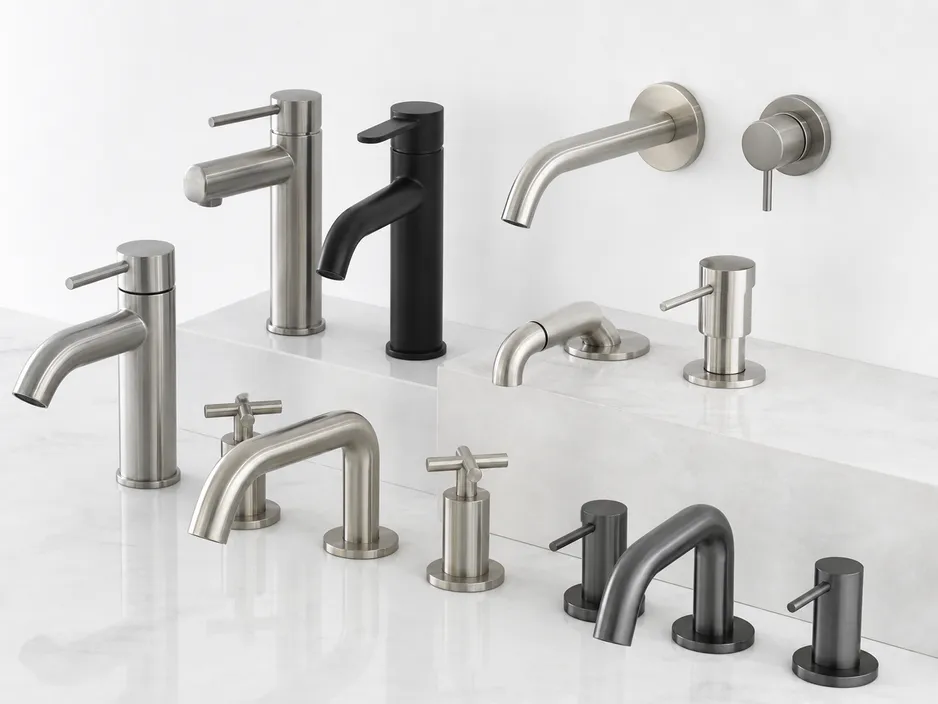
Customization Options for Stainless Steel Bathroom Faucets

The stainless line has a narrower customization range than our brass line — that's an honest limitation of the forming process versus casting. A brass body can be cast into almost any geometry; a formed stainless body has constraints based on the tube and sheet stock dimensions and the hydroforming tooling. Here's what's available and what isn't.

What You Can Specify

Finish

Brushed stainless (standard) or polished stainless. Both are mechanical finishes in the material itself — no coating layers. Custom PVD color coatings (matte black, PVD gold) can be applied over polished stainless on runs of 500+ pieces, though the adhesion characteristics differ from PVD over brass and we recommend sample testing before committing to volume.

Flow Rate

1.2 GPM, 1.5 GPM, or 2.2 GPM aerator configurations. Specify at order time for WaterSense or WELS compliance.

Handle Style

Lever handle standard. Cross handle available on select body configurations. Handle material is typically 304 stainless to match the body.

Mounting Configuration

Single-hole deck mount standard. Three-hole deck mount available. Wall mount available on select body configurations — confirm rough-in requirements before ordering.

Supply Connection

3/8" compression standard. Flexible braided hose supply lines available as an included accessory.

Packaging & Branding

Custom carton printing, branded installation instructions, OEM labeling. Same packaging customization available as on the brass line.

Stainless steel bathroom faucet customization options including finish, handle style, and mounting configurations

What Has Constraints

Body geometry is more limited than brass casting. If you have a specific design brief that requires complex curves or unusual proportions, we'll review it against our forming tooling and give you an honest assessment of feasibility before you commit to tooling cost. For most standard bathroom faucet profiles — cylindrical body, straight or gently curved spout — the forming process handles it well.

For custom PVD color over stainless, adhesion characteristics differ from PVD over brass. We recommend sample testing before committing to volume.

MOQ Reference

Standard OEM orders 200 pcs / SKU
Custom PVD color over stainless 500 pcs minimum

500-piece minimum for PVD color runs reflects PVD line setup cost. Same MOQ structure as the brass line for standard configurations.

Discuss Your Customization Requirements

Send us your design brief or specification sheet. We'll review it against our forming tooling and give you a direct assessment of what's feasible and at what run size before you commit to anything.

Specification Guidance

Stainless vs. Brass Bathroom Faucets: Choosing the Right Specification for Your Market

Both are in our catalog, and we supply both to buyers who carry mixed product lines. The decision isn't about which is better — it's about which is right for the application.

Factor Stainless Steel Brass (Plated)
Body material Grade 304 stainless C36000-equivalent brass
Formation process Hydroformed / press-formed Gravity cast
Corrosion resistance Excellent — passive oxide layer, no dezincification Good — depends on alloy quality and plating integrity
Finish options Brushed stainless, polished stainless (+ PVD over polished) Chrome, brushed nickel, matte black, PVD gold, oil-rubbed bronze
Finish durability Texture in the metal — no coating to wear through Coating-dependent — quality varies by plating stack
Design flexibility More limited — forming constraints High — casting allows complex geometries
Per-unit cost Higher Lower to mid
Best fit Healthcare, commercial, coastal, high-traffic institutional Residential, hospitality, retail distribution

If you're building a catalog that covers both residential distribution and commercial/institutional accounts, carrying both stainless and brass bathroom faucets gives you the full specification range. Most of our buyers who serve commercial contractors stock stainless as a separate SKU alongside their brass residential line — the segments don't overlap much, and having both means you can respond to a commercial bid without sending the buyer elsewhere.

Finish-Specific Variants in the Brass Line

Stainless steel and brass bathroom faucets side by side for specification comparison

Logistics & Procurement

Container Loading and Landed Cost for Stainless Steel Bathroom Faucets

Stainless steel bathroom faucets are slightly heavier per unit than equivalent brass configurations — the formed stainless body with its 1.0–1.2mm wall thickness runs approximately 10–15% heavier than a comparable brass casting. For container planning, this affects your gross weight calculation more than your CBM calculation, since the carton dimensions are similar.

Carton Packing & Container Capacity

Standard carton packing runs 6–12 units per master carton depending on configuration, with individual units in foam-lined inner boxes. A 40HQ container typically loads 1,800–3,000 units of standard stainless centerset bathroom faucets.

We provide a packing list with CBM and gross weight per SKU before you confirm the order — your freight forwarder needs the gross weight per container to quote accurately, and stainless is worth flagging separately from brass in a mixed-product container.

Mixed-Product Container Coordination

For buyers consolidating stainless and brass bathroom faucets in the same container, we coordinate the packing sequence to keep the weight distribution balanced. Documentation prepared in parallel with production: commercial invoice, packing list, certificate of origin, and the relevant certification test reports for your destination market.

Lead Times

Standard Catalog

25–35 days

Order confirmation to container loading

OEM / Custom Config

35–50 days

Custom packaging or non-standard configurations

Stainless steel bathroom faucets packed in master cartons ready for 40HQ container loading

Weight Planning Note

~10–15% heavier per unit vs. brass

The 1.0–1.2mm stainless wall adds weight without significantly changing carton CBM. Flag stainless separately from brass when your freight forwarder calculates gross weight per container.

Pre-order packing list provided

CBM and gross weight per SKU confirmed before order. Includes commercial invoice, packing list, certificate of origin, and destination-market certification test reports.

Buyer FAQ

Frequently Asked Questions: Stainless Steel Bathroom Faucets

Specification and sourcing questions answered directly — grade selection, finish durability, and how to match the right product to your market.

What grade of stainless steel do you use, and does it matter for my market?

We use Grade 304 stainless steel (18/8 chromium-nickel composition) for bathroom faucet bodies. 304 is the standard for plumbing fixtures and food service equipment — it provides the corrosion resistance and hygiene characteristics that drive stainless steel specification in commercial and healthcare applications.

Grade 316 (marine grade, with molybdenum addition) offers better resistance in direct saltwater immersion but is rarely specified for indoor bathroom faucets even in coastal environments.

For the applications where stainless bathroom faucets are typically specified — healthcare, commercial restrooms, coastal hospitality — 304 is the correct grade. If your project specification explicitly calls for 316, contact us and we'll discuss feasibility.

Grade Comparison at a Glance

Property
304 (Our Grade)
316 (Marine)
Composition
18% Cr, 8% Ni
18% Cr, 10% Ni + Mo
Indoor corrosion
Excellent
Excellent
Saltwater immersion
Good
Superior
Typical use
Plumbing, food service
Marine, chemical
Specified for indoor bathrooms
Standard
Rarely

Even in coastal hospitality environments, 304 is the standard specification for indoor bathroom faucets. 316 is available on request for projects with explicit marine-grade requirements.

How does brushed stainless compare to brushed nickel for durability in high-traffic environments?

Brushed stainless is more durable in high-traffic environments because the texture is in the metal itself, not in a coating layer. Brushed nickel is an electroplated finish — the brushed texture is applied to a chrome/nickel/copper plating stack over a brass body.

In high-traffic environments with frequent cleaning, the plating can wear through at contact points (handle grip areas, spout tip) over 18–36 months. Brushed stainless doesn't have a coating to wear through — the surface looks the same at year five as at installation.

The trade-off is finish variety: brushed stainless comes in one color, while brushed nickel is part of a broader finish family that includes chrome, matte black, and PVD gold.

Decision Guide by Application

Commercial & Institutional

High-traffic, frequent cleaning, durability is the priority. Brushed stainless wins.

Residential Distribution

Finish variety drives sales across chrome, matte black, PVD gold. Brushed nickel is the better catalog choice.

Hospitality / Mixed Use

Evaluate cleaning frequency and replacement cycle. Stainless reduces long-term maintenance cost; nickel broadens finish matching options.

Plating Wear Timeline

Brushed nickel plating typically shows wear at contact points (handle grip, spout tip) within 18–36 months under commercial cleaning schedules. Brushed stainless has no coating layer to wear through.

Factor
Brushed Stainless
Brushed Nickel
Surface type
Texture in base metal
Electroplated coating over brass
Wear resistance
No coating to wear through
Plating wears at contact points
Finish variety
One color option
Chrome, matte black, PVD gold, more
Best fit
Commercial / Institutional
Residential distribution

Sourcing brushed nickel for residential distribution? See our full finish range.

Brushed Nickel Bathroom Faucets

Can stainless steel bathroom faucets be used in healthcare facilities that require NSF/ANSI 61 compliance?

Yes. Our stainless steel bathroom faucets carry cUPC certification, which covers NSF/ANSI 61 and 372 lead-free compliance for North American plumbing code. The 304 stainless body itself is inherently lead-free — there's no brass alloy to test for lead content. We test every incoming stainless batch for material compliance, and the test reports travel with the shipment documentation.

Additional documentation available for healthcare procurement:

  • Material safety data sheets
  • Surface finish specifications
  • Compliance statements for specific infection control protocols

Contact us with your specific requirements for documentation beyond the standard cUPC test reports.

What is the minimum order quantity for stainless steel bathroom faucets?

200 pieces per SKU for OEM orders. For standard catalog configurations under the Wfaucet brand, contact us with your target volume and we'll confirm.

200 pcs

OEM per SKU

Mixed

SKU consolidation

500 pcs

Custom PVD color run

Mixed-SKU orders are common — stainless and brass bathroom faucets can consolidate into the same container. For custom PVD color coatings over polished stainless, minimum run is 500 pieces.

How do stainless steel bathroom faucets perform in coastal environments with salt air exposure?

Grade 304 stainless steel's passive chromium oxide layer provides strong resistance to salt air corrosion in typical coastal indoor environments. The passive layer regenerates when scratched, which is why stainless is the standard material for marine hardware and coastal commercial installations.

Grade 304 — Indoor Coastal

Hotel bathrooms, coastal residential, resort facilities within a few kilometers of the ocean. Significantly outlasts electroplated brass finishes. Standard and appropriate specification.

Grade 316 — Direct Outdoor / Saltwater

For direct outdoor exposure or immersion in saltwater, Grade 316 is the correct specification. For indoor coastal applications, 304 is standard.

What lead time should I plan for a stainless steel bathroom faucet order?

Standard Catalog

25–35 days

Order confirmation to container loading. Standard configurations, no new tooling.

OEM / Custom

35–50 days

Custom packaging, non-standard configurations, or new tooling required.

We schedule production in 4-week windows and commit to the window at order confirmation. We don't push orders back to accommodate larger buyers' rush orders.

Manufacturer Direct

Source Stainless Steel Bathroom Faucets from a Manufacturer Who Makes Both

One supplier relationship. Consistent QC standards. Complete documentation across your full catalog mix.

Most factories that offer stainless steel bathroom faucets either specialize in stainless — and don't have the brass line depth for your other SKUs — or treat stainless as an afterthought on a brass-focused floor.

We've built both lines with the same production discipline: same QC standards, same certification stack, same documentation process.

If you're sourcing a mixed catalog that includes both stainless commercial faucets and brass residential faucets, one supplier relationship covers both. Your compliance documentation, your packaging specs, and your reorder process are consistent across the product mix.

Same QC Standards Across Both Lines

Stainless and brass production share the same inspection protocols, dimensional tolerances, and sign-off process — not two separate quality tiers.

Unified Certification Stack

cUPC, CE, WaterMark, and other market-specific certifications are maintained across both material lines. One documentation package covers your full order.

Consistent Reorder Process

Packaging specs, lead times, and reorder workflows are the same whether you're replenishing stainless commercial SKUs or brass residential SKUs.

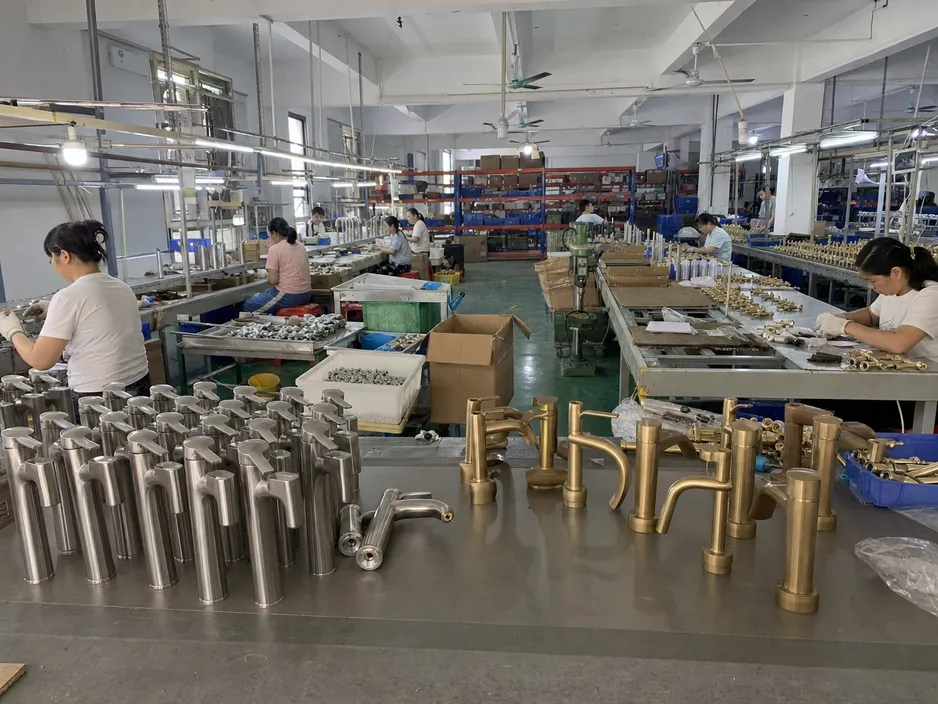
Wfaucet production floor showing both stainless steel and brass bathroom faucet lines

Ready to send your SKU list?

Send us your target configurations, finishes, volumes, destination market, and any certification requirements specific to your buyers. We'll come back with a detailed quote and flag any configuration details worth discussing before you commit.

Submit a Quote Request