

Kitchen Faucet Hoses Built to Faucet Spec
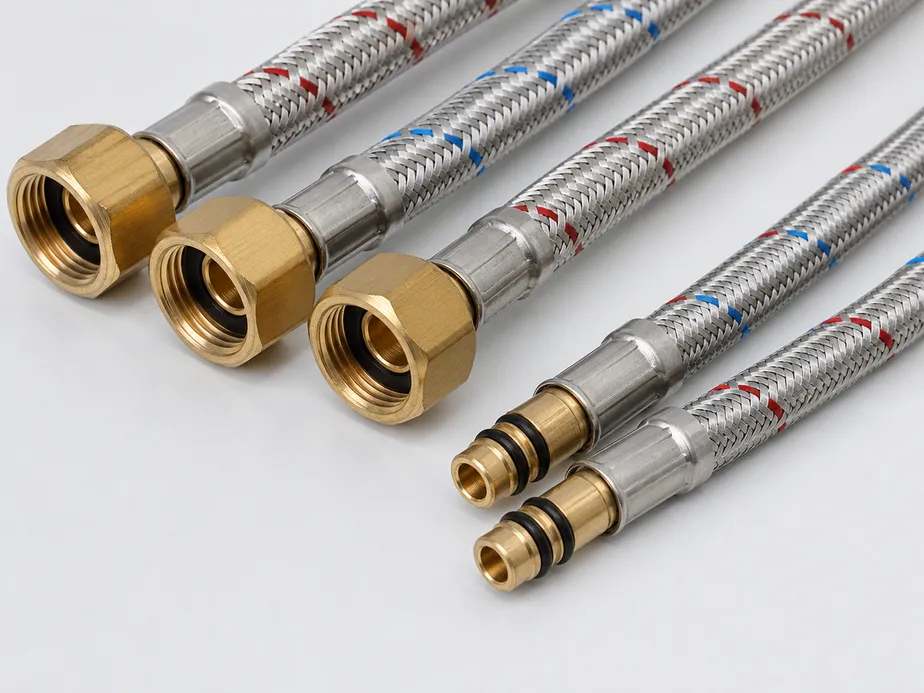
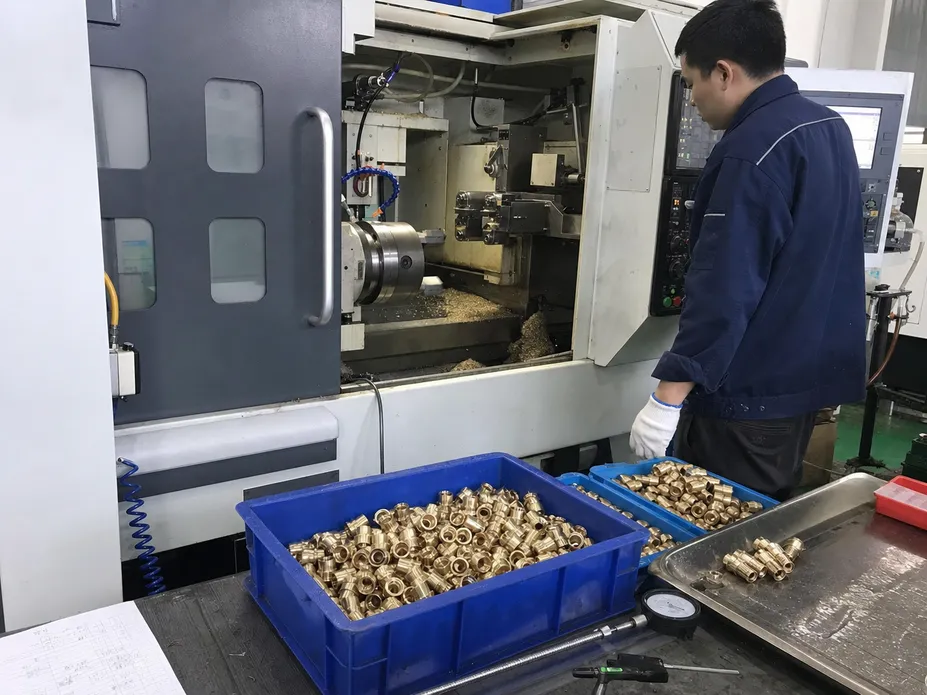
Braided stainless supply hoses and pull-down spray hoses manufactured in-house — 500 PSI burst tested, end fittings machined on the same CNC equipment that runs our faucet bodies. Standard lengths ship from stock; custom lengths, fittings, and private-label packaging available from 200 pieces.
Burst Tested
500 PSI
Every production batch
OEM From
200 pcs
Custom lengths & fittings
Product Overview
Two Hose Types, One Sourcing Decision
Kitchen faucet hoses split into two distinct product types, and the distinction matters when you're building a catalog or a replacement parts program.
Type 01
Supply Hoses
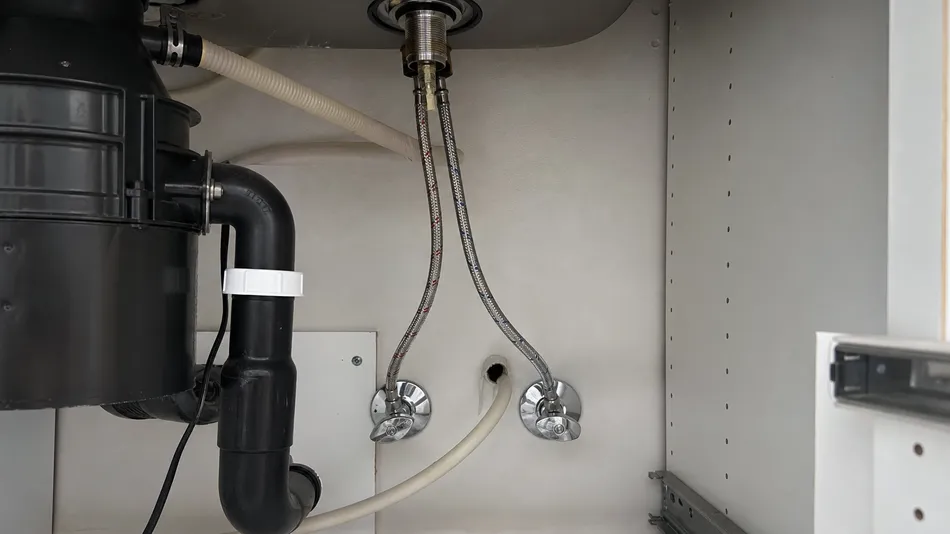
Supply hoses connect the faucet body to the shut-off valve under the sink. They carry cold or hot water at line pressure — typically 40–80 PSI in residential systems, higher in commercial installations.
Failure Mode to Understand
The failure mode here is slow: a pinhole in the braiding or a cracked fitting that weeps for months before anyone notices, then floods the cabinet. The commercial consequence is a warranty claim that arrives 18 months after the sale, by which time your customer has forgotten the brand name and just knows the faucet "leaked."
Type 02
Pull-Down Spray Hoses
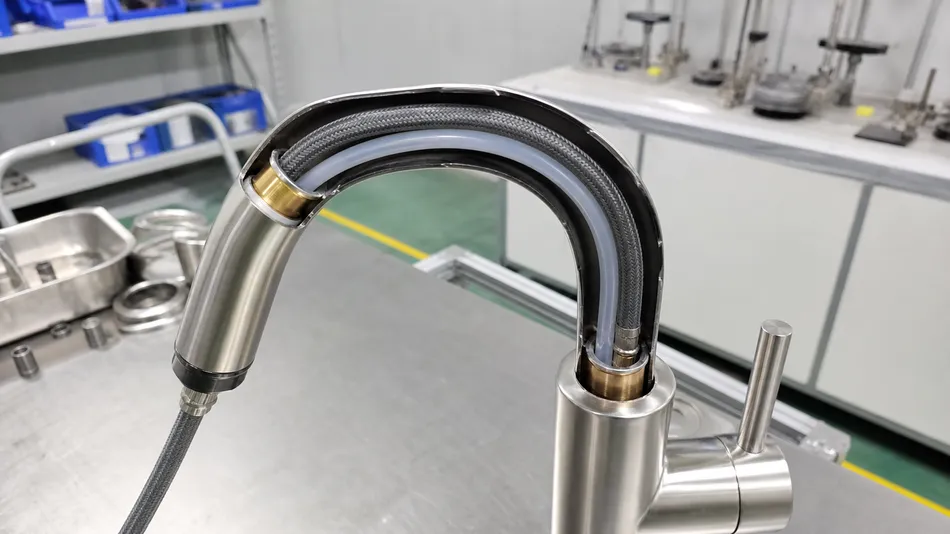
Pull-down spray hoses are the flexible hose inside a pull-down or pull-out kitchen faucet that connects the spray head to the faucet body. These take a different kind of abuse — they flex thousands of times a year as the spray head is extended and retracted, they run through a tight radius inside the faucet neck, and they need to retract smoothly without kinking.
Failure Mode to Understand
The failure mode is mechanical fatigue: the hose develops a kink point at the bend radius, the inner tube cracks, and you get a drip that the end user can't trace to a visible fitting. We've seen pull-down hoses from other suppliers fail at the neck bend within 18 months — the inner tube material was too stiff for the bend radius the faucet design required. We spec our pull-down hose inner tube to match the minimum bend radius of each faucet model it ships with.
Why It Matters for Sourcing
We manufacture both types. The specs, materials, and QC protocols differ between them — which is why we cover each in detail below. One supplier, two hose types, matched to the same faucet bodies they ship with.
Specifications
Supply Hose Specifications
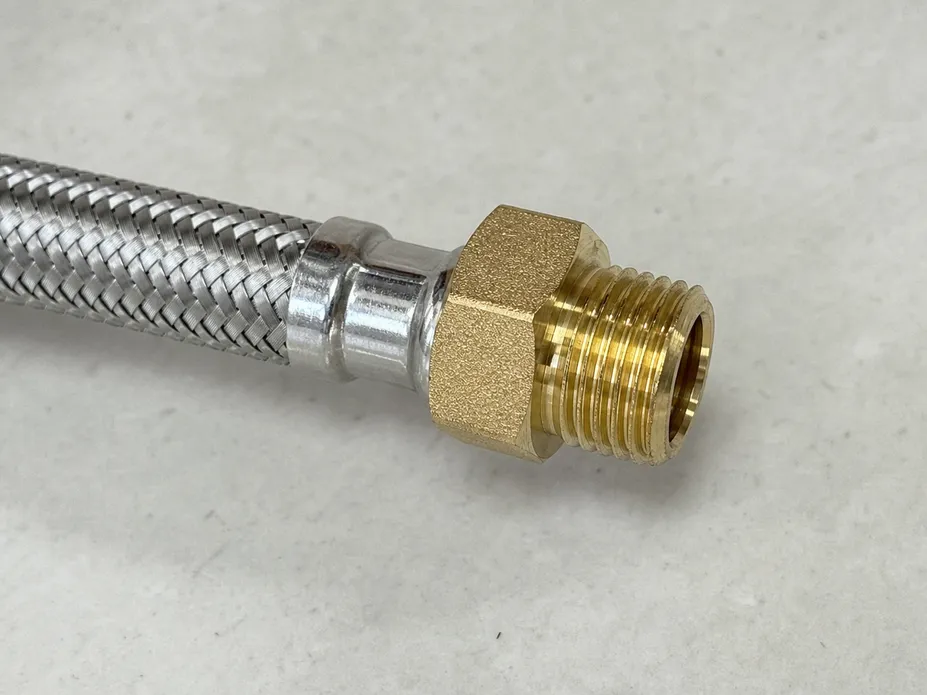
Supply hoses are the higher-volume SKU for most replacement parts programs. The spec decisions that matter are inner tube material, braiding type, fitting configuration, and length.
Burst Pressure
500 PSI
Tested per production batch
Working Pressure
0–150 PSI
3:1 safety margin at 150 PSI
Temperature Range
0–90°C
EPDM inner tube
Thread Tolerance
±0.05mm
CNC-machined brass fittings
Standard Production Specifications
Contact us for exact data sheets or to confirm specifications for your application.
| Parameter | Standard Specification |
|---|---|
| Inner tube | EPDM rubber, 5/16" ID |
| Braiding | 304 stainless steel wire, 16-strand |
| Burst pressure | 500 PSI (tested per batch) |
| Working pressure | 0–150 PSI |
| Temperature range | 0–90°C |
| Standard lengths | 24" (600mm), 36" (900mm) |
| Custom lengths | Available on OEM orders (12"–72" range) |
| End fitting — faucet end | 3/8" compression (standard) or 1/2" NPT |
| End fitting — valve end | 3/8" compression (standard) or 1/2" NPT |
| Fitting material | Brass, C36000-equivalent alloy |
| Finish | Chrome-plated brass (standard); brushed nickel available |
| Nut type | Swivel nut (standard) for tool-free alignment |
Burst Pressure Testing Protocol
The 500 PSI burst pressure is tested on every production batch — not just on new product introductions. We pull samples from each run, pressurize to failure, and log the result. The working pressure ceiling of 150 PSI covers commercial building supply pressures with a 3:1 safety margin. For buyers supplying into markets where building codes specify minimum burst pressure for supply hoses (California's Title 24 references ASME A112.18.6, which requires 500 PSI minimum), our standard spec is already compliant.
Fitting Material: The Detail Most Buyers Overlook
We use C36000-equivalent free-machining brass for all end fittings — the same alloy we use in our faucet bodies. Zinc alloy fittings are cheaper to produce, but they corrode at the thread interface in humid under-sink environments, and the corrosion makes the fitting difficult to remove during replacement. A plumber who has to cut out a corroded fitting on a warranty call will remember the brand. We machine our fittings to ±0.05mm thread tolerance, which means they thread onto standard 3/8" compression valves without cross-threading.
ASME A112.18.6 / California Title 24 Compliance
Our standard 500 PSI burst-tested supply hose meets the minimum burst pressure requirement referenced in California's Title 24 (ASME A112.18.6). No spec upgrade required for California-market distribution. Contact us for full compliance documentation by destination market.
Specifications
Pull-Down Hose Specifications
Pull-down hoses carry the same water pressure as supply hoses but add a mechanical fatigue requirement. The hose flexes thousands of times per year at the neck bend. Inner tube material, wall thickness, and minimum bend radius are the specs that determine service life.
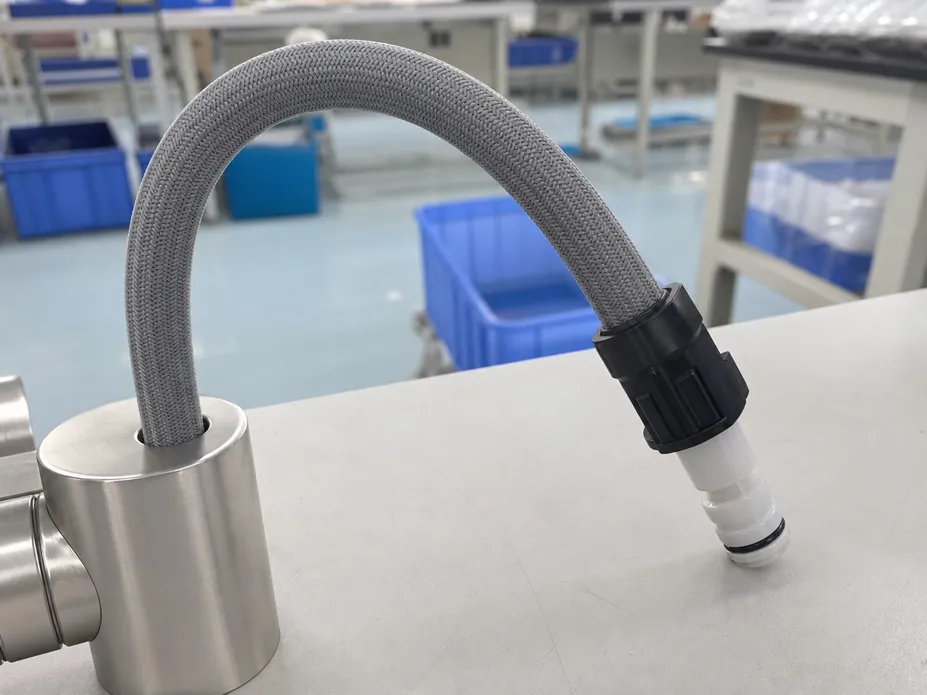
Flex Cycle Rating
500K+
At rated bend radius
Working Pressure
0–150 PSI
Same as supply hose
Min. Bend Radius
35mm
Model-matched to faucet neck
Standard Length
59" / 1500mm
Custom lengths available
Standard Production Specifications
Contact us for exact data sheets or to confirm specifications for your application.
| Parameter | Standard Specification |
|---|---|
| Inner tube | Nylon PA12, 3/8" ID |
| Outer jacket | Stainless steel spiral or PVC-coated braid |
| Burst pressure | 500 PSI (tested per batch) |
| Working pressure | 0–150 PSI |
| Temperature range | 0–80°C |
| Minimum bend radius | 35mm (model-matched; confirm per faucet SKU) |
| Flex cycle rating | 500,000+ cycles at rated bend radius |
| Standard length | 59" (1500mm) |
| Custom lengths | Available on OEM orders |
| Faucet-end fitting | Quick-connect (model-specific) or 1/2" NPT |
| Valve-end fitting | 3/8" compression or 1/2" NPT |
| Fitting material | Brass, C36000-equivalent alloy |
| Weight system | Counterweight included (zinc or brass, model-specific) |
Why Flex Cycle Rating Matters More Than Burst Pressure
A pull-down hose in a busy kitchen flexes at the neck bend 20–30 times per day. Over a 10-year service life that's 70,000–110,000 cycles at minimum — and in a commercial or rental setting, multiples of that. Our PA12 inner tube is specified for 500,000+ cycles at the rated bend radius, which is why we match the hose spec to the faucet model rather than shipping a generic hose. A hose with a 50mm minimum bend radius installed in a faucet neck that bends to 30mm will fail in the tube wall long before the fittings show any wear.
Quick-Connect Fitting Compatibility
Pull-down hoses use proprietary quick-connect fittings at the faucet end — the fitting geometry is specific to each faucet body design. We manufacture the hose and the faucet body in the same facility, so the quick-connect interface is dimensioned and tested as a matched assembly. For OEM buyers integrating our hose into a third-party faucet body, we can produce a custom fitting to your drawing or reverse-engineer from a sample. Lead time for a new quick-connect tooling run is typically 4–6 weeks.
Bend Radius Is Model-Specific — Confirm Before Ordering
The minimum bend radius spec on a pull-down hose is only meaningful relative to the faucet neck geometry it installs into. We publish bend radius per faucet SKU in our OEM data sheets. If you are sourcing replacement hoses for an existing faucet model — yours or a third party's — send us the faucet model number or a dimensional drawing and we will confirm compatibility before production.
Request a compatibility checkMaterial Selection
Inner Tube and Braiding Materials
The inner tube material determines chemical compatibility, temperature ceiling, and flex life. The braiding material determines corrosion resistance and burst pressure margin. Here is how we select each for the two hose types.
Inner Tube: EPDM vs. PA12 Nylon
EPDM Rubber
Supply hose inner tube
Why We Use It for Supply Hoses
EPDM has excellent resistance to hot water, ozone, and the chlorine levels found in municipal water supplies. It maintains elasticity across the 0–90°C range without hardening or cracking. For a supply hose that sits static under a sink for years, EPDM's long-term dimensional stability under pressure is the primary selection criterion.
Key Properties
- Temperature range: 0–90°C
- Chlorine-resistant (municipal water compatible)
- Ozone and UV resistant
- Low creep under sustained pressure
- Not recommended for repeated tight-radius flex cycling
PA12 Nylon
Pull-down hose inner tube
Why We Use It for Pull-Down Hoses
PA12 nylon has a higher flex fatigue resistance than EPDM at tight bend radii. It absorbs less moisture than PA6 or PA66, which matters because moisture absorption causes dimensional changes in the tube wall that affect the bend radius over time. PA12 also has a smooth bore that reduces flow restriction — relevant for pull-down spray heads that need consistent flow at the nozzle.
Key Properties
- Temperature range: 0–80°C
- 500,000+ flex cycles at rated bend radius
- Low moisture absorption vs. PA6/PA66
- Smooth bore — low flow restriction
- Lower max temperature than EPDM (80°C vs. 90°C)
Braiding: 304 Stainless Steel vs. PVC-Coated
304 Stainless Steel Braid
Standard on supply hoses; available on pull-down
304 stainless is the industry standard for braided supply hoses because it resists the humid, occasionally wet environment under a sink without surface corrosion. The 16-strand braid pattern we use distributes hoop stress evenly across the tube wall, which is why our burst pressure margin is consistent across the length of the hose rather than concentrated at the fittings.
PVC-Coated Braid / Spiral Wrap
Common on pull-down hoses for flexibility
Pull-down hoses sometimes use a PVC-coated braid or stainless spiral wrap rather than a tight stainless braid, because the outer jacket needs to flex smoothly through the faucet neck guide without binding. A tight stainless braid that works well under a sink can create friction drag in a pull-down neck that makes the spray head feel stiff to extend. We select the outer jacket construction based on the faucet neck guide geometry for each model.
Material Selection Summary
Quick reference for sourcing decisions.
| Property | EPDM (Supply) | PA12 (Pull-Down) |
|---|---|---|
| Max temperature | 90°C | 80°C |
| Flex fatigue life | Moderate (static application) | 500,000+ cycles |
| Chlorine resistance | Excellent | Good |
| Moisture absorption | Low | Very low (vs. PA6/PA66) |
| Bore smoothness | Good | Excellent (smooth bore) |
| Primary failure mode | Creep / fitting interface | Fatigue crack at bend |
Technical Specifications
Pull-Down Spray Hose Specifications
Pull-down spray hoses are a more specialized product than supply hoses, and the spec requirements are tighter. The hose has to flex repeatedly through a small bend radius, resist kinking, and retract smoothly — all while carrying water at line pressure.
| Parameter | Standard Specification |
|---|---|
| Inner tube | Nylon PA12, 8mm ID |
| Outer jacket | Braided stainless steel or nylon (buyer's choice) |
| Burst pressure | 500 PSI |
| Working pressure | 0–150 PSI |
| Minimum bend radius | 40mm |
| Standard lengths | 59" (1500mm), 71" (1800mm) |
| Custom lengths | Available on OEM orders |
| Faucet-end fitting | 1/2" UNF male (standard) or custom per faucet spec |
| Weight end | Integrated counterweight sleeve (standard) or bare hose |
| Temperature range | 0–85°C |
Contact us to confirm fitting compatibility with your faucet body design before ordering.
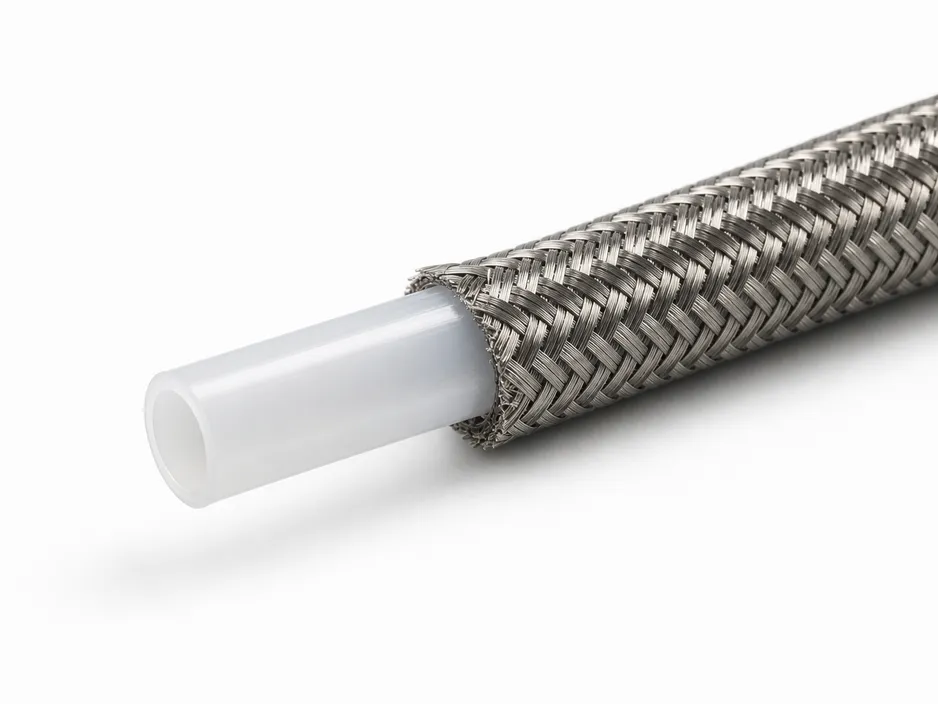
Why PA12 Nylon for the Inner Tube
PA12 nylon is the inner tube material we settled on after testing several alternatives. It has a lower stiffness than standard nylon PA6, which means it flexes more easily through the neck bend without developing a permanent set.
The minimum bend radius of 40mm covers the geometry of most pull-down faucet neck designs. If your faucet has a tighter neck radius, send us the drawing and we'll confirm compatibility before you commit to a production order. We had one buyer come to us with a faucet design that had a 30mm neck radius — we had to spec a different inner tube compound to make it work. Better to catch that in sampling than in a container of assembled faucets.
Counterweight Sleeve: The Retraction Detail
The counterweight sleeve is the detail that determines whether the spray head retracts smoothly or hangs limp. We supply an integrated brass counterweight sleeve as standard on pull-down hoses — it adds about 80g to the hose assembly and provides enough return force to retract the spray head without a spring mechanism.
For buyers who prefer a spring-return system or who are integrating the hose into a faucet design that already has a counterweight, we supply the bare hose without the sleeve.
Standard Configuration
Sourcing Guidance
Fitting Configurations and Market Compatibility
End fitting configuration is where most sourcing errors happen with kitchen faucet hoses. The wrong fitting means a 100% return rate — the hose physically won't connect. Here's the practical breakdown by market.
North America
The dominant standard is 3/8" compression on both ends for supply hoses. Most US and Canadian shut-off valves use 3/8" OD compression outlets, and most faucet inlets accept 3/8" compression. The exception is older construction where 1/2" IPS (iron pipe size) valves are still in place — for replacement parts programs targeting the renovation market, stocking both 3/8" compression and 3/8" compression × 1/2" FIP adapters covers the majority of installations.
Europe
BSP (British Standard Pipe) fittings dominate. G3/8" and G1/2" are the most common. If you're building a European replacement parts catalog, specify BSP fittings — 3/8" compression fittings will not thread onto BSP valves.
Australia
AS/NZS 3718 governs plumbing fittings. The common configuration is 3/8" compression on the valve end and a proprietary faucet-end fitting that varies by brand. For OEM supply hoses paired with faucets you're also sourcing from us, we coordinate the faucet-end fitting spec from the faucet drawing — no guesswork.
Middle East / Southeast Asia
Market is mixed. Gulf projects often specify European BSP fittings due to European contractor influence. Southeast Asian residential construction is more varied — confirm the local standard before specifying.
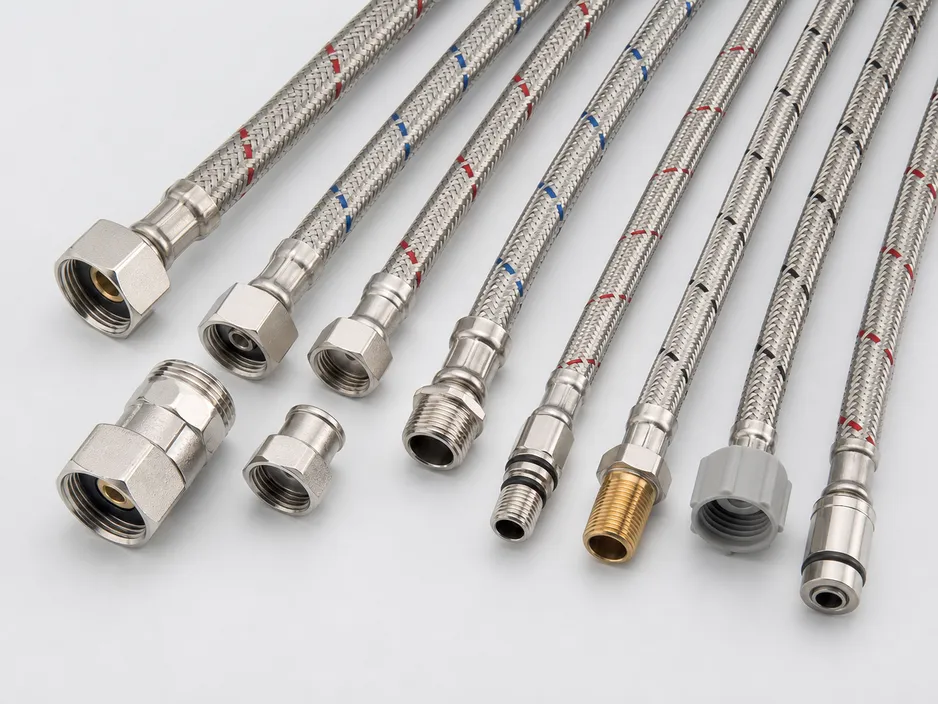
Custom Fitting Capability
We manufacture all of these fitting configurations. For OEM orders, we can also produce custom fitting configurations to match your existing faucet line — send us the faucet body drawing or a sample fitting and we'll machine a matching end.
Fitting Reference by Market
| Market | Supply Hose Fitting | Pull-Down Fitting |
|---|---|---|
| US / Canada | 3/8" compression (standard) or 1/2" NPT | 1/2" UNF male (standard) |
| Europe | G3/8" or G1/2" BSP | M10×1 or custom per faucet |
| Australia | 3/8" compression (WaterMark compliant) | Custom per faucet spec |
| Middle East | G3/8" BSP (common) or 3/8" compression | Custom per project spec |
Where Kitchen Faucet Hoses Move: Market Segments Worth Targeting
Kitchen faucet hoses are a replacement parts category — demand is driven by the installed base of kitchen faucets, not by new construction alone. That's a different commercial dynamic than selling faucets, and it's worth understanding if you're building a distribution program around this product.
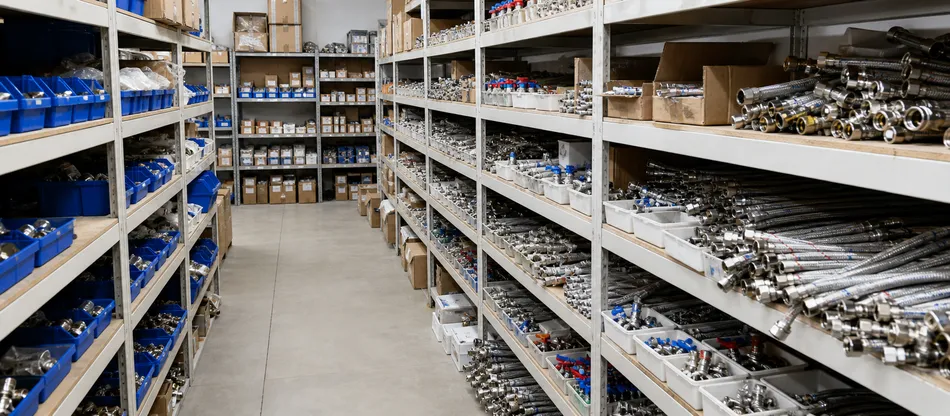
Highest Volume Channel
Plumbing Wholesale & Distribution
The highest-volume channel for supply hoses. Plumbing distributors stock hoses as a consumable alongside shut-off valves, supply lines, and P-traps. A distributor carrying 24" and 36" supply hoses in both 3/8" compression and 1/2" NPT configurations covers the majority of residential service calls.
Reorder frequency: A mid-size plumbing distributor might turn this SKU 8–12 times per year. Demand is predictable and the product is not brand-sensitive at the end-user level — making supply hoses a logical anchor SKU for any private-label plumbing accessories line.
Component Sourcing
Kitchen Faucet OEM Programs
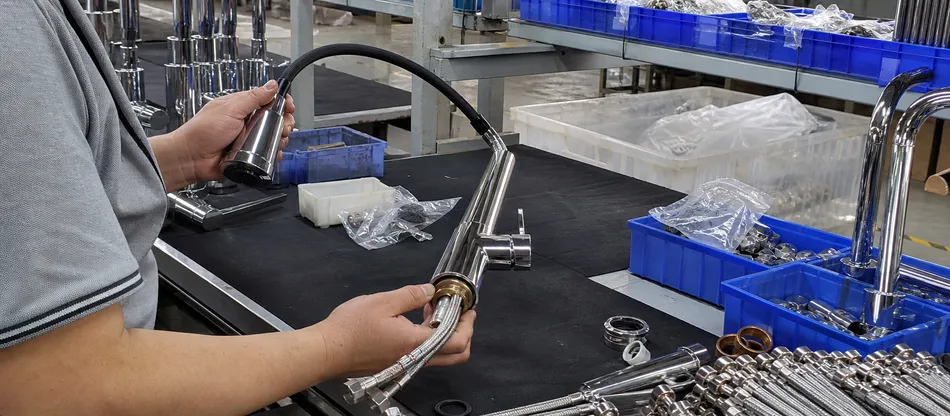
If you're manufacturing or sourcing kitchen faucets — particularly pull-down and pull-out models — you need a pull-down spray hose that's spec'd to your faucet design. Sourcing the hose from the same factory as the faucet eliminates the tolerance mismatch problem.
We supply pull-down hoses as a component to several buyers who assemble faucets under their own brand, coordinating the hose spec with the faucet body drawing so the assembly fits correctly the first time.
Amazon & Online Retail
E-Commerce Replacement Parts
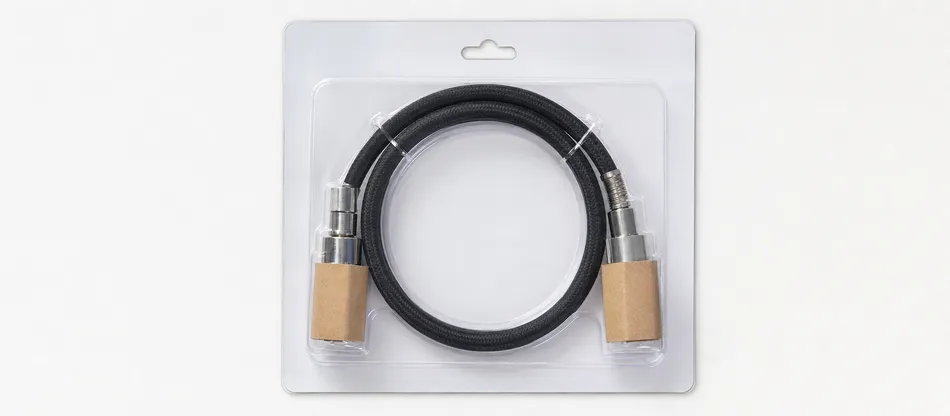
The kitchen faucet replacement hose market on Amazon and similar platforms is substantial. Buyers searching "kitchen faucet replacement hose" are typically homeowners or plumbers replacing a failed hose on an existing faucet — they need a hose that fits standard configurations and ships in retail-ready packaging.
For buyers building an e-commerce accessories catalog, we supply hoses with retail blister packaging, UPC barcodes, and hang tags pre-applied. The packaging is designed to survive FBA warehouse handling without the fittings getting damaged.
We added cardboard end caps to the fitting ends after seeing a batch arrive at an Amazon warehouse with thread damage from loose fittings rattling in the poly bag. The end caps add $0.04 per unit and eliminate the problem.
Scheduled Maintenance
Hospitality & Commercial Renovation
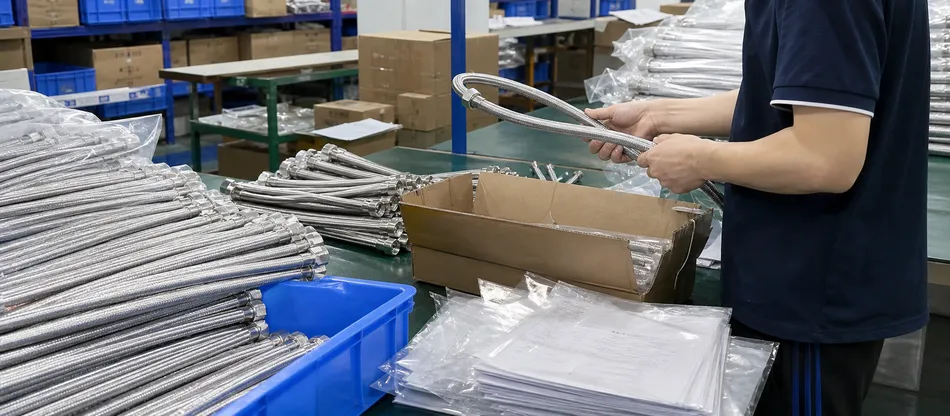
Hotels and commercial kitchens replace supply hoses on a scheduled maintenance cycle — typically every 5–7 years as a preventive measure, regardless of visible wear. A facilities management company running 200 hotel properties might order 2,000–5,000 supply hoses per year on a maintenance contract.
Key spec for this segment: burst pressure documentation. Facilities managers need the test report to satisfy their insurance requirements. Every batch ships with full pressure test documentation included.
Ready to discuss your target volume?
Whether you're building a private-label line, sourcing OEM components, or setting up an e-commerce catalog, we can spec the right hose configuration for your channel.
How We Make the Hoses: Process Details That Affect Your Warranty Exposure
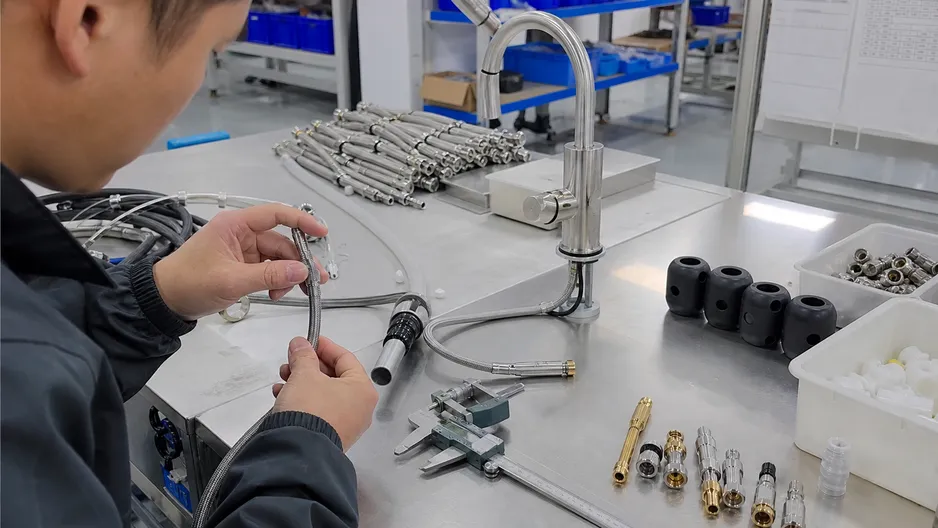
The manufacturing steps that determine hose reliability are the ones that happen before the hose looks finished — inner tube extrusion quality, braiding tension consistency, and fitting crimping force.
Inner Tube Extrusion
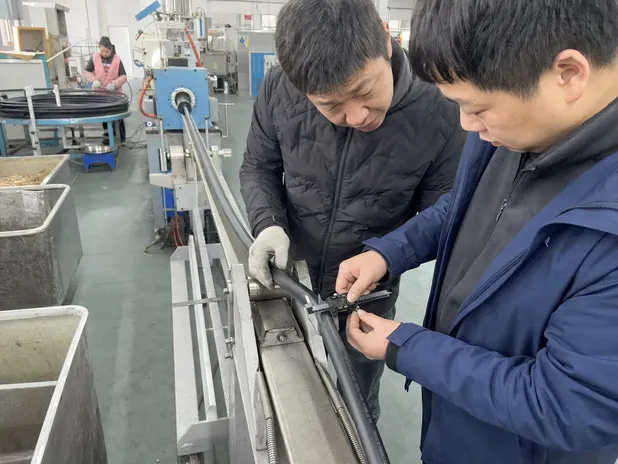
Inner tube extrusion is where most hose failures originate. An EPDM tube with inconsistent wall thickness will have thin spots that fail under pressure cycling — the tube expands and contracts with each pressure surge, and a thin spot develops a pinhole over time.
Wall thickness tolerance: ±0.15mm
100% visual inspection of extruded tube before braiding. Tubes with visible surface defects or diameter variation outside tolerance are rejected before they reach the braiding machine.
Catching the defect at extrusion costs nothing compared to catching it after the fitting is crimped.
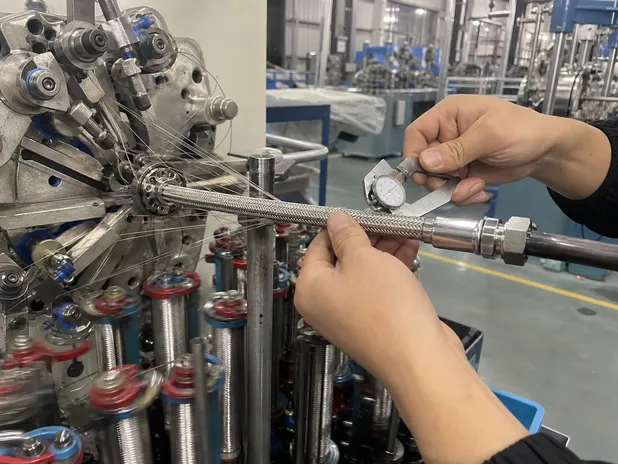
Braiding Tension
Braiding tension is the variable that determines whether the stainless braid provides consistent burst pressure across the full length of the hose. Loose braiding at the fitting ends — which happens when the braiding machine tension isn't set correctly for the fitting diameter transition — creates a weak point right where the hose is most stressed.
Target braid angle: 54°44'
The "neutral angle" where the braid provides equal resistance to both elongation and compression. Deviation from this angle reduces burst pressure. Tension is calibrated to the fitting OD, and braid angle at fitting ends is checked on every production run.
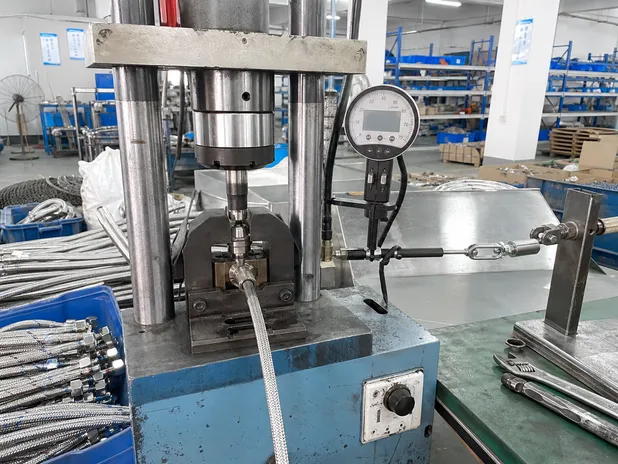
Fitting Crimping
The crimp force has to be high enough to create a gas-tight seal between the fitting and the inner tube, but not so high that it cuts into the tube wall. We use hydraulic crimping presses with force gauges calibrated quarterly.
Destructive pull-out test: 200 lbs axial pull force
A sample is pulled from each production run. The fitting must withstand 200 lbs of axial pull force before the tube separates. Every batch ships with the pull-out test result in the documentation package.
Why These Steps Matter for Your Warranty Exposure
Each of the three process controls above maps directly to a failure mode that generates warranty claims. Thin-spot pinholes, fitting-end burst failures, and fitting pull-outs are the three most common field failures in braided supply hoses — and all three are preventable at the manufacturing stage, not the inspection stage.
Extrusion
±0.15mm wall tolerance
100% pre-braid visual inspection
Braiding
54°44' neutral angle
Per-run fitting-end braid check
Crimping
200 lb pull-out test
Quarterly press calibration
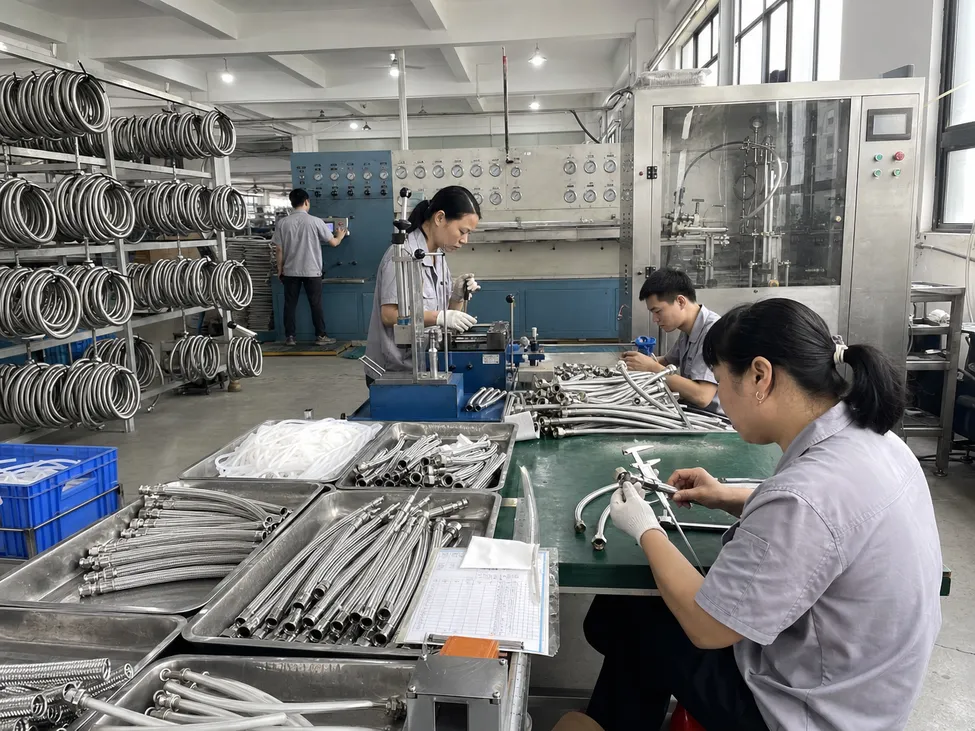
OEM Kitchen Faucet Hoses: Private Label from 200 Pieces
Most buyers sourcing kitchen faucet hoses at scale are running private-label programs. The category is not brand-sensitive at the end-user level — your brand on the packaging is what matters, not ours on the hose.
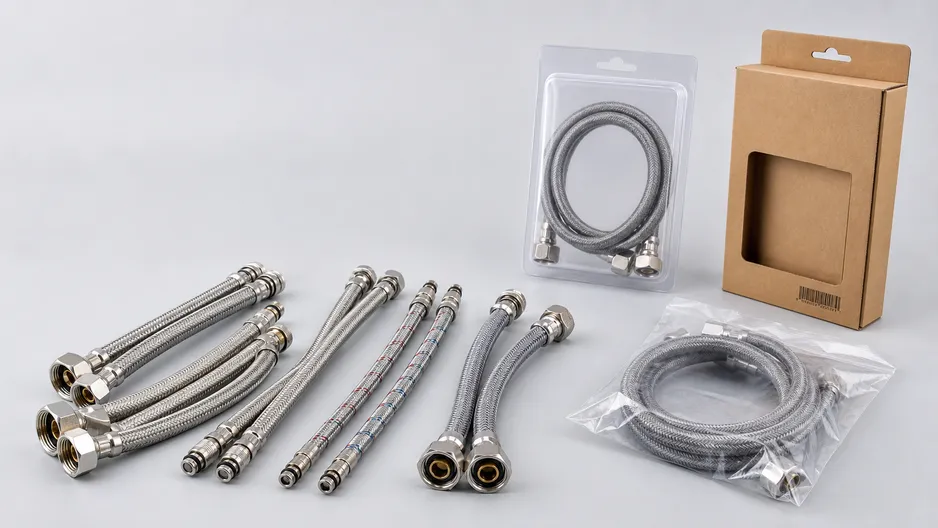
Supply Hose OEM Customization
Configurable Parameters
-
Length — 12" to 72" range
-
End Fitting — 3/8" compression, 1/2" NPT, G3/8" BSP, G1/2" BSP, or custom
-
Braiding Material — 304 stainless or nylon
-
Finish — Chrome or brushed nickel on fittings
-
Packaging — Retail blister pack, bulk poly bag, or branded box with your UPC and hang tag
MOQ: 200 pieces per SKU — low enough to test a new SKU in your market before committing to a full container.
Pull-Down Spray Hose OEM Options
Configurable Parameters
-
Length — custom to your faucet design
-
Faucet-End Fitting — configuration matched to your faucet body
-
Counterweight Sleeve — included or excluded
-
Packaging — retail or bulk, branded to your spec
Pairing with a faucet design?
Send us the faucet body drawing and we'll confirm the fitting spec and bend radius compatibility before you place the order. This qualification process typically takes 5–7 days to review the drawing and confirm or propose a fitting modification.
Standard OEM Lead Time
15–20 days
From order confirmation. Applies to existing tooling with new length or packaging configuration.
Custom Fitting Tooling
+15–20 days
Added for new fitting configurations requiring die fabrication. We maintain an in-house tooling room — revisions don't go to an outside vendor.
Coordinated Container Shipping
If you're sourcing hoses to pair with kitchen faucets you're also buying from us, we can coordinate production schedules so hoses and faucets arrive in the same container. One freight booking instead of two — a landed cost saving that compounds quickly on a 12-month replenishment program.
Compliance Documentation by Destination Market
Supply hoses sold into regulated markets need documentation that travels with the shipment. Here's what we provide by market.
Destination Market
North America
Manufacturing Standard
ASME A112.18.6 / CSA B125.6 for flexible water connectors.
Lead Compliance
Brass fittings use C36000-equivalent alloy with lead content below 0.25% — compliant with California AB 1953 and the federal Reduction of Lead in Drinking Water Act.
Canadian Market
cUPC certification covers hose assemblies for Canadian plumbing code compliance.
Included Documentation
Destination Market
Europe
CE Marking
CE marking covers hose assemblies for EU market entry. Relevant standard: EN 13618 for flexible hose assemblies in drinking water installations.
Material Approval
EPDM inner tube is WRAS-approved material, suitable for contact with drinking water.
Included Documentation
Destination Market
Australia
WaterMark Certification
WaterMark certification is required for plumbing products sold in Australia. Our supply hoses carry WaterMark, and certification documentation is included with every shipment to Australian buyers.
Applicable Standard
AS/NZS 3718.
Included Documentation
Destination Market
Middle East / Southeast Asia
SGS Test Reports
SGS test reports are available for all hose lines. Most Gulf and ASEAN markets accept SGS documentation for import clearance.
Saudi Arabia & UAE
SASO and ESMA documentation available on request for buyers supplying into Saudi Arabia or UAE.
Available Documentation
Building a Multi-Market Catalog?
If you need hoses certified for more than one region, we supply the same SKU with the full documentation package — cUPC + CE + WaterMark on one part number. That simplifies your inventory management and your customs documentation considerably.
cUPC
North America
CE
Europe
WaterMark
Australia
One part number. Full documentation package. Simplified customs.
Logistics & Cost Planning
Packaging, Container Loading, and Landed Cost per Unit
Supply hoses are a high-volume, moderate-CBM product. Container loading efficiency directly affects your landed cost per unit, and the packaging format affects your downstream handling cost.
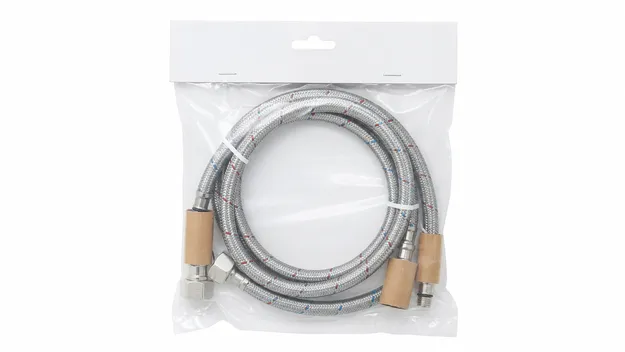
Standard Retail Packaging
Each hose is coiled and poly-bagged with a header card showing the length, fitting configuration, and your brand (on OEM orders). Cardboard end caps protect the fittings during transit.
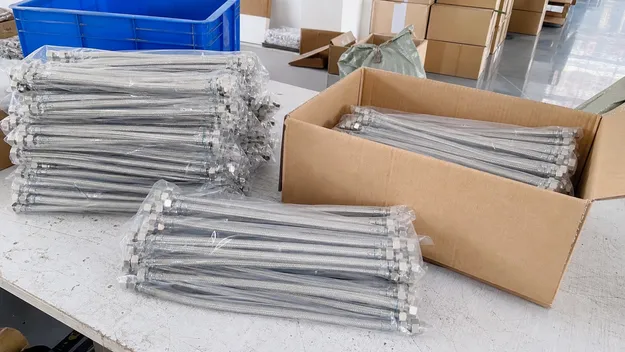
Bulk Packaging
For buyers supplying into plumbing wholesale where retail packaging isn't needed. Hoses supplied in bulk poly bags, 50 units per master carton.
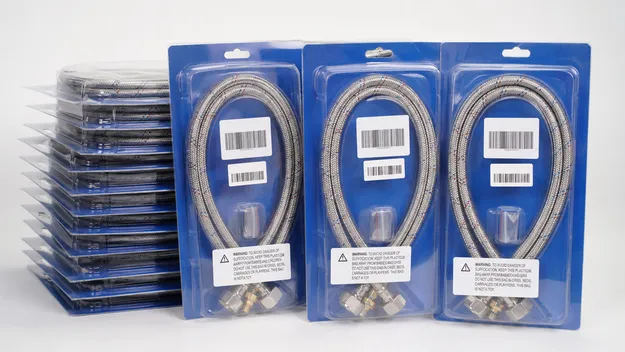
E-Commerce Packaging
For Amazon FBA or similar fulfillment. Retail blister packs with UPC barcode, FNSKU label, and suffocation warning pre-applied. Blister cavity depth is designed to survive drop testing without fitting corners breaking through the card backing.
Consolidating Hoses with a Faucet Order?
For buyers consolidating hoses with a faucet order into one container, we coordinate the packing sequence and provide a single combined packing list. Your freight forwarder gets one document, not two.
Buyer Questions
Frequently Asked Questions
Decision-support answers for buyers sourcing kitchen faucet hoses — covering product selection, market specs, compatibility, compliance, and OEM options.
What is the difference between a supply hose and a pull-down spray hose, and how do I know which one I need?
A supply hose connects the faucet body to the shut-off valve under the sink — it carries water at line pressure and doesn't flex during normal use. A pull-down spray hose is the internal hose inside a pull-down or pull-out kitchen faucet that connects the spray head to the faucet body — it flexes every time the spray head is extended and retracted.
If you're sourcing replacement parts for standard kitchen faucets (deck-mount, wall-mount, two-handle), you need supply hoses. If you're sourcing components for pull-down or pull-out faucets, or assembling pull-down faucets under your own brand, you need pull-down spray hoses. Most replacement parts programs stock both.
What fitting configuration do I need for the North American market?
For residential supply hoses in the US and Canada, 3/8" compression on both ends covers the majority of installations — most residential shut-off valves use 3/8" OD compression outlets, and most faucet inlets accept 3/8" compression. For older construction with 1/2" IPS valves, a 3/8" compression × 1/2" FIP configuration covers the gap.
If you're building a replacement parts catalog for the North American market and want to cover 90%+ of installations with two SKUs, stock 3/8" compression × 3/8" compression in 24" and 36" lengths and you'll cover the majority of service calls.
How do I verify that a pull-down spray hose is compatible with my faucet design before ordering?
Send us the faucet body drawing (or a sample of the existing hose if you're replacing a current supplier) and we'll confirm fitting compatibility and bend radius before you commit to a production order.
The two parameters that determine compatibility are the faucet-end fitting thread spec and the minimum bend radius inside the faucet neck. If the existing hose is from another supplier, we can usually match the fitting spec from a sample — we've done this for several buyers transitioning their faucet supply chain to us.
What burst pressure standard applies to kitchen faucet supply hoses in the US market?
ASME A112.18.6 / CSA B125.6 is the governing standard for flexible water connectors in the US and Canada. It requires a minimum burst pressure of 500 PSI for supply hoses.
Our standard supply hoses are tested to 500 PSI on every production batch. If your buyer or their compliance team needs the test report, we include it in the shipment documentation — you don't need to request it separately.
Can you supply kitchen faucet hoses with custom lengths for a specific faucet installation requirement?
Yes. We manufacture supply hoses in lengths from 12" to 72" on OEM orders, and pull-down spray hoses in lengths from 47" to 79". Standard lengths (24" and 36" for supply hoses; 59" and 71" for pull-down hoses) ship from stock or with standard lead times.
Custom lengths use existing tooling — only the cut length and crimp position change — so there's no tooling cost for length customization. MOQ for custom lengths is 200 pieces per SKU.
What is your MOQ for private-label kitchen faucet hoses, and what customization is available?
MOQ is 200 pieces per SKU. Customization options include: length, end fitting configuration (3/8" compression, 1/2" NPT, BSP, or custom), braiding material (stainless or nylon), fitting finish (chrome or brushed nickel), and packaging (retail blister, bulk poly bag, or branded box with your UPC and hang tag).
For custom fitting configurations that require new tooling, we quote tooling cost separately — typically $600–$1,200 depending on fitting complexity, amortized over the first production run.
Complete Your Sourcing Program
Other Components in the Same Catalog
These sibling products ship from the same factory and can be consolidated into one container — useful if you're building a faucet accessories or replacement parts program.
Shower Components
Shower Faucet Cartridges
25mm, 35mm, and 40mm ceramic disc cartridges, 500,000-cycle endurance tested. The natural pairing for buyers supplying faucet replacement parts to plumbing distributors.
View CartridgesKitchen Components
Kitchen Faucet Aerators
Swivel and fixed aerators for kitchen spouts, 50,000 switch-cycle tested. Rounds out a kitchen faucet replacement parts SKU set alongside supply hoses.
View AeratorsStandard Range
Faucet Aerators
Standard M16–M24 aerators in male and female thread configurations. The highest-volume replacement parts SKU in most plumbing distribution catalogs.
View AeratorsFor the full component range and category-level specifications, see Faucet Aerators & Components.
Source Kitchen Faucet Hoses from the Factory That Makes the Faucets
We've been manufacturing kitchen faucet hoses since 2008 as part of an integrated faucet manufacturing operation — not as a standalone hose supplier.
The brass fittings are machined on the same CNC equipment as our faucet bodies. The EPDM inner tube spec is the same material we use in our faucet valve seats. The QC protocols — burst pressure testing, pull-out testing, dimensional inspection — run on the same schedule as our faucet production batches.
That integration matters when you're sourcing hoses to pair with faucets, building a replacement parts program that needs consistent quality across multiple SKUs, or looking for a single supplier who can handle the documentation for North America, Europe, and Australia from one factory.
Send us your target SKUs, fitting configurations, and volume expectations — we'll come back with a detailed quote, sample availability, and a recommendation on which configurations fit your market and compliance requirements.
Request a Quote
Include target SKUs, fitting configurations, and volume expectations for a detailed quote.
Learn more about our manufacturing capabilities and quality infrastructure on the About Wfaucet page.