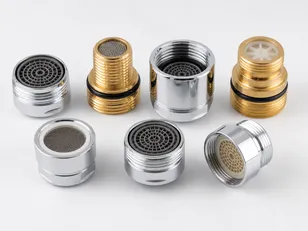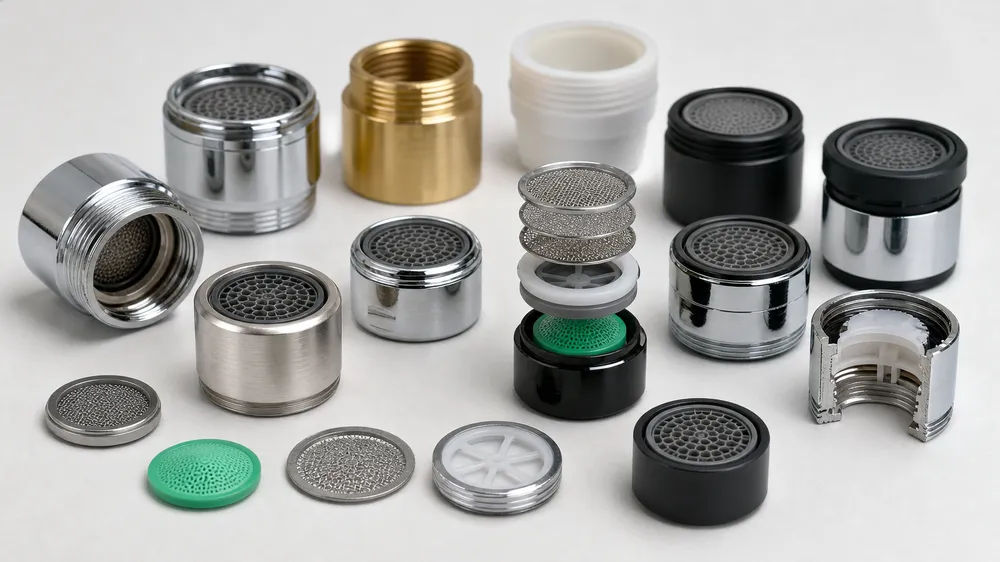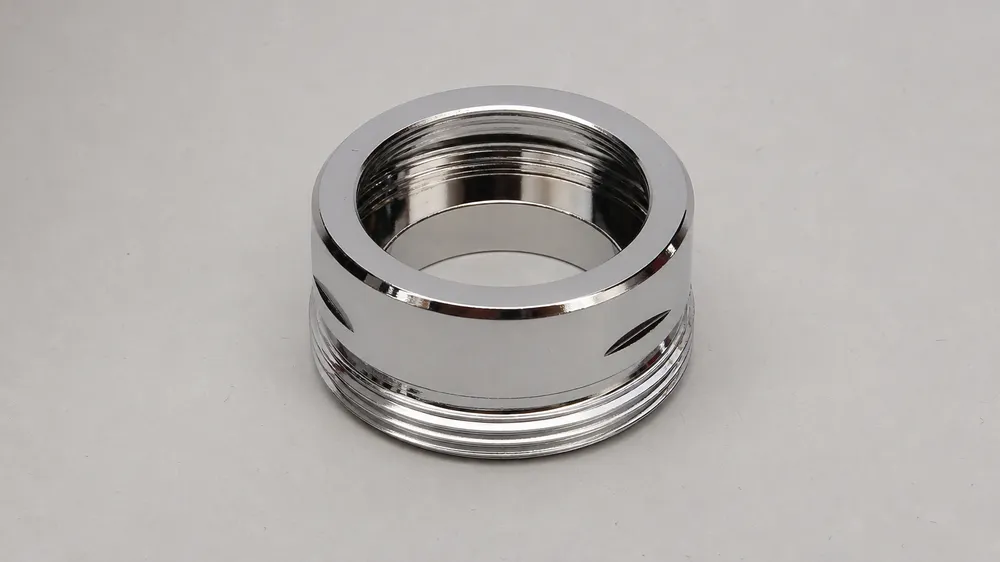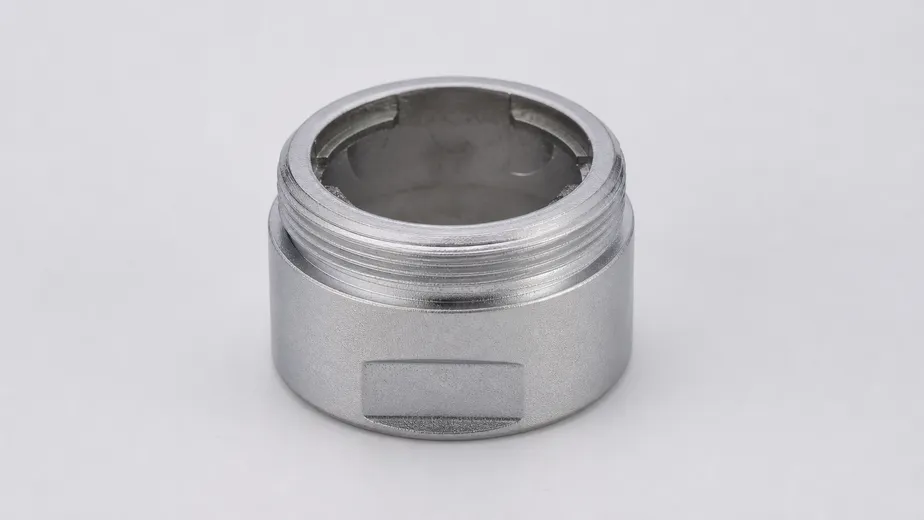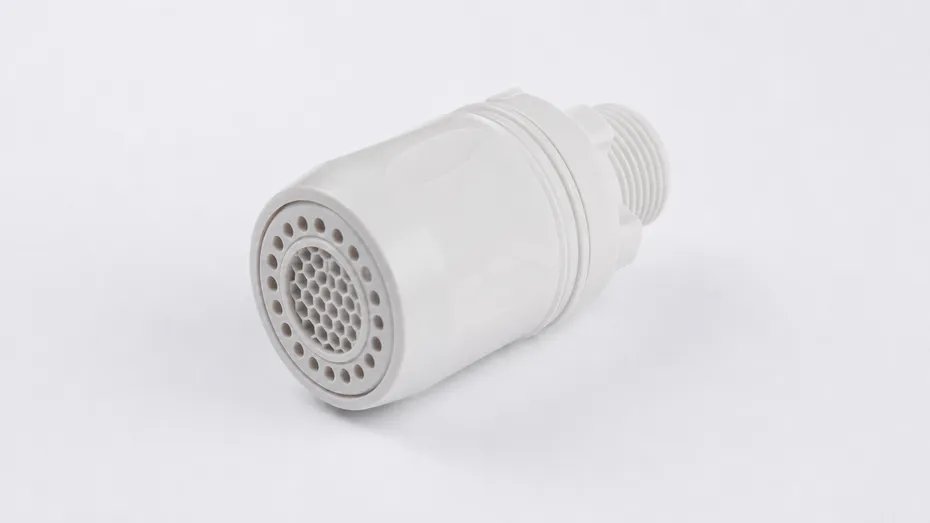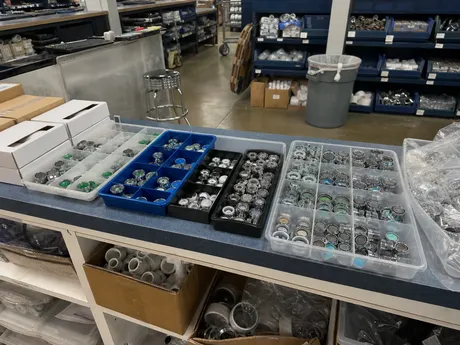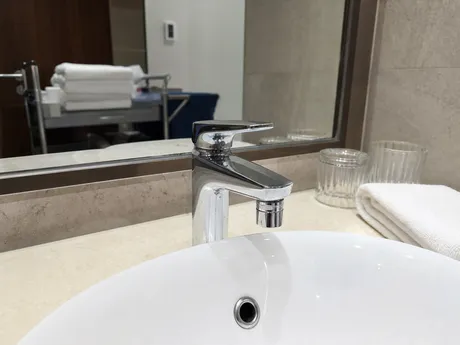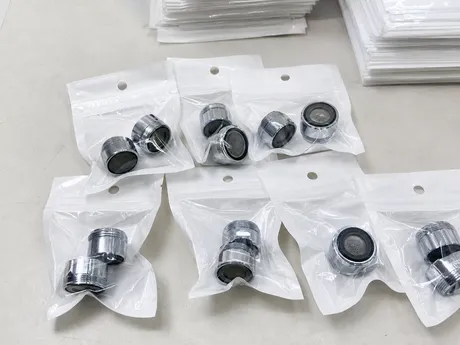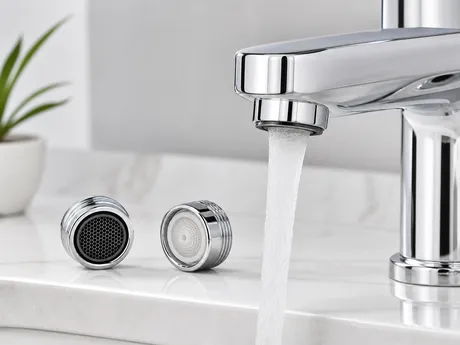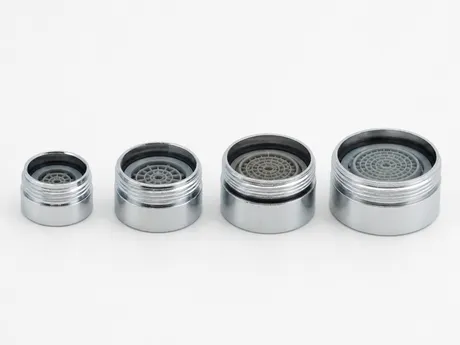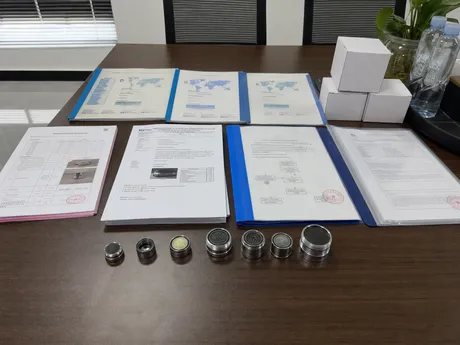

Brass and zinc alloy housings, M16–M24 thread compatibility, flow rates from 0.5 to 2.2 GPM. Every batch ships with compliance documentation for North America, Europe, and Australia.
Thread Range
M16 – M24
Male & Female
Flow Rates
0.5 – 2.2 GPM
7 options
Product Context
The short answer: not much, mechanically. The commercial answer: quite a bit, in terms of how you build a catalog around them.
A sink faucet aerator is the thread-on insert at the tip of any sink spout — kitchen or bathroom — that controls flow rate, reduces splash, and in some configurations adds a pre-filter stage. The "sink" designation matters for sourcing because it signals cross-application compatibility.
Where a kitchen faucet aerator is typically specified for a single spout diameter and a higher flow rate (1.8–2.2 GPM), and a bathroom faucet aerator is usually a compact cache or external unit at 1.0–1.5 GPM, a sink faucet aerator covers both ends of that range. That makes it the right SKU for distributors building a replacement parts assortment that needs to work across a mixed faucet inventory — one part number that fits the kitchen sink and the bathroom vanity, rather than two separate SKUs with overlapping coverage.
Get a Quote for Sink Faucet AeratorsCross-application · 0.5–2.2 GPM
Covers both kitchen and bathroom spout diameters. One SKU that fits a mixed faucet inventory. The right choice for replacement parts assortments and private-label programs spanning a full sink faucet line.
Single-application · 1.8–2.2 GPM
Specified for a single spout diameter at higher flow rates. Optimized for kitchen sink volume demands. Narrower SKU scope — appropriate when the catalog is kitchen-only.
Compact format · 1.0–1.5 GPM
Usually a compact cache or external unit at lower flow rates. Sized for lavatory spout diameters. Appropriate for bathroom-only catalogs; does not cover kitchen sink applications.
Who Specifies Sink Aerators
We've been making aerators since 2008. Buyers who specify sink aerators specifically are almost always in one of two situations:
Both are straightforward to supply — our thread range and flow rate options cover the full sink application spectrum.
Engineering Data
The parameters below represent our standard production range for sink faucet aerators. Exact specifications for your order depend on thread size, flow rate, housing material, and finish selection — all of which are configurable within these ranges.
Contact us to confirm exact parameters for your application
The thread size question is where most sourcing errors happen. These two sizes are not interchangeable:
M22×1
Dominant thread in North American sink faucets
M24×1
Standard across most European product
If you're building a cross-market replacement parts catalog, you need both. We manufacture all four male and four female sizes — a single supplier relationship covers your full thread range.
Flow rate requires market-specific attention. Key compliance thresholds:
One housing, multiple flow rates: The flow restrictor disc is a separate insert. You can run multiple flow rate variants without changing the housing SKU.
Share your thread size and flow rate requirements and we'll confirm production availability and lead time.
Request a QuoteThis is the decision that has the most downstream impact on your business, and it's the one most buyers underspecify on their first order. We manufacture sink aerator housings in three materials: brass (C36000-equivalent free-machining alloy), zinc alloy (ZA-8), and ABS. The choice determines your finish durability, your warranty exposure in different climate markets, and your price positioning.
Premium Tier
The right call for any product going into a premium channel, a commercial application, or a coastal/humid market. Brass holds thread tolerances across temperature cycling — the thread interface doesn't loosen over time the way zinc alloy can in markets with significant temperature swings.
Warranty note: Chrome on zinc alloy typically shows corrosion at the thread interface within 12–18 months in humid climates. That's the kind of slow-burn warranty claim that damages your brand with distributors before you can trace it back to the aerator housing material.
Mid-Market Tier
Appropriate for mid-market price points where the retail price target doesn't support brass. ZA-8 has better corrosion resistance than standard Zamak, which is why we use it rather than the cheaper alloy.
Cost math: Brass adds $0.12–0.18 per unit over zinc alloy. Buyers who specify zinc alloy to hit a price point and then sell into a humid market almost always come back to brass after their first warranty season — paying for it in warranty costs instead of unit cost.
Entry / Consumable Tier
For price-sensitive applications where the aerator is essentially a consumable — filter aerator configurations where the buyer expects to replace the whole unit every 6–12 months, or entry-level product where appearance is secondary to function.
Best for: Filter faucet aerator configurations and entry-level product lines where function takes priority over finish longevity.
| Market / Condition | Brass | Zinc ZA-8 | ABS |
|---|---|---|---|
| Coastal / humid climate (FL, Gulf Coast, SE Asia) | |||
| Premium retail / commercial channel | |||
| Bathroom sink (permanent humidity exposure) | |||
| Mid-market, dry-climate interior | |||
| Filter aerator / 6–12 month replacement cycle | |||
| Entry-level, function over finish |
Recommended Acceptable with caveats Not recommended
The commercial logic for stocking sink faucet aerators is straightforward: aerators are the highest-turnover replacement part in any plumbing distribution catalog. They wear out, they get clogged, they get replaced during faucet upgrades. The question is which market segments generate the most predictable reorder volume.
Segment 01
Replacement aerators are a staple SKU in any plumbing distributor's catalog — they move in small quantities but constantly, and they're the kind of product that keeps a contractor coming back to your counter.
Lead SKUs: M22 × M24, 1.0 / 1.5 / 2.2 GPM
Segment 02
Hotels, student housing operators, and facility management companies replace aerators on a scheduled maintenance cycle — typically every 12–24 months across their entire property portfolio.
Lead SKUs: Cache aerators, 1.0–1.5 GPM
Segment 03
Sink faucet aerators are a natural e-commerce product — low weight, easy to ship, high search volume for replacement queries.
Key requirement: Thread sizes matching top-selling faucet brands
Segment 04
WaterSense-compliant aerators (≤1.5 GPM) and ultra-low-flow units (0.5–1.0 GPM) are specified in LEED projects, government building retrofits, and utility rebate programs.
Lead SKUs: Low-flow aerators, 0.5 / 1.0 / 1.2 / 1.5 GPM
We'll recommend the right aerator configuration — housing material, flow rate, thread size, and packaging — based on your distribution channel and destination market.
Thread size, flow rate, housing material, and aerator type are the four variables that determine whether a unit fits and performs. Here's how each one works and what the standard options are.
Thread size is the first compatibility check. Most residential faucets use M22 (male) or M24 (male), with female variants for recessed spouts. Mismatched threads are the most common reason for returns.
Flow rate is set by the restrictor insert inside the aerator body. It's the spec most likely to be driven by regulation — California, for example, mandates ≤1.2 GPM for lavatory faucets.
Housing material affects durability, corrosion resistance, and price point. The right choice depends on your end market and whether the aerator is visible or recessed.
Type determines installation method and tamper resistance. Standard units thread on by hand; cache aerators recess into the spout and require a key tool for removal — the spec for hospitality and institutional applications.
| Thread Size | Type | Flow Rate | Housing | Spray Pattern | MOQ | Primary Market |
|---|---|---|---|---|---|---|
| M22 × 1mm (M) | Standard external | 1.0 / 1.5 / 2.2 GPM | Chrome brass / ABS | Aerated / laminar | 500 pcs | US residential, wholesale |
| M24 × 1mm (M) | Standard external | 1.0 / 1.5 / 2.2 GPM | Chrome brass / ABS | Aerated / laminar | 500 pcs | EU / AU residential |
| M22 × 1mm (F) | Cache (recessed) | 0.5 / 1.0 / 1.5 GPM | Chrome brass | Laminar | 200 pcs | Hospitality, institutional |
| M24 × 1mm (F) | Cache (recessed) | 0.5 / 1.0 / 1.5 GPM | Chrome brass | Laminar | 200 pcs | EU hospitality |
| M22 / M24 dual | Dual-thread universal | 1.5 / 2.2 GPM | ABS / zinc alloy | Aerated | 1,000 pcs | E-commerce, retail |
| M18 × 1mm (M) | Standard external | 0.5 / 1.0 GPM | Chrome brass | Laminar | 500 pcs | Bar sinks, compact faucets |
| 15/16" – 55/64" | Standard external | 1.0 / 1.5 / 2.2 GPM | Chrome brass / ABS | Aerated | 500 pcs | US replacement market |
MOQ figures are indicative for standard configurations. Custom flow rates, finishes, and private-label packaging may carry different minimums — confirm with your account manager.
Aerated flow mixes air into the stream — it's the standard for residential sinks, feels full at lower GPM, and is the default for most replacement aerators. Laminar flow produces a clear, non-splashing stream and is specified for healthcare and food-service environments where aerated flow can create aerosol risk.
Cache aerators require a matching removal key — the key profile is specific to the aerator model. We supply matching keys with every cache aerator order and can include spare keys in your packaging if your end customer is a facilities team that needs them on hand for maintenance cycles.
We can provide full technical data sheets, flow rate test reports, and material certifications for any SKU in our catalog. Request them before you place your first order.
Sourcing Guidance
The most common sourcing question we get on sink aerators is: "Will this fit Brand X?" The honest answer is that thread size is standardized, but you need to verify before you commit to a production order.
M22×1 — North American Standard
The majority of US-manufactured and US-market faucets use M22×1 male thread on the spout exterior (external aerators) or M22×1 female thread on the spout interior (cache aerators). Delta, Moen, Kohler, and American Standard all use M22 as their primary thread across most of their sink faucet lines.
Exceptions: older product lines and European-market variants from these brands may differ.
M24×1 — European Standard
The standard for most European-origin faucets. Grohe, Hansgrohe, and similar brands use M24×1 as their primary thread specification.
M18×1 — Compact Spout Applications
Appears on smaller-diameter spouts, particularly in compact bathroom faucets and some Asian-market product.
M16×1 — Budget-Tier & Asian Domestic
Less common in Western markets. Appears in some budget-tier product and in certain Asian domestic market faucets.
Practical Minimum Catalog
For buyers building a cross-brand replacement parts assortment, the practical minimum catalog is M22 and M24 in both external and cache configurations, at 1.0 and 1.5 GPM — that covers the majority of North American and European sink faucet applications.
Four-SKU Starter Set
Available as a four-SKU starter set with 200 pieces per SKU — a manageable initial inventory position.
| Thread Size | Primary Market | Representative Brands | Configuration | Notes |
|---|---|---|---|---|
| M22×1 | North America | Delta, Moen, Kohler, American Standard | Male (external) & Female (cache) | Exceptions in older lines and EU-market variants |
| M24×1 | Europe | Grohe, Hansgrohe | Male (external) & Female (cache) | Standard for most European-origin faucets |
| M18×1 | Asia / Compact | Various compact bathroom faucet lines | Male (external) & Female (cache) | Smaller-diameter spouts; some Asian-market product |
| M16×1 | Asia Domestic / Budget | Budget-tier and Asian domestic market faucets | Male (external) & Female (cache) | Less common in Western markets |
Sourcing Aerators to Pair with Wfaucet Faucets?
If you're sourcing aerators to pair with faucets you're also buying from us, we confirm the thread spec from the faucet drawing — no guesswork, no returns. We manufacture all four thread sizes in both male and female configurations.
Product Detail
Aerator finish is the detail that buyers most often overlook in the spec process and most often hear about from their downstream customers. A chrome faucet with a brushed nickel aerator is a visible mismatch — and in the age of product reviews, visible mismatches generate one-star comments that affect your conversion rate on the whole product listing.
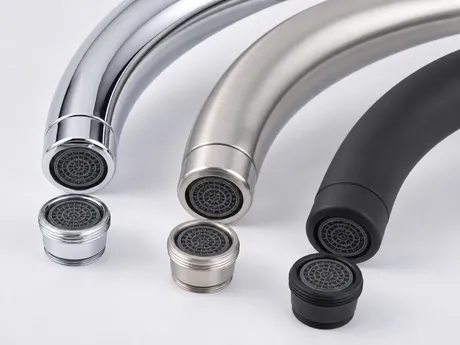
Chrome
Copper base coat, nickel mid-coat, chrome top coat — the same electroplating process used on Wfaucet faucet bodies. Color and sheen match our faucet finishes directly.
Salt spray: 24-hour minimum standard; most batches clear 48 hours.
Brushed Nickel
Same plating stack as chrome — copper base, nickel mid-coat — with a mechanical brushing step on the nickel layer before the final clear coat.
Consistent brush direction and texture matched to Wfaucet faucet body finish.
Matte Black
PVD coating over brass or zinc alloy housing. 0.3–0.5μm thickness. Cross-cut adhesion tested per batch.
PVD process delivers consistent matte depth and durability across production runs.
Sourcing from Another Manufacturer?
If you're sourcing aerators to pair with faucets from another manufacturer, send us a sample or a finish specification and we'll match as closely as the process allows.
Bathroom Vanity Note
The finish matching issue is more acute for bathroom sink faucet aerator applications than for kitchen — bathroom vanity faucets are more visible and more likely to be photographed for product listings. If you're building a bathroom-focused catalog, get a finish sample before you commit to a production run.
Finish Coverage
3 Finishes
Chrome, Brushed Nickel, Matte Black — covering dominant North American and European faucet finish programs
Chrome Durability
48h Salt Spray
Most batches clear 48-hour salt spray; 24-hour minimum standard across all chrome production
Matte Black PVD
0.3–0.5μm
PVD coating thickness with cross-cut adhesion testing performed per production batch
Most of our aerator buyers are running private-label programs. The process is straightforward and the MOQ is low enough to test a new SKU before committing to volume.
Housing Material
Brass, zinc alloy, or ABS — your choice based on market and price point
Thread Size
Any of our eight standard thread configurations (M16–M24, male and female)
Flow Rate
Any of our six standard flow rates (0.5–2.2 GPM) — the restrictor disc is a separate insert, so multiple flow rates run from the same housing tooling
Finish
Chrome, brushed nickel, or matte black
Logo
Engraved or pad-printed on the housing cap
Packaging
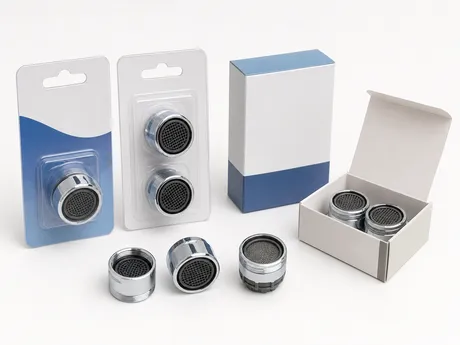
Retail polybag with header card, retail blister pack, bulk poly bag, or branded box with your UPC barcode pre-applied
Minimum Order
200 pcs
per SKU
Existing Tooling
15–20 days
new finish, flow rate, or packaging
New Tooling
+20–25 days
new housing profile or non-standard thread
Tooling Cost
$800–$1,500
quoted separately, amortized over first run
Multi-SKU programs: For buyers building a multi-SKU aerator program, we can coordinate production across SKUs so they ship in the same container — which matters for landed cost when you're running 200 pieces each of six different configurations.
Sink faucet aerators sold into regulated markets need the right documentation to clear customs and meet point-of-sale requirements. Here's what we supply for each major market.
United States
Our brass aerator housings use C36000-equivalent alloy with lead content below 0.25% — compliant with California AB 1953 and the federal Reduction of Lead in Drinking Water Act (NSF/ANSI 61 wetted surface requirements).
cUPC certification covers our aerators for US and Canadian plumbing code compliance.
WaterSense Programs
We supply aerators at ≤1.5 GPM (federal) and ≤1.2 GPM (California CEC). WaterSense certification requires third-party testing by an EPA-recognized laboratory — we supply the compliant aerator and can connect you with a testing lab for the label process.
Europe
CE marking covers our aerators for EU market entry. Thread dimensions are manufactured to EN 246 tolerances (M22×1 and M24×1).
EU Water Label
Voluntary but increasingly expected by major European retailers. We can supply aerators at ≤6 L/min (≈1.6 GPM) for lavatory applications to meet the label's efficiency threshold.
Australia
WaterMark certification is required for plumbing products sold in Australia. Our aerators carry WaterMark, and the certification documentation ships with every Australian order.
WELS star rating packaging is available for buyers who need it.
Middle East & Southeast Asia
SGS test reports are available for all aerator lines and are accepted for import clearance in most Gulf and ASEAN markets without additional local certification.
If you're building a multi-market catalog and need the same SKU certified for more than one region, we can supply the full documentation package — cUPC + CE + WaterMark on one part number. That simplifies your inventory management and your customs documentation considerably.
One part number. Full documentation. Reduced inventory complexity across markets.
After-Sales Cost Reduction
Aerators are the one faucet component that end users replace themselves — which means installation simplicity directly affects your after-sales call volume. A complicated aerator replacement generates support calls; a straightforward one doesn't.
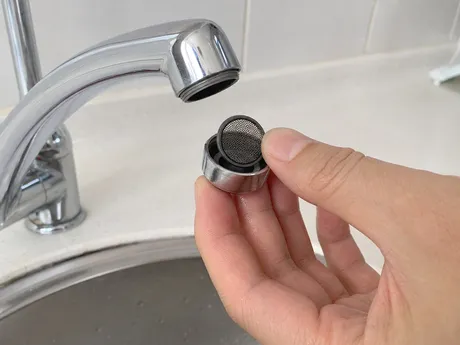
Our standard external sink faucet aerators thread on by hand or with a standard wrench — no special tools, no proprietary key. The housing is designed for tool-free disassembly so the mesh screen can be cleaned without replacing the whole unit.
This matters for your downstream customers in hard-water markets: an aerator that can be cleaned and reinstalled has a longer service life and generates fewer replacement orders — but it also generates fewer warranty claims and support calls.
Cache aerators are the exception — they require a key tool for removal by design. We supply the key tool with every cache aerator order. One key per 50 units is standard; adjust on request.
For commercial buyers selling into hospitality or institutional channels, the key-removal feature is a selling point, not a complication — your buyers in those segments understand why it's there.
Thread compatibility with the installed faucet is the main installation variable. If you've confirmed the thread spec, installation is a 30-second job. If the thread spec is wrong, it's a 100% return.
Confirm thread size from a faucet drawing or a physical sample before committing to a production order.
For replacement parts programs where you're matching against an existing installed base, thread verification is non-negotiable.
Tool-free disassembly and standard thread sizing means end users can install and maintain aerators without contacting your support team.
Cleanable mesh screens extend service life in hard-water markets, reducing the replacement cycle and the warranty exposure that comes with it.
Confirming thread spec before production eliminates the primary cause of aerator returns — a wrong-thread fit that results in a 100% return regardless of product quality.
Complete Aerator Range
Sink faucet aerators cover both kitchen and bathroom sink applications. Depending on your catalog strategy, you may want to source application-specific aerators alongside the universal sink aerator SKU.
Kitchen Application
Swivel-style and dual-function spray/stream aerators sized for kitchen spout diameters, at 1.8–2.2 GPM. The swivel function and higher flow rate are features your kitchen faucet buyers will expect.
Bathroom Application
Compact cache and external thread configurations at 1.0–1.5 GPM, optimized for bathroom vanity applications. Covers compact housing configurations that fit narrow spout diameters.
Water Conservation
0.5 GPM and 1.0 GPM flow-restricted aerators for WaterSense programs, LEED projects, and California CEC compliance. The dedicated SKU when water conservation compliance is the primary driver.
Water Quality
Aerators with integrated replaceable sediment pre-filter inserts, for markets with inconsistent municipal water quality. The filter element is replaceable without removing the housing.
Full Component Range
For the complete component range including cartridges and supply hoses, see the Faucet Aerators & Components category page.
The mechanical function is identical — all three are thread-on inserts that control flow rate and aeration pattern. The distinction is in application scope. Kitchen faucet aerators are typically specified for higher flow rates (1.8–2.2 GPM) and often include swivel or spray/stream switching. Bathroom faucet aerators are usually compact units at 1.0–1.5 GPM. A sink faucet aerator covers both applications — it's the right SKU when you need a single part number that works across a mixed kitchen and bathroom faucet catalog, or when you're building a universal replacement parts assortment.
Unscrew the existing aerator and measure the outside diameter of the male thread (or inside diameter of the female thread) with a caliper. M22×1 (outside diameter approximately 22mm) is the most common thread in North American faucets. M24×1 (outside diameter approximately 24mm) is standard in most European product. If you're sourcing aerators to pair with faucets you're also buying from us, we confirm the thread spec from the faucet drawing — no measurement required on your end.
For the US federal market, 1.5 GPM is the WaterSense ceiling for lavatory faucets. For California specifically, the CEC requirement is 1.2 GPM. If you're selling into both markets from the same SKU, specify 1.2 GPM — it meets both requirements. If you're selling only into non-California US markets and want to carry the WaterSense label, 1.5 GPM is the standard. We manufacture both; the flow restrictor disc is a separate insert in our housing design, so you can run both flow rates from the same housing tooling.
Clogging is almost always sediment or mineral scale accumulating on the mesh screen. Our aerators use a multi-layer mesh stack — a coarser outer screen catches larger particles before they reach the fine inner mesh. The housing is designed for tool-free disassembly so the screen can be cleaned without replacing the whole unit. For hard-water markets, we recommend our filter faucet aerator line, which adds a replaceable sediment pre-filter upstream of the mesh stack. Single-mesh aerators with no pre-filter stage clog within 3 months in hard-water areas and generate a steady stream of warranty calls — we've seen it enough times to be direct about it.
We supply aerators at ≤1.5 GPM (federal WaterSense threshold) and ≤1.2 GPM (California CEC). The aerator spec is the compliance foundation, but WaterSense certification itself requires third-party testing by an EPA-recognized laboratory — the aerator alone doesn't get you the label. We supply the compliant aerator with our internal flow rate test documentation, and we can connect you with a testing lab for the WaterSense certification process if you're building a labeled program.
MOQ is 200 pieces per SKU for OEM orders. Lead time for orders using existing tooling (new finish, flow rate, or packaging) is 15–20 days from order confirmation. New housing profiles or non-standard thread sizes requiring new tooling add 20–25 days; tooling cost is quoted separately, typically $800–$1,500 depending on complexity. For standard catalog items without OEM customization, lead time is 15–20 days and MOQ is also 200 pieces.
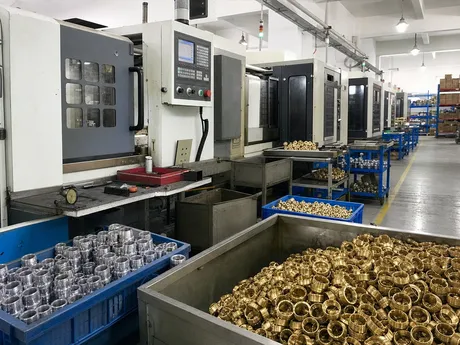
We've been manufacturing sink faucet aerators since 2008 — brass and zinc alloy housings, the full thread range, every flow rate the major markets require. The same QC infrastructure that runs our faucet lines runs our aerator lines: incoming XRF lead testing on every brass batch, multi-layer mesh stack for clog resistance, 24-hour salt spray on every finish batch.
If you're building a replacement parts program, a private-label aerator line, or sourcing aerators to pair with faucets you already carry, send us your thread size, flow rate, housing material preference, and target volume. We'll come back with a detailed quote and, if you're not sure which configuration fits your market, a recommendation based on what's working for our existing buyers in that region.
New to sourcing aerators from a faucet manufacturer?
Most buyers start with a sample set — 5–10 units across the thread sizes and flow rates they're evaluating. We ship samples within 7 days of order confirmation, with flow rate test documentation included.
What to include in your inquiry
Explore Related Aerator Products
© 2026 Wfaucet. All rights reserved.