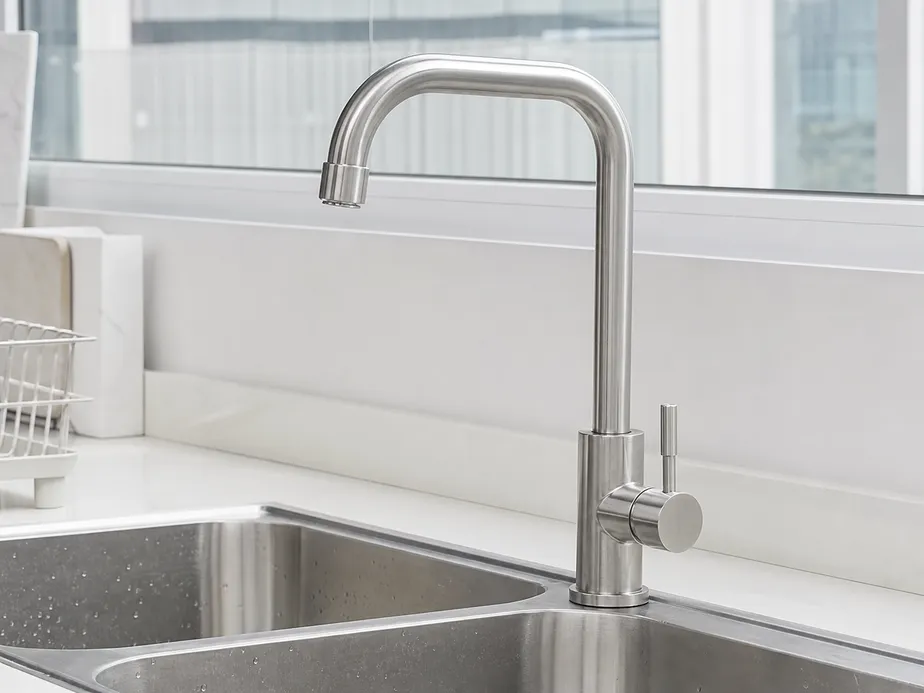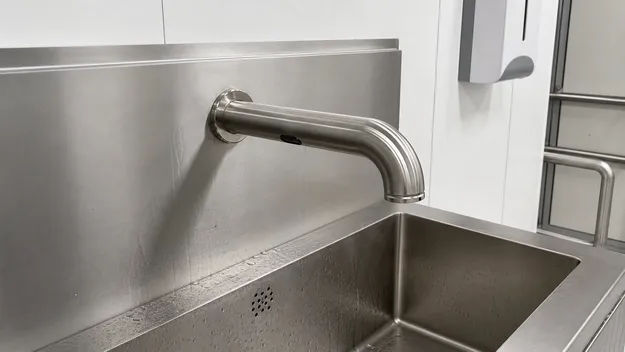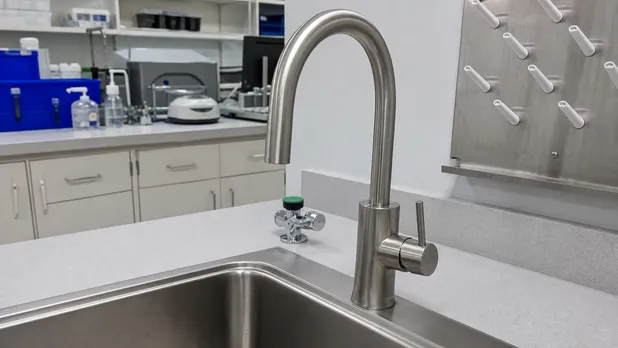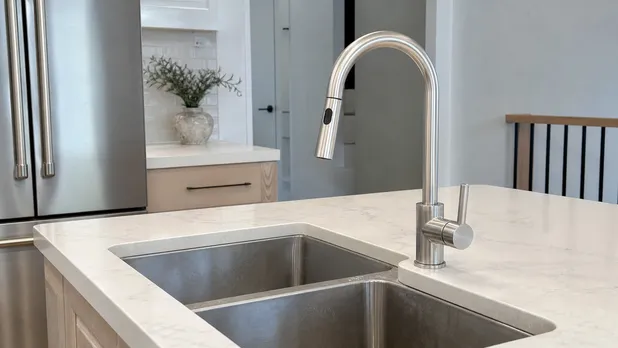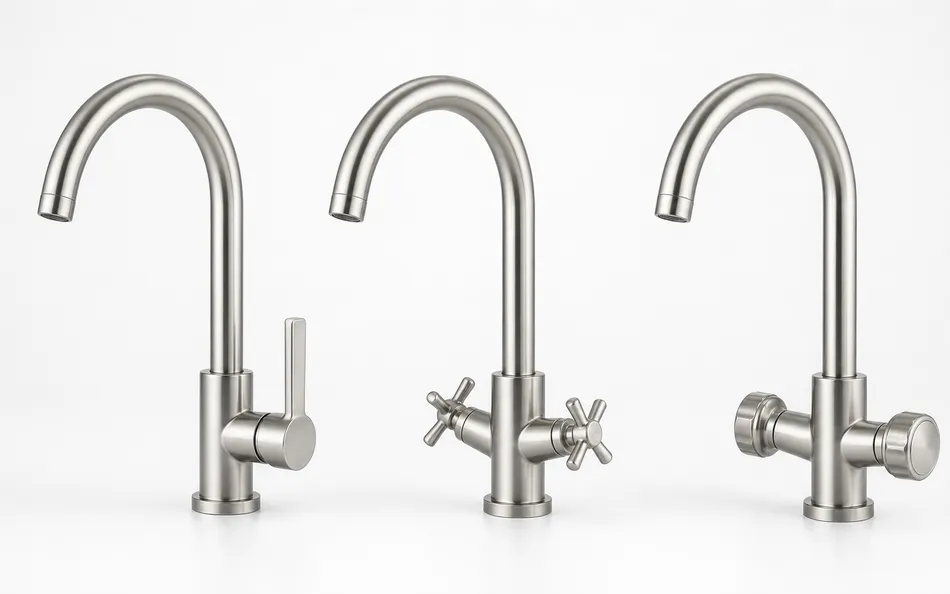

Single-hole and three-hole configurations, brushed and polished finishes, CE/cUPC/WaterMark certified. The visual and material match between a stainless faucet and a stainless sink is the selling point — we manufacture the faucet side of that pairing.
Product Definition
A stainless sink faucet is a deck-mount faucet with a 304 stainless steel body, designed specifically for installation on stainless steel sinks. The distinction from a standard brass faucet with a brushed finish matters commercially: the body material is stainless, not plated brass, so the corrosion resistance is intrinsic rather than coating-dependent.
That difference is what your buyers in commercial kitchen supply, laboratory equipment, and food service distribution are actually specifying when they ask for "stainless."
The deck-mount configuration — single-hole or three-hole — is what separates this product from our stainless mixer taps, which cover a broader range of mounting configurations. Stainless sink faucets are optimized for the sink-pairing application: the spout geometry, the deck plate dimensions, and the finish options are all calibrated for the commercial and specialty sink market rather than for general plumbing distribution.
If your buyers are sourcing faucets to pair with stainless steel sinks — whether for commercial kitchens, laboratory benches, food processing facilities, or the residential market segment that specifies stainless for aesthetic reasons — this is the product.
The parent category page covers the full stainless steel and specialty faucet line, including sensor faucets and brushed finish variants. View the full stainless steel faucet range if you're evaluating the broader category. This page focuses on the stainless sink faucet specifically: its construction, specifications, application segments, and what to verify before you commit to a supplier.
Intrinsic corrosion resistance
304 stainless body — not plated brass. Corrosion resistance is in the material, not a coating stack that can fail.
Sink-pairing geometry
Spout geometry, deck plate dimensions, and finish options calibrated for commercial and specialty sink pairings.
Deck-mount focus
Single-hole and three-hole configurations. Distinct from stainless mixer taps, which cover broader mounting configurations.
Manufacturing Process
The manufacturing path for a stainless sink faucet is different from our brass faucet lines, and that difference is worth understanding because it affects what you can and can't customize, and what failure modes to watch for.
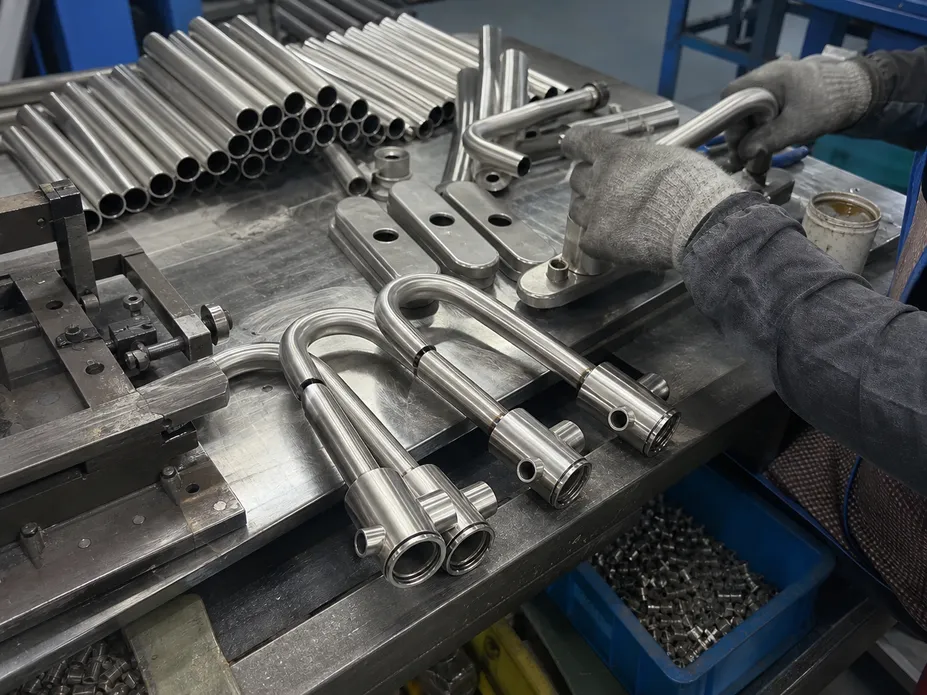
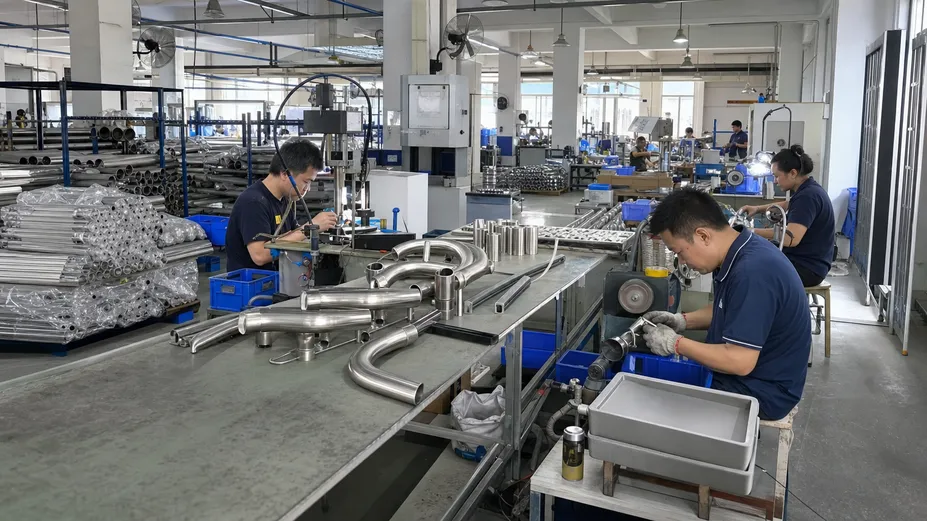
Stainless steel doesn't cast well for faucet bodies — the material properties that give it corrosion resistance also make it difficult to gravity-cast into complex shapes. So stainless sink faucet bodies are fabricated from 304 stainless steel tube and sheet stock, formed by hydroforming and welding rather than casting.
The spout body is typically drawn or hydroformed from tube stock; the base and deck plate are formed from sheet and welded to the spout assembly. This is why stainless faucets have cleaner, more geometric profiles than brass faucets — it's a consequence of the fabrication process, not a design choice made in isolation.
Heat from welding depletes the chromium content in the heat-affected zone — exactly where corrosion initiates if the seam isn't treated post-weld. We passivate all weld seams as a standard production step: acid treatment that restores the chromium oxide layer and closes the corrosion pathway.
This is not universal practice in the industry. We've seen stainless faucets from other factories fail at weld seams within 18 months in commercial kitchen environments. Passivation is the first thing to ask about when qualifying a stainless faucet supplier.
Tube & sheet stock selection
304 stainless tube for spout body; sheet for base and deck plate
Hydroforming & drawing
Spout body drawn or hydroformed from tube stock — produces clean geometric profiles
Welding assembly
Base and deck plate formed from sheet and welded to spout assembly
Weld seam passivation
Acid treatment restores chromium oxide layer at heat-affected zones — standard on every production batch
Surface finishing
Mechanical brushing for brushed finish; progressive polishing for mirror finish — no coating stack
The valve cartridge is ceramic disc — the same specification as our brass faucet lines. 500,000-cycle rated, tested on every production batch. The stainless body changes the body's corrosion behavior; it doesn't change the valve specification.
Internal waterway surfaces are smooth-finished to minimize mineral deposit buildup. This matters in commercial installations where water hardness varies and descaling frequency directly affects maintenance cost.
Brushed finish: mechanical brushing of the stainless surface. Polished finish: progressive polishing to a mirror surface. Neither requires a coating stack — the finish is the material itself. No plating layer to fail, no adhesion to check, no coating thickness to specify.
Because there's no coating stack, finish quality inspection on stainless is about surface consistency: uniform brush direction, no cross-hatching, no visible weld seam through the finish. These are the checkpoints that distinguish production-grade stainless faucets from lower-tier fabrication.
Material Specification
The grade question comes up on almost every commercial and OEM inquiry. Here's the honest answer: 304 is the right choice for the vast majority of sink faucet applications. 316 is the right choice for a specific subset. Understanding the difference prevents both over-specification and under-specification.
| Property | 304 Stainless | 316 Stainless |
|---|---|---|
| Chromium content | 18% | 16–18% |
| Nickel content | 8–10% | 10–14% |
| Molybdenum content | None | 2–3% (key differentiator) |
| Chloride resistance | Good — suitable for most potable water | Superior — resists pitting in chloride-rich environments |
| Typical faucet applications | Residential, commercial kitchen, laboratory, food service | Marine, coastal, chemical processing, high-chloride water |
| Material cost premium | Baseline | ~20–35% higher depending on market |
| Our standard offering | Standard | Available on request |
For OEM and commercial programs that require documented material grade, we provide mill certificates on request. The certificate traces the stainless stock to the originating mill heat, confirming alloy composition against the stated grade. This is standard practice for pharmaceutical, food processing, and government procurement specifications. If your program requires it, ask at the RFQ stage — not after production starts.
Product Configurations
Our stainless sink faucet range covers the configurations most commonly specified for commercial, laboratory, and residential applications. Each configuration has a distinct installation footprint and use case — the right choice depends on the sink deck, the application, and the flow control requirement.
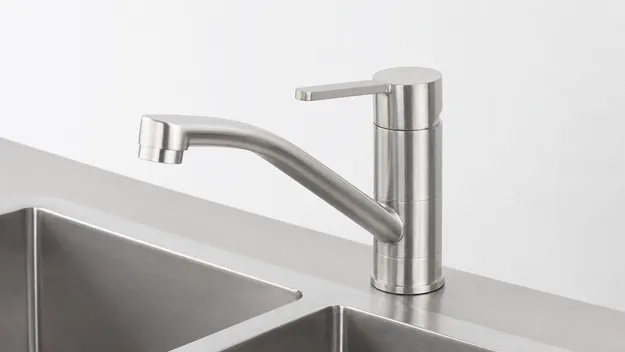
One deck hole, single lever handle controls both temperature and flow. The most specified configuration for commercial kitchen and laboratory sinks. Minimal deck penetration, easy to clean around the base.
Separate hot and cold handles on a shared deck plate or individual escutcheons. Common in laboratory and medical environments where independent temperature control is preferred, and in residential applications matching traditional sink aesthetics.
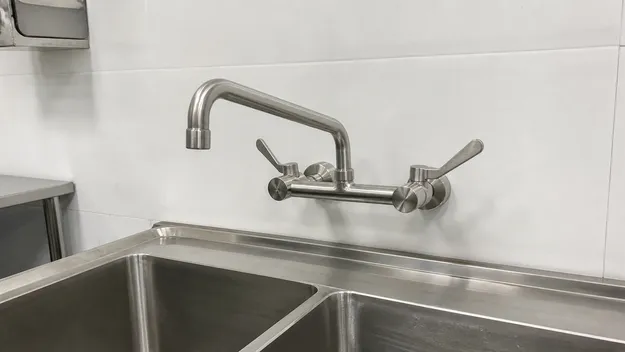
Mounts to the wall above the sink — no deck penetration. Preferred in commercial kitchens and food processing where the sink deck must remain unobstructed for cleaning and sanitation. Requires rough-in supply lines in the wall.
Infrared sensor activation — no handle contact. Specified for medical, food processing, and high-traffic commercial environments where cross-contamination risk drives the specification. Stainless body pairs naturally with the hygienic use case.
Spring-return spout with spray head for commercial dishwashing stations. The stainless body is the natural material choice here — the application demands it. High-cycle, high-temperature, high-chemical-exposure environment.
High-clearance gooseneck spout for laboratory sinks where tall vessels and equipment need to fit under the spout. Stainless is the standard material for lab faucets — chemical resistance and cleanability are the primary drivers.
| Application | Recommended Config | Key Reason |
|---|---|---|
| Commercial kitchen — prep sink | Single-hole or wall-mount | Clean deck, easy sanitation |
| Commercial kitchen — dish station | Pre-rinse spring spout | High-cycle, spray head required |
| Laboratory sink | Gooseneck or two-handle | Vessel clearance, independent temp control |
| Medical / clinical sink | Sensor / touchless | Cross-contamination prevention |
| Food processing facility | Wall-mount or sensor | Unobstructed deck, hygienic operation |
| Residential / hospitality | Single-hole single-handle | Clean aesthetic, minimal footprint |
Material Science
Both grades are austenitic stainless steels with similar mechanical properties. The difference is corrosion resistance in specific environments — and that difference matters when specifying for the wrong application.
18% Cr / 8% Ni — "18/8"
The workhorse grade. Covers the vast majority of commercial kitchen, laboratory, and general-purpose sink faucet applications. Excellent resistance to oxidation, most food acids, and cleaning chemicals at normal concentrations.
Best for
16% Cr / 10% Ni / 2% Mo
The molybdenum addition (2–3%) significantly improves resistance to chloride pitting and crevice corrosion. Specified when the environment includes seawater exposure, high-chlorine sanitizers, or aggressive chemical cleaning cycles.
Best for
Grade alone does not determine faucet quality. Wall thickness of the spout and body is the structural variable that separates commercial-grade from budget product — and it is rarely stated clearly in product listings.
Budget / Residential
0.6–0.8mm
Adequate for low-cycle residential use. Prone to denting and flex under commercial conditions.
Mid-Grade Commercial
1.0–1.2mm
Suitable for most commercial kitchen and laboratory applications. Good balance of weight and durability.
Heavy Commercial
1.5–2.0mm
Specified for high-cycle, high-abuse environments. Noticeably heavier. Longer service life under demanding conditions.
Brushed / Satin (No. 4)
Directional grain finish. Most common for commercial and laboratory. Hides fingerprints and minor scratches. Easy to maintain.
Mirror / Polished (No. 8)
High-reflectivity mirror finish. Preferred for hospitality and architectural applications. Shows fingerprints; requires more frequent wiping.
Matte / Bead-Blast
Uniform low-sheen surface from bead or sand blasting. Non-directional. Common in industrial and food processing environments.
PVD Black / Colored
Physical vapor deposition coating over stainless base. Durable decorative finish for hospitality and residential. Maintains corrosion resistance of base metal.
Installation & Specification
Getting the specification right before ordering avoids the most common field problems: wrong deck hole size, incompatible supply connections, and insufficient spout reach. These are the dimensions and details that matter.
Deck hole diameter and count
Standard single-hole: 35–38mm. Confirm sink specification before ordering. Two-handle configurations require 100mm or 150mm center-to-center spacing.
Spout reach and height
Measure from deck hole center to sink basin center. Spout reach must clear the basin edge and reach the drain area. Height must clear any equipment placed in the sink.
Supply connection size and type
Most commercial faucets: G1/2" or 1/2" NPT. Confirm thread standard (BSP vs NPT) for your region. Flexible braided supply lines are standard; rigid copper requires offset fittings.
Flow rate and pressure requirements
Commercial kitchen: typically 1.8–2.2 GPM. Lab: 1.5–2.0 GPM. Confirm minimum operating pressure (usually 0.5–1.0 bar). High-rise buildings may need pressure-reducing valves.
Compliance requirements
US commercial food service: NSF/ANSI 61 (materials) and NSF/ANSI 372 (lead content). Medical: check local health code. Export: confirm CE marking or regional certification requirements.
Deck hole too large for faucet base
Faucet base diameter smaller than existing hole. Fix: use an escutcheon plate or deck plate to bridge the gap. Specify faucet base diameter before cutting new holes.
Spout reach misses the basin
Faucet mounted too far back or spout reach too short. Measure deck hole to basin center before specifying. Most commercial faucets offer configurable reach options.
Thread mismatch on supply connections
BSP and NPT threads are not interchangeable despite similar dimensions. Confirm thread standard. Use appropriate adapters — do not force-thread incompatible fittings.
Low flow at the outlet
Usually an aerator clogged with installation debris or a partially closed supply valve. Remove and clean aerator after first use. Check supply valve is fully open.
Handle stiff or hard to operate
Cartridge installed without lubrication, or overtightened packing nut. Apply manufacturer-specified silicone grease to cartridge O-rings during installation. Do not overtighten.
Commercial stainless sink decks are typically 1.2–2.0mm thick — much thinner than stone or ceramic countertops. Most commercial faucets are designed for this range. Problems arise when mounting a commercial faucet on a thick stone countertop, or a residential faucet on a thin stainless deck.
Stainless sink deck
1.2–2.0mm. Standard commercial faucet shank length fits without extension. Lock nut tightens directly against underside of deck.
Stone / solid surface
20–40mm. Requires faucet with extended shank or a shank extension kit. Confirm maximum deck thickness in faucet specification sheet.
Undermount / vessel sink
Faucet mounts to countertop separately. Spout reach and height must be calculated relative to sink position, not deck hole position.
Product Data
Specifications shown are standard values for this product type. Actual dimensions vary by model. Contact us for detailed product data sheets and model-specific drawings.
| Parameter | Specification |
|---|---|
| Body Material | 304 stainless steel (316 available on OEM orders) |
| Fabrication Method | Hydroforming and welding, post-weld passivation |
| Finish Options | Brushed stainless, polished stainless |
| Mounting Configuration | Single-hole deck mount; three-hole deck mount (with deck plate) |
| Spout Reach | Typical 150–200 mm (custom reach available on OEM) |
| Spout Height | Typical 180–250 mm (varies by model) |
| Valve Type | Ceramic disc cartridge |
| Valve Cycle Rating | 500,000 open/close cycles |
| Operating Pressure | 0.05–0.8 MPa |
| Flow Rate | 1.5–8 L/min (aerator-adjustable) |
| Water Temperature | Cold water / mixed (up to 90°C) |
| Connection | Standard 3/8" compression fitting (G1/2 available) |
| Certifications | CE cUPC WaterMark SGS |
| MOQ (catalog) | 200 units |
| MOQ (OEM/custom) | 200 units |
| Lead Time (catalog) | 25–35 days |
| Lead Time (OEM) | 35–50 days (new tooling); 15–20 days (catalog body modification) |
Request model-specific drawings and product data sheets
Market Intelligence
Understanding where demand originates helps you position inventory, set reorder cadence, and qualify buyers. Each segment has distinct procurement patterns, certification requirements, and margin profiles.
Segment 01
This is the primary volume segment for stainless sink faucets. Health codes in most markets require or strongly prefer stainless steel in food preparation areas — the material's resistance to cleaning chemicals, its non-porous surface, and its visual compliance with stainless sink installations make it the default specification for commercial kitchen fit-out. Distributors supplying restaurant equipment dealers, commercial kitchen contractors, or institutional catering operations (hospitals, schools, corporate cafeterias) have consistent, recurring demand for stainless sink faucets.
Order patterns in this segment are predictable: moderate volumes with high reorder frequency. A commercial kitchen equipment distributor might run 300–600 units per order, multiple times per year, across a mix of single-hole and three-hole configurations. The reorder cycle is driven by new restaurant openings, kitchen renovations, and replacement demand — all of which are relatively stable demand sources. For your distribution business, this segment offers the kind of repeatable, forecastable volume that justifies holding stainless sink faucets as a catalog line rather than a special-order item.
Key Procurement Note
The cUPC certification is a prerequisite for this segment in North America, not a differentiator. Our cUPC documentation covers the stainless sink faucet line, so your buyers in licensed plumbing channels can specify without a compliance gap.
Segment 02
Laboratory benches and healthcare facility sinks specify stainless faucets for chemical resistance and cleanability. In laboratory settings, the faucet contacts a wider range of chemicals than in commercial kitchens — acids, solvents, and cleaning agents that would attack a plated brass body over time. 304 stainless handles the majority of laboratory chemical environments; applications involving concentrated acids or halide-rich solutions may warrant 316, which we supply on OEM orders.
Healthcare procurement in North America runs through GPO channels, which means cUPC certification is a baseline requirement. The procurement volumes in this segment tend to be project-based rather than continuous — a hospital expansion or laboratory fit-out generates a defined order, then a gap until the next project. For distributors, this segment is worth cultivating for the project volume even if the reorder cycle is longer than food service.
Buyer Intelligence
Buyers in the laboratory supply channel often ask about 316 stainless specifically for chemistry lab applications. If your buyers are in that segment, it's worth flagging the 316 option — the material cost premium is real but modest, and it's a meaningful differentiator against suppliers who only offer 304.
Segment 03
The third segment is smaller in volume but higher in margin: residential buyers who specify stainless sink faucets for aesthetic reasons, pairing them with stainless steel or stone resin sinks in contemporary kitchen designs. The visual coherence of a stainless faucet on a stainless sink is a consistent selling point in kitchen showrooms and online retail — it's a complete material story that photographs well and commands a premium over chrome-finished alternatives.
Distributors supplying kitchen and bath showrooms, e-commerce platforms, or premium residential plumbing channels can position stainless sink faucets as a design-forward option at a margin premium. The brushed stainless finish in particular aligns with the contemporary kitchen aesthetic that's been driving residential renovation spending.
E-Commerce Angle
For Amazon or Wayfair distribution, the stainless-on-stainless pairing is a strong product listing angle — buyers searching for stainless sink faucets in this channel are often already committed to a stainless sink and looking for the matching faucet.
| Segment | Order Pattern | Typical Volume | Cert Requirement | Margin Profile |
|---|---|---|---|---|
| Commercial Kitchen / Food Service | Recurring, predictable | 300–600 units/order | cUPC (NA) | Moderate, volume-driven |
| Laboratory & Healthcare | Project-based | Defined per project | cUPC (NA GPO) | Moderate; 316 premium available |
| Residential / Specialty Design | Showroom & e-commerce | Smaller, higher-value | Market-dependent | Higher margin per unit |
Product Selection
The stainless steel and specialty faucet category includes several products that overlap in application. Here's how to navigate the choice.
| Product | Body Material | Mounting | Best Fit |
|---|---|---|---|
| Stainless Sink Faucet This Page | 304 stainless | Deck mount (1-hole, 3-hole) | Stainless sink pairings, commercial kitchen, lab |
| Stainless Steel Faucet | 304 stainless | Multiple configurations | Broader stainless applications, not sink-specific |
| Stainless Mixer Tap | 304 stainless | Single-lever, kitchen/bath | European/Australian markets, mixer tap format |
| Brushed Nickel Faucet | Brass (plated) | Multiple configurations | Residential/hospitality, brushed aesthetic, lower cost |
The application specifically involves a stainless steel sink and the buyer needs a genuine stainless body — not a plated brass faucet in a brushed finish. Commercial kitchen and laboratory channels are the primary fit.
If your buyers are in European or Australian markets and need a mixer tap format, the stainless mixer tap is the better fit for those distribution channels.
If the requirement is a brushed aesthetic for residential distribution without the stainless body requirement, the brushed nickel faucet delivers the look at a lower landed cost.
OEM & Private Label
Stainless sink faucets have a narrower customization envelope than our brass faucet lines, because the hydroforming tooling is more expensive to modify than casting dies. Here's what's practical.
Spout reach and height
Within the range achievable with existing tube stock and tooling, typically ±20–30 mm from catalog dimensions. Larger changes require new tooling.
Handle style
Lever handle, cross handle, or knob handle configurations. Handle changes don't require body tooling changes.
Deck plate configuration
Single-hole or three-hole, with deck plate dimensions adjustable within standard sink cutout ranges.
Connection type
3/8" compression or G1/2 BSP, depending on your destination market's plumbing standard.
Finish
Brushed or polished. Both are achievable on the same body; it's a finishing process difference, not a tooling difference.
Branding
Laser engraving or etching on the body or handle for private label. Minimum run for branded product is 200 units.
Complex compound curves or highly decorative profiles
Stainless fabrication doesn't support the same design complexity as brass casting. If your design requires that level of detail, a brass body with a brushed finish is the more practical manufacturing path.
Significant spout profile changes
If your design requires a substantially different spout geometry, we'll need new hydroforming tooling. We'll give you a tooling cost estimate and an honest assessment of whether adapting an existing body is a better option for your volume.
316 stainless body
Available on OEM orders, but the material cost premium is real. We'll tell you whether your application actually warrants 316 or whether 304 is sufficient.
Minimum Order Quantities
OEM customization
200 units minimum
Private label branding on catalog bodies
200 units minimum
New tooling projects
Tooling cost and amortization discussed before you commit
Market Clearance
Stainless sink faucets ship to markets with different compliance requirements. Here's what we hold and what it covers for this specific product.
North America
North American plumbing code compliance. Covers lead content (NSF 61/372 — maximum 0.25% weighted average lead content in wetted surfaces), pressure and flow performance, and material standards. Required for sale through licensed plumbing channels in the US and Canada.
Our stainless sink faucet line carries cUPC certification. For California specifically, AB 1953 compliance is covered under cUPC.
European Union
European conformity marking. Required for sale in EU markets. Covers material safety, pressure ratings, and flow performance under EN 817 and EN 200 standards.
Australia & New Zealand
Australian standards compliance (AS/NZS 3718). Required for sale through licensed plumbing channels in Australia and New Zealand.
Third-Party Testing
Third-party testing and audit. SGS test reports cover material composition (XRF analysis confirming 304 stainless), salt spray performance, and endurance testing. These travel with shipment documentation as standard — your QC team has the data without having to request it separately.
For the stainless body specifically: we provide XRF material test reports confirming 304 stainless composition on every production batch. This is the documentation your buyers need to verify the "stainless steel" claim.
It's what separates a credible stainless faucet supplier from one that's labeling chrome-plated brass as stainless.
Logistics & Fulfillment
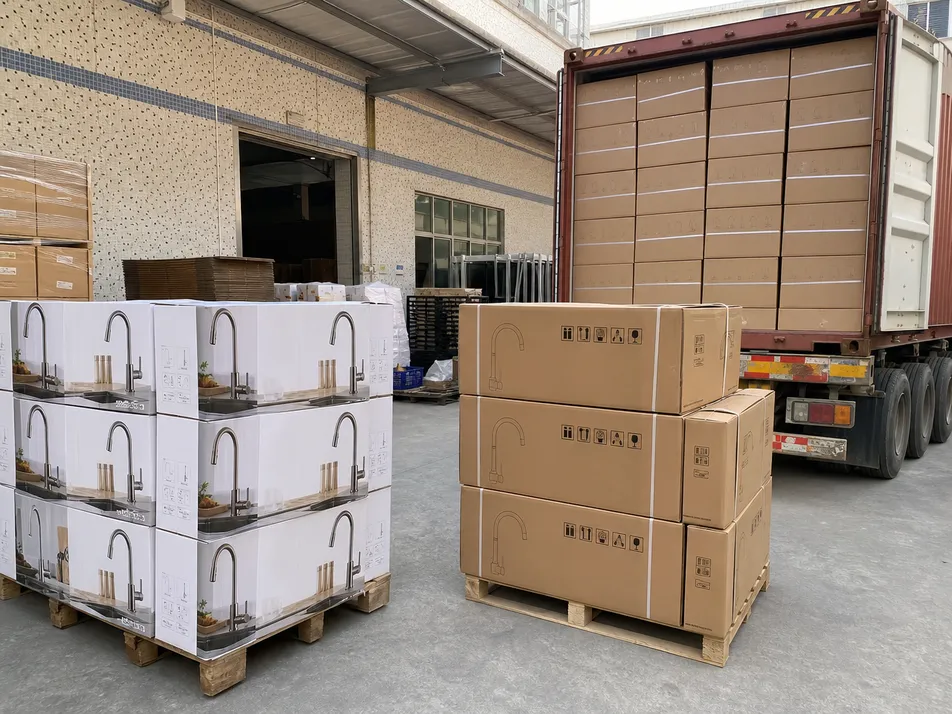
Stainless sink faucets ship in individual retail-ready cartons — inner box with product photography and specification callouts, outer master carton for container packing.
Inner box with product photography and specification callouts. Outer master carton for container packing. Carton dimensions are designed against 20GP and 40HQ container floor plans to minimize void space.
A standard 40HQ container loads approximately 800–1,200 units depending on configuration and carton size.
Packing list with CBM and gross weight per SKU is provided before order confirmation so your freight forwarder can quote accurately.
For Amazon FBA, Wayfair, and independent online retail, the inner carton is designed to survive standard parcel carrier handling without additional outer packaging.
Drop resistance tested to ISTA 2A protocol — the carton and internal cushioning protect the faucet body and handle assembly through the drop sequence without damage. Fewer damage claims from your fulfillment center means fewer returns and a cleaner margin on your e-commerce channel.
For commercial kitchen fit-out and laboratory supply, we can pack in bulk master cartons without retail inner packaging to reduce per-unit packaging cost.
White-label and blind drop-shipping are available. We ship without Wfaucet branding on outer cartons on request, and we can include your branded documentation inside the carton for direct-to-customer fulfillment.
Decision-support answers for distributors, procurement teams, and OEM buyers evaluating stainless sink faucets.
The body material is different. A stainless sink faucet has a 304 stainless steel body — the corrosion resistance is intrinsic to the material. A brushed nickel faucet has a brass body with a brushed nickel plating stack — the corrosion resistance depends on the plating quality.
For buyers in commercial kitchen, food service, or laboratory channels, the distinction matters: health codes and procurement specs often require genuine stainless, not plated brass.
For buyers in residential or hospitality distribution where the requirement is a brushed aesthetic rather than a material specification, brushed nickel delivers the look at a lower landed cost. Know which requirement your buyers are actually specifying before you choose.
The installation process is the same — deck mount, standard compression fittings, standard supply line connections.
One practical note: stainless steel is harder than brass, so over-tightening the mounting nut can crack the deck plate on thin-gauge stainless bodies. Our deck plates are formed from adequate-gauge stock to handle standard installation torque.
It's worth including a torque specification in your installation documentation if your buyers are in commercial channels where multiple installers are working from the same spec sheet. We can provide installation documentation with your shipment.
MOQ is 200 units for standard catalog items. You can mix single-hole and three-hole configurations within the same order to reach the MOQ — for example, 120 single-hole and 80 three-hole.
For OEM orders with custom tooling, MOQ is 200 units per SKU.
If you're building a starter SKU mix for a new market, tell us your target application and volume expectations — we'll recommend the configuration split based on what moves for our existing buyers in similar markets.
Request the XRF material test report. We provide this as standard documentation with every production batch — it confirms the alloy composition of the body material.
A quick field check: 304 stainless is non-magnetic or very weakly magnetic (slight magnetism at weld points is normal). A faucet body that sticks firmly to a magnet is not 304 stainless.
For formal procurement qualification, the XRF report is the document your QC team needs.
Standard Catalog
25–35 days
Order confirmation to container loading
OEM (Existing Body)
15–20 days sample
Then standard production after approval
OEM (New Tooling)
50–70 days total
25–35 days sample + 25–35 days production
We schedule production in 4-week windows and don't push committed orders back for larger buyers — if your order is in the queue, it ships in the window we committed to.
304 stainless handles standard outdoor environments — rain, humidity, temperature cycling — without corrosion issues.
For coastal outdoor installations where the faucet is exposed to salt air or salt water spray, 316 stainless is the better specification. We supply 316 on OEM orders.
For fully outdoor installations, also verify that the valve cartridge and internal components are rated for the temperature range in your climate — our standard ceramic disc cartridge handles down to -10°C, which covers most temperate and subtropical outdoor applications.
Send us your target application, mounting configuration (single-hole or three-hole), finish preference, and volume expectations. We'll come back with a detailed quote, the relevant certification documentation for your destination market, and a recommendation on configuration if you're building a new SKU.
If you're currently sourcing stainless sink faucets from another supplier and seeing quality issues — weld seam corrosion, finish inconsistency, or documentation gaps — send us a sample or describe the failure mode. We can usually identify the root cause and tell you whether our process addresses it.
Phone
+86-0757-81228796Address
Block A, Jinsha Smart Manufacturing Park, No. 88 Xilian East Road, Danzao Town, Nanhai District, Foshan City, Guangdong Province, China
If you're seeing quality issues with your current source — weld seam corrosion, finish inconsistency, or documentation gaps — send us a sample or describe the failure mode.
We can usually identify the root cause and tell you whether our process addresses it. No obligation to switch — just a straight answer on whether we can solve the problem.
© 2026 Wfaucet. All rights reserved.