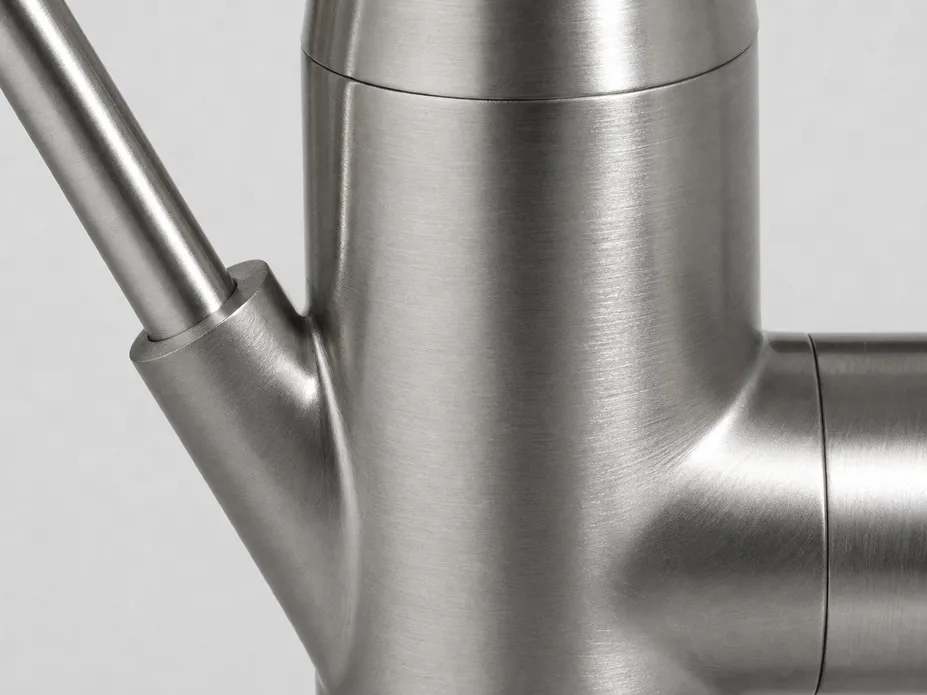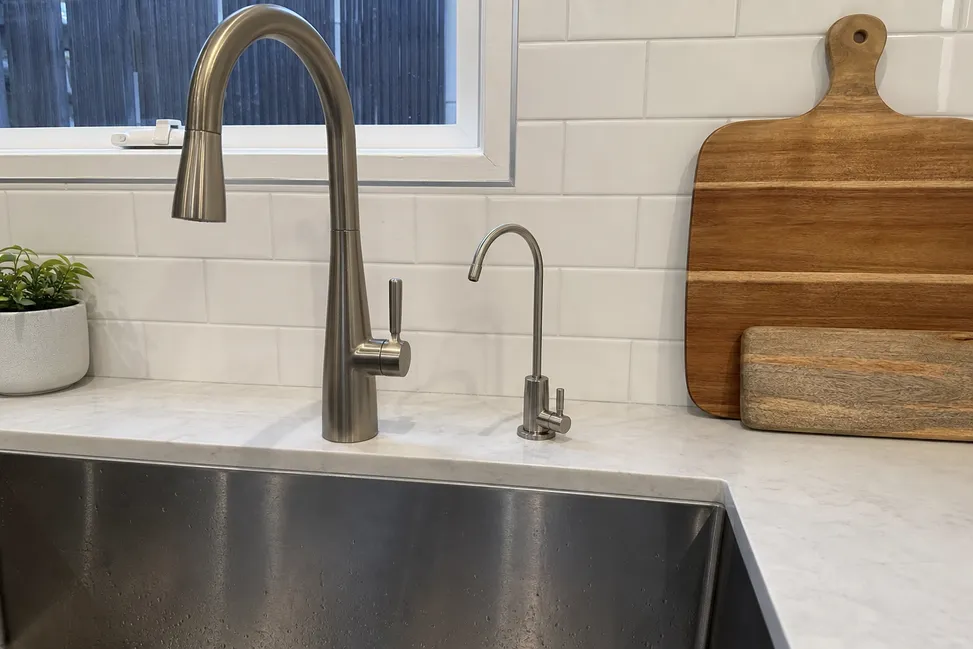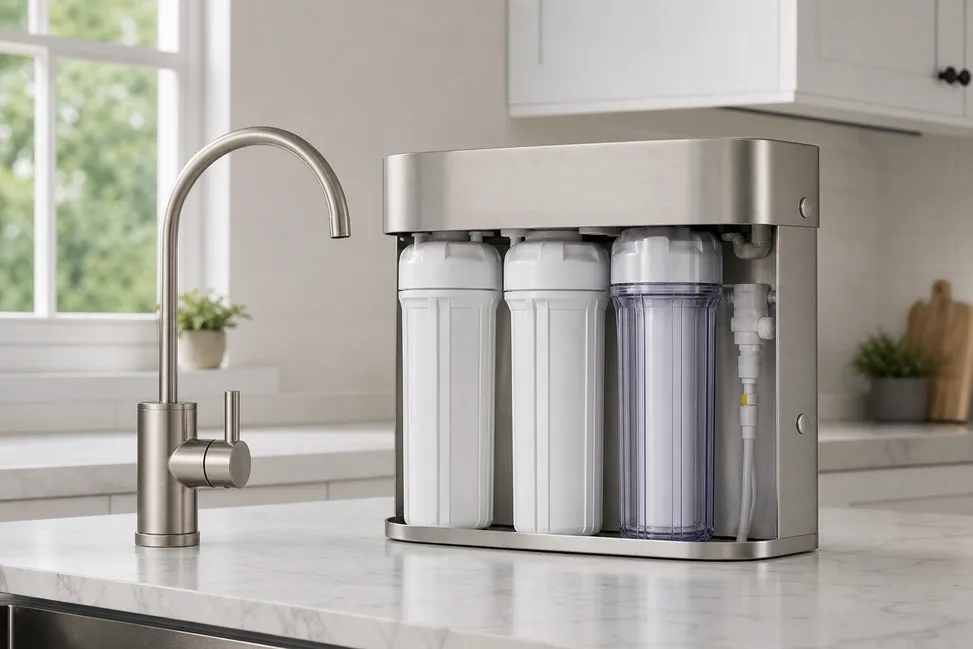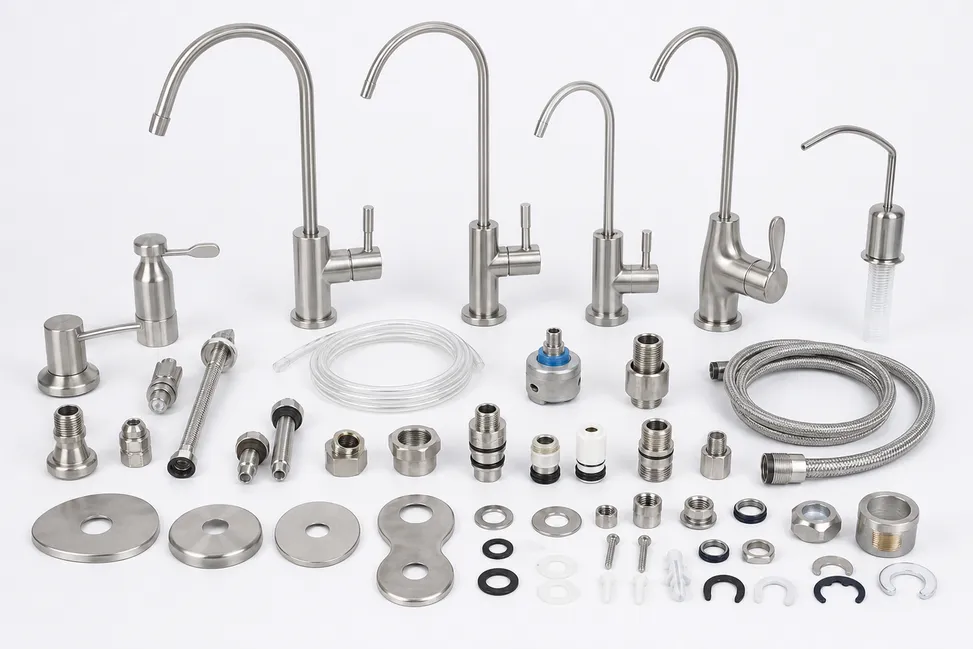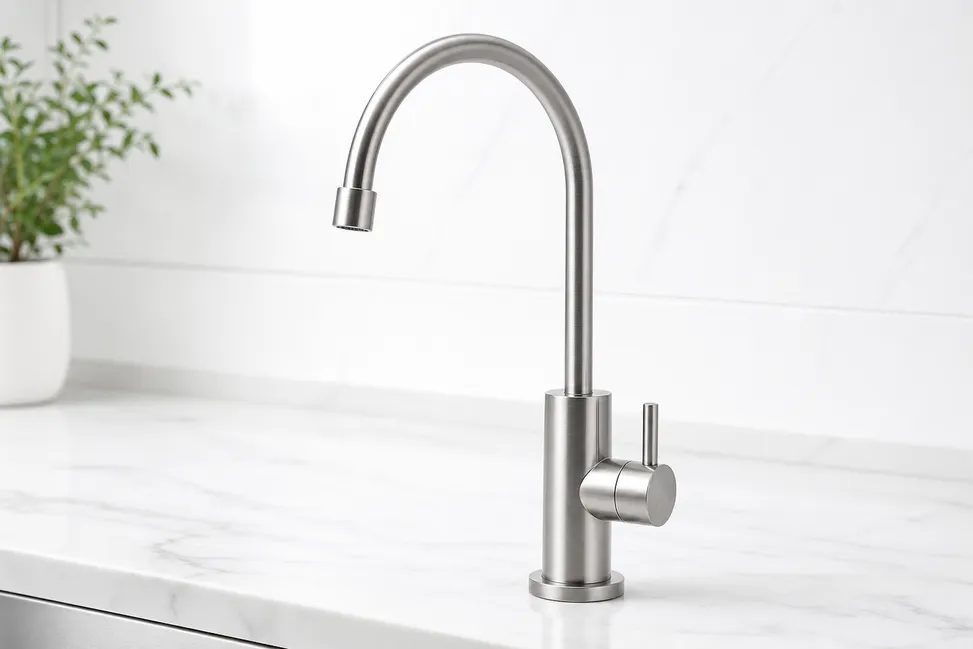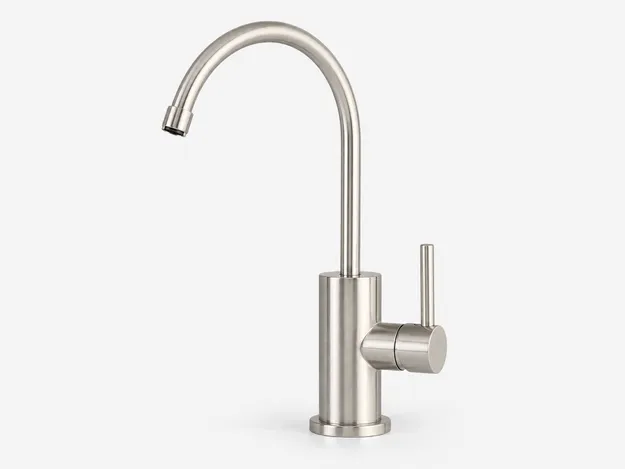

Brushed finish on a drinking-water-grade brass body — the finish choice that moves in North American residential remodel and the SKU that anchors a filter faucet catalog.
Brushed nickel over a full copper/nickel/chrome plating stack, ≤0.25% lead brass body, cUPC-compliant, and available for OEM from 200 pieces. Everything your downstream market expects, built to hold up in a kitchen environment.
Certified
cUPC & CE
Lead Content
≤0.25% Brass
Cartridge
500K Cycles
OEM From
200 Pieces
Market Positioning
The finish decision on a filter faucet is not cosmetic — it's a market positioning decision. Brushed nickel has been the dominant finish in North American residential kitchen remodel for the better part of a decade, and it holds that position for a practical reason: the brushed texture hides water spots and minor surface contact marks better than polished chrome in a countertop environment where the faucet gets handled multiple times a day.
For your downstream customers, that means the product looks presentable longer without maintenance. For you, it means fewer finish-related complaints and returns from the residential channel.
The brushed water filter faucet sits at the intersection of two purchasing decisions your buyers are already making: they're renovating or upgrading their kitchen, and they're adding a filtration or RO system. The faucet needs to coordinate with the existing hardware — brushed nickel handles, brushed nickel cabinet pulls, brushed stainless appliances. A chrome filter faucet in that environment looks like an afterthought. A brushed filter faucet looks like it was specified.
That visual coherence is what justifies the price premium over chrome in the residential remodel channel, and it's the margin story you can tell your retail or distribution customers.
View all water filter faucet variantsFinish Distribution — North American Export Orders
Matte black has been closing the gap over the past two to three years in the premium residential segment, but brushed nickel remains the volume finish for the mainstream remodel market.
Brushed texture masks daily contact marks better than polished chrome in high-touch countertop use.
Matches brushed nickel handles, cabinet pulls, and brushed stainless appliances — looks specified, not added.
Visual coherence justifies the price premium over chrome — a clear sell-through argument for retail and distribution.
Three-Layer Electroplating Stack
Brushed Nickel Top Coat
Applied mechanically after nickel deposition. Creates the directional grain that defines the brushed appearance.
Nickel Mid-Coat 8–12μm
The corrosion barrier. This is the layer that separates a finish passing 24-hour salt spray from one that fails at 12 hours. Skipping it saves ~15–20% on plating cost — the difference isn't visible on a new product, but shows up 12–18 months into use.
Copper Base Coat
Provides adhesion to the brass substrate. Foundation of the full plating stack.
Brass Substrate
≤0.25% lead, drinking-water-grade. cUPC-compliant body casting.
24h
Minimum salt spray pass
48h
Extended test — new plating batches
Construction Detail
This is where the product either holds up in the field or generates warranty claims, and it's worth being specific about what we do.
The brushed nickel finish on this faucet runs a three-layer electroplating stack: copper base coat, nickel mid-coat, brushed nickel top coat. The copper base provides adhesion to the brass substrate. The nickel mid-coat — typically 8–12μm thick — is the corrosion barrier. The brushed top coat is applied mechanically after the nickel layer is deposited, creating the directional grain that defines the brushed appearance.
The Cost-Reduction Move to Watch For
Skipping the nickel mid-coat is the most common cost-reduction move in this product category — it saves roughly 15–20% on plating cost per unit, and the difference isn't visible on a new product. It shows up 12–18 months into use, when the finish starts to dull, mottle, or delaminate at the base where moisture accumulates. We run the full three-layer stack on every unit.
Our brushed nickel passes 24-hour salt spray as a minimum; most production batches clear 48 hours on the extended test we run on new plating line runs and new finish batches.
There's one more detail specific to filter faucets that we address at the assembly stage: the base-to-deck interface. This is a moisture trap — water from the filter system drips, condensation forms under the faucet body, and cleaning products pool at the base.
We apply a sealant bead at the base-to-deck interface before packaging. It adds about 30 seconds to assembly, but it eliminates the most common cosmetic warranty claim in this product type.
We added this step after seeing a pattern of base delamination complaints from a North American distributor in a humid climate market — the plating was fine, but the moisture ingress at the base joint was accelerating corrosion at the edge of the plating coverage.
Plating Layers
3
Cu / Ni / Brushed Ni
Nickel Thickness
8–12μm
Corrosion barrier
Salt Spray
24–48h
Min. pass / extended test
Performance Specification
The faucet is a delivery device. Its job is to pass filtered water at a usable flow rate without restricting the filter system upstream. Here's what the numbers actually mean for your end customer.
This faucet is rated at 0.5 GPM at 60 PSI — the standard residential supply pressure in North America. That's intentional. Filter faucets don't need high flow; the filter cartridge upstream is the actual flow limiter in the system, and a faucet rated above the filter's output just creates false headroom.
Most under-sink carbon block and RO post-filters are rated between 0.4 and 0.75 GPM. A faucet rated at 1.5 GPM paired with a 0.5 GPM filter doesn't deliver 1.5 GPM — it delivers whatever the filter allows, with the faucet valve partially open and the user wondering why the flow feels slow.
Matching the faucet rating to the filter output range means the valve opens fully at normal use, the flow feels consistent, and there's no perceived restriction at the faucet itself.
The faucet body contributes less than 2 PSI of pressure drop across the valve at rated flow. This matters for RO systems, where post-filter pressure is already reduced — typically 40–55 PSI after the membrane stage. A faucet with a restrictive internal path compounds the pressure loss and reduces perceived flow at the spout.
The internal waterway on this faucet is sized to keep its own contribution to pressure drop minimal, so the filter system's rated output reaches the spout without additional restriction from the delivery hardware.
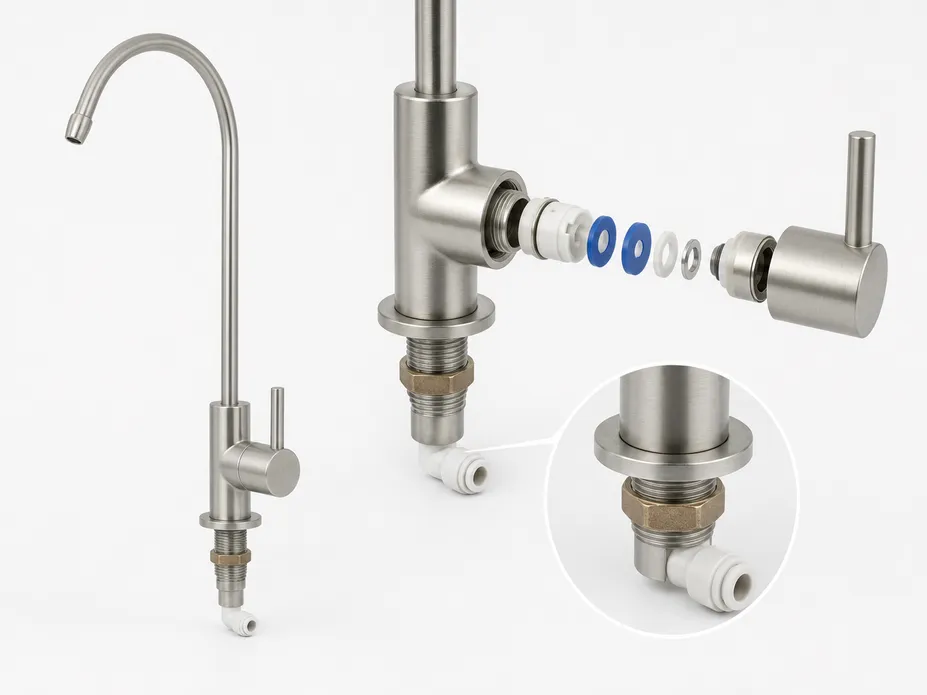
The faucet ships with a standard ¼" push-fit inlet fitting. This is the connection standard used by the majority of under-sink filter systems — including most RO units, inline carbon block systems, and multi-stage countertop-to-under-sink configurations.
For distributors bundling this faucet with a filter system: the inlet fitting is field-replaceable. If your system uses a 3/8" line, the fitting swaps in under a minute without tools.
Flow & Pressure Specifications
Filter faucets are opened and closed multiple times per day — more frequently than a standard kitchen faucet. A rubber-seat valve degrades under that cycle count; ceramic disc valves are rated to 500,000 cycles and don't require washer replacement. It's the right valve type for this use pattern, and it's what we spec on every unit.
Installation Detail
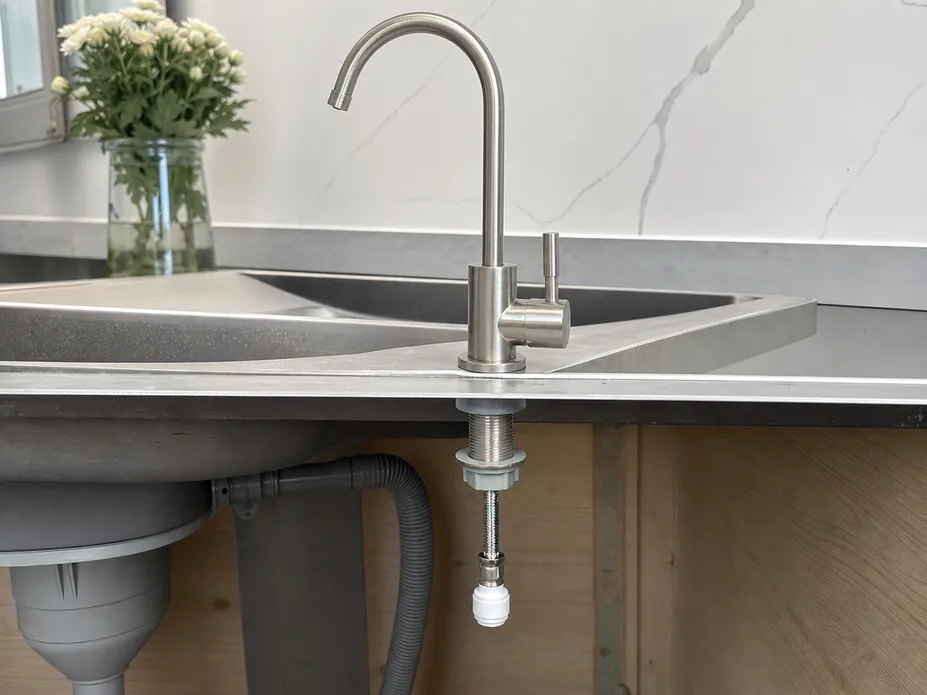
This faucet mounts through a standard 1-3/8" (35mm) deck hole — the pre-drilled knockout dimension on most stainless steel sinks and the standard size for aftermarket hole saws. No custom drilling, no adapter plates, no special tooling required.
The mounting hardware accommodates deck thickness from 3/8" to 2" — covering stainless steel sinks, granite composite, solid surface, and most natural stone countertop installations. The mounting nut is hand-tightenable from below; no basin wrench required for standard installations.
Clearance Requirements for Bundled Installations
When this faucet is installed alongside a standard kitchen faucet on the same sink deck, the minimum center-to-center spacing is 4". The faucet body diameter at the base is 1-1/8", and the spout clears a standard sink rim by 6-1/2" at full extension. These dimensions are relevant for distributors specifying sink-and-faucet bundles — confirm the sink's pre-drilled hole layout before finalizing a bundle configuration.
The supply line exits the base vertically and routes downward through the deck hole. The ¼" push-fit inlet is accessible from below the deck without removing the faucet — filter cartridge changes and line replacements don't require disturbing the faucet installation.
Typical Installation Sequence
Feed supply line through 1-3/8" deck hole from above.
Set faucet base on deck; apply sealant bead if not pre-applied.
Thread mounting nut from below; hand-tighten, then snug with wrench — do not overtorque.
Connect ¼" push-fit supply line from filter system output to faucet inlet.
Open filter system supply valve; check for leaks at inlet fitting and base seal.
Dimensional Reference
Fits the pre-drilled 1-3/8" hole on most stainless steel sinks — no modification needed.
Mounting hardware range covers granite, quartz composite, and solid surface installations.
Mounting nut is hand-accessible from below on standard under-sink cabinet depths.
Push-fit inlet reachable from below without removing the faucet — cartridge changes stay simple.
Regulatory Compliance
Compliance documentation is a procurement requirement in most channels. Here's what each certification covers, what it doesn't, and why it matters for your specific market.
IAPMO / NSF 61 & 372
The baseline plumbing product certification for the US and Canadian market. cUPC covers material safety (NSF 61 — no harmful leaching into drinking water) and lead content (NSF 372 — ≤0.25% weighted average lead in wetted surfaces).
This is the certification that gets you into Home Depot, Lowe's, and most regional plumbing distributors. Without it, you're not on the shelf.
What it doesn't cover: Filter performance. cUPC certifies the faucet body, not the filtration system it's connected to.
Drinking Water System Components
NSF 61 tests every material in the wetted flow path — brass body, ceramic disc, O-rings, sealants — for chemical extraction into drinking water. The standard sets maximum allowable concentrations for a defined list of contaminants.
For filter faucets specifically, this certification is the one end consumers and health-conscious buyers look for. It's the answer to "is this safe for drinking water contact."
Scope: Covers the faucet as a component. The filter system requires its own NSF 42/53/58 certification for contaminant reduction claims.
Lead-Free Compliance
NSF 372 defines "lead-free" for plumbing products: ≤0.25% weighted average lead content across all wetted surfaces. This is the federal standard under the Reduction of Lead in Drinking Water Act (2011) and is required for sale in all US states.
California AB 1953 and Vermont Act 193 set the same ≤0.25% threshold. This faucet meets those requirements — relevant for distributors with West Coast or New England retail exposure.
Documentation: Third-party test reports available on request. Certification number included in product documentation package.
Compliance Summary
cUPC Listed
IAPMO certified
NSF/ANSI 61
Material safety
NSF/ANSI 372
Lead-free ≤0.25%
CA / VT Compliant
AB 1953 & Act 193
Surface Engineering
The brushed nickel finish isn't cosmetic — it's a multi-layer PVD process engineered for corrosion resistance, scratch tolerance, and long-term color stability in wet environments.
The brass body is mechanically polished and ultrasonically cleaned to remove surface oxides and contaminants. Surface roughness is controlled to Ra ≤0.4 µm before coating begins.
Parts are loaded into a vacuum chamber at 10⁻³ to 10⁻⁴ Pa. A titanium or zirconium target is sputtered under argon plasma, depositing a dense metallic layer at the atomic level — no pinholes, no voids.
Nitrogen is introduced into the chamber, reacting with the deposited metal to form titanium nitride (TiN) or zirconium nitride (ZrN). This ceramic-like layer reaches 20–25 GPa hardness — harder than most tool steels.
The brushed nickel tone is achieved by adjusting nitrogen partial pressure during deposition. A final top coat seals the surface and provides the matte-satin texture characteristic of brushed nickel.
Care Instructions
Wipe with a damp cloth and mild soap. Avoid abrasive cleaners, steel wool, or bleach-based products. The PVD surface does not require waxing or polishing — routine wiping is sufficient to maintain appearance.
Finish Warranty
The PVD finish is covered under the product warranty against defects in material and workmanship. Warranty documentation is included in the product packaging and available in the distributor resource portal.
Installation
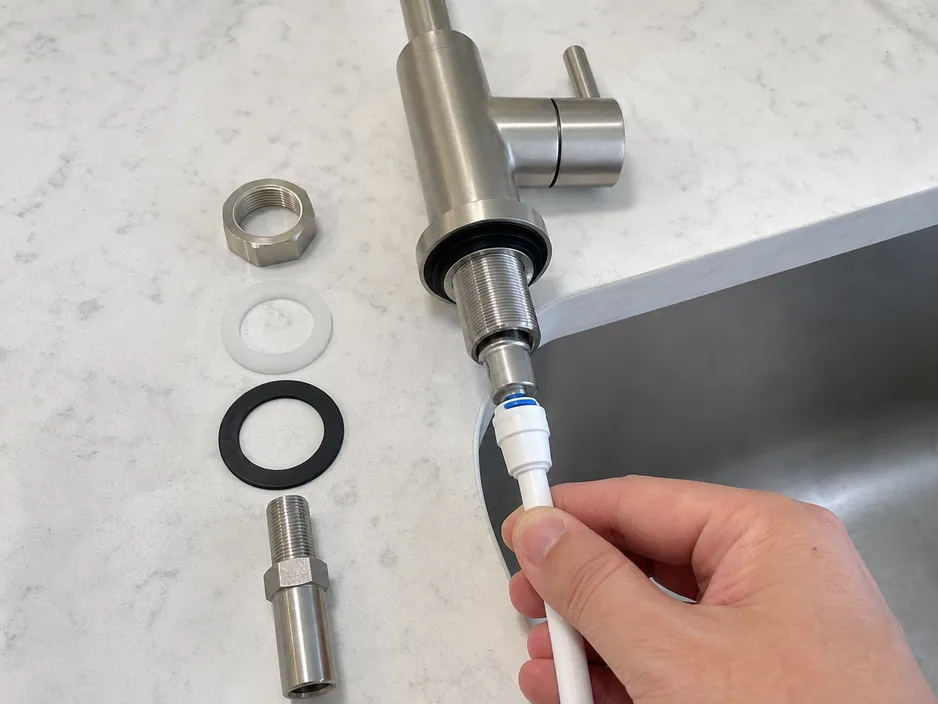
Single-hole deck mount. No special tools required for standard installations. The process below covers the typical under-sink cabinet scenario — granite or thick composite decks may require the extended mounting hardware included in the box.
Confirm the existing hole is 1-3/8" (35mm) diameter. Most stainless steel sinks ship with this knockout pre-drilled. Stone decks will need to be drilled — use a diamond-tipped hole saw at low RPM with water cooling.
Thread the supply line down through the deck hole from above. The faucet body seats on the deck surface — no deck gasket is required on smooth surfaces, but the included rubber gasket should be used on textured or uneven decks.
From below, slide the friction washer and mounting nut onto the shank. Hand-tighten the nut until the faucet base is snug against the deck. A quarter-turn with a wrench is sufficient — do not overtighten, which can crack stone decks.
Push the supply line into the filter system outlet port until it clicks. The push-fit connector is rated for 150 PSI and requires no tools. To disconnect, depress the collet ring and pull the line straight out.
Open the faucet lever and run water for 3–5 minutes to flush the supply line and seat the ceramic disc. Check all connections for drips. The lever should operate smoothly with no stiffness — if resistance is felt, verify the cartridge is fully seated.
Installer Note
For RO system connections, the faucet inlet accepts standard 1/4" John Guest or equivalent push-fit fittings. Confirm the filter system outlet is also 1/4" OD before connecting — adapters are available separately if the system uses 3/8" tubing.
Trade & Wholesale
Built for distributors, kitchen and bath dealers, and water treatment OEMs. Volume pricing, private label options, and dedicated account support are available at qualifying order levels.
Pricing is tiered by annual volume commitment. Contact the trade desk for a quote — response within one business day.
Private label setup requires 8–12 weeks lead time for first production run. Samples provided before full production.
All trade accounts receive access to the distributor portal with live inventory, order tracking, and compliance documentation.
Ready to discuss a sourcing arrangement?
Send us your volume requirements and target market — we'll respond with pricing and lead times within one business day.
Product Data
Industry-standard values for this product type. Actual specifications may vary by model configuration. Contact us for detailed product data sheets and exact dimensions.
| Parameter | Specification |
|---|---|
| Body material | C36000-equivalent free-machining brass |
| Lead content | ≤0.25% by weight (NSF/ANSI 61 Section 9 compliant) |
| Finish | Brushed nickel (3-layer electroplating: copper / nickel / brushed top coat) |
| Nickel mid-coat thickness | Typical 8–12μm |
| Salt spray rating | 24h minimum; 48h extended test on new batches |
| Valve type | Ceramic disc cartridge |
| Cartridge endurance | 500,000 open/close cycles (tested per production batch) |
| Spout reach | Typical 120–150mm (confirm for specific model) |
| Deck hole size | Standard 1-3/8" (35mm) |
| Supply tube connection | 1/4" push-fit (standard); 3/8" available |
| Operating pressure | 0.05–0.8 MPa |
| Flow rate | Typical 1.5–2.0 L/min at 0.3 MPa |
| Certifications | cUPC, CE; NSF/ANSI 61 material documentation available |
| OEM MOQ | 200 pieces per SKU |
Specifications shown are industry-standard values for this product type. Actual specifications may vary by model configuration. Contact us for detailed product data sheets and exact dimensions.
Request a Spec Sheet or QuoteEngineering Detail
Standard kitchen faucets operate at 0.4–0.6 MPa inlet pressure. Under-sink filter systems and RO systems operate at lower pressure — often 0.2–0.3 MPa for standard filter systems, and as low as 0.14–0.2 MPa for RO storage tank output.
A ceramic disc cartridge calibrated for standard tap pressure can develop a slow drip at these lower pressures because the disc seating force is designed around higher inlet pressure holding the discs together. The result is a faucet that drips intermittently when the filter system is running at low pressure — a warranty claim that's difficult to diagnose and frustrating for the end user.
This is the kind of specification detail that doesn't appear on most competitor product pages, but it's the difference between a filter faucet that generates warranty claims and one that doesn't. Your downstream customers are pairing this faucet with a filter or RO system — the cartridge needs to be spec'd for that system's operating pressure, not for a standard tap.
Filter Faucet Cartridge
±0.003mm
Disc seating surface flatness tolerance — maintains positive seal at low inlet pressure without requiring elevated seating force
Standard Kitchen Cartridge
±0.005mm
Typical disc flatness tolerance — relies on higher inlet pressure to maintain seating force; prone to drip at RO/filter system pressures
Batch-Level Pressure Testing at 0.2 MPa
We test every production batch at 0.2 MPa — not just at the standard 0.6 MPa — specifically to catch this failure mode before the product ships. If a batch shows any drip at 0.2 MPa, it doesn't leave the floor.
Operating Pressure Reference
Compliance & Material Safety
Filter faucets are drinking water contact products. The compliance requirements are stricter than for standard kitchen or bathroom faucets, and the downstream liability for getting it wrong is more serious.
Below NSF/ANSI 61 Section 9 Threshold
Our brass body is held to ≤0.25% lead by weight — below the NSF/ANSI 61 Section 9 threshold for drinking water contact surfaces. We test every incoming brass batch with XRF analysis before it enters production. This isn't a periodic audit; it's incoming inspection on every batch.
The XRF test takes about 90 seconds per sample and gives us a full elemental breakdown of the alloy. If a batch comes in above spec, it goes back to the supplier — it doesn't enter the casting line.
XRF test reports and material certifications available with each shipment for buyers who need to demonstrate compliance to their own customers or to state-level regulators.
Beyond the material specification, we machine the internal waterway surfaces smooth and passivate them after machining. Rough casting porosity in the waterway is a secondary lead leaching pathway that material specification alone doesn't address.
The porous surface area in contact with standing water is larger than a smooth surface, and lead can leach from those micro-cavities even when the bulk alloy is within spec. The machining and passivation step closes that pathway.
cUPC Certification
Covers plumbing code compliance for most US states and Canadian provinces.
NSF/ANSI 61 Adopted States
California, Vermont, Maryland, and several other states have adopted NSF/ANSI 61 into law. Our material documentation supports compliance in those markets.
Full NSF 61 Product Certification
If your buyers require a full NSF 61 product certification (as opposed to material compliance documentation), we can discuss the certification extension process for specific SKUs.
≤0.25%
Lead by Weight
Below NSF/ANSI 61 Section 9 threshold
100%
Batch XRF Inspection
Every incoming brass batch tested before production
cUPC
Certified
US states + Canadian provinces plumbing code
Distribution & Channel Strategy
Four distinct buyer channels drive volume in brushed nickel filter faucets. Each has its own commercial logic, reorder pattern, and margin profile.
Segment 01
The primary channel for this finish. Kitchen remodel is a high-frequency, high-value segment — the average US kitchen remodel involves replacing faucets, and homeowners who are adding a filtration system during a remodel want the filter faucet to match the rest of the hardware.
Distributors who stock brushed nickel filter faucets alongside brushed nickel kitchen faucets capture the complete remodel order rather than losing the filter faucet sale to a different supplier.
Reorder Pattern
Remodel activity tracks housing market cycles. Distributors who are established in the channel see consistent volume — predictable and recurring, not project-by-project.
Segment 02
Companies that manufacture or assemble RO systems under their own brand need a faucet that looks like it was designed with the system — same finish family, consistent handle style. A brushed nickel RO faucet paired with a brushed nickel system housing is a complete, coordinated product that commands a higher retail price than a mismatched bundle.
We supply several RO system OEMs on a private-label basis in brushed nickel, typically in runs of 1,000–3,000 units per order.
Commercial Logic
The faucet is a small line item in the system BOM but a large part of the perceived quality at the point of sale. Finish coordination is the differentiator.
Segment 03
Need brushed nickel as a stocked finish because it's what's already installed in the majority of North American kitchens. When a filter faucet fails or a kitchen is renovated, the replacement faucet needs to match the existing hardware.
Distributors who stock brushed nickel capture the replacement market; those who only stock chrome lose those sales to competitors.
Replacement Cycle Reality
This replacement cycle is real and recurring — it's not a one-time installation market. Stocking brushed nickel is a structural advantage in the replacement segment.
Segment 04
Sourcing for Amazon, Wayfair, or independent stores find that brushed nickel filter faucets consistently outperform chrome in search conversion in the North American market. The finish photographs well against white kitchen backgrounds, and the brushed texture reads as premium in product imagery.
For buyers building an e-commerce catalog, brushed nickel is the finish that protects margin against the race-to-the-bottom pricing pressure that chrome SKUs face.
Margin Protection
Chrome SKUs face intense price compression online. Brushed nickel holds margin because it reads as premium and differentiates from commodity listings.
Channel 01
Residential Remodel
Complete remodel order capture. Tracks housing cycles.
Channel 02
RO System OEMs
1,000–3,000 unit runs. Private label. Finish-matched bundles.
Channel 03
Water Treatment Distributors
Recurring replacement cycle. Structural stocking advantage.
Channel 04
E-Commerce Importers
Higher search conversion. Margin protection vs. chrome.
Related Products in This Category
Finish Durability & Technical Specifications
A brushed nickel finish is only as durable as the process used to apply it and the substrate it's applied to. Here's what separates a finish that lasts a decade from one that starts showing wear in eighteen months.
Recommended Process
PVD deposits a thin ceramic or metallic layer at the atomic level in a vacuum chamber. The bond is mechanical, not chemical — the finish becomes part of the substrate rather than sitting on top of it. The result is a surface that resists scratching, tarnishing, and corrosion at a level that electroplating cannot match.
Standard Process
Electroplating deposits nickel ions from a chemical bath onto the substrate. The bond is adhesive rather than atomic. It's a lower-cost process and produces an acceptable finish for budget-tier products, but the durability ceiling is lower — especially in humid environments like under-sink installations.
The faucet body is cast from C89000-series lead-free brass (≤0.25% lead by weight), meeting the requirements of California AB 1953 and the federal Reduction of Lead in Drinking Water Act. Brass provides the pressure resistance and machinability that zinc alloy (zamak) cannot match at equivalent wall thickness.
Applicable standard: NSF/ANSI 61 Section 9 (lead content in wetted surfaces)
All wetted components — body, stem, seat, and o-rings — are tested to NSF/ANSI 61 for drinking water system components. NSF/ANSI 372 certification confirms lead-free compliance for the complete assembled faucet. Third-party test reports are available for OEM and distributor customers on request.
Required for sale in California, Vermont, Maryland, and Louisiana markets
The valve mechanism uses a ceramic disc cartridge rated to 500,000 open/close cycles — roughly 136 years of daily use at ten operations per day. Ceramic discs do not degrade with filtered water chemistry the way rubber washers do, and they eliminate the drip-on-close failure mode common in washer-based valves.
Cycle rating per EN 817 / ASME A112.18.1 test protocol
Specifications apply to the standard single-handle 360° swivel model. Custom configurations available on request.
| Parameter | Specification | Notes |
|---|---|---|
| Body material | Lead-free brass (C89000 series) | ≤0.25% Pb by weight |
| Finish process | PVD brushed nickel (standard) / electroplated (budget tier) | PVD recommended for premium SKUs |
| Finish hardness | 2,000–3,000 HV (PVD) | 200–400 HV for electroplated |
| Salt spray resistance | 500+ hours (PVD) | Per ASTM B117 |
| Valve type | Ceramic disc cartridge | 500,000 cycle rated |
| Inlet connection | 3/8" compression (standard) | 1/4" push-fit available |
| Spout reach | 140 mm (5.5 in) standard | Long-reach 180 mm available |
| Spout height | 270 mm (10.6 in) standard | Air-gap model: 320 mm |
| Swivel range | 360° | Fixed spout available on request |
| Flow rate | 1.5 L/min at 60 psi (0.4 bar) | Suitable for RO and gravity-fed systems |
| Max working pressure | 125 psi (8.6 bar) | Tested to 200 psi burst |
| Deck hole requirement | 35 mm (1-3/8 in) diameter | Standard sink knockout size |
| Certifications | NSF/ANSI 61, NSF/ANSI 372 | Third-party test reports on request |
| Air-gap port | Available (separate SKU) | Required in some US jurisdictions |
| Packaging | Individual color box (retail) or bulk carton (OEM) | Custom packaging available MOQ 500 |
OEM & Private Label
The brushed finish is one of the most requested OEM configurations we run. Here's how the path from brief to first sample works — and where you can move faster with our ODM catalog.
Submit Design Brief
Handle style, spout profile, deck plate configuration, or reference product.
Tooling & Die Work
In-house brass casting dies — no outside vendor delays. Revisions stay on our floor.
First Sample in 25–35 Days
Full OEM path from brief to physical sample. ODM modified samples: 15–20 days.
MOQ: 200 Pieces per SKU
Applies to both OEM and ODM paths.
These are the standard configuration axes for a private-label brushed water filter faucet. Each can be specified independently within the casting die parameters.
Handle Style & Geometry
Lever, cross, or knob handle. Height and reach adjustable within casting die parameters.
Spout Profile & Reach
Standard reach 120–150mm. Extended reach available for specific sink configurations.
Deck Plate Configuration
Single-hole deck mount (standard) or escutcheon plate for covering existing 3-hole sink cutouts.
Branding
Logo engraving on the body or handle, or a branded badge plate. Minimum quantity for engraving: 200 pieces.
Supply Tube Connection
1/4" push-fit is standard. 3/8" and compression fittings available for specific market requirements.
Finish Variant
Brushed gold or brushed champagne bronze alongside brushed nickel — same body casting, different plating chemistry. Run multiple finishes in one order.
For buyers who want to move faster, our ODM path starts from existing catalog bodies with modified handles, finishes, or branding. Modified samples typically turn around in 15–20 days — versus 25–35 days for full OEM tooling.
Most new buyers in this category start here. It's a lower-risk way to get a differentiated product into your catalog without the full tooling investment. MOQ is 200 pieces per SKU for both OEM and ODM paths.
15–20
Days to ODM modified sample
25–35
Days to full OEM first sample
200
Piece MOQ per SKU (OEM & ODM)
In-house
Brass casting dies — no outside vendor delays
Logistics & Landed Cost
Brushed filter faucets pack the same way as the rest of our filter faucet line. Here's what's in the box, how containers load, and what we do for e-commerce buyers who need FBA-compliant packing.
Individual retail-ready inner boxes with product photography and specification callouts. Packed into master cartons of 12–24 units depending on the model.
For a standard 40HQ container loaded with brushed filter faucets, you're looking at approximately 8,000–10,000 units depending on the specific model and carton configuration.
Pre-Order Packing List
We calculate the exact loading plan against your SKU mix and provide a packing list with CBM and gross weight per SKU before you confirm the order — your freight forwarder can quote accurately without waiting for the container to be loaded.
For e-commerce buyers, we configure packaging for FBA compliance at the factory before the container is loaded — eliminating prep costs at the Amazon fulfillment center and reducing the risk of FBA rejection on arrival.
Getting an accurate landed cost before you commit to an order requires knowing CBM, gross weight, and carton count per SKU. We provide all three in the pre-order packing list — not after the container is loaded.
For North American e-commerce buyers running FBA, the factory-applied compliance packing removes a cost center that typically runs $0.50–$1.50 per unit at a third-party prep center. We've been running FBA-compliant packing for North American e-commerce buyers for several years — the requirements are stable and the process is documented.
Container & Packing Summary
Compliance & Documentation
Brushed filter faucets ship with the same certification package as our full filter faucet line. Here's what's covered, what documentation we provide, and what to ask for when you request a quote.
Our brass filter faucets are tested and certified to NSF/ANSI 61 (drinking water system components — health effects) and NSF/ANSI 372 (lead-free compliance). These are the baseline certifications required for potable water contact in the US and Canada.
Certification documentation is available on request. We provide the test report and certificate of conformance — not just a claim on a spec sheet.
For buyers supplying the UK and European markets, our filter faucets carry WRAS approval — the Water Regulations Advisory Scheme certification required for fittings in contact with drinking water in the UK. EU buyers should confirm local requirements with their compliance team; WRAS is widely accepted across European markets.
Brass alloy composition meets California AB 1953 low-lead requirements (≤0.25% weighted average lead content). For buyers selling into California, we provide the material declaration and test data to support your Prop 65 compliance documentation.
We don't make buyers chase documentation after the order ships. The standard documentation package is available before you commit — so your compliance team can review before you place the order.
NSF/ANSI 61 testing covers the full faucet assembly including the finish. Our brushed nickel and brushed gold PVD finishes are included in the tested assembly — not tested separately as a coating in isolation. This matters because some suppliers test the base brass and claim the finish is covered; ours is tested as a complete unit.
If your buyer or retailer requires finish-specific test data, request the full NSF test report — it will identify the tested configuration including finish type.
Need documentation before you quote?
We can send the compliance documentation package before you place an order. Just mention it when you request a quote and we'll include it with the price sheet.
Finish Selection Guide
These three finishes cover the majority of the filter faucet market. The right mix depends on where you're selling — market geography, buyer price sensitivity, and margin targets all point to different finish priorities.
| Finish | Primary Market | Margin Profile | Durability Notes |
|---|---|---|---|
| Brushed Nickel | North America residential remodel, mainstream | Mid-to-High | Hides water spots; full 3-layer plating stack; 24h+ salt spray |
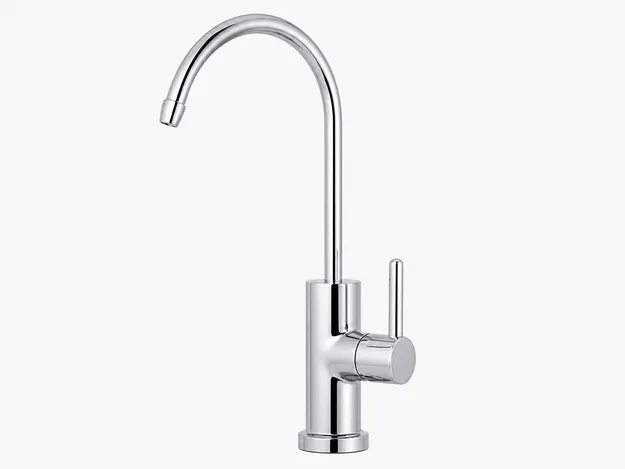
| Chrome | Europe, Southeast Asia, price-sensitive segments | Lower | Polished surface shows water spots; same 3-layer stack on our product |
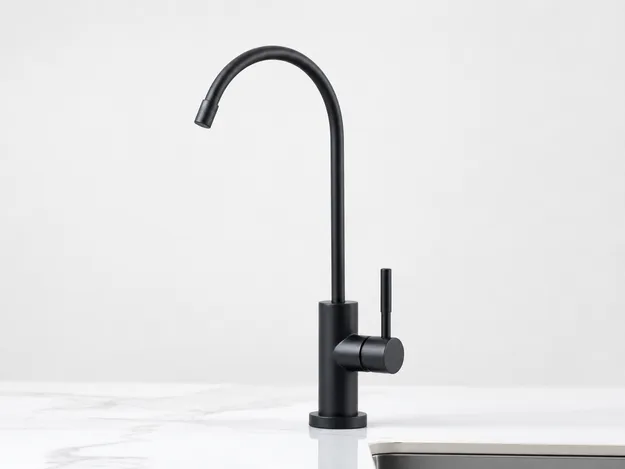
| Matte Black | Premium residential, design-forward retail | Highest | Growing demand; shows water spots in hard water areas; strong margin |
Volume SKU — North America
The volume finish for North American distribution. The directional grain texture hides water spots and surface contact marks — critical for a kitchen counter faucet handled multiple times daily. Typically commands a 15–25% higher retail price than chrome in the same product line.
Price-Competitive Entry — Europe / SEA
The right choice for European and Southeast Asian markets where chrome remains the dominant finish preference. Adds a price-competitive entry point for buyers who are more price-sensitive. Same 3-layer plating stack as brushed nickel — the polished surface shows water spots more readily, but the underlying construction is identical.
Margin-Protecting SKU — Premium Residential
The highest retail price point and the lowest price sensitivity in the finish range. Demand is growing in design-forward retail. Smaller volume than brushed nickel in most markets, but the margin profile makes it the right premium option to carry alongside brushed nickel.
Brushed nickel as your primary SKU with matte black as a premium option covers the majority of North American demand. Adding chrome gives you a price-competitive entry point for buyers who are more price-sensitive. All three finishes are supplied from the same brass body casting — the body tooling investment covers your full finish range.
Primary SKU
Brushed nickel — volume driver, mid-to-high margin, dominant in North American remodel channel
Premium Option
Matte black — highest margin, lowest price sensitivity, growing design-forward demand
Entry Point
Chrome — price-competitive for price-sensitive buyers; dominant in European and Southeast Asian markets
Related Products in This Finish Family
Stainless Steel Water Filter Faucet
No plating, no finish degradation risk. Natural brushed stainless appearance for commercial and premium residential applications where buyers need a stainless steel body rather than plated brass.
Water Filter Faucet
Standard chrome and matte black filter faucet options. The right product for buyers who need those finish options without the brushed nickel specification.
Buyer Questions
Technical and sourcing questions from distributors, importers, and private-label buyers evaluating brushed water filter faucets.
The difference is the finish process and the market it serves, not the underlying product. Both use the same brass body, the same ceramic disc cartridge, and the same cUPC-compliant construction. The brushed nickel finish goes through an additional mechanical brushing step after the nickel layer is deposited, creating the directional grain texture. That texture hides water spots and minor surface contact marks better than polished chrome — which is why brushed nickel dominates the North American residential remodel channel where the faucet sits on a kitchen counter and gets handled multiple times a day. Chrome remains the preferred finish in European and Southeast Asian markets. For North American distribution, brushed nickel typically commands a 15–25% higher retail price than chrome in the same product line.
Yes, if the plating stack is correct. The key is the nickel mid-coat — an 8–12μm nickel layer between the copper base and the brushed top coat. That nickel layer is the corrosion barrier. Cleaning products, steam, and moisture exposure will eventually attack a finish that lacks the nickel mid-coat, leading to dullness and delamination within 12–18 months.
Our brushed nickel runs the full three-layer stack and passes 24-hour salt spray minimum. We also apply a sealant bead at the base-to-deck interface — the moisture trap where most finish failures on filter faucets originate — before packaging.
cUPC covers plumbing code compliance for most US states and Canadian provinces — it's the baseline requirement for retail listing and distribution in North America. NSF/ANSI 61 Section 9 is the drinking water contact material standard; California, Vermont, Maryland, and several other states have adopted it into law, and most major retailers and distributors require it as a condition of listing.
We hold cUPC and can provide NSF 61 material documentation (XRF test reports, material certifications) with each shipment. If your buyers require a full NSF 61 product certification rather than material documentation, we can discuss the certification extension process for specific SKUs.
200 pieces per SKU for both OEM (custom tooling) and ODM (existing catalog body with modified finish or branding) orders. Most new buyers start with a 200-unit trial order in brushed nickel to test market response before scaling to container quantities. We can ship samples in advance — typically 2–3 units — so you can evaluate the finish quality and product fit before committing to a production order.
Yes. Brushed nickel is available across our full filter and RO faucet line — standard filter faucets, air gap RO faucets, non-air gap RO faucets, and under-sink configurations. The same brass body casting and the same three-layer plating stack apply across all variants.
If you're building a private-label RO system bundle, we can supply matched pairs — brushed nickel filter faucet and brushed nickel RO faucet — with the same handle style and finish consistency, so the faucet looks like it was designed with the system.
Three layers: material specification, incoming inspection, and surface treatment.
Material specification: The brass body is held to ≤0.25% lead by weight — below the NSF/ANSI 61 threshold.
Incoming inspection: Every incoming brass batch is tested with XRF analysis before it enters production.
Surface treatment: Internal waterway surfaces are machined smooth and passivated to eliminate casting porosity — a secondary leaching pathway that bulk alloy specification alone doesn't address.
XRF test reports and material certifications are available with each shipment.
Tell us your target SKU configuration — handle style, spout reach, deck plate preference — along with your volume and destination market. We'll come back with a detailed quote, finish availability confirmation, and a recommendation on whether OEM or ODM is the faster path for your timeline.
If you're new to this product category, tell us your target retail price point and we'll spec the configuration that protects your margin.
© 2026 Wfaucet. All rights reserved.