

Water Filter & RO Faucets
Non-Air Gap RO Faucet The Volume SKU for Residential RO OEMs
Two-port, brass-body non-air gap RO faucet — the volume SKU that residential RO system OEMs and water treatment distributors build their product line around. Simpler installation, lower retail price point, and the same lead-free brass construction and cUPC compliance as our full filter faucet range.
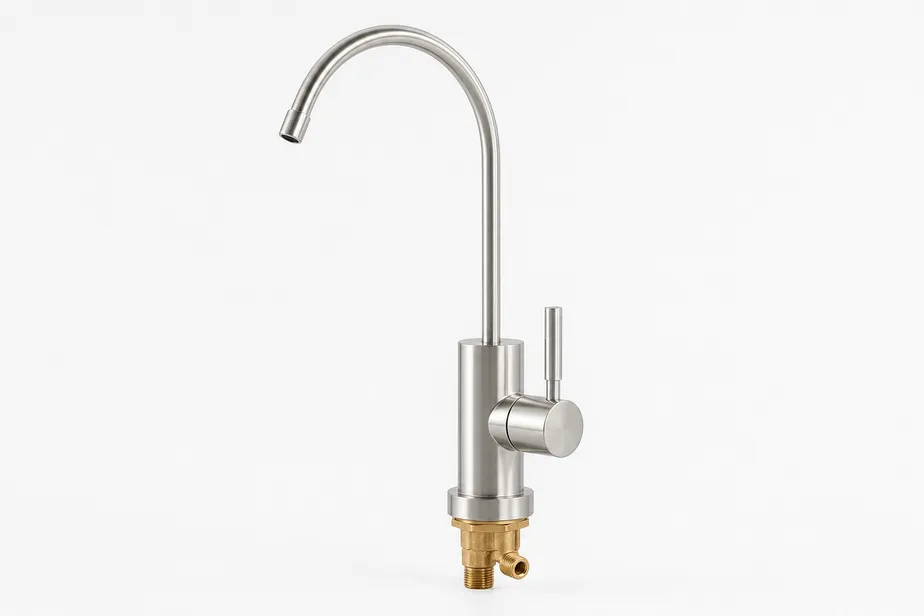
Product Overview
What This Product Is and Where It Fits in Your Line
The non-air gap RO faucet is a two-port dispensing faucet designed specifically for reverse osmosis systems. One port connects to the purified water supply line from the RO storage tank; the other is the spout outlet. That's the whole system — no drain connection, no third port, no air gap mechanism. The installation is straightforward: a single deck hole, two tube connections, done.
This is the configuration that the majority of residential RO installations use. Most US states permit non-air gap faucets, and residential RO system OEMs default to this design because it reduces installation complexity for their end customers and keeps the retail price of the complete system competitive. If you're supplying RO system manufacturers, assemblers, or distributors who sell into the residential market, the non-air gap RO faucet is the volume SKU in this category — not the air gap version.
The distinction from its sibling product matters for your inventory planning. Our Air Gap RO Faucet has three ports and an integrated air gap mechanism required by plumbing code in California, Massachusetts, and several other states. It's a necessary SKU for full US market coverage, but it's not the volume driver. The non-air gap version outsells it roughly 3:1 in our export orders to North American buyers.
Building a Private-Label RO System Bundle?
We can supply both the non-air gap and air gap variants in matched finishes and handle styles — so the faucet looks like it was designed with the system rather than sourced separately. One supplier, one production schedule, consistent visual identity across your full SKU range.
Discuss your bundle requirements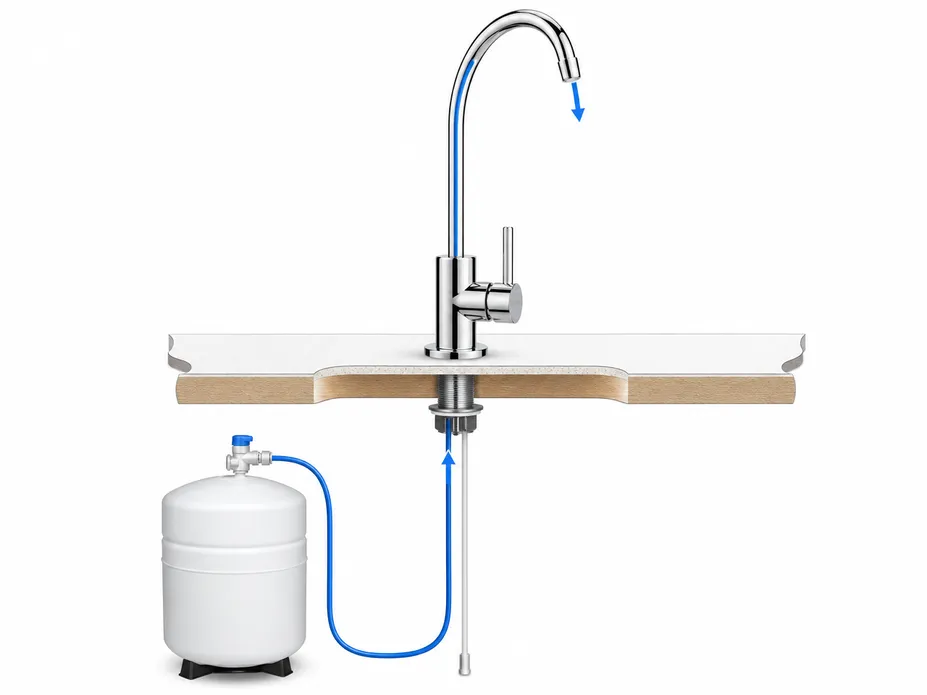
Two-Port Design
Inlet from RO storage tank + spout outlet. No drain line, no air gap mechanism, no third port.
Residential Volume SKU
The default configuration for most US residential RO installations. Permitted in the majority of US states.
Simple Installation
One deck hole, two tube connections. Reduces labor time for end customers and OEM assemblers alike.
Competitive Price Point
Lower unit cost than the air gap variant. Keeps the retail price of the complete RO system package competitive.
Related Products in This Range
Design & Supply Chain
Two-Port Design: What the Simplicity Means for Your Supply Chain
The non-air gap design is not a stripped-down version of the air gap faucet — it's a purpose-built configuration for the application it serves.
The body casting is machined for two ports: a 1/4" push-fit inlet at the base for the RO supply tube, and the spout outlet. There's no third port to machine, no air gap channel to drill, no additional fitting to assemble. That simplicity translates directly into production efficiency, which is part of why the non-air gap faucet carries a lower unit cost than the air gap variant.
For your downstream customers — RO system OEMs who are assembling complete systems — the two-port design means a faster installation step. The faucet goes in with one deck hole and two tube connections. No drain line to route, no air gap fitting to position. In a residential RO system installation, that's a meaningful reduction in labor time, and it's one of the reasons OEMs prefer this configuration for their standard system packages.
We manufacture the non-air gap and air gap variants on the same production line using the same brass body casting. The difference is in the CNC machining step — the non-air gap body gets two port bores, the air gap body gets three plus the internal channel. Lead times and MOQs are identical. If you're stocking both, you're not managing two separate supply relationships or two different production schedules.
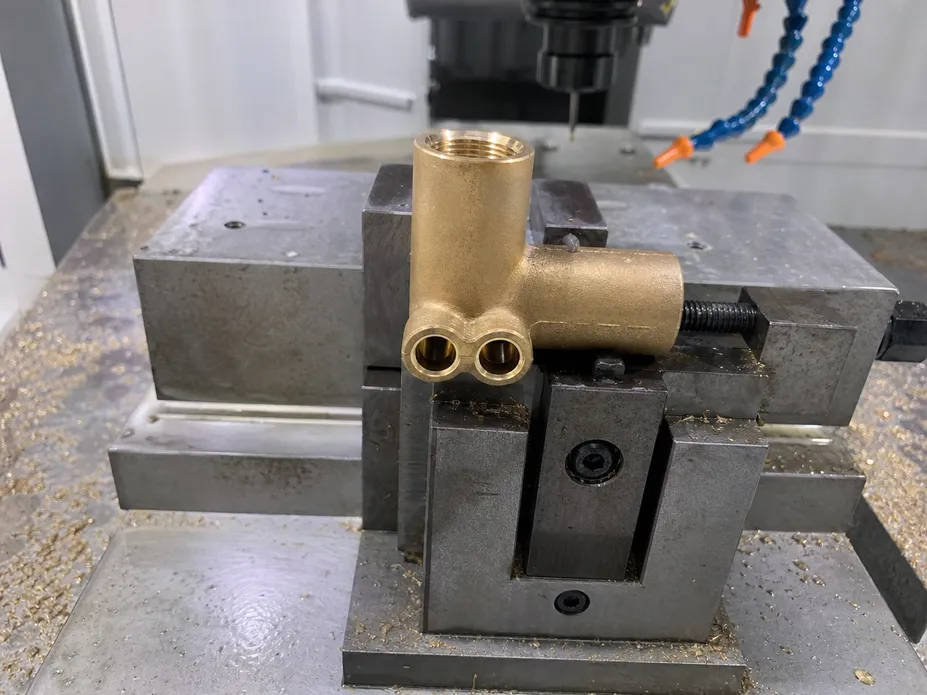
Non-Air Gap vs. Air Gap: Production Comparison
One Production Line, Both Variants
Because both variants share the same brass body casting and production line, stocking both doesn't mean managing two separate supply relationships or two different production schedules. Identical lead times and MOQs across the range.
Technical Specifications
Full parameter set for the non-air gap RO faucet. Use these values for BOM verification, compliance documentation, and channel-specific configuration decisions.
Parameter Reference Table
| Parameter | Specification |
|---|---|
| Configuration | Non-air gap (2-port: supply inlet + spout outlet) |
| Body material | C36000-equivalent free-machining brass |
| Lead content | ≤0.25% by weight (NSF/ANSI 61 Section 9 compliant) |
| Valve type | Ceramic disc cartridge |
| Cartridge endurance | 500,000 open/close cycles (tested per production batch) |
| Spout reach | Typically 120–160 mm (standard catalog); custom reach available |
| Spout height | Typically 250–320 mm overall height |
| Deck hole size | Standard 1-3/8" (35mm) |
| Supply tube connection | 1/4" push-fit (standard); 3/8" push-fit available |
| Operating pressure | 0.05–0.8 MPa; minimum 0.2 MPa for reliable flow |
| Flow rate | 1.0–1.8 L/min at 0.3 MPa ↓ see note |
| Finishes available | Chrome, brushed nickel, matte black, PVD gold, oil-rubbed bronze |
| Salt spray rating | 24h minimum (chrome, brushed nickel); 48h extended test on new finish batches |
| Certifications |
cUPC CE WaterMark SGS
|
Specifications shown are industry-standard values for this product type. Actual specifications may vary by configuration. Contact us for detailed product data sheets.
Note on Flow Rate
The restricted flow path is by design. RO membranes produce purified water slowly and store it in a pressurized tank — a high-flow faucet would drain the tank faster than the system can replenish it. The 1.0–1.8 L/min range is the correct specification for this application. Buyers comparing this to a standard kitchen faucet flow rate are comparing the wrong products.
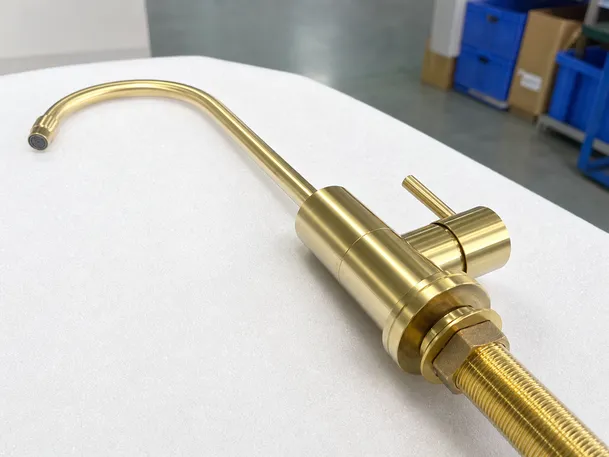
Standard Catalog Configuration
C36000-equivalent brass body, ceramic disc cartridge, 35mm deck hole. Custom spout reach and supply connection available on request.
Need a Data Sheet?
Full product data sheets with dimensional drawings, pressure curves, and compliance documentation available on request.
Request Data SheetCertifications
The Cartridge: Where Most RO Faucet Failures Start
The ceramic disc cartridge determines whether your buyers get warranty claims or reorders. Low-pressure RO conditions expose a failure mode that standard factory testing misses entirely.
The Pressure Gap Problem
Standard tap water runs at 0.3–0.6 MPa. RO storage tanks typically deliver water at 0.05–0.15 MPa — significantly lower. Ceramic disc cartridges that are spec'd and tested only at standard tap pressure can develop a slow drip at RO system pressures because the disc seating force is calibrated for higher inlet pressure.
The disc doesn't fully seat against the lower hydraulic force, and you get a drip that doesn't show up in the factory test but appears in the field within weeks of installation.
How We Address It
Low-pressure cartridge specification
We spec the cartridge spring tension and disc flatness tolerance specifically for low-pressure operation. The seating surface flatness tolerance is held to ±0.003mm — tighter than the standard cartridge spec — to ensure positive sealing at low inlet pressure.
Dual-pressure batch testing
We test every production batch at 0.2 MPa inlet pressure, not just at the standard 0.6 MPa. That second test is the one that catches the failure mode before the product ships.
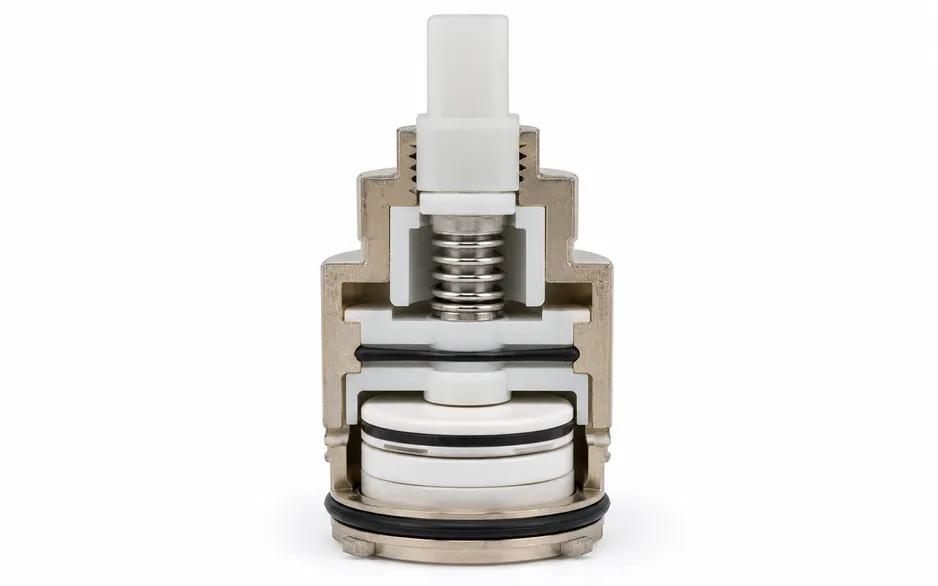
Ceramic Disc Cartridge
Seating surface flatness held to ±0.003mm. Spring tension spec'd for 0.05–0.15 MPa RO tank delivery pressure, not standard tap pressure.
Why We Added the Second Test
We added the low-pressure batch test after seeing early drip failures on a batch of filter faucets shipped to a North American distributor in 2021. The standard pressure test passed. The low-pressure test would have caught it. We've run both tests on every batch since.
The cartridge performance your sample showed is the cartridge performance your container delivers.
Cartridge Specification Comparison
| Parameter | Industry Standard Cartridge | Wfaucet RO Cartridge |
|---|---|---|
| Disc flatness tolerance | Standard (unspecified for RO) | ±0.003mm |
| Spring tension spec | Calibrated for 0.3–0.6 MPa tap pressure | Spec'd for 0.05–0.15 MPa RO tank pressure |
| Production batch test pressure | 0.6 MPa only | 0.6 MPa + 0.2 MPa (both required) |
| Endurance test frequency | New product introduction only | Every production batch — 500,000 cycles |
| Field drip risk at RO pressure | Present (failure mode not tested) | Caught at batch level before shipment |
Lead Content and Drinking Water Compliance: The Documentation Your Markets Require
Non-air gap RO faucets are drinking water contact products. The water coming through the spout has been purified — your downstream customers are drinking it directly. That puts this product in a different compliance category than a standard kitchen faucet, and the documentation requirements reflect that.
Brass Alloy Specification
C36000-equivalent, ≤0.25% lead by weight
Our brass body is cast from C36000-equivalent alloy held to ≤0.25% lead by weight. We test every incoming brass batch with XRF analysis before it enters production — this is not a periodic audit, it's every batch.
The ≤0.25% threshold meets NSF/ANSI 61 Section 9 requirements for drinking water contact surfaces, which is the standard that California, Vermont, Maryland, and several other US states have adopted into law. We started applying this specification to all our filter and RO faucet production in 2019, after a North American distributor asked us to match their state-level requirements. We kept the tighter spec across all markets because the discipline is worth it — and because lead content is the compliance issue that creates the most serious downstream liability if it goes wrong.
Internal Waterway Treatment
Machined smooth + passivated after casting
The internal waterway surfaces are machined smooth and passivated after casting. Rough casting porosity is a secondary lead leaching pathway that material specification alone doesn't address — water sitting in a porous internal surface between uses can pick up lead even if the bulk alloy is within spec. The machining and passivation step closes that pathway.

NSF/ANSI 61 Material Documentation
XRF test reports and material certifications are available on request for buyers who need to demonstrate compliance to their own customers or to state-level regulators. If your buyers require a full NSF 61 product certification, we can discuss the certification extension process for specific SKUs.
View our full certifications pageCertifications Held for This Product
North American Plumbing Code
Covers most US states and Canadian provinces. Required for entry into the North American residential and commercial plumbing market.
European Conformity
Required for EU market entry. Demonstrates conformity with applicable European health, safety, and environmental protection standards.
Australian Standards
Australian standards compliance. Required for plumbing products sold into the Australian and New Zealand markets.
Third-Party Audit & Testing
Independent third-party audit and testing by SGS, one of the world's leading inspection, verification, testing, and certification companies.
Market Segments Where This SKU Generates Volume
Four buyer types drive the majority of volume for this configuration. Each has a different sourcing logic — understanding which one you are shapes how you should structure your order and your product line.
Residential RO System OEMs
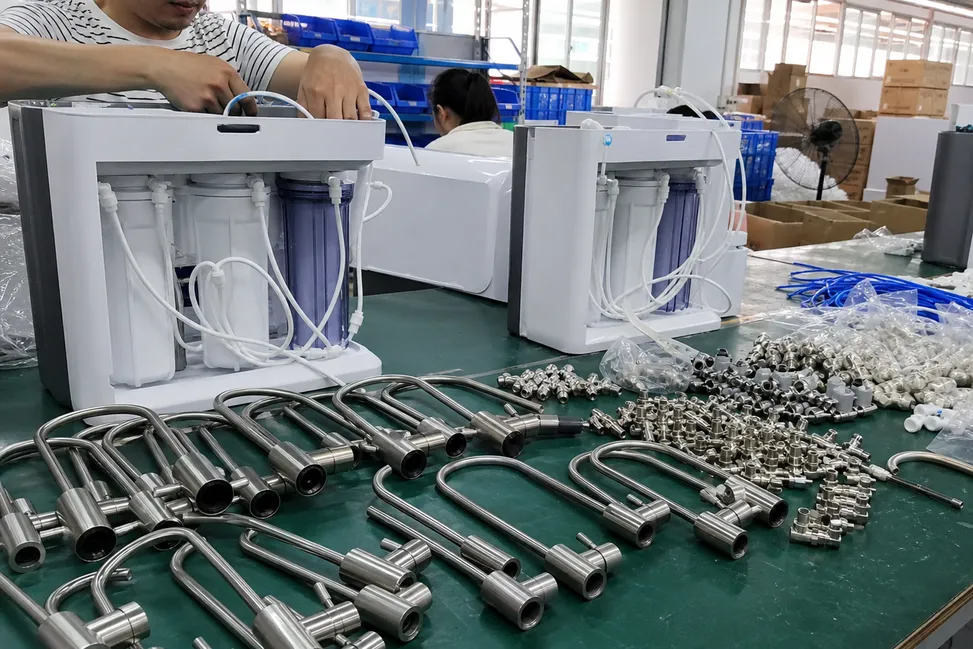
Companies that manufacture or assemble RO systems under their own brand need a matched faucet to complete the system — and they need it in consistent finish, consistent quality, and consistent supply across orders. The faucet is the most visible component of the RO system; it's what the end customer touches every day and what they photograph when they post a review.
Getting the faucet wrong is a brand problem for the OEM, not just a product return. We supply several RO system OEMs on a private-label basis, typically in runs of 2,000–5,000 units per order, with matched finishes and handle styles across the faucet and any other visible components in the system.
Water Treatment Distributors
Distributors in North America, Europe, and Australia carry non-air gap RO faucets as both new-installation components and replacement parts. The replacement cycle is real and predictable: faucet bodies get replaced when kitchens are renovated, when the original faucet shows finish wear, or when a homeowner upgrades their RO system.
Distributors who stock two or three finishes in this configuration capture both the new installation market and the replacement market without carrying excessive SKU depth. Brushed nickel and chrome cover the majority of the installed base in North America; matte black is the growth finish for buyers targeting the premium residential segment.

Kitchen & Bath Product Importers
If you're already importing kitchen or bathroom faucets, adding RO faucets is a natural extension — same supplier relationship, same documentation, same container. The non-air gap RO faucet is the entry point for this category because it's the highest-volume SKU and the easiest installation for your downstream customers.
The filter faucet category has been growing faster than standard kitchen faucets in most of our export markets for the past several years, driven by increasing consumer awareness of water quality. This is particularly true in the Middle East and Southeast Asia, where municipal water quality concerns are driving RO adoption at the residential level — worth paying attention to if you're building your product line for those regions.
E-Commerce and Amazon Sellers
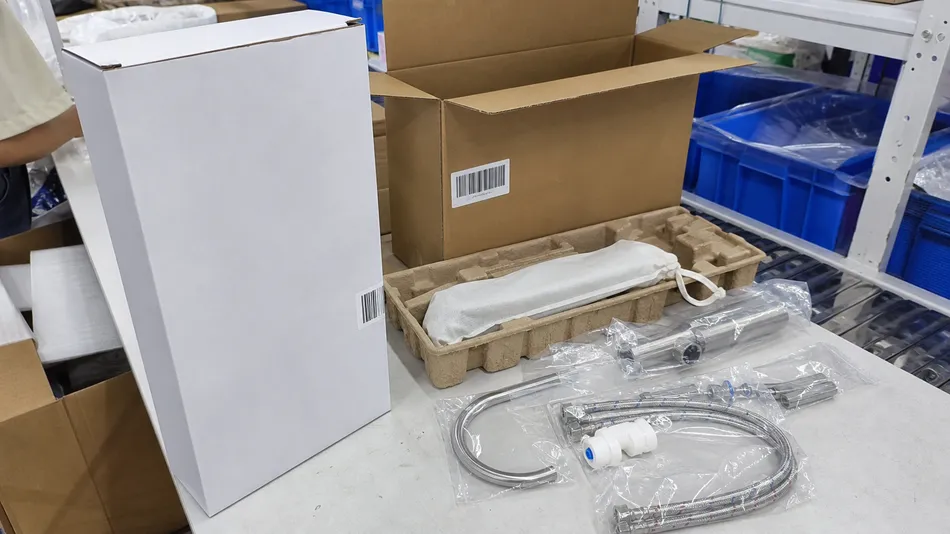
Sourcing a private-label RO faucet to list alongside RO system accessories. The non-air gap configuration is the right SKU for this channel because it's the configuration that most residential buyers need and search for.
We support FBA-ready packaging — individual retail boxes with barcodes, poly-bagged components, and drop-test-rated cartons — and can ship directly to Amazon fulfillment centers or your warehouse. White-label capability means your brand on the box, not ours.
Explore Related Products in This Category
Browse the full range of water filter and RO faucet configurations available from Wfaucet, or compare this product against the air gap configuration for markets that require it.
Finish Guide
Finish Selection for This Product: What Moves and What Protects Margin
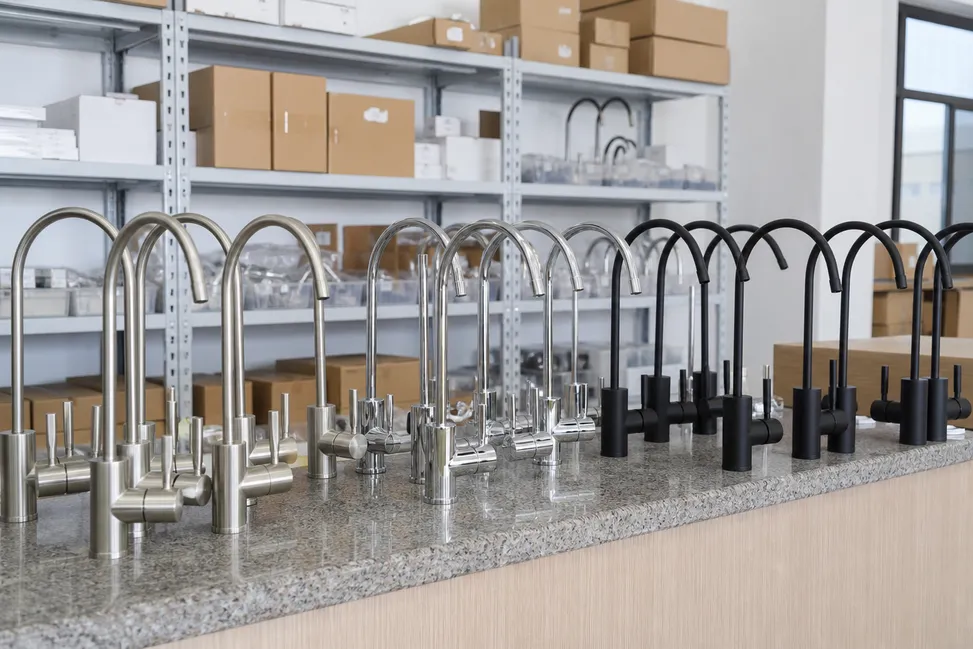
Five finishes run in-house on this product: chrome, brushed nickel, matte black, PVD gold, and oil-rubbed bronze. All five are available on the brass body. Here's how they perform commercially across our export markets.
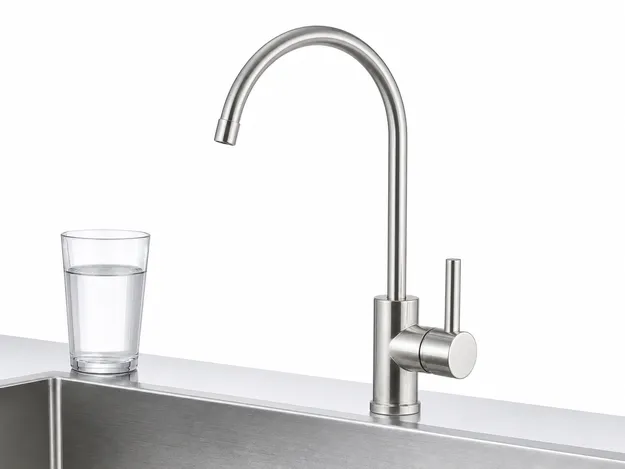
Brushed Nickel
The volume finish for North American buyers. Coordinates with stainless appliances, hides water spots and minor scratches better than chrome, and sits at a mid-range retail price point.
If you're stocking one finish for the North American residential market, this is it.
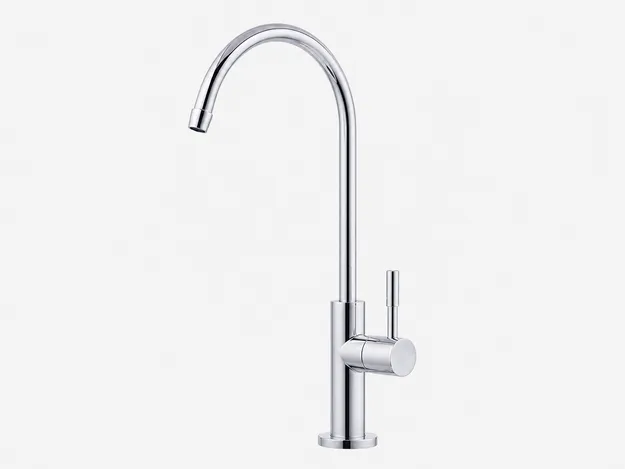
Chrome
Leads in Europe and Southeast Asia. The most economical finish to produce. Some suppliers skip the nickel mid-coat in the plating stack to save a few cents per unit — it cuts salt spray performance from 48 hours to under 24.
Our chrome runs the full copper/nickel/chrome electroplating stack. The nickel mid-coat is what gives the finish its corrosion resistance. A batch of chrome filter faucets from a competitor showed up in a distributor's warranty claims after 14 months in a coastal market — plating delaminating at the base. Full stack doesn't do that.
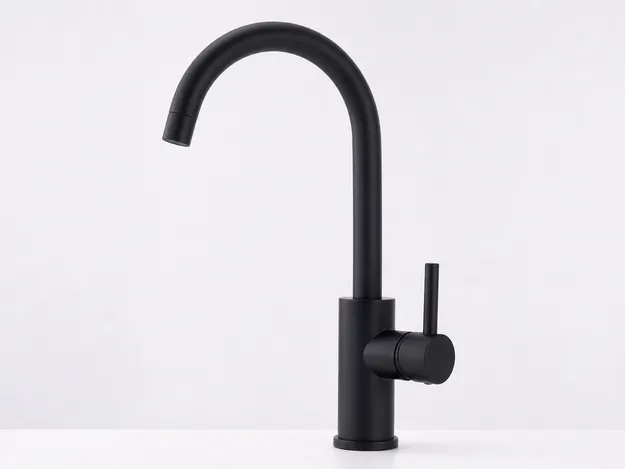
Matte Black
The fastest-growing finish across all export markets for the past three years. Carries a higher retail price point than chrome or brushed nickel — the margin-protecting SKU in a competitive catalog.
Trade-off: shows water spots more readily in hard water areas. Worth communicating to downstream customers to set the right expectations.

PVD Gold
Lower volume but carries the highest retail price points in this product line. Growing in the Middle East and premium residential segments globally.
Top of the price range in this catalog.
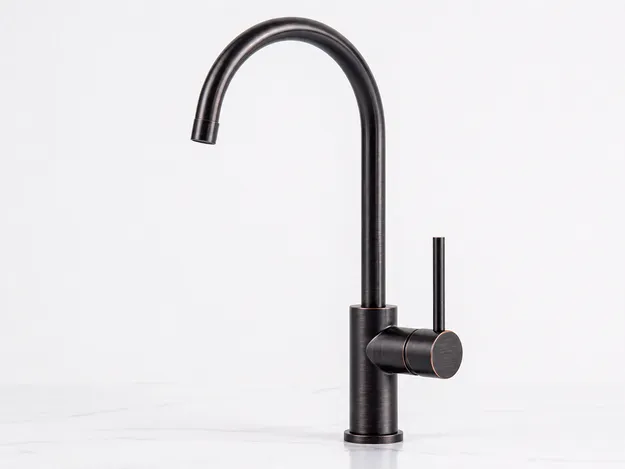
Oil-Rubbed Bronze
Lower volume alongside PVD gold, but carries the highest retail price points in this product line. Rounds out a full-spectrum catalog from entry to premium.
Top of the price range in this catalog.
Finish Durability at the Base
For RO faucets specifically, finish durability at the base matters. The area where the faucet body meets the deck plate is a moisture trap — and it's where finish failures start.
We apply a sealant bead at the base-to-deck interface before packaging on all finishes. It adds 30 seconds to assembly and eliminates the most common cosmetic warranty claim in this product category.
All 5 Finishes
Sealant bead applied at base-to-deck interface before packaging
Chrome Stack
Full copper / nickel / chrome electroplating — no skipped mid-coat
Salt Spray
48-hour performance maintained with full plating stack
| Finish | Primary Market | Volume Profile | Price Point | Notes |
|---|---|---|---|---|
| Brushed Nickel | North America | High | Mid-range | Hides water spots; coordinates with stainless |
| Chrome | Europe, SE Asia | High | Entry | Full Cu/Ni/Cr stack; 48-hr salt spray |
| Matte Black | All markets | Fast-growing | Mid-premium | Fastest growth 3 yrs; shows spots in hard water |
| PVD Gold | Middle East, premium residential | Lower | Premium | Growing globally in premium segments |
| Oil-Rubbed Bronze | Specialty | Lower | Premium | Completes full price-spectrum catalog |
OEM & Private Label
OEM and Private Label: Building Your Non-Air Gap RO Faucet Line
The water treatment market rewards brand differentiation. RO system OEMs and distributors who sell under their own brand consistently command better margins than those reselling generic product — and the faucet is the component where brand differentiation is most visible to the end customer.
We support private-label development on this product from 200 pieces per SKU. That's low enough to test a new finish or handle configuration in your market before committing to container quantities.
We maintain in-house tooling for brass casting dies, so tooling revisions don't go to an outside vendor and add weeks to the timeline.

OEM Path
From your design brief or reference sample
The typical OEM path runs from your design brief or reference sample to first sample in 25–35 days. In-house tooling for brass casting dies means revisions don't go to an outside vendor.
Best for
Custom handle geometry, unique spout profiles, or configurations not available in the existing catalog. Full tooling investment with maximum differentiation.
ODM Path
From existing catalog bodies
Starts from existing catalog bodies with modified handles, finishes, or branding. Modified samples typically turn around in 15–20 days. Most new buyers in this category start here.
Best for
Lower-risk market entry. Get a differentiated product into your catalog without the full tooling investment. Proven path for new buyers testing a market.
Common Customization Dimensions
Handle Style & Geometry
Lever, cross, or knob handle. Custom profiles available with tooling.
Spout Profile & Reach
Standard gooseneck, straight, or angled spout. Reach adjustable within body casting constraints.
Deck Plate Configuration
Single-hole mount or escutcheon plate. Plate size and shape customizable.
Supply Tube Connection
1/4" push-fit standard. 3/8" push-fit and compression fittings available for specific market requirements.
Finish
All five in-house finishes available. Custom RAL colors available on runs over 500 units with powder coat option.
Branding
Logo engraving on body or handle, custom badge, branded packaging.
MOQ: 200 Pieces Per SKU
MOQ for OEM and ODM orders is 200 pieces per SKU. Below 200 pieces, the tooling changeover cost doesn't make sense for either of us — but 200 units is a realistic market test quantity for most distribution channels.
Most new buyers in this category start with the ODM path — it's a lower-risk way to get a differentiated product into your catalog without the full tooling investment.
200 pcs
MOQ per SKU
15–20 days
ODM sample lead time
25–35 days
OEM first sample
No commitment required. We'll respond within one business day.
Logistics & Fulfillment
Installation Footprint and Packaging for Your Channel
Standard deck hole, included hardware, and channel-ready packaging — the details that determine whether this SKU lands cleanly in your fulfillment operation.
Deck Hole Specification
Installs through a standard 1-3/8" (35mm) deck hole — the same hole size used by most RO system manufacturers in their countertop or sink cutout specifications. No additional drilling required for standard installations.
Supply Connection
The supply tube connects to the 1/4" push-fit inlet at the base. The mounting nut and supply tube are included in the standard package — no sourcing additional hardware for a complete installation.
Retail Box Contents
Each unit ships in an individual retail box. Standard package includes:
- Faucet unit
- Supply tube
- Mounting hardware
- Installation instructions
Multi-Language Instructions
Instructions available in English, French, Spanish, German, or other languages depending on your destination market. Specify at order time — no minimum language surcharge for standard languages.
FBA & E-Commerce Compliance
Retail boxes are sized for shelf display and FBA compliance. We can provide FNSKU labeling and poly-bagging for Amazon fulfillment — specify requirements at order time.
Container Loading
Approximately 24 units per master carton. A standard 40HQ container holds approximately 10,000–12,000 units of this product. We provide a packing list with CBM and gross weight per SKU before you confirm the order so your freight forwarder can quote accurately.
Mixed Container Consolidation
For buyers consolidating this product with other Wfaucet SKUs in the same container — kitchen faucets, bathroom faucets, or the air gap RO variant — we coordinate the packing sequence to minimize void space. A mixed container is a common order pattern for our distributors and reduces per-unit freight cost.
Configuration Selection
Non-Air Gap vs. Air Gap: Choosing the Right Configuration for Your Market
Both products are in our line. The right answer depends on where your buyers are installing.
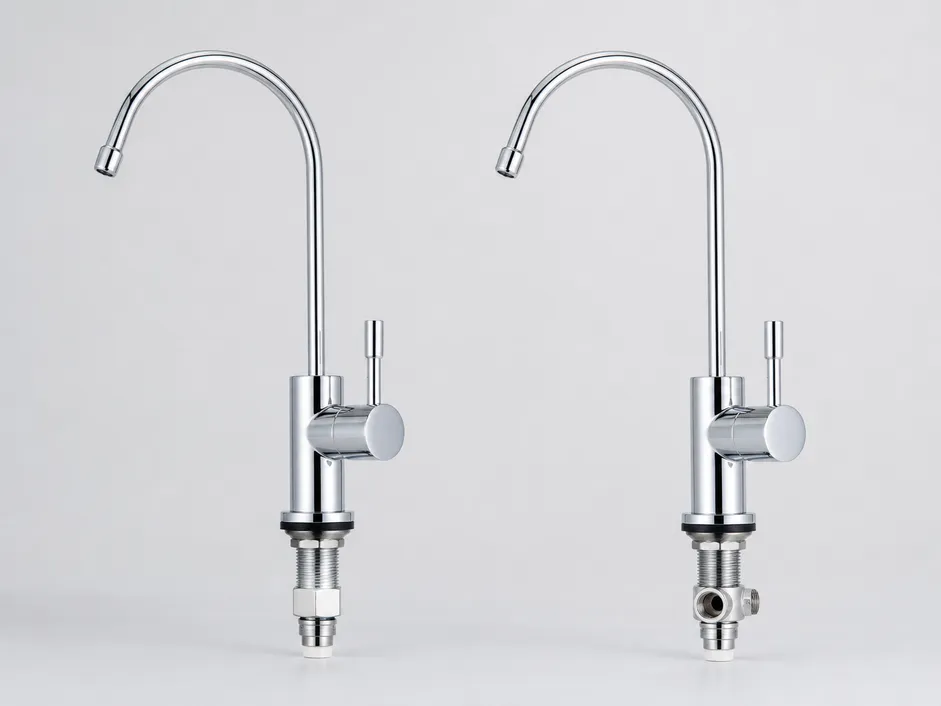
Body Casting: Identical Between Variants
The body casting is identical between the two variants. The difference is in the CNC machining step — the air gap version gets an additional port bore and internal channel. Lead times, MOQs, and finish options are the same for both.
Coverage Guidance
If you're covering the full US market, carry both. If you're focused on markets outside the states that mandate air gap, the non-air gap version is the right starting point.
- Non-air gap: Residential RO OEMs, most US and international markets — the high-volume default SKU
- Air gap: Full US market coverage including CA, MA, and other code-mandate states; commercial projects
| Non-Air Gap RO Faucet | Air Gap RO Faucet | |
|---|---|---|
| Ports | 2 (supply + spout) | 3 (supply + drain + spout) |
| Installation complexity | Lower — no drain connection | Higher — drain line required |
| Retail price point | Lower | Higher |
| Code compliance | Permitted in most US states | Required in CA, MA, and others |
| Volume pattern | High — the default residential SKU | Lower — code-compliance SKU |
| Best for | Residential RO OEMs, most US/international markets | Full US market coverage, commercial projects |
Need the Air Gap Variant?
Same body casting, same lead times and MOQs — with the additional port bore and drain channel for code-mandate markets.
Frequently Asked Questions
Answers to the questions buyers and specifiers ask most often about non-air gap RO faucets — product differences, compliance, flow rates, and ordering.
What is a non-air gap RO faucet and how does it differ from an air gap faucet?
A non-air gap RO faucet has two ports: one for the purified water supply line from the RO storage tank, and one for the spout outlet. An air gap faucet has three ports — it adds a drain connection and an internal air gap mechanism that prevents contaminated drain water from siphoning back into the RO membrane.
The air gap is a backflow prevention feature required by plumbing code in several US states. Non-air gap faucets are simpler to install and carry a lower retail price; they're the standard choice for residential RO installations in markets where the air gap is not code-required.
Which US states require an air gap RO faucet?
California, Massachusetts, and several other states require air gap faucets for RO system installations under their plumbing codes. The specific requirement varies by state and sometimes by local jurisdiction.
If you're distributing across multiple US states, the safest approach is to carry both configurations and let your installer or end customer confirm local code requirements. We manufacture both variants with identical body castings and matched finishes, so stocking both doesn't require managing two separate supplier relationships.
What is the minimum order quantity for non-air gap RO faucets?
200 pieces per SKU for both OEM (custom tooling) and ODM (catalog body with modified finish or branding) orders. Most new buyers start with a 200-unit trial order in one or two finishes to test market response before scaling to container quantities.
We can ship samples in advance of a production order so you can evaluate the product with your own customers first.
Does this faucet meet NSF/ANSI 61 requirements for drinking water contact?
Our brass body is held to ≤0.25% lead by weight, which meets the NSF/ANSI 61 Section 9 material threshold for drinking water contact surfaces. We test every incoming brass batch with XRF analysis and can provide test reports and material certifications with each shipment.
If your buyers require a full NSF 61 product certification (as opposed to material compliance documentation), contact us to discuss the certification extension process for specific SKUs.
What flow rate should I expect from a non-air gap RO faucet?
Typically 1.0–1.8 L/min at 0.3 MPa inlet pressure. This is intentionally lower than a standard kitchen faucet — RO membranes produce purified water slowly and store it in a pressurized tank, and a high-flow faucet would drain the tank faster than the system can replenish it.
The restricted flow rate is the correct specification for this application. If your buyers are comparing this to a standard kitchen faucet flow rate, that's a product mismatch, not a quality issue.
Can the faucet handle the low pressure from an RO storage tank?
Yes — and this is a spec point worth verifying with any supplier you evaluate. RO storage tanks typically deliver water at 0.05–0.15 MPa, significantly lower than standard tap pressure. We spec our cartridge spring tension and disc flatness tolerance specifically for low-pressure operation, and we test every production batch at 0.2 MPa inlet pressure to verify sealing at RO system conditions.
Cartridges spec'd only for standard tap pressure can develop a slow drip at RO system pressures — a failure mode that passes the factory test but appears in the field within weeks of installation.
What finishes are available and which sells best for RO faucets?
Five finishes: chrome, brushed nickel, matte black, PVD gold, and oil-rubbed bronze. For North American residential RO markets, brushed nickel is the volume finish — it coordinates with stainless appliances and hides water spots well. Chrome leads in Europe and Southeast Asia. Matte black is the fastest-growing finish across all markets and carries a higher retail price point.
Brushed Nickel
Volume finish for North America. Coordinates with stainless appliances, hides water spots.
Chrome
Leads in Europe and Southeast Asia. Standard starting point for non-North American markets.
Matte Black
Fastest-growing finish across all markets. Carries a higher retail price point.
If you're starting with one finish, brushed nickel for North America or chrome for other markets is the standard starting point.
Get a Quote for
This Product
Send us your target volume, finish requirements, and destination market — we'll come back with a detailed quote and, if relevant, a recommendation on whether the non-air gap or air gap configuration better fits your market.
If you're building a private-label RO system bundle, tell us what the complete system looks like and we'll spec a matched faucet that looks like it was designed with the system.
Submit an RFQWhat to Include in Your Inquiry
-
Target volume
Units per order and estimated annual volume. MOQ is 200 pcs per SKU.
-
Finish requirements
Chrome, brushed nickel, matte black, PVD gold, or oil-rubbed bronze — or multiple finishes.
-
Destination market
Helps us confirm whether non-air gap or air gap configuration is appropriate for your market's code requirements.
-
OEM or private-label intent
If you're bundling with an RO system, describe the complete system so we can spec a matched faucet.
-
Compliance documentation needs
Let us know if you need XRF test reports, material certifications, or full NSF 61 product certification discussion.