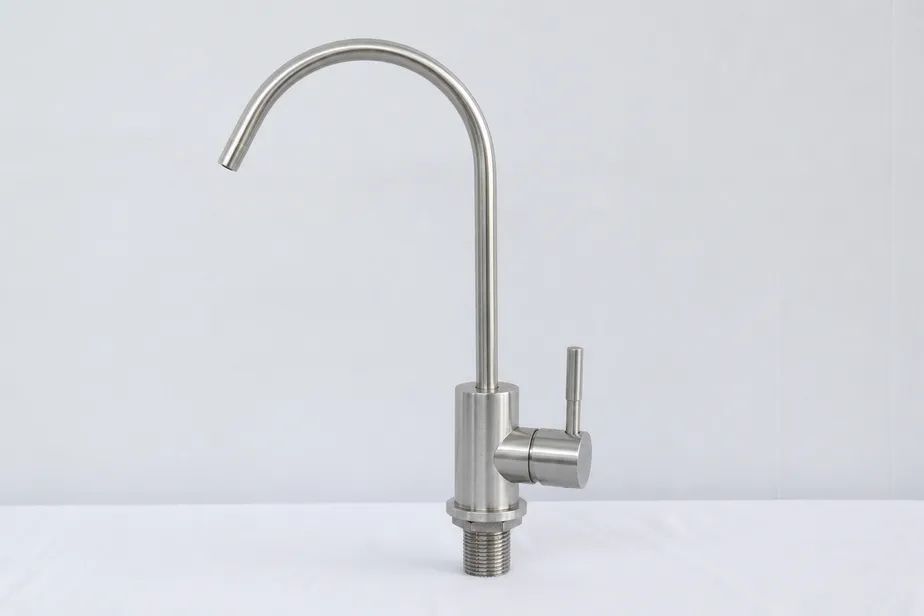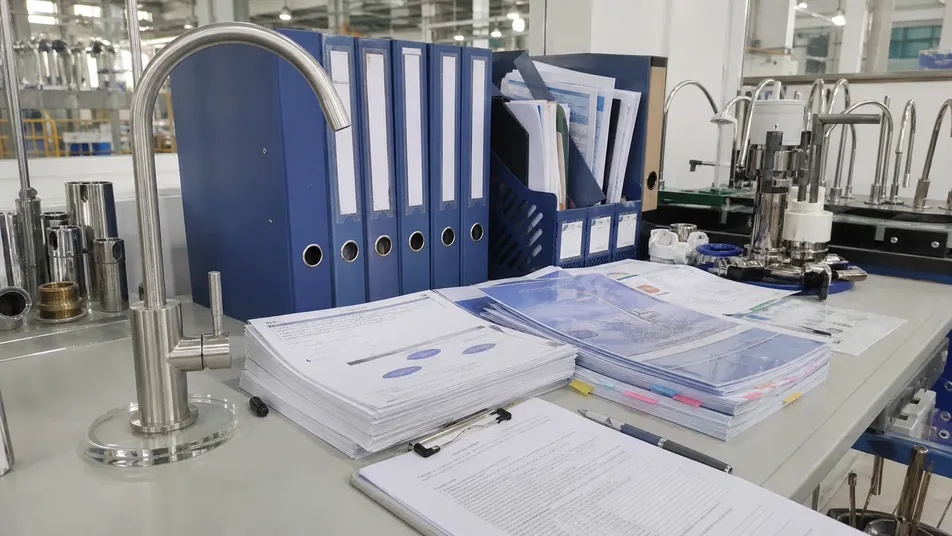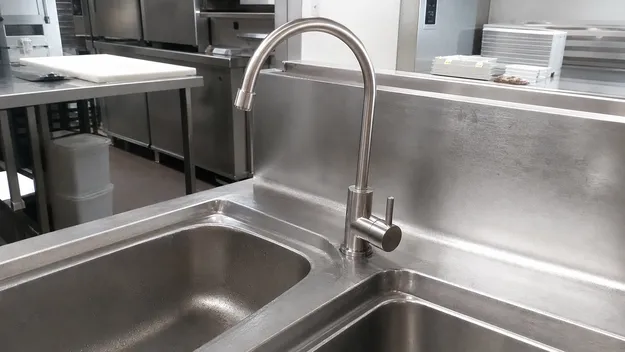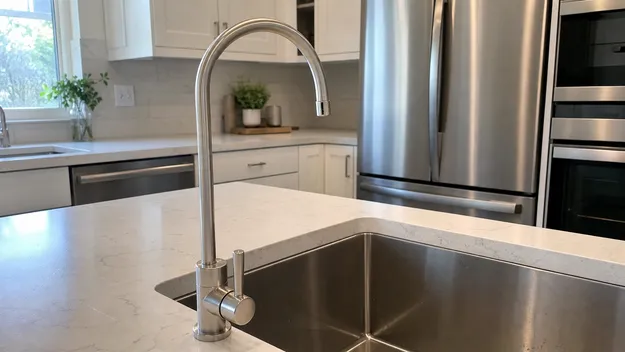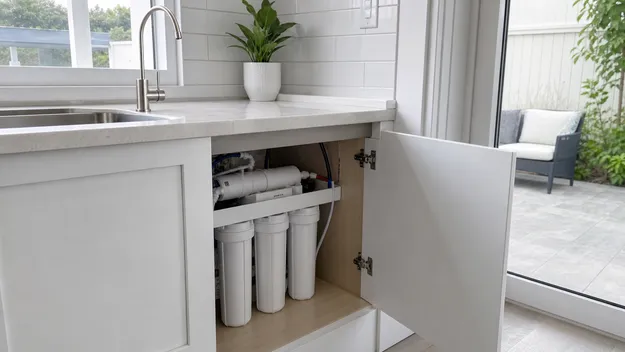

Solid body, no plating stack, no finish degradation risk in drinking water environments.
Built for buyers who need a filter faucet that holds up in commercial kitchens, high-use residential installs, and premium product lines where finish failure is a brand problem.
Material Advantage
The standard water filter faucet in our line — and in most of the market — uses a brass body with an electroplated finish. That's a perfectly sound product when the plating is done correctly. But plating introduces a failure mode that solid stainless steel doesn't have: the finish can delaminate, tarnish, or corrode, particularly in the moisture-heavy environment around a kitchen sink where filter faucets live.
When that happens, it's a warranty claim, a return, and a conversation with your customer about why the faucet they bought looks worse than the one it replaced.
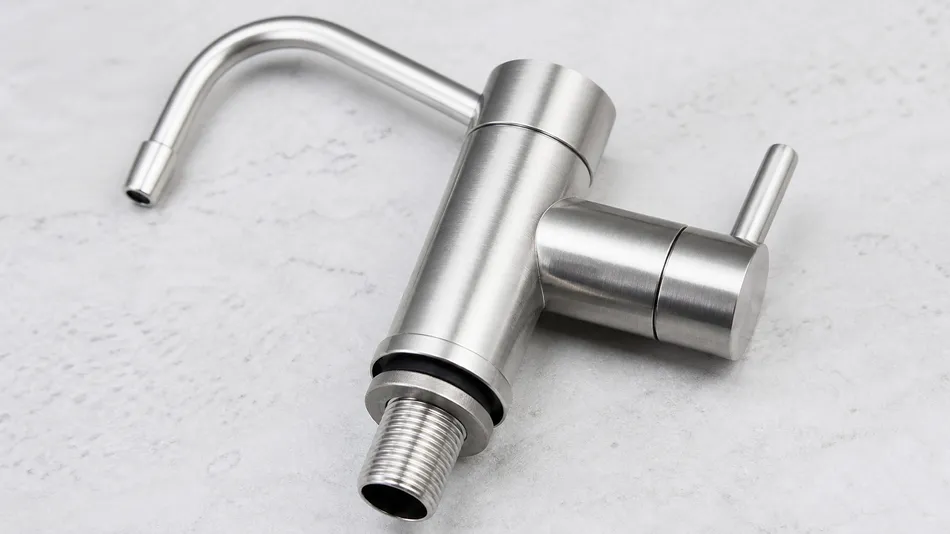
The stainless steel water filter faucet eliminates that failure mode entirely. The body is machined from 304 stainless steel — the same alloy used in commercial kitchen equipment and food-contact surfaces — and the finish is a brushed mechanical texture applied directly to the steel surface. There's no plating stack to delaminate, no nickel mid-coat to skip, no chrome layer to pit. The surface you ship is the surface your customer has five years later.
For buyers building a premium residential line, supplying commercial foodservice accounts, or selling into markets where water quality and material safety are active consumer concerns, that durability profile is a meaningful selling point — and a meaningful reduction in after-sale cost.
View the full water filter faucet range
Brass + Plating
304 Stainless Steel
Who Specifies This Product
We've been running stainless filter faucets alongside our brass line for several years. The buyers who gravitate toward them are typically in one of two situations:
Supplying commercial or semi-commercial environments where the faucet takes more abuse than a residential install
Building a premium SKU that needs to justify a higher retail price point — the stainless body does both jobs
Technical Data
Specifications shown are industry-standard values for this product type. Exact dimensions vary by configuration. Contact us for detailed product data sheets.
Stainless Steel Water Filter Faucet — Full Specification
| Body material | 304 stainless steel |
| Finish | Brushed stainless (mechanical, no plating) |
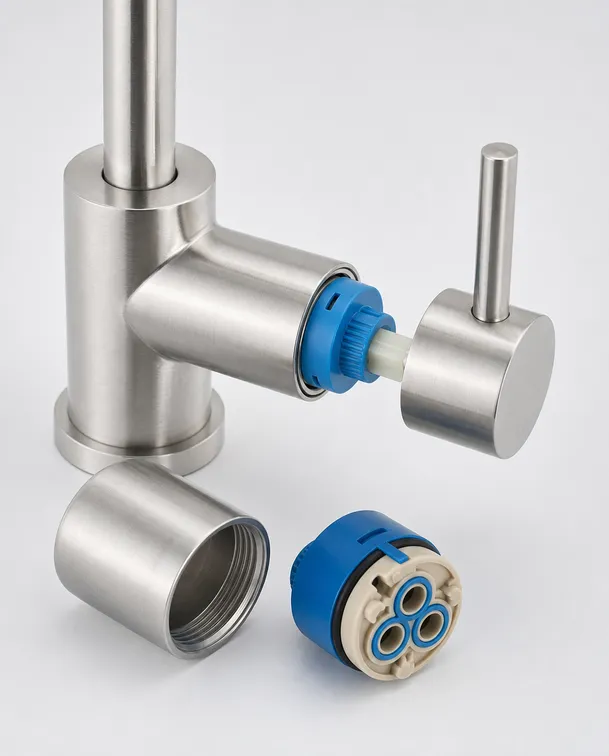
| Valve type | Ceramic disc cartridge |
| Cartridge endurance | 500,000 open/close cycles (tested per production batch) |
| Spout reach | Typically 120–160 mm (confirm for specific variant) |
| Overall height | Typically 280–340 mm (confirm for specific variant) |
| Deck hole size | Standard 1-3/8" (35 mm) |
| Supply tube connection | 1/4" push-fit (standard); 3/8" available |
| Operating pressure | 0.05–0.8 MPa |
| Flow rate | 1.0–1.8 L/min at 0.3 MPa |
| Lead content | ≤0.25% by weight (NSF/ANSI 61 Section 9 compliant) |
| Certifications |
cUPC CE WaterMark SGS
|
| Salt spray rating | N/A — stainless body, no plating |
Note on Flow Rate
The 1.0–1.8 L/min flow rate range is intentional — filter and RO faucets are designed for restricted flow to match the output rate of the filtration system. This is correct for this application. If your customers are comparing this to a standard kitchen faucet, that's the conversation to have before the order ships.
Key Highlights
304 Stainless Body
Same alloy as commercial kitchen equipment and food-contact surfaces
Ceramic Disc Cartridge
500,000-cycle endurance tested per production batch
NSF/ANSI 61 Material Docs
Lead content ≤0.25% by weight; documentation available on request
OEM from 200 pcs
Custom configurations available; contact us for product data sheets
Manufacturing Process
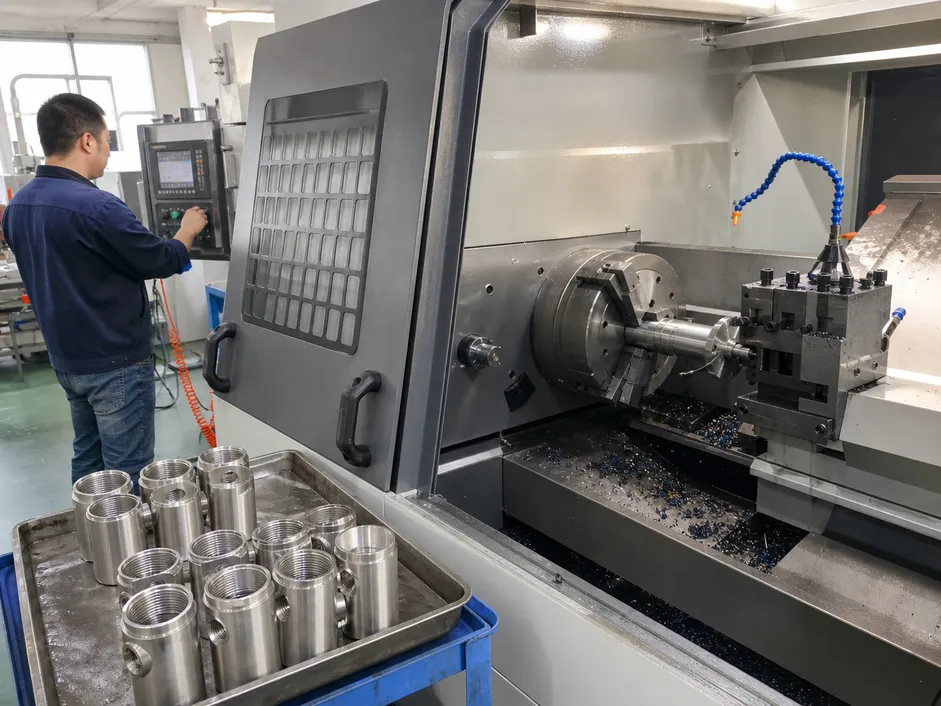
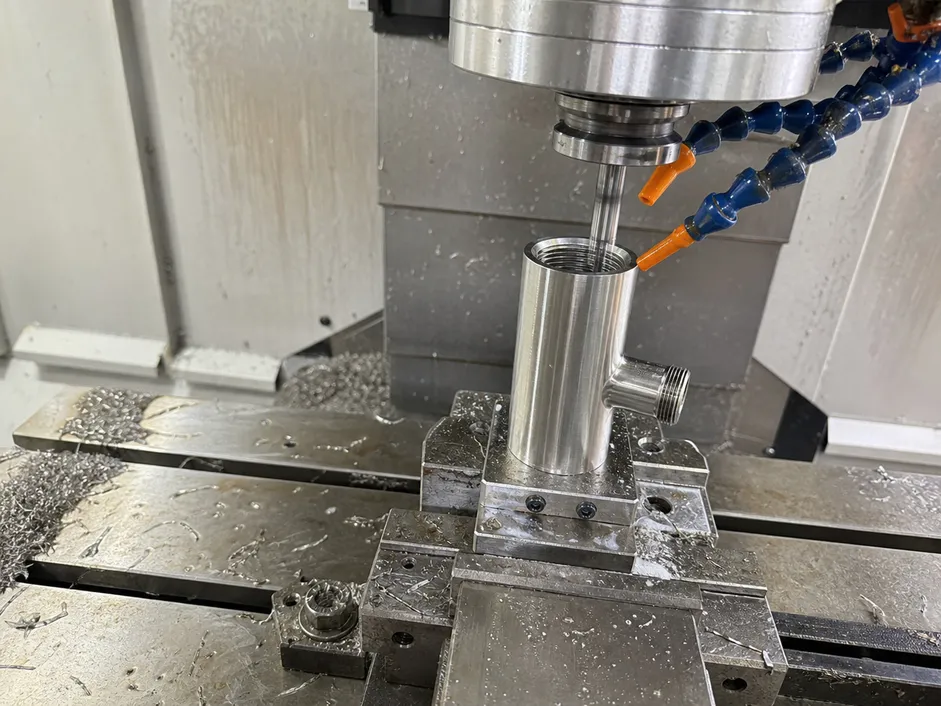
Stainless steel is harder to machine than brass, and the internal waterway geometry matters more in a drinking water faucet than in a standard kitchen faucet. Here's what we do differently on this product.
Not cast — tighter dimensional control
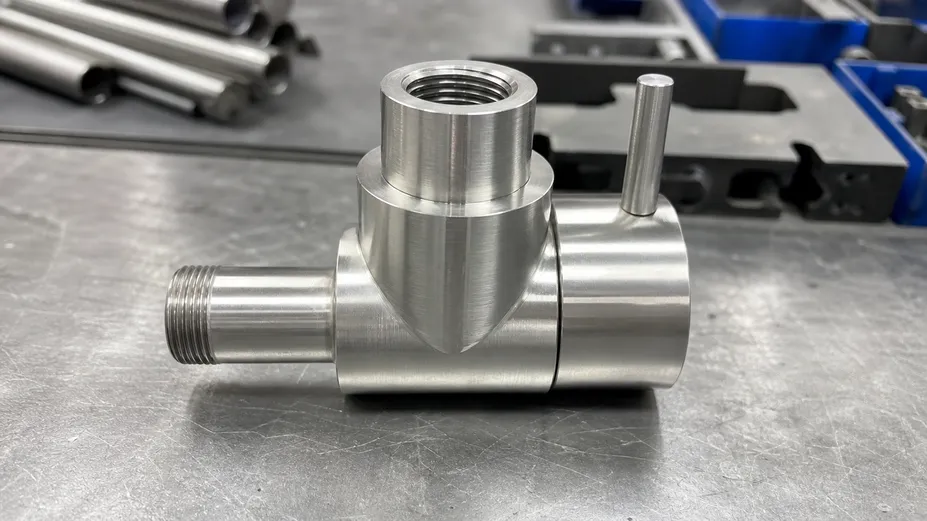
The body starts as 304 stainless bar stock. We don't cast stainless the way we cast brass, because the alloy doesn't lend itself to gravity casting at the tolerances we need. CNC-machining from bar stock gives us tighter dimensional control on the internal waterway surfaces than a cast-and-machined brass body.
Eliminates a failure mode invisible until field deployment
Internal surfaces are machined to a smooth finish and passivated. The passivation step removes free iron from the surface and promotes the formation of the chromium oxide layer that gives stainless its corrosion resistance.
Why this matters: We added the passivation step after seeing early stainless faucets from our line develop minor surface rust at the internal waterway after extended water contact. The machining process can leave free iron on the surface, and without passivation, that iron oxidizes. It's a step that adds cost but eliminates a failure mode that would be invisible until the product is in the field.
Same spec as brass — no relaxation for harder material
The valve seat interface is machined to the same ±0.05mm thread tolerance we hold on our brass bodies. A loose valve seat is the most common source of drip failure regardless of body material, and we don't relax that tolerance because the material is harder to machine.
500,000-cycle rating, tested at RO operating pressure
The ceramic disc cartridge is the same unit we use across our filter faucet line, rated for 500,000 open/close cycles and tested at 0.2 MPa inlet pressure to simulate real-world RO system operating conditions.
The brushed finish is applied mechanically after machining — a consistent-direction grain pattern that hides minor surface marks and coordinates visually with stainless kitchen appliances and sinks.
We don't apply any coating over the brushed surface, which means there's nothing to chip, peel, or discolor. The surface is what it is, and it stays that way.
Finish Method
Mechanical Brushing
Coating Applied
None
CNC-machine body from 304 stainless bar stock
Machine internal waterway surfaces to smooth finish
Passivate to remove free iron and form chromium oxide layer
Machine valve seat to ±0.05mm thread tolerance
Install ceramic disc cartridge (500,000-cycle rated)
Apply mechanical brushed finish — no coating over surface
Compliance & Documentation
For a stainless steel drinking water faucet, the lead content question is simpler than it is for brass — 304 stainless steel contains no lead by composition. The alloy is iron, chromium, and nickel, with trace amounts of carbon and manganese. There's no lead to leach.
Iron, chromium, and nickel — with trace amounts of carbon and manganese. No lead in the alloy by design.
Buyers selling into regulated markets still need documentation even when the base material is lead-free.
The one area where stainless steel faucets still require attention is the cartridge and internal fittings.
If your market requires full lead-free documentation across all wetted components, we can provide the material certifications for each component in the assembly.
304 stainless body — material certification confirming composition
Ceramic disc cartridge — lead-free component documentation
Supply tube fittings — C36000-equiv. brass, ≤0.25% lead by weight
NSF/ANSI 61 Section 9 material documentation for state-level regulators
cUPC certification covering US and Canadian plumbing code compliance
Standard North American Market
cUPC certification covers plumbing code compliance for most US states and Canadian provinces. Material certifications confirming 304 stainless composition available on request.
State-Level Regulator or End-Customer Compliance
NSF/ANSI 61 Section 9 material documentation available for buyers who need to demonstrate drinking water contact compliance to their own customers or to state-level regulators.
Full Wetted-Component Lead-Free Documentation
Material certifications for each component in the assembly — body, cartridge, and supply tube fittings — available for markets requiring complete lead-free documentation across all wetted parts.
Market Positioning
The stainless steel water filter faucet is the right SKU for specific situations. It's not the right SKU for every situation, and being clear about that saves everyone time.
Restaurant prep stations, commercial coffee bars, office kitchen installations, and food service environments all benefit from the stainless body — it matches the surrounding equipment aesthetically, handles higher use frequency without finish degradation, and meets the material safety expectations of commercial food service operators.
Typical Order Pattern
Commercial accounts typically order 50–200 units per project, with repeat orders as facilities expand or renovate — a reliable volume pattern for distributors building this segment.
The stainless body commands a higher retail price than a plated brass equivalent — typically 20–35% higher at retail, depending on the market. For distributors or importers building a premium tier in their filter faucet catalog, the stainless SKU is the margin-protecting option.
Market Fit
Coordinates naturally with stainless kitchen appliances and sinks that dominate the premium residential segment in North America and Northern Europe — easier for your downstream customers to sell.
If you're assembling an RO system under your own brand and positioning it at the upper end of the market, a stainless steel dispensing faucet signals quality in a way that a chrome-plated brass faucet doesn't — even if the underlying filtration performance is identical.
Private Label Available
We supply matched stainless faucets to several RO system OEMs on a private-label basis for exactly this reason.
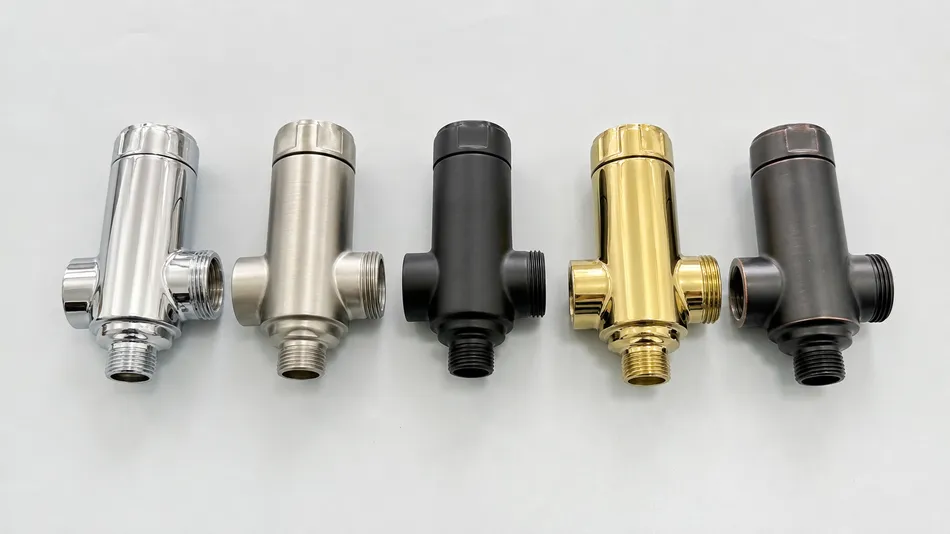
Buyers who need multiple finish options. The stainless body ships in brushed stainless only — there's no chrome, no matte black, no PVD gold option on this variant. If your market requires finish variety, the brass body variants in our line cover five finishes and are the better starting point.
The brushed water filter faucet in brushed nickel is the closest alternative if you want the brushed aesthetic without the stainless body premium.
OEM & Private Label
We support OEM and private-label development on this product from 200 pieces per SKU. The stainless body has a different customization profile than our brass variants — here's what's available and what isn't.
Handle Style and Geometry
The handle is a separate component and can be modified or replaced with a custom design.
Spout Profile and Reach
Within the constraints of the stainless machining process, we can adjust spout geometry for specific aesthetic or functional requirements.
Branding
Logo engraving on the body or handle, custom packaging, private-label documentation.
Supply Tube Connection Spec
1/4" push-fit is standard; 3/8" and compression fittings are available.
Deck Plate Configuration
Single-hole or with escutcheon plate.
Body Finish
Brushed stainless is the only finish option. We don't plate over stainless on this product line.
Body Material
This is a stainless-specific product. If you need brass with a brushed finish, that's a different SKU.
25–35
Days
Design brief to first sample — OEM path with in-house CNC tooling, no outside vendor involvement
15–20
Days
ODM path — modified samples from existing catalog body with custom handles or branding
200
Pieces MOQ
Minimum order for OEM projects. Most new buyers start with a 200-unit trial order to test market response before scaling
For OEM projects, the path from design brief to first sample runs 25–35 days. We maintain in-house CNC tooling, so modifications to the machining program don't require outside vendor involvement.
For buyers who want to move faster, our ODM path starts from the existing catalog body with modified handles or branding — modified samples typically turn around in 15–20 days.
MOQ is 200 pieces for OEM orders. Most new buyers in this segment start with a 200-unit trial order to test market response before scaling.
We can ship samples before the production order so you can evaluate the product with your own customers.
Logistics & Landed Cost
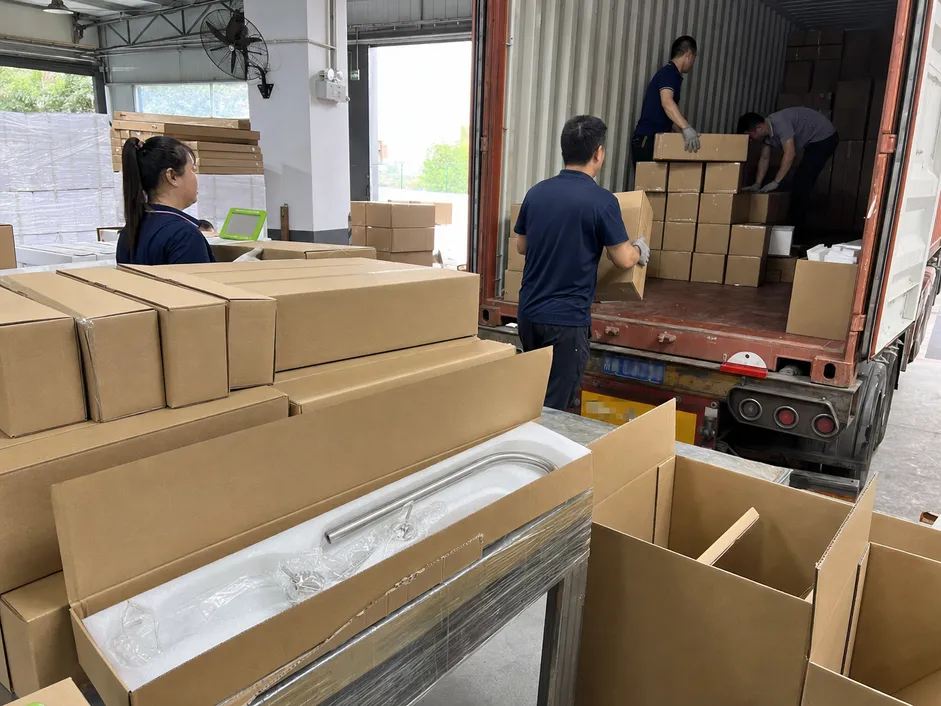
Stainless steel faucets are slightly heavier than their brass equivalents — worth factoring into your freight and container planning before you finalize your SKU mix.
304 stainless vs. brass casting
The 304 stainless body runs approximately 15–20% heavier than a comparable brass casting. For container loading, this means a modest reduction in unit count per container compared to the brass variants.
Standard 40HQ container
A standard 40HQ container loads approximately 6,000–9,000 units of this product depending on the specific configuration and carton dimensions. We calculate the exact loading plan against your SKU mix and provide a packing list with CBM and gross weight per SKU before you confirm the order.
Retail-ready inner box
Each unit ships in an individual inner box with supply tube, mounting hardware, and installation instructions. The inner box is designed for retail-ready presentation — if you're selling through distribution into retail channels, the packaging is shelf-ready without modification.
For buyers who need custom packaging — private-label boxes, specific language requirements, or branded inserts — we handle that as part of the OEM process.
The stainless body's higher unit weight does affect freight cost per unit compared to brass variants — worth factoring into your landed cost calculation, particularly for markets where freight is a significant portion of total cost. For most North American and European buyers, the higher retail price point of the stainless SKU more than offsets the freight differential.
Material Selection Guide
Both body materials are sound choices — the decision comes down to your market segment and what your buyers are optimizing for.
| Attribute | Stainless Steel Body | Brass Body (Plated) |
|---|---|---|
| Finish options | Brushed stainless only | Chrome, brushed nickel, matte black, PVD gold, oil-rubbed bronze |
| Finish durability | No plating — no delamination risk | Depends on plating quality; full copper/nickel/chrome stack required |
| Lead content | None by composition | ≤0.25% by weight (our spec); varies by supplier |
| Retail price point | Higher (20–35% premium typical) | Lower to mid-range |
| Best fit | Commercial, premium residential, RO system premium bundles | Residential, multi-finish catalogs, volume SKUs |
| Weight | Slightly heavier | Lighter |
| Customization | Handle, spout, branding | Handle, spout, branding, finish |
If you're supplying a specific commercial or premium segment where finish variety is less important than material credibility, the stainless body is the cleaner choice. No plating stack means no delamination risk and a straightforward material safety story for your buyers.
If you're building a catalog that needs to cover multiple price points and finish options, start with the brass variants and add the stainless SKU as your premium tier. Brass supports the full finish range your residential and multi-finish catalog buyers expect.
If you're building a catalog that needs to cover multiple price points and finish options, start with the brass variants and add the stainless SKU as your premium tier. If you're supplying a specific commercial or premium segment where finish variety is less important than material credibility, the stainless body is the cleaner choice.
Premium Tier
Stainless Steel Body
20–35% retail premium · brushed stainless · no plating risk
Volume / Multi-Finish Tier
Brass Body (Plated)
5 finish options · lower to mid-range price · residential volume
Answers to the questions buyers and compliance teams ask most often about our stainless steel filter faucet line.
Yes. 304 stainless steel is the standard alloy for food-contact and drinking water applications — it's used in commercial kitchen equipment, water storage tanks, and plumbing fittings globally. The alloy contains no lead, and the chromium oxide surface layer that forms naturally on stainless steel is chemically inert in contact with water. Our stainless filter faucets carry cUPC certification and we can provide NSF/ANSI 61 material documentation confirming the alloy composition and drinking water contact compliance.
Two reasons: material cost and machining cost. 304 stainless steel is more expensive than brass by weight, and it's significantly harder to machine — cutting tools wear faster, cycle times are longer, and the passivation step adds a process stage that brass doesn't require. The brushed finish on stainless is also applied mechanically after machining, which is a separate operation. The result is a higher unit cost, but also a product with no plating failure mode — which translates to lower warranty claim rates and a justifiable retail price premium.
No. The stainless body ships in brushed stainless only — we don't apply electroplating over stainless on this product line. If you need chrome or matte black, the brass body variants are the right starting point. The water filter faucet and brushed water filter faucet cover those finish options.
200 pieces per SKU. For OEM orders with custom handle or spout modifications, first sample in 25–35 days. For ODM orders starting from our existing catalog body with modified branding or packaging, first sample in 15–20 days. We can ship pre-production samples before the production order so you can evaluate the product with your own customers.
Better than plated brass. Hard water deposits (calcium and magnesium scale) form on any faucet surface, but they're easier to remove from brushed stainless than from chrome or brushed nickel — the mechanical grain texture of the brushed finish doesn't trap scale the way a smooth plated surface can. More importantly, the cleaning products used to remove hard water scale — mild acids, descalers — can attack plated finishes over time. Stainless steel is chemically resistant to the concentrations used in household cleaning products, so the finish holds up through repeated cleaning cycles.
WaterMark certification, which is required for plumbing products sold in Australia and New Zealand. We also hold CE for European markets and cUPC for North America. All relevant certification documentation ships with the order — your customs broker and compliance team have what they need without chasing us for it after the container ships.
Send us your target volume, destination market, and any customization requirements — handle style, branding, packaging, or supply tube spec. We'll come back with a detailed quote and, if you're evaluating the stainless body against our brass variants, a side-by-side comparison of the landed cost and retail price positioning for your market.
New to this product? A 2-unit sample order is the standard starting point. We can ship samples within the standard lead time so you can evaluate the product with your own customers before committing to a production order.
MOQ
200 pcs
per SKU
ODM Sample
15–20 days
catalog body
OEM Sample
25–35 days
custom modifications
© 2026 Wfaucet. All rights reserved.