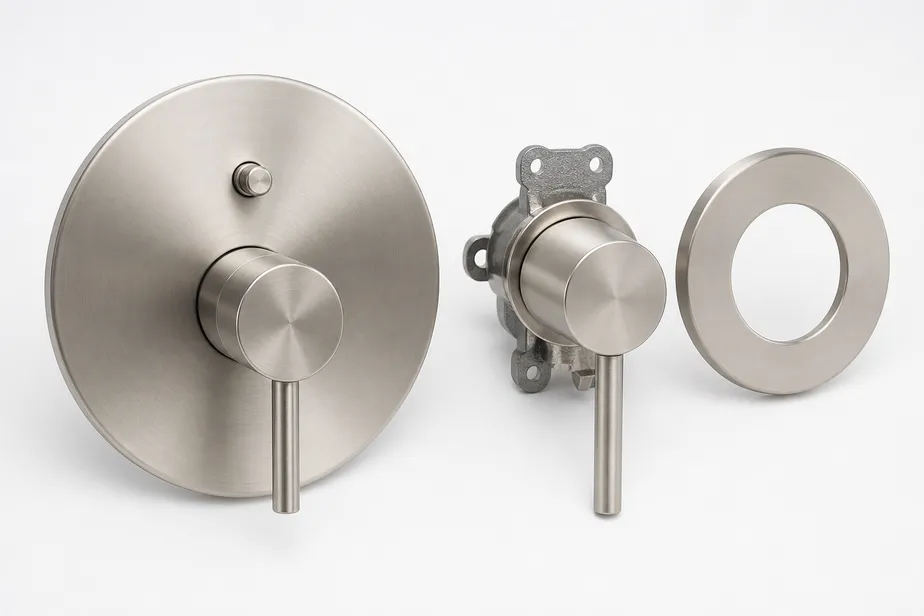


A rough-in error on a concealed system costs more to fix than the valve itself. Once the wall is tiled, a body that's 10mm too deep or a port thread that doesn't match the local supply standard means demo work, rescheduled trades, and a project handover delay that lands on your desk. Getting the spec right before the wall closes is the only move that makes commercial sense.
This guide covers the four specification dimensions that matter most for procurement and project sourcing: body size, rough-in depth, port configuration, and cUPC compliance. Each section maps the spec to what it means for your installation cost, compliance risk, and supplier documentation requirements.
The full spec picture before you order
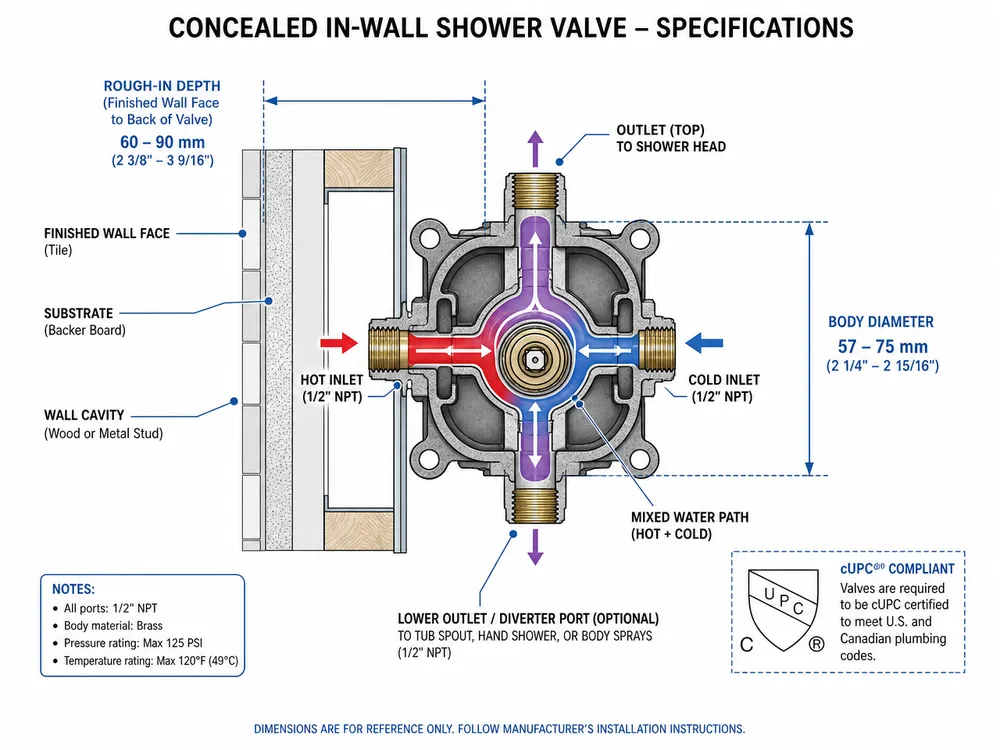
"Concealed shower valve specifications" covers more ground than most supplier datasheets show. The dimensions that matter for a successful installation and a clean import are:
| Parameter | Typical range | What it affects |
|---|---|---|
| Body diameter | 57–75 mm | Wall cavity fit, trim kit compatibility |
| Body length (depth) | 80–120 mm | Rough-in depth requirement |
| Rough-in depth from finished wall | 60–90 mm | Wall assembly type (2×4 vs 2×6 framing) |
| Inlet port size | 1/2" NPT or 1/2" BSP | Supply line thread compatibility |
| Outlet port count | 2 or 3 | Trim kit and diverter selection |
| Outlet port size | 1/2" NPT or 1/2" BSP | Trim kit thread compatibility |
| Max working pressure | 0.6–1.0 MPa | System pressure compliance |
| Certification | cUPC, CE, WaterMark | Market import clearance |
Every one of these parameters needs to be confirmed before you finalize a purchase order. A mismatch on any single line — thread standard, rough-in depth, outlet count — creates a field problem that no amount of documentation fixes after the fact.
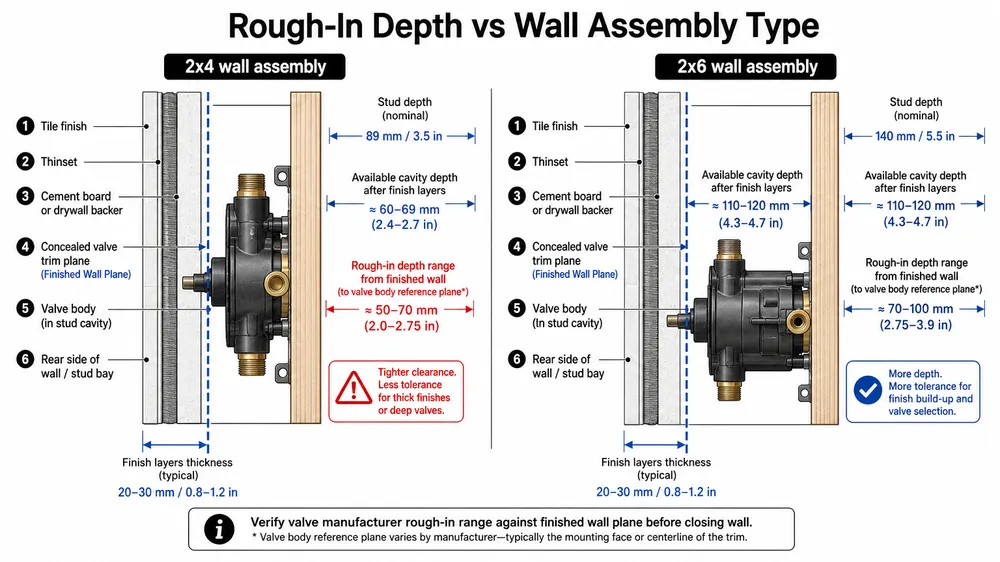
We've seen buyers source a valve with the right body diameter and the right certification, then discover on-site that the rough-in depth assumes a 2×6 wall and their project is framed in 2×4. That's a 38mm difference in available cavity depth, and it's not recoverable without structural work.
Body size and wall cavity: what the numbers actually mean on-site
Body diameter for concealed shower valves typically runs 57–75 mm. The diameter itself is rarely the constraint — standard wall cavities in North American 2×4 framing give you roughly 89 mm of clear width between studs, so even a 75 mm body fits with clearance. What matters more is the body length and how it translates to rough-in depth.
Rough-in depth is the distance from the finished wall face to the centerline of the supply inlets. This is the number your installer needs, and it's the number most supplier datasheets either omit or bury in a footnote.
Standard rough-in depth ranges by wall assembly:
| Wall assembly | Stud depth | Drywall + tile | Available cavity | Required rough-in depth |
|---|---|---|---|---|
| 2×4 framing | 89 mm | ~25–35 mm | ~54–64 mm | 60–65 mm max |
| 2×6 framing | 140 mm | ~25–35 mm | ~105–115 mm | Up to 90 mm |
| Concrete/masonry | Variable | ~30–50 mm | Variable | Confirm per project |
A valve with a 75 mm rough-in depth fits a 2×4 wall with standard tile. A valve with a 90 mm rough-in depth requires 2×6 framing or a furring-out solution. If your buyers are supplying hotel fit-outs or multi-unit residential projects, the wall assembly type is a project-specific variable — not something you can assume from a catalog spec.
Our standard concealed valve body runs at 65 mm rough-in depth, which fits 2×4 framing with tile without modification. We also produce a 75 mm rough-in variant for buyers whose projects use 2×6 framing or thicker tile assemblies. (The 75 mm variant is the more common request from our hotel fit-out buyers in North America — commercial projects tend to use 2×6 exterior walls and thicker stone tile, so the extra depth is used up quickly.)
Port configuration: inlet thread standard and outlet count
Port configuration is where sourcing errors are most common, and where the spec sheet needs to be read carefully rather than assumed.
Inlet thread standard: NPT vs BSP
The two thread standards you'll encounter are:
- 1/2" NPT (National Pipe Taper) — North American standard, used in the US and Canada
- 1/2" BSP (British Standard Pipe) — Used in the UK, Australia, most of Europe, and much of Southeast Asia
NPT and BSP are not interchangeable. The thread pitch and taper angle differ, so an NPT supply line connected to a BSP valve body will leak under pressure. This is a field failure that generates installer callbacks and warranty claims.
If you're supplying the North American market, specify NPT inlets. If you're supplying Australia, the UK, or Europe, specify BSP. If you're supplying multiple markets from one SKU, you need to decide whether to stock two variants or use an adapter strategy — and adapters add installation complexity that your downstream buyers may not appreciate.
We produce both NPT and BSP inlet configurations. For OEM orders, the thread standard is specified at the order stage and machined into the body — it's not a field-swappable component. (We've had buyers try to order a "universal" valve that works with both thread standards. There's no such thing at the body level. The right answer is two SKUs or a clear market segmentation.)
Outlet count: 2-outlet vs 3-outlet
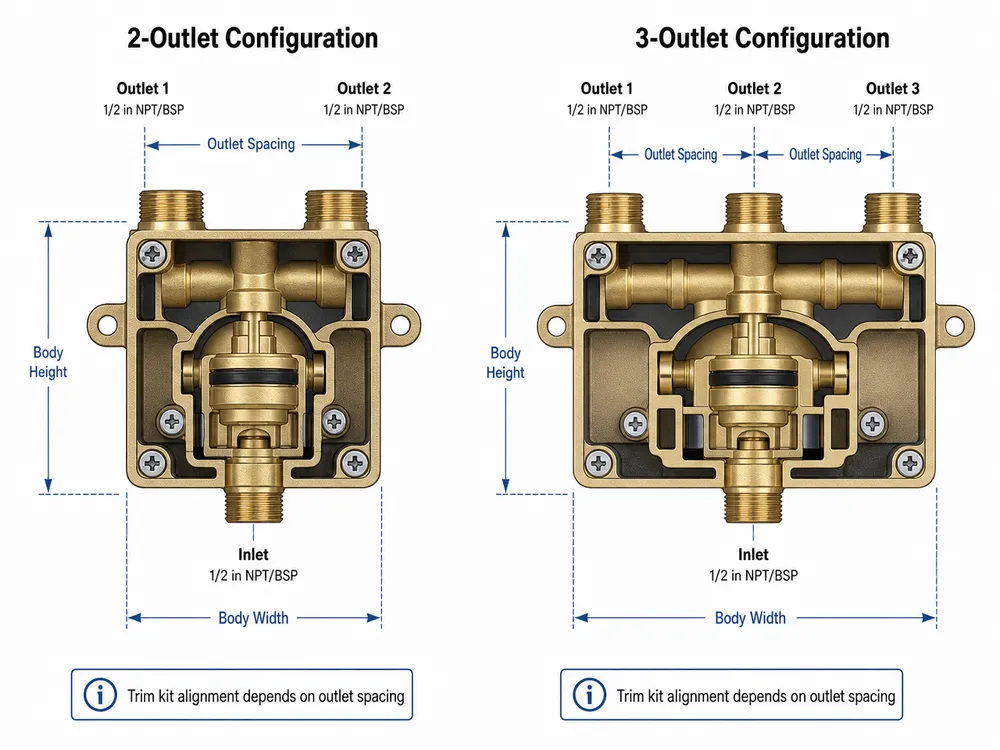
Outlet count determines which trim kits and diverter configurations are compatible with the valve.
| Configuration | Outlets | Typical application | Trim kit requirement |
|---|---|---|---|
| 2-outlet | 1 inlet → 2 outlets | Shower head + hand shower | 2-function diverter trim |
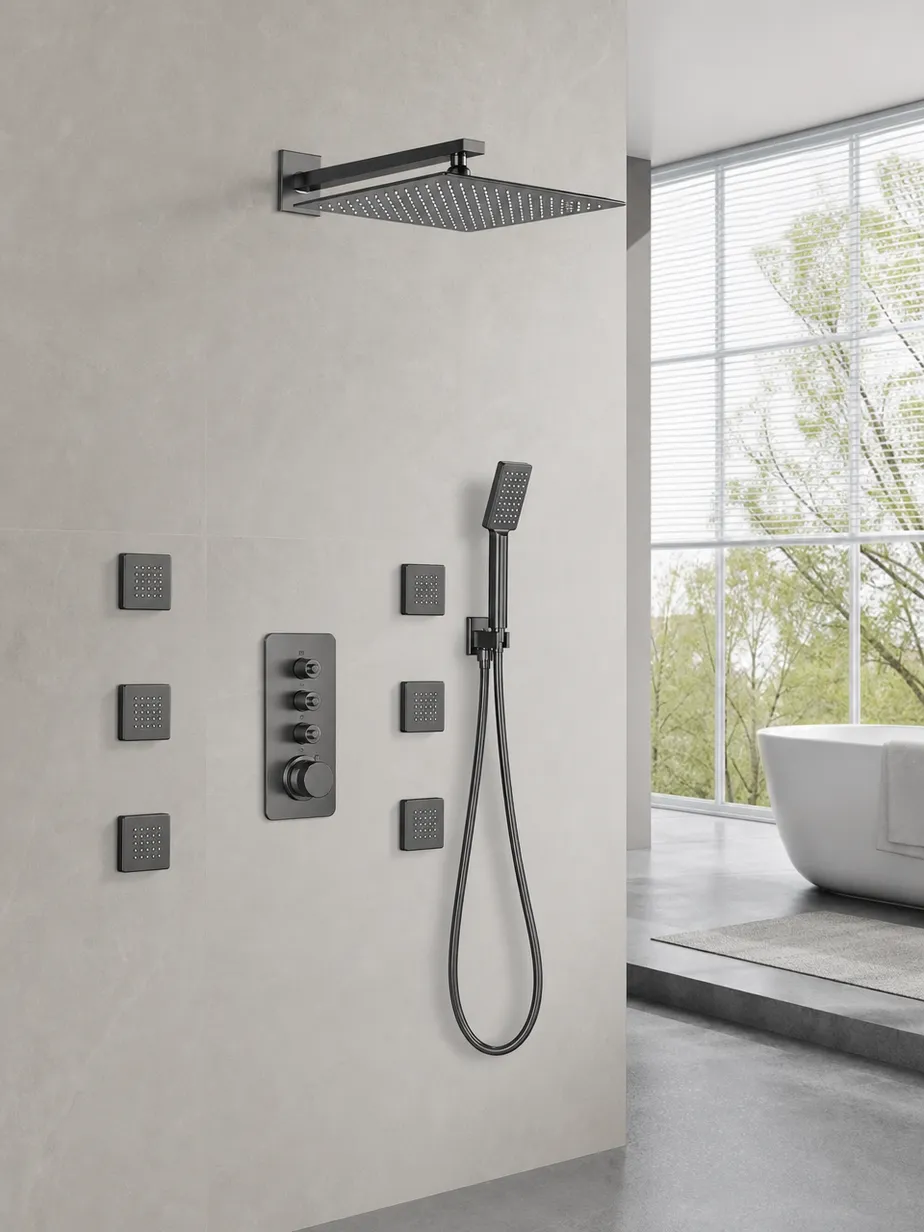
| 3-outlet | 1 inlet → 3 outlets | Shower head + hand shower + body jets | 3-function diverter trim |
| Thermostatic 2-outlet | 1 inlet → 2 outlets | Temperature-controlled shower | Thermostatic trim kit |
The outlet count is fixed at the valve body level. A 2-outlet valve cannot be field-converted to 3-outlet by swapping the trim — the internal diverter cartridge and the port machining are different. If your project spec calls for a 3-function shower system, the valve body needs to be specified as 3-outlet from the factory.
This is the most common mismatch we see in project procurement: a buyer sources a 2-outlet valve because it's cheaper, then the project architect specifies a 3-function trim kit, and the valve and trim are incompatible. The fix is a new valve body, not a new trim kit.
Outlet port spacing and trim kit compatibility
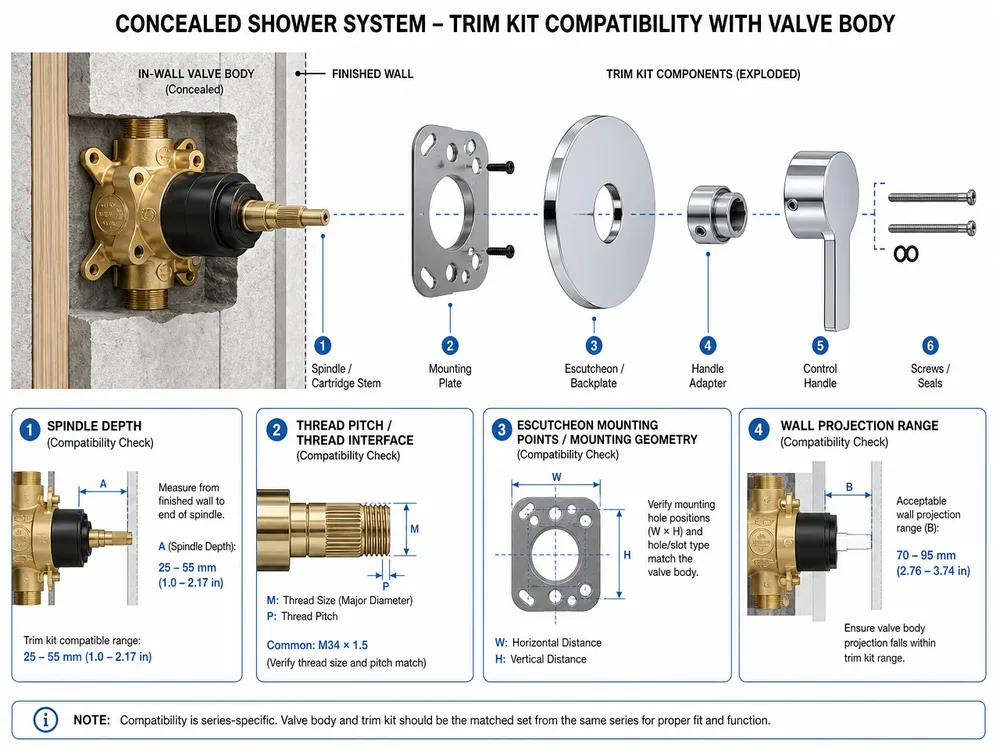
Outlet port center-to-center spacing is the dimension that determines whether a specific trim kit will align with the valve body. Standard spacing for 2-outlet valves is typically 150 mm center-to-center. For 3-outlet valves, spacing varies by manufacturer.
If you're sourcing a valve to pair with a specific trim kit — whether from us or from another supplier — confirm the outlet port spacing before ordering. A 5 mm mismatch in port spacing means the trim plate won't cover the wall penetrations cleanly, and that's a visible defect in a finished installation.
For OEM buyers, we can adjust outlet port spacing within a ±10 mm range from our standard tooling. Beyond that range, new tooling is required, which adds lead time and tooling cost. Most project specs fall within the standard range.
cUPC and ASSE 1016: what the standards require and what documentation you need
cUPC is the certification mark administered by the International Association of Plumbing and Mechanical Officials (IAPMO) for plumbing products sold in the US and Canada. For concealed shower valves, the relevant standards are:
- ASSE 1016 — Performance requirements for automatic compensating valves for individual showers and tub/shower combinations (anti-scald protection)
- NSF 61 — Drinking water system components — health effects (lead content and material safety)
- NSF 372 — Drinking water system components — lead content (the "lead-free" standard for wetted surfaces)
A cUPC-listed concealed shower valve has been tested and certified to meet ASSE 1016 anti-scald performance and NSF 61/372 material safety requirements. Without cUPC listing, the valve cannot legally be installed in most US and Canadian jurisdictions — it will fail the rough-in inspection, and your buyer's project will not receive a certificate of occupancy.
What documentation to request from your supplier
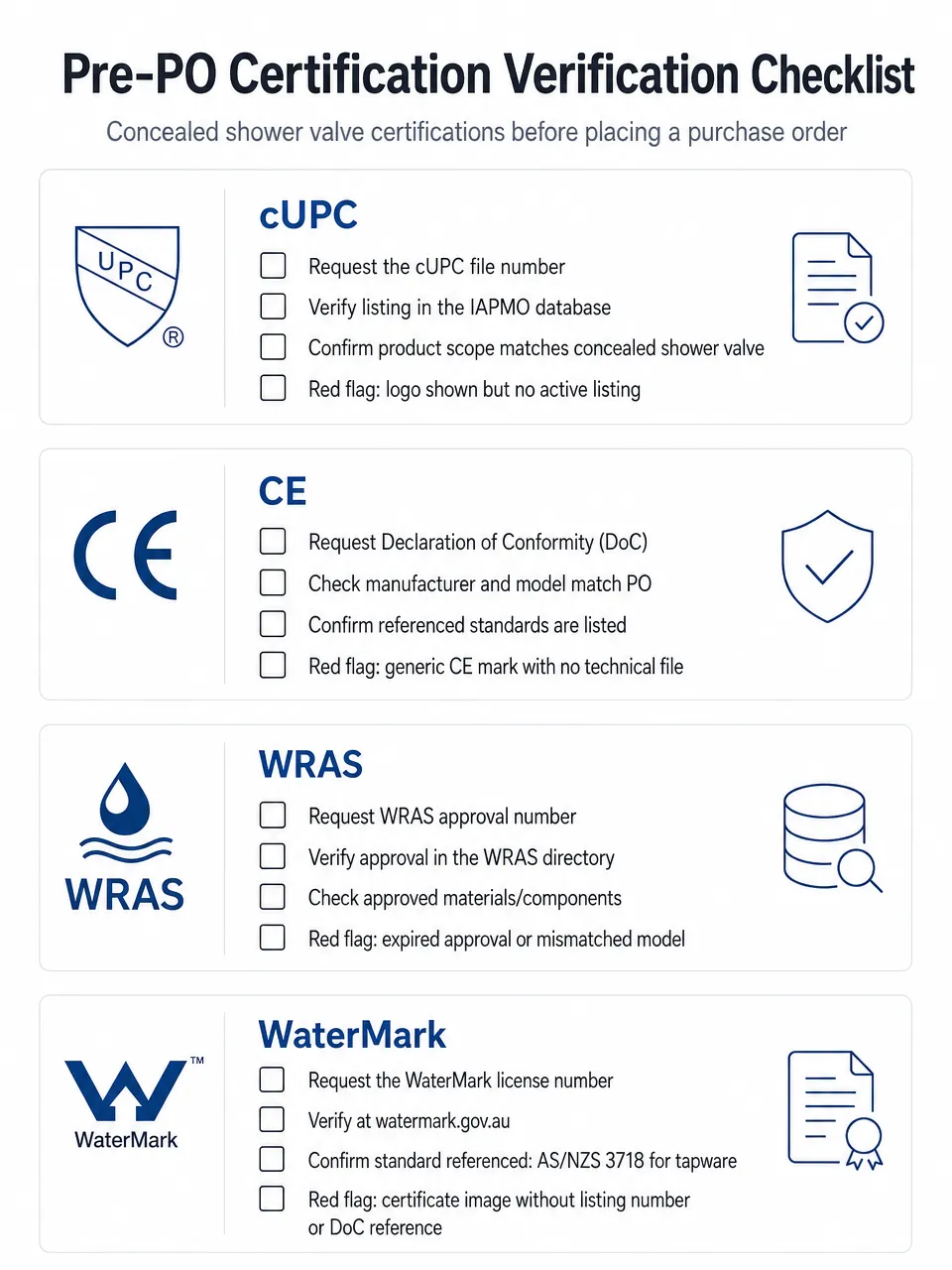
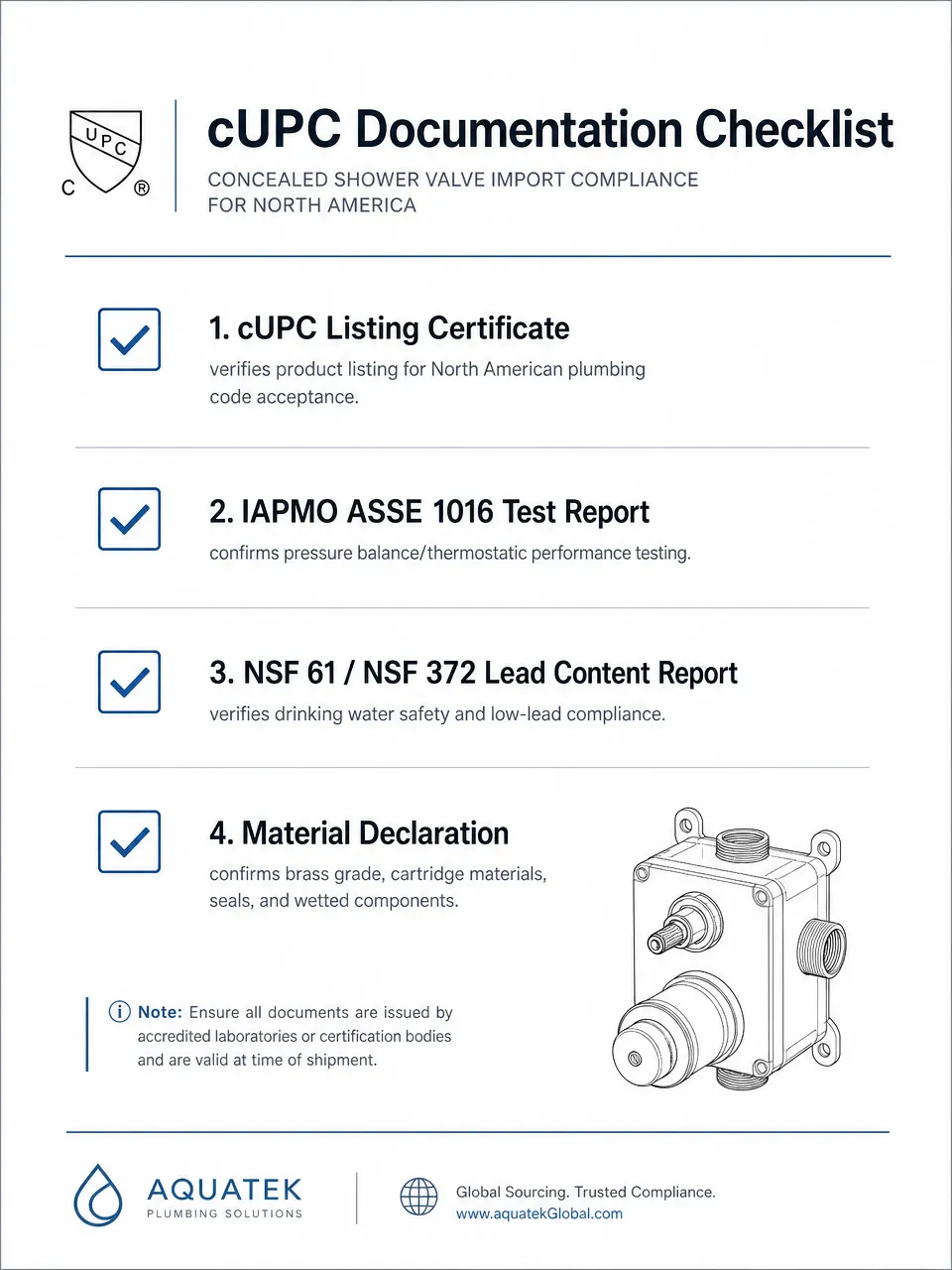
When sourcing a cUPC-listed concealed shower valve, request the following before placing a bulk order:
- cUPC listing certificate — Shows the specific model number, listing date, and the standards covered. Verify the model number on the certificate matches the product you're ordering.
- IAPMO test report — The underlying test data for ASSE 1016 compliance. Some buyers don't ask for this; they should.
- NSF 61/372 test report — Lead content test results for wetted components. This is the document your customs broker may need for US import clearance.
- Material declaration — Brass alloy specification confirming lead content in wetted surfaces meets NSF 372 requirements (≤0.25% weighted average lead content).
We hold cUPC certification in-house and include the full documentation package — listing certificate, ASSE 1016 test report, NSF 61/372 report — with every shipment. You don't need to chase a third-party testing lab or request documents separately after the order ships. (We learned early that documentation gaps at the port are more expensive than the cost of maintaining the paperwork system. Our QC manager built the documentation workflow specifically around export compliance, not as an afterthought.)
cUPC vs non-cUPC: the sourcing risk in plain terms
A non-cUPC valve may be physically identical to a cUPC-listed valve. The difference is the testing and certification record. For your buyers:
- A non-cUPC valve cannot be installed in most US/Canadian residential or commercial projects without a variance — and variances are rarely granted for plumbing fixtures.
- A non-cUPC valve will fail rough-in inspection, generating a project delay and a replacement order at your buyer's expense.
- A non-cUPC valve may not clear US customs if the import documentation doesn't include NSF 61/372 compliance.
The price difference between a cUPC-listed valve and a non-listed valve from the same factory is typically 8–15%. The cost of a failed rough-in inspection, a replacement order, and a project delay is orders of magnitude higher. For any buyer supplying the North American market, cUPC listing is not an optional upgrade — it's a baseline requirement.
For buyers supplying Australia, CE marking covers European conformity and WaterMark covers Australian compliance. We hold both certifications, so a single factory relationship covers US, EU, and AU market documentation from one source.

OEM specification flexibility: what can be adjusted and at what MOQ
For buyers sourcing on OEM terms, the question is which parameters are fixed by the standard tooling and which can be adjusted for a specific project or market.
| Parameter | Adjustable? | MOQ for adjustment | Notes |
|---|---|---|---|
| Rough-in depth | Yes, within range | 200 pcs | ±15 mm from standard; beyond that requires new tooling |
| Body diameter | No (standard tooling) | — | Fixed by casting die; new tooling required for change |
| Inlet thread standard | Yes | 200 pcs | NPT or BSP specified at order stage |
| Outlet count | No (standard tooling) | — | 2-outlet and 3-outlet are separate SKUs |
| Outlet port spacing | Yes, within range | 200 pcs | ±10 mm from standard without new tooling |
| Finish | Yes | 200 pcs | Chrome, brushed nickel, matte black, PVD gold |
| Trim kit pairing | Yes | 200 pcs | Specify trim kit model at order stage for compatibility check |
| Private label / branding | Yes | 200 pcs | Packaging and trim plate branding |
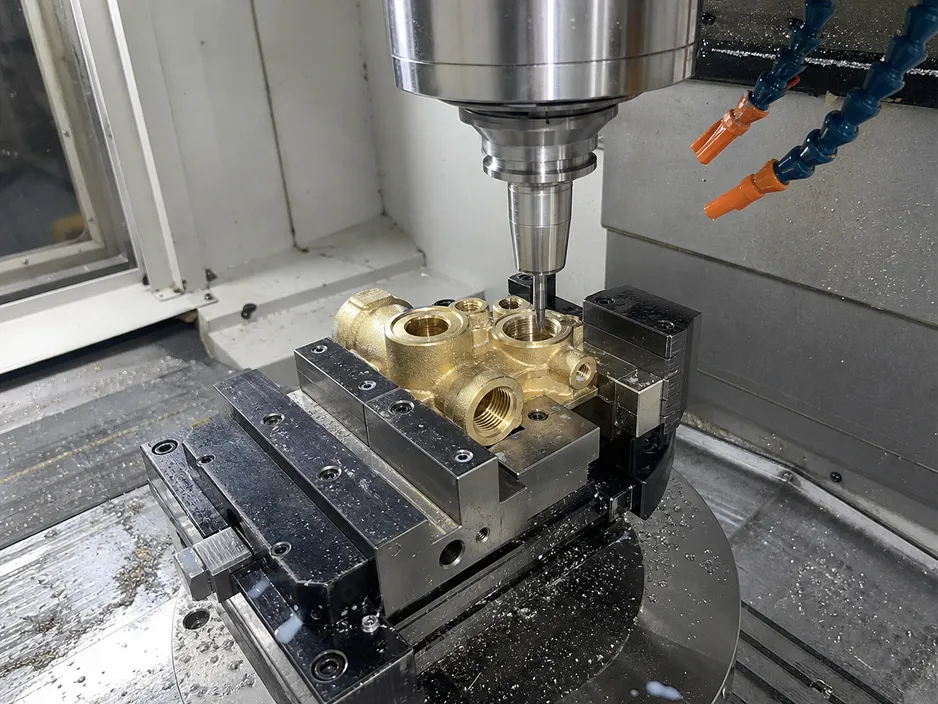
The 200-piece MOQ applies to OEM adjustments within our standard tooling range. For changes that require new casting dies or CNC fixtures — a new body diameter, a non-standard outlet count — tooling cost and lead time apply. We maintain the tooling in-house, so revisions don't go to an outside vendor. A tooling revision typically adds 10–15 days to the first-sample timeline.
For buyers entering the concealed shower valve category for the first time, the practical starting point is our standard 2-outlet, 65 mm rough-in, 1/2" NPT body with cUPC certification. That configuration covers the majority of North American residential and light commercial projects. Once you've validated the spec with your first buyers, adjustments for specific project requirements are straightforward at 200-piece minimums.
Explore our full range of Concealed Shower Valves to see standard configurations and available finish options.
How to use this spec sheet when sourcing: a pre-order checklist
Before finalizing a concealed shower valve order — whether for stock or a specific project — confirm the following with your supplier:
Wall assembly and rough-in depth
- [ ] What is the rough-in depth of the valve body?
- [ ] What wall assembly type does the project use (2×4, 2×6, masonry)?
- [ ] Does the rough-in depth fit the available cavity after drywall and tile?
Port configuration
- [ ] What is the inlet thread standard (NPT or BSP)?
- [ ] How many outlets does the valve have (2 or 3)?
- [ ] What is the outlet port center-to-center spacing?
- [ ] Is the trim kit you're pairing confirmed compatible with this valve body?
Compliance and documentation
- [ ] Is the valve cUPC-listed? Request the listing certificate with the specific model number.
- [ ] Does the supplier provide the ASSE 1016 test report and NSF 61/372 report with the shipment?
- [ ] For Australian projects: is WaterMark certification current?
- [ ] For European projects: is CE marking current?
OEM and customization
- [ ] If rough-in depth adjustment is needed, is it within the supplier's standard tooling range?
- [ ] Is the outlet count confirmed before tooling is committed?
Running through this checklist at the RFQ stage costs nothing. Running through it after the wall is tiled costs a demo crew and a project delay.
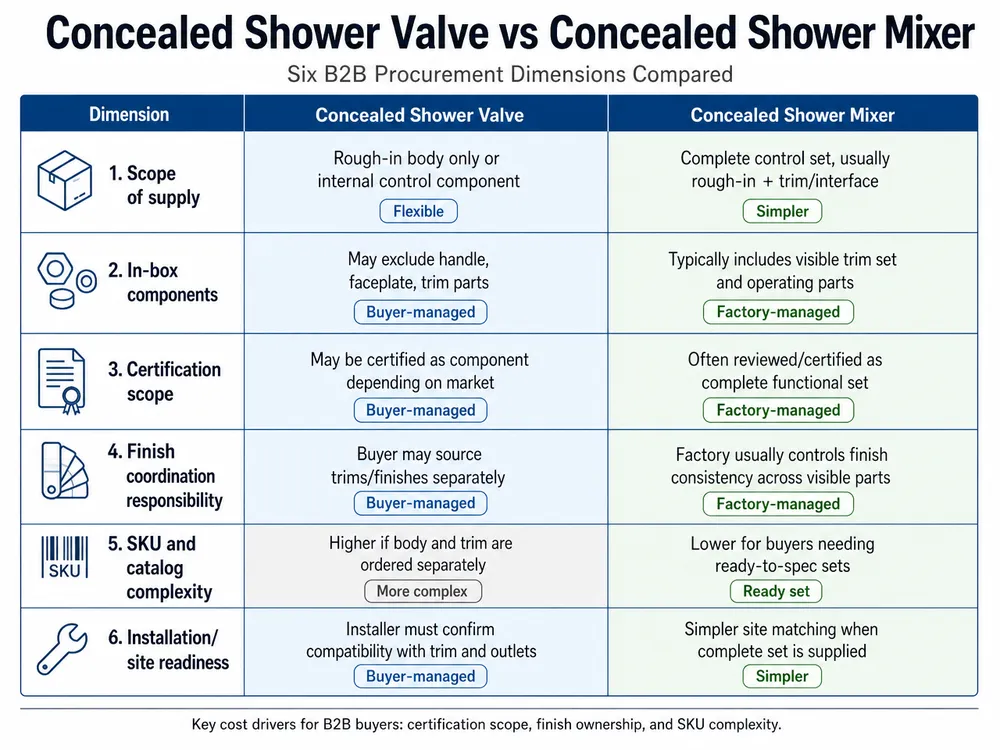
For buyers sourcing concealed shower systems at scale, the Concealed Shower Mixers & Sets category page covers the full system configuration — valve body, trim kit, and outlet accessories — with compatibility notes for each combination.
FAQ: concealed shower valve specifications
What rough-in depth do I need for a concealed shower valve in a standard 2×4 wall?
For a 2×4 framed wall with standard drywall and ceramic tile, the available cavity depth is typically 54–64 mm from the finished wall face. A valve with a 60–65 mm rough-in depth fits this assembly without modification. If the tile is thicker (stone, large-format porcelain), the available depth decreases — confirm the finished wall buildup with your installer before specifying the valve.
What is the difference between NPT and BSP threads on a concealed shower valve inlet?
NPT (National Pipe Taper) is the North American standard; BSP (British Standard Pipe) is used in the UK, Australia, Europe, and most of Asia. The thread pitch and taper angle differ between the two standards — they are not interchangeable. Connecting an NPT supply line to a BSP valve body will result in a leak under pressure. Specify the thread standard that matches your local supply line standard at the order stage.
Can a 2-outlet concealed valve be converted to 3-outlet in the field?
No. The outlet count is determined by the internal diverter cartridge and the port machining in the valve body — both are fixed at the factory. A 2-outlet valve cannot be field-converted to 3-outlet. If your project requires a 3-function shower system, specify a 3-outlet valve body from the start.
What documents should I request to verify cUPC compliance for a concealed shower valve?
Request four documents: the cUPC listing certificate (verify the model number matches your order), the IAPMO ASSE 1016 test report, the NSF 61/372 lead content test report, and a material declaration confirming the brass alloy meets NSF 372 lead-free requirements. A supplier who holds genuine cUPC certification should provide all four without hesitation.
What is ASSE 1016 and why does it matter for concealed shower valves?
ASSE 1016 is the performance standard for automatic compensating valves — the anti-scald mechanism that prevents sudden temperature spikes when another fixture draws cold water. Most US and Canadian plumbing codes require ASSE 1016 compliance for shower valves in residential and commercial installations. A valve without ASSE 1016 certification will fail rough-in inspection in these jurisdictions.
At what MOQ can I adjust the rough-in depth or port configuration for an OEM order?
Rough-in depth adjustments within ±15 mm of our standard tooling range are available from 200 pieces. Outlet port spacing adjustments within ±10 mm are also available from 200 pieces. Changes that require new casting dies or CNC fixtures — a new body diameter or a non-standard outlet count — require tooling investment and a minimum run discussion. Contact us with your target spec and we'll confirm what's feasible within your volume.
If your project spec is ready, send it to us via Request Quote with your target rough-in depth, port configuration, wall assembly type, and destination market. We'll confirm spec compatibility and provide a cUPC-compliant quote with the full documentation package.