

Hole configuration is the spec that kills orders. Not finish. Not handle style. Hole configuration.
We've seen it happen more than once: a buyer confirms 2,000 units of a centerset faucet, the sinks on the project are pre-drilled for widespread, and the whole order sits in a warehouse while the project manager figures out what went wrong. The faucet itself was fine. The spec was wrong from the start.
This article is a working reference for anyone sourcing bathroom faucets at volume — whether you're stocking a distribution catalog, specifying for a hotel fit-out, or building an OEM product line. We'll cover the three standard configurations with exact dimensions, explain how hole count maps to handle type and certification requirements, and walk through how to document your spec correctly when placing a bulk order.
The three configurations: dimensions and handle compatibility at a glance
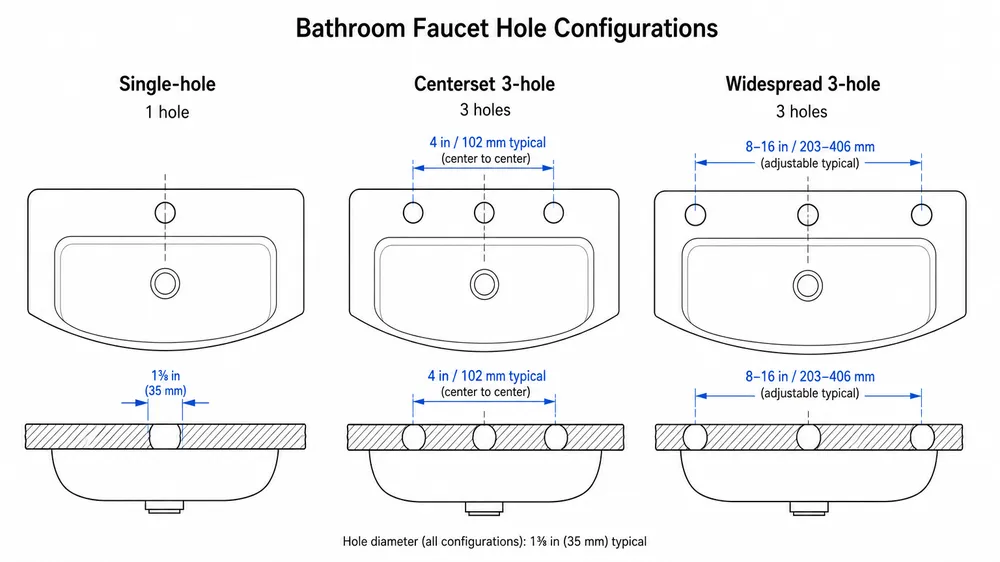
Before getting into each type, here's the reference table your RFQ team should be working from:
| Configuration | Hole count | Center-to-center spacing | Typical handle type | Deck plate option |
|---|---|---|---|---|
| Single-hole | 1 | N/A | Single-handle | Yes — covers unused holes in 3-hole sinks |
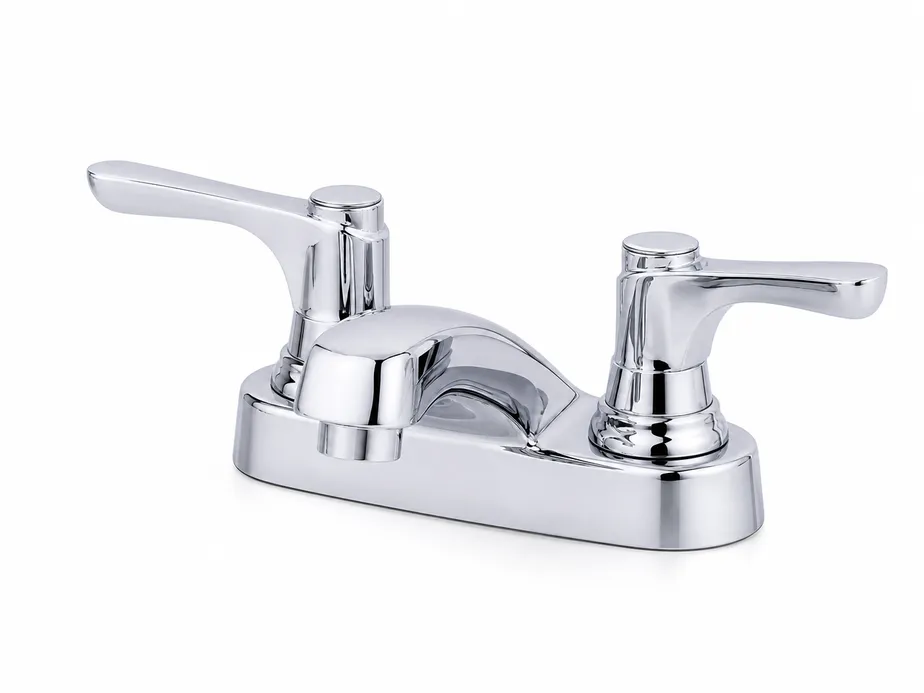
| Centerset | 3 | 4 inches (102mm) fixed | Single or double handle | No — body bridges the holes |
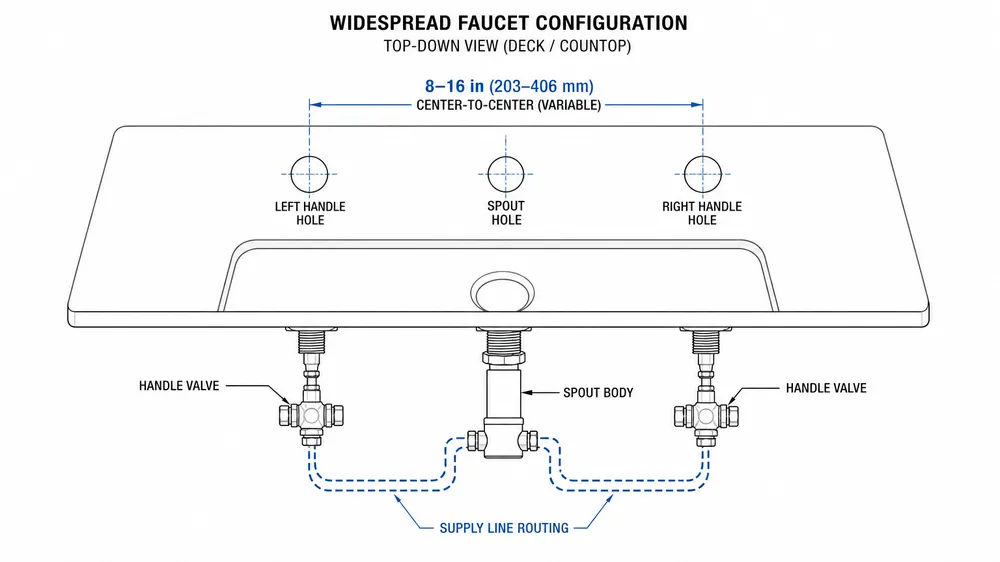
| Widespread | 3 | 8–16 inches (203–406mm) variable | Two separate handles | No — handles mount independently |
The spacing dimension is the one that gets misquoted most often. "3-hole faucet" is not a complete spec — centerset and widespread are both 3-hole, but they are not interchangeable. A centerset faucet body bridges a 4-inch spread; a widespread faucet uses three independent mounting points at whatever spacing the sink provides. Ordering the wrong one means the faucet physically cannot mount to the sink.
(We flag this in every RFQ we receive that says "3-hole" without a spacing dimension. It's a quick clarification, but it saves a costly substitution error downstream.)
Single-hole configuration: procurement advantages and deck plate logistics
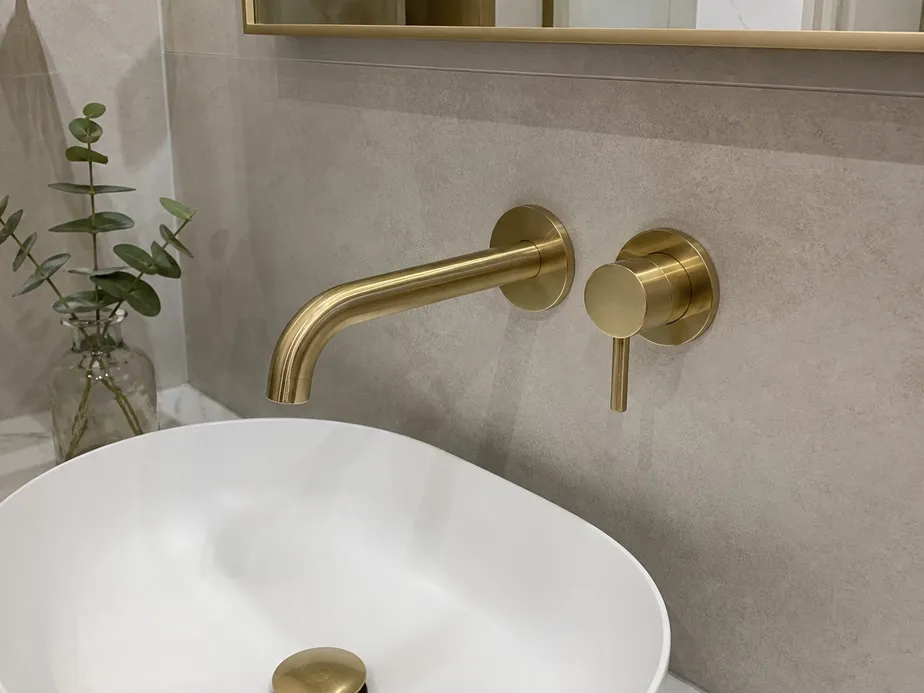
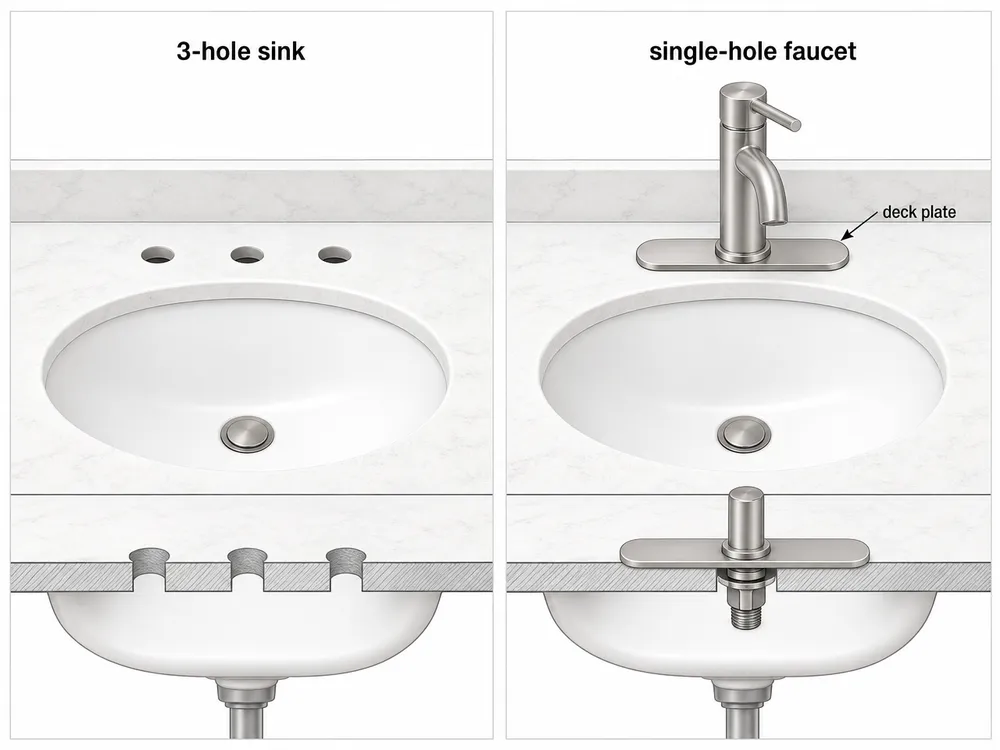
A single-hole faucet mounts through one hole in the sink deck, typically 35–38mm in diameter. The entire faucet body — spout and handle — is a single unit. This is the configuration we see most often in hotel room bathrooms, apartment fit-outs, and commercial washroom projects where the priority is installation speed and a clean countertop profile.
From a procurement standpoint, single-hole has a real SKU consolidation advantage. One faucet model covers the entire project. No handle-left, handle-right variants. No separate hot and cold supply line routing to coordinate. Your installer picks up one box and mounts one unit.
The complication comes when the project's sinks are pre-drilled for 3-hole centerset. This happens more than you'd expect — a developer sources sinks from one supplier and faucets from another, and the specs don't match until the plumber is on site. The fix is a deck plate: a cover plate that mounts over the unused holes and gives the single-hole faucet a clean base. We supply deck plates as a standard accessory for our single-hole models, and we can match the finish to the faucet body. (If you're sourcing single-hole faucets for a project where sink specs aren't confirmed yet, ask about deck plate availability upfront — it's a small item that prevents a large problem.)
For Single-Handle Bathroom Faucets, single-hole is the natural configuration. The handle and spout share one mounting point, so the body design is compact and the installation footprint is minimal.
Centerset configuration: the commercial standard and why it dominates volume orders
Centerset is the most common bathroom faucet hole configuration in commercial projects, and the reason is simple: it's the default spec for most North American and European sink manufacturers. If a project spec sheet says "standard bathroom faucet" without further detail, centerset at 4-inch spread is almost certainly what the sink is drilled for.
The centerset body bridges all three holes — the center hole takes the spout, and the two outer holes at exactly 4 inches (102mm) center-to-center take the handles. Because the body is a single casting that spans the spread, the mounting is rigid and the installation is fast. There's no independent handle alignment to manage.
Handle options on centerset are broader than most buyers realize. A centerset body can carry a single-handle design (one lever controls both temperature and flow through the center hole, with the outer holes used for mounting posts) or a two-handle design (separate hot and cold handles in the outer holes). Both use the same 4-inch sink drilling. This matters for catalog buyers: you can offer two handle style variants from the same sink compatibility base, which simplifies your inventory and your customer's purchasing decision.
The 4-inch spread is fixed. There is no variation in centerset — if a sink is drilled centerset, the center-to-center distance between the outer holes is 4 inches. Any faucet labeled "centerset" must fit that spacing. We machine our centerset mounting posts to ±0.3mm on the center-to-center dimension, because even a small deviation creates visible misalignment on the sink deck and generates installation complaints.
For Two-Handle Bathroom Faucets, centerset is the dominant configuration in the mid-market commercial segment. If you're building a catalog for hotel supply or residential development, centerset two-handle is the SKU that moves volume.
Widespread configuration: specification flexibility and the sourcing complexity it creates
Widespread faucets use three independent mounting points — a separate spout body and two separate handle valves — with no rigid bridge between them. The center-to-center spacing between the handle holes can range from 8 to 16 inches (203–406mm), depending on the sink. This is what makes widespread the configuration of choice for premium vanities, custom countertops, and high-end hospitality projects: the designer can specify the sink and the faucet independently, and the widespread handles adapt to whatever spread the sink provides.
That flexibility is also the sourcing complexity. When you're ordering widespread faucets for a project, you need the exact hole spacing from the sink spec sheet before you can confirm the faucet order. "Widespread" is not a complete spec. An 8-inch spread and a 12-inch spread are both widespread, but the supply lines connecting the handles to the spout body are different lengths. Order the wrong spread and the supply lines either don't reach or bunch up under the deck.
We see this most often in hotel renovation projects where the existing sinks are staying and only the faucets are being replaced. The project buyer sends us a photo of the sink and asks for a widespread faucet — we always ask for the measured hole spacing before we confirm the SKU. It takes one extra email and saves a return shipment.
Widespread also changes the certification picture slightly. Because the spout and handles are separate components, each component needs to meet the applicable standard independently. For cUPC-certified widespread faucets, the valve bodies in the handles are the critical compliance point — the lead content and pressure performance requirements apply to each valve, not just the spout. We certify our widespread models as complete assemblies, so the cUPC documentation covers the full three-piece set.
For buyers sourcing Widespread Bathroom Faucets for premium or custom projects, the key spec to confirm is the supply line length included with the faucet — and whether the factory can adjust that length for non-standard spreads.

How hole configuration affects certification — what most content skips
Most guides treat hole configuration as a purely mechanical spec. It's not. Certification coverage depends on it.
For cUPC compliance in North America, the faucet must be tested and certified as a complete assembly in the configuration it will be sold. A single-hole faucet certified under cUPC is certified in that configuration. If you want to sell the same body as a centerset variant, that variant needs its own certification documentation — the single-hole cert doesn't transfer. This is the detail that catches buyers who try to simplify their SKU count by mixing configurations under one cert number.
CE marking for European markets works similarly. The Declaration of Conformity covers the product as specified. If you're sourcing a faucet for both the North American and European markets, confirm that the factory holds cUPC and CE on the specific configuration you're ordering — not just on some version of the product.
WaterMark for Australia adds a flow rate requirement on top of the structural and material standards. Widespread faucets with separate valve bodies need to meet the flow rate spec at each valve, which affects the cartridge selection inside the handle. We've had buyers come to us after sourcing widespread faucets from another factory and discovering the WaterMark cert only covered the centerset version of the same body. The fix was a full re-certification run — expensive and slow.
We hold cUPC, CE, and WaterMark across our single-hole and widespread configurations. When you request a quote, we confirm which cert applies to the specific SKU and configuration you're ordering — not just the product family.
Specification checklist for procurement teams
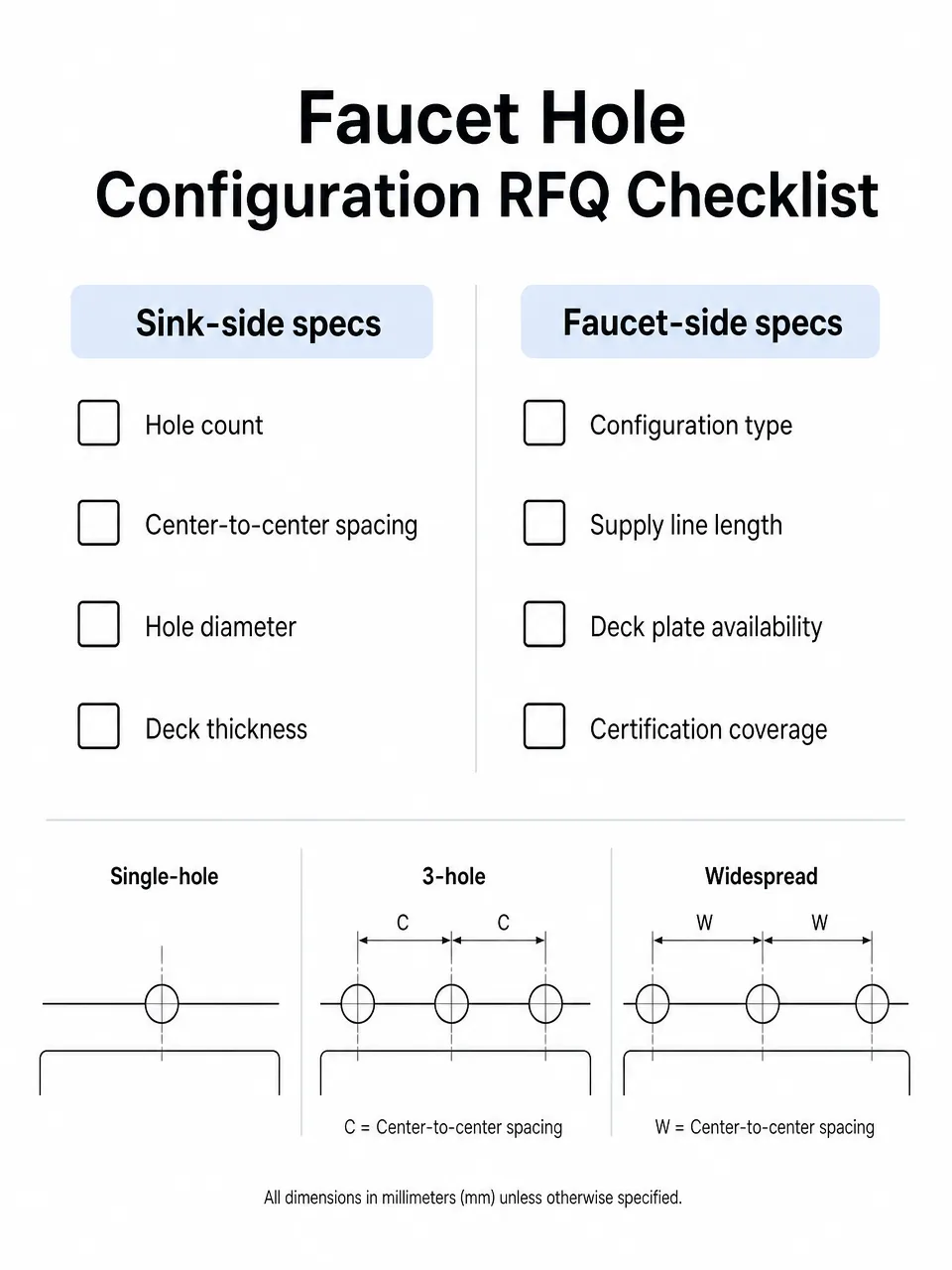
When you're placing a bulk order for bathroom faucets, the hole configuration section of your RFQ should include:
Sink-side specs (confirm before ordering):
- Hole count (1 or 3)
- For 3-hole: center-to-center spacing between outer holes (4 inches for centerset; 8–16 inches for widespread — measure the actual sink)
- Hole diameter (standard is 35–38mm; some older sinks run 32mm)
- Deck thickness (affects the length of the mounting hardware)
Faucet-side specs (confirm with the factory):
- Configuration type: single-hole, centerset, or widespread
- For widespread: supply line length included, and whether non-standard lengths are available
- Deck plate availability for single-hole faucets going into 3-hole sinks
- Certification coverage: which cert applies to this specific configuration and finish
For OEM or custom orders:
- Confirm whether the factory can produce the configuration you need, and at what MOQ
- Ask for a sample in the target configuration before committing to production volume
- Confirm that certification documentation will cover the OEM variant, not just the factory's standard catalog item
The last point matters more than most buyers realize. Some factories certify their standard catalog items and then produce OEM variants without running the OEM through certification. If your OEM faucet gets to a North American distributor without a valid cUPC cert, it doesn't clear the supply chain — and the factory's standard cert doesn't cover your product.
OEM configuration customization: what's actually possible from 200 units
The retail-focused content on this topic never mentions OEM flexibility, so let's be direct about what a factory can and can't do.
Standard catalog configurations — single-hole, centerset at 4-inch spread, widespread at common spreads — are available off the shelf. If your project spec matches a standard configuration, you're ordering from existing tooling and the lead time is 25–35 days.
Non-standard configurations are possible but require tooling. If your project needs a centerset body at 3.5-inch spread (common in some European markets), or a single-hole body with a larger deck footprint for a specific vanity design, that's an OEM project. We can produce it from 200 units, which is low enough for a market test. The tooling cost depends on how much of the existing casting die can be reused — for a spread variation on an existing body, it's usually a partial die modification rather than a full new tool, which keeps the cost manageable.
Certification for OEM variants is handled as an extension of the base product certification where possible. If the OEM variant uses the same valve body and cartridge as a certified standard product, and the change is limited to the mounting configuration, we can often extend the existing cert documentation rather than running a full new certification. We manage that process with the certification body — you don't need to coordinate it separately.
MOQ for OEM configuration variants starts at 200 units. For buyers who need a non-standard spread or a custom deck plate profile, that's a realistic trial quantity before committing to a full container. Most buyers in this situation start with a 200-unit sample run, test the product with their customers or on a pilot project, and then move to 1,000–2,000 units for the main order.
(The 200-unit MOQ is a real number, not a floor we negotiate up from. Below 200 units, the setup cost per piece makes the economics difficult for both sides.)
Sourcing decision matrix: matching configuration to your market segment
Different market segments have different default configurations. Here's how we see it across our export markets:
| Market segment | Dominant configuration | Key sourcing note |
|---|---|---|
| North American hotel/hospitality | Centerset 4-inch, single or two-handle | cUPC required; confirm per-configuration |
| North American residential development | Single-hole or centerset | Single-hole growing in new construction |
| European residential | Single-hole dominant | CE required; check local water pressure specs |
| Australian commercial | Centerset or single-hole | WaterMark required; flow rate spec critical |
| Middle East hospitality | Widespread for premium; centerset for standard | Confirm supply line length for widespread |
| Southeast Asia distribution | Centerset most common | CE or local cert depending on market |
This isn't a rigid rule — project specs override market defaults. But if you're building a starter catalog for a new market and don't have project specs yet, this is where to begin.
For buyers covering multiple markets from one factory relationship, the most efficient approach is to confirm which configurations are certified for which markets before finalizing your SKU list. We can map our certified configurations against your target markets and flag any gaps before you commit to an order.
FAQ
What is the difference between centerset and widespread bathroom faucets?
Both are 3-hole configurations, but the mounting geometry is completely different. A centerset faucet is a single body that bridges a fixed 4-inch (102mm) center-to-center spread — the spout and handles are integrated into one unit. A widespread faucet has three separate components (spout body plus two independent handle valves) that mount at variable spacing, typically 8–16 inches apart. They are not interchangeable. A centerset faucet cannot mount on a widespread-drilled sink, and vice versa.
Can a single-hole faucet be installed on a 3-hole sink?
Yes, with a deck plate. The deck plate covers the two unused holes and gives the faucet a clean mounting base. The deck plate should match the faucet finish — sourcing both from the same manufacturer is the simplest way to guarantee a finish match. If you're ordering single-hole faucets for a project where sink specs aren't confirmed, ask the factory whether deck plates are available in the same finish options as the faucet.
Does hole configuration affect cUPC or CE certification?
Yes. Certifications cover the product as tested in a specific configuration. A cUPC cert on a single-hole faucet does not automatically cover a centerset version of the same body. If you're sourcing multiple configurations, confirm that each configuration has its own certification documentation. This is especially important for OEM orders — the factory's standard cert may not cover your custom variant.
What hole spacing should I specify for a widespread faucet order?
Measure the actual sink. Widespread hole spacing varies from 8 to 16 inches depending on the sink manufacturer and model. "Widespread" is not a complete spec — you need the exact center-to-center dimension between the two handle holes. If you're replacing faucets on existing sinks, measure before ordering. If you're specifying new sinks and faucets together, confirm the sink's hole spacing in the sink spec sheet and match the faucet supply line length to that dimension.
What is the minimum order quantity for a custom hole configuration?
At Wfaucet, OEM configuration customization starts at 200 units. For non-standard spreads or custom deck plate profiles, we assess whether the change requires a new casting die or a partial modification to an existing tool — the latter is faster and less expensive. We can provide a tooling cost estimate and lead time after reviewing your configuration drawing or reference sample.
How do I avoid substitution errors when ordering bathroom faucets for a multi-unit project?
Include the full hole configuration spec in your RFQ: hole count, center-to-center spacing (for 3-hole configurations), hole diameter, and deck thickness. Don't rely on the factory to infer the configuration from a product photo or a general description. If the project has multiple bathroom types with different sink specs, list each configuration separately in the RFQ and confirm that the factory can supply all variants with matching certification coverage.
If your project has a specific hole configuration requirement — standard or non-standard — send us the sink spec sheet or measured dimensions along with your target market and order volume. We'll confirm which certified SKUs fit your spec, flag any certification gaps, and scope an OEM variant if your configuration falls outside our standard catalog. Request a quote or browse our Bathroom Faucets catalog to start with the standard configurations.