

Most faucet failures in the field trace back to a plumbing mismatch that was set up at installation — wrong supply line diameter, incorrect valve seat engagement, or a pressure rating that didn't match the building's system. The faucet itself was fine. The plumbing setup wasn't. This guide covers the technical side of bathroom faucet plumbing: supply connections, mounting configurations, valve mechanics, pressure requirements, and the details that separate a clean installation from a callback six months later.
Supply Line Specifications: Where Most Mismatches Start
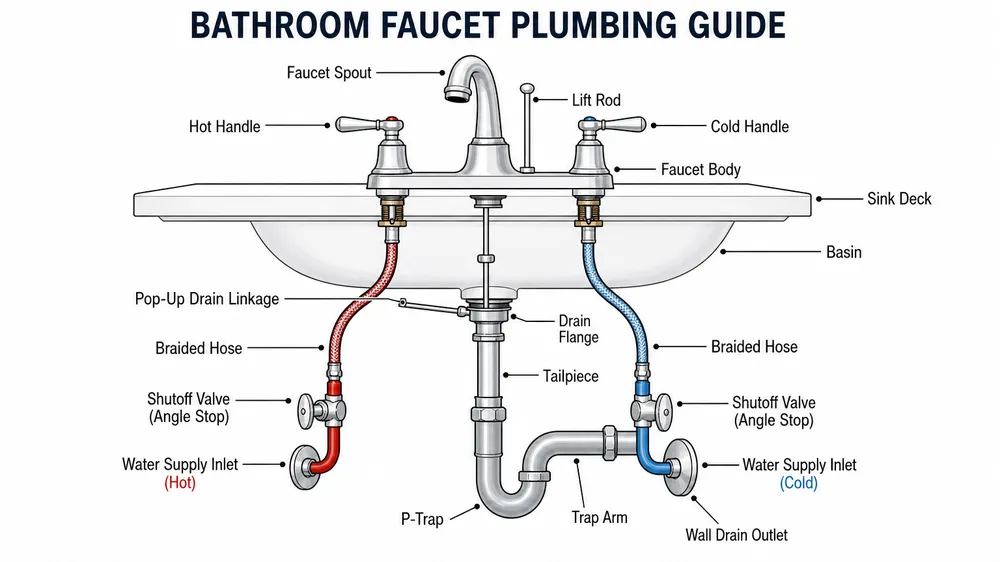
The supply line is the first place a plumbing problem gets built in. Standard bathroom faucet supply connections use 3/8-inch compression fittings at the shutoff valve end and 1/2-inch or 7/16-inch threaded connections at the faucet inlet. The mismatch happens when buyers spec a faucet without confirming the existing shutoff valve configuration — particularly in older buildings where 1/2-inch IPS (iron pipe size) shutoffs are still common.
Flexible braided stainless supply lines are the standard for residential and light commercial installations. They're rated to 125 PSI working pressure in most configurations, with burst ratings typically at 500 PSI or higher. For project procurement, the relevant spec is the working pressure rating relative to the building's supply pressure — most municipal systems run 40–80 PSI, but high-rise buildings and some commercial systems can push 100 PSI or above. A supply line rated to 125 PSI working pressure has adequate margin for standard residential use; for commercial projects, confirm the building's static pressure before specifying.
(We've seen buyers spec faucets for hotel renovation projects without flagging the building's 90 PSI supply pressure to their plumber — the supply lines held, but the cartridge seals showed accelerated wear. Pressure regulators are cheap insurance on high-pressure systems.)
Supply line length matters for installation clearance. Standard under-sink supply lines run 12 inches, 20 inches, or 24 inches. Pedestal sink installations and vessel sink configurations often need longer runs — 30 to 36 inches — because the shutoff valves are further from the faucet inlets. Specify supply line length based on the actual installation geometry, not a default.
| Connection Point | Standard Size | Common Variants |
|---|---|---|
| Shutoff valve outlet | 3/8" compression | 1/2" IPS (older installs) |
| Faucet inlet (most residential) | 1/2" or 7/16" threaded | M10 × 1.0 (some European spec) |
| Supply line working pressure | 125 PSI | 250 PSI (commercial grade) |
| Typical supply line lengths | 12", 20", 24" | 30", 36" (extended runs) |
Mounting Configurations and Deck Hole Requirements
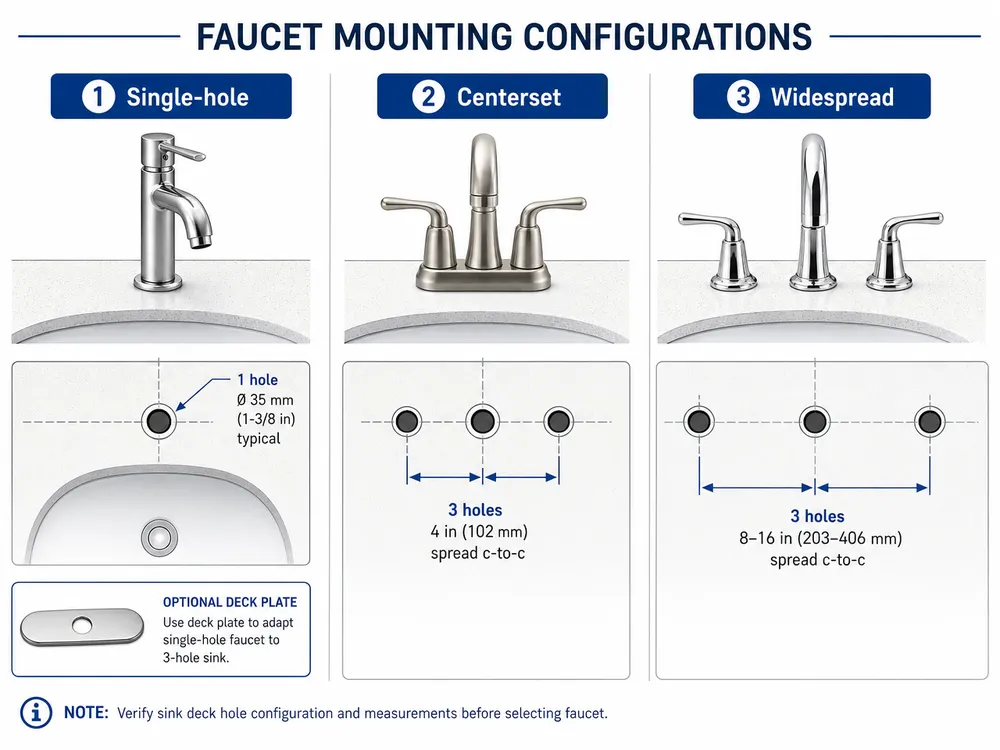
Bathroom faucets mount in three primary configurations: single-hole, centerset (4-inch spread), and widespread (8-inch spread). The mounting configuration is fixed by the sink or countertop — you can't change it without replacing the deck. This is the spec that needs to be confirmed before any faucet order is placed.
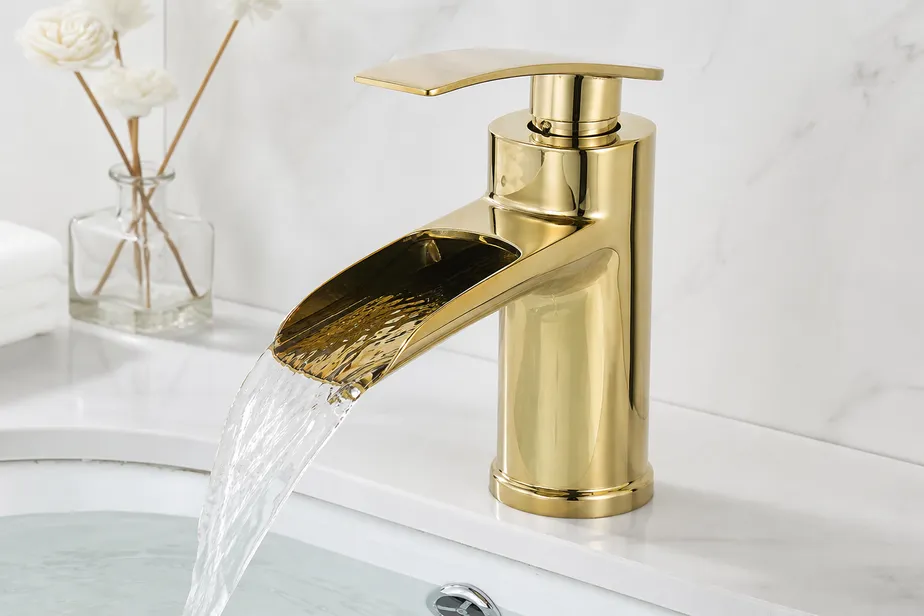
Single-hole faucets use one deck penetration for the entire body. They're the most common configuration in contemporary bathroom design and the simplest to install. The deck hole diameter is typically 1-3/8 inches (35mm), though some designs require up to 1-1/2 inches. Single-hole faucets can be adapted to three-hole sinks using a deck plate, which covers the unused holes — a useful option when replacing a centerset faucet with a single-hole model.
Centerset faucets have handles and spout on a single base plate, with the handles set 4 inches apart center-to-center. They require three deck holes: one center hole for the spout and two side holes for the handles. The center hole is typically 1-3/8 inches; the side holes are 1-1/4 inches. Centerset configurations are common in standard vanity sinks and are the most straightforward three-hole installation.
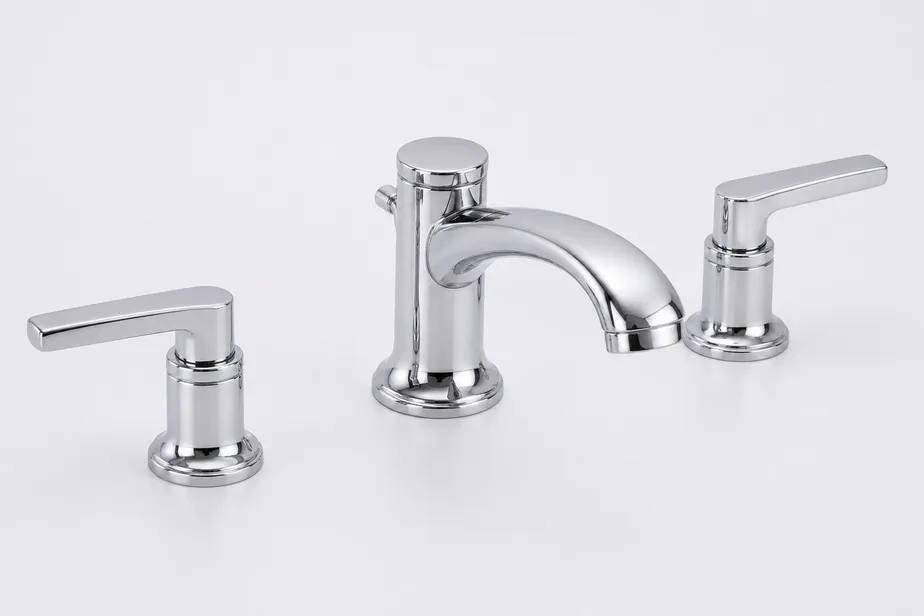
Widespread faucets separate the spout and handles entirely, with handles set 8 to 16 inches apart. Each component mounts independently through its own deck hole. The installation is more complex — three separate supply connections, three separate deck penetrations — but widespread configurations allow more design flexibility and are standard in higher-end vanity applications. For project procurement, widespread faucets add installation labor cost; factor that into your landed cost calculation when comparing configurations.
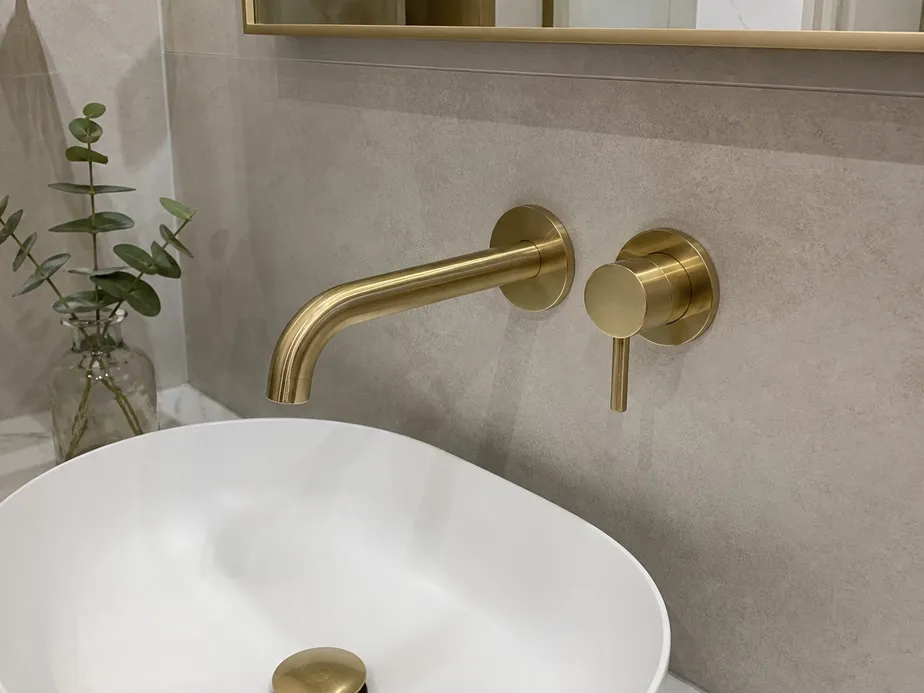
Wall-mount configurations are a separate category. The faucet body mounts to the wall above the sink, with supply connections running through the wall to rough-in valves set at the correct height. The critical spec for wall-mount installations is the rough-in height — typically 4 to 6 inches above the sink rim — and the center-to-center distance between hot and cold supply ports, which is standardized at 6 inches in most markets. Wall-mount faucets require the rough-in to be set correctly during construction or renovation; retrofitting a wall-mount faucet into a space built for a deck-mount is a significant plumbing job.
Valve Mechanics: Cartridge, Ball, and Ceramic Disc
The valve is the component that controls flow and temperature, and it's the component most likely to generate a warranty claim if it's under-specified for the application. Three valve types are in common use for bathroom faucets: cartridge, ball, and ceramic disc.
Cartridge valves are the dominant type in contemporary bathroom faucets. A cartridge is a self-contained unit — ceramic or polymer disc stack inside a brass or plastic housing — that slides into the faucet body and controls flow through linear or rotary movement. The cartridge design makes replacement straightforward: when the valve fails, you pull the cartridge and insert a new one without disassembling the faucet body. For distributors and project buyers, cartridge replaceability is a meaningful after-sales cost factor. A faucet with a proprietary cartridge that's only available from the original manufacturer creates a service dependency; a faucet using a standard cartridge format (Kerox, Sedal, or equivalent) gives the end user sourcing flexibility.
We run 500,000-cycle endurance testing on every cartridge batch before it enters assembly — not just on new product introductions. That number represents roughly 30 years of typical residential use at 40 cycles per day. The test catches early-failure cartridges before they reach a container, which is the only point in the supply chain where catching them is cost-free.
Ball valves use a rotating brass or stainless ball with a port through the center to control flow. They're more common in kitchen faucets than bathroom faucets, and they have more wear points than a cartridge — the ball seats, springs, and O-rings all wear independently. Ball valve faucets are generally lower cost to manufacture but higher cost to service; the repair involves replacing multiple small components rather than a single cartridge.
Ceramic disc valves use two ceramic discs — one fixed, one rotating — that align or misalign ports to control flow. Ceramic disc valves have excellent wear resistance and are common in higher-end single-lever faucets. The failure mode is different from cartridge or ball valves: ceramic discs don't wear gradually, they crack. Cracking is usually caused by thermal shock (very hot water followed immediately by cold) or by debris in the water supply scoring the disc surface. For markets with hard water or variable water quality, ceramic disc valves benefit from an upstream sediment filter.
| Valve Type | Wear Points | Replacement Method | Best Application |
|---|---|---|---|
| Cartridge | Single unit | Pull and replace cartridge | Residential, light commercial |
| Ball | Ball, seats, springs, O-rings | Multi-component rebuild | Kitchen faucets, utility |
| Ceramic disc | Disc pair | Replace disc cartridge | High-end residential |
Water Pressure and Flow Rate: The Specs That Affect Downstream Performance
Bathroom faucets are rated for a working pressure range, typically 0.05 MPa to 0.8 MPa (7 to 116 PSI). The minimum pressure rating matters as much as the maximum — a faucet that requires 0.1 MPa minimum won't perform correctly in a low-pressure system, and the symptom (weak flow, inconsistent temperature mixing) will look like a product defect to the end user even though the faucet is operating within spec.
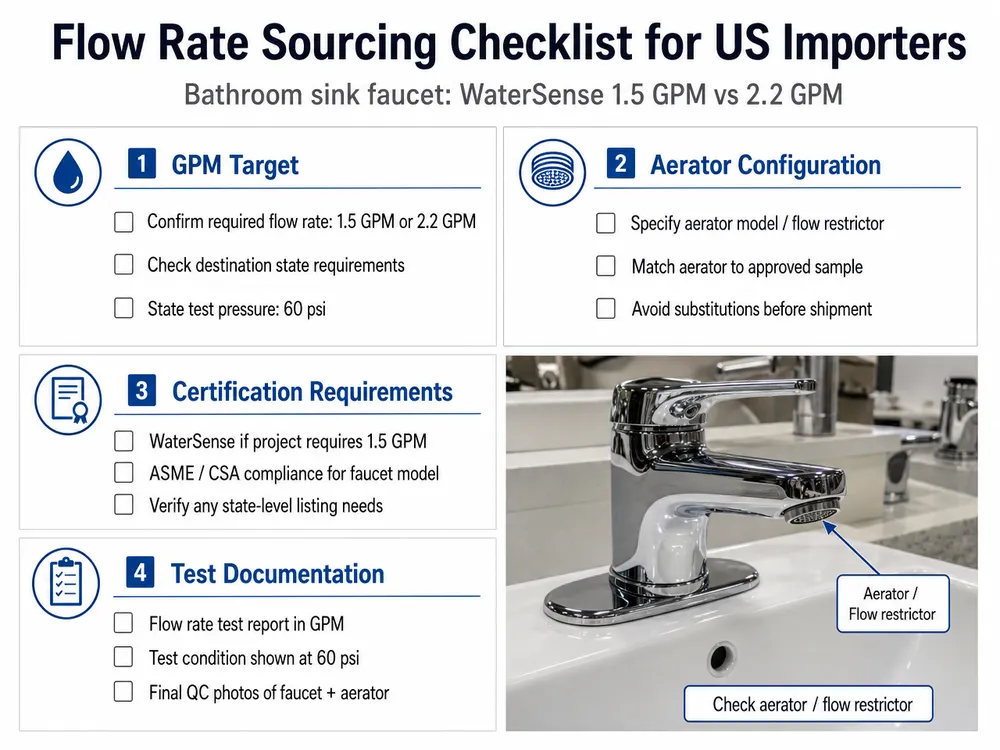
Flow rate is the other pressure-related spec that affects downstream satisfaction. Standard bathroom faucets flow at 1.5 to 2.2 GPM (gallons per minute) at 60 PSI. Water-efficient models flow at 1.0 to 1.5 GPM. For markets with water efficiency regulations — California's CALGreen standard requires 1.2 GPM maximum for lavatory faucets, and WaterSense certification requires 1.5 GPM or less — the flow rate spec needs to be confirmed before the product is listed. Selling a 2.2 GPM faucet into a California project is a compliance problem, not just a preference issue.
(The aerator is what controls flow rate in most faucets — the faucet body itself is unrestricted. We can configure aerators to any flow rate from 0.5 GPM to 2.2 GPM at the factory. If you're sourcing for a market with specific flow requirements, specify the aerator flow rate in your order, not just the faucet model.)
Flow rate also affects temperature mixing performance in single-handle faucets. At very low flow rates — below 0.5 GPM — the mixing chamber doesn't have enough volume to blend hot and cold water evenly, and the output temperature becomes inconsistent. This is a physics constraint, not a manufacturing defect, but it generates service calls. For applications where very low flow rates are expected (water-scarce markets, conservation-focused projects), confirm that the faucet's cartridge is rated for low-flow operation.
Drain Assembly and P-Trap Connections
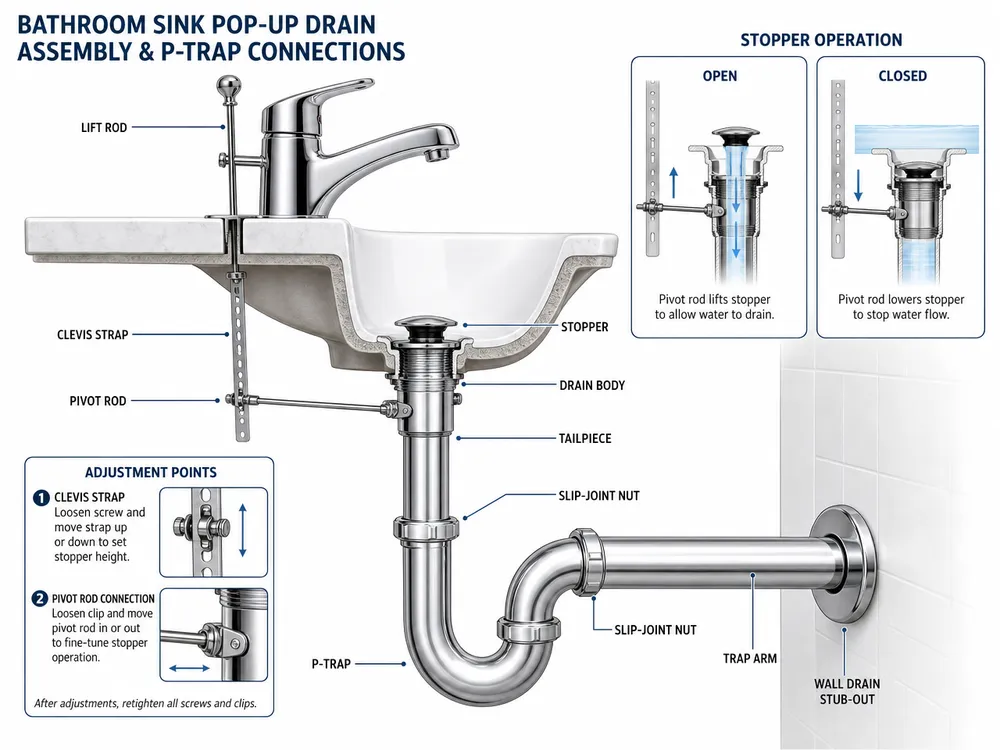
The drain assembly is part of the bathroom faucet plumbing system even though it's not part of the faucet itself. Pop-up drain assemblies — the standard for bathroom sinks — connect to the faucet via a lift rod that runs through the faucet body. The lift rod connects to a clevis strap and pivot rod that operates the drain stopper. This linkage is the most common source of installation callbacks: the pivot rod height needs to be adjusted to match the drain body position, and if it's not set correctly, the stopper either won't close fully or won't open fully.
Standard pop-up drain assemblies use a 1-1/4-inch drain body with a 1-1/4-inch P-trap connection. The P-trap connects to the drain stub-out in the wall, which is typically 1-1/2 inches — a 1-1/4-to-1-1/2-inch reducer is standard in the drain kit. For vessel sinks, the drain configuration is different: vessel sinks use a vessel drain (no overflow) rather than a pop-up assembly, and the drain body height needs to clear the sink bottom.
The P-trap serves two functions: it holds a water seal that blocks sewer gas from entering the room, and it provides a cleanout point for debris. P-trap depth — the distance from the drain outlet to the trap arm — should be 2 to 4 inches. Shallower traps dry out faster in low-use installations (vacation properties, guest bathrooms); deeper traps can create slow drainage. For project specifications, confirm the drain stub-out height relative to the sink bottom to ensure the P-trap fits within the vanity cabinet depth.

Rough-In Dimensions and Installation Clearances
Getting rough-in dimensions right before the faucet is ordered prevents the most expensive kind of problem: a product that physically doesn't fit the installation. The key dimensions to confirm are:
Sink deck thickness: Most faucets accommodate deck thicknesses from 1/2 inch to 2-1/4 inches using the included mounting hardware. Thicker stone countertops — granite or marble at 3/4 inch to 1-1/4 inch — are within standard range. Vessel sink installations on thick countertops can push the total deck thickness above 2-1/4 inches; confirm the faucet's maximum deck thickness spec before ordering.
Under-sink clearance: The faucet's supply line connections and mounting nut need clearance below the deck. Standard vanity cabinets provide 8 to 12 inches of clearance below the deck; pedestal sinks are open. The issue arises with shallow vanity cabinets or when a garbage disposal or other under-sink equipment reduces available clearance. A basin wrench is required for tightening the mounting nut in tight spaces — factor that into installation labor estimates for project work.
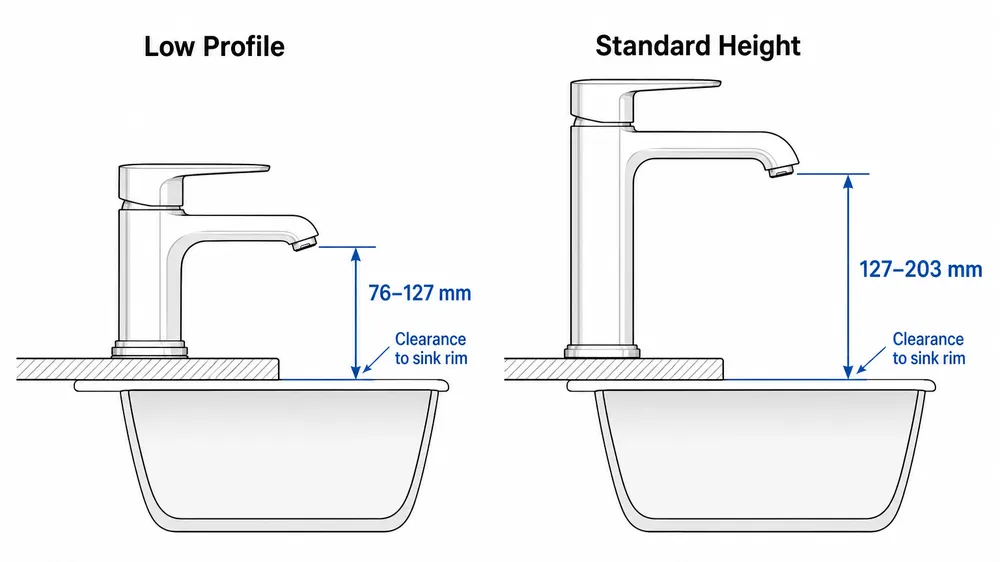
Spout reach and height: Spout reach is the horizontal distance from the faucet centerline to the water stream. Standard bathroom faucet spout reach is 4 to 6 inches. For vessel sinks, which sit above the countertop, spout height needs to be sufficient to clear the sink rim — typically 8 to 12 inches of spout height for a standard vessel sink. Specifying a standard-height faucet for a vessel sink installation is a common error that results in the water stream hitting the sink rim rather than the basin.
| Dimension | Standard Range | Notes |
|---|---|---|
| Deck thickness (max) | Up to 2-1/4" | Confirm for thick stone countertops |
| Spout reach | 4–6" | Increase for vessel sinks |
| Spout height (vessel sink) | 8–12" | Measured from countertop to spout outlet |
| Under-sink clearance needed | 8–12" | Confirm for shallow cabinets |
| Wall-mount rough-in height | 4–6" above sink rim | Set during construction |
Certification Requirements by Market: What Clears Customs and What Doesn't
Bathroom faucet plumbing products face market-specific certification requirements that affect whether a container clears customs and whether the product can be legally installed. Sourcing without confirming certification coverage is the fastest way to create a compliance problem.
North America (cUPC): The Uniform Plumbing Code requires faucets to be listed by an approved certification body. cUPC (Canadian/Uniform Plumbing Code) certification covers both the US and Canada. The critical requirement for North American markets is lead content — NSF/ANSI 61 and NSF/ANSI 372 require that wetted surfaces contain no more than 0.25% weighted average lead content. This is the spec that caused us to requalify our brass alloy supplier when we first pursued cUPC certification in 2013. We test every incoming brass batch with XRF analysis and apply the same standard to all production regardless of destination market.
Europe (CE + EN 817): CE marking for faucets covers the pressure equipment directive and, for products with flow control, the construction products regulation. EN 817 is the European standard for mechanical mixing valves — it defines pressure ratings, temperature performance, and endurance requirements. CE-marked faucets need to meet EN 817 test requirements, which include 70,000-cycle endurance testing at minimum. (Our 500,000-cycle standard exceeds this by a significant margin — we set the internal standard higher because the EN 817 minimum doesn't reflect real-world service life expectations in the markets we supply.)
Australia (WaterMark): WaterMark certification is mandatory for all plumbing products installed in Australia. It's administered by the Australian Building Codes Board and requires third-party testing to AS/NZS 3718 (water supply — tap ware). WaterMark certification is product-specific — a certification on one faucet model doesn't extend to variants unless they're included in the original certification scope.
For buyers sourcing across multiple markets, the most efficient approach is to source from a factory that holds all three certifications under one roof. Managing separate supplier relationships for North American and European compliance adds sourcing complexity and creates documentation inconsistencies that slow customs clearance.
You can review our full certification coverage at /certifications, and our bathroom faucet catalog shows which models carry which certifications.
Common Plumbing Failures and Their Manufacturing Root Causes
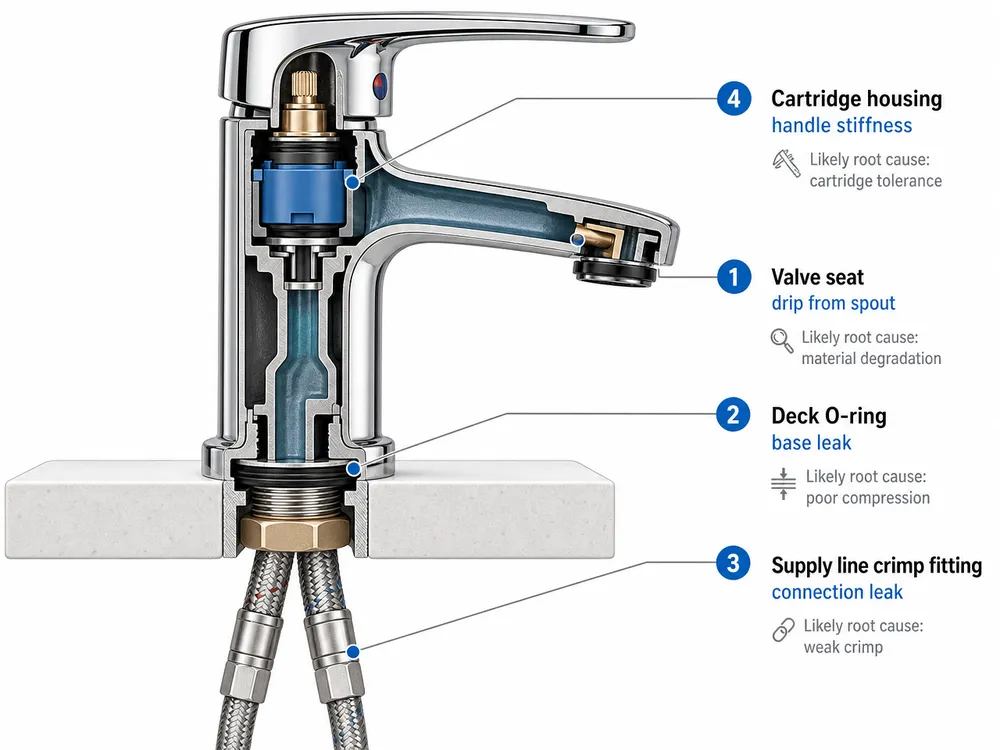
Understanding where faucet plumbing failures originate helps you evaluate supplier quality claims more precisely. Most field failures fall into four categories:
Drip from the spout: Almost always a valve seat or cartridge issue. The valve seat is the sealing surface inside the faucet body where the cartridge disc or ball seats against. If the valve seat is machined out of tolerance — we hold ±0.05mm on valve seat threads — the cartridge can't form a complete seal and the faucet drips from day one. If the valve seat is in tolerance but the cartridge wears prematurely, the drip develops over time. Cartridge wear rate is a function of water quality (hard water accelerates ceramic disc wear), operating pressure (higher pressure increases seal stress), and cycle count. A cartridge rated to 500,000 cycles in a residential bathroom at 40 cycles per day lasts roughly 34 years; the same cartridge in a commercial restroom at 200 cycles per day lasts about 7 years.
Leak at the base: Base leaks are almost always an O-ring or gasket failure. The O-ring seals the faucet body to the deck surface; if it's not compressed correctly during installation (under-torqued mounting nut) or if it's made from a material that degrades in contact with chlorinated water, it fails. We use EPDM O-rings on all deck-mount faucets — EPDM has better chlorine resistance than standard NBR rubber, which matters in markets with heavily chlorinated municipal water.
Leak at supply line connections: Usually an installation issue — under-torqued compression fitting or cross-threaded connection — but can also be a supply line quality issue. Braided stainless supply lines fail at the crimp fittings, not in the hose itself. The crimp fitting quality is what separates a supply line that lasts 10 years from one that fails at 18 months. For project procurement, specify supply lines with stainless steel crimp fittings, not plastic.
Handle stiffness or failure: Handle stiffness that develops over time is a cartridge issue — the ceramic discs are binding due to mineral buildup or the cartridge housing is deforming under repeated thermal cycling. Handle stiffness from day one is a tolerance issue in the handle-to-cartridge interface. We test handle torque on every unit in final inspection — the spec is 0.3 to 0.8 N·m for standard single-lever faucets. Units outside that range don't ship.
Sourcing Evaluation: What to Verify Before You Commit
When you're evaluating a bathroom faucet supplier, the plumbing-related specs are where the quality gap between factories shows up most clearly. Generic marketing claims about "high quality" and "durable materials" don't tell you anything useful. These are the specific questions and documents that do:
Valve seat tolerance documentation: Ask for the dimensional inspection report on valve seat machining. The tolerance should be ±0.05mm or tighter. A supplier who can't produce this report either doesn't measure it or doesn't want you to see the results.
Cartridge endurance test reports: Ask for the cycle count and test conditions. The EN 817 minimum is 70,000 cycles. Any serious manufacturer tests to 200,000 cycles or more. If the supplier quotes 500,000 cycles, ask for the test report — that number should be backed by documentation, not just stated.
Pressure test records: Every faucet should be leak-tested at 0.6 MPa (87 PSI) for a minimum of 60 seconds before it leaves the factory. Ask for the outgoing inspection protocol and a sample test record.
Certification scope: Ask for the actual certificate, not just a logo on the website. Confirm that the specific model you're ordering is within the certification scope — not just the brand or a different model from the same factory.
Lead content documentation: For North American orders, ask for the XRF test report on the brass alloy used in the faucet body. The report should show lead content below 0.25% weighted average. If the supplier can't produce this, the product may not clear US customs.
The /rfq page is the right starting point if you want to request documentation alongside a quote — send us the specific models you're evaluating and we'll include the relevant test reports with the pricing.
FAQ: Bathroom Faucet Plumbing
What is the standard supply line size for a bathroom faucet?
Most bathroom faucets use 3/8-inch compression fittings at the shutoff valve end. The faucet inlet is typically 1/2-inch or 7/16-inch threaded. Confirm both ends before ordering supply lines — the shutoff valve configuration in older buildings is often 1/2-inch IPS, which requires a different supply line than a 3/8-inch compression shutoff.
What water pressure do bathroom faucets require?
Standard bathroom faucets operate between 0.05 MPa and 0.8 MPa (7 to 116 PSI). Most municipal systems run 40–80 PSI, which is well within range. For buildings with supply pressure above 80 PSI, a pressure-reducing valve (PRV) protects both the faucet and the supply lines from accelerated wear. Confirm the building's static pressure before specifying faucets for commercial or multi-unit projects.
What is the difference between a cartridge and a ceramic disc valve in a bathroom faucet?
A cartridge is a replaceable unit that contains the sealing mechanism — it can be pulled and replaced without disassembling the faucet body. A ceramic disc valve uses two ceramic discs that rotate against each other to control flow. Ceramic discs have excellent wear resistance but crack under thermal shock; cartridges wear gradually and are easier to service. For most commercial and residential applications, cartridge valves offer the better balance of durability and serviceability.
How do I know if a bathroom faucet is cUPC certified for the US market?
The cUPC mark should appear on the product packaging and in the product documentation. More importantly, ask the supplier for the actual certification document — it will list the specific model numbers covered. A cUPC logo on a website doesn't confirm that the specific model you're ordering is certified. For North American projects, also confirm NSF/ANSI 372 lead-free compliance, which is a separate requirement from cUPC listing.
What causes a bathroom faucet to drip after installation?
A drip immediately after installation almost always indicates a valve seat tolerance issue or a damaged cartridge. A drip that develops after months of use is typically cartridge wear — accelerated by hard water, high operating pressure, or high cycle count. Before attributing a drip to a manufacturing defect, confirm the supply pressure is within the faucet's rated range and that the water supply doesn't contain sediment that could score the valve seat.
Can a single-hole faucet be installed in a three-hole sink?
Yes, using a deck plate (also called an escutcheon plate) that covers the unused holes. The deck plate mounts over the sink surface and the faucet mounts through the center hole. Confirm that the deck plate dimensions match the sink's hole spacing — standard three-hole sinks have 4-inch center-to-center spacing, but some sinks vary.
The plumbing details covered here — supply line specs, mounting configurations, valve mechanics, pressure ratings, and certification requirements — are the variables that determine whether a bathroom faucet performs correctly in the field or generates callbacks. Getting them right at the sourcing stage is cheaper than resolving them after installation.
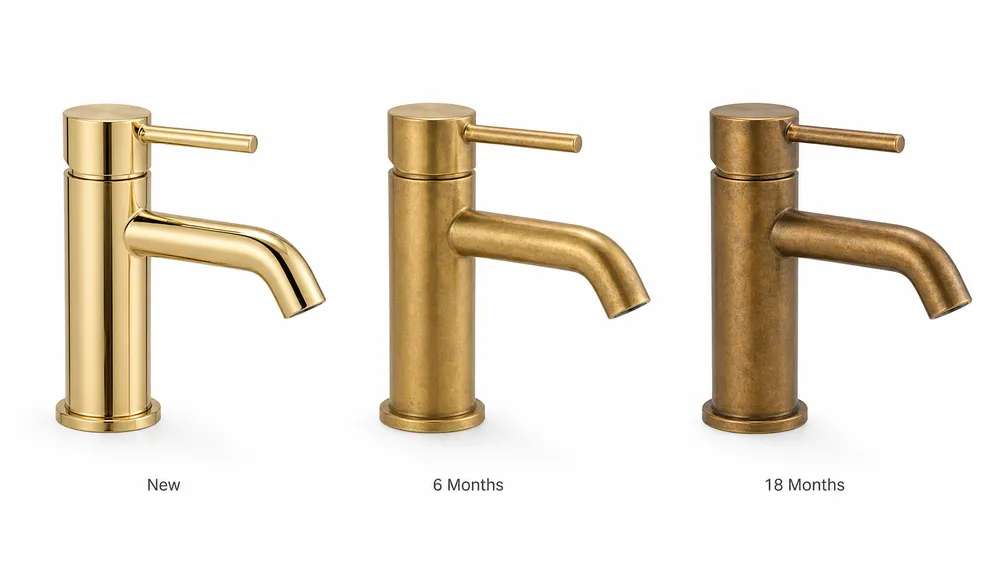
For the full range of bathroom faucets we manufacture — including single-hole, centerset, widespread, and wall-mount configurations across five finishes — the category page has the complete catalog with certification coverage noted per model.