

Flow rate is the specification that most importers get wrong — not because it's complicated, but because the US market has two overlapping standards, a patchwork of state-level mandates that override the federal baseline, and a compliance mechanism (the aerator) that most buyers never think to specify on their purchase order. Get it wrong and your container clears customs fine, then fails a green building inspection in California or gets rejected by a hotel procurement spec that requires WaterSense labeling.
The short version: 2.2 GPM is the federal baseline under ASME A112.18.1. 1.5 GPM is the EPA WaterSense threshold. Several states have already moved below both. And the aerator — a $0.40 component — is what actually sets the output.
This article covers what each standard covers, which markets require which, and how to specify flow rate correctly when you're placing an OEM order.
What GPM actually measures — and why the test pressure matters
GPM (gallons per minute) is the volume of water a faucet delivers at a specified supply pressure. The rated pressure for US testing is 60 psi (0.41 MPa). That's the number on the spec sheet, the number on the certification, and the number your buyer's inspector will reference.
The reason pressure matters: a faucet rated at 1.5 GPM at 60 psi will deliver noticeably less at 40 psi — which is common in older commercial buildings, mid-rise residential, and some hotel properties where supply pressure drops under load. We test every outgoing unit at 0.6 MPa (87 psi) during final QC, which gives buyers a documented performance baseline above the rated condition. If the unit passes at 0.6 MPa, it will meet its rated GPM at 60 psi with margin.
(The 0.6 MPa test pressure is also what cUPC requires for leak verification — so we're running both checks in the same final QC pass, not as separate operations.)
LPM (liters per minute) is the metric equivalent. 1.5 GPM = 5.68 LPM; 2.2 GPM = 8.33 LPM. If you're supplying a project that mixes US and metric specs, confirm which unit the spec sheet is using before you sign off on the order.
The two dominant US standards: 2.2 GPM vs 1.5 GPM
These two numbers come from different regulatory frameworks and serve different purposes.
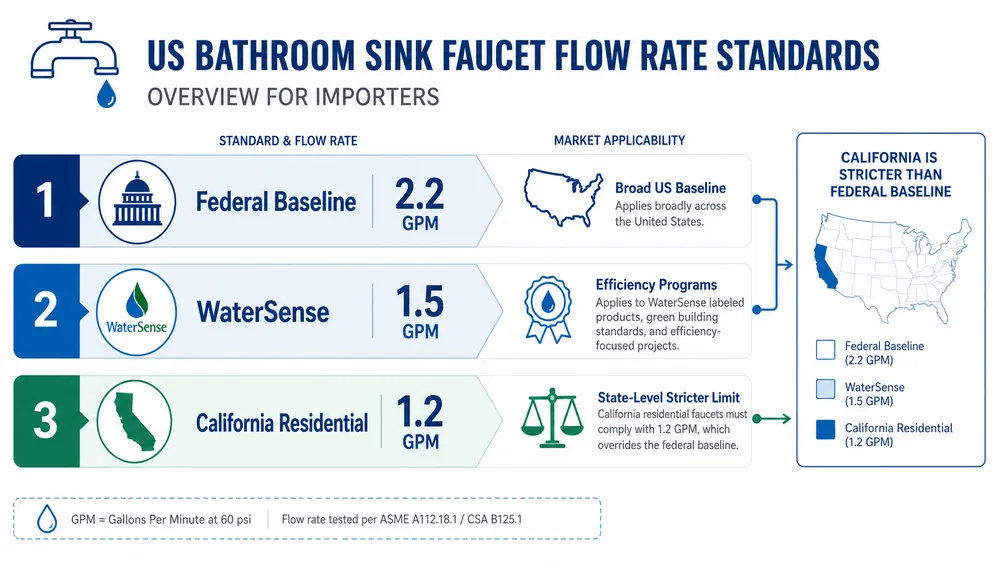
2.2 GPM — the federal baseline
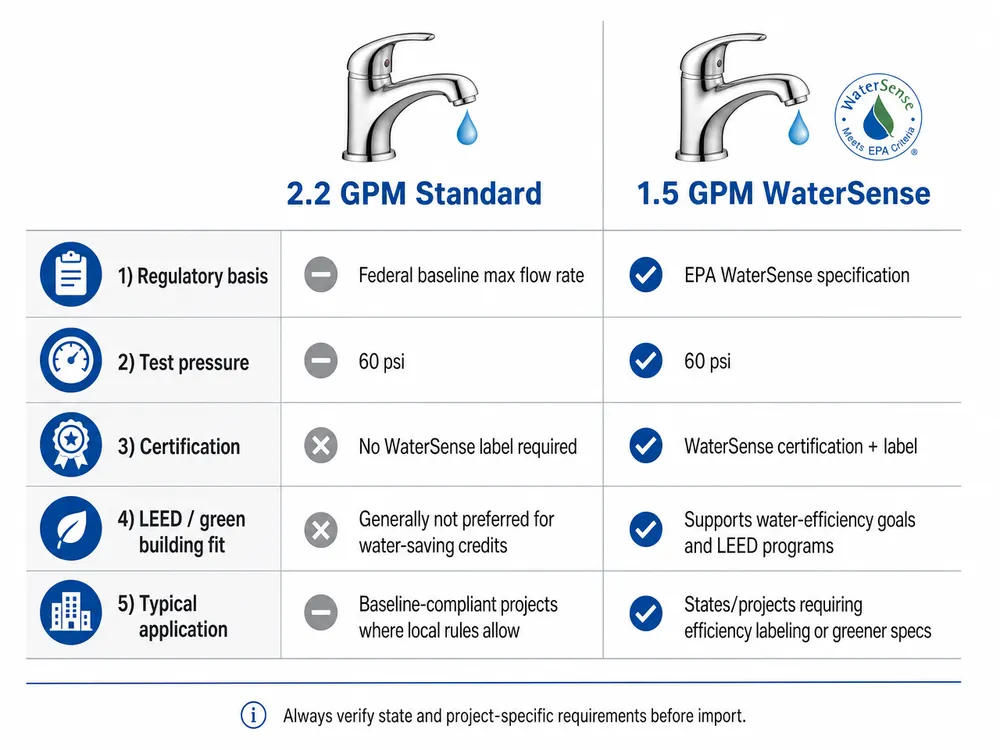
The 2.2 GPM limit comes from ASME A112.18.1, the primary US standard for plumbing supply fittings. It's also referenced in the Uniform Plumbing Code (UPC) and the International Plumbing Code (IPC). Federally, a bathroom sink faucet that delivers ≤2.2 GPM at 60 psi is compliant for sale and installation across the US — no additional certification required.
For most general-market distribution (hardware chains, plumbing wholesale, non-green-building commercial projects), 2.2 GPM is the spec you're working to. It's the standard that covers the broadest market without additional certification overhead.
1.5 GPM — the WaterSense label threshold
The EPA's WaterSense program sets 1.5 GPM as the maximum flow rate for labeled bathroom faucets and faucet accessories. WaterSense certification requires third-party testing by an EPA-recognized laboratory, and the label itself is what unlocks access to specific market segments: LEED-certified projects, government procurement specs, utility rebate programs, and hotel chains with sustainability commitments.
WaterSense is voluntary at the federal level. But it's not optional if your buyer is selling into green building projects, bidding on government contracts, or distributing to markets where state law has effectively made 1.5 GPM the mandatory ceiling.
| Specification | 2.2 GPM (ASME A112.18.1) | 1.5 GPM (EPA WaterSense) |
|---|---|---|
| Regulatory basis | Federal plumbing code | EPA voluntary label program |
| Test pressure | 60 psi (0.41 MPa) | 60 psi (0.41 MPa) |
| Certification required | No (code compliance only) | Yes — EPA-recognized lab |
| LEED credit eligible | No | Yes |
| State rebate programs | No | Yes (varies by state) |
| Green building specs | Rarely accepted | Standard requirement |
| Typical application | General distribution, standard commercial | Hospitality, government, LEED projects |
State-level mandates that override the federal baseline
This is where importers distributing nationally run into trouble. Several states have enacted flow rate limits stricter than the federal 2.2 GPM standard — and in some cases stricter than WaterSense's 1.5 GPM threshold.
California
California's Title 20 appliance efficiency regulations set the most restrictive limits in the country:
- Residential bathroom faucets: ≤1.2 GPM (effective January 1, 2016)
- Commercial bathroom faucets: ≤1.5 GPM
A 1.5 GPM WaterSense-labeled faucet is compliant for California commercial use but not for California residential installation. If you're distributing to California retailers who sell into both residential and commercial channels, you need to know which aerator configuration is in the box.
Colorado
Colorado's HB 21-1151 (effective January 1, 2023) requires bathroom faucets sold in the state to meet ≤1.5 GPM. This effectively makes WaterSense-equivalent flow rate mandatory for all Colorado sales, regardless of application type.
Other states with ≤1.5 GPM requirements
Washington, Oregon, and several New England states have adopted or are in the process of adopting ≤1.5 GPM requirements for bathroom faucets. The trend is clear: the federal 2.2 GPM baseline is becoming a ceiling that fewer states accept for new installations.
What this means for SKU planning
If you're distributing nationally, you have two practical options:
- Specify 1.5 GPM across your entire line. A 1.5 GPM faucet is compliant everywhere in the US, including California commercial. The only gap is California residential, which requires 1.2 GPM. For most importers, this is the lower-complexity path.
- Run separate SKUs by market. 2.2 GPM for states with no restriction, 1.5 GPM for restricted states, 1.2 GPM for California residential. This gives you maximum flexibility but multiplies your SKU count and inventory management complexity.
The aerator is what makes option 1 viable without sacrificing performance in unrestricted markets — which brings us to the component that actually controls your flow rate output.
How the aerator controls flow rate — and what to specify on your PO
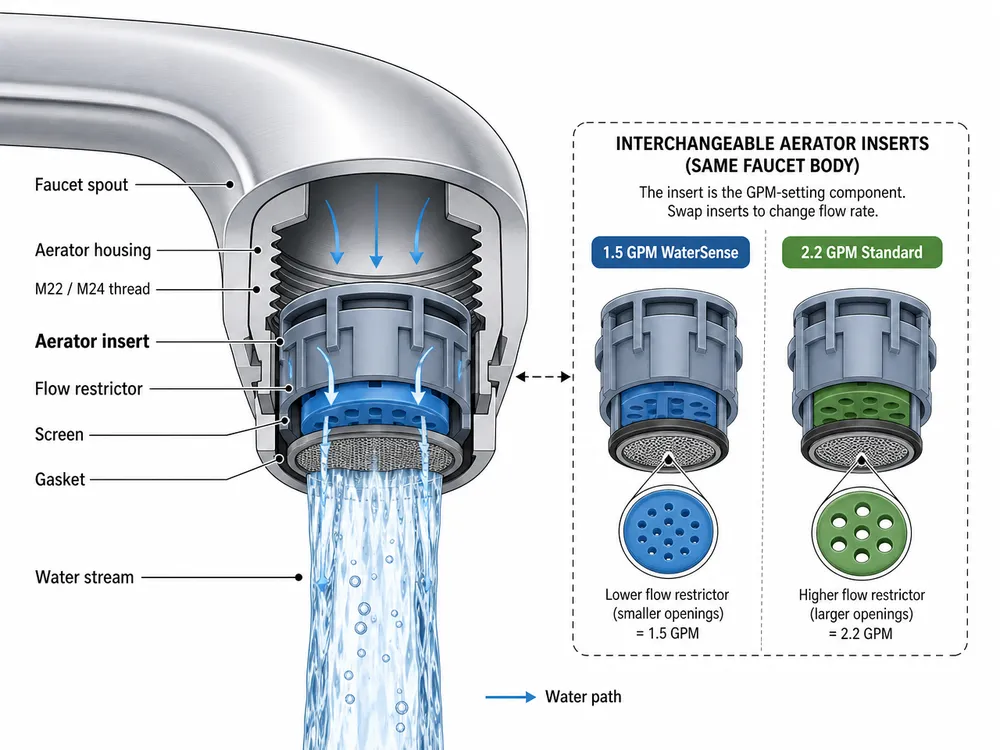
The aerator is the threaded insert at the tip of the faucet spout. It mixes air into the water stream, reduces splash, and — most importantly for compliance — restricts flow to a rated GPM. The faucet body itself doesn't determine the flow rate. The aerator does.
This is a factory-level detail that most buyers never ask about, and it's the source of most flow rate compliance problems we see on incoming orders.
Standard aerator thread sizes for bathroom faucets are M22 (22mm male thread, common on European-origin designs) and M24 (24mm male thread, more common on US-spec faucets). The thread size is fixed by the spout design. The flow rate is set by the aerator insert — a 1.5 GPM insert and a 2.2 GPM insert use the same thread, so you can swap between them without changing the faucet body.
What this means for OEM buyers:
On the same faucet body, we can install a 1.5 GPM aerator or a 2.2 GPM aerator at the assembly stage. You don't need two separate faucet SKUs to cover two markets — you need one faucet body and two aerator configurations. For buyers distributing across multiple states, this reduces tooling cost, simplifies inventory, and keeps your catalog manageable.
(We've had buyers come to us after committing to a 2.2 GPM run for a national retailer, then discovering their California stores couldn't sell the product. The fix was straightforward — we swapped the aerator on the California allocation before shipping. But it's a much cleaner conversation when it's planned at the PO stage rather than resolved at the last minute.)
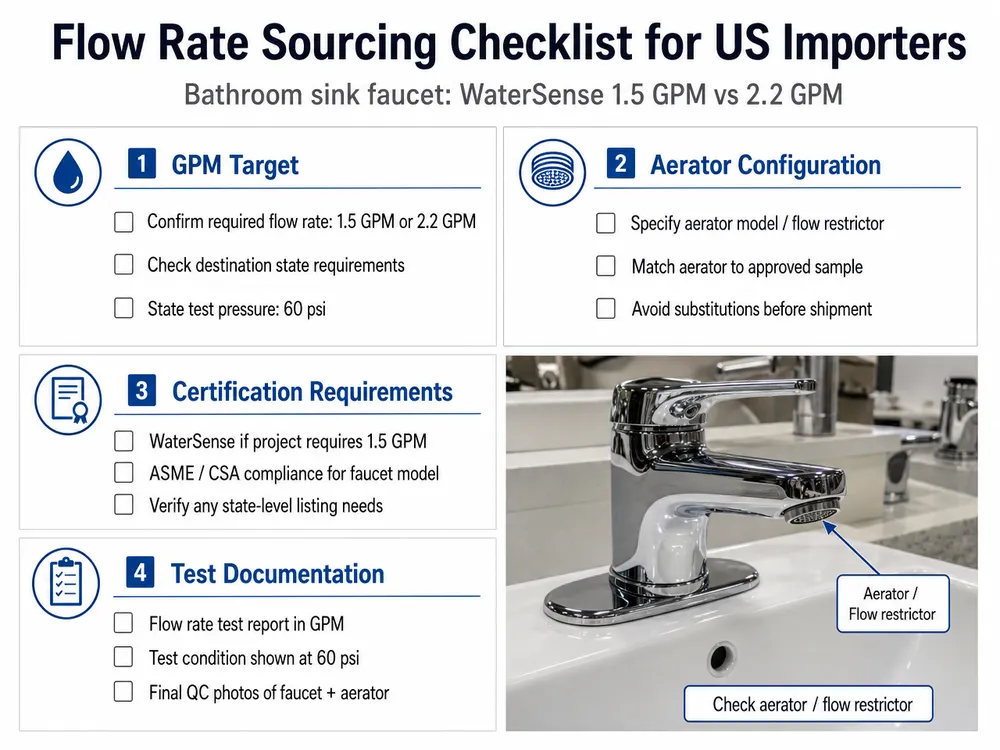
What to specify on your PO:
- Target GPM output (1.5 or 2.2, or 1.2 for California residential)
- Destination market or state (so we can confirm the applicable standard)
- Whether WaterSense certification documentation is required
If you don't specify GPM on the PO, we default to the configuration that matches your stated destination market. For North American orders without a state specified, we default to 1.5 GPM — it's compliant everywhere except California residential, and it avoids the situation where a buyer's product fails a state inspection they didn't anticipate.
WaterSense certification: what the label actually requires
WaterSense is an EPA program, not a product standard. The label is a market access credential — it tells buyers, specifiers, and end users that the product has been independently tested and meets the EPA's efficiency and performance criteria.
For bathroom faucets, WaterSense requires:
- Maximum flow rate of 1.5 GPM at 60 psi
- Minimum flow rate of 0.8 GPM at 60 psi (to ensure adequate performance at lower supply pressures)
- Testing by an EPA-recognized third-party laboratory
- Manufacturer registration with the EPA WaterSense program
The minimum flow rate requirement is worth noting. A faucet that restricts flow too aggressively — below 0.8 GPM — fails WaterSense certification even though it uses less water. The program is designed to balance conservation with usability, and the 0.8 GPM floor is the EPA's line for acceptable performance.
What the label unlocks commercially:
- LEED v4 Water Efficiency credits (WE Credit: Indoor Water Use Reduction)
- State and utility rebate programs (varies by state — California, Colorado, and several Northeast states have active rebate programs for WaterSense-labeled fixtures)
- Government procurement specifications (GSA and many state agencies require WaterSense for new construction and renovation)
- Hotel and hospitality chain specs (major chains including Marriott, Hilton, and IHG have sustainability commitments that reference WaterSense)
What documentation to request from your supplier:
- WaterSense Partner ID and product listing (verifiable on the EPA WaterSense website)
- Third-party test report from an EPA-recognized laboratory
- Flow rate test data at rated pressure (60 psi)
We hold cUPC certification in-house, which covers North American plumbing code compliance including flow rate requirements. For WaterSense labeling specifically, we work with EPA-recognized testing laboratories and can provide the test documentation with your order. If your buyer's spec requires the WaterSense label on the product packaging, confirm this at the RFQ stage — the label licensing and packaging artwork need to be coordinated before production.
Flow rate under real supply pressure conditions
The 60 psi test condition is a standard, not a guarantee of field performance. Supply pressure in real installations varies considerably:
- Residential single-family: typically 40–80 psi
- Mid-rise residential (above 4th floor): often 30–50 psi without a booster pump
- Older commercial buildings: 35–55 psi is common
- Hotel properties: varies by floor and building age
At 40 psi supply pressure, a 1.5 GPM aerator will deliver roughly 1.1–1.2 GPM — still within WaterSense's 0.8 GPM minimum, but noticeably lower than the rated output. For hospitality buyers specifying faucets for upper-floor hotel rooms, this is worth factoring into the product selection conversation with their plumbing engineer.
The practical implication for importers: if your buyer is supplying a project with known low supply pressure, a 2.2 GPM aerator at 40 psi will deliver approximately 1.6–1.7 GPM — closer to what a 1.5 GPM aerator delivers at 60 psi. In low-pressure applications, the 2.2 GPM configuration may actually be the right choice for performance, even in markets that permit it.
We include flow rate test data at 0.6 MPa with every outgoing shipment. If your buyer needs performance data at a specific lower pressure for a project spec, we can run supplemental testing and include it in the documentation package.
Specifying flow rate correctly on a PO — and what test reports to request
Most flow rate compliance problems we see trace back to one of three sourcing mistakes:
1. No GPM specified on the PO
The supplier ships whatever their default configuration is. If that's 2.2 GPM and your buyer is in Colorado, you have a compliance problem on arrival.
2. GPM specified but aerator not confirmed
The PO says "1.5 GPM" but doesn't confirm the aerator insert specification. Some suppliers interpret this as a target and ship a 2.2 GPM aerator with a note that the faucet "can achieve" 1.5 GPM with a different insert. That's not the same as shipping a 1.5 GPM-configured product.
3. WaterSense label assumed from flow rate compliance
A faucet that delivers 1.5 GPM is not automatically WaterSense certified. WaterSense requires third-party testing and EPA program registration. If your buyer's spec says "WaterSense labeled," you need the certification documentation, not just a flow rate that happens to match the threshold.
What to include in your RFQ and PO:
- Target GPM (1.5 or 2.2, or 1.2 for California residential)
- Destination state(s) or market
- Whether WaterSense certification and labeling is required
- Whether flow rate test reports are required with shipment documentation
What test reports to request:
- Flow rate test report at 60 psi (0.41 MPa) — confirms rated GPM
- Leak test report at 0.6 MPa — confirms pressure integrity
- WaterSense third-party test report (if WaterSense label is required)
- cUPC test report (for North American plumbing code compliance)
We include flow rate test data and leak test results with every shipment as standard documentation. cUPC certification covers the North American plumbing code requirements. WaterSense test reports are available on request — confirm at RFQ stage if your order requires them.

Handling mixed-market orders without doubling your SKU count
If you're distributing to multiple states with different flow rate requirements, the aerator swap approach is the most practical way to manage compliance without multiplying your inventory.
Here's how we handle it on the factory side: the faucet body, finish, and cartridge are identical across configurations. The only variable is the aerator insert installed at final assembly. On a mixed-market order, you specify the split — for example, 3,000 units at 1.5 GPM for general distribution and 500 units at 1.2 GPM for California residential — and we configure them separately before packing. Each carton is labeled with the GPM configuration so your warehouse team can allocate correctly.
For buyers who want maximum flexibility, we can also ship a small quantity of replacement aerators (both 1.5 GPM and 1.2 GPM) as spare parts with the order. If your distribution network needs to reconfigure units in the field, the aerator swap takes about 30 seconds with a coin or flathead screwdriver. (This is also useful for buyers who discover mid-distribution that a state has tightened its requirements — they can reconfigure existing inventory rather than returning product.)
The SKU consolidation benefit is real. One faucet body, two aerator configurations, full national compliance. Your catalog stays clean, your tooling investment covers both markets, and your reorder process doesn't split across two separate product lines.
For buyers sourcing Bathroom Sink Faucets for the US market, this is the conversation worth having at the RFQ stage — before tooling is committed and before the first container is loaded.
Frequently asked questions
Does a 1.5 GPM faucet feel noticeably weaker than a 2.2 GPM faucet?
At 60 psi supply pressure, the difference is perceptible but not dramatic — the aerator's air-mixing function maintains a full-looking stream even at lower flow rates. The more relevant variable is supply pressure: at 40 psi, a 1.5 GPM aerator delivers around 1.1–1.2 GPM, which some users find noticeably reduced. For hospitality projects in older buildings with lower supply pressure, this is worth discussing with the project's plumbing engineer before specifying 1.5 GPM across all floors.
Can I swap the aerator after the faucet is installed?
Yes. Aerators are designed to be field-replaceable. The thread size (M22 or M24) is fixed by the spout, but the insert is removable with a coin or aerator key. If your buyer needs to reconfigure installed units — for example, to comply with a state regulation that changed after installation — the aerator swap is a straightforward field operation. Confirm the thread size with us at the order stage so your buyer has the right replacement aerator specification.
What's the difference between cUPC and WaterSense certification for flow rate?
cUPC (Canadian/Uniform Plumbing Code) certification covers plumbing code compliance for North American installation, including the 2.2 GPM federal maximum. It's what your product needs to clear customs and pass a plumbing inspection. WaterSense is a separate EPA program that certifies efficiency performance at ≤1.5 GPM and requires independent third-party testing. A cUPC-certified faucet at 2.2 GPM is code-compliant but not WaterSense labeled. A WaterSense-labeled faucet at 1.5 GPM is both code-compliant and eligible for green building credits and rebate programs. We hold cUPC in-house; WaterSense test reports are available on request.
What flow rate should I specify for a hotel project?
For new hotel construction or renovation, 1.5 GPM is the standard specification — it satisfies WaterSense requirements, qualifies for LEED credits, and meets the sustainability commitments of most major hotel chains. The exception is California properties, where residential-use bathrooms require 1.2 GPM. For a mixed-use hotel project in California, confirm with the project's plumbing engineer whether guest bathrooms are classified as residential or commercial under the applicable code.
How do I verify a supplier's flow rate claim without running my own test?
Request the flow rate test report from an accredited third-party laboratory, not just the supplier's internal QC data. The report should specify the test pressure (60 psi / 0.41 MPa), the measured flow rate, and the aerator configuration tested. For WaterSense claims, verify the product listing on the EPA WaterSense website using the supplier's Partner ID — the listing is publicly searchable and confirms both the certification status and the specific product models covered.
Flow rate compliance for the US market comes down to three decisions: which GPM standard your destination market requires, whether WaterSense certification is needed for your buyer's application, and how to configure the aerator to hit the target without multiplying your SKU count. Get those three right at the PO stage and the compliance side takes care of itself.
Browse our Bathroom Faucets catalog or go directly to the Bathroom Sink Faucets page to see available configurations. If you're ready to specify flow rate for an order, Request Quote with your target GPM, destination market, and volume — we'll confirm the aerator configuration, applicable certifications, and include flow rate test data with the quote.