

The faucet height decision looks simple until you're three weeks into a 200-room hotel installation and the plumber is calling because the spout clears the vessel sink rim by 40mm — not enough to get a hand under the water stream. That's a callback. That's a warranty claim. That's a sourcing decision that failed at the spec stage.
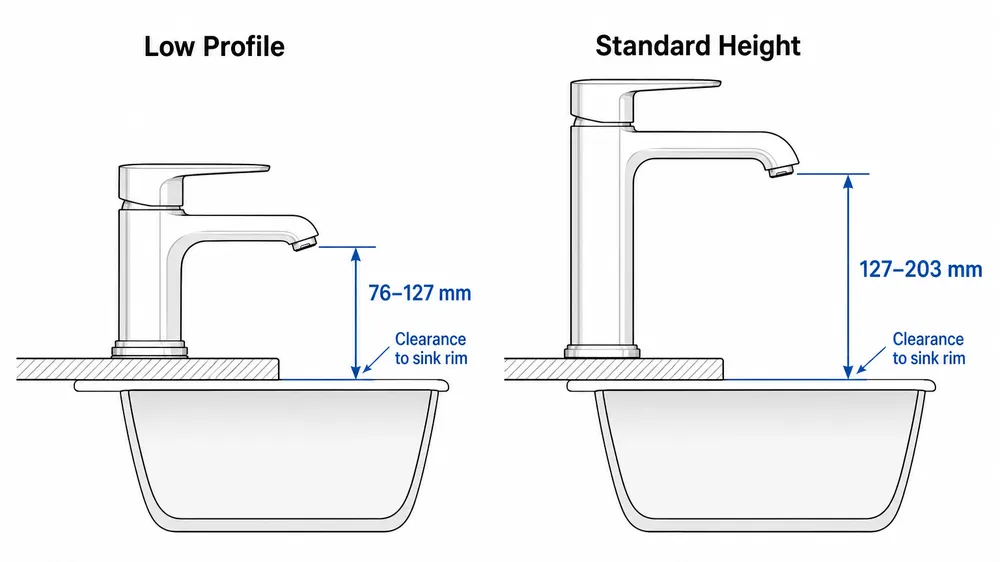
Here's the short verdict before we get into the mechanics: standard height faucets (spout height 127–203 mm / 5–8 in) are the default for undermount and drop-in sinks in residential and hospitality projects. Low profile faucets (spout height 76–127 mm / 3–5 in) are the correct choice for shallow vessel sinks, pedestal basins with limited deck clearance, and any project where the sink rim sits elevated above the deck. Mixing them up generates callbacks. Specifying the wrong one across a 50-unit residential development means your installer is back on-site, and your margin is gone.
The rest of this article explains why — with the spec table, the sink compatibility matrix, and the project-type decision logic you need to write a clean RFQ.

Spout Height Defined: The Spec That Drives Every Downstream Decision
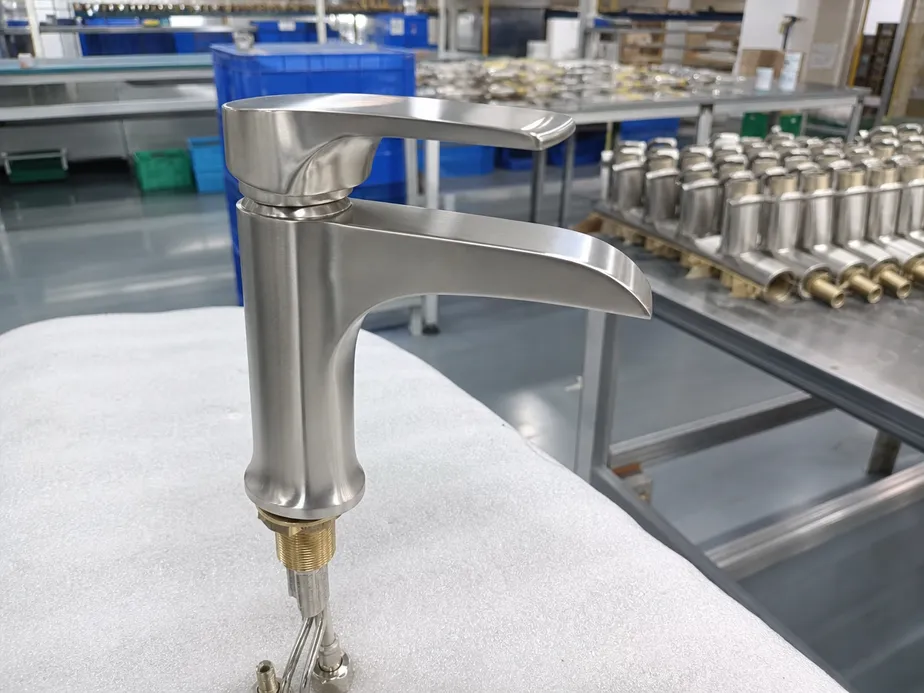
Spout height is measured from the deck surface (the mounting plane) to the center of the water outlet. It is not the same as the overall faucet height, which includes the body and handle assembly above the deck. When a plumber says "the faucet is too short," they almost always mean the spout height — the arc of water lands inside the basin instead of clearing the rim, or the clearance between the outlet and the sink floor is too tight for comfortable hand-washing.
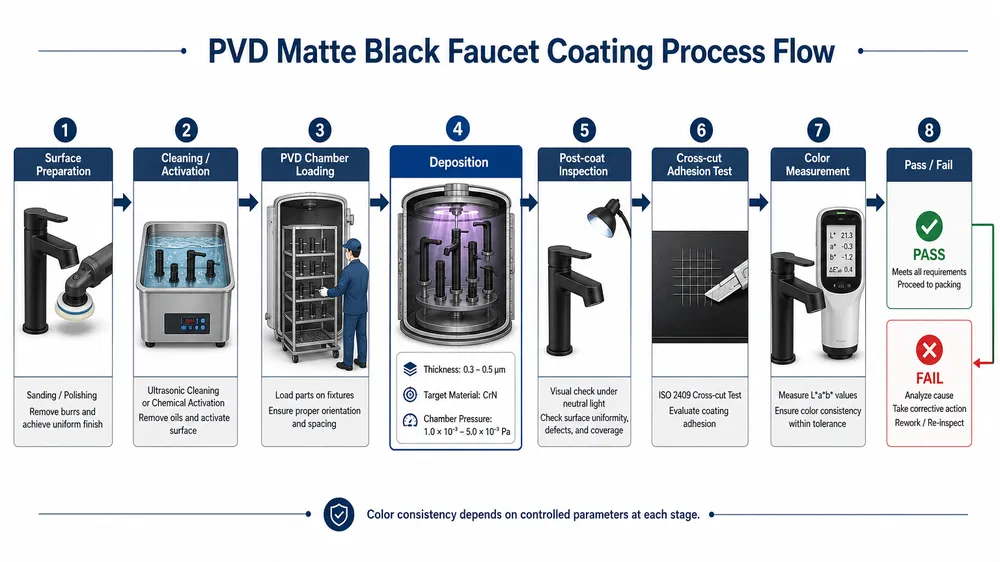
We manufacture both variants from the same certified brass body at our Foshan facility. The spout geometry is machined on our CNC lines to hold ±0.3 mm on the outlet position — that tolerance matters when you're specifying clearance for a vessel sink where the rim sits 80–100 mm above the deck. A 2 mm error in spout height on a low profile unit can mean the difference between a clean installation and a splash-back complaint.
| Specification | Low Profile Faucet | Standard Height Faucet |
|---|---|---|
| Spout height range | 76–127 mm (3–5 in) | 127–203 mm (5–8 in) |
| Typical spout reach | 100–130 mm (4–5 in) | 120–160 mm (4.7–6.3 in) |
| Deck clearance required | 25–40 mm below spout outlet | 40–60 mm below spout outlet |
| Compatible sink types | Vessel (elevated rim), shallow pedestal, countertop vessel | Undermount, drop-in, standard pedestal, semi-recessed |
| Handle-to-rim clearance risk | Low (spout stays below vessel rim height) | High if paired with elevated vessel sink |
| Splash-back risk | Higher if paired with deep undermount sink | Low for standard undermount/drop-in |
| Typical project fit | Hospitality vessel sink rooms, boutique residential, retail display | Standard residential, multi-unit development, commercial washroom |
| cUPC / CE / WaterMark certified | Yes (same body, same certification) | Yes |
(Note: the 76–127 mm range covers the majority of low profile SKUs we produce — if your vessel sink rim sits higher than 100 mm above deck, confirm the exact clearance calculation before committing to a SKU. We can run that calculation for you if you send the sink spec sheet.)
Sink Compatibility: Where Each Height Wins and Where It Fails
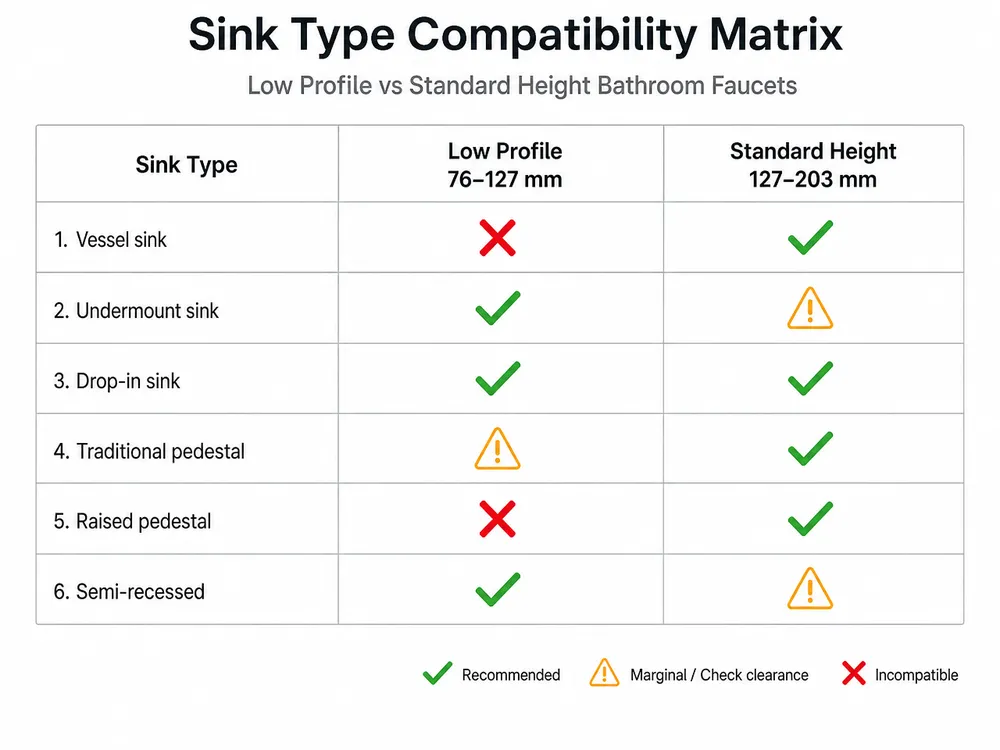
This is where most specification errors happen. The sink type determines the required spout height — not the other way around. Choosing a faucet first and then fitting it to whatever sink the designer specified is how callbacks get generated.
Vessel sinks sit on top of the deck surface, with the rim typically 100–150 mm above the mounting plane. A standard height faucet paired with a vessel sink creates two problems: the spout outlet may sit below the vessel rim (water hits the rim, not the basin), and the handle arc can interfere with the vessel wall during operation. Low profile faucets are designed for this configuration — the spout clears the vessel rim cleanly, and the handle geometry stays outside the vessel footprint.
Undermount and drop-in sinks sit at or below the deck surface. The basin floor is 150–200 mm below the deck. A low profile faucet here means the water stream drops nearly 200 mm before hitting the basin floor — generating splash-back onto the deck and the user. Standard height faucets are the correct specification for this configuration. The longer spout arc directs water toward the basin center, and the outlet height keeps the stream controlled.
Pedestal basins vary. Traditional pedestal designs with a shallow basin and a rim close to deck height work with standard height faucets. Contemporary pedestal designs with a raised bowl — common in boutique hotel bathrooms — behave like vessel sinks and require low profile specifications.
Semi-recessed sinks (partially inset into the vanity top) sit with the rim 30–60 mm above the deck. This is the configuration where we see the most specification errors in multi-unit residential projects. The rim height is close enough to deck level that buyers assume standard height faucets will work — and they often do, but the clearance is marginal. We recommend confirming the exact rim height and running a clearance check before specifying standard height for semi-recessed installations at scale.
The Hidden Cost: How Height Mismatch Generates Installer Callbacks
A faucet that ships correctly but gets installed in the wrong sink configuration is a warranty claim waiting to happen. The failure modes are predictable, and they all trace back to the same root cause: the spout height was not matched to the sink geometry at the specification stage.
Splash-back from low profile faucets in deep sinks. When the spout outlet sits too close to the basin floor, the water stream hits the basin at a steep angle and deflects onto the deck and the user. In a hotel bathroom, this generates guest complaints within the first week of occupancy. The property manager calls the contractor. The contractor calls the distributor. The distributor calls you. By the time the faucet gets replaced, the cost of the callback has exceeded the margin on the original order.
Handle interference from standard height faucets in vessel sink installations. A standard height faucet mounted next to a vessel sink often has the handle arc intersecting the vessel wall. The handle physically contacts the vessel rim during operation, or the user has to reach around the vessel to operate the handle. In a 200-room hotel project, this generates callbacks from multiple rooms simultaneously — and the fix requires either replacing the faucet or replacing the sink, neither of which is cheap.
Clearance failures in tight vanity configurations. Some contemporary vanity designs specify a vessel sink on a narrow deck with limited front-to-back depth. A standard height faucet in this configuration can have the spout outlet positioned too far forward, directing water onto the deck rather than into the basin. Low profile faucets with a shorter spout reach solve this — but only if the spout reach dimension was checked against the basin diameter at the specification stage.
We've seen all three of these failure modes in orders that came back to us for replacement product. In every case, the original specification was made without a clearance calculation. The faucet itself was fine — the pairing was wrong. (This is why we ask for the sink spec sheet when a buyer is ordering for a mixed-sink project. It takes five minutes to confirm the clearance and saves a callback.)
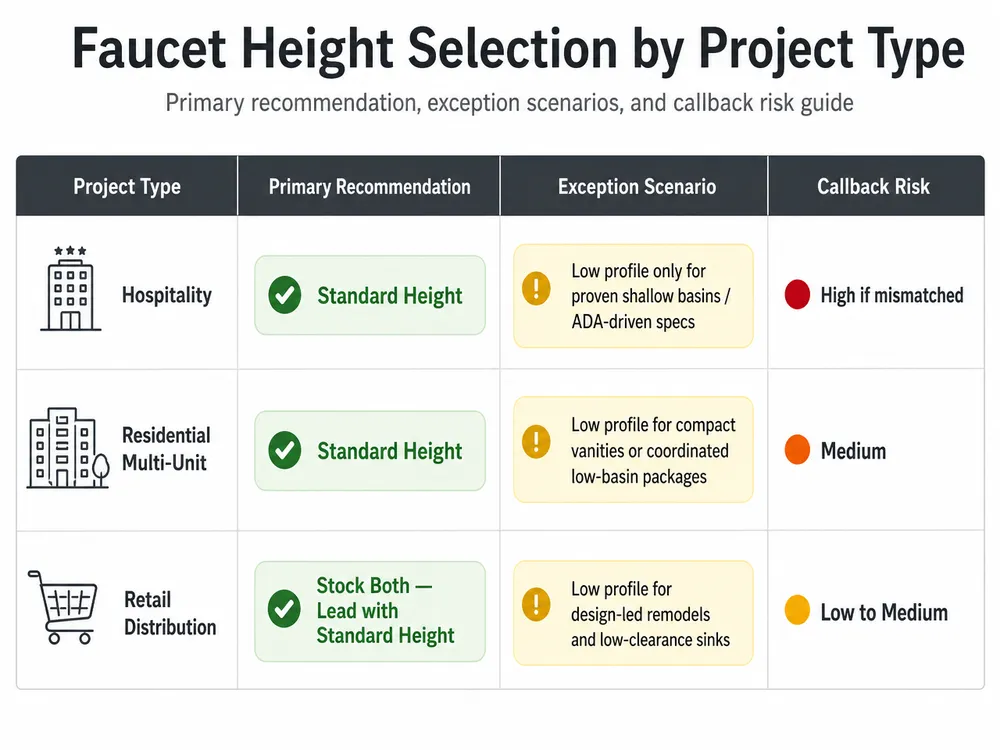
Project-Type Decision Guide: Which Height Fits Your Procurement Scenario
The right faucet height depends on the project type, not just the sink type. Here's how the decision maps across the three main procurement scenarios we supply.
Hospitality Projects: Vessel Sink Rooms Require Low Profile Specification
Contemporary hotel bathroom design has moved heavily toward vessel sinks over the past decade — the elevated bowl creates a visual statement that designers favor for mid-range and upscale properties. If you're supplying faucets for a hospitality project with vessel sink bathrooms, low profile is the correct specification for the majority of rooms.
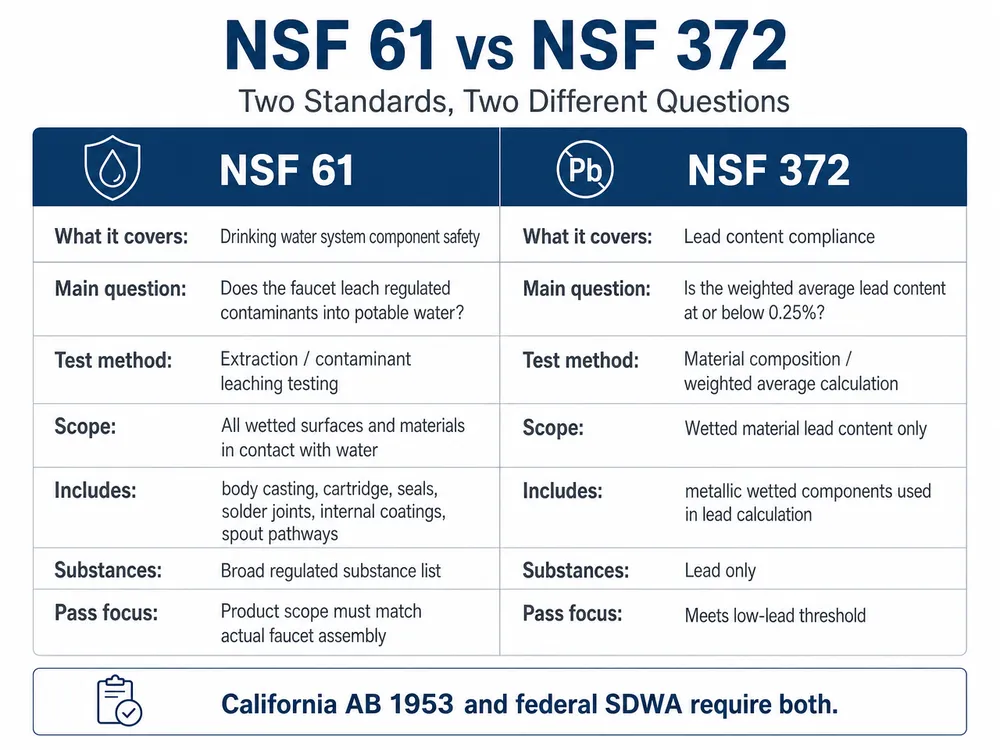
The exception is the accessible bathroom configuration, which typically uses an undermount or drop-in sink at ADA-compliant height. A hospitality project with mixed bathroom types — standard rooms with vessel sinks, accessible rooms with undermount sinks — needs both height variants. Sourcing both from the same manufacturer with the same certification documentation simplifies the procurement paperwork significantly. Our cUPC, CE, and WaterMark certifications cover both variants from the same brass body, so your compliance documentation is consistent across the entire order.
Residential Multi-Unit Development: Standard Height Is the Safe Default, With Exceptions
Standard residential construction — apartments, condominiums, townhouses — predominantly uses undermount or drop-in sinks in bathrooms. Standard height faucets are the correct specification for this configuration, and they represent the majority of what we ship for residential development projects.
The exception is the premium unit tier. Developers increasingly specify vessel sinks in penthouse units, show suites, and premium floor plans to differentiate the product. If your residential project has a mixed specification — standard sinks in most units, vessel sinks in premium units — you need both height variants. The risk of specifying standard height across the entire project and then discovering the premium units have vessel sinks is a mid-project change order, which is expensive for everyone.
Retail Distribution: Stock Both, Lead With Standard Height
If you're building a bathroom faucet SKU range for distribution, standard height faucets move in higher volume because they cover the larger installed base of undermount and drop-in sinks. Low profile faucets are a necessary addition to the range — vessel sink installations are common enough that distributors who don't carry a low profile option lose sales to competitors who do.
The practical approach is to stock both heights in your core finish options (chrome, brushed nickel, matte black) and use the same supplier for both so your documentation, packaging, and warranty terms are consistent. Buyers who are comparing your range against a competitor's will notice if your low profile and standard height faucets come from different sources with different certification coverage.
OEM Spout Height Customization: When Standard Ranges Don't Cover Your Project
Standard low profile and standard height ranges cover the majority of sink configurations. But hospitality chains, branded residential developers, and large-format distributors occasionally specify a non-standard clearance requirement — a proprietary sink design, a custom vanity height, or a brand standard that falls between the two standard ranges.
We can adjust spout height within a certified brass body from a 200-piece MOQ. The CNC machining step that sets the spout geometry is a controlled variable in our production process — we're not retooling the casting, we're adjusting the machined profile on an existing certified body. That means the cUPC, CE, and WaterMark certifications remain valid for the modified variant, and your compliance documentation doesn't require a new certification cycle.
The practical limit is roughly ±15 mm from the standard range endpoints. Beyond that, the spout geometry starts to affect the flow path in ways that require re-testing. Within that range, we can hold the same ±0.3 mm tolerance on the outlet position that we hold on standard production runs.
For hospitality chains specifying a consistent bathroom standard across multiple properties — where the sink is a proprietary design and the faucet height needs to match exactly — this is the sourcing path that eliminates the clearance guesswork. You send us the sink spec sheet, we confirm the required spout height, and we produce a certified variant that fits the installation without a clearance calculation on every job site.
(We've done this for a few hotel groups in the Middle East and Southeast Asia where the bathroom design was specified by the chain's interior design team and the sink was a custom piece. The faucet height was non-standard in both cases. The OEM path was faster than trying to adapt a standard SKU.)
Sourcing Validation: What to Confirm Before You Commit to a Height Specification
Whether you're sourcing low profile or standard height faucets, there are four things worth confirming before you place an order at volume.
Spout height tolerance documentation. Ask for the dimensional drawing with the spout height tolerance called out. A supplier who can't provide a dimensional drawing with tolerances is a supplier whose production consistency you can't verify. We provide full dimensional drawings with all critical tolerances for every SKU in our Bathroom Faucets catalog.
Certification coverage for your target market. cUPC covers North America. CE covers Europe. WaterMark covers Australia. If your project spans multiple markets — a hotel chain with properties in the US, UK, and Australia, for example — you need a supplier whose certifications cover all three. We hold cUPC, CE, and WaterMark on our bathroom faucet range, so one supplier handles the documentation for all three markets.
Consistent certification across height variants. This is the detail that catches buyers who source low profile and standard height faucets from different suppliers. If the two variants carry different certifications, or if one variant's certification is from a different body than the other, your compliance documentation is inconsistent. For a hospitality project with mixed sink types, that inconsistency creates problems at the property handover stage. Our Low Profile Bathroom Faucets and standard height variants share the same certified brass body — the certification documentation is identical except for the spout height dimension.
Spout reach, not just spout height. Spout height tells you the vertical clearance. Spout reach tells you where the water stream lands in the basin. A faucet with the correct spout height but insufficient reach will direct water toward the front of the basin — or onto the deck. Confirm both dimensions against the basin diameter and the faucet's mounting position before specifying at scale. For detailed dimensional specs on our low profile range, see low profile bathroom faucet specifications.
Scenario Verdicts: Three Situations, One Clear Answer Each
Scenario 1: 150-room hotel, vessel sink bathrooms, mid-range property. Low profile faucet, 90–110 mm spout height. Standard height will generate handle interference and potential clearance failures at the vessel rim. The callback risk on a 150-room installation is not worth the marginal cost difference.
Scenario 2: 80-unit residential development, undermount sinks throughout, standard vanity height. Standard height faucet, 140–160 mm spout height. Low profile here creates splash-back in the deep basin. Standard height is the correct specification and the lower-risk choice for a uniform installation.
Scenario 3: Distribution range build, mixed market, need to cover both sink types. Stock both. Lead with standard height in your core SKUs. Add low profile in at least chrome and brushed nickel to cover vessel sink installations. Source both from the same manufacturer to keep certification documentation consistent and simplify your supplier count. One supplier, two height variants, same certified body — that's the clean sourcing path.