

The most expensive mistake in a concealed shower project isn't a bad valve — it's a valve that doesn't fit the wall. Rough-in depth mismatches and trim kit escutcheon failures are the two issues that generate installer callbacks, project delays, and warranty disputes long after the container has cleared customs. Both are preventable at the sourcing stage, and both come down to spec clarity between you and your factory.
This guide covers the three decision points that cause the most sourcing errors for OEM concealed shower systems: rough-in depth variance by valve type, trim kit compatibility mechanics, and MOQ structure with tooling cost implications. It also covers how certification documentation is structured for multi-market buyers — because cUPC, CE, and WaterMark don't attach to the same components, and that matters when you're sourcing for more than one destination.
What an OEM Concealed Shower System Actually Ships As
Before getting into specs, it's worth being precise about what you're ordering — because "concealed shower system" means different things to different buyers, and the component breakdown affects your MOQ, your certification requirements, and your trim compatibility risk.
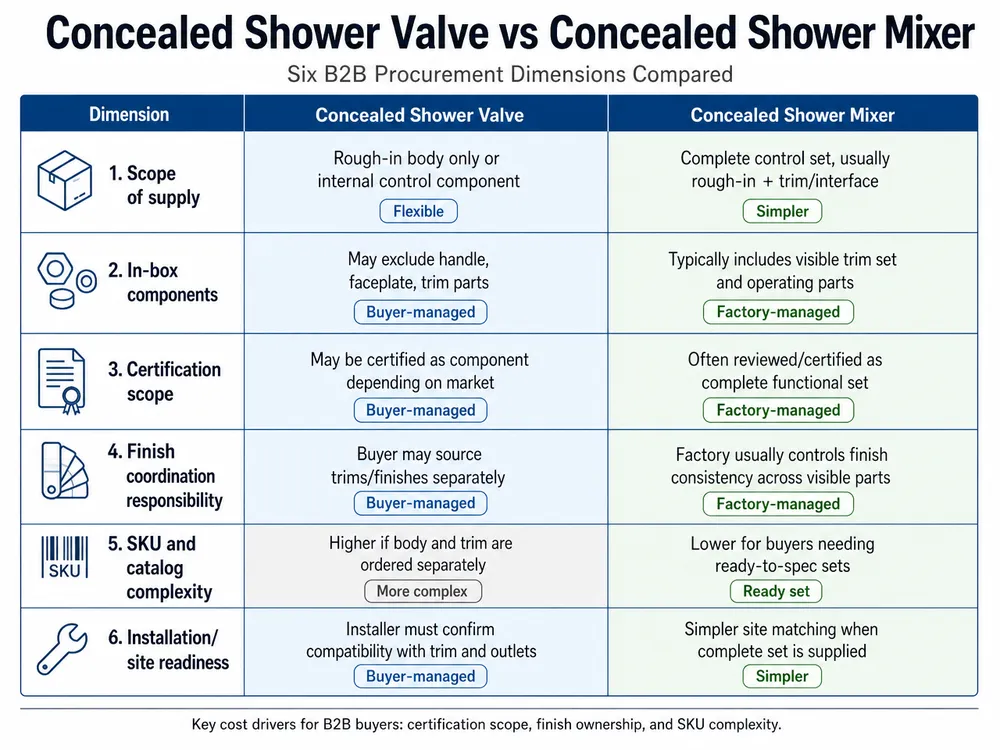
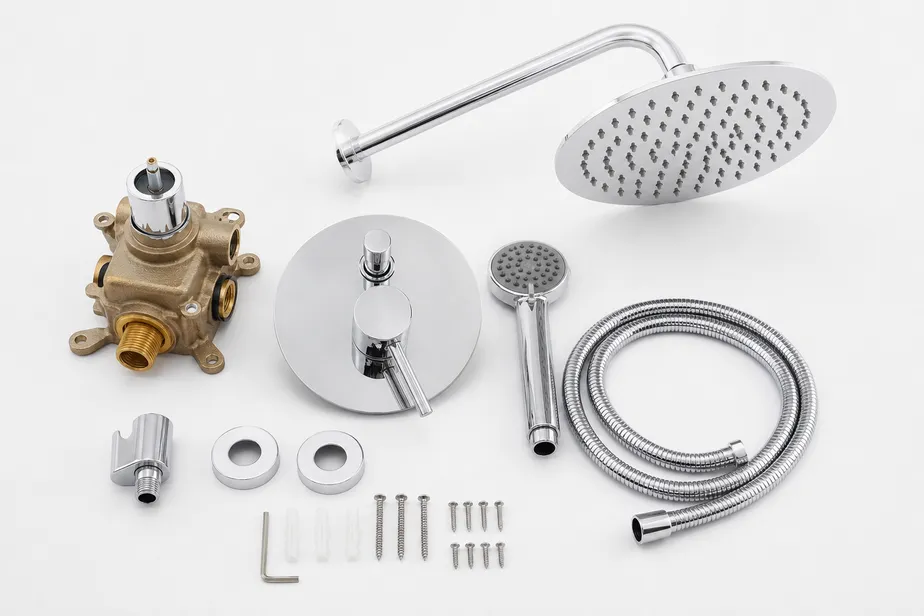
A complete OEM concealed shower system ships as three separable components:
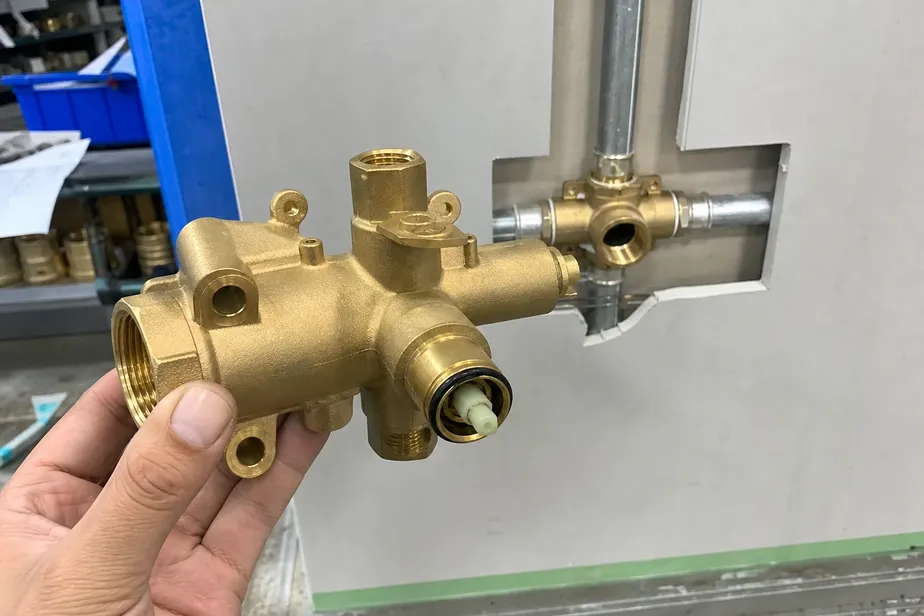
The valve body is the functional core — the pressure-balance or thermostatic cartridge assembly that mounts inside the wall. This is the certified component. cUPC, CE, and WaterMark all attach to the valve body, not to the trim. The valve body determines your rough-in depth requirement and your outlet configuration (2-way or 3-way).
The rough-in box (also called the installation box or mounting frame) is the structural housing that sets into the wall cavity during construction. It defines the face plate opening dimensions and the depth range the valve body must fit within. This is where most fit failures originate — when the rough-in box is sourced separately from the valve body, dimensional tolerances stack up and the trim kit may not cover the gap.
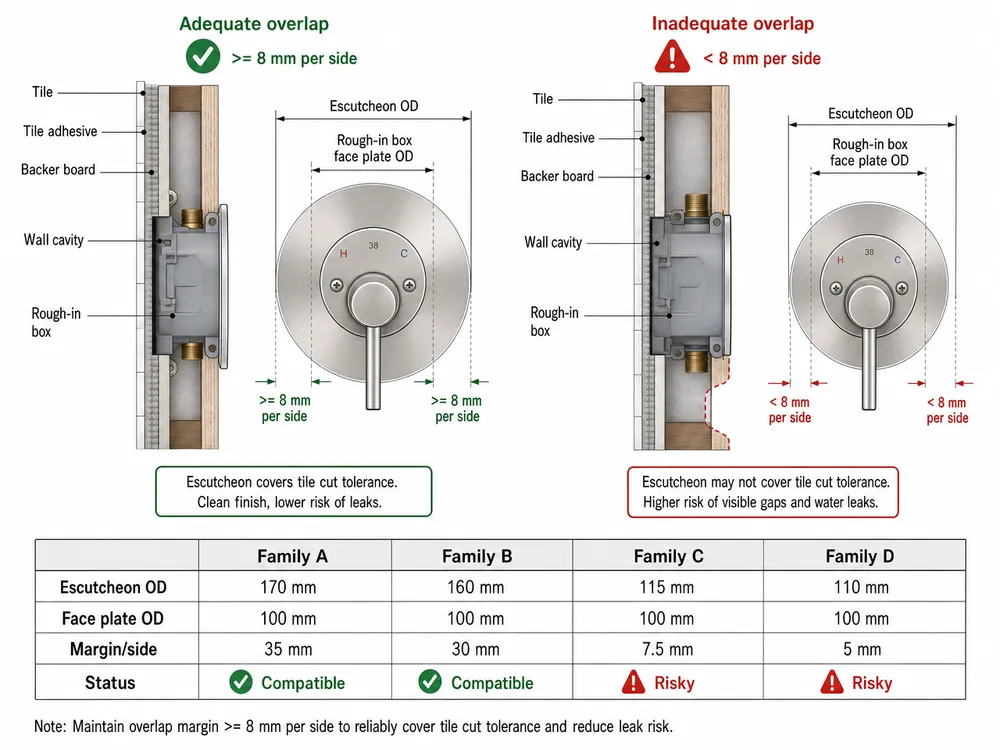
The trim kit is the visible surface layer: the escutcheon plate, handle, and outlet covers. The escutcheon's outer diameter must overlap the rough-in box face plate opening by enough margin to conceal the wall cutout. When valve body, rough-in box, and trim kit come from the same factory and the same product family, that overlap is engineered in. When they come from different sources, you're relying on dimensional luck.
We ship all three components as a matched set for OEM orders. Buyers who want to source the trim separately — for a custom handle design, for example — need to confirm escutcheon OD against our rough-in box face dimensions before committing to tooling. We've seen enough cross-brand fit failures to be direct about this.
Rough-In Depth by Valve Type: The Spec Table You Need Before the Wall Closes
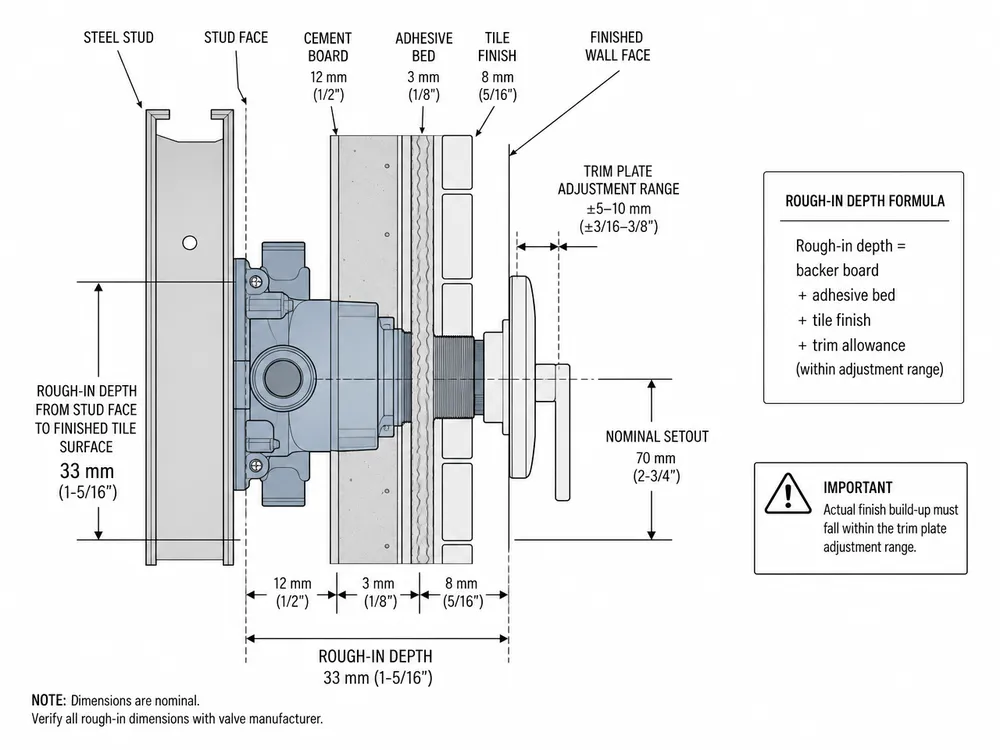
Rough-in depth is the distance from the finished wall surface to the back of the rough-in box. Get this wrong and you're either cutting into the wall cavity after tiling or shimming out the trim kit with visible gaps. Neither outcome is acceptable on a hotel fit-out or a residential project with a visible feature wall.
The depth requirement varies by valve type, outlet configuration, and wall construction. Here are the typical ranges we work with:
| Valve Type | Configuration | Rough-In Depth Range | Notes |
|---|---|---|---|
| Pressure-balance | 2-way (shower + diverter) | 55–65 mm | Thinner body, suits standard stud walls |
| Pressure-balance | 3-way (shower + tub + diverter) | 60–70 mm | Additional outlet adds ~5 mm to body depth |
| Thermostatic | 2-way (shower + volume) | 65–75 mm | Thermostatic cartridge adds depth vs PB |
| Thermostatic | 3-way (shower + tub + volume) | 70–85 mm | Deepest configuration — confirm wall cavity |
| Thermostatic | 2-way with integrated diverter | 68–78 mm | Common hotel spec; confirm with project architect |
(These are the ranges we manufacture to. Exact depth for a specific SKU is confirmed in the technical drawing we provide with every OEM sample.)
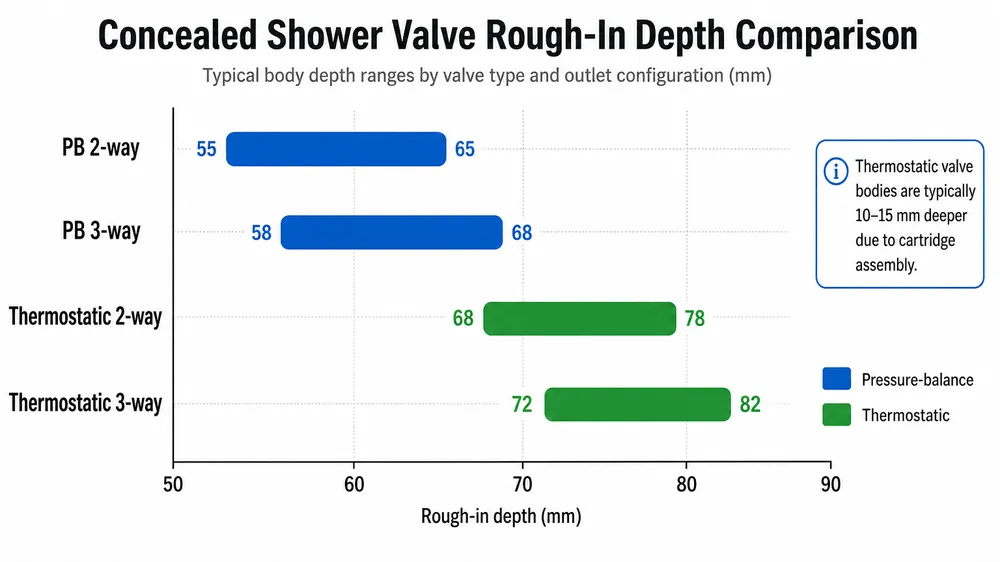
The wall construction variable is the one that catches buyers off guard. A standard North American stud wall with 1/2" drywall gives you roughly 90–100 mm of usable cavity depth — enough for any configuration above. A European tile-on-concrete wall may give you 70–80 mm, which rules out the deeper thermostatic 3-way bodies unless the architect has planned for a recessed cavity. For hotel projects in markets with solid masonry construction, confirm the available cavity depth with the project team before specifying a thermostatic 3-way body.
Pressure-balance vs thermostatic is also a certification question, not just a spec question. cUPC requires pressure-balance protection on all shower valves in North American residential applications — a thermostatic-only body without an integrated pressure-balance mechanism won't pass. For the North American market, we supply thermostatic bodies with integrated pressure-balance protection to meet this requirement. For European and Australian markets, thermostatic-only bodies are standard. If you're sourcing for multiple markets from a single SKU, confirm the valve body configuration covers both requirements — or plan for two SKUs.
Trim Kit Compatibility: Why Escutcheon OD Is the Number That Matters
The trim kit escutcheon has one job: cover the wall cutout around the rough-in box face plate opening. If the escutcheon OD is too small, the cutout shows. If the rough-in box face plate is too large for the escutcheon, same problem. The overlap margin — the difference between escutcheon OD and rough-in box face plate OD — needs to be at least 8–10 mm on each side to account for tile cutting tolerances and wall surface variation.
Here's the compatibility matrix for our standard concealed shower product families:
| Product Family | Rough-In Box Face Plate OD | Escutcheon OD (standard trim) | Overlap Margin |
|---|---|---|---|
| Standard pressure-balance (2-way) | 120 mm | 145 mm | 12.5 mm per side |
| Standard pressure-balance (3-way) | 130 mm | 158 mm | 14 mm per side |
| Thermostatic (2-way) | 135 mm | 162 mm | 13.5 mm per side |
| Thermostatic (3-way) | 148 mm | 175 mm | 13.5 mm per side |
(OEM trim kits with custom escutcheon profiles are available — see the ODM section below. Custom escutcheon OD must be confirmed against the rough-in box face plate dimensions before tooling is cut.)

Cross-brand compatibility is a real risk. The industry has no standard for rough-in box face plate dimensions — every factory sets its own. A trim kit from one supplier will not reliably fit a rough-in box from another, even if the nominal valve size is the same. We see this most often when a buyer sources the valve body from one factory and the trim kit from another to get a specific handle design. The handle design is achievable — but it needs to be engineered against the rough-in box dimensions, not assumed to fit.
The cleanest solution is sourcing valve body, rough-in box, and trim kit from the same factory and the same product family. When you source the full set from us, the escutcheon overlap is engineered to spec and confirmed in the technical drawing. If you want a custom handle or escutcheon profile for your OEM brand, we can tool that as part of the ODM process — the custom trim is designed against our rough-in box dimensions from the start, so fit is guaranteed.
For buyers who are already committed to a specific rough-in box from a previous supplier, send us the face plate OD and we'll confirm whether our standard trim kits cover it or whether a custom escutcheon is needed. This is a 10-minute check that prevents a container-load of callbacks.
MOQ and Tooling Cost Structure: Three Tiers, Different Economics
OEM concealed shower sourcing from China doesn't have a single MOQ — it has three tiers with different economics, and the right tier depends on how much customization you need and how much volume you're committing to.
Tier 1: Standard catalog OEM — 200 pieces, no new tooling
This is the entry point for most new buyers. You select a valve body configuration and trim kit from our existing product family, apply your brand name and packaging, and order from 200 pieces. No tooling cost, no tooling lead time. Sample lead time is 7–10 days from an existing production SKU.
The 200-piece MOQ is lower than most China factories quote for concealed systems — the typical floor is 500 pieces, because concealed valve assembly is more labor-intensive than a standard faucet. We can hold 200 pieces because our concealed system assembly line runs dedicated assemblers who know the product family, so the per-unit labor cost doesn't spike on smaller runs.
This tier works well for market testing a new SKU, for hotel project procurement where the volume is defined by the project scope, and for distributors adding a concealed system to an existing catalog without committing to a full container.
Tier 2: ODM adaptation — 200 pieces, 15–20 day sample
ODM adaptation means taking an existing valve body from our catalog and modifying the trim kit — custom escutcheon profile, custom handle design, custom finish combination — to match your brand's design language. The valve body stays the same (no new casting tooling), but the trim components get new tooling.
Trim tooling cost depends on complexity: a custom escutcheon plate runs lower tooling cost than a custom handle with internal geometry. We quote tooling separately from unit cost, and tooling is a one-time charge — it doesn't recur on reorders. MOQ stays at 200 pieces because the valve body is unchanged. First sample in 15–20 days from tooling approval.
(We've done ODM trim adaptations for buyers who wanted a specific rectangular escutcheon profile that our standard round escutcheon didn't match. The valve body was identical to our catalog SKU — only the escutcheon and handle were new tooling. Total tooling cost was modest, and the buyer had a differentiated product that their competitors couldn't list-match on price.)
Tier 3: Custom body tooling — 500+ pieces, 25–35 day first sample
Full custom OEM means a new valve body design — different internal geometry, different outlet positioning, different body dimensions. This requires new brass casting dies and CNC fixtures, which is where the tooling cost and lead time increase.
We maintain an in-house tooling room for brass casting dies, so tooling revisions don't go to an outside vendor. That's what keeps the first-sample turnaround at 25–35 days instead of 45–60 days. The MOQ floor for custom body tooling is 500 pieces — below that, the tooling amortization per unit makes the landed cost uncompetitive.
Custom body tooling makes sense when you need a specific rough-in depth that our catalog doesn't cover, a proprietary outlet configuration, or a valve body geometry that's part of a patented product design. For most buyers, Tier 1 or Tier 2 covers the requirement.
| Tier | Customization Level | MOQ | Sample Lead Time | Tooling Cost |
|---|---|---|---|---|
| Standard catalog OEM | Brand + packaging only | 200 pcs | 7–10 days | None |
| ODM trim adaptation | Custom trim kit, existing body | 200 pcs | 15–20 days | Trim tooling (one-time) |
| Custom body tooling | New valve body design | 500 pcs | 25–35 days | Body + trim tooling (one-time) |
Certification Coverage by Market: What Travels with the Valve Body vs the Trim Kit
This is the section most sourcing guides skip, and it's the one that causes the most documentation problems at customs.
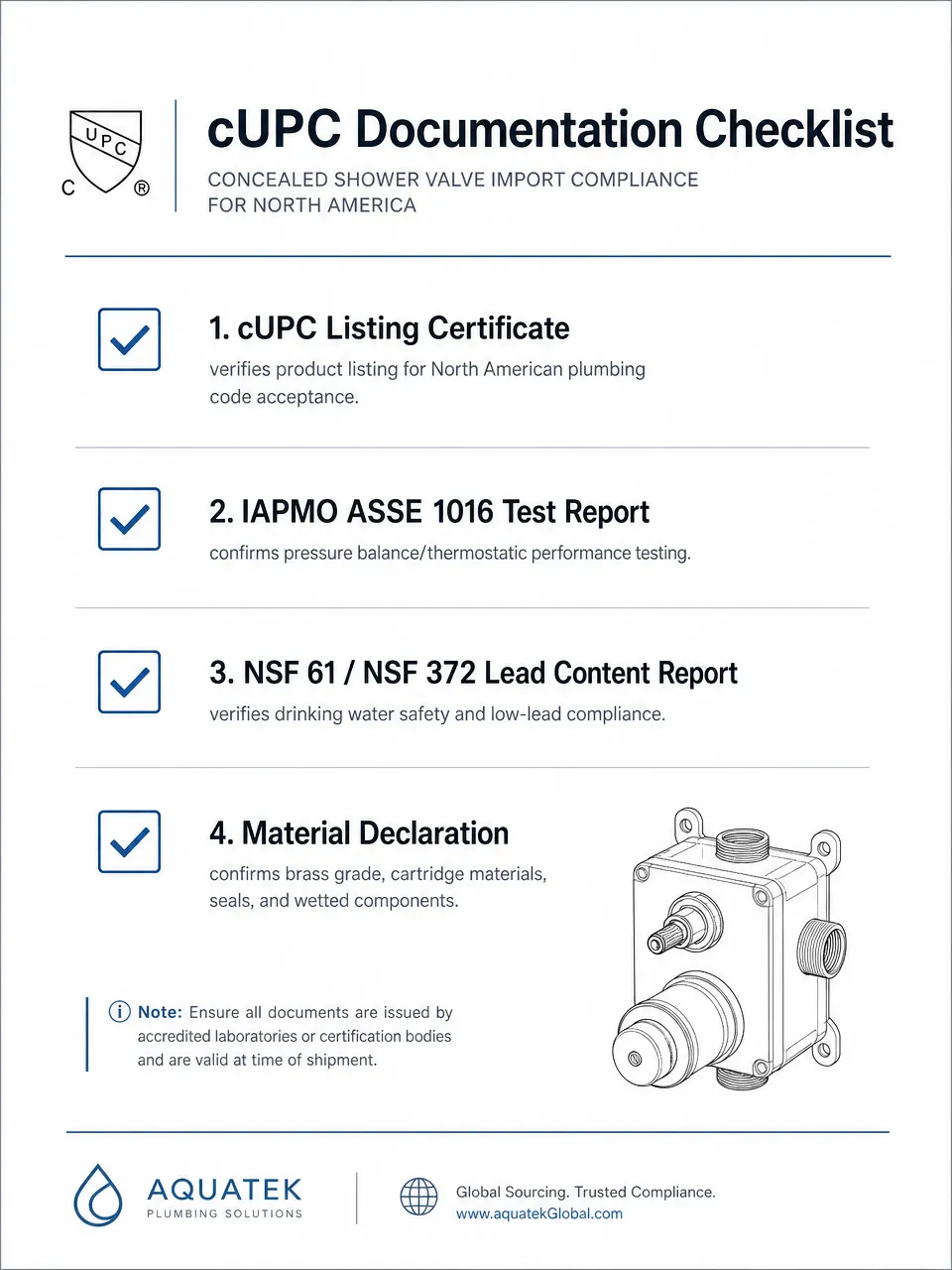
The valve body carries the certification. cUPC, CE, and WaterMark are all tested and certified against the valve body assembly — the cartridge, the body casting, the internal flow path, and the pressure/temperature performance. The trim kit (escutcheon, handle, outlet covers) is not independently certified under these standards. When you order a certified concealed shower system, you're ordering a certified valve body with a matched trim kit.
This has two practical implications:
First, if you want to sell the same valve body into multiple markets, you need the certifications for each market on the same valve body SKU. We hold cUPC (North America), CE (Europe), and WaterMark (Australia) on our concealed shower valve bodies — all three from the same factory, on the same production line. You don't need to manage separate supplier relationships for different destination markets.
Second, if you're doing ODM trim adaptation (Tier 2 above), the custom trim kit doesn't require re-certification as long as the valve body is unchanged. The certification documentation references the valve body model number, not the trim kit. Your custom escutcheon and handle are cosmetic components — they don't affect the certified performance of the valve body. We document this clearly in the certification package so your compliance team isn't chasing a re-test that isn't required.
| Certification | Market | Attaches To | Re-test Required for Custom Trim? |
|---|---|---|---|
| cUPC | North America (US, Canada) | Valve body | No |
| CE | European Union | Valve body | No |
| WaterMark | Australia | Valve body | No |
| ISO 9001:2015 | All markets | Factory QMS | No |
A note on WRAS (UK): Post-Brexit, the UK no longer accepts CE marking for plumbing products. WRAS approval is the relevant standard for the UK market. We can advise on WRAS documentation requirements for buyers targeting the UK — it's a separate certification process from CE, and the timeline and cost are different. If the UK is a target market, flag it at the RFQ stage.
For North American buyers: cUPC covers both US and Canadian plumbing code requirements. A cUPC-certified valve body ships into both markets without separate Canadian certification. The documentation package includes the cUPC certificate, the test report, and the installation instructions in the format required by US and Canadian plumbing inspectors.
How We Test Every Production Batch — Not Just New Products
The 500,000-cycle cartridge endurance test is the one we get asked about most. Most factories run endurance testing on new product introductions — they test the prototype, get the certification, and then assume production units perform the same. We run the 500,000-cycle test on every production batch.
The reason is straightforward: cartridge performance is sensitive to assembly tolerances. A ceramic disc cartridge that's assembled with the disc faces 0.02 mm out of parallel will pass a 50,000-cycle test and fail at 200,000 cycles. The only way to catch that is to test production units, not just prototypes. We pull a sample from every batch and run the full endurance cycle before the batch ships.
(We've had two cartridge suppliers over the years who passed paper qualification but showed early failure rates in our endurance testing. Both were removed from the approved supplier list. We now require a 50,000-cycle pre-qualification test on any new cartridge supplier before they enter production — that's a factory-side requirement, not a certification requirement.)
The test reports travel with the shipment documentation. Your QC team gets the data without requesting it separately, and your downstream customers get a product whose performance matches the spec sheet.
Salt spray testing on surface finishes runs 24 hours minimum on every batch, with extended 48-hour tests on new finish batches or new plating line runs. For concealed trim kits, the escutcheon and handle are the visible components that your end customer sees every day — finish durability is a warranty claim waiting to happen if the plating isn't right. Our chrome and brushed nickel finishes use a full copper/nickel/chrome electroplating stack; skipping the nickel mid-coat is a common cost-cutting move in the industry, and it's why you see chrome trim kits from some factories showing corrosion at 12 months in humid climates.
How to Write an OEM Concealed Shower RFQ That Gets a Useful Quote Back
Most RFQs we receive for concealed shower systems are missing at least two of the inputs we need to quote accurately. The result is a back-and-forth that adds a week to the process. Here's the checklist:
Required inputs for an accurate quote:
- Valve type: pressure-balance or thermostatic
- Outlet configuration: 2-way or 3-way (specify which outlets: shower head, hand shower, tub spout, body jets)
- Target market: determines which certification(s) are required (cUPC for North America, CE for EU, WaterMark for AU, WRAS for UK)
- Rough-in depth requirement: if you have a specific wall construction constraint, state it; otherwise we'll quote our standard depth for the valve type
- Finish: chrome, brushed nickel, matte black, PVD gold, or oil-rubbed bronze
- Escutcheon style: round or square, standard or custom profile
- Customization tier: catalog OEM (brand + packaging), ODM trim adaptation, or custom body
- Order volume: initial order quantity and expected annual volume (affects tooling amortization discussion)
Optional but useful:
- Reference product or photo of what you're currently sourcing (helps us identify the closest catalog match or flag compatibility issues)
- Target retail price point (helps us recommend the configuration that protects your margin)
- Project timeline (hotel fit-out projects often have hard installation dates that affect sample and production scheduling)
The more complete your RFQ, the more specific our quote. A complete RFQ gets a response with unit pricing, tooling cost (if applicable), sample lead time, and production lead time. An incomplete RFQ gets a clarification request.
You can browse our full Concealed Shower Mixers & Sets range to identify the valve body configuration closest to your requirement before submitting an RFQ. For trim kit details and escutcheon dimensions, the concealed shower trim kits page has the dimensional specs for each product family. If you're evaluating thermostatic vs pressure-balance for your target market, the concealed thermostatic shower mixer page covers the configuration options in detail.
When you're ready to move forward, Request Quote with the inputs above and we'll come back with a complete quote including sample lead time and, if relevant, a tooling cost breakdown.
Frequently Asked Questions
Can I source the valve body from Wfaucet and the trim kit from another supplier?
You can, but confirm the escutcheon OD against our rough-in box face plate dimensions before committing. Our rough-in box face plate dimensions are in the technical drawing for each product family — request it at the RFQ stage. If the third-party trim kit's escutcheon OD doesn't provide at least 8 mm overlap margin on each side, you'll have a fit problem on site. We've seen this cause project delays on hotel fit-outs where the trim kit was specified by the interior designer without checking the rough-in dimensions.
What's the minimum order for a concealed shower system with my brand name on the packaging?
200 pieces for standard catalog OEM — no new tooling required, just your brand name and packaging spec. This is lower than most China factories quote for concealed systems because our dedicated concealed system assembly line keeps per-unit labor cost stable on smaller runs.
Does a custom escutcheon design require re-certification of the valve body?
No. cUPC, CE, and WaterMark certifications attach to the valve body assembly, not the trim kit. A custom escutcheon is a cosmetic component — it doesn't affect the certified performance of the valve body. We document this in the certification package so your compliance team has the confirmation in writing.
What's the rough-in depth for a thermostatic 3-way concealed shower body?
Typically 70–85 mm from finished wall surface to the back of the rough-in box. The exact depth for a specific SKU is confirmed in the technical drawing. For solid masonry wall construction, confirm the available cavity depth with the project architect before specifying a thermostatic 3-way body — some masonry wall constructions don't provide enough cavity depth without a planned recess.
How long does it take to get a first sample for a custom trim kit design?
15–20 days from tooling approval for ODM trim adaptation (custom escutcheon or handle, existing valve body). 25–35 days for full custom body tooling. We maintain an in-house tooling room for brass casting dies, so tooling revisions don't go to an outside vendor and add weeks to the timeline.
Which certifications do I need for the US market vs the EU market?
cUPC for the US and Canada. CE for the EU. Both certifications attach to the valve body — the same valve body SKU can carry both certifications if it was tested to both standards. We hold cUPC and CE on our concealed shower valve bodies, so a single SKU covers both markets. For Australia, add WaterMark. For the UK post-Brexit, WRAS is required separately from CE.