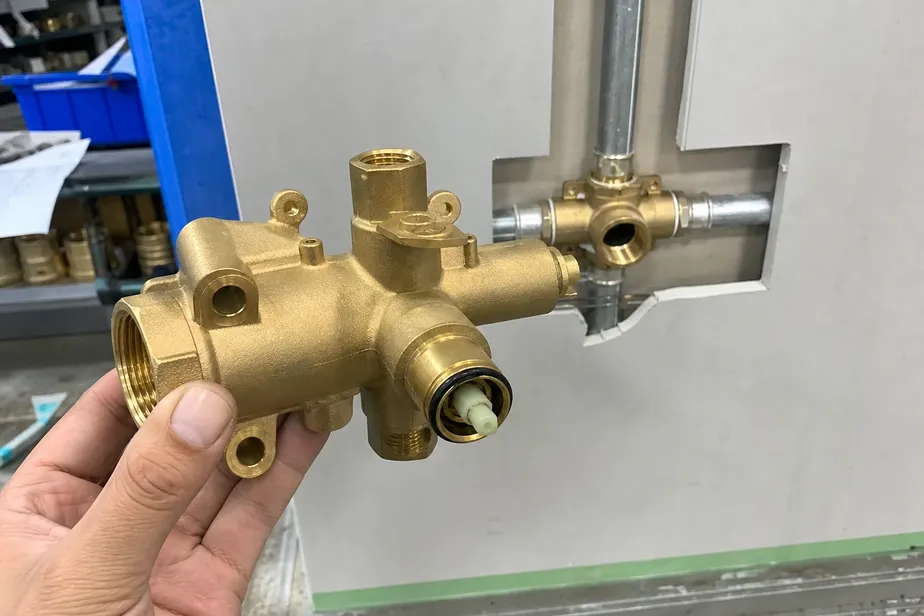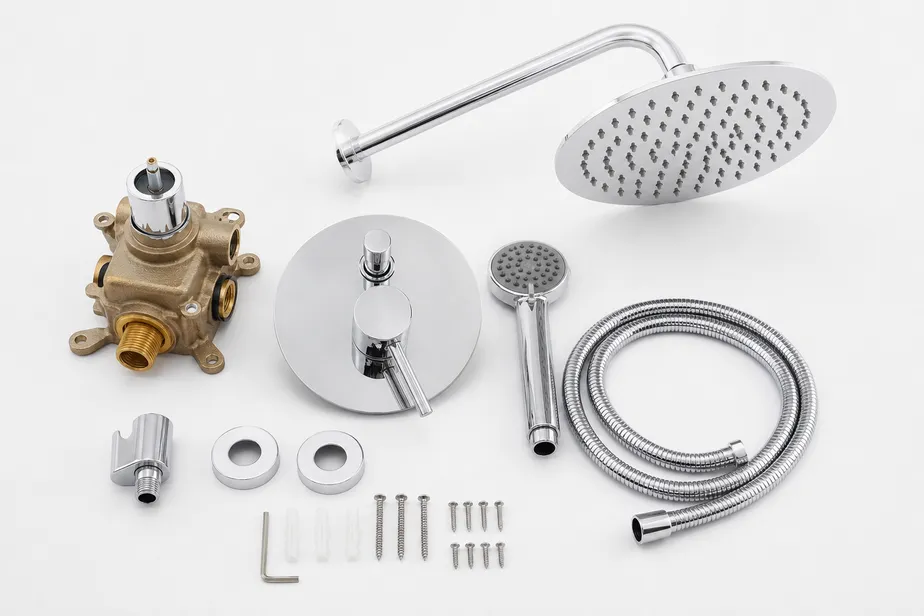


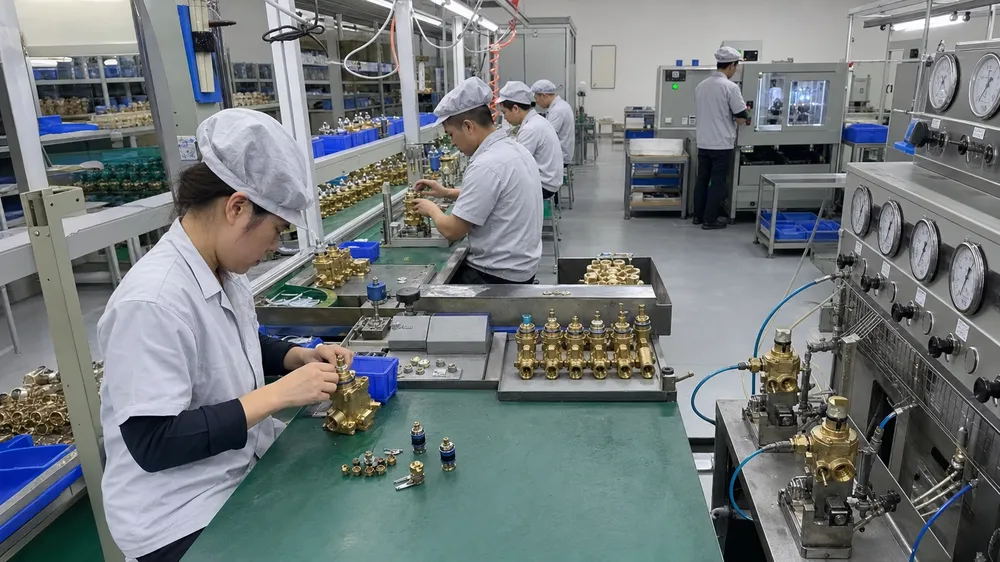
The concealed shower valve market in the US looks well-supplied until you start asking the questions that actually matter for import procurement: Is the cUPC certification current and documented? Can the supplier support OEM trim kits at your volume? What's the real landed cost after distributor margin? At that point, the list of viable options gets shorter fast.
This guide covers 10 real suppliers active in the US concealed shower market — from premium European brands to domestic manufacturers to factory-direct options from Foshan. For each one, we've noted the supplier model, certification posture, and where the trade-offs land for a buyer sourcing to resell or deploy at scale. The goal isn't a theatrical ranking. It's a sourcing framework that helps you decide which model fits your order profile.
What cUPC Compliance Actually Requires for Concealed Shower Valves
Before evaluating any supplier, you need to understand what cUPC certification means for this specific product category — because "cUPC certified" on a product listing and a properly documented cUPC certification package are two different things.
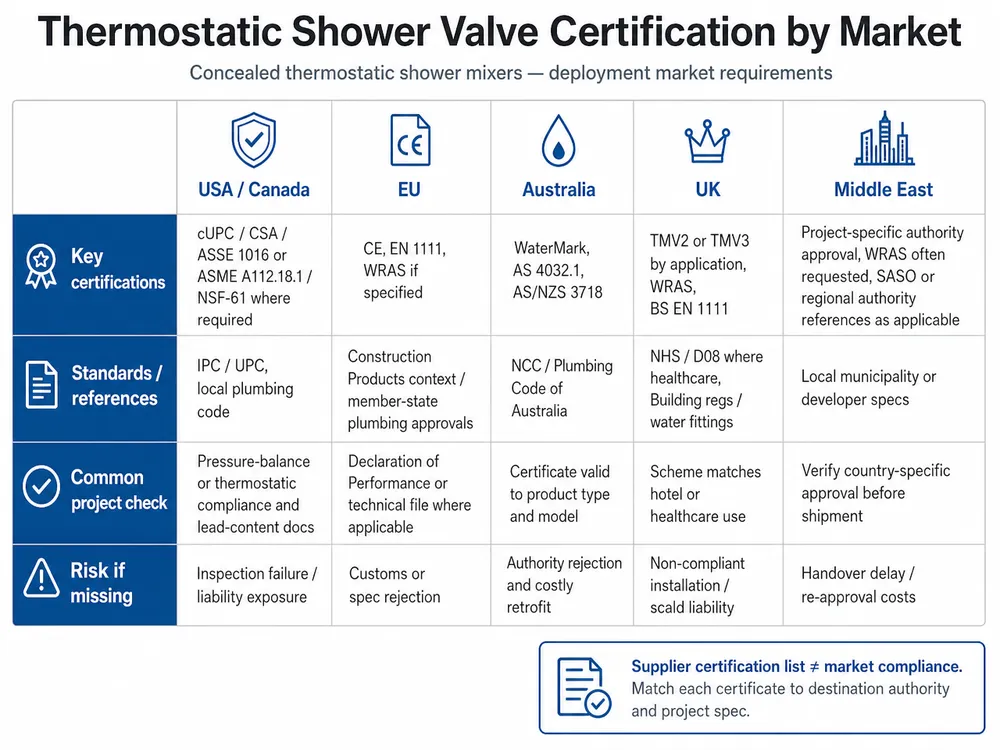
For concealed shower valves sold into the US and Canadian markets, cUPC compliance is governed by ASME A112.18.1 / CSA B125.1, which covers the mechanical performance of the valve itself: pressure balance or thermostatic control, anti-scald protection, flow rate, and shutoff performance. The valve body and wetted components must also comply with NSF/ANSI 61 for lead content — the allowable lead leaching threshold is 0.25 μg/L under the Reduction of Lead in Drinking Water Act, which effectively requires low-lead brass alloys throughout the wetted path.
What this means in practice: a supplier needs to have tested the specific valve model against ASME A112.18.1 at an accredited third-party lab, maintained a documented quality system that covers incoming material controls for lead content, and kept the certification current through periodic surveillance audits. A certificate number you can look up in the IAPMO product directory is the minimum verification standard. A certificate that expired two years ago, or a certificate that covers a different valve body than the one you're ordering, is not compliant documentation.
(We've seen this specific problem more than once — a buyer receives a cUPC certificate with the order, but the model number on the certificate doesn't match the valve in the carton. That's a customs and liability exposure, not just a paperwork inconvenience.)
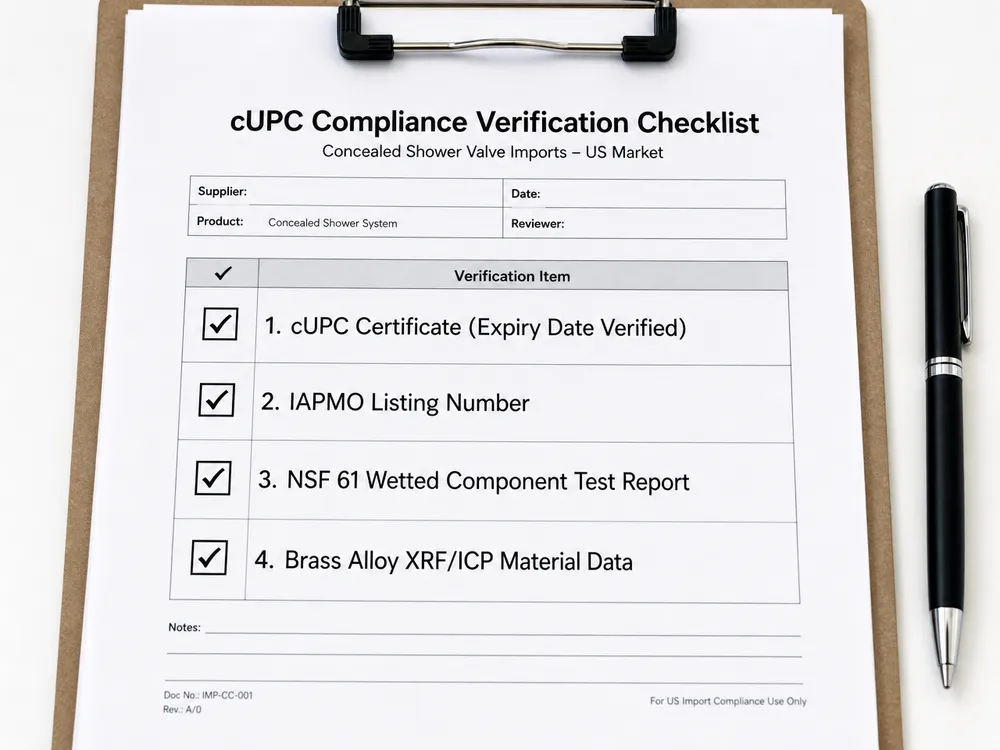
The documentation package a compliant supplier should be able to provide without hesitation: the cUPC certificate with current expiry date, the IAPMO listing number, the NSF 61 test report for wetted components, and the XRF or ICP test data for the brass alloy used in production. If a supplier hesitates on any of those four items, that's your answer.
How to Evaluate Concealed Shower Suppliers Before the List
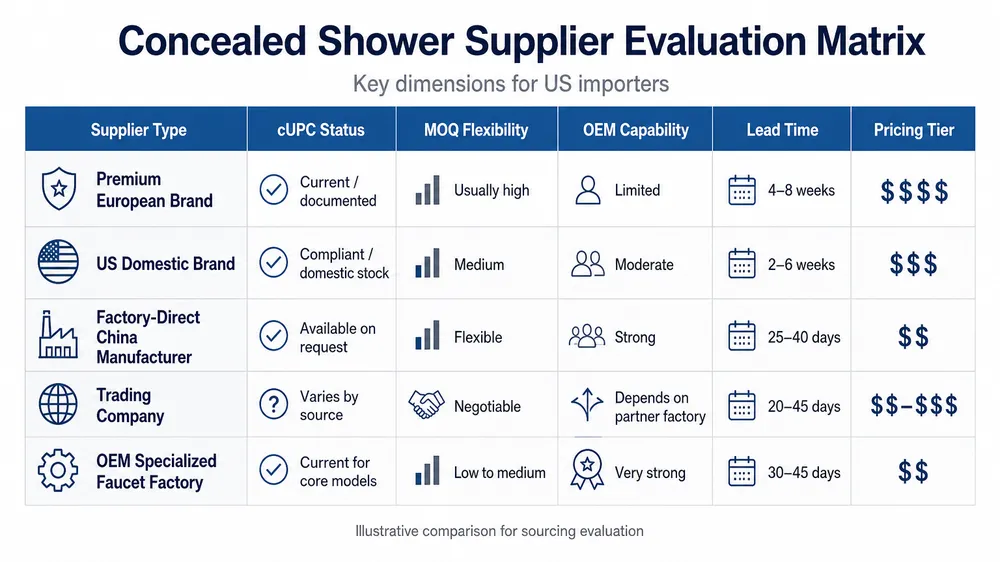
The 10 suppliers below cover a range of models — premium retail brands, domestic manufacturers, and factory-direct options. Before you read the list, here's the evaluation framework we use when a buyer asks us to benchmark their current sourcing against alternatives.
Five criteria that determine total landed cost and supply chain risk:
- cUPC documentation completeness: Certificate + IAPMO listing number + NSF 61 test report + material test data. All four, not just the certificate.
- Supplier model: Manufacturer vs. trading company vs. brand-only licensor. This determines whether you can get factory-level pricing, OEM capability, and direct QC access.
- MOQ and order flexibility: For concealed systems, MOQ matters more than for standard faucets because trim kits, rough-in valves, and accessories often need to be ordered as a set. A supplier with a 500-unit MOQ per SKU may require a 2,000-unit minimum order when you factor in the full system.
- Lead time to container loading: "4–6 weeks" is a common claim. Ask for the specific definition — is that from order confirmation, from deposit receipt, or from material procurement? The difference can be 2–3 weeks.
- OEM and finish capability: If you're building a private-label line or need a specific finish to match an existing product range, you need a supplier with in-house finishing. Subcontracted finishing means inconsistent color matching across batches and a second point of failure in your supply chain.
The 10 Suppliers: Model, Certification Posture, and Trade-Off Analysis
1. Grohe (grohe.com)
Grohe is a German brand now owned by LIXIL Group, with a strong retail and specification presence in the US market. Their concealed shower range — particularly the Grohtherm and Rapido series — is well-documented for cUPC compliance and carries genuine IAPMO listings. The engineering quality is real: thermostatic cartridge performance and trim kit fit tolerances are consistent.
The trade-off for importers is structural. Grohe operates through a distributor network in North America — you're buying from a regional distributor, not from a factory. That means distributor margin is baked into your cost, OEM and private-label options don't exist, and your pricing is fixed to the distributor's tier structure. For a buyer building a private-label concealed shower line or sourcing for a hotel fit-out project where margin matters, Grohe's pricing model doesn't work. Where it does work: specification projects where the architect or designer has called out Grohe by name, or where the brand recognition carries a retail premium your end customer will pay for.
2. Hansgrohe (hansgrohe.com)
Hansgrohe — the parent brand, distinct from Grohe despite the shared history — covers the premium and ultra-premium segment with their iBox universal rough-in body and the Raindance and ShowerSelect trim ranges. cUPC compliance is documented and current. The iBox system's universal rough-in body is a genuine engineering advantage for hotel and multi-unit residential projects: one rough-in body accepts multiple trim configurations, which simplifies procurement and reduces installation variation across a large project.
The pricing reality is the same as Grohe: distributor-only in North America, no OEM, no factory-direct access. Hansgrohe's positioning is explicitly premium — their concealed systems are priced for the specification market, not for volume import procurement. If your buyer is a luxury hotel brand or a high-end residential developer with a fixed spec, Hansgrohe belongs on the shortlist. If your buyer is a mid-market hotel chain or a distributor building a private-label line, the economics don't work.
3. Kohler (kohler.com)
Kohler is the largest US-headquartered plumbing brand and has a meaningful concealed shower offering through their DTV+ digital shower system and the Rite-Temp pressure-balance valve range. cUPC compliance is standard across their plumbing product lines. Kohler manufactures in the US and internationally, with distribution through their own showrooms and wholesale distribution network.
For US importers, Kohler presents a different kind of limitation: they are a brand, not a supplier. There is no OEM or private-label path, no factory-direct pricing, and no flexibility on product configuration beyond what's in their catalog. Their concealed shower range is also weighted toward the premium and digital-control segment, which carries a price point that limits the addressable market for volume distributors. Kohler is a strong option for specification sales into the premium residential and hospitality segment — it's not a sourcing option for importers building their own product line.
4. Delta Faucet (deltafaucet.com)
Delta is the volume leader in US residential faucets and has a growing in-wall shower offering through their MultiChoice Universal valve system. The MultiChoice rough-in body is a practical engineering choice for residential projects: one valve body accepts pressure-balance, thermostatic, and diverter trim, which reduces SKU complexity for distributors serving the residential new-construction market.
cUPC compliance is documented. Delta manufactures primarily in the US (Jackson, Tennessee) and sources components internationally. Like Kohler, Delta operates as a brand — no OEM, no private label, no factory-direct pricing. Their concealed shower range is narrower than the European brands and skews toward the residential mid-market rather than the hospitality specification segment. For a distributor serving residential plumbing contractors, Delta's brand recognition and parts availability are genuine advantages. For an importer building a private-label concealed shower line, Delta is not a sourcing option.
5. Moen (moen.com)
Moen's in-wall shower offering centers on the Posi-Temp and ExactTemp valve systems, with a broad trim kit catalog that covers the residential and light commercial segment. cUPC compliance is standard. Moen is owned by Fortune Brands Home & Security and manufactures in the US and internationally.
The sourcing model is the same as Delta and Kohler: brand-only, distributor-channel, no OEM access. Moen's strength for US distributors is parts availability and brand recognition in the residential market — their trim kits are stocked at most plumbing wholesale distributors, which matters for contractors who need same-day availability. For importers sourcing concealed systems for a private-label program or a hotel fit-out project where unit cost matters, Moen's channel structure adds cost without adding flexibility.
6. American Standard (americanstandard-us.com)
American Standard, now owned by LIXIL (the same parent as Grohe), has a concealed shower offering that covers the residential and light commercial segment. Their Town Square S and Spectra+ concealed valve systems carry cUPC compliance. American Standard's positioning sits below Grohe in the LIXIL portfolio — more accessible price point, broader distribution through home improvement retail and wholesale plumbing.
For importers, American Standard presents a similar structural limitation to the other US-distributed brands: no OEM, no factory-direct pricing, distributor margin in the cost stack. Their concealed shower range is narrower than Grohe or Hansgrohe, and the product development cadence is slower. Where American Standard has a practical advantage is in the residential replacement and renovation segment — their products are stocked at Home Depot and Lowe's, which matters for contractors who need immediate availability on a service call. That's a different buyer profile than an importer sourcing for a hotel project or a private-label program.
7. Symmons Industries (symmons.com)
Symmons is a US-based manufacturer focused on the commercial and institutional plumbing segment — hotels, healthcare facilities, multi-unit residential. Their Temptrol and Safetymix concealed valve systems are specified heavily in the hospitality and healthcare segments, where anti-scald performance and durability under high-cycle use are the primary requirements. cUPC compliance is documented and current.
Symmons is one of the few brands on this list that genuinely serves the commercial specification market rather than the residential retail market. Their concealed valve systems are engineered for high-cycle commercial use — the Temptrol valve has a documented service life that makes it a defensible specification for hotel procurement. The trade-off: Symmons operates through a rep and distributor network, pricing is not factory-direct, and OEM options don't exist. For a buyer sourcing for a hotel chain's standard specification, Symmons is a credible option. For a buyer building a private-label line or sourcing for cost-sensitive projects, the channel pricing structure is a constraint.
8. Rohl (rohl.com)
Rohl is a premium brand focused on the luxury residential and boutique hospitality segment, with a concealed shower offering that emphasizes Italian and European design aesthetics. Their Country and Palladian concealed shower systems carry cUPC compliance. Rohl is owned by Fortune Brands (the same parent as Moen) and distributes through luxury plumbing showrooms and specification channels.
The positioning is explicitly luxury — Rohl's concealed shower systems are priced for the high-end residential market where design differentiation commands a premium. For a distributor serving luxury residential developers or boutique hotel brands, Rohl's design catalog and brand positioning are genuine assets. For a volume importer or a buyer sourcing for mid-market hotel projects, Rohl's price point and distribution model are misaligned with the procurement objective.
9. Brizo (brizo.com)
Brizo is Delta's luxury sub-brand, positioned at the intersection of design and performance for the premium residential market. Their Sensori and MultiChoice concealed shower systems carry cUPC compliance and share Delta's underlying valve engineering — which means the mechanical reliability is solid. The design language is more fashion-forward than Delta's core range, targeting the luxury residential segment where the architect or interior designer is driving the specification.
Like Rohl, Brizo is a brand play rather than a sourcing option for importers. No OEM, no factory-direct pricing, distributor-only channel. The practical use case for Brizo in an import procurement context is narrow: if you're supplying a luxury residential developer who has specified Brizo by name, you're buying through the distributor at the distributor's price. There's no alternative sourcing path.
10. Wfaucet — Foshan DTE Sanitary Ware Co., Ltd (wfaucet.com)
Wfaucet is the export brand of Foshan DTE Sanitary Ware Co., Ltd, a dedicated faucet and sanitary ware manufacturer based in Danzao Town, Nanhai District, Foshan — the center of China's sanitary hardware manufacturing cluster. We've been running production here since 2008, and our concealed shower mixer and concealed thermostatic shower mixer lines have been part of our export catalog since 2013, when we completed our first cUPC certification for the North American market.
The factory model is different from every other supplier on this list. We are the manufacturer — not a brand licensing production to a contract factory, not a trading company aggregating product from multiple sources. The concealed shower assembly line is one of our 6 dedicated production lines in a 12,000 m² facility. When you order from us, you're ordering from the floor where the valve is assembled, tested, and packed.
cUPC compliance: Our cUPC certification covers the concealed valve body and wetted components under ASME A112.18.1 / CSA B125.1. The documentation package we provide with every North American shipment includes the cUPC certificate with current expiry, the IAPMO listing number, the NSF 61 test report for wetted components, and the XRF material test data for the brass alloy used in production. All four documents, every shipment, without being asked. We run XRF testing on incoming brass rod for every production batch — the lead content requirement under NSF 61 is non-negotiable, and we apply the same standard to all production regardless of destination market.
Cartridge endurance testing: Every production batch — not just new product introductions, not just samples — runs 500,000 open/close cycles on the cartridge assembly before the batch ships. We added this protocol after seeing early cartridge wear on a batch from a subcontracted cartridge supplier in 2019. We now require a 50,000-cycle pre-qualification test on any new cartridge supplier before they enter production, and we run the 500,000-cycle batch test as a standing QC requirement. The test report travels with the shipment documentation.
In-house surface finishing: Chrome, brushed nickel, matte black, PVD gold, and oil-rubbed bronze all run on our own finishing lines. PVD coating thickness runs 0.3–0.5μm with cross-cut adhesion testing on every batch. Chrome and brushed nickel go through a multi-layer electroplating stack — copper base, nickel mid-coat, chrome or brushed top coat. The nickel mid-coat is what gives the finish its corrosion resistance; skipping it is a common cost-cutting move in the industry, and it's why chrome faucets from some factories fail salt spray at 48 hours. Our chrome passes 24-hour salt spray as a minimum. For mixed-SKU orders covering multiple finishes, everything runs on our lines — no subcontracted finishing, no color-matching inconsistency between batches.
OEM from 200 pieces: MOQ for OEM concealed shower systems starts at 200 pieces per configuration. That's low enough to test a new SKU in your market before committing to a full container. For ODM projects — adapting an existing catalog item to your spec — we can turn around a modified sample in 15–20 days. For full OEM with new tooling, first sample in 25–35 days. We maintain an in-house tooling room for brass casting dies and CNC fixtures, so tooling revisions don't go to an outside vendor and add weeks to the timeline.
Lead time: 25–35 days from order confirmation to container loading for standard catalog items. That's a specific, contractual commitment — not "4–6 weeks" with an asterisk. For OEM orders with new tooling, 35–50 days.
Pricing tier: Factory-direct. No distributor margin, no brand premium. The price you pay is the factory price plus your freight and import costs. For buyers sourcing 500+ units per order on a repeat cycle, the landed cost difference versus buying through a US distributor is typically significant enough to change the margin structure of the product line.

The Cost of Convenience: When Local Distribution Makes Sense and When It Doesn't
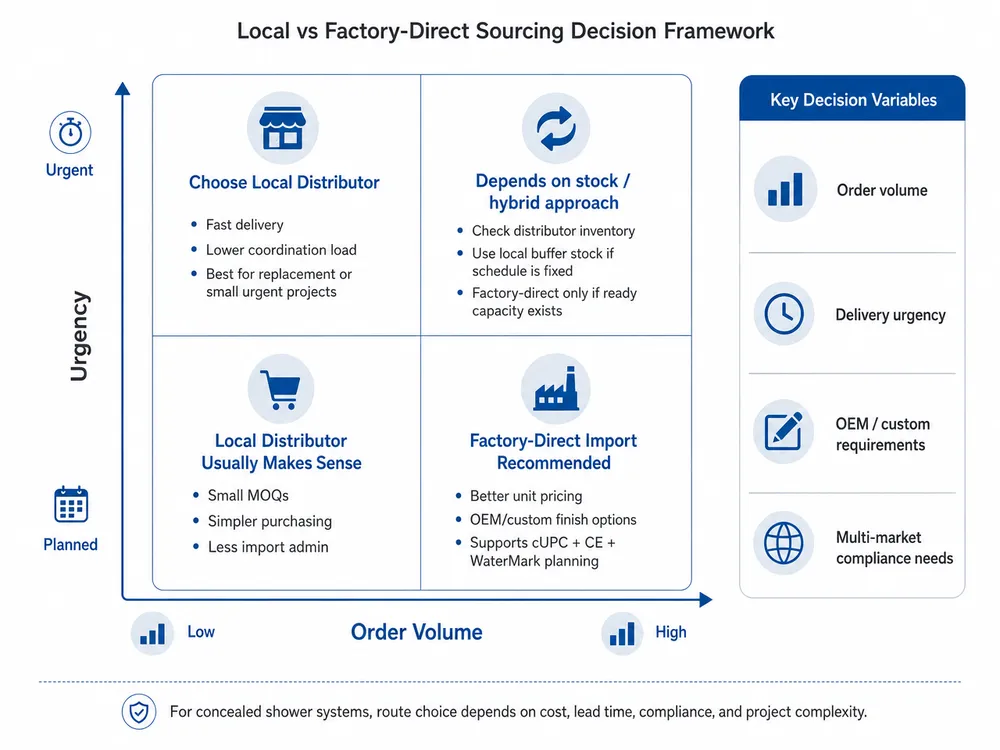
The nine brands above the Wfaucet entry all operate through US distribution networks. That's not a flaw — it's a deliberate model that serves specific buyer needs well. Before you decide whether factory-direct sourcing makes sense for your situation, it's worth being honest about when local distribution is the right answer.
Local distribution wins when:
- You need product in 5–10 business days for an urgent project or emergency replacement. No factory in China can compete with a distributor warehouse in your region on speed.
- Your order volume is too small to justify a container. A 50-unit order for a small hotel renovation doesn't make economic sense as a direct import — the per-unit freight cost eliminates the price advantage.
- Your customer has specified a brand by name and won't accept a substitution. If the architect's spec sheet says Hansgrohe iBox, you're buying Hansgrohe iBox.
- You need local warranty support and parts availability for a service-intensive account. US-based brands have parts stocked domestically; a factory in Foshan cannot provide same-day parts for a service call.
Factory-direct sourcing wins when:
- Your order volume is 500+ units per SKU on a repeat cycle. At that volume, the landed cost difference versus distributor pricing is typically 25–40%, depending on the product tier and the distributor's margin structure.
- You're building a private-label concealed shower line. None of the nine brands above offer OEM or private-label options. Factory-direct is the only path.
- You need finish options or configuration variants that aren't in a brand's standard catalog. A factory with in-house finishing can produce matte black or PVD gold at the same lead time as chrome; a distributor can only sell what the brand catalogs.
- You're sourcing for a hotel fit-out project where the specification is performance-based rather than brand-specific. If the spec says "cUPC-certified thermostatic concealed shower valve, anti-scald, 0.6 MPa rated," a factory-direct supplier who can document compliance is a legitimate alternative to a premium brand at 2× the unit cost.
- You're managing a multi-market product line that needs cUPC for North America, CE for Europe, and WaterMark for Australia from the same supplier. Managing three separate brand relationships to cover three markets adds procurement overhead that a single factory with multi-market certification eliminates.
(The multi-market certification point is one we hear about frequently from buyers who started with a European brand for their US business and then expanded to Australia — they end up managing two supplier relationships, two documentation packages, and two lead time commitments for what is essentially the same product. We hold cUPC, CE, and WaterMark under one roof.)
Verifying a Supplier's cUPC Certification Before You Commit
The IAPMO product directory at pld.iapmo.org is the authoritative source for cUPC certification verification. Any supplier claiming cUPC compliance should be able to give you a listing number you can look up directly. The listing will show the certified product model numbers, the certification scope (which standards are covered), and the certificate status (active or expired).
Three verification steps that take less than 10 minutes and protect you from a customs problem:
- Look up the IAPMO listing number the supplier provides. Confirm the certificate is active, not expired. Confirm the model number on the certificate matches the model number on the product you're ordering.
- Request the NSF 61 test report for the wetted components. This is separate from the cUPC certificate — it covers lead content in the brass alloy and any other wetted materials. A supplier who can't produce this document is either not compliant or doesn't understand what compliance requires.
- Ask for the material test data (XRF or ICP analysis) for the brass alloy used in production. This is the factory-level evidence that the incoming material meets the lead content standard. A certificate from a third-party lab is the right format — an internal test report without a lab stamp is not sufficient.
If a supplier provides all three without hesitation, their compliance posture is real. If they provide the certificate but stall on the NSF 61 report or the material data, treat that as a red flag. The documentation exists if the compliance is genuine.
Supplier Comparison: At a Glance
| Supplier | Type | cUPC Status | OEM Available | Pricing Tier | Best Fit |
|---|---|---|---|---|---|
| Grohe | Brand / Distributor | Active | No | Premium | Specification projects, brand-specified |
| Hansgrohe | Brand / Distributor | Active | No | Ultra-premium | Luxury specification, iBox universal rough-in |
| Kohler | Brand / Distributor | Active | No | Premium | Premium residential, digital shower |
| Delta Faucet | Brand / Distributor | Active | No | Mid-market | Residential new construction, contractor supply |
| Moen | Brand / Distributor | Active | No | Mid-market | Residential, parts availability priority |
| American Standard | Brand / Distributor | Active | No | Mid-market | Residential renovation, home improvement retail |
| Symmons | Brand / Distributor | Active | No | Commercial | Hotel, healthcare, high-cycle commercial |
| Rohl | Brand / Distributor | Active | No | Luxury | Luxury residential, boutique hospitality |
| Brizo | Brand / Distributor | Active | No | Luxury | Luxury residential, design specification |
| Wfaucet | Factory-Direct Manufacturer | Active + Full Docs | Yes, from 200 pcs | Factory-Direct | Private label, hotel fit-out, volume import |
Sourcing Route Decision Guide
The right supplier depends on your order profile, not on a ranking. Here's how the decision breaks down across the four most common buyer situations:
Urgent small orders (under 200 units, needed within 2 weeks): Buy from a US distributor. Grohe, Delta, Moen, and Symmons all have domestic stock. The per-unit cost is higher, but the speed and availability justify it. Factory-direct doesn't compete on this dimension.
Repeat volume procurement (500+ units per order, planned 60–90 days out): Factory-direct sourcing from a cUPC-certified manufacturer is the economically rational choice. The landed cost advantage at this volume is typically large enough to change the margin structure of the product line. Wfaucet's 25–35 day lead time to container loading fits a 60-day procurement cycle with room to spare.
Private-label or OEM concealed shower line: Factory-direct is the only path — none of the nine brand suppliers offer OEM or private-label options. MOQ from 200 pieces at Wfaucet means you can test a new SKU in your market before committing to a full container. Our Concealed Shower Mixers & Sets catalog covers pressure-balance and thermostatic configurations with multiple trim options.
Cost-sensitive hotel fit-out or multi-unit residential project: If the specification is performance-based (cUPC-certified, anti-scald, specific flow rate) rather than brand-specific, factory-direct sourcing at a documented compliance level is a legitimate alternative to premium brand pricing. The documentation package we provide — cUPC certificate, IAPMO listing, NSF 61 report, material test data — is the same standard your compliance team needs to clear the specification. The unit cost difference versus a premium brand through distribution is typically 40–60% on comparable performance specifications.
FAQ: Concealed Shower Sourcing for US Importers
What is the minimum order quantity for factory-direct concealed shower systems?
At Wfaucet, OEM concealed shower systems start at 200 pieces per configuration. For standard catalog items without customization, we can discuss smaller trial orders — contact us with your target SKU and volume and we'll advise on the most practical order structure. Most new buyers in this category start with a 200–500 unit trial order to test the product with their own customers before committing to a full container.
Does cUPC certification cover both pressure-balance and thermostatic concealed valves?
Yes, but the certification is model-specific — a cUPC certificate for a pressure-balance valve does not automatically cover a thermostatic valve, even from the same manufacturer. When you're verifying a supplier's compliance, confirm that the IAPMO listing covers the specific valve type and model number you're ordering. At Wfaucet, our cUPC certification covers both pressure-balance and thermostatic configurations in our concealed shower range — we can provide the listing numbers for each.
What rough-in depth do concealed shower valves typically require, and how does this affect project planning?
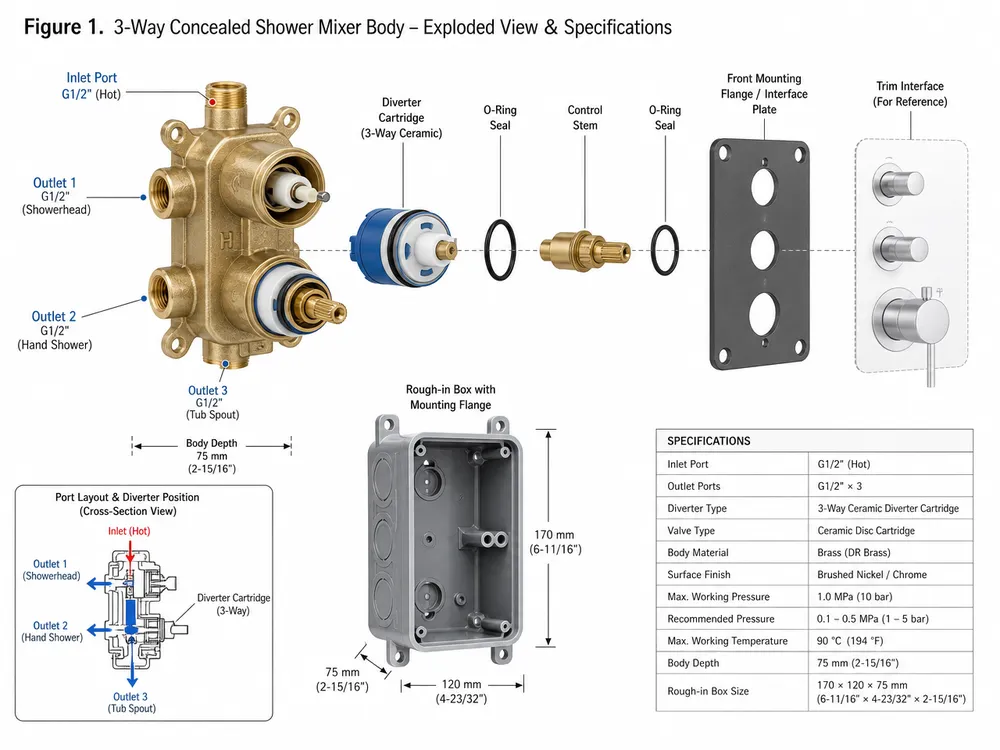
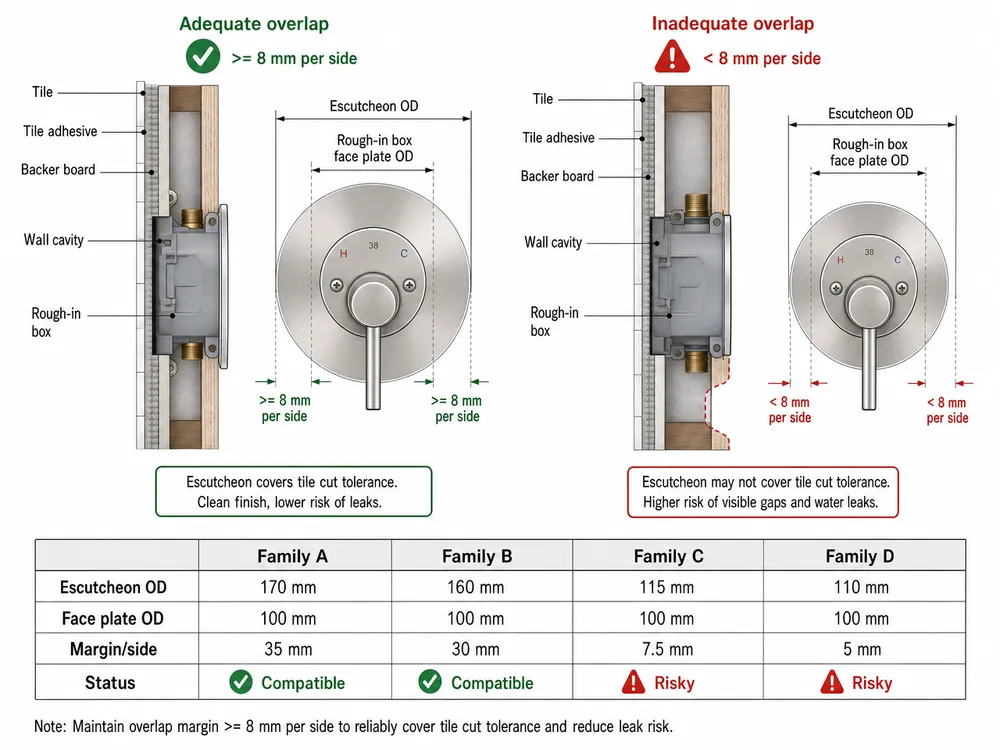
Standard concealed shower valves require a rough-in depth of 60–80mm from the finished wall surface to the valve centerline, though this varies by manufacturer and valve body design. This is the dimension that causes the most installation problems on projects — if the rough-in depth doesn't match the valve spec, the trim kit won't seat correctly against the wall, and fixing it after the wall is closed is expensive. Before specifying a concealed valve for a project, confirm the rough-in depth against the wall construction detail. We provide rough-in dimension drawings with every product inquiry — a rough-in error on a concealed system costs more to fix than the valve itself.
How do I compare factory-direct landed cost against US distributor pricing?
The calculation has four components: factory price + ocean freight (typically $0.80–1.20/kg for FCL from Foshan to a US West Coast port) + import duty (currently 0% for most plumbing valves under HTS 8481.80) + customs clearance and inland freight. For a 500-unit order of concealed shower valves, the total landed cost from a Foshan factory is typically 30–45% below the equivalent US distributor price for comparable specification product. The exact number depends on your freight forwarder's rates and your specific product mix — we can provide a detailed landed cost estimate with any quotation.
What finish options are available for OEM concealed shower systems, and can finishes be mixed in one order?
We run five finishes in-house: chrome, brushed nickel, matte black, PVD gold, and oil-rubbed bronze. Mixed-finish orders are standard — we regularly ship containers with multiple finish variants in the same order. Because all finishing runs on our own lines, color consistency across finishes and across batches is controlled by one team. Minimum per-finish quantity for OEM orders is 200 pieces; below that, the finishing line changeover cost doesn't make sense for either side.
What lead time should I plan for concealed shower valve imports from China?
For standard catalog items at Wfaucet, 25–35 days from order confirmation to container loading. Add ocean transit time (14–18 days to US West Coast, 25–30 days to US East Coast) and customs clearance (3–7 business days with pre-filed documentation). Total door-to-door for a planned order is typically 45–65 days. For OEM orders with new tooling, add 10–15 days to the production lead time. Build your procurement cycle around a 60-day planning horizon and you'll have buffer for normal variation.
The concealed shower supplier landscape in the US is well-served at the premium and mid-market brand level — Grohe, Hansgrohe, Kohler, Delta, Moen, Symmons, and the others on this list are real companies with real products and real cUPC compliance. The question isn't whether they're credible. The question is whether their sourcing model fits your procurement objective.
If you're building a private-label concealed shower line, sourcing for a hotel fit-out project where unit cost matters, or managing a multi-market product range that needs cUPC, CE, and WaterMark from one supplier, the factory-direct model is worth a serious evaluation. Send us your target configuration — pressure-balance or thermostatic, finish requirements, annual volume, and destination market — and we'll come back with factory-direct pricing, the full cUPC documentation package, and a landed cost estimate your freight forwarder can work from. Request a quote here.