

A rough-in error on a concealed system costs more to fix than the valve itself. That's not a warning I give lightly — it's the single most expensive sourcing mistake we see in hotel fit-out and residential project procurement, and it almost always traces back to incomplete spec documentation at the RFQ stage.
This article covers the full technical specification picture for 3-way concealed shower mixers: body dimensions, port sizing, pressure ratings, outlet sequencing behavior, diverter mechanism types, pressure drop per outlet, rough-in requirements, and certification relevance by destination market. If you're sourcing for a project or building a product line, this is the spec reference you need before the wall closes.

Core Specification Parameters for 3-Way Concealed Shower Mixer Bodies
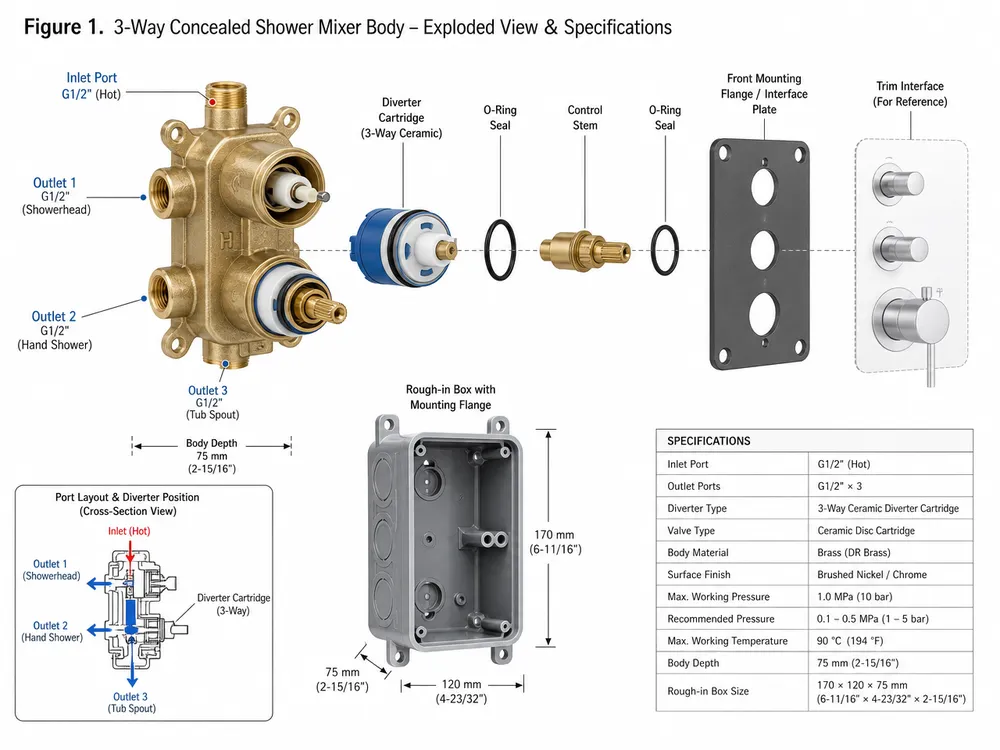
Before getting into sequencing behavior and pressure drop, here's the baseline spec table. These are the parameters that belong in every RFQ for a 3-way concealed mixer — and the ones most commonly missing from competitor datasheets.
| Parameter | Typical Specification |
|---|---|
| Body material | Brass (C36000-equivalent free-machining alloy) |
| Inlet port size | G1/2" (BSP) or 1/2" NPT |
| Outlet port size | G1/2" (BSP) or 1/2" NPT per outlet |
| Number of outlets | 3 (sequential or simultaneous, depending on configuration) |
| Max working pressure | 1.0 MPa (10 bar) |
| Min working pressure | 0.05 MPa (0.5 bar) |
| Operating temperature range | 0–90°C |
| Flow rate per outlet (at 0.3 MPa) | 12–18 L/min (varies by outlet port diameter and diverter type) |
| Rough-in body depth | 65–90 mm (wall cavity requirement) |
| Trim plate coverage | 150–180 mm diameter (varies by trim kit) |
| Diverter type | Ceramic disc (standard) or ball diverter (economy) |
| Cycle rating | 500,000 cycles (ceramic disc) |
A few notes on these numbers. The G1/2" inlet is standard for most European and Australian projects; North American projects often specify 1/2" NPT, and that thread conversion needs to be confirmed at RFQ, not discovered at installation. The 0.05 MPa minimum working pressure is the floor — below that, the diverter seal may not seat fully, and you get cross-flow between outlets. We've seen this cause callbacks on low-pressure gravity-fed systems where the installer assumed the valve would compensate.
What "3-Way" Actually Means: Body Construction and Port Logic
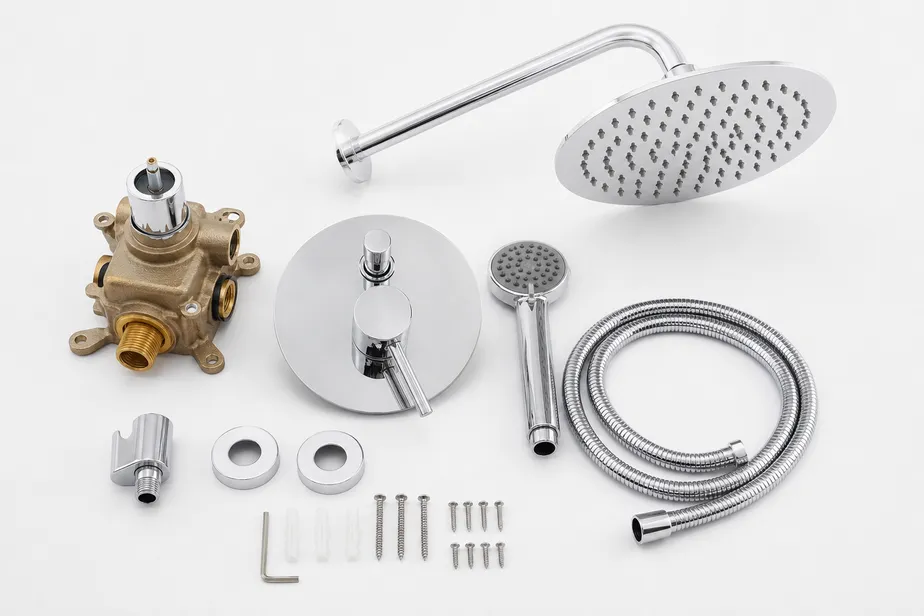
A 3-way concealed shower mixer has one cold inlet, one hot inlet, and three outlet ports controlled by a diverter mechanism. The mixing function (temperature control) and the diverting function (outlet selection) are handled by separate cartridges within the same body — this is the key structural difference from a 2-way mixer, which has the same mixing cartridge but only two outlet ports.
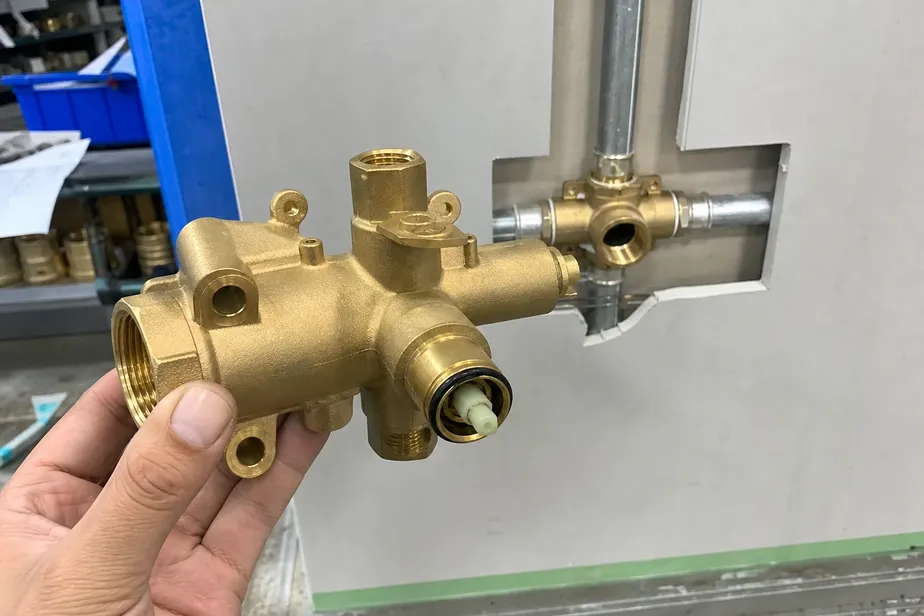
The body is a single brass casting with machined port interfaces. Ours are cast from C36000-equivalent free-machining brass and CNC-machined at the valve seat interfaces to ±0.05mm tolerance. That tolerance is what determines whether the diverter seals cleanly between outlet cycles — a loose seat lets water bleed through to a closed outlet, which shows up as a drip from the showerhead when the body jet is running.
The three outlet ports are typically arranged in a fixed geometric pattern on the body casting. Standard configurations place outlets at 120° spacing around the body axis, or in a linear array for wall-mounted trim kits. (Port positioning is one of the OEM customization parameters we handle most often — hotel fit-out projects frequently have specific outlet spacing requirements driven by the trim plate design, and we can adjust the casting geometry from 200 pieces.)
For a comparison of 2-way vs. 3-way body configurations and when each applies to your project type, see our 2-Way vs 3-Way Concealed Shower Mixer reference.
Outlet Sequencing: Sequential vs. Simultaneous Operation
This is the specification point most competitor datasheets skip entirely, and it's the one that causes the most project-level confusion.
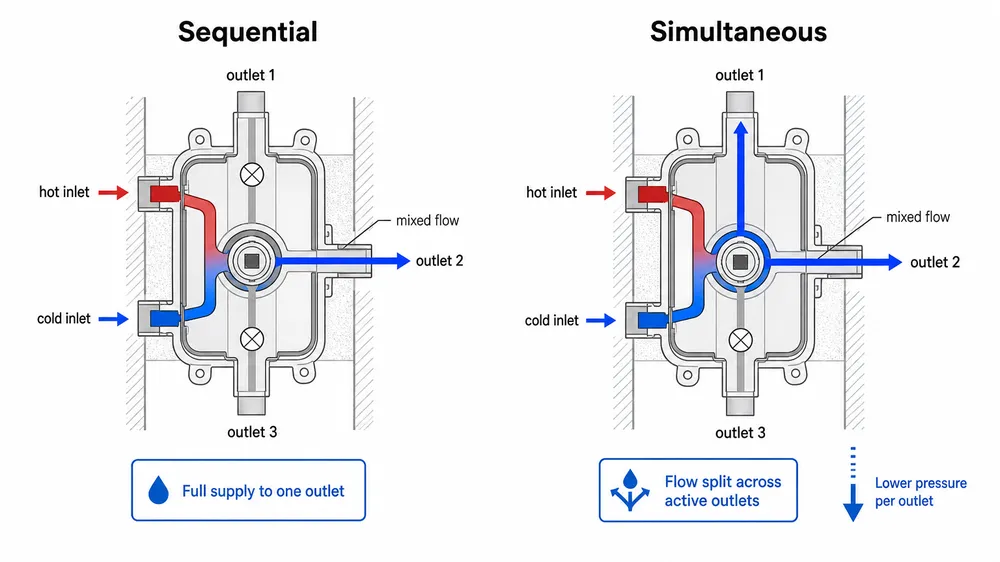
Sequential operation means only one outlet is active at a time. The diverter routes flow to outlet 1, outlet 2, or outlet 3 — never two simultaneously. This is the standard configuration for most residential and hospitality applications: overhead rain shower, body jets, and handheld, with the user selecting one at a time via the diverter handle.
Simultaneous operation means two or more outlets can run concurrently. This requires a different internal valve architecture — instead of a single diverter cartridge that routes flow, the body uses individual flow control valves per outlet, or a multi-position diverter that allows combined positions. Simultaneous configurations are specified for spa and wellness installations where overhead and body jets run together, and for commercial shower panels where multiple spray zones activate at once.
The distinction matters for your supply pressure calculation. A sequential 3-way body draws full flow through one outlet at a time, so your supply pressure requirement is based on single-outlet flow demand. A simultaneous configuration splits supply pressure across active outlets — if your supply is 0.3 MPa and you're running two outlets simultaneously, each outlet sees less than 0.3 MPa minus the pressure drop through the body. We'll cover the pressure drop math in the next section.
| Configuration | Outlets Active | Typical Application | Supply Pressure Requirement |
|---|---|---|---|
| Sequential (standard) | 1 at a time | Residential, hotel rooms | 0.1–1.0 MPa |
| Simultaneous (2-outlet) | 2 concurrent | Spa suites, wellness rooms | 0.2–1.0 MPa |
| Simultaneous (3-outlet) | 3 concurrent | Commercial shower panels | 0.3–1.0 MPa |
Most of the 3-way concealed mixers we produce for hotel fit-out projects are sequential. The simultaneous configurations come up in spa and wellness procurement, and they require a separate body casting with a different internal valve layout — they're not a firmware switch on the same body. Confirm which configuration your project requires before the RFQ, because the body casting is different.
Diverter Function Mechanics: Ceramic Disc vs. Ball Diverter
The diverter cartridge is the component that determines long-term seal reliability across outlet cycles. Two types are in common use:
Ceramic disc diverter uses two precision-ground ceramic discs — one fixed, one rotating — to open and close outlet ports. The ceramic-on-ceramic interface is self-lubricating and dimensionally stable across temperature cycles. Our ceramic disc diverters are rated to 500,000 cycles, and we test every production batch at that rating, not just new product introductions. For a hotel project running 10 outlet switches per room per day, 500,000 cycles is roughly 137 years of operation — the valve will outlast the renovation cycle.
Ball diverter uses a brass or stainless ball with drilled ports, rotated by the handle to align with outlet openings. Ball diverters are lower cost and simpler to manufacture, but the elastomeric O-ring seals that create the outlet seal degrade faster under thermal cycling and chlorinated water exposure. In our testing, ball diverter assemblies typically show measurable seal degradation at 100,000–150,000 cycles under hot water conditions. For residential applications with lower cycle frequency, that's still years of service. For commercial hospitality, the ceramic disc is the right specification.
The cycle rating difference has a direct commercial implication: a hotel property that specifies ball diverters to save $3–5 per valve on a 200-room fit-out will likely face maintenance callbacks within 5–7 years. The ceramic disc option costs more upfront and reduces that risk. We make both — the choice depends on your project type and your buyer's risk tolerance.
(One thing we check on every incoming ceramic disc cartridge batch: flatness of the disc faces. A disc that's out of flat by more than 0.01mm will leak under pressure even if the cycle count is fine. We've had two cartridge suppliers over the years who passed dimensional specs on paper but showed early leakage in our pressure testing — both were removed from the approved supplier list.)
| Diverter Type | Seal Mechanism | Cycle Rating | Best Application | Cost Position |
|---|---|---|---|---|
| Ceramic disc | Ceramic-on-ceramic | 500,000 cycles | Hotel, commercial, high-frequency | Higher |
| Ball diverter | Elastomeric O-ring | 100,000–150,000 cycles | Residential, low-frequency | Lower |
Pressure Drop Across Outlet Ports: What the Numbers Mean for Your System
Pressure drop is the specification most commonly absent from concealed mixer datasheets, and it's the one that causes the most field performance complaints.
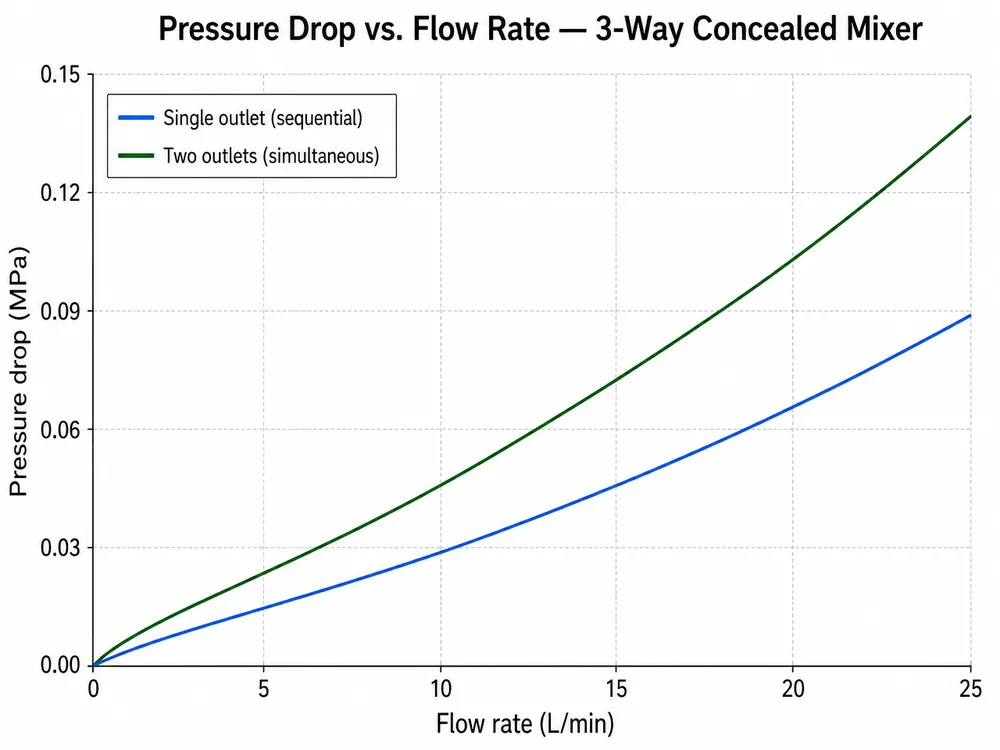
Every time water flows through the mixer body — through the inlet ports, across the mixing cartridge, through the diverter, and out the outlet port — it loses pressure. That pressure loss is the pressure drop, and it determines the actual dynamic pressure available at your showerhead or body jet.
For a typical 3-way concealed mixer body at rated flow:
| Flow Condition | Pressure Drop (typical) |
|---|---|
| Through mixing cartridge only | 0.02–0.04 MPa |
| Through diverter cartridge | 0.01–0.03 MPa |
| Through outlet port (G1/2") | 0.005–0.01 MPa |
| Total body pressure drop (single outlet, 12 L/min) | 0.03–0.07 MPa |
| Total body pressure drop (single outlet, 18 L/min) | 0.06–0.12 MPa |
These are typical ranges for a well-machined brass body with G1/2" ports. The actual pressure drop for a specific body depends on port diameter, internal passage geometry, and cartridge design. A body with undersized internal passages — common in lower-cost castings where the core geometry isn't tightly controlled — can show pressure drops 30–50% higher than these figures.
The practical implication: if your supply pressure is 0.2 MPa and your showerhead requires 0.1 MPa minimum to operate correctly, you have 0.1 MPa of budget for the entire pipe run plus the mixer body. A body with 0.07 MPa pressure drop at your target flow rate leaves you 0.03 MPa for the pipe run — which may not be enough depending on pipe length and diameter. This calculation needs to happen at the design stage, not after the wall is closed.
For simultaneous outlet operation, the pressure drop compounds. Running two outlets simultaneously at 12 L/min each means the body is passing 24 L/min total — and the pressure drop through the mixing cartridge and inlet passages scales with total flow, not per-outlet flow. The per-outlet pressure available drops accordingly.
Minimum supply pressure recommendations by configuration:
- Sequential, single outlet active: 0.15 MPa minimum at the mixer inlet
- Simultaneous, two outlets active: 0.25 MPa minimum at the mixer inlet
- Simultaneous, three outlets active: 0.35 MPa minimum at the mixer inlet
These are conservative minimums for acceptable shower performance. For hotel projects where guest experience is the commercial concern, we recommend targeting 0.3 MPa at the mixer inlet for sequential configurations and 0.4 MPa for simultaneous.
Rough-In and Wall Cavity Requirements
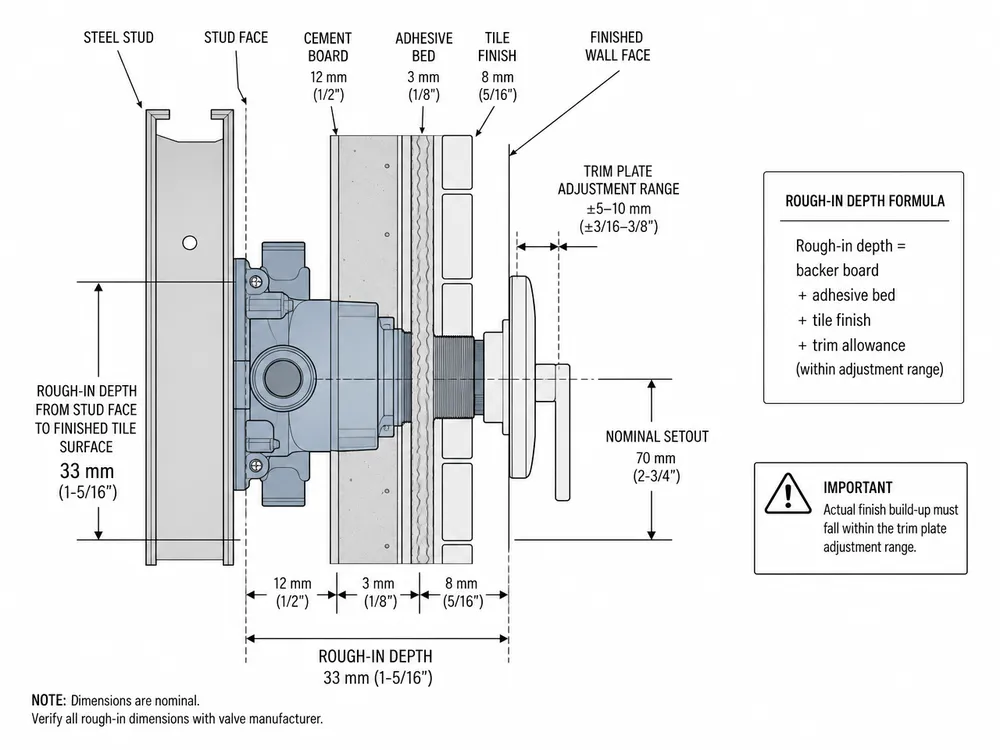
This is where concealed system projects most often go wrong. The rough-in body needs to fit inside the wall cavity before the tile goes on — and the wall cavity depth is determined by the structural framing, not by the plumber's preference.
Standard rough-in depth for a 3-way concealed mixer body is 65–90 mm from the finished wall face to the back of the rough-in box. The variation within that range depends on body design: a body with a deeper mixing cartridge stack will require more depth. Our standard 3-way body fits in a 70 mm cavity, which accommodates most timber-framed and steel-stud construction with standard 90 mm stud depth.
| Wall Construction Type | Typical Cavity Depth | Compatibility |
|---|---|---|
| Timber stud (90 mm) + 12 mm tile backer | 78 mm usable | Compatible with 70 mm body |
| Steel stud (64 mm) + 12 mm tile backer | 52 mm usable | Requires slim-body variant (≤50 mm) |
| Concrete/masonry chase | 80–120 mm (cut to spec) | Compatible with standard body |
| Double-stud partition | 140+ mm | Compatible, may need extension sleeve |
The steel stud scenario is the one that generates the most callbacks. A 64 mm steel stud with tile backer leaves 52 mm of usable depth — a standard 70 mm body won't fit. If your project uses steel stud framing (common in commercial construction and apartment fit-outs), confirm the rough-in depth before ordering. We produce a slim-body variant at 50 mm depth for exactly this application.
Additional rough-in parameters to confirm at RFQ:
- Service access panel: minimum 200 × 200 mm recommended for cartridge replacement without tile removal
- Inlet connection orientation: standard is rear-entry (both hot and cold from behind the wall); side-entry is available as an OEM option
- Outlet connection orientation: standard is front-face outlets; bottom-exit is available for specific trim kit configurations
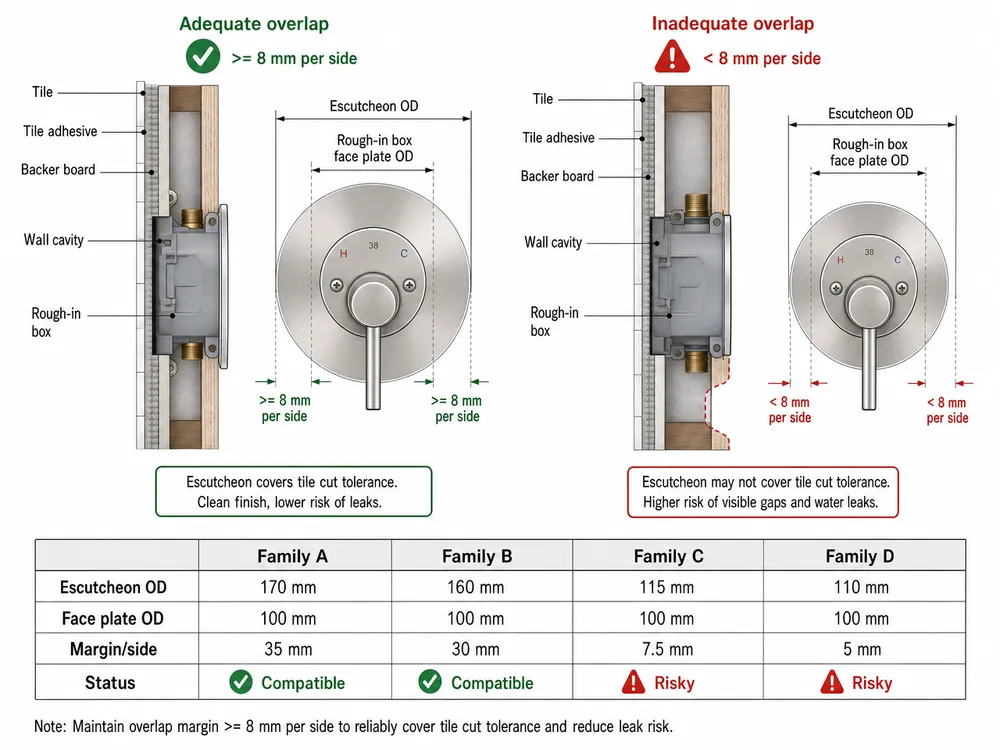
- Trim plate overlap: the trim plate must cover the rough-in box opening plus a minimum 10 mm overlap on all sides for a clean finish
(We've seen projects where the architect specified a trim plate that was 5 mm too small to cover the rough-in opening after tile was set. The fix required either re-tiling or a custom trim plate — both expensive. We now include a trim plate coverage check in our project documentation package.)
Compliance Certification by Destination Market
For export procurement, the certification on the valve body determines whether your shipment clears customs and whether the product can be legally installed in the destination market. Three certifications cover the major markets:
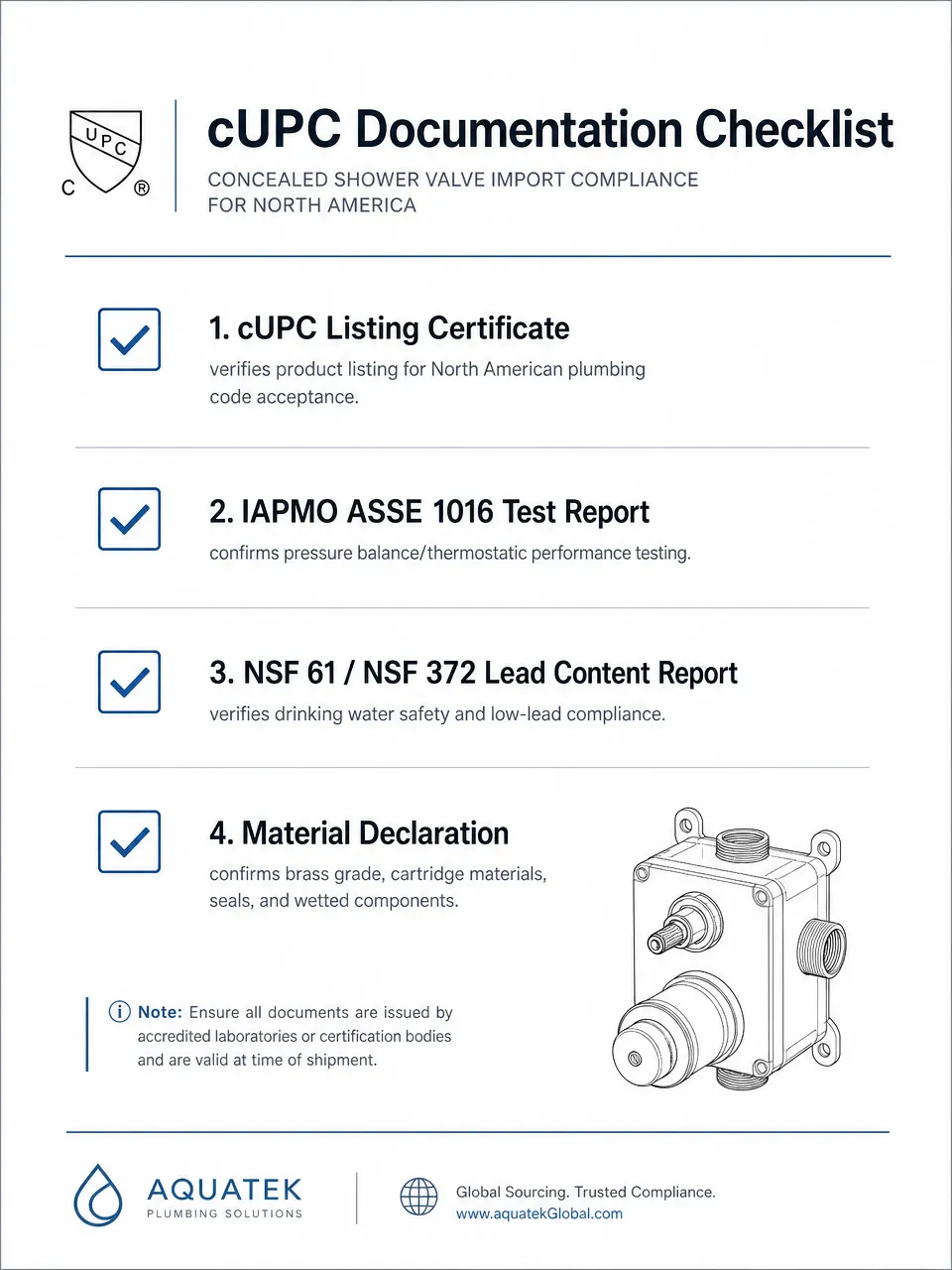
cUPC (North America) — Required for plumbing fixtures sold into the US and Canadian markets under the Uniform Plumbing Code. cUPC certification covers lead content (NSF 61/372 compliance), pressure performance, and flow rate. Our 3-way concealed mixer bodies are cUPC certified, and the test reports travel with every North American shipment. The lead content requirement is the most operationally demanding part of cUPC — it requires the brass alloy to meet NSF 372 low-lead standards, which we maintain across all production regardless of destination market.
CE (Europe) — The CE mark for sanitary fittings covers the Construction Products Regulation (CPR) requirements and, for water contact materials, the European Drinking Water Directive. CE certification for concealed mixers covers pressure performance, flow rate, and material safety. Our CE documentation covers the EU market and is accepted in most European export markets.
WaterMark (Australia) — WaterMark is the Australian mandatory certification for plumbing products, administered by the Australian Building Codes Board. It covers performance, materials, and installation requirements under AS/NZS standards. Our WaterMark certification covers the Australian and New Zealand markets.
| Market | Required Certification | Key Technical Requirements |
|---|---|---|
| USA / Canada | cUPC (NSF 61/372) | Lead ≤0.25% weighted average, pressure performance, flow rate |
| European Union | CE (CPR + DWD) | Material safety, pressure performance, flow rate |
| Australia / NZ | WaterMark (AS/NZS) | Performance, materials, installation compliance |
| UK (post-Brexit) | WRAS (Water Regulations Advisory Scheme) | Material safety, backflow prevention |
| Middle East / Southeast Asia | Often CE accepted; confirm per country | Varies by jurisdiction |
We hold cUPC, CE, and WaterMark under one roof, so a buyer sourcing for North American, European, and Australian distribution can clear all three markets from a single factory relationship. That matters operationally — managing certification documentation across two or three suppliers for the same product category adds compliance overhead that compounds across every shipment.
For UK projects post-Brexit, WRAS approval is the relevant certification. We can provide WRAS-compliant product on request — confirm at RFQ stage so we can include the appropriate documentation in your shipment package.
OEM Customization Scope: What You Can Specify Without Volume Penalties
Most large factories treat OEM customization as a high-MOQ service — you need 5,000 or 10,000 pieces before they'll adjust the casting geometry or change the outlet port layout. We run OEM from 200 pieces with in-house tooling, which means the customization parameters below are accessible at market-test volumes.
What can be customized on a 3-way concealed mixer body:
- Outlet port positioning: spacing, angular arrangement, and exit orientation (front-face, bottom-exit, side-exit)
- Inlet connection type: G1/2" BSP, 1/2" NPT, or 3/4" for higher-flow applications
- Rough-in body depth: standard 70 mm, slim 50 mm, or extended depth for specific wall constructions
- Handle torque: the resistance feel of the diverter handle can be adjusted within the cartridge design — lighter for elderly care applications, firmer for high-traffic commercial use
- Trim kit compatibility: we can machine the rough-in box interface to match your existing trim kit footprint, so your concealed body works with trim you're already distributing
- Private label packaging: full OEM packaging with your brand, including installation instructions in your target market language
The outlet port positioning customization is the one that comes up most in hotel fit-out procurement. Architects specify trim plate designs with fixed outlet positions, and the rough-in body needs to match. We've done this for buyers in the Middle East and Southeast Asia where the trim plate design was already committed before the valve body was sourced — the casting adjustment takes 15–20 days for tooling modification, and the first sample ships within 25–35 days of design confirmation.
For buyers building a concealed shower system product line, the trim kit compatibility customization is worth discussing early. If you're already distributing a trim kit from another supplier, we can often adapt our rough-in body to work with it — which means you're adding a concealed body SKU to your line without forcing your customers to change their trim kit preference.
See our full 3 Way Concealed Shower Mixers product range for standard configurations available for immediate sampling.
How to Specify a 3-Way Concealed Mixer: What Belongs in Your RFQ
The most common RFQ gap we see is a buyer specifying "3-way concealed mixer" without the parameters that actually determine which body they need. Here's what a complete RFQ specification looks like:
Required parameters:
- Outlet configuration: sequential or simultaneous; if simultaneous, how many outlets concurrent
- Inlet/outlet port thread standard: G1/2" BSP or 1/2" NPT (confirm for destination market)
- Max working pressure: confirm your supply system's maximum — this affects cartridge selection
- Minimum supply pressure: confirm your system's minimum — this determines whether the valve will perform correctly
- Wall cavity depth: measure the available depth from finished wall face to back of cavity
- Diverter type: ceramic disc (commercial/hospitality) or ball diverter (residential/cost-sensitive)
- Destination market: determines which certification documentation ships with the order
- Annual volume: determines whether standard catalog or OEM customization is the right path
- Finish: chrome, brushed nickel, matte black, PVD gold, or oil-rubbed bronze
Documents to request from any supplier:
- Pressure test report (leak test at rated pressure, minimum 0.6 MPa for 60 seconds)
- Endurance test report (cycle count and test conditions)
- Certification documentation (cUPC, CE, WaterMark as applicable)
- Dimensional drawing with rough-in depth and port positions
- Material declaration (brass alloy grade and lead content for cUPC markets)
The dimensional drawing is the one most buyers forget to request until after the order is placed. A supplier who can't provide a dimensioned rough-in drawing before you commit is a supplier whose product may not fit your wall cavity. Get the drawing first.
For buyers sourcing across multiple destination markets, the certification documentation request is worth making explicit in the RFQ. Ask for the actual test reports, not just a statement that the product is certified — the test reports are what your customs broker and compliance team need, and a supplier who can't produce them quickly is a supplier whose certification may not be current.
Browse our full Concealed Shower Mixers & Sets range or Request Quote with your project specifications — include outlet configuration, wall cavity depth, destination market, and annual volume, and we'll respond with a detailed quote and, where relevant, a recommendation on body configuration or OEM adaptation scope.
Frequently Asked Questions
Can a 3-way concealed mixer be converted from sequential to simultaneous operation in the field?
No. Sequential and simultaneous configurations use different internal valve architectures — the body casting and cartridge assembly are different components. This is not a field adjustment. The configuration must be specified at the RFQ stage. If your project requirements change after the order is placed, the body needs to be replaced, not modified.
What is the minimum wall cavity depth for a 3-way concealed mixer?
Standard bodies require 65–70 mm from the finished wall face to the back of the cavity. Slim-body variants are available at 50 mm for steel stud construction. Below 50 mm, a surface-mounted valve is the practical alternative — a concealed body physically cannot fit in a shallower cavity.
Does the pressure drop specification change if I use a thermostatic cartridge instead of a manual mixing cartridge?
Yes. Thermostatic cartridges have a more complex internal geometry than manual mixing cartridges, and they typically add 0.02–0.04 MPa to the total body pressure drop. If you're specifying a thermostatic 3-way body, add that increment to the pressure drop figures in this article and recalculate your minimum supply pressure requirement.
How do I verify that a supplier's cUPC certification covers the specific body I'm ordering, not just a different product in their range?
Request the cUPC certificate and cross-reference the model number on the certificate against the model number on your order. cUPC certification is product-specific — a certificate for one body model does not cover a different body, even from the same manufacturer. If the model numbers don't match, the product is not certified for your order.
What's the typical lead time for an OEM 3-way concealed mixer with custom outlet port positioning?
Tooling modification for outlet port repositioning takes 15–20 days. First sample ships within 25–35 days of design confirmation. Production lead time after sample approval is 25–35 days for standard volumes. Total timeline from design brief to first production shipment is typically 50–70 days, depending on sample revision rounds.
Is a 3-way concealed mixer suitable for gravity-fed (low-pressure) systems?
Sequential configurations can operate at 0.05 MPa minimum, which covers most gravity-fed systems. However, at low supply pressure, flow rate per outlet will be significantly below the rated figures — expect 6–8 L/min rather than 12–18 L/min. Simultaneous configurations are not recommended for gravity-fed systems; the pressure split across active outlets will result in inadequate flow at each outlet. Confirm your supply pressure before specifying a simultaneous body for a low-pressure application.