

The grade question comes up in almost every stainless steel faucet sourcing conversation we have. A buyer specifies "stainless steel" on their RFQ, the factory quotes 304, and somewhere downstream — after the container has landed and the product has been in the field for 18 months — pitting shows up around the spout base in a coastal hotel installation or a hard water market. The return claim lands on the importer's desk, and the conversation about grade starts too late.
This article is for buyers who want to have that conversation at the spec stage, not after the fact. We'll cover what separates 304 from 316 at the chemistry level, how that difference plays out in hard water and chlorinated municipal supply, when the cost premium for 316 is justified and when it isn't, and what to put in your sourcing brief so the factory you're working with can't substitute one for the other without your knowledge.
The Chemistry That Separates 304 from 316
Both grades are austenitic stainless steels — same crystal structure, similar machinability, both non-magnetic in the annealed state. The difference that matters for faucet applications is a single alloying element: molybdenum.
316 contains 2–3% molybdenum. 304 contains none.
That molybdenum addition is what earns 316 its "marine grade" designation. It stabilizes the passive oxide layer on the steel surface against chloride ion attack — the specific corrosion mechanism that causes pitting in bathroom environments. Everything else about the two grades is close enough that the distinction rarely matters for structural or machining purposes. For corrosion resistance in wet, chloride-containing environments, it's the only thing that matters.
| Property | 304 (SUS304 / 1.4301) | 316 (SUS316 / 1.4401) |
|---|---|---|
| Chromium (Cr%) | 18–20% | 16–18% |
| Nickel (Ni%) | 8–10.5% | 10–14% |
| Molybdenum (Mo%) | 0% | 2–3% |
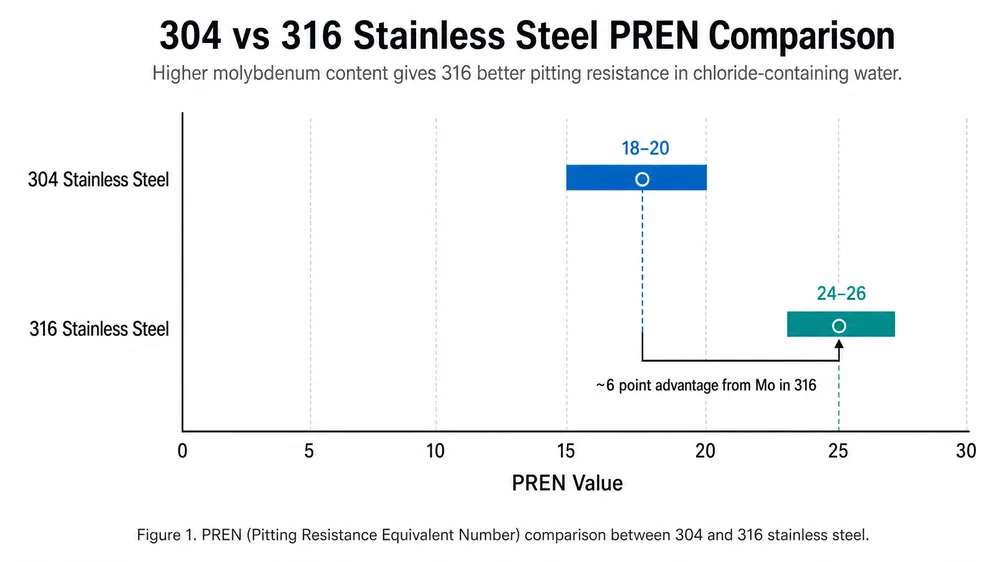
| PREN (typical) | ~18–20 | ~24–26 |
| Tensile strength (typical) | 515–620 MPa | 515–620 MPa |
| Yield strength (typical) | 205–310 MPa | 205–310 MPa |
| AISI designation | 304 | 316 |
| JIS designation | SUS304 | SUS316 |
| EN designation | 1.4301 | 1.4401 |
The PREN column is the one to focus on. PREN — Pitting Resistance Equivalent Number — is calculated as: Cr% + 3.3 × Mo% + 16 × N%. For 304, with no molybdenum, PREN sits around 18–20. For 316, the 2–3% Mo contribution pushes PREN to roughly 24–26. That 6-point gap is the quantified difference in chloride pitting resistance between the two grades.
Tensile and yield strength are essentially identical between the two grades — so if a buyer is specifying 316 for structural reasons on a faucet body, that's over-specification. The case for 316 is entirely about corrosion resistance, and specifically about chloride pitting.
How Hard Water and Chlorinated Supply Attack Stainless Steel Faucets
Hard water and chloride attack are two separate mechanisms, and they interact in ways that make the grade decision more nuanced than a simple "harder water = use 316" rule.
Hard water scaling — calcium and magnesium carbonate deposits — is primarily a surface problem. Scale builds up on the faucet body and around the spout outlet, and if left unaddressed, it traps moisture against the steel surface. On its own, scale doesn't cause pitting in 304. The problem is what's dissolved in the water alongside the calcium and magnesium.
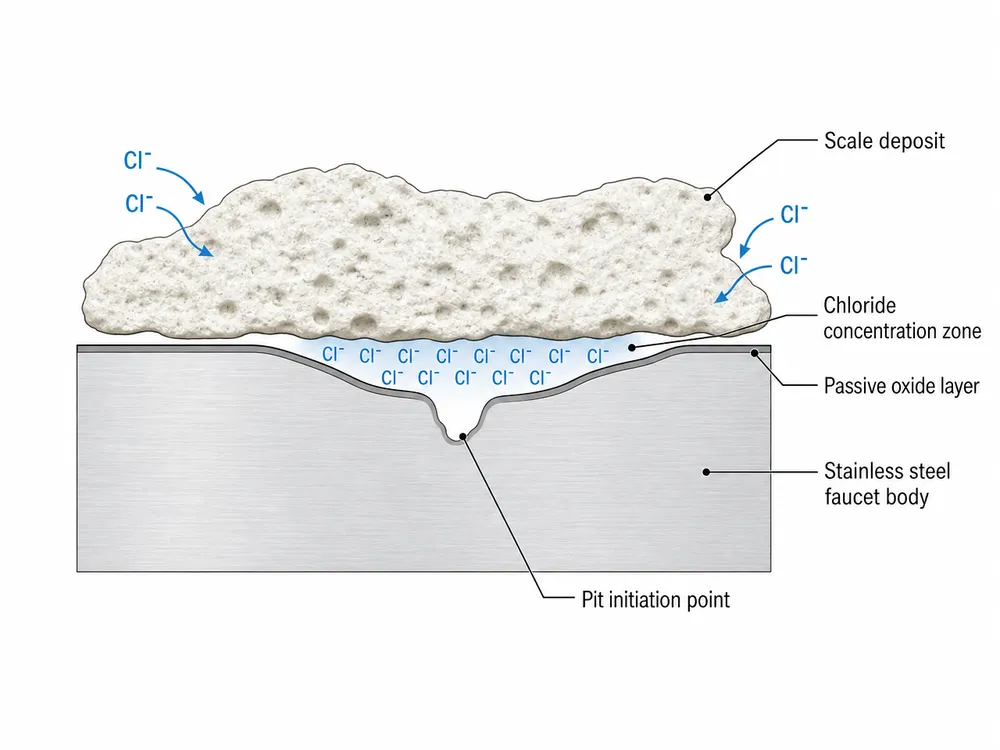
Chloride ion attack is the actual corrosion mechanism. Municipal water treatment uses chlorine or chloramines to disinfect supply, and both break down to release chloride ions. Chloride ions are small enough to penetrate the passive chromium oxide layer on stainless steel surfaces, particularly at grain boundaries and surface defects. Once the passive layer is breached, pitting initiates — and pitting is autocatalytic, meaning once it starts, the chemistry inside the pit accelerates further attack.
The combination of hard water and chlorinated supply is worse than either alone. Scale deposits create crevices where chloride-rich water concentrates and stagnates. The local chloride concentration inside a scale crevice can be significantly higher than the bulk water chemistry — high enough to initiate pitting on 304 in water supplies that would otherwise be within 304's tolerance range.
(We've seen this pattern in field returns from the Middle East and parts of Australia — both hard water markets with chlorinated municipal supply. The pitting typically initiates under scale deposits at the base of the spout or around the aerator housing, not on the exposed face of the faucet body.)
For 316, the molybdenum in the passive layer raises the critical pitting potential — the electrochemical threshold at which chloride attack can initiate. In practical terms, 316 tolerates higher chloride concentrations and longer exposure before pitting begins. In a hard water market with standard municipal chlorination, 316 provides a meaningful service life advantage over 304.
When 316 Justifies Its Cost Premium — and When 304 Is Sufficient
316 typically carries a 20–30% material cost premium over 304 at the stainless steel coil or bar stock level. For a finished faucet, the grade premium translates to a smaller percentage of total landed cost — machining, finishing, and logistics costs are the same regardless of grade — but it's still a real number that affects your margin or your price point.
The honest answer is that 304 is sufficient for a large portion of bathroom faucet applications. Over-specifying 316 across an entire product line adds cost without adding value in markets where the water chemistry doesn't justify it.
Here's how we think about the decision:
304 is appropriate when:
- The destination market has soft to moderately hard water (below ~200 mg/L total dissolved solids)
- Municipal chlorination is standard (not elevated — coastal desalination plants sometimes run higher chloride in the treated supply)
- The faucet will be installed in a regularly cleaned, well-ventilated bathroom environment
- The product is positioned at a price point where the 316 premium would price it out of the target segment
316 is worth specifying when:
- The destination market has hard water above ~300 mg/L TDS, particularly with elevated chloride
- The installation environment is coastal, where airborne chloride adds to the corrosion load
- The product is going into commercial or hospitality applications where cleaning chemicals (bleach-based sanitizers) are used regularly
- The buyer's downstream customers are in markets with desalinated water supply — Gulf states, parts of Australia, coastal Southeast Asia
- The product is positioned as a premium or long-warranty SKU where field performance is a brand differentiator
(The hospitality segment is worth paying attention to here. Hotel procurement teams increasingly specify 316 for bathroom fittings in coastal properties — it's become a standard clause in some FF&E specifications. If you're supplying into that channel, 316 is often the minimum the spec will accept.)
For mixed-market distributors, the practical approach is to offer both grades as separate SKUs with clear grade marking, rather than defaulting to one grade for the entire line. Your buyers in Germany and the UK can likely run 304 without issue. Your buyers in the UAE, coastal Australia, or Singapore have a stronger case for 316.
Surface Finish Behavior on 304 vs 316 Substrates
Grade choice doesn't just affect corrosion resistance — it affects how surface finishes perform and how long they hold up in the field. This is something that rarely appears in material datasheets but matters a lot in practice.
Brushed finish: Both 304 and 316 take a brushed finish well. The brushing process creates a directional grain that's largely independent of the base alloy. Long-term appearance retention is better on 316 in corrosive environments because the substrate resists the micro-pitting that eventually makes a brushed surface look dull and uneven. On 304 in a hard water market, you'll see the brushed finish lose its crispness faster — not from finish failure, but from the substrate beginning to pit beneath it.
Matte black PVD: PVD coatings on stainless steel bodies are thin — typically 0.3–0.5μm — and they're not fully impermeable. Chloride ions can migrate through micro-defects in the PVD layer over time. On a 304 substrate, this can initiate pitting under the coating, which eventually causes the PVD layer to lift or blister. On 316, the higher pitting resistance of the substrate means the coating stays intact longer even if chloride reaches the steel. For matte black PVD on stainless steel bodies going into hard water markets, we recommend 316 substrate as the default.
Electropolished finish: Electropolishing removes the surface layer and leaves a bright, smooth finish that actually improves corrosion resistance by removing surface inclusions and creating a more uniform passive layer. On 316, electropolished surfaces perform very well in chloride environments. On 304, electropolishing helps but doesn't close the gap with 316 in high-chloride conditions.
Chrome plating over stainless: Less common on stainless steel bodies (chrome plating is more typical on brass), but when it appears, the substrate grade matters for the same reason as PVD — the plating is a barrier, not a permanent seal, and the substrate's corrosion resistance determines what happens when the barrier is eventually compromised.
The practical implication: if you're specifying a matte black or brushed finish for a hard water market, the grade decision and the finish decision need to be made together. A 304 body with a premium PVD finish in a Gulf market is a warranty claim waiting to happen.
How Grade Choice Propagates into OEM Documentation and Compliance
This is where the sourcing decision gets operationally real. Specifying a grade on your RFQ is the easy part. Verifying that the factory actually used that grade — and having documentation that proves it — is where most buyers have gaps.
Stainless steel grades are not visually distinguishable. A 304 faucet body and a 316 faucet body look identical. Without material documentation, you cannot tell them apart by inspection. This is the sourcing trap: a factory can quote 316, supply 304, and you won't know until a field failure or a third-party test reveals the substitution.
The documents that close this gap:
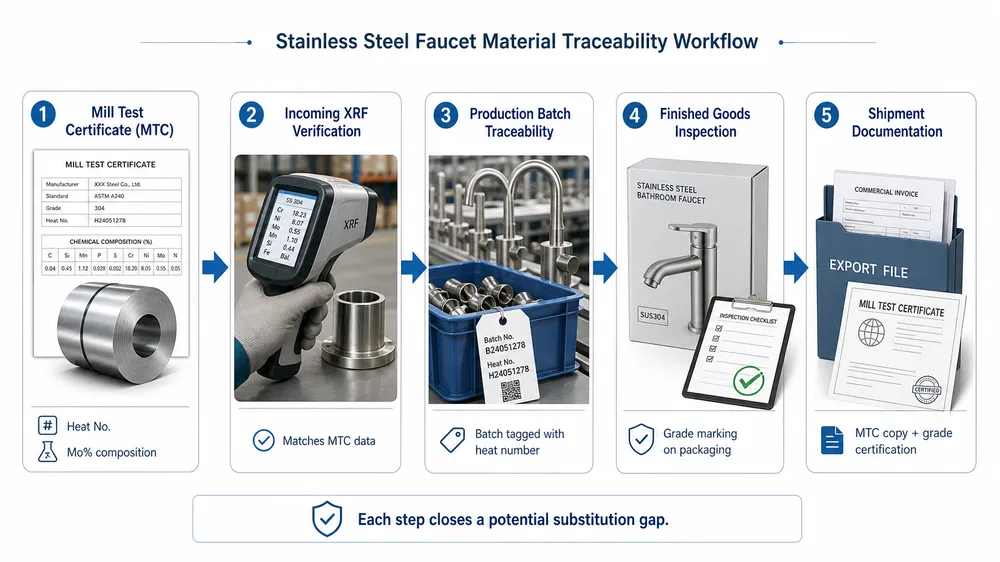
Mill Test Certificate (MTC): The primary material traceability document. Issued by the steel mill, it certifies the chemical composition of the specific heat (batch) of steel used. An MTC for 316 will show Mo% in the 2–3% range. An MTC for 304 will show Mo% at or near zero. Request the MTC as a standard deliverable on any stainless steel faucet order — it should reference the heat number traceable to the material used in your production run.
XRF verification report: X-ray fluorescence analysis can verify the elemental composition of finished parts non-destructively. We run incoming XRF checks on stainless steel bar stock and coil before it enters production — the same discipline we apply to brass alloy incoming inspection. If your factory can't tell you how they verify incoming stainless steel grade, that's a gap worth asking about.
Grade marking on finished goods: For OEM orders, we can mark the grade (304 or 316) on the product packaging and in the product documentation. This matters for your downstream customers who need to communicate material specs to their end buyers or to project specification teams.
Compliance documentation for destination markets: Grade choice can affect which certifications apply. cUPC and WaterMark both have material requirements for wetted components — the grade needs to be documented in the certification file. If you're adding a 316 SKU to a product line that was previously certified on 304, the certification documentation needs to be updated. We manage this as part of the OEM project workflow.
(One thing we've seen buyers overlook: the grade requirement needs to be explicit in the purchase order, not just in the RFQ. If your PO says "stainless steel bathroom faucet" without specifying grade, the factory is not contractually obligated to supply 316 even if you discussed it during quoting. Put the grade in the PO line item description.)

Specifying Grade in Your OEM Sourcing Brief
A well-written grade specification in your sourcing brief prevents substitution, simplifies the certification workflow, and gives your factory a clear target. Here's what to include:
Material grade: State the AISI designation (304 or 316) and the equivalent JIS or EN designation if your destination market uses those standards (SUS304/SUS316 for Japan-influenced markets; 1.4301/1.4401 for European specifications). Don't rely on "marine grade" or "food grade" as substitutes — these are informal descriptors that don't map cleanly to a single AISI grade.
Wetted vs non-wetted components: In a bathroom faucet, the body, spout, and internal flow path are wetted components. The handle and decorative trim may not be. You can specify 316 for wetted components and 304 for non-wetted trim to manage cost without compromising corrosion performance where it matters.
Surface finish and substrate grade together: As discussed above, specify the finish and the substrate grade as a paired requirement. "Matte black PVD on 316 substrate" is a complete specification. "Matte black PVD" alone leaves the substrate grade open.
Documentation requirements: List the documents you need with the shipment: MTC with heat number, XRF verification report (if required), grade marking on packaging, and any certification documentation relevant to your destination market.
Test standard for corrosion performance: If you have a specific salt spray or corrosion test requirement, state it. For 316 stainless steel faucets going into coastal or hard water markets, a 48-hour neutral salt spray test per ISO 9227 is a reasonable baseline. For premium or long-warranty products, 96 hours or higher is worth specifying.
For buyers sourcing Stainless Steel Bathroom Faucets for the first time, the grade specification is the single most important line in your brief. Everything else — finish, flow rate, hole configuration — can be adjusted after sampling. Grade substitution in the field is not adjustable.
Corrosion Test Performance: What the Numbers Mean for Your Market
Salt spray testing is the standard accelerated corrosion test for faucet finishes, but it's worth understanding what it does and doesn't tell you about grade performance.
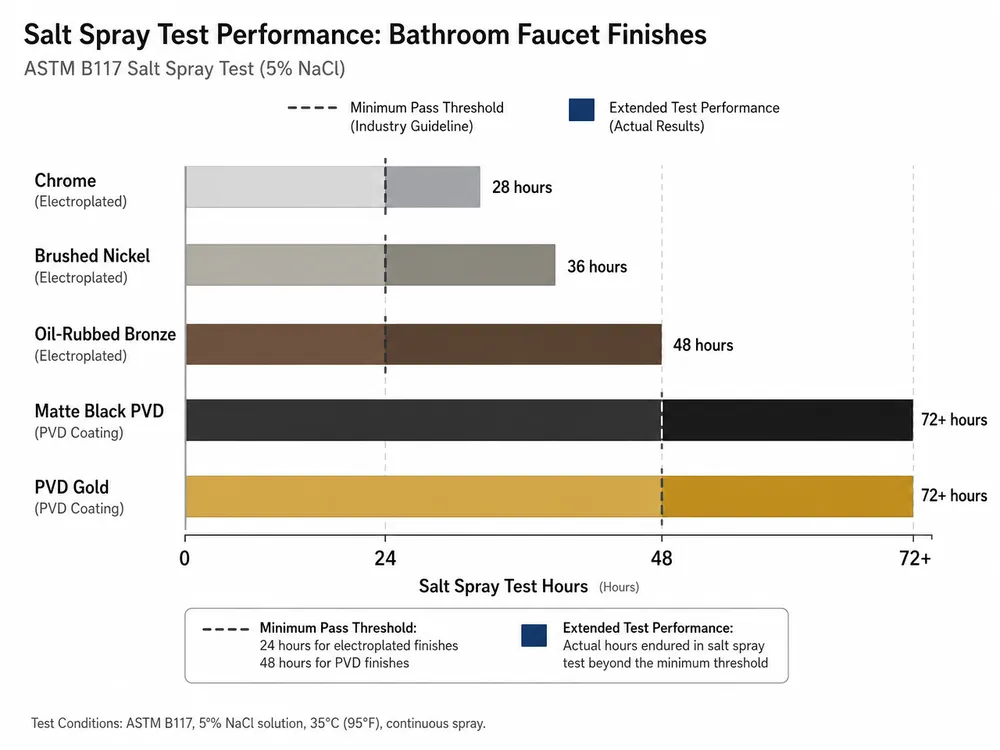
The neutral salt spray test (NSS, ISO 9227 / ASTM B117) exposes parts to a 5% sodium chloride fog at 35°C. It's an accelerated test — 24 hours of NSS exposure doesn't map directly to 24 hours of real-world service. The test is primarily useful for comparing relative performance between samples and for catching gross defects in surface finishing.
For stainless steel faucet bodies specifically, the NSS test is less diagnostic than it is for plated brass bodies. A well-finished 304 stainless body can pass 48-hour NSS without issue — the test doesn't replicate the crevice corrosion conditions that cause real-world pitting under scale deposits. The more relevant test for stainless steel grade performance is a crevice corrosion test or a pitting potential measurement, but these are less commonly specified in commercial faucet sourcing.
The practical implication: don't use NSS pass/fail as your sole criterion for grade selection. A 304 faucet that passes 48-hour NSS can still pit in a hard water market over a 3–5 year service life. The grade decision needs to be based on the water chemistry of your destination market, not just on a salt spray result.
What NSS testing does tell you reliably: whether the surface finishing process is consistent and whether the passive layer on the stainless steel surface is intact after finishing. We run NSS on every production batch — it's a process quality check, not a grade verification tool.
Frequently Asked Questions
Is 316 stainless steel required for cUPC or WaterMark certification?
No — both 304 and 316 are acceptable under cUPC and WaterMark material requirements for faucet bodies. The certification doesn't mandate a specific grade; it requires that the material meet the applicable lead content and corrosion resistance standards. Both grades clear those requirements. The grade decision is a performance and market-fit choice, not a certification compliance requirement in most cases. That said, if your product is going into a specification that explicitly calls for 316 (some commercial and hospitality project specs do), you'll need the grade documented in your certification file.
Can I verify the grade of a stainless steel faucet I've already received?
Yes, with XRF analysis. A handheld XRF gun can read the elemental composition of a finished part non-destructively in under a minute. The Mo% reading will tell you definitively whether the part is 304 (Mo near zero) or 316 (Mo 2–3%). Third-party testing labs in most major markets offer this service. If you're auditing an existing supplier's grade compliance, XRF spot-checks on incoming shipments are the most practical approach.
Does 316L differ from 316 for faucet applications?
316L is the low-carbon variant of 316 — carbon content is held below 0.03% versus 0.08% maximum for standard 316. The low-carbon spec reduces carbide precipitation at weld heat-affected zones, which matters for welded assemblies. For faucet bodies that are machined rather than welded, the difference between 316 and 316L is negligible in practice. Both have the same Mo% and essentially the same PREN. If a factory quotes 316L, it's acceptable for faucet body applications — it's not a downgrade.
What's the minimum order quantity for 316 stainless steel faucets at Wfaucet?
Our standard MOQ for stainless steel faucet OEM orders starts at 200 pieces, the same as our brass line. For 316 specifically, the material cost is higher, so the economics of a 200-piece trial order are tighter — but it's workable for a market test. Most buyers who are introducing 316 into their line start with a 200–500 piece sample run to validate the product with their customers before committing to a full container.
How do I know if my destination market needs 316 or if 304 is sufficient?
The two data points that matter most are total dissolved solids (TDS) in the local water supply and whether the market uses chloramine-based disinfection (more aggressive than chlorine alone). Water quality reports for most municipal supplies are publicly available. As a rough guide: below 200 mg/L TDS with standard chlorination, 304 is generally sufficient. Above 300 mg/L TDS, or in coastal markets with elevated airborne chloride, 316 is the safer specification. If you're unsure, send us your destination market and we'll give you our read based on what we've seen from existing buyers in that region.
If you're ready to specify grade for your next stainless steel faucet order, the fastest path is to send us your target market, finish requirement, and volume — we'll return a quote with material certification and the relevant compliance documentation included. You can reach us through the Request Quote page or browse our full Bathroom Faucets range to identify the base models that fit your line.