

Most sourcing mistakes on bathroom faucets don't happen at the factory — they happen at the spec stage, before a single unit is cast. A buyer locks in a finish without knowing the salt-spray rating. They order a 3-hole widespread without confirming the rough-in dimensions match their target market's standard vanity. They request cUPC documentation and receive a certificate that covers the body but not the cartridge assembly. By the time the container arrives, the problem is already baked in.
This guide covers the three decisions that determine whether a bathroom faucet order lands cleanly or generates problems downstream: finish selection and durability, hole configuration and its SKU implications, and certification scope by destination market. We've been manufacturing and exporting bathroom faucets since 2008, and these are the questions we work through with every new importer before we write a quote.
Finish Durability: What the Salt-Spray Numbers Actually Mean for Your Market
The finish is the first thing your downstream customer sees and the last thing most importers verify before placing an order. That's backwards. Finish failure — tarnishing, peeling, pitting — is the leading cause of warranty returns on bathroom faucets, and the failure mode is almost always traceable to the plating process, not the product design.
There are two fundamentally different finish technologies in the market: electroplating and PVD (physical vapor deposition). They look similar in a catalog photo. They perform very differently in the field.
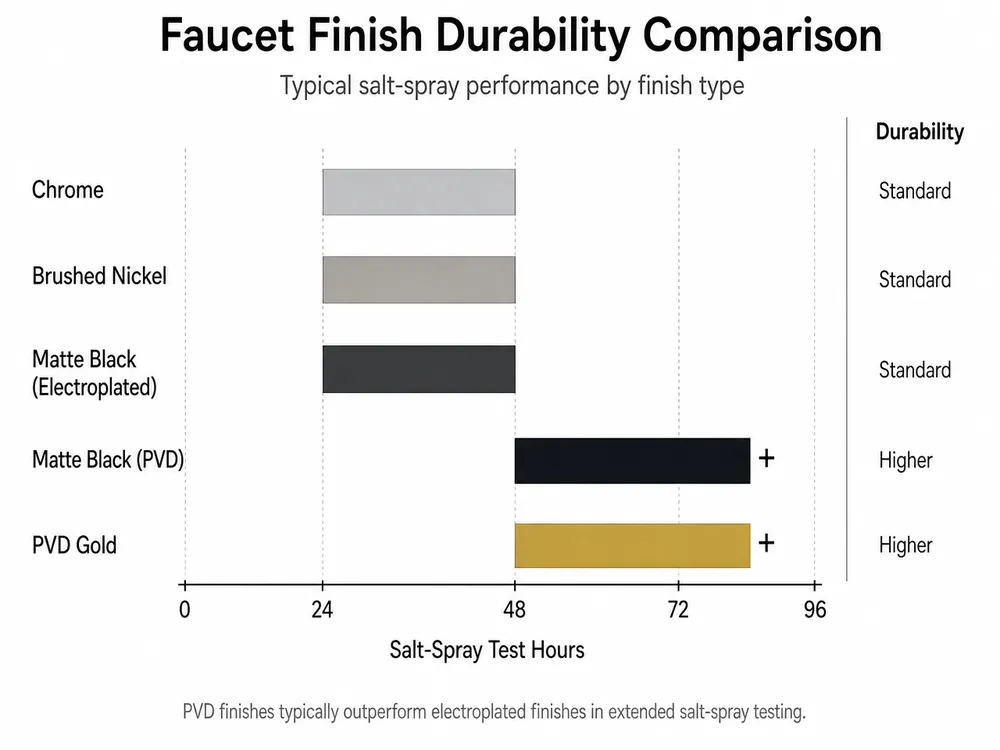
Electroplated finishes (chrome, brushed nickel, oil-rubbed bronze) build up in layers: a copper base coat for adhesion, a nickel mid-coat for corrosion resistance, and the decorative top coat. The nickel mid-coat is the critical layer. Factories that skip it or run it thin can produce chrome that looks identical to a properly plated piece — until it hits a humid bathroom environment or a coastal climate. We run a copper/nickel/chrome stack on our electroplated finishes, and our chrome passes 24-hour salt spray as a minimum, with most production batches clearing 48 hours. (The 48-hour threshold matters specifically for buyers supplying coastal markets or humid climates — we started tracking this after a batch of brushed nickel product showed early tarnishing in a Southeast Asian market. The root cause was a thin nickel mid-coat from a previous supplier run.)
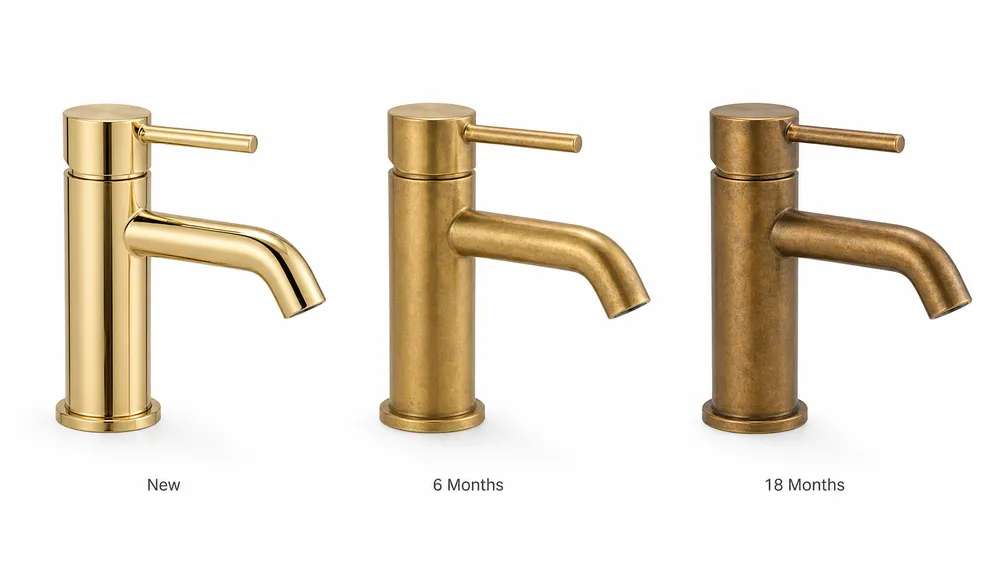
PVD finishes (gold, rose gold, gunmetal, and increasingly matte black) are deposited in a vacuum chamber at the atomic level — the coating bonds to the substrate rather than sitting on top of it. PVD coating thickness on our line runs 0.3–0.5μm, and we test adhesion on every batch using a cross-cut tape test before parts move to assembly. PVD is harder and more scratch-resistant than electroplating, and it holds up better in high-use commercial applications. The trade-off is cost: PVD tooling and process time add to unit price, and not every market will pay the premium.
The table below maps finish type to typical salt-spray performance, maintenance expectations, and the market segments where each finish has the strongest commercial pull:
| Finish | Process | Typical Salt-Spray | Best Markets | Maintenance Notes |
|---|---|---|---|---|
| Chrome | Electroplating (Cu/Ni/Cr) | 24–48h | North America, Europe, Middle East | Wipes clean; shows water spots in hard-water areas |
| Brushed Nickel | Electroplating (Cu/Ni/brushed Ni) | 24–48h | North America, Europe | Hides water spots; popular in transitional design |
| Matte Black | Electroplating or PVD | 24–48h (EP) / 48h+ (PVD) | North America, Australia, Europe | PVD matte black holds color better long-term |
| PVD Gold | PVD | 48h+ | Middle East, Southeast Asia, luxury segments | Scratch-resistant; higher unit cost |
| Oil-Rubbed Bronze | Electroplating (living finish) | 24h | North America (traditional style) | Intentional patina variation; not for buyers expecting uniformity |
When you're evaluating a supplier's finish claims, ask for the salt-spray test report — not just the certification, but the actual test data with hours and pass/fail criteria. A supplier who can't produce batch-level salt-spray data is either not testing or not keeping records. Both are problems.
One thing worth knowing about matte black bathroom faucets: the finish can be produced by either electroplating or PVD, and the two look nearly identical in photos. PVD matte black holds its color significantly better over time, especially in high-use environments. If your buyer is positioning matte black as a premium finish, specify PVD in your purchase order — don't assume.

Hole Configuration: Rough-In Dimensions, SKU Planning, and What Gets Locked In at the Vanity
Hole configuration is a structural decision, not a style decision. Once your buyer's vanity is drilled, the faucet has to fit — and if it doesn't, the faucet goes back, not the vanity. Getting this wrong at the sourcing stage means returns, reorders, and a distributor who doesn't call you again.
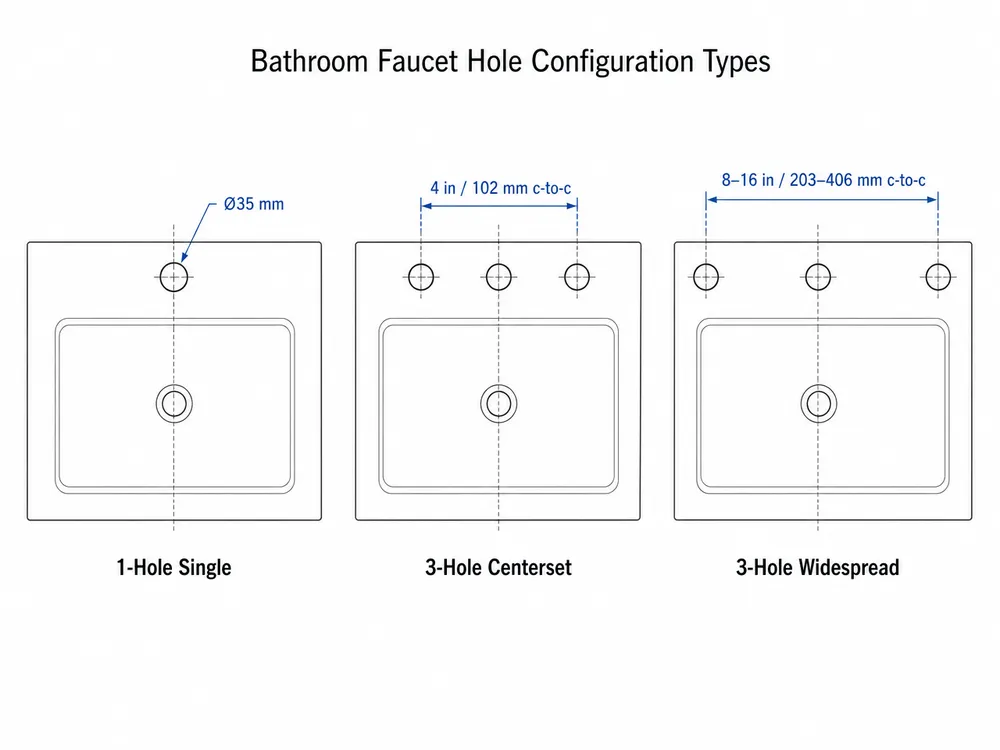
There are three configurations that cover the vast majority of the bathroom faucet market:
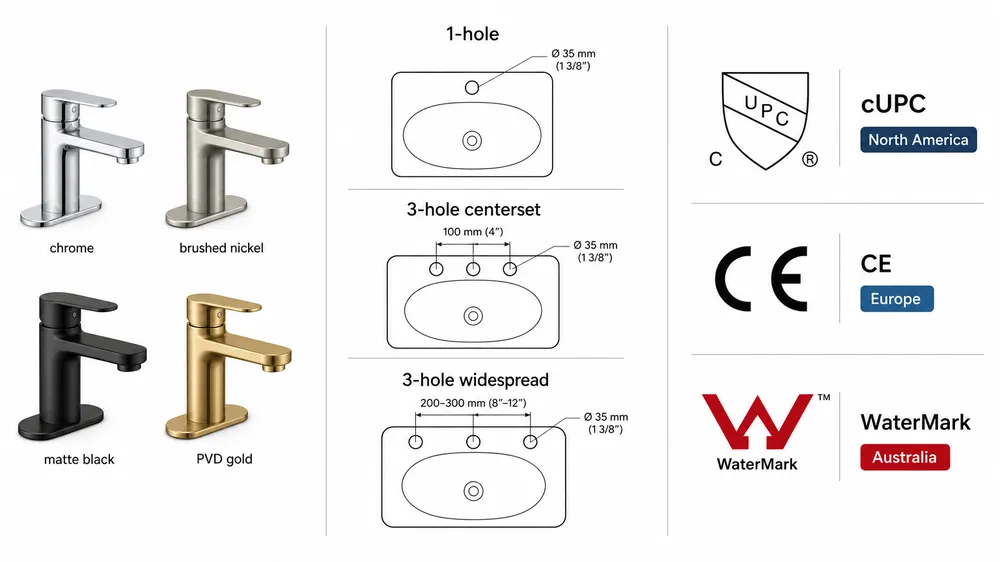
1-hole centerset (single-hole): One hole, typically 35mm diameter, accommodates the faucet body and handle in a single unit. This is the simplest rough-in and the most flexible for vanity manufacturers — a single hole can accept a wide range of faucet styles. Standard in new construction across North America and increasingly common in European markets. If you're building a starter SKU for a new market, this is usually the right configuration to lead with.
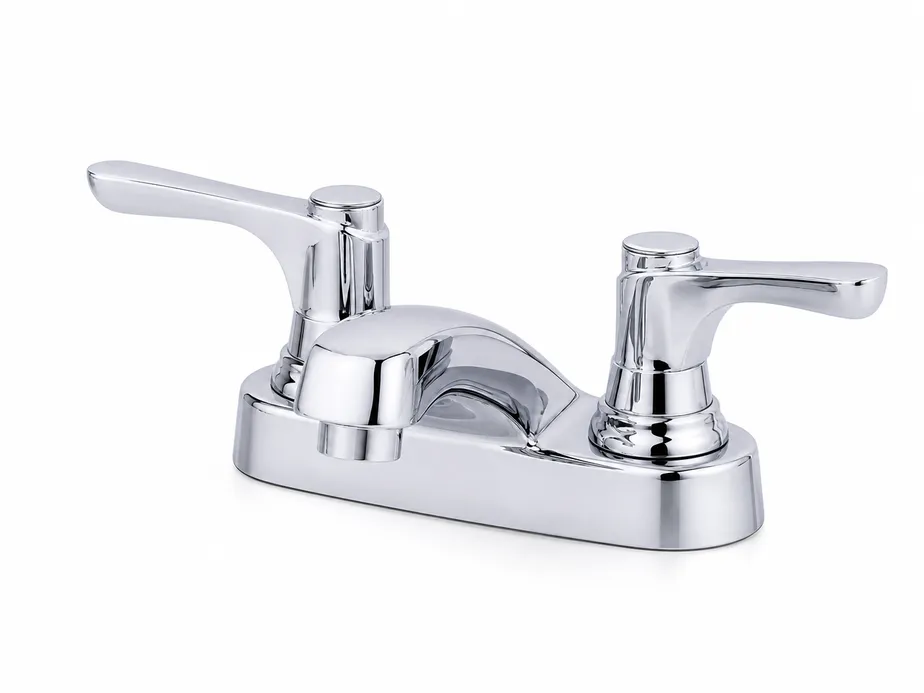
3-hole centerset: Three holes in a 4-inch (102mm) center-to-center spread. The two outer holes take the hot and cold handles; the center hole takes the spout. This configuration is common in North American replacement markets where older vanities were drilled for 3-hole setups. It's a significant portion of the replacement/renovation segment — buyers supplying hardware stores or home improvement chains need it in their SKU mix.
3-hole widespread: Three holes with an 8–16 inch (203–406mm) center-to-center spread between the outer holes. The handles and spout are separate pieces, giving more design flexibility and a higher-end appearance. Standard in European bathroom design and popular in the North American luxury and hospitality segments. Rough-in dimensions vary more widely here — confirm the spread range your target market expects before specifying. Our widespread bathroom faucets cover the standard 8-inch spread that works across most North American and European applications.
Wall-mount: No deck holes — the faucet mounts through the wall above the basin. Common in European design-forward markets and increasingly specified in hospitality projects. Rough-in depth (the distance from the finished wall surface to the valve body) is the critical dimension here, and it has to be coordinated with the plumber before the wall is closed. Wall-mount faucets are not a high-volume SKU for most importers, but they're worth having in the catalog for hospitality and contract accounts.
SKU planning implications
The hole configuration decision has a direct effect on how many SKUs you need to cover a market. A buyer entering the North American market typically needs at minimum:
- 1-hole single in 2–3 finishes (new construction and modern renovation)
- 3-hole centerset in 2–3 finishes (replacement market)
- 1 or 2 widespread SKUs for the mid-to-upper segment
That's 6–8 SKUs before you've touched wall-mount or specialty configurations. Container mix planning matters here — if you're running a 40HQ, you want to know the CBM per SKU before you finalize the order so you're not short on your fastest-moving configuration.
We calculate carton dimensions against container floor plans and provide a packing list with CBM and gross weight per SKU before order confirmation. If you're mixing configurations in one container, tell us the split early — it affects how we sequence the packing.
Certification Requirements by Destination Market
This is the section most consumer-facing buying guides skip entirely. For importers, it's the one that determines whether your container clears customs or sits at the port.
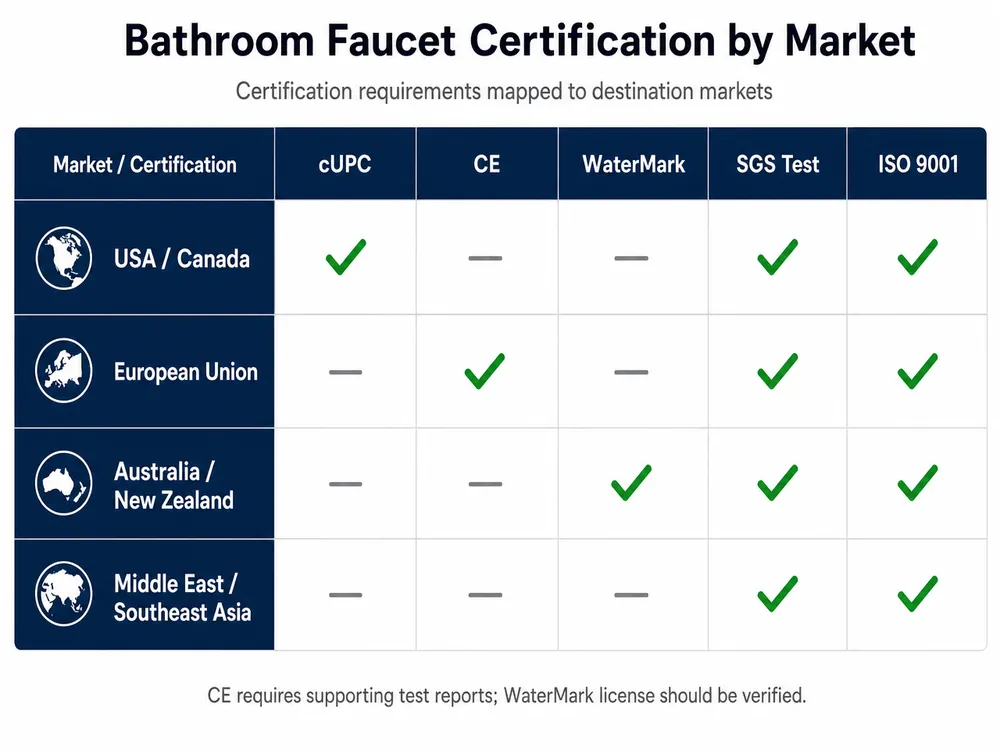
The three certifications that cover the major English-language import markets are cUPC (North America), CE (Europe), and WaterMark (Australia). They test different things, require different documentation, and are issued by different bodies. Holding all three under one supplier relationship is not the norm — most factories have one or two, and multi-market importers end up managing multiple supplier relationships to cover their footprint. We hold all three, which is the main reason multi-market buyers come to us.
| Certification | Market | What It Covers | Key Requirements | Documentation |
|---|---|---|---|---|
| cUPC | USA & Canada | NSF/ANSI 61 (lead content), NSF/ANSI 372 (lead-free), ASME A112.18.1 (performance) | Lead content ≤0.25% weighted average in wetted surfaces; flow rate compliance | cUPC certificate + NSF test report |
| CE | European Union | EU Construction Products Regulation; EN 817 (mechanical mixing valves) | Pressure testing, flow rate, temperature performance | CE Declaration of Conformity + EN 817 test report |
| WaterMark | Australia & NZ | AS 3718 (tap ware) | Performance, materials, markings | WaterMark license number + SAI Global listing |
| SGS | Multi-market | Third-party audit and material testing | Varies by scope | SGS test report (specify scope at RFQ) |
A few things worth knowing before you request documentation:
cUPC scope matters. The certificate covers a specific product model. If you're ordering a new handle configuration or a new finish on an existing body, confirm whether the variant is covered under the existing certificate or requires a documentation update. We manage certification extensions for new variants in-house — you don't need to run a full re-certification from scratch, but you do need to flag the change before production starts.
CE is a self-declaration, but the test data has to exist. The CE mark on a faucet means the manufacturer has declared conformity with the relevant EU directives. The declaration is only as good as the underlying test reports. Ask for the EN 817 test report, not just the CE declaration. If a supplier can't produce the test report, the CE mark is decorative.
WaterMark is a licensed scheme. The license number is publicly searchable on the SAI Global database. If a supplier gives you a WaterMark certificate, verify the license number is active and covers the specific product. We've heard from buyers who received certificates for products that weren't actually listed under the license — it's worth 30 seconds to check.
Lead content is non-negotiable for North America. NSF/ANSI 372 requires that wetted surface components contain no more than 0.25% lead by weighted average. This applies to the brass body, the valve seat, the cartridge housing — every component that contacts the water stream. We test every incoming brass batch with XRF analysis and apply the same standard to all production regardless of destination market. If a supplier can't show you incoming material test data for lead content, that's a red flag regardless of what their certificate says.
Key Specs to Verify Before You Place an Order
Certifications confirm compliance. They don't tell you whether the faucet will hold up across 50,000 open/close cycles in a hotel bathroom or whether the cartridge will drip after 18 months in a hard-water market. These are the specs worth verifying at the RFQ stage:
Brass alloy grade. The body should be C36000-equivalent free-machining brass or equivalent. Zinc alloy (zamak) bodies are cheaper and look identical in photos, but they corrode faster in chlorinated water systems and are not suitable for markets with aggressive water chemistry. Ask for the material certificate on the brass rod or casting alloy. If the supplier can't produce it, assume zinc.
Cartridge endurance rating. The cartridge is the component that fails first. A 500,000-cycle endurance test means the cartridge has been cycled 500,000 times open and closed under test conditions without failure. We run this test on every production batch — not just on new product introductions or samples. The test report should show the cycle count, the test pressure, and the pass/fail criteria. A supplier who only tests samples is giving you sample performance, not production performance.
Valve seat tolerance. Thread tolerance on the valve seat interface is where drip failures originate. We hold ±0.05mm on valve seat threads. Ask for the dimensional inspection report from the machining stage — it should show actual measured values, not just a pass/fail stamp.
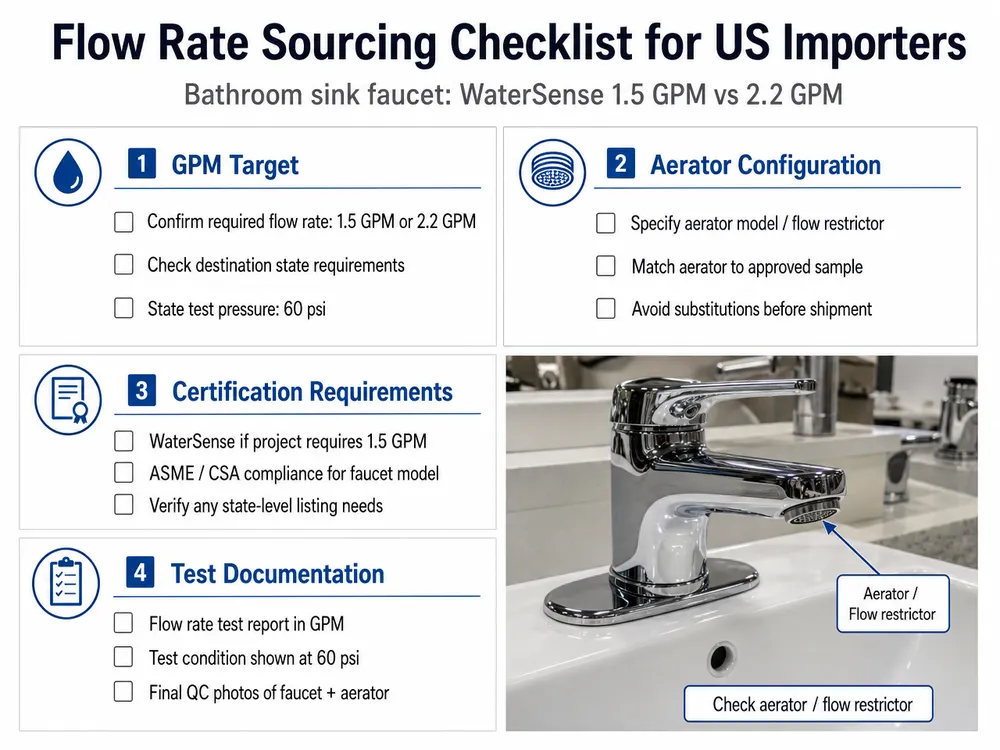
Flow rate at rated pressure. cUPC and WaterMark both specify flow rate requirements. For North America, the standard is 1.5 GPM at 60 PSI for lavatory faucets (per ASME A112.18.1). Confirm the flow rate in the test report matches your target market's requirement — some markets have moved to lower flow rates for water efficiency compliance, and a faucet spec'd for one market may not pass in another.
Cartridge supplier qualification. Ask who makes the cartridge and whether the supplier has a qualification process for cartridge vendors. We've removed two cartridge suppliers from our approved list after they passed paper qualification but showed early failure rates in our endurance testing. A factory that can't tell you who makes their cartridges or what their qualification process looks like is running a risk you'll absorb downstream.
How to Read a Supplier's Quality Claims Without Getting Misled
Every factory in Foshan has a quality page on their website. The claims are nearly identical. Here's how to separate documentation from decoration:
Ask for batch-level test reports, not just certificates. A certificate tells you the product type was tested at some point. A batch-level report tells you the specific production run you're buying was tested. For salt spray, endurance testing, and lead content, you want batch-level data.
Check the test dates. A cUPC certificate issued in 2018 for a product that's been through three handle redesigns since then may not cover what you're actually ordering. Certificates have scope — confirm the scope covers your specific configuration.
Request the incoming material XRF report for lead content. This is the document that proves the brass used in your order meets NSF/ANSI 372. It should show the test date, the batch number, and the measured lead content. If the supplier says they test but can't produce the report, they're not testing systematically.
Ask about cartridge endurance testing frequency. "We test our cartridges" is not the same as "we test every production batch." The difference matters because cartridge quality can vary between supplier batches. We test every production batch at 500,000 cycles — the test report travels with the shipment documentation.
Verify WaterMark license numbers. As noted above, the SAI Global database is publicly searchable. A 30-second check confirms whether the license is active and covers the product you're ordering.
The sourcing trap in this category is that bathroom faucets look like a commodity. The price range from the cheapest to the most expensive factory in Foshan is wide, and the products look similar in photos. The difference shows up in the test data, the material certificates, and — eventually — in your warranty return rate.
Sourcing Checklist: What to Request at RFQ Stage
Before you confirm a bathroom faucet order, this is the documentation and information you should have in hand:
Certifications (scope-verified):
- [ ] cUPC certificate — confirm it covers your specific model and configuration
- [ ] CE Declaration of Conformity + EN 817 test report (for EU markets)
- [ ] WaterMark license number — verify active status on SAI Global
- [ ] ISO 9001:2015 certificate
Material and process documentation:
- [ ] Brass alloy material certificate (C36000-equivalent or equivalent grade)
- [ ] XRF lead content test report for incoming brass batch
- [ ] Cartridge supplier name and qualification documentation
Performance test reports (batch-level):
- [ ] Salt-spray test report — minimum 24h, specify 48h for coastal/humid markets
- [ ] Cartridge endurance test report — 500,000 cycles minimum
- [ ] Dimensional inspection report for valve seat thread tolerance
- [ ] Flow rate test at rated pressure (confirm against destination market standard)
Sourcing terms:
- [ ] MOQ per SKU (and whether mixed-SKU orders count toward MOQ)
- [ ] Lead time from order confirmation to container loading
- [ ] OEM/ODM capability and tooling cost if custom configuration needed
- [ ] Certification extension process for new variants
We can provide all of the above for any order. If you're evaluating multiple suppliers, this checklist is a useful filter — the ones who can't produce batch-level test data are the ones whose quality claims are unverifiable.
Matching Configuration to Market: Practical Decision Points
A few scenarios we see regularly, and how we'd approach them:
Entering the North American market for the first time. Lead with a 1-hole single in chrome and brushed nickel — these two finishes cover 70%+ of the replacement and new construction market. Add a 3-hole centerset in the same finishes for the renovation segment. Confirm cUPC scope covers all configurations before production starts. MOQ of 200 pieces per SKU means you can test 4–6 SKUs in a single container without overcommitting.
Supplying a European distributor. CE documentation is the entry requirement, but the real differentiator in the European market is design — widespread configurations, matte black and brushed finishes, and wall-mount options for the design-forward segment. Confirm EN 817 test reports are current and cover your specific configurations. Flow rate requirements vary by country within the EU — verify against your distributor's target market.
Building a hospitality supply catalog. Hospitality buyers care about cartridge durability above almost everything else — a dripping faucet in a hotel room generates a maintenance call and a guest complaint. Specify 500,000-cycle cartridge endurance testing and ask for batch-level reports. Widespread and wall-mount configurations are common in mid-to-upper hospitality. PVD finishes hold up better in high-use environments and reduce maintenance callbacks.
Testing a new finish in your market. OEM from 200 pieces means you can run a market test on a new finish — say, PVD brushed gold for a Middle Eastern distributor — without committing to a full container. We maintain in-house tooling, so a new finish variant on an existing body doesn't require new casting dies. First sample in 15–20 days for a finish variant on an existing certified body.
If you're working through any of these scenarios and want a quote with the right spec and documentation package for your destination market, send us an RFQ with your target market, preferred finish, hole configuration, and volume — we'll come back with a detailed quote and flag any certification or configuration questions before production starts.
Frequently Asked Questions
What's the difference between cUPC and NSF certification for bathroom faucets?
cUPC is the certification mark issued by the International Association of Plumbing and Mechanical Officials (IAPMO) confirming that a product meets the Uniform Plumbing Code. NSF/ANSI 61 and NSF/ANSI 372 are the specific standards that govern lead content in drinking water system components — they're the underlying standards that cUPC compliance requires. When a buyer asks for "NSF certification," they usually mean they want confirmation that the product meets NSF/ANSI 372 lead-free requirements. The cUPC certificate covers this, but ask for the NSF test report as supporting documentation if your compliance team needs it separately.
Can I order the same faucet body in multiple finishes under one cUPC certificate?
It depends on how the certificate was issued. cUPC certification covers a specific product model, and finish variants are sometimes covered under the same certificate and sometimes require a separate documentation update. We manage this in-house — if you're adding a new finish to an existing certified body, we'll confirm whether it's covered or flag the documentation update needed before production starts. Don't assume coverage; confirm it.
What's the minimum order quantity for a custom OEM bathroom faucet?
Our OEM MOQ starts at 200 pieces per configuration. That's low enough to run a market test before committing to a full container. For a new body design requiring new casting tooling, the tooling cost is a one-time charge — we maintain the tooling in-house, so revisions don't go to an outside vendor. For a finish variant or handle configuration change on an existing certified body, there's typically no new tooling cost.
How do I verify a WaterMark certificate is legitimate?
The WaterMark licensing scheme is administered by SAI Global. Every licensed product has a license number that's searchable in the SAI Global product database at watermark.saiglobal.com. Search the license number and confirm it's active and that the listed product description matches what you're ordering. We've heard from buyers who received certificates for products that weren't actually listed — the 30-second database check is worth doing.
Does PVD matte black cost significantly more than electroplated matte black?
Yes, typically 15–25% more at the unit level, depending on order volume. The PVD process requires vacuum chamber time and more controlled process parameters than electroplating. For buyers positioning matte black as a premium finish — hospitality, design-forward retail, luxury residential — the PVD price premium is usually absorbable in the margin. For buyers competing on price in the mid-market, electroplated matte black with a documented 24h+ salt-spray rating is a reasonable choice. The key is specifying which process you want in the purchase order, not assuming.
What flow rate should I specify for North American lavatory faucets?
The current federal standard in the US is 1.5 GPM at 60 PSI for lavatory faucets (per the Energy Policy Act). Some states — California, Colorado, and others — have adopted lower limits (1.2 GPM or 1.0 GPM). If you're supplying a national retailer or distributor, the 1.5 GPM spec covers most of the market. If you're supplying a California-focused buyer, confirm the state-level requirement. We can configure flow restrictors to hit any of these targets — specify the flow rate in your RFQ.