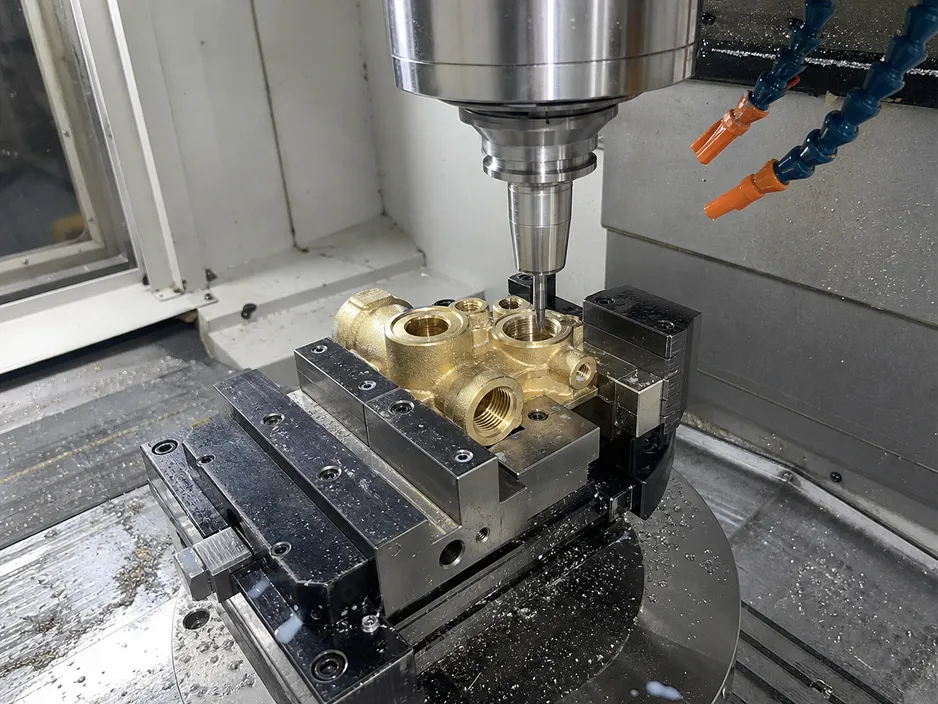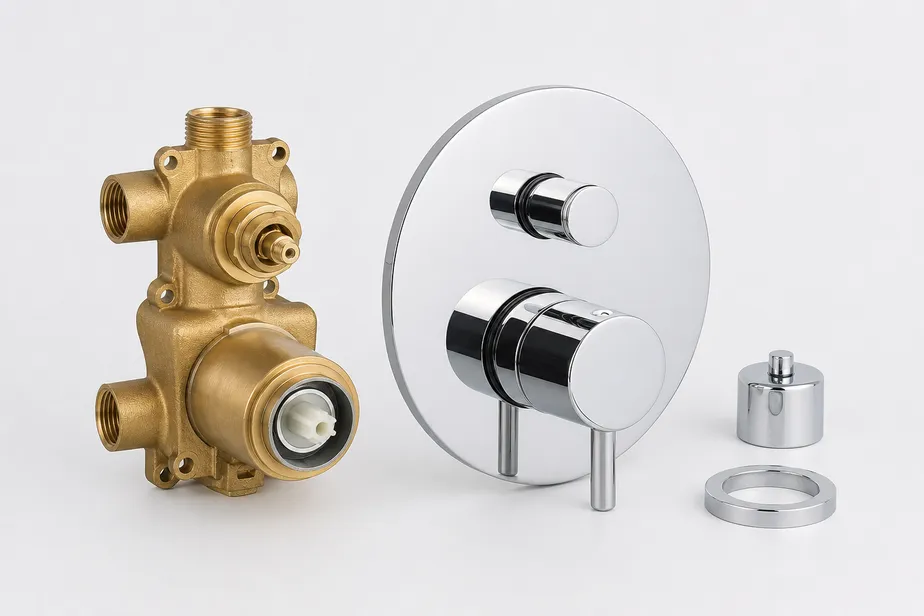


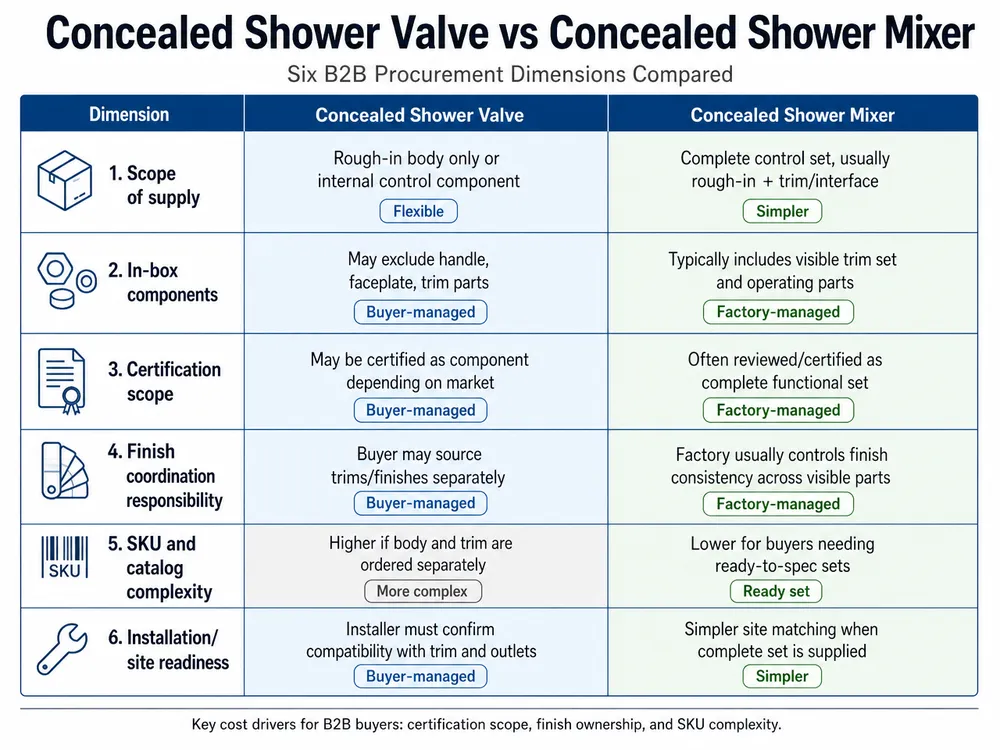
The confusion usually surfaces mid-order. A distributor sends an RFQ for "concealed shower valves," and when we ask whether they need the rough-in body only or the complete trim assembly, the line goes quiet. It's not a small distinction — it affects what goes in the box, what the installer needs on-site, which certifications apply, and how you structure your SKU catalog. Getting it wrong means either a container of incomplete product or a container of over-specified product that your customers can't use without sourcing additional components.
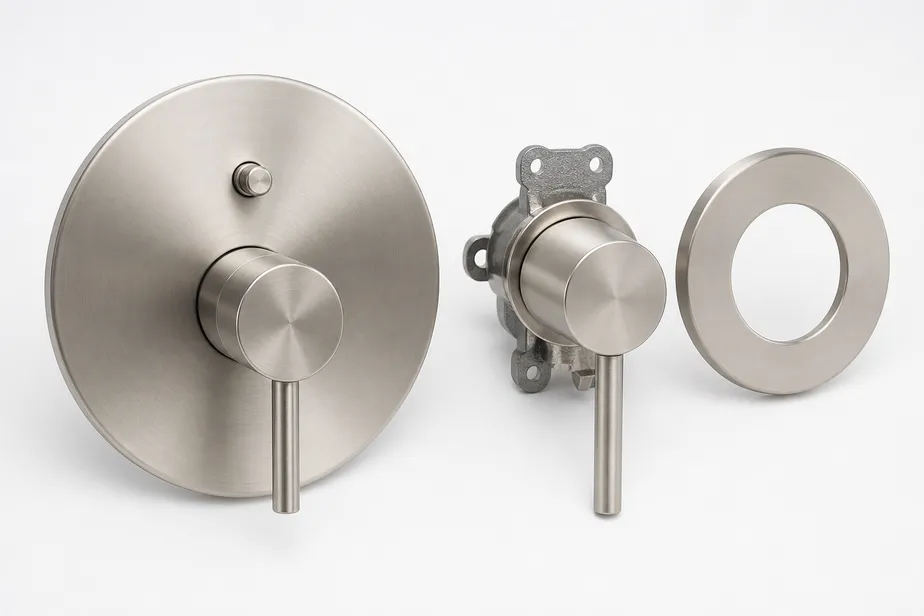
Here's the short version: a concealed shower valve is the rough-in body — the brass cartridge housing that installs inside the wall, controls water flow and temperature, and ships without a visible trim plate. A concealed shower mixer integrates that valve body with a trim plate and control handle into a single purchasable assembly. Same core function, fundamentally different procurement unit.
Which one you should be ordering depends on your project type, your installer base, and how you want to manage SKU complexity. We'll work through each dimension.
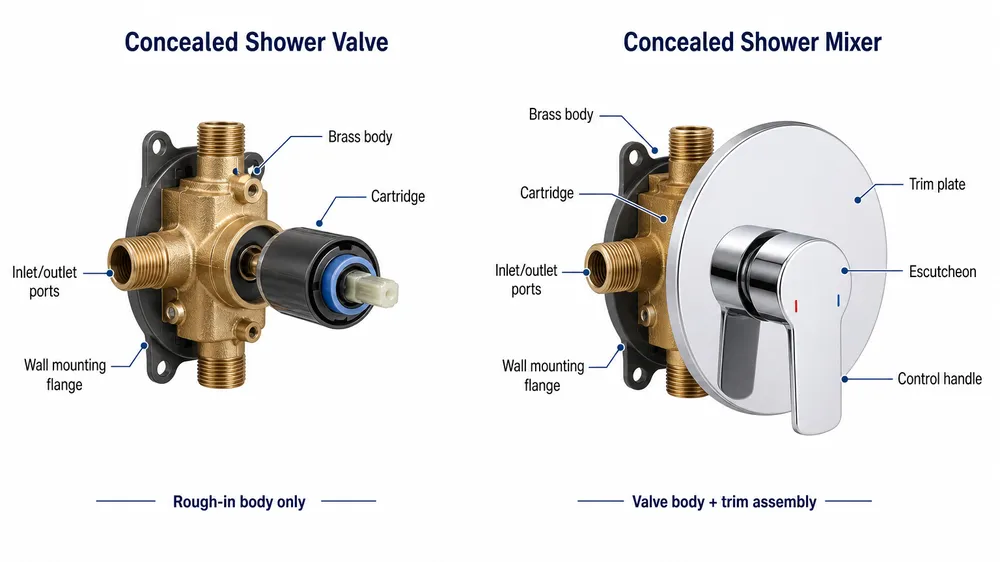
The Mechanical Distinction That Changes Your Procurement Unit
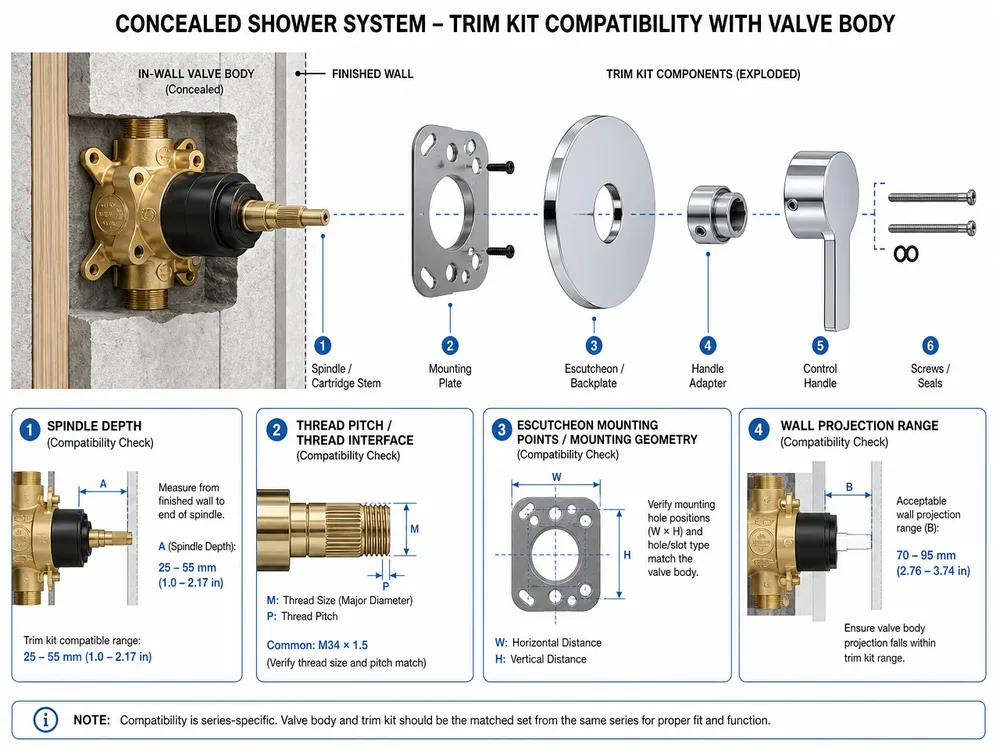
A concealed shower valve is a rough-in component. It goes into the wall during the structural phase of a bathroom build — before tile, before finishing, before any visible surface work. The valve body houses the cartridge (pressure balance or thermostatic), the inlet and outlet ports, and the mounting bracket. What it does not include is anything the end user sees or touches. The trim plate, the handle, the escutcheon — those are separate components, sourced either from the same manufacturer or from a trim kit supplier.
This matters for procurement because the valve body and the trim kit can come from different supply chains. A contractor running a multi-brand project might specify a particular trim aesthetic from one source and source the rough-in body separately for cost reasons. An OEM buyer might want to private-label the trim while using a standard certified valve body underneath. The valve-only format gives you that flexibility — but it also means your buyer or their installer is responsible for trim coordination.
A concealed shower mixer collapses that complexity. The valve body, trim plate, and control interface ship as a single SKU. The installer receives one box, installs one product, and the finish is already matched. There's no trim sourcing, no compatibility check, no risk of a mismatched escutcheon arriving on-site after the tile is already set. (We've heard enough stories about that last scenario from hotel project managers to know it's not a theoretical risk.)
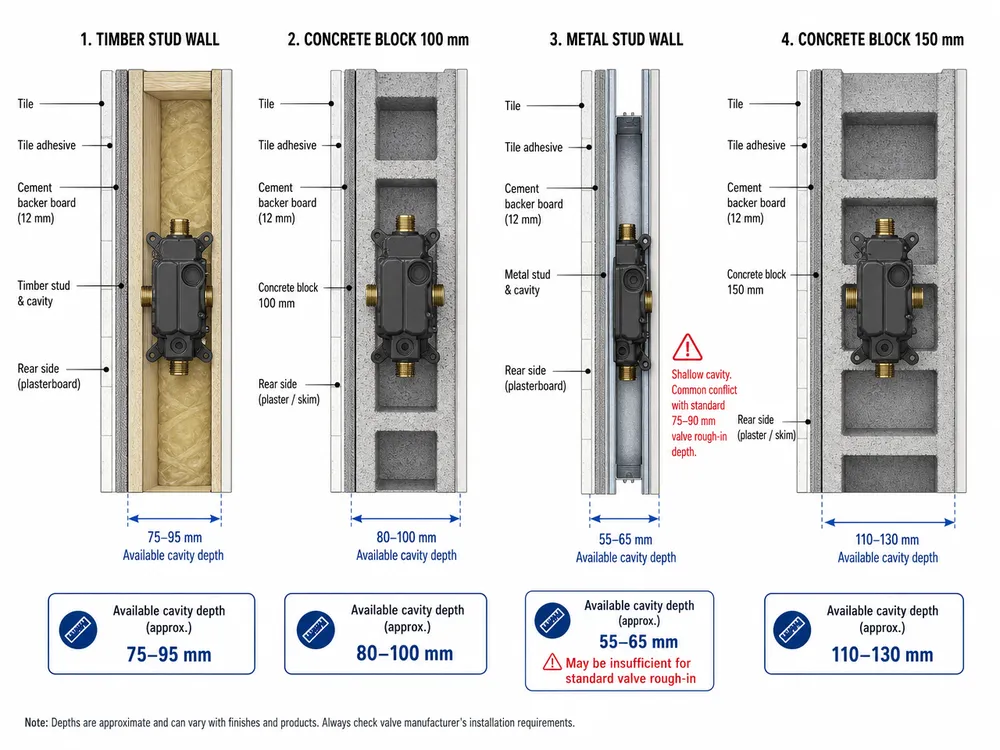
The rough-in depth specification is where the two formats diverge most critically. Valve-only bodies typically require a specific rough-in depth — commonly 65–90mm from the finished wall surface — and the trim kit must be specified to match. With a complete mixer, the trim plate is engineered to the valve body's exact rough-in depth, so that compatibility is already resolved at the factory. For buyers supplying to contractors who are less experienced with concealed systems, the mixer format eliminates a common source of installation callbacks.
Head-to-Head: Six Procurement Dimensions
| Dimension | Concealed Shower Valve (Rough-In Only) | Concealed Shower Mixer (Integrated Assembly) |
|---|---|---|
| Components included | Valve body + cartridge + mounting hardware | Valve body + cartridge + trim plate + handle + escutcheon |
| Rough-in depth coordination | Buyer/installer must match trim to valve spec | Factory-resolved — trim engineered to valve body |
| Finish coordination | Trim sourced separately; finish match is buyer's responsibility | Single-source finish — body and trim matched at factory |
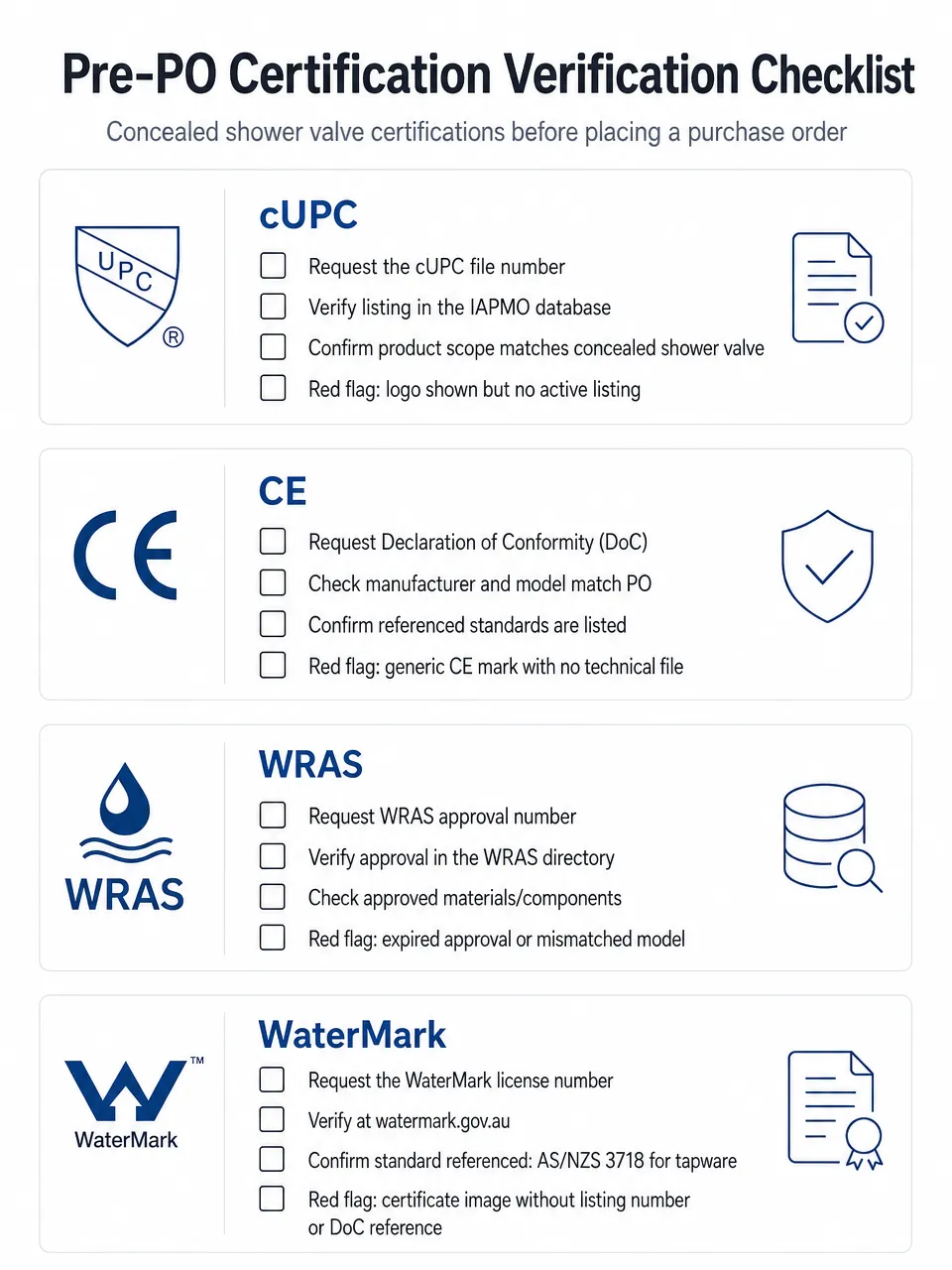
| Certification scope | Valve body certified (ASSE 1016, EN 1111, AS 4032) | Full assembly certified — trim included in test scope |
| SKU and packaging complexity | One SKU per valve body; trim is a separate line item | One SKU covers complete installation unit |
| OEM customization scope | Valve body OEM + separate trim OEM program | Single OEM program covers full visible assembly |
| Typical project fit | Experienced installers, OEM trim programs, multi-brand projects | Hotel FF&E, turnkey contractors, distributor catalog simplicity |
| MOQ structure | Lower MOQ possible on valve body alone | MOQ applies to complete assembly; trim tooling adds cost |

The Hidden Cost That Doesn't Show Up in Unit Price
The unit price difference between a valve-only body and a complete mixer is real — a valve body without trim is cheaper per unit. But that comparison only holds if you account for what the valve-only format requires downstream.
Trim coordination is the cost that most buyers underestimate. If you're supplying valve bodies to a contractor who sources trim separately, you're adding a procurement step, a compatibility verification step, and a delivery coordination step to every project. When those steps go wrong — wrong rough-in depth, mismatched finish, delayed trim delivery — the callback cost lands on your customer, and the warranty conversation eventually comes back to you. We've seen buyers switch from valve-only to complete mixer sourcing specifically because the trim coordination overhead was eating into their margin on smaller projects.
Certification scope is the other hidden cost. A valve body certified to ASSE 1016 (cUPC) covers the rough-in component. When you add a trim kit from a different source, that trim kit needs its own compliance documentation for certain markets. In Australia, WaterMark certification under AS 4032 applies to the complete fitting — a certified valve body with an uncertified trim plate is not a compliant installation. If your buyer is supplying to a project that requires full assembly certification, valve-only sourcing creates a documentation gap that can delay project sign-off.
With a complete mixer, the certification covers the assembly as tested. One document, one product, one compliance conversation. For hotel procurement teams working to a project timeline, that simplicity has real value — not because it's convenient, but because a documentation gap on a 200-room hotel fit-out can hold up the entire floor handover.
Finish consistency is the third dimension. In-house PVD and electroplating means we can match the trim plate finish to the valve body finish within the same production batch. When trim comes from a separate source, finish matching becomes a tolerance negotiation between two factories. Brushed nickel from one supplier and brushed nickel from another are not the same color — and in a hotel bathroom where the shower valve, the basin faucet, and the towel rail are all supposed to match, that difference is visible.
Which Format Wins in Each Project Segment
Hotel FF&E and Hospitality Procurement
Complete mixer, every time. Hotel procurement operates on tight project timelines, and the installation crew on a 150-room fit-out doesn't have bandwidth to manage trim sourcing as a separate procurement stream. The FF&E specification calls for a complete product — one SKU, one delivery, one installation. Certification documentation needs to cover the full assembly for the project's compliance file.
The 500,000-cycle cartridge endurance testing we run on every production batch is directly relevant here. A hotel shower valve that fails in year two generates a maintenance call, a room out of service, and a warranty conversation. The endurance test data travels with the shipment documentation — your procurement team has it for the project file without requesting it separately.
Residential Developer and Contractor Supply
This is where the answer splits based on your installer base. If you're supplying to experienced plumbing contractors who run their own trim programs or work with architects who specify trim separately, valve-only sourcing gives them the flexibility they want. The contractor controls the trim aesthetic, the developer controls the finish specification, and the valve body is a commodity rough-in component that gets certified and installed without drama.
If you're supplying to a broader contractor base — including smaller operators who don't have established trim sourcing relationships — the complete mixer reduces callbacks. The rough-in depth is pre-matched, the finish is pre-coordinated, and the installer has one product to install rather than two components to reconcile. For distributors building a catalog for this segment, the complete mixer is a simpler SKU to support.
Distributor Catalog and OEM Private Label
Valve-only sourcing makes sense when you're running an OEM trim program — you want your brand on the visible components, and you're sourcing the certified rough-in body as the functional core. Our OEM program starts at 200 pieces, which is low enough to test a valve-only SKU in your market before committing to container volume. We maintain in-house tooling for trim plate dies, so if you want to move from valve-only to a private-label complete mixer, the tooling development stays in-house and doesn't add weeks to the timeline.
For distributors who want catalog simplicity, the complete mixer is the stronger SKU. One product number, one installation instruction, one certification document. Your sales team doesn't need to explain trim compatibility to every customer, and your returns process doesn't involve sorting out whether the valve or the trim is the source of a complaint.
(This segment has grown significantly for us over the last three years — more distributors are moving toward complete mixer SKUs because the after-sales support cost on valve-only is higher than the unit price difference suggests.)
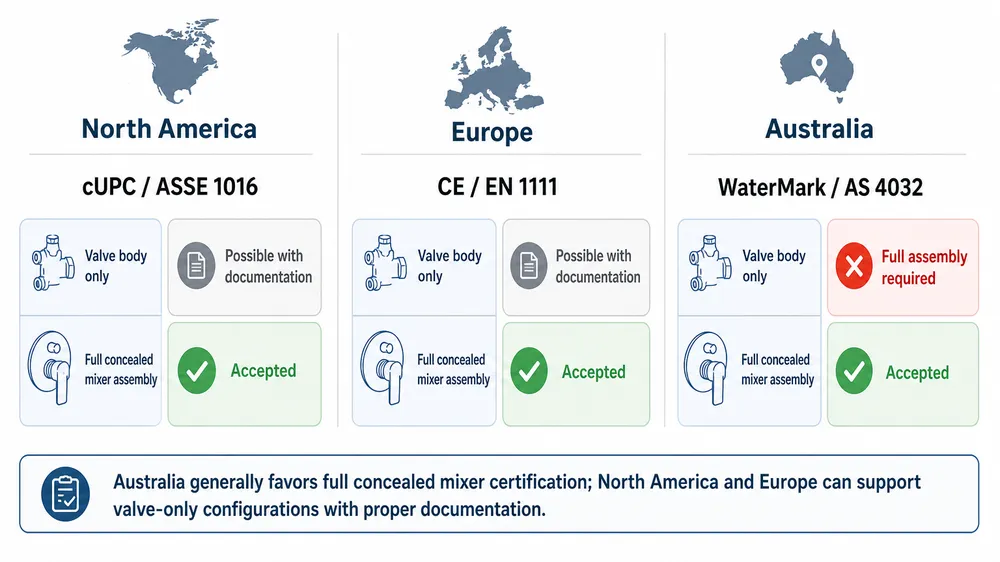
Certification Scope by Export Market: What Each Format Requires
This is the dimension that most sourcing guides skip, and it's the one that creates the most problems at customs or project sign-off.
North America (cUPC / ASSE 1016): The ASSE 1016 standard covers shower control valves — the rough-in body. A cUPC-certified valve body satisfies the code requirement for the valve function. Trim plates and handles are not separately certified under ASSE 1016, but they must be compatible with the certified valve body. For buyers supplying to US or Canadian projects, a certified valve body with a compatible trim kit is compliant — but you need to be able to document the compatibility.
Europe (CE / EN 1111 / EN 1287): CE marking for thermostatic mixing valves covers the complete mixing function. EN 1111 applies to thermostatic mixing valves for sanitary purposes. The certification scope typically covers the valve assembly as tested — which means a complete mixer with CE marking is a cleaner compliance position than a valve body with a separately sourced trim.
Australia (WaterMark / AS 4032): WaterMark is the most demanding in terms of assembly scope. AS 4032 covers temperature control devices for heated water systems, and WaterMark certification applies to the complete fitting as installed. A valve body with an uncertified trim plate is not a compliant WaterMark installation. If you're supplying to Australian projects, the complete mixer with WaterMark certification on the full assembly is the only clean path.
We hold cUPC, CE, and WaterMark under one roof — the same valve body can be documented for all three markets without switching suppliers. For buyers with multi-market distribution, that means one factory relationship covers your North American, European, and Australian compliance requirements.
SKU Structure and OEM Implications for Bulk Orders
The valve vs mixer distinction has a direct effect on how you structure your order and how we structure the OEM program.
A valve-only order is simpler on the factory side — one SKU covers the rough-in body across multiple trim configurations. If you're running three finish options (chrome, brushed nickel, matte black), the valve body is the same casting across all three; only the trim plate changes. That means lower tooling investment and more flexibility to add finish variants without a full new product development cycle.
A complete mixer order bundles the trim into the SKU, which means each finish variant is a distinct SKU with its own packaging, its own part number, and its own certification documentation if the trim is included in the test scope. For a distributor running 5 finish options across 2 valve configurations, that's 10 SKUs instead of 2 valve body SKUs plus 5 trim SKUs. The catalog management overhead is higher, but the customer-facing simplicity is also higher — one product number per complete installation unit.
For OEM private-label programs, the valve-only path lets you brand the visible components (trim plate, handle, escutcheon) while using a standard certified valve body as the functional core. This is the most common structure for distributors who want their brand on the product without investing in full valve body tooling. Our OEM MOQ starts at 200 pieces on trim components, and we can run mixed-finish trim orders against a standard valve body SKU — so you're not forced to commit to a single finish at the OEM stage.
The complete mixer OEM path makes sense when you want a fully branded product — your logo on the trim plate, your packaging, your installation instructions. The tooling investment is higher (trim plate die plus handle tooling), but the result is a product that's entirely yours from box to wall. Lead time from approved design to first sample runs 25–35 days for standard configurations; add 10–15 days if the trim plate requires new tooling.
What to Specify in Your RFQ to Avoid Rough-In Errors
A rough-in error on a concealed system costs more to fix than the valve itself. Once the tile is set, accessing the valve body to correct a depth mismatch or a port configuration error means breaking tile, replumbing, and retiling — a cost that falls on the contractor and eventually on the supplier relationship. Getting the specification right before the order is placed is the only way to avoid it.
When you send an RFQ for concealed shower valves or mixers, include:
- Valve type: pressure balance (single-function temperature control) or thermostatic (independent temperature and flow control). Thermostatic valves are the standard for hotel projects; pressure balance is common in residential.
- Outlet count: how many shower outlets the valve needs to control (body jets, overhead, handheld). This determines whether you need a diverter valve integrated into the body.
- Rough-in depth: the distance from the finished wall surface to the supply pipe centerline. Standard range is 65–90mm; specify your wall construction if you're not sure.
- Target finish: chrome, brushed nickel, matte black, PVD gold, or oil-rubbed bronze. For complete mixers, the finish applies to the trim plate and handle.
- Destination market: determines which certification documentation we prepare — cUPC for North America, CE for Europe, WaterMark for Australia.
- Annual volume: affects MOQ structure and whether OEM tooling investment makes sense at your volume.
We run both concealed shower valves and complete concealed shower mixers on a dedicated assembly line — the same line that handles the cartridge assembly, endurance testing, and finish application for both formats. Single-source for buyers who need both formats in one order, or who want to test valve-only vs complete mixer SKUs before committing to container volume.
FAQ: Concealed Shower Valve vs Mixer for B2B Sourcing
What is the difference between a concealed shower valve and a concealed shower mixer?
A concealed shower valve is the rough-in body only — the brass cartridge housing that installs inside the wall and controls water flow and temperature. It ships without a trim plate or handle. A concealed shower mixer integrates the valve body with a trim plate and control handle into a single assembly. The mixer is a complete installation unit; the valve is a component that requires a separately sourced trim kit.
Which format is better for hotel FF&E procurement?
Complete mixer. Hotel projects require a single SKU that ships complete, installs without trim coordination, and carries full assembly certification for the project compliance file. The complete mixer eliminates the trim sourcing step and the compatibility verification step — both of which add project management overhead that hotel procurement timelines don't accommodate.
Does WaterMark certification cover valve-only or full assembly?
WaterMark under AS 4032 applies to the complete fitting as installed. A certified valve body with an uncertified trim plate is not a compliant WaterMark installation. For Australian projects, the complete mixer with WaterMark certification on the full assembly is the correct sourcing path.
What is the MOQ for OEM concealed shower valves from Wfaucet?
OEM starts at 200 pieces for trim components against a standard certified valve body. Full OEM programs covering both valve body and trim tooling are available from 500 pieces. We maintain in-house tooling for brass casting dies and trim plate dies, so tooling revisions don't go to an outside vendor.
Can the same valve body be certified for North America, Europe, and Australia?
Yes — we hold cUPC, CE, and WaterMark under one roof. The same valve body casting can be documented for all three markets. For buyers with multi-market distribution, this means one factory relationship covers your compliance requirements across North America, Europe, and Australia without switching suppliers or managing separate certification timelines.
How do I prevent rough-in depth mismatches on a concealed valve order?
Specify the rough-in depth (distance from finished wall surface to supply pipe centerline) in your RFQ. Standard range is 65–90mm. For complete mixers, the trim plate is engineered to the valve body's exact rough-in depth — that compatibility is factory-resolved. For valve-only orders, confirm the trim kit's rough-in depth range before the order is placed. A mismatch discovered after tile installation is a costly correction.
For buyers comparing Concealed Shower Valves and complete Concealed Shower Mixers & Sets for a bulk order, the decision comes down to three questions: who is doing the trim coordination, which markets need certification coverage, and how much SKU complexity your catalog can support. If you have a project spec or a volume target in mind, send us the details — valve type, outlet count, target finish, destination market, and annual volume — and we'll come back with pricing and a recommendation on which format fits your sourcing program.