

The container arrives. Your customs broker flags it. The faucets are listed as potable water fixtures, and the importer of record needs NSF 61 documentation before the shipment clears. Your supplier sends a certificate number. You look it up in the NSF database. The scope covers the body casting — but not the cartridge, not the solder joints, not the internal coating on the spout. The product fails the scope check.
That scenario plays out more often than it should, and it's almost always a sourcing documentation problem, not a product problem. The faucets may be perfectly safe. But if the certification scope doesn't cover every wetted surface component, the certificate is commercially useless in markets that require full NSF 61 compliance.
This guide explains what NSF 61 actually tests, how it differs from NSF 372 (the standard most buyers conflate it with), and how to qualify a supplier before the order is placed — not after the container is on the water.
What NSF 61 Actually Tests — and Why Stainless Steel Body Material Alone Doesn't Guarantee Compliance
NSF/ANSI 61 is a drinking water system components standard. It tests whether a product leaches contaminants into potable water at levels that exceed health-based thresholds. The test protocol exposes wetted surfaces to water under controlled conditions, then analyzes the extract for a list of regulated substances — lead, cadmium, antimony, barium, and others depending on the component category.
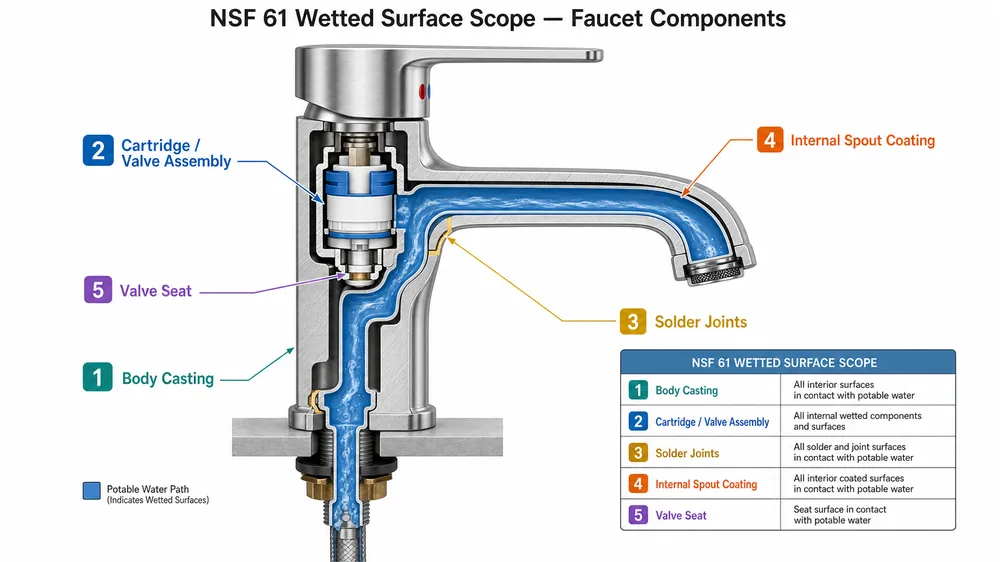
The critical word is "wetted surfaces." NSF 61 doesn't care what the outside of your faucet looks like. It cares about every surface that water touches from the inlet to the outlet.
For a stainless steel bathroom faucet, that means:
- The body casting — stainless steel or brass, depending on the product line
- The cartridge and ceramic disc assembly — including the cartridge housing material and any lubricants applied during assembly
- Internal coatings — some spout bodies have an internal epoxy or polymer coating to prevent corrosion; that coating is a wetted surface
- Solder and flux residue — if any brazed joints exist in the water path
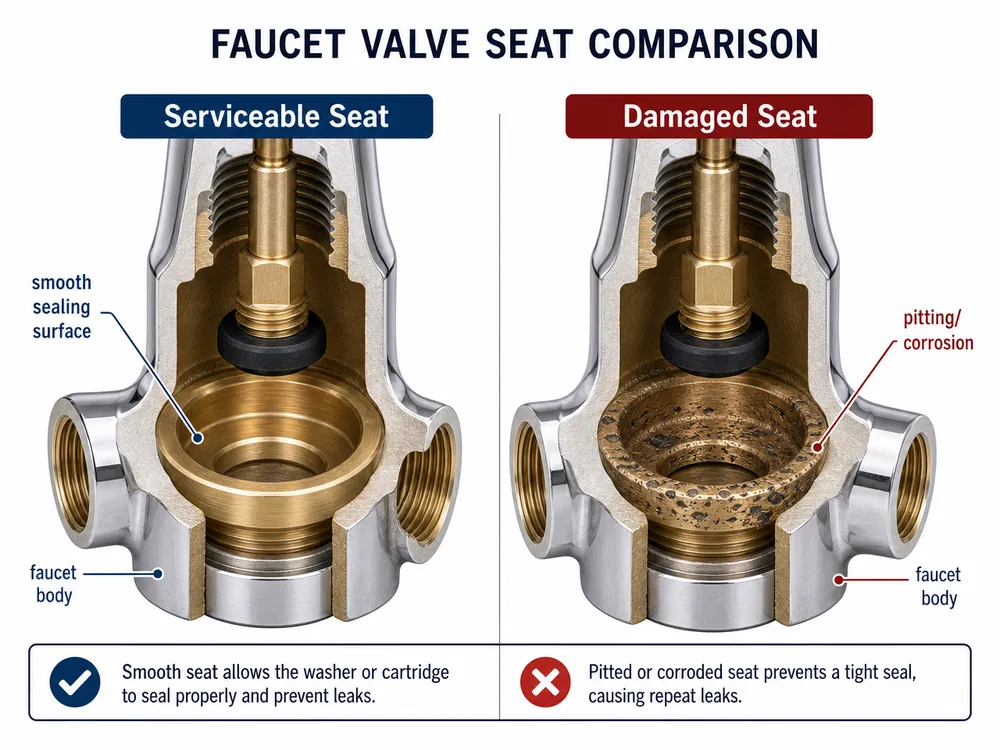
- The valve seat — the seating surface the ceramic disc contacts
- O-rings and seals — elastomers in the water path are tested separately under NSF 61 Section 9
A stainless steel body is a good starting point. Grade 304 stainless has low leachable metal content and handles chlorinated water well. But if the cartridge housing is made from a brass alloy with elevated lead content, or if the internal spout coating hasn't been tested, the body material is irrelevant to the compliance question.
We've seen buyers come to us after a compliance failure where the faucet body was fine — the problem was a cartridge sourced from a supplier who hadn't run NSF 61 testing on the housing material. The cartridge passed functional testing. It failed the extract analysis.
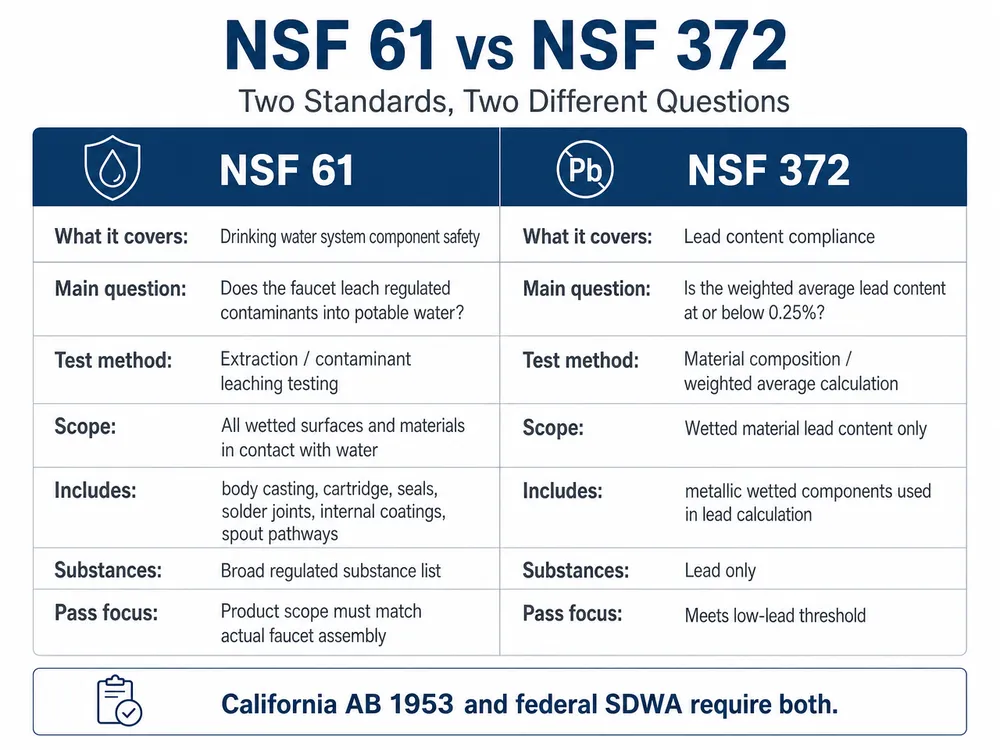
NSF 61 vs NSF 372: Two Standards, Two Different Questions
This is where most buyers lose time. NSF 61 and NSF 372 are related but not interchangeable, and conflating them creates documentation gaps that surface at the worst possible moment.
NSF/ANSI 61 asks: does this product leach contaminants into drinking water at harmful levels? It covers a broad list of regulated substances and applies to the full wetted surface assembly.
NSF/ANSI 372 asks: is the weighted average lead content of all wetted surfaces below 0.25%? It's a lead-specific standard, and it's the one referenced by the US Safe Drinking Water Act's "lead-free" definition for plumbing fittings.
The practical difference for sourcing:
| Standard | What it tests | Who requires it | What a certificate covers |
|---|---|---|---|
| NSF 61 | Full contaminant leaching from all wetted surfaces | Most US state plumbing codes; California, Vermont, Maryland, Louisiana | The specific product configuration tested — body + cartridge + seals as assembled |
| NSF 372 | Weighted average lead content of wetted surfaces | Federal "lead-free" definition under SDWA; required for sale in all US states | Lead content calculation across all wetted components |
California's AB 1953 and the federal SDWA amendments require both standards for faucets sold into potable water applications. A product can pass NSF 372 (low lead content) and still fail NSF 61 (leaches another regulated substance). A product can have NSF 61 certification and still fail NSF 372 if the lead calculation wasn't done correctly.
(The confusion is compounded by the fact that some certification bodies issue a combined NSF 61/372 listing. When you see that, it means both standards were tested in the same program — it's not a shortcut, it's just efficient paperwork.)
For buyers sourcing into North America, you need both. For buyers sourcing into Australia, WaterMark covers similar ground under AS/NZS 4020. For Europe, the relevant standard is EN 15664 for metallic materials in contact with drinking water. The underlying testing logic is similar across all three — wetted surface extract analysis — but the specific thresholds and scope definitions differ.

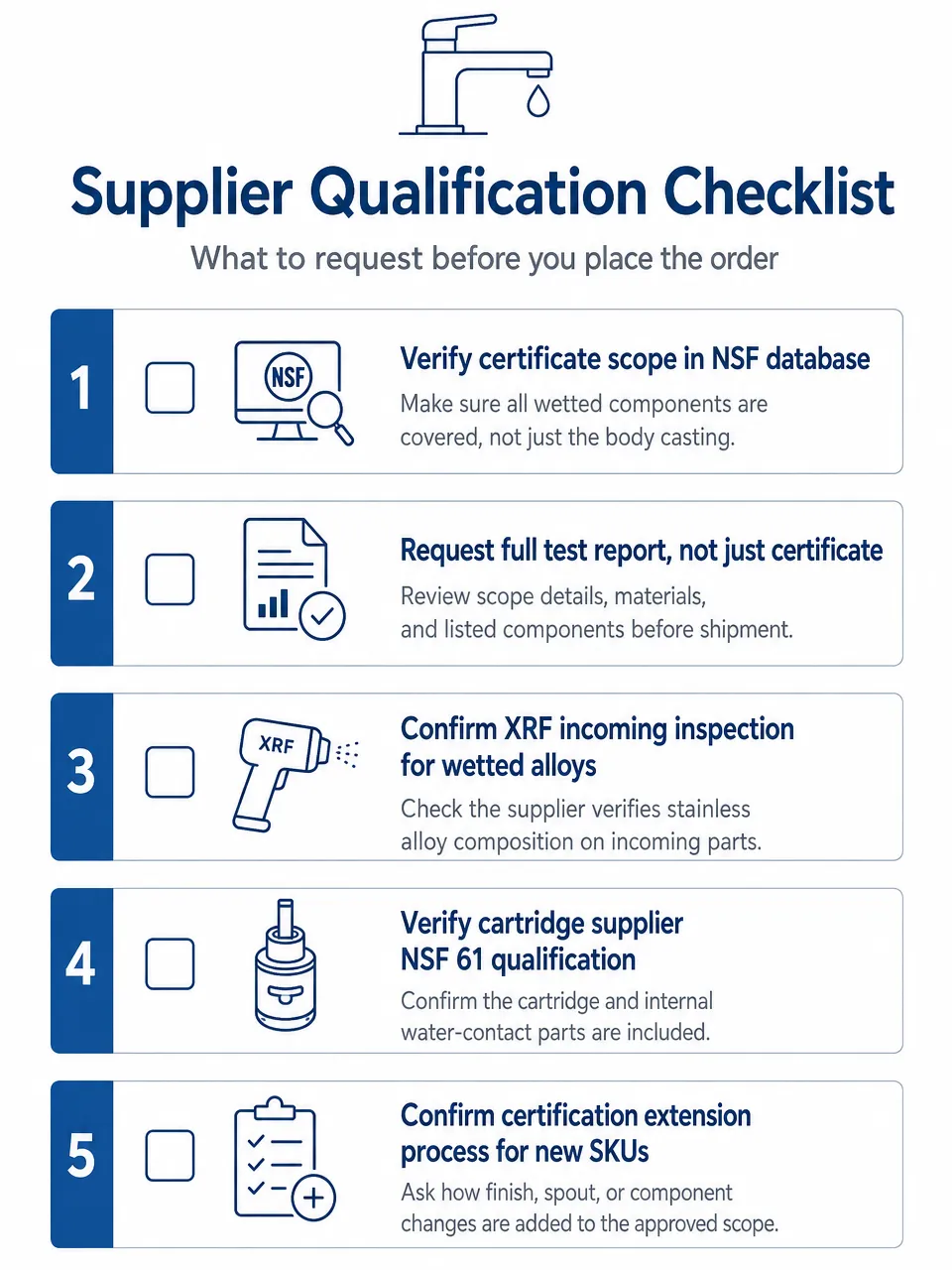
The Supplier Qualification Checklist: What to Request Before You Place the Order
The most expensive compliance problem is the one you discover after the container ships. The documentation checklist below is what we'd recommend requesting from any supplier before committing to an order of NSF 61-relevant product.
Step 1: Verify the certificate scope, not just the certificate number
Ask for the actual NSF certification listing, not a copy of the certificate. The NSF International database (nsf.org) is publicly searchable. Look up the certificate number and confirm:
- The listed product model matches what you're ordering
- The scope includes the complete assembly — body, cartridge, and seals — not just the body casting
- The certificate is current (not expired or suspended)
- The certification body is accredited (NSF, IAPMO, UL, or another ANSI-accredited body)
A certificate number that covers only the body casting is not NSF 61 compliance for the assembled faucet. This is the most common documentation gap we see.
Step 2: Request the test report, not just the certificate
The test report shows what was actually tested and what the extract results were. Ask for:
- The full NSF 61 test report for the product configuration you're ordering
- The NSF 372 lead content calculation worksheet
- The cartridge supplier's NSF 61 test report for the cartridge housing material (if the cartridge is sourced separately)
If the supplier can't produce the test report — only the certificate — that's a red flag. Certificates can be transferred or misapplied. Test reports are specific to the product configuration tested.
Step 3: Confirm incoming material controls for wetted surface alloys
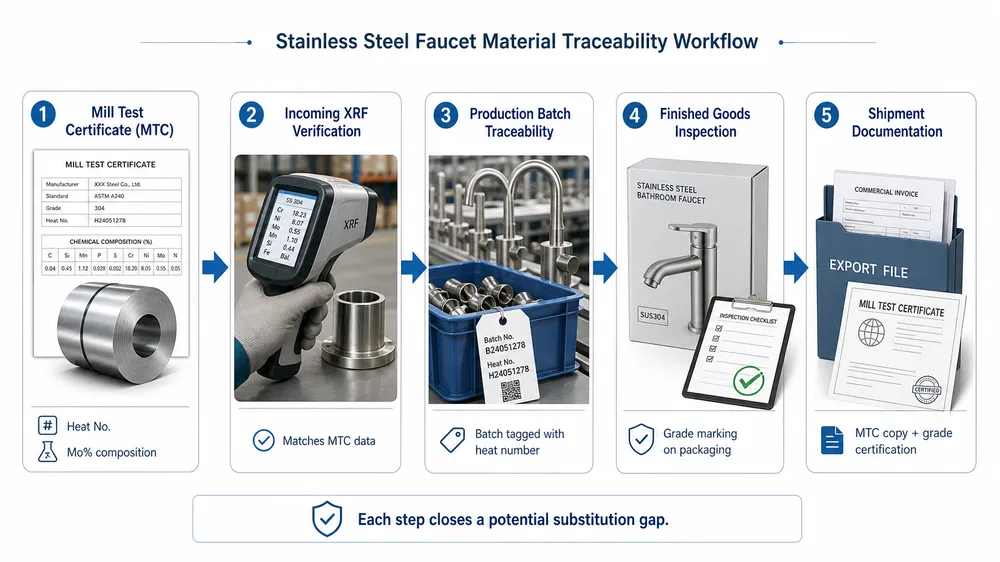
Ask how the supplier controls lead content in incoming brass or stainless alloys. The answer you want is XRF (X-ray fluorescence) incoming inspection on every batch. XRF gives a non-destructive elemental analysis of the alloy in under a minute — it's the standard tool for incoming lead content verification in factories that take cUPC or NSF 372 seriously.
If the supplier's answer is "we rely on the mill certificate," that's a weaker control. Mill certificates are batch-level documents, and they don't catch alloy substitution or contamination that happens between the mill and the casting floor.
Step 4: Verify cartridge supplier qualification
The cartridge is the component most likely to create a compliance gap. Ask:
- Who supplies the cartridge?
- Does the cartridge supplier hold NSF 61 certification for the cartridge housing material?
- What endurance testing does the supplier run on incoming cartridge batches?
A cartridge that passes functional testing (500,000 cycles, no leak) can still fail NSF 61 extract analysis if the housing material wasn't qualified. These are separate tests.
Step 5: Confirm the certification extension process for new variants
If you plan to add SKUs — new finishes, new handle configurations, new spout lengths — ask how the supplier handles certification extension. A full re-certification from scratch takes months and costs money. A supplier with an established certification program can often extend coverage to new variants through a documentation update with the certification body, provided the wetted surface materials haven't changed.
How Wfaucet's Existing Documentation Infrastructure Maps to NSF 61 Requirements
We don't hold NSF 61 certification as a standalone listing — I want to be direct about that. What we do hold is cUPC certification for North American product lines, and the cUPC program under IAPMO runs NSF 61 and NSF 372 testing as part of its qualification process. So for products in our cUPC-certified range, the NSF 61 and 372 testing has been done — it's embedded in the cUPC documentation package.
For buyers who need a standalone NSF 61 listing (some state codes or project specifications require it explicitly), we can work with you on the certification path. The testing infrastructure is already in place; it's a matter of running the product through an ANSI-accredited certification body and getting the listing issued.
Here's what the documentation package looks like for a standard cUPC-certified product from our line:
- cUPC test report — includes NSF 61 extract analysis and NSF 372 lead content calculation as part of the IAPMO qualification
- XRF incoming inspection records — we run XRF on every incoming brass alloy batch, and we apply that standard to all production, not just North American orders
- Cartridge supplier qualification records — our approved cartridge suppliers have been through a 50,000-cycle pre-qualification test, and we hold their material test reports on file
- SGS audit report — third-party factory audit covering our QC system and material controls
- Brass alloy specification — C36000-equivalent free-machining brass, with lead content documented in the alloy spec and verified by incoming XRF
The brass alloy qualification process we went through for cUPC in 2013 is directly analogous to what NSF 61 requires for wetted surface materials. We revalidated our alloy supplier and casting parameters at that point, and those controls have been in place since. (That revalidation wasn't painless — we had to qualify a new alloy supplier and run a full casting parameter study. But it's done, and the documentation exists.)
For multi-market buyers, the combination of cUPC, CE, and WaterMark under one roof means you're not managing separate supplier relationships to cover North America, Europe, and Australia. The documentation for each market ships with the order.
Common Sourcing Mistakes That Create Compliance Exposure
These are the patterns we see most often when buyers come to us after a compliance problem with a previous supplier.
Accepting a certificate number without verifying scope. The certificate exists. The product is listed. But the scope covers only the body casting, not the assembled product. The buyer didn't check. The container shipped. The project specification required full assembly certification.
Overlooking cartridge and valve seat materials. The body is stainless steel or low-lead brass. The cartridge housing is a different alloy, sourced from a different supplier, with no NSF 61 testing on the housing material. The body passes. The cartridge fails the extract analysis.
Treating NSF 61 and NSF 372 as the same requirement. The supplier provides an NSF 372 lead-free certificate. The project specification requires NSF 61. These are different tests. The buyer assumes one covers the other. It doesn't.
Not requesting batch-level test reports. The supplier has a valid NSF 61 certificate from a test run two years ago. The current production batch uses a different cartridge supplier. The certificate is still valid. The current product configuration hasn't been tested.
Assuming stainless steel body = automatic NSF 61 compliance. Stainless steel has low leachable metal content, which is a genuine advantage. But NSF 61 tests the full wetted surface assembly. A stainless body with an unqualified internal coating or an unqualified cartridge doesn't pass NSF 61 on the strength of the body material alone.
How to Structure Your RFQ to Get NSF 61 Documentation Upfront
The way you write the RFQ determines what documentation you receive — and when. Most buyers ask for "NSF 61 compliant" product without specifying what documentation they need. The supplier confirms compliance. The documentation arrives after the order is placed, or after the container ships, and it doesn't match what the project specification requires.
Structure your RFQ to include these explicit documentation requirements:
Required documentation (to be provided with quotation):
1. NSF 61 test report for the specific product configuration quoted
   (body + cartridge + seals as assembled — not body casting only)
2. NSF 372 lead content calculation worksheet
3. Current NSF/IAPMO/UL certification listing with scope confirmation
4. XRF incoming inspection protocol for wetted surface alloys
5. Cartridge supplier NSF 61 qualification documentation
6. Certification extension process for new finish or configuration variants
If the supplier can't provide items 1–3 with the quotation, that's the answer. You're not asking for anything unusual — you're asking for documentation that any supplier with genuine NSF 61 compliance should have on file.
One more thing worth stating plainly: a supplier who pushes back on providing test reports before the order is placed is telling you something. Test reports aren't proprietary. They're the evidence that the certification is real.
Practical FAQ
Can I use a cUPC-certified faucet to satisfy an NSF 61 requirement?
In most cases, yes. IAPMO's cUPC program includes NSF 61 and NSF 372 testing as part of the qualification. If the product holds a current cUPC listing, the NSF 61 testing has been done. Verify by checking the IAPMO product listing — it will show the specific standards covered. Some project specifications or state codes require a standalone NSF 61 listing rather than accepting cUPC as equivalent; confirm the requirement before assuming cUPC satisfies it.
Does a stainless steel faucet body require less NSF 61 testing than a brass body?
The testing scope is the same — all wetted surfaces must be tested regardless of body material. Stainless steel (304 or 316 grade) typically produces lower leachable metal results than brass in the extract analysis, which reduces the risk of failing the contaminant thresholds. But the cartridge, seals, and internal coatings still need to be tested. The body material affects the test results; it doesn't change the test scope.
What's the difference between NSF 61 Section 8 and Section 9?
Section 8 covers metallic and non-metallic materials in contact with drinking water — this is where faucet bodies, cartridge housings, and internal coatings are tested. Section 9 covers mechanical devices such as valves and faucets as assembled products. Most faucet certifications reference Section 9, which covers the assembled product. If a supplier's certificate references only Section 8, it covers materials, not the assembled faucet — that's a scope gap.
How often does NSF 61 certification need to be renewed?
NSF International and IAPMO both require annual factory audits and periodic retesting as part of maintaining a listing. The certification doesn't expire on a fixed date, but it can be suspended or withdrawn if the factory audit fails or if a product change isn't reported to the certification body. Always verify the current status in the certification body's database, not just the certificate document.
If I add a new finish to an existing certified product, does it need full re-certification?
Usually not, if the wetted surface materials haven't changed. A new external finish (chrome to brushed nickel, for example) doesn't affect the wetted surface assembly, so the existing NSF 61 certification typically extends to the new finish variant through a documentation update. A new internal coating or a different cartridge supplier would require retesting. Confirm the specific scope of any change with your supplier before assuming the existing certification covers it.
If you're sourcing Stainless Steel Bathroom Faucets for North American distribution or project supply and need the compliance documentation to match, send us your target SKU, destination market, and the specific certification requirements in your project specification. We'll respond with the applicable test reports and a compliance documentation package alongside the quote — not after the order is placed.
Browse our full Bathroom Faucets range, or Request a Quote with your compliance requirements included.