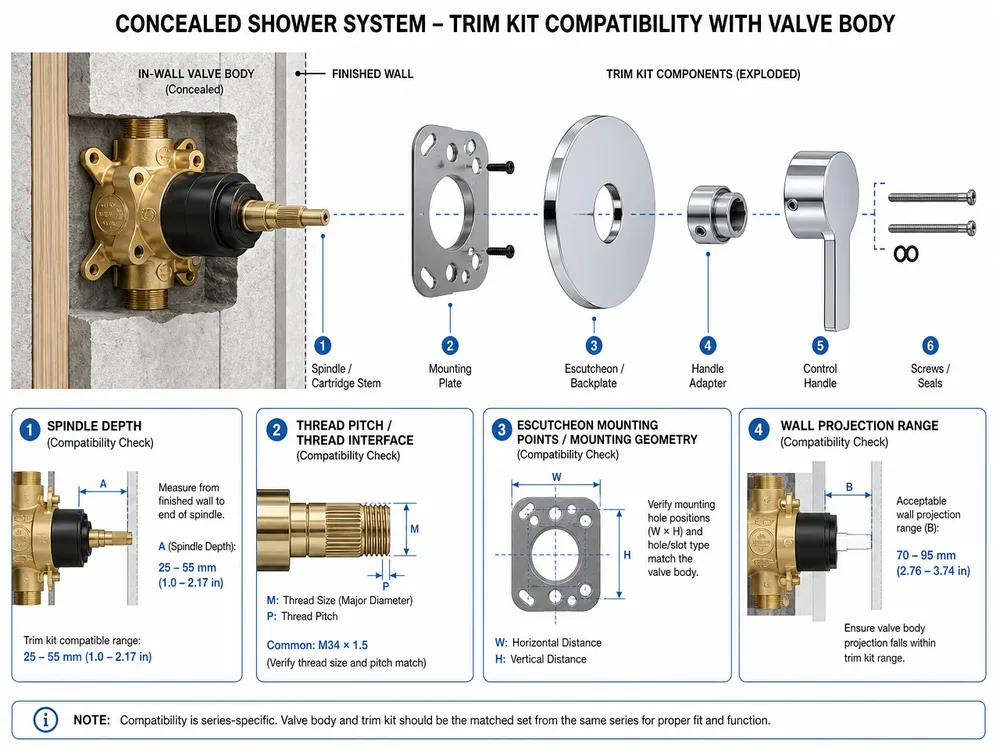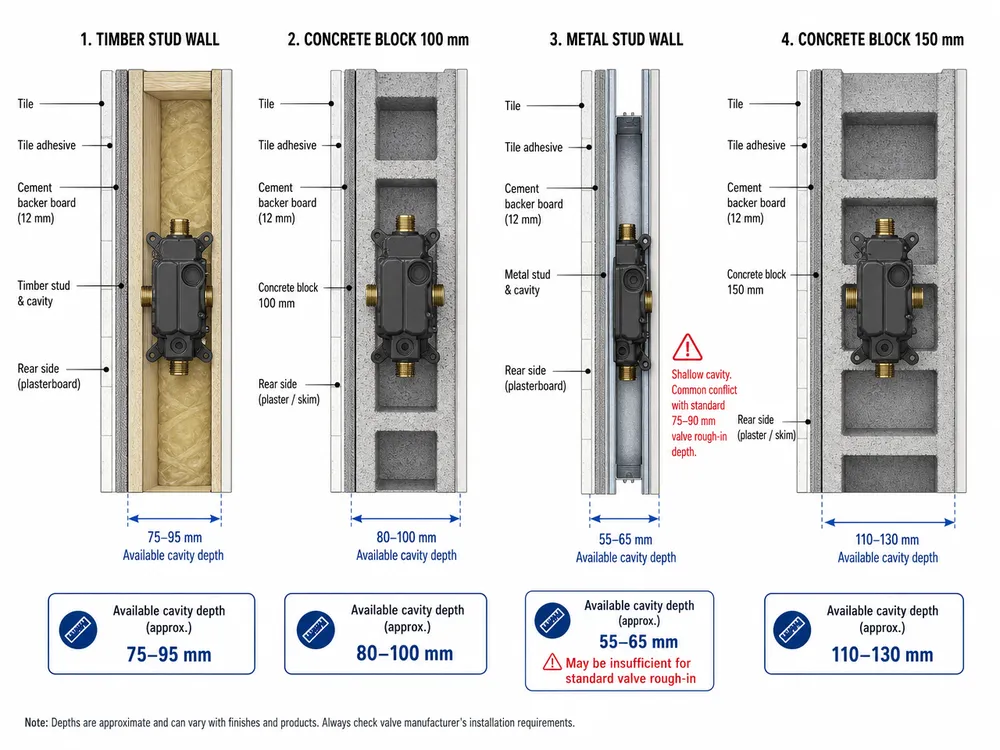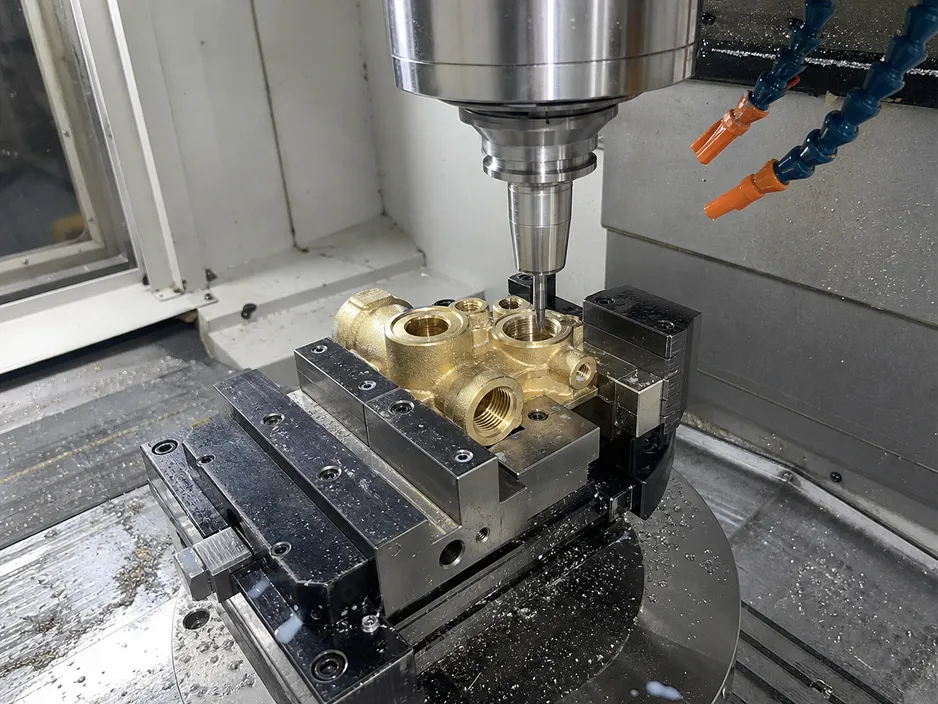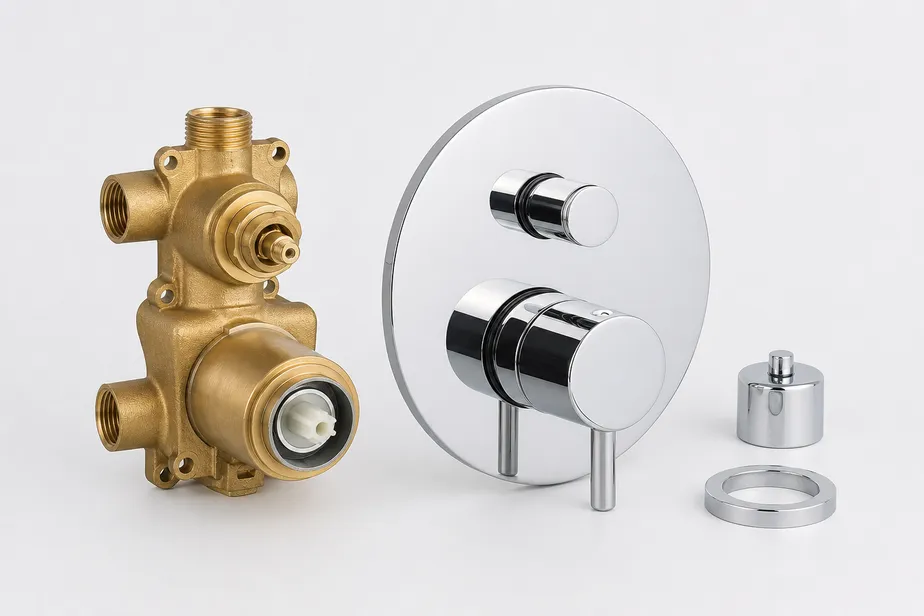


We had a container held at a US port in 2011 over a documentation gap on a concealed valve shipment. The product was fine. The certification was real. The paperwork was incomplete. That delay cost our buyer two weeks and a missed project deadline, and it cost us a relationship that took a year to rebuild.
That experience is why I'm writing this. The certifications themselves are not complicated once you understand what each one actually tests and what documentation it generates. The problem is that most of what's published about shower valve certifications is written by the certification bodies themselves — useful for understanding the standard, but not useful for understanding what it means when you're placing a PO with a Chinese factory and need to know what to ask for.
This article covers cUPC, CE, WRAS, and WaterMark from the factory side: what each certification requires us to do, what it produces in terms of documentation, and how you can verify it before your shipment leaves the floor.
Which Certification Goes to Which Market
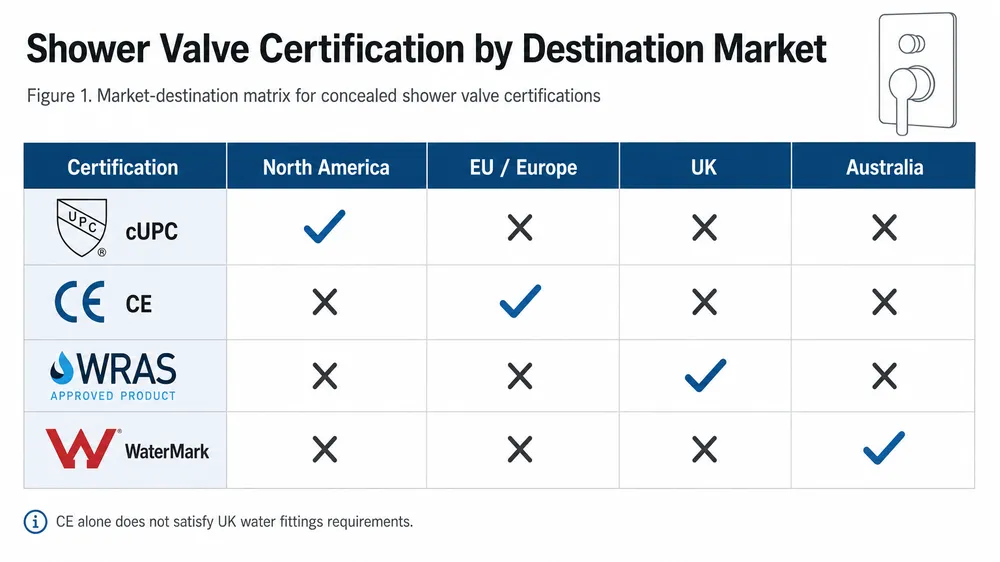
Before getting into what each standard tests, here's the destination map. This is the question that causes the most confusion at the PO stage.
| Certification | Issuing Body | Primary Market | What It Covers |
|---|---|---|---|
| cUPC | IAPMO | USA & Canada | Lead content, pressure, flow, materials |
| CE | Self-declared / notified body | EU member states | Pressure equipment, material safety, product conformity |
| WRAS | Water Regulations Advisory Scheme | UK (water fittings) | Water quality protection, material approval |
| WaterMark | WaterMark Certification Scheme | Australia & NZ | Plumbing product performance and safety |
A few things worth noting here. CE and WRAS are not interchangeable for UK shipments — post-Brexit, the UK runs its own water fittings approval system, and WRAS approval is the relevant standard for concealed shower mixers going into UK plumbing installations. A CE mark alone does not satisfy UK water regulations. We see buyers make this assumption regularly, and it creates problems at the distributor level when their customers or installers ask for WRAS documentation.
WaterMark is often overlooked by buyers who are primarily focused on North American or European markets, but if you're building a product line for Australian distribution, it's non-negotiable. Australian plumbing codes require WaterMark certification for any product that connects to the water supply — and enforcement at the installer level is real.
What cUPC Actually Tests — and Why Brass Alloy Selection Matters
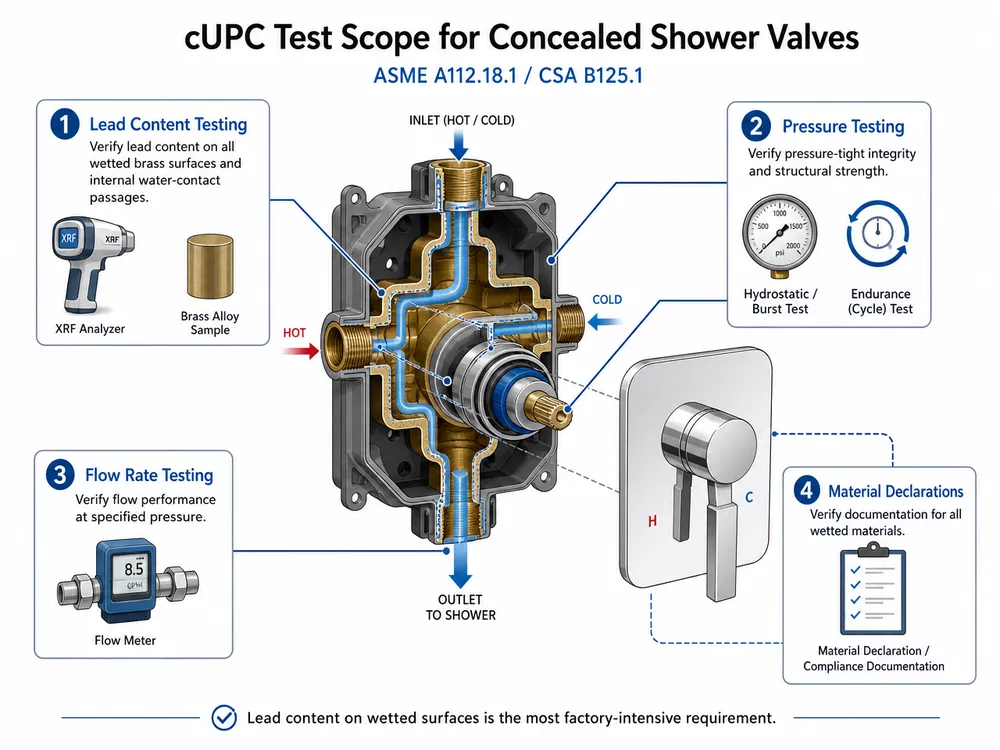
cUPC is issued by IAPMO (International Association of Plumbing and Mechanical Officials) and is the certification that North American distributors and project procurement teams will ask for first. The standard it references is ASME A112.18.1 / CSA B125.1, which covers plumbing supply fittings.
The test scope for a concealed shower valve includes:
- Lead content: The Reduction of Lead in Drinking Water Act (effective 2014) requires that wetted surfaces contain no more than a weighted average of 0.25% lead. This is the test that forced us to requalify our brass alloy supplier when we first pursued cUPC certification. The alloy we were using for domestic-market production was a standard free-machining brass with lead content that was fine for non-potable applications but didn't meet the weighted average calculation for wetted surfaces. We switched to a low-lead brass alloy and revalidated our casting parameters before the certification audit.
- Pressure performance: Valves are tested at rated working pressure (typically 125 psi / 860 kPa) and at elevated pressure to verify no leakage or structural failure.
- Flow performance: Flow rate at rated pressure must meet minimum thresholds. For thermostatic concealed valves, the test also covers temperature stability under varying inlet pressure conditions.
- Material declarations: All wetted materials must be declared and verified against the standard's approved materials list.
The lead content requirement is the one that separates factories that have genuinely gone through cUPC certification from those that are claiming it. Running XRF analysis on incoming brass batches is the only reliable way to verify lead content before production — and it's what we do on every batch, regardless of destination market. (We made that call after certification because the discipline of testing every batch is cheaper than the risk of a non-conforming shipment.)
When you're verifying a supplier's cUPC claim, ask for the IAPMO listing number. Every certified product has one, and you can verify it directly in the IAPMO product directory. A certificate image without a listing number is not sufficient.
CE Marking for Shower Valves: What It Covers and What It Doesn't
CE marking for concealed shower valves is more nuanced than it appears on the surface. The relevant EU directives depend on the product's pressure rating and function.
For most concealed shower mixers and thermostatic valves, the applicable framework is the Pressure Equipment Directive (PED 2014/68/EU) for the pressure-bearing components, combined with the Construction Products Regulation (CPR) if the product is being installed as part of a building's fixed plumbing system. The RoHS Directive applies to any electronic components in thermostatic or digital concealed systems.
What CE marking does not cover: water quality protection. The CE mark confirms that the product meets EU safety and performance requirements, but it does not certify that the materials in contact with drinking water are safe for that purpose. That's covered separately by the EU Construction Products Regulation Article 3(1)(e) and, in practice, by national-level approvals like the German DVGW, French ACS, or UK WRAS. For most EU export markets, CE plus a material declaration (confirming compliance with the relevant drinking water contact material standards) is what your buyers will need.
The documentation CE generates: a Declaration of Conformity (DoC) signed by the manufacturer, a technical file held at the factory, and the CE mark on the product and packaging. The DoC must reference the specific directives and harmonized standards the product was tested against. If a supplier gives you a CE certificate without a DoC, ask for the DoC — the certificate alone is not the compliance document.
We've had buyers come to us after sourcing from factories that had CE marks on their packaging but couldn't produce a DoC or a technical file. The CE mark is self-declared for many product categories, which means the compliance burden is on the manufacturer — and some factories treat it as a label rather than a documented compliance process.
WRAS Approval: The UK-Specific Requirement That CE Doesn't Replace
WRAS (Water Regulations Advisory Scheme) approval is the UK's water fittings approval system, and it operates differently from CE marking. Where CE is largely self-declared, WRAS approval requires third-party testing by a WRAS-approved test house and listing in the WRAS product approval scheme database.
For a concealed shower mixer, WRAS testing covers:
- Material approval: All materials in contact with water must be approved under BS 6920, which tests for effects on water quality (taste, odor, toxicity, microbial growth support). This is the test that catches materials that are structurally fine but leach compounds into the water supply.
- Backflow prevention: UK water regulations require that fittings prevent backflow that could contaminate the supply. Concealed thermostatic valves with check valves built into the body need to demonstrate that the check valves meet the required backflow prevention category.
- Pressure and flow performance: Similar to cUPC, but referenced against UK water pressure norms (typically 1–10 bar working pressure).
The WRAS approval database is public and searchable at wras.co.uk. Every approved product has a listing with the approval number, the test house, and the scope of approval. If a supplier claims WRAS approval, verify the listing number in the database before placing the order.
One thing buyers sometimes miss: WRAS approval is product-specific and configuration-specific. An approval for a chrome concealed mixer does not automatically extend to a brushed nickel version of the same body if the surface finish uses different materials. We manage this through our certification extension process — when we add a new finish to a WRAS-approved body, we submit the finish material data to the test house for review before listing the new configuration. (This is also why we maintain detailed material declarations for every finish option — it's not just good practice, it's required for certification maintenance.)
WaterMark: Australia's Non-Negotiable for Plumbing Products
WaterMark certification is administered by the Australian Building Codes Board and is mandatory for any plumbing product that connects to the water supply in Australia. The relevant standard for concealed shower valves is AS/NZS 3718 (water supply — tapware).
The test scope covers pressure performance, flow rate, temperature stability (for thermostatic valves), and material safety. WaterMark certification requires testing by a JAS-ANZ accredited laboratory and listing in the WaterMark product database, which is maintained by the ABCB.
For buyers building Australian distribution, the practical implication is that WaterMark certification needs to be confirmed before the product is specified into a project. Australian plumbers are required to use WaterMark-certified products, and they will ask for the certification number. A product without WaterMark certification cannot legally be installed in Australian plumbing systems.
We hold WaterMark certification on our concealed shower valve range, and the listing numbers are available on request with any quote for Australian-market orders.
How to Verify Certification Documentation Before You Place the PO
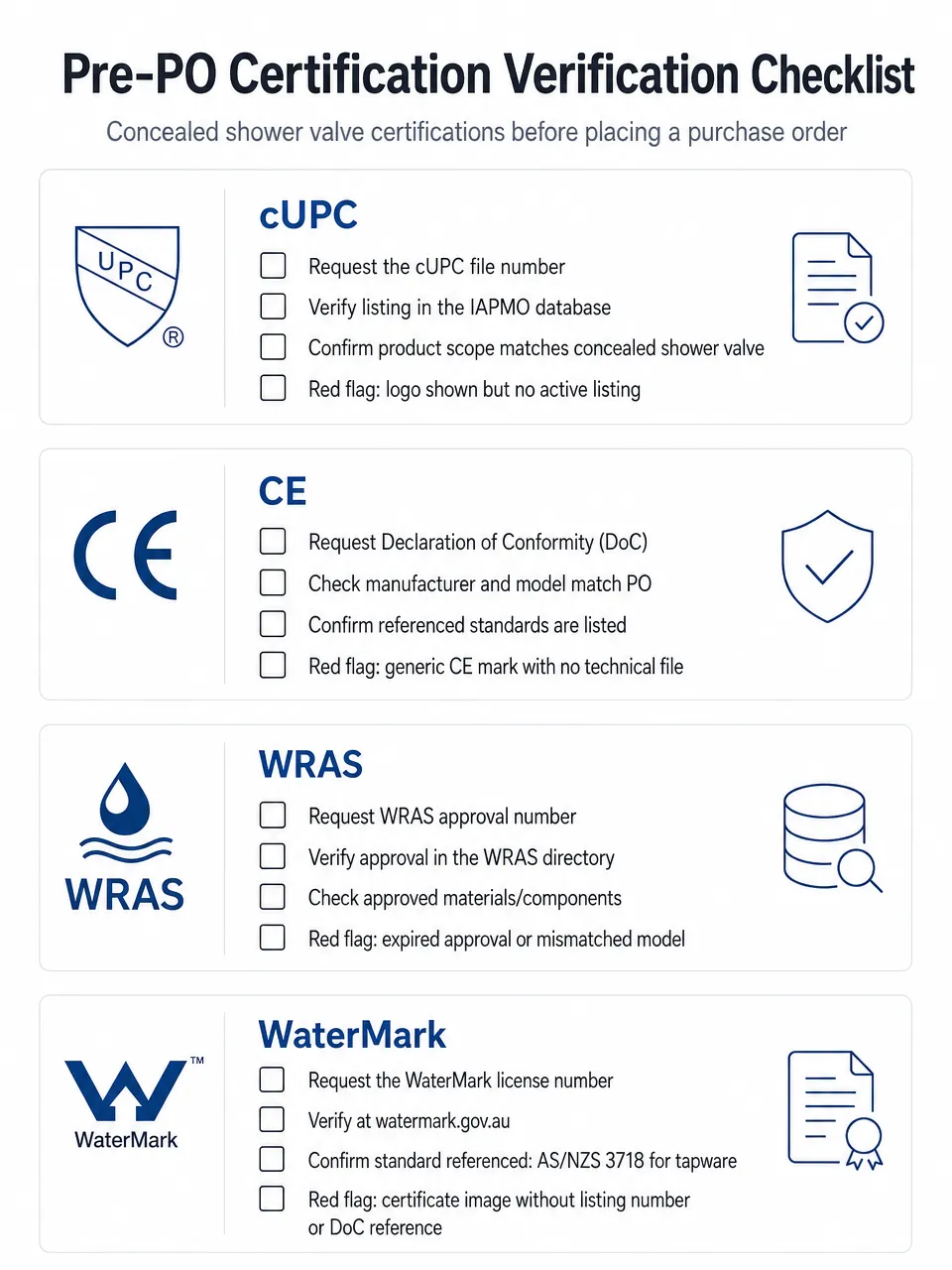
This is the section that most certification guides skip. Here's what to request and what to check.
For cUPC
- Request the IAPMO listing number for the specific product model
- Verify the listing at iapmo.org/product-directory
- Confirm the listing covers the exact configuration you're ordering (body type, trim kit, finish)
- Request the test report from the IAPMO-accredited laboratory — this should show lead content results, pressure test data, and flow test data
For CE
- Request the Declaration of Conformity (not just a certificate image)
- The DoC must name the specific EU directives and harmonized standards
- Request the technical file index — you don't need the full file, but a supplier who can't describe what's in it hasn't actually built one
- For drinking water contact compliance, request the material declaration referencing the relevant EU or national standard
For WRAS
- Request the WRAS approval number
- Verify the listing at wras.co.uk/product-approvals
- Confirm the approval covers the specific finish and configuration you're ordering
- Check the approval expiry date — WRAS approvals require periodic renewal
For WaterMark
- Request the WaterMark license number
- Verify at watermark.gov.au
- Confirm the standard referenced (AS/NZS 3718 for tapware)

Red flags to watch for:
- A certificate image without a listing number or DoC reference
- A listing that covers a different model number than what you're ordering
- A supplier who can't name the test house or laboratory that issued the certification
- CE marking without a Declaration of Conformity
- WRAS or WaterMark claims that don't appear in the public database
We've seen all of these. The most common is a CE mark on packaging that was applied based on a self-declaration that was never properly documented. It passes visual inspection at the port but creates problems when your buyer's compliance team or a building inspector asks for the technical file.
OEM Variants and Certification Extensions: What Changes When You Customize
This is a question we get regularly from buyers who want to add a new finish or a custom handle configuration to a certified concealed valve body.
The short answer: adding a new finish or handle to an existing certified body does not require full re-certification in most cases, but it does require a certification extension or variant review. The process varies by certification body.
For cUPC, IAPMO allows listing amendments for new finish variants if the base body and wetted components remain unchanged. We submit the finish material data and a declaration that the wetted surface configuration is identical to the listed product. The amendment process typically takes 4–8 weeks and is significantly less expensive than a full certification.
For CE, new finish variants require an update to the Declaration of Conformity and the technical file. If the new finish introduces materials not previously declared, those materials need to be verified against the relevant EU standards. We handle this internally — our engineering team maintains the technical file and updates it for each new variant.
For WRAS, new finish variants require a material review by the test house. If the finish materials are already on the BS 6920 approved list, the review is straightforward. If they're not, testing is required. This is why we maintain a list of WRAS-compatible finish options for our concealed valve range — it lets buyers add finishes without triggering a full re-test.
For WaterMark, variant extensions follow a similar process to WRAS — material review with the accredited laboratory, followed by a listing update.
The practical implication for OEM buyers: if you're planning to offer multiple finishes under your own brand, confirm with the factory which finishes are already covered under the existing certification before finalizing your SKU list. Adding a finish that requires new testing adds 6–12 weeks to your timeline and cost that wasn't in your original budget.
(We've had buyers come to us mid-project after discovering their previous supplier's certification didn't cover the brushed gold finish they'd already listed in their catalog. Getting that sorted out after the fact is expensive and slow.)
Holding Multiple Certifications from One Factory: What It Means for Your Supply Chain
Most mid-size Chinese faucet factories hold one or two certifications — typically CE for European buyers and sometimes cUPC for North American accounts. Holding cUPC, CE, and WaterMark from a single factory is less common than it should be, given how many buyers are sourcing for multiple markets.
We hold all three, plus SGS and ISO 9001:2015. The reason that matters for your supply chain is consolidation: your North American, European, and Australian orders ship from the same factory with the same production standards, the same QC process, and the same documentation workflow. You're not managing two supplier relationships to cover your market footprint, and you're not reconciling different quality baselines between suppliers.
The certification infrastructure also means that when you add a new market to your distribution, the certification documentation is already in place. If you're currently selling into North America and want to expand into Australia, you don't need to qualify a new supplier — you request the WaterMark documentation with your next quote.
For buyers sourcing concealed shower systems across multiple markets, this is the supply chain efficiency argument that tends to close the conversation. The product is the same. The documentation changes by destination. One factory handles both.
Frequently Asked Questions
Does a cUPC-certified concealed shower valve automatically comply with California's AB 1953 lead requirements?
Yes. AB 1953 (California's lead-free plumbing law) uses the same 0.25% weighted average lead content standard as the federal Reduction of Lead in Drinking Water Act, which is what cUPC certification tests against. A valid cUPC listing confirms compliance with both. That said, confirm with your supplier that the cUPC listing covers the specific product configuration you're ordering — a listing on the valve body doesn't automatically extend to trim kits or accessories that weren't part of the original certification.
Can I use a CE-marked concealed shower valve in a UK project?
For the structural and pressure safety aspects, yes — CE marking is still recognized in Great Britain for many product categories under transitional arrangements. But for water fittings specifically, UK Water Supply (Water Fittings) Regulations require that products in contact with water are approved under WRAS or an equivalent scheme. CE marking alone does not satisfy this requirement. If you're supplying into UK residential or commercial projects, WRAS approval is the relevant certification to verify.
What's the difference between a WRAS-approved product and a WRAS-listed material?
WRAS operates two separate schemes. Material approval (under BS 6920) covers raw materials and components — a brass alloy or a rubber seal compound can be WRAS-approved as a material. Product approval covers the finished fitting as a whole, tested in its assembled configuration. For import compliance purposes, you need product approval, not just material approval. A supplier who says their materials are WRAS-approved is not saying the same thing as a supplier with a WRAS product listing.
How long does cUPC certification take for a new concealed valve design?
From submitting the product for testing to receiving the IAPMO listing, the process typically runs 3–6 months for a new product. The timeline depends on the test laboratory's queue and whether any test failures require design modifications and retesting. For OEM buyers developing a new concealed valve under their own brand, this timeline needs to be built into the product development schedule — it's not something that can be compressed at the end of the project.
If I'm ordering a concealed thermostatic shower mixer for a hotel fit-out project, which certifications should I require?
It depends on the project location. For North American hotel projects, cUPC is the standard requirement. For UK hotel projects, WRAS approval is required for water fittings. For EU hotel projects, CE marking plus a material declaration for drinking water contact compliance. For Australian hotel projects, WaterMark. If the project spans multiple markets or the buyer is a distributor supplying into multiple regions, confirm which certifications are held before finalizing the specification — retrofitting certification after a product is specified into a project is expensive and slow.
What documentation should travel with the shipment for customs clearance?
For North American shipments: commercial invoice, packing list, certificate of origin, and the IAPMO test report or listing confirmation. For EU shipments: commercial invoice, packing list, certificate of origin, and the Declaration of Conformity. For UK shipments: same as EU plus WRAS approval documentation. For Australian shipments: commercial invoice, packing list, certificate of origin, and WaterMark license documentation. We prepare all applicable documentation in parallel with production — it travels with the shipment so your customs broker has everything on arrival.
If you're sourcing concealed shower valves for a specific market and want to confirm which certifications apply to your configuration, send us an RFQ with your target market, required certifications, and product specification. We'll confirm coverage and include the relevant test reports and listing numbers with the quote.